.svg)


Ever tried figuring out what you should actually earn as a product manager? The whole process is frustrating. Salary sites give you ranges so wide they're basically useless. Job posts bury compensation details. And your company definitely isn't telling you what your peers make. This product manager salary guide pulls from anonymous submissions shared by Uxcel's community of over half a million design and product professionals. We cross-checked everything against Glassdoor, Levels.fyi, and Reddit threads to make sure the numbers held up. It's real PM salary data from people actually doing the job, organized to help you negotiate an offer, prep for a raise conversation, or figure out if a product manager career path makes financial sense.
What you'll find in this Product Manager salary guide
- Real salary ranges by experience level across the US, UK, Germany, France, and Poland
- What companies actually expect at junior, mid, and senior levels
- Interview questions that keep showing up (with answers that work)
- How the PM career path typically unfolds
- Concrete ways to push your Product Manager compensation higher
Product Manager salary breakdown
Salaries are presented as annual salaries
| Country | Entry-level PM | Mid-level PM | Senior PM |
|---|---|---|---|
| United States | $75,000-$95,000 | $100,000-$150,000 | $130,000-$190,000 |
| United Kingdom | £33,000-£45,000 | £50,000-£75,000 | £70,000-£120,000 |
| Germany | €45,000-€55,000 | €60,000-€85,000 | €85,000-€120,000 |
| France | €36,000-€45,000 | €50,000-€70,000 | €68,000-€95,000 |
| Poland | PLN 96,000-PLN 144,000 | PLN 168,000-PLN 228,000 | PLN 228,000-PLN 312,000 |
The average salary and average product manager salary can vary significantly depending on the organization and industry. For example, salaries at top organizations or in certain industries may be higher due to specific working conditions or market demand. The average total compensation for product managers often includes not just base salary, but also bonuses, stock options, and other benefits, which can differ across regions and companies.
How much do Product Managers make in the United States?
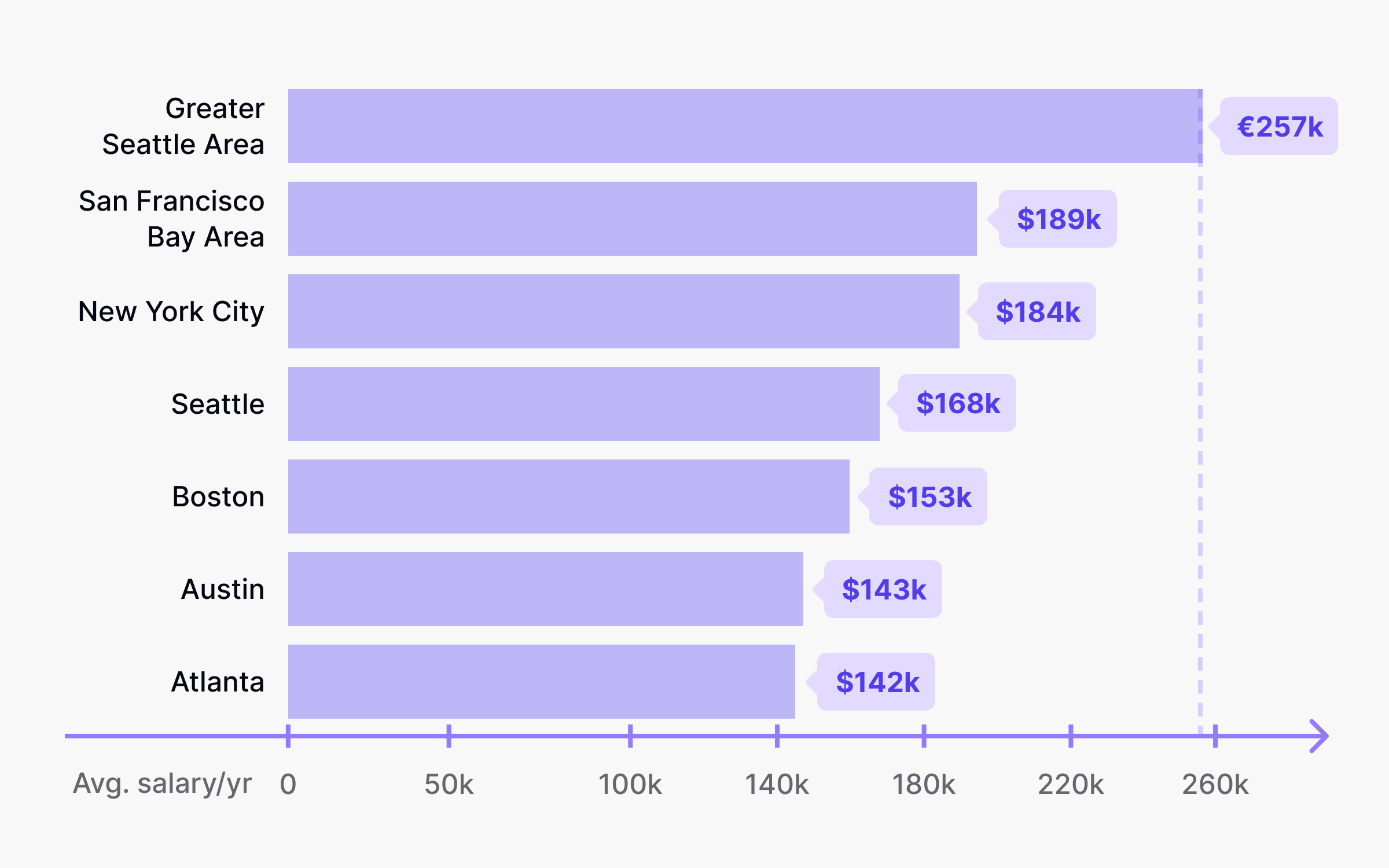
US still pays PMs better than anywhere else. That’s not surprising. What stands out is how much variation exists even within the same experience band when it comes to Product Manager salary expectations.
When analyzing product manager salary data, it's important to consider the impact of major tech hubs and tech hubs across the US. Cities like San Francisco, New York City, Seattle, Austin, Boston, and Atlanta are leading regions for product manager salaries due to their concentration of technology companies and high demand for tech talent.
Organizations and employers in these tech hubs, especially FAANG companies, are known for offering higher average salaries and total compensation packages. These packages often include bonuses, stock options, and other perks, making the total comp significantly higher than just the base salary.
Here’s a summary of the average product manager salary and average total compensation in major US tech hubs:
- San Francisco Bay Area: Average Product Manager salary is around $189,000/year.
- New York City: Average Product Manager salary is around $184,000/year.
- Seattle: Average Product Manager salary is about $168,000/year.
- Austin: Average Product Manager salary is about $143,000/year.
- Boston: Average Product Manager salary is roughly $153,000/year.
- Atlanta: Average Product Manager salary is about $142,000/year.
- Greater Seattle Area: Highest average total compensation at €257,428.
The average product manager salary and average total compensation can vary significantly depending on the employer and organization, with FAANG companies and other prestigious employers in these tech hubs typically offering the most competitive packages.
What do junior PMs earn in the US?
Junior Product Managers typically land somewhere between $75,000 and $95,000 per year. Those just starting out with less than a year of experience can expect offers closer to $70,000. Entry level product manager and associate product manager roles are common starting points for workers beginning their product management careers, each with its own typical salary range and rapid growth opportunities. A couple of years of experience pushes compensation toward the higher end of the Product Manager pay scale.
At this level, the work centers on execution rather than strategy. Junior PMs write user stories, manage backlogs for smaller features, sit in on customer interviews, and coordinate with engineering on sprint planning. Most companies won’t hand over anything significant until the fundamentals are proven.
The upside? This is where compensation grows fastest. Demonstrating the ability to ship things leads to rapid salary jumps. The longer workers stay in a role, the more skills and knowledge they accumulate, which typically results in higher salaries over time.
What about mid-level PM salaries?
Mid-level PMs earn between $100,000 and $150,000 annually. The average hovers around $125,000, but huge swings exist based on company size and location. Mid-level Product Managers typically earn between $101,000 and $158,000 in base pay, and the next step in the career path is often a Senior Product Manager role with increased responsibilities in strategy, roadmapping, and cross-functional alignment.
This is where things get interesting for Product Manager compensation. Mid-level PMs own features end-to-end. Companies expect them to define requirements without hand-holding, make prioritization calls, and present roadmaps to stakeholders. The role involves running A/B tests, interpreting dashboards, and navigating the inevitable conflicts between design, engineering, and business teams.
Here’s what stands out from career discussions: the jump from junior to mid-level is where most people plateau. It requires showing business impact, not just completing tasks.
How much do senior PMs make?
Senior PMs command $130,000 to $190,000 in base salary. At major tech companies, total compensation (with equity and bonuses) regularly pushes past $250,000. Bonuses are a significant part of total compensation for senior product managers.
At this level, the focus shifts to product strategy. Senior product managers are paid higher salaries, especially in high-demand locations or when they have advanced skills. Employers want evidence of identifying market opportunities, building business cases, mentoring junior PMs, and influencing company direction. Senior PMs present to executives and make decisions with incomplete information.
The bar is high. Job descriptions and recruiter posts consistently ask for proof of products shipped that moved real business metrics.
What are PM salaries like in the United Kingdom?
The UK market offers some surprises. Product Manager salary figures run about 20-30% lower than US equivalents, but the gap narrows quite a bit when factoring in purchasing power and benefits.
Junior PM compensation in the UK
Junior PMs earn between £33,000 and £45,000 per year. London roles trend higher, with entry-level positions in the capital averaging £40,000-£48,000.
Expectations mirror the US market. Junior PMs support senior PMs, maintain documentation, and coordinate with developers. One notable difference in UK job posts: they emphasize structured frameworks like Agile and Scrum more heavily than American companies tend to.
Breaking in typically requires either tech-adjacent experience or a bootcamp credential.
Mid-level PM earnings
Mid-level PMs earn £50,000 to £75,000 annually. The average sits around £65,000, with fintech and enterprise software companies paying at the top of the Product Manager pay range.
At this stage, UK employers want autonomous ownership. The role involves running discovery cycles, defining success metrics, and managing relationships with engineering leads.
Senior PM salary ranges
Senior PMs command £70,000 to £120,000, with exceptional performers at top firms reaching £130,000 or more.
Responsibilities expand to product line ownership and team leadership. Companies consistently ask for strategic thinking and experience shipping products at scale.
How does Germany compare for PM salaries?
Germany offers competitive Product Manager compensation with strong job protections. Berlin has become a serious startup hub, while Munich commands premium compensation for enterprise roles.
Entry-level PM compensation
Junior PMs earn €45,000 to €55,000 annually. Berlin startups typically offer €50,000-€56,000, while Munich enterprise companies start around €55,000-€64,000.
German companies expect methodical, data-driven approaches from junior PMs. Many employers value technical backgrounds more heavily than their US counterparts.
One thing that stands out: English-language roles are common in Berlin's startup ecosystem, making it accessible for international candidates.
Mid-level salaries in Germany
Mid-level PMs earn €60,000 to €85,000 per year. The average sits around €72,000 for Product Manager salary in this market.
German companies often expect stronger technical depth at this level. Requirements frequently mention discussing architecture decisions and understanding development trade-offs.
Senior PM compensation
Senior PMs command €85,000 to €120,000 in base salary. Top performers see packages reaching €130,000 or more with bonuses and equity.
What do PMs earn in France?
France's tech sector has grown significantly, with Paris emerging as a European startup hub. Product Manager salary figures are competitive within the EU, though generally lower than in Germany or the UK.
Junior PM salaries
Junior PMs earn €36,000 to €45,000 annually. Paris roles trend toward the higher end, averaging €40,000-€43,000.
French companies expect strong analytical skills. Fluency in French remains advantageous, though English-only roles exist at international companies.
Mid-level compensation
Mid-level PMs earn €50,000 to €70,000 per year. The average hovers around €60,000.
At this level, PMs own product features independently. Building relationships across departments becomes increasingly important for career advancement.
Senior PM earnings
Senior PMs command €68,000 to €95,000 annually, with top performers reaching €115,000 or more.
How does Poland stack up for Product Manager pay?
Poland offers attractive salaries relative to the cost of living. Warsaw leads in Product Manager compensation, with Krakow and Wroclaw close behind.
Entry-level PM salaries
Junior PMs earn PLN 8,000 to 12,000 per month (roughly PLN 96,000-144,000 annually). Warsaw positions trend toward the higher end.
Many roles involve working with international clients or distributed teams.
Mid-level compensation
Mid-level PMs earn PLN 14,000 to 19,000 monthly (PLN 168,000-228,000 annually). The average sits around PLN 200,000 per year.
Companies expect autonomous decision-making and the ability to drive features from concept to launch.
Senior PM earnings
Senior PMs command PLN 19,000 to 26,000 monthly (PLN 228,000-312,000 annually), with top performers at international companies earning more.
What questions come up in entry-level PM interviews?
These questions show up constantly in interview prep threads and recruiter advice for Product Manager candidates.
Optimizing your resume to highlight relevant skills and using helpful interview prep resources can increase your chances of landing an entry-level product manager role.
"Tell me about yourself and why product management?"
A response that works: "I spent three years as a business analyst where I kept finding myself asking 'why are we building this feature?' instead of just documenting requirements. I started conducting informal user interviews, pushing back on assumptions, and eventually realized I wanted to own the 'what' and 'why' decisions, not just the 'how.' Product management lets me combine my analytical background with customer empathy and strategic thinking."
Why this comes up: Interviewers want intentional career thinking. They're evaluating whether candidates understand what the role actually involves.
"How would you improve a product you use regularly?"
A response that works: "I'd focus on my bank's mobile app. The core problem is that checking my spending trends requires too many taps. I'd propose a dashboard summary that surfaces automatically when opening the app, showing weekly spending against my typical patterns. Success metrics would be daily active users viewing the dashboard and user-reported satisfaction with financial awareness. I'd validate this by interviewing users about their current workarounds."
Why this comes up: This reveals your product thinking process. Can the candidate identify real problems, propose solutions grounded in user needs, and think about measurability?
"Describe a time you used data to make a decision."
A response that works: "In my previous role, we noticed support tickets spiking after a feature launch. I pulled data showing 70% of tickets came from users who had completed onboarding but hadn't used the feature within 7 days. We hypothesized the feature was discoverable but not intuitive. I proposed adding contextual tooltips and a one-time walkthrough. Tickets dropped 40% within two weeks."
Why this comes up: Interviewers test whether candidates can translate metrics into actionable insights.
What do intermediate PM interviews focus on?
Mid-level interviews dig deeper into execution experience and strategic thinking for Product Manager roles. Interviewers often assess how well candidates align product decisions and roadmaps with overall business goals, ensuring that product strategies support the company's objectives and targets.
"How do you prioritize features on a roadmap?"
A response that works: "I use a framework combining business impact, user value, and effort. First, I clarify what success looks like for the quarter. Then I score each potential feature against that goal. I look at reach, impact, confidence, and effort. I also consider dependencies and strategic alignment. The output isn't a rigid ranking but a discussion tool for aligning stakeholders."
Why this comes up: Prioritization reveals judgment and ability to make tradeoffs.
"Tell me about a product you launched. What went well and what didn't?"
A response that works: "I led a checkout flow redesign that reduced cart abandonment by 15%. What went well: we invested heavily in user research upfront, identifying that shipping cost surprise at checkout was the primary drop-off driver. What didn't go well: we underestimated engineering complexity and missed our launch date by three weeks. I learned to involve engineering earlier in scoping."
Why this comes up: Self-awareness matters. Interviewers want PMs who learn from mistakes.
"How do you handle disagreements with engineering?"
A response that works: "I start by assuming positive intent and trying to understand their perspective. Often what looks like pushback is legitimate technical concern I hadn't considered. I ask clarifying questions. If we still disagree, I try to find common ground on the problem, then explore alternative solutions together. When necessary, I'll escalate with both perspectives clearly presented, but that's a last resort."
Why this comes up: PM is cross-functional. Interviewers need to see candidates can navigate conflict without damaging relationships.
What technical questions should you expect?
Technical questions assess whether candidates can communicate with engineering teams and make informed tradeoffs as a Product Manager. As technology continues to evolve, skills in data analysis, security awareness, and understanding responsible AI practices are increasingly important for product managers, ensuring ethical, compliant, and effective product development.
"How would you approach building an MVP?"
A response that works: "I'd start by defining the core user problem and the minimum functionality needed to test our hypothesis. For example, if we're building a recommendation engine, the MVP might be a simple rule-based system rather than full machine learning. I'd work with engineering to identify what's buildable in 2-4 weeks, then define success metrics we can measure quickly."
Why this comes up: This tests understanding of iterative development.
"Explain a technical concept to a non-technical person."
A response that works: "Let's say the concept is APIs. Think of an API as a waiter in a restaurant. You don't go into the kitchen and cook yourself. You tell the waiter what you want, the waiter goes to the kitchen, gets your food prepared, and brings it back. APIs work the same way. They take your request, translate it for the computer system, and return the result."
Why this comes up: PMs constantly translate between technical and non-technical stakeholders.
"How do you decide when to build vs. buy?"
A response that works: "I consider four factors: strategic importance, customization needs, total cost of ownership, and time-to-market. If the capability is core to our competitive advantage, building makes sense even if it's more expensive. If it's commodity functionality, buying saves engineering resources for differentiated work. I also factor in maintenance burden."
Why this comes up: Resource allocation decisions are fundamental to PM.
Preparing for your next PM interview? Our complete guide to PM interview questions helps you practice with real examples from top companies.
How does the PM career path typically unfold?
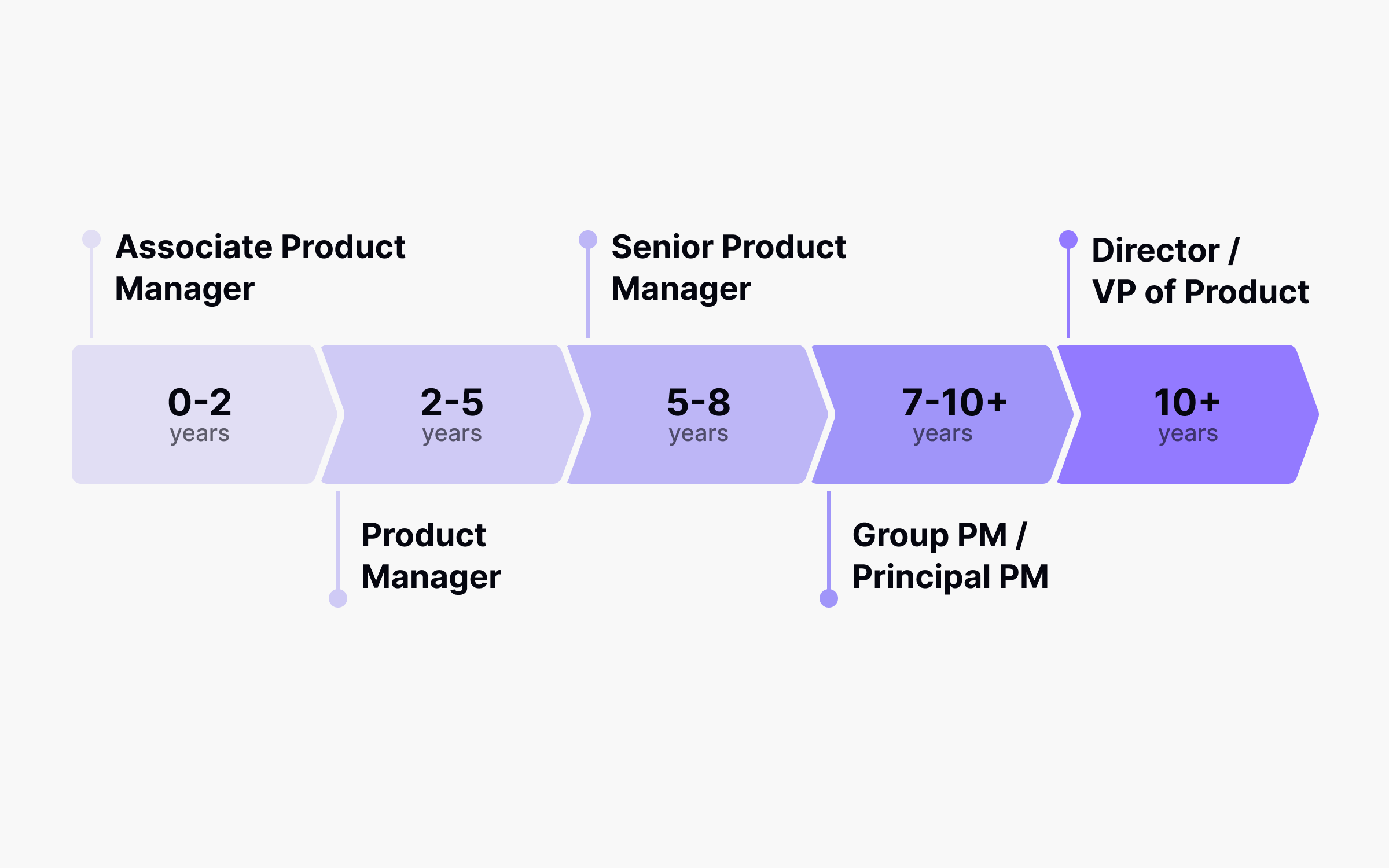
Product management offers multiple progression paths. The traditional ladder runs from Associate Product Manager (often the entry-level role) through to Chief Product Officer, but lateral moves and specializations exist too. If you're still exploring how to become a product manager, this complete guide covers the full path. Understanding the career trajectory helps contextualize Product Manager salary expectations at each level.
- Associate Product Manager / Junior PM (0-2 years): Feature execution, documentation, and user research support. This stage focuses on learning the fundamentals and proving the ability to ship. Associate Product Manager is a common entry-level title with rapid growth opportunities.
- Product Manager (2-5 years): Feature ownership, roadmap contribution, cross-functional coordination. PMs at this level own outcomes for their product area.
- Senior Product Manager (5-8 years): Product strategy, team mentorship, stakeholder management at the executive level. Senior Product Manager is a common mid- to senior-level title, with increased responsibilities in strategy, roadmapping, and cross-functional alignment. Senior PMs influence company direction.
- Group PM / Principal PM (7-10+ years): Multi-product portfolio ownership, organizational influence, PM hiring and development. Principal Product Managers often have strategic influence and deep expertise across multiple teams, which justifies higher compensation.
- Director / VP of Product (10+ years): Department leadership, business strategy alignment, P&L responsibility. Vice President is a typical title at this level, reflecting significant strategic influence within the organization.
- Chief Product Officer: Company-wide product vision, board reporting, executive team membership.
Attracting and developing top talent is a key focus for organizations as they build out their product management teams.
Uxcel’s Product Manager career path helps build foundational skills for progression. You’ll develop competencies in product strategy, user research, analytics, and cross-functional leadership through practical, skill-focused learning.
What actually moves the needle on Product Manager salary?
Salary growth doesn’t happen automatically. Here’s what shows up consistently in discussions about compensation increases for Product Manager roles.
- Document impact with numbers. Before every review cycle, compile specific metrics: revenue influenced, costs reduced, engagement improved, churn decreased. Vague claims about “improving the product” won’t justify raises.
- Develop technical depth. PMs who can read code, understand system architecture, and speak credibly with engineers command premium salaries. Daily coding isn’t required, but technical fluency matters for Product Manager compensation.
- Build AI and data skills. Product Managers with AI/ML expertise currently earn 20-30% premiums. Understanding how to scope AI for product teams and evaluate models is increasingly valuable. Check out Uxcel’s AI courses to build these competencies.
- Get certified. Professional product management certifications add credibility and often correlate with higher compensation. They signal commitment to the craft and can justify higher Product Manager pay.
- Pursue advanced education. Higher academic degrees, such as a master's or MBA, often lead to higher salaries for product managers. Education level is a key factor influencing earning potential.
- Leverage stock options and equity. At major tech companies, stock awards and stock options are significant components of total compensation and can substantially increase overall earnings.
- Develop sales and marketing skills. Product managers who understand sales strategies and marketing, including market research and competition analysis, are better positioned to drive revenue and align product strategy with business objectives.
- Focus on customer needs. PMs who excel at identifying and prioritizing customer needs are often rewarded with higher salaries, as they help ensure products meet market demands and user expectations.
- Change companies strategically. Internal raises typically cap at 5-10% annually. External moves can deliver 15-25% jumps. Timing matters, so move after shipping something significant worth pointing to.
- Negotiate deliberately. Most PM offers have 10-15% negotiation room. Research market rates using multiple sources, and come prepared with competing offers if possible.
- Keep building skills. The market rewards demonstrable growth. Uxcel’s Impact Report shows learners who consistently develop their skills see meaningful salary increases and higher interview success rates.
Is a Product Manager career worth the salary?
Product management offers strong compensation, intellectual variety, and genuine business impact. Product managers tackle interesting challenges and develop solutions that address real human needs, making the role both impactful and meaningful. The career path is accessible from multiple backgrounds, and demand continues to grow.
That said, it’s not for everyone. PM requires comfort with ambiguity, constant context-switching, and influencing without direct authority. Those who prefer deep technical work or clear hierarchical structures might find other paths more suitable.
Common questions about Product Manager salaries
How much does a Product Manager make in 2026?
Product Manager salary varies significantly by location and experience. In the US, ranges span $75,000 (junior) to $190,000+ (senior). UK salaries range £33,000-£120,000. German PMs earn €45,000-€120,000. These figures represent base salary; total compensation at tech companies often includes equity and bonuses. Typical salaries for product managers often surpass the national average for similar roles, making this a competitive field.
Is Product Manager a high-paying job?
Yes. Product Manager compensation consistently ranks among the highest for non-engineering tech roles. Senior PMs at major tech companies regularly earn $200,000+ in total compensation. Even entry-level positions offer competitive salaries compared to other business roles. Product managers are in demand, but companies are prioritizing capital efficiency to pay for expensive compute.
What’s the difference between PM salary at startups vs. big tech?
Big tech typically offers higher base salaries plus significant equity. Startups may offer lower base pay but larger equity percentages. Total compensation at successful startups can exceed big tech, but the risk is higher. Base Product Manager salary at startups often runs 10-20% below market. Employer reputation and profitability can also impact salary levels, with more prestigious or profitable companies often offering higher compensation.
How quickly does Product Manager pay increase?
PM salaries grow fastest in the first 5 years. Moving from junior to mid-level typically adds 30-50% to compensation. The jump to senior adds another 25-40%. After senior level, growth depends more on moving into leadership or joining higher-paying companies. Salaries for product managers have risen by an average of 10-15% from 2020 to 2025, depending on location and experience level.
Do Product Managers need technical skills to earn more?
Technical skills correlate with higher Product Manager salary, particularly at tech companies. PMs who can discuss architecture, read code, and communicate credibly with engineers command premiums. Technical Product Manager roles specifically often pay 10-20% more than generalist PM positions.
Ready to earn what you’re worth?
Start building your portfolio with real projects, get certified, and unlock the salary you deserve by creating an account on Uxcel.
Related articles
UX/UI Designer Salary in the USA
Product Designer Salary in the USA
Join 500,000+ product professionals leveling up with Uxcel. Build real skills, get certified, and grow fast in the AI-powered product world.