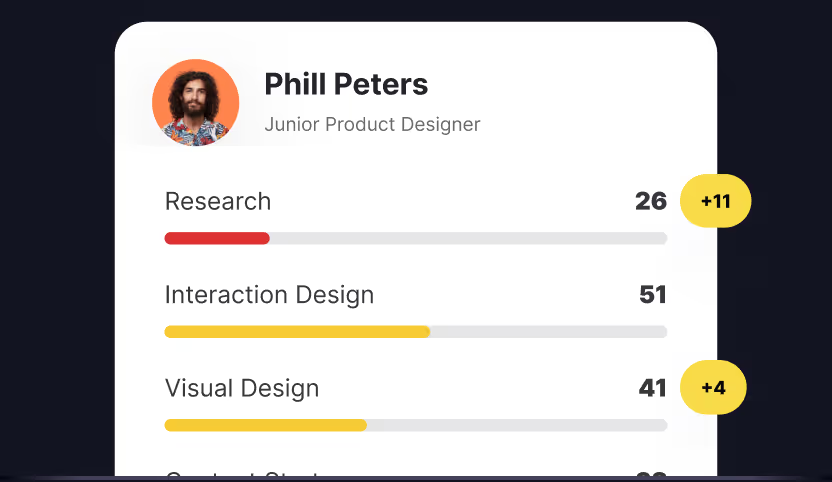

.svg)


Product School pricing ranges from $2,999 to $4,999, but is Product School worth it? I spent weeks going through dozens of sources and hundreds of reviews to find out.
The numbers look impressive on paper. Over 20,000 graduates. Instructors from Google, Meta, Netflix. A community of around 2.3 million product professionals. But then you see the price tag, $2,999 for a single certification to $4,999 a year for unlimited access, and the reviews split into two camps. Some people swear it changed their careers. Others say it’s overpriced and underwhelming.
Here’s what I found after weeks of research: Product School works for a specific type of person. If your employer is paying, you value networking with Silicon Valley pros, and you already have some product or tech background, it can be valuable. However, Product School is not as beginner friendly as some alternatives. Those completely new to product management may find it less accessible without prior experience in tech or leadership.
This review covers what Product School actually offers, what students really say (including the criticism), your job prospects (they don’t publish placement rates), and whether a PM professional certificate from a cheaper alternative might serve you better.
What do you need to know upfront?
Here’s what you need to know upfront about Product School:
Program type: Live online PM certifications, not a traditional bootcamp. Cohorts of 20 students.
Founded: 2014 in Silicon Valley. Over a decade in business.
Certifications offered: 10 live, instructor-led certifications with rolling start dates: Product Management Foundations, AI Product Management, Vibe Coding, Claude Code for PMs, Agentic Workflows & Loops, AI Evals, Product Analytics & Experimentation, Go-to-Market, Product Leadership, and AI Product Strategy for Leaders. The old PMC, SPMC, and PLC names are gone. Beginners start with Product Management Foundations.
Duration: 6 weeks part-time. 30 hours live instruction plus pre-work and capstone. Total time: 30-40 hours.
Cost: $2,999 one-time for a single certification, $3,999 a year for Pro (2 courses), or $4,999 a year for Unlimited (10 courses). Refunds apply only if you cancel shortly after joining and haven't opened course materials, so confirm your start date before you pay.
Format: Live online via Zoom. Twice weekly evenings or Saturday sessions. Pre-recorded pre-work modules. Each certificate program is made up of individual courses, allowing for some flexibility in learning paths.
Instructors: Product Leaders from Google, Meta, Netflix, Airbnb, Uber, Amazon. Practitioners, not professors. Quality varies.
Reviews: 4.76-4.8/5 across platforms. Over 200 verified reviews. Ratings don’t tell the full story.
Job guarantee: None. Career support provided but no placement guarantees.
Placement rate: Not published. Major red flag for career changers.
Best known for: Silicon Valley instructors, 2.3M alumni community, ProductCon conferences, part-time flexibility.
What exactly is Product School?
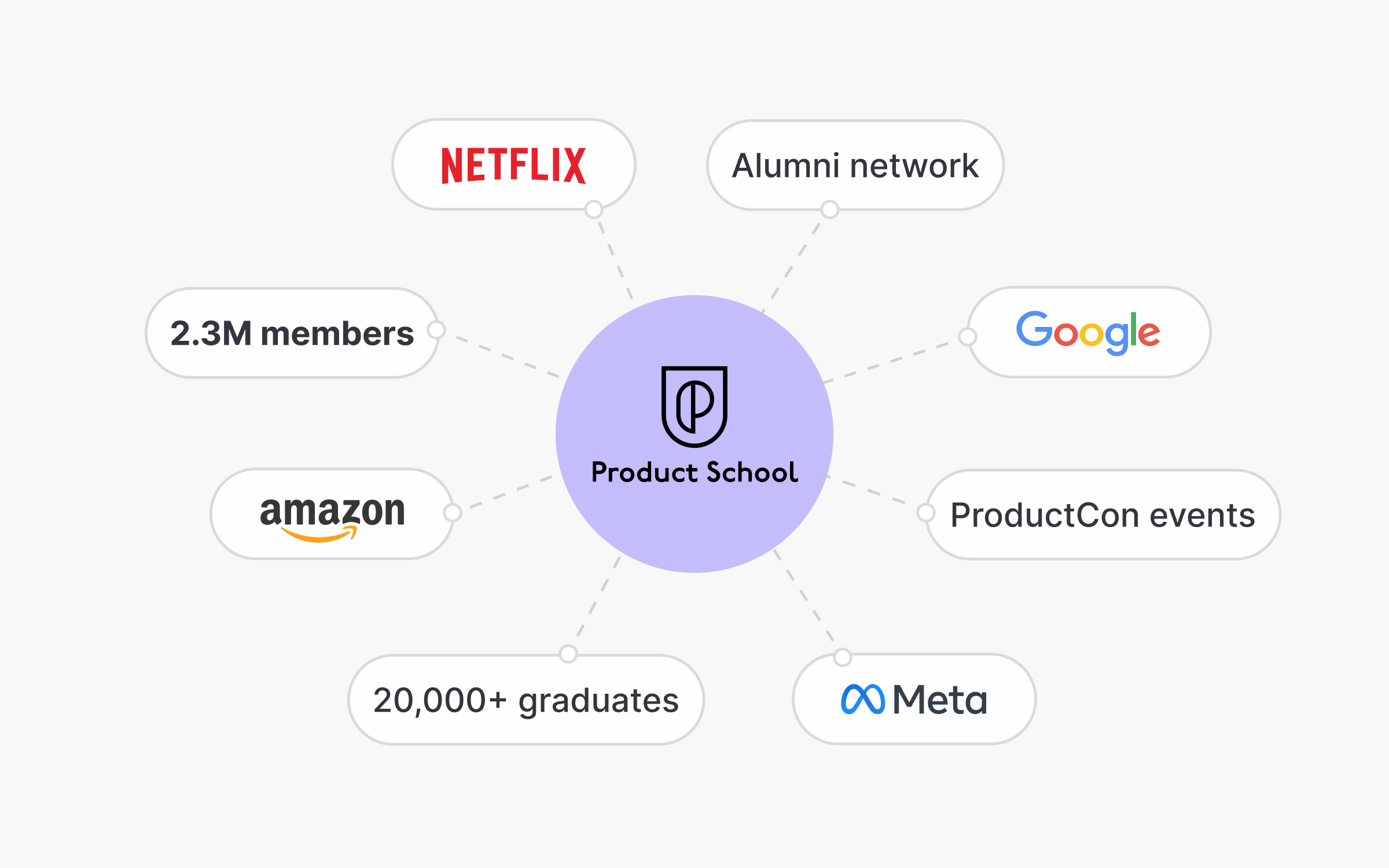
So what is Product School? It started back in 2014 when the founders saw a gap in the market. Plenty of coding bootcamps existed, but nothing specifically for product managers. They positioned themselves as the “go-to” place for PM training, especially emphasizing their Silicon Valley roots and connections to top tech companies.
The core idea is simple. Take working Product Leaders from companies everyone recognizes (Google, Meta, Netflix) and have them teach small cohorts of aspiring or current PMs, including those looking to start or advance their product manager career progression. Classes happen live online, not pre-recorded videos. You’re in a Zoom room with 19 other students and an instructor who’s working in product at a major tech company. That’s the pitch, anyway.
They’ve grown to operate globally in 100+ countries with around 2.3 million community members (including webinar attendees and email subscribers). Over 20,000 completed certifications.
In 2024 and 2025, Product School pivoted hard toward AI. They now offer nine different certifications, with several focused specifically on AI product management, AI prototyping, AI evaluation, and AI agents. Product School also offers specialized courses on managing AI powered products, including a dedicated AI/ML upskilling program led by industry professionals. This shift makes sense given the market, but it also means their positioning has changed from “learn product management fundamentals” to “become an AI-native PM.”
Product School differs from traditional full-time bootcamps. While it is not a product management bootcamp, it shares some similarities in structure and outcomes, such as a structured curriculum, collaborative projects, mentorship, and career support. It targets part-time learners with jobs. Two certificates (Senior PM and Product Leader) focus on current PMs, not beginners.
The business model relies on volume and brand, running cohorts constantly with 20 students each, and at $4,000 to $5,000 per student, a single cohort generates $80,000 to $100,000 in revenue, while keeping costs relatively low by having instructors teach on the side (these are working PMs, not full-time faculty) and using a standardized curriculum that instructors customize based on their experience.
Their main value propositions are instructor credentials, networking opportunities, and community access. When you enroll, you’re paying for three things: the structured curriculum, access to an instructor from a top tech company, and entry into their alumni network and events. Whether that’s worth $4,000 to $5,000 depends entirely on your situation.
The company recently raised $25 million in funding and made GSV’s list of top 150 EdTech companies. They also host ProductCon, a multi-city conference series for product managers. These events are separate from the certifications but serve as networking opportunities and brand-building exercises.
What hands-on experience will you gain in six weeks?
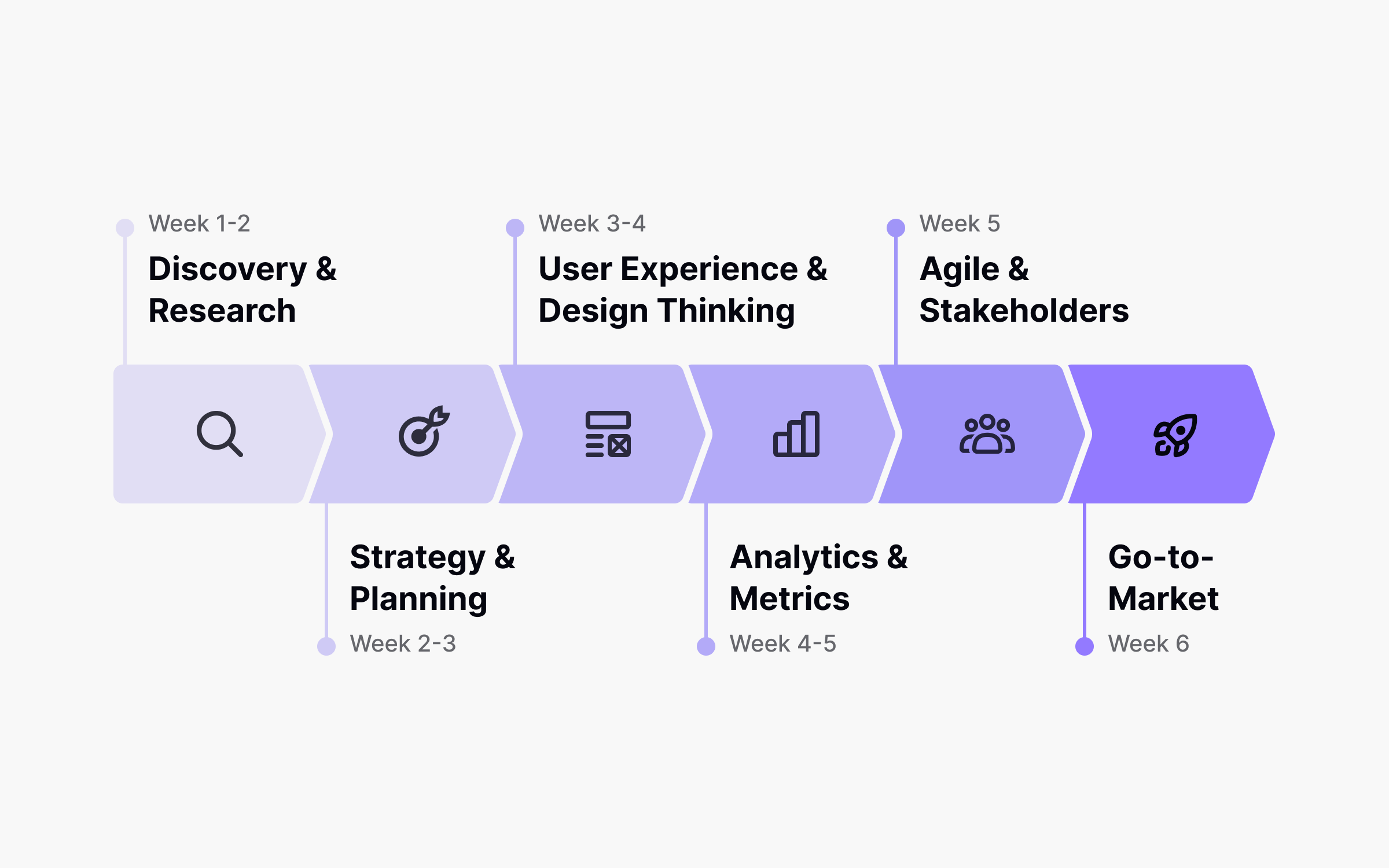
Here’s what you’ll spend six weeks learning. The Product Management Certification (PMC) covers the full product lifecycle from discovery through launch and iteration.
Pre-work modules are self-paced with videos, templates, and knowledge checks. 2.5 hours per cla2ss, weekly. Professionally produced but standard content.
Live sessions: 30 hours total over six weeks. Experience varies significantly by instructor.
Curriculum breakdown by week:
| Week | Focus area | Key topics | Deliverable |
|---|---|---|---|
| Week 1-2 | Discovery and Research | User interviews, personas, competitive analysis | Research plan |
| Week 2-3 | Strategy and Planning | OKRs, roadmaps, prioritization frameworks | Strategy document |
| Week 3-4 | UX and Design | Wireframing, prototyping, design thinking basics | Deisgn specs |
| Week 4-5 | Analytics and Metrics | KPIs, A/B testing, data analysis fundamentals | Analytics report |
| Week 5 | Agile and Stakeholders | Sprint planning, backlog management, team collaboration | Sprint plan |
| Week 6 | Go-to-Market | Launch strategy, marketing coordination, sales enablement | Capstone project |
The curriculum includes these modules:
Product Discovery and Research. You learn customer development, user research methods, persona creation, and problem identification. The focus is on understanding user needs before building anything. You’ll learn to identify customer needs and potential customers through user research, ensuring your product ideas are grounded in real user problems. Tools covered include user interviews, surveys, and competitive analysis frameworks.
Product Strategy and Roadmapping. This module covers vision setting, OKRs (Objectives and Key Results), prioritization frameworks, and roadmap creation. You learn how to align product decisions with business goals and communicate strategy to stakeholders. You’ll also create and use a product roadmap to guide development and align your team.
User Experience and Design Thinking. Covers the basics of UX design, wireframing, prototyping, and design thinking methodology. Students noted this section is high-level, not a detailed look. You’re not becoming a designer. You’re learning enough to collaborate effectively with design teams. Rapid prototyping is introduced as a method for quickly validating ideas and iterating on solutions.
Product Analytics and Metrics. Focuses on defining success metrics, A/B testing, and building analytics-based product management skills through analytics tools.. This section gets mixed reviews. Some students loved it. Others felt it skimmed the surface, especially if they already had analytics experience.
Agile and Sprint Planning. Covers scrum, kanban, sprint planning, backlog management, and working with engineering teams. Standard agile training that product managers need. You’ll break down user stories into actionable tasks and collaborate closely with software engineers to ensure smooth execution.
Stakeholder Management and Communication. Addresses how to work with executives, manage cross-functional teams, and communicate effectively across the organization. Students consistently rated this as one of the most valuable sections because it’s harder to learn on your own. You’ll develop core skills needed to lead product teams and your own product team, including influencing, aligning stakeholders, and driving outcomes.
Go-to-Market Planning. Covers product launches, marketing coordination, sales enablement, and launch strategy. You learn the mechanics of taking a product from development to market.
Capstone Project. Throughout the six weeks, you work in groups on a product challenge. Teams build and deliver products, gaining hands on experience and practical skills by collaborating with cross-functional team members. This project becomes a portfolio piece you can show to potential employers. The goal is to deliver successful products that can be showcased in a strong portfolio. The catch: group dynamics significantly impact the experience. Multiple students mentioned struggling with teammates who didn’t contribute equally.
A few important points about the curriculum:
First, it’s comprehensive but not deep. Six weeks covers a lot of ground, which means each topic gets addressed but not exhaustively. One Reddit user put it bluntly: “I was disappointed in the lack of challenge this course provided.” If you’re hoping for intensive, graduate-level training, this isn’t it.
Second, the curriculum itself is standardized, but instructors customize based on their experience. Shilpa Vir (a PM at Google) might emphasize different aspects than another instructor at a smaller tech company. Quality varies.
Third, there’s limited hands-on technical work. You’re not coding. You’re not doing deep data analysis. You’re learning frameworks and methodologies. Some students wanted more practical, technical depth. One review on Course Report mentioned the learning platform itself wasn’t user-friendly, which seemed ironic for a product management school.
Fourth, roughly 36.5 hours of the program involve group work on your capstone project. One Course Report reviewer noted that despite the program advertising “36.5 hours of instructor-led learning,” much of that time is you working in groups while the instructor circulates. This bothered people who expected more direct teaching. Expect to deliver in a few months, mirroring real-world product cycles.
Tools mentioned in the curriculum include Jira, Figma, Google Analytics, Miro, and Strategyzer. However, students noted the platform’s Mural boards (used for group projects) were poorly designed and confusing. Several people mentioned this disconnect: a product management school should have excellent product design, yet their own learning platform had usability issues.
The value of the curriculum depends largely on your starting point. Complete beginners found it helpful as an introduction to PM concepts and terminology. People with adjacent experience (business analysts, project managers, designers) felt it was somewhat redundant. Career PMs looking to formalize their knowledge had mixed reactions. Some appreciated the structure, others felt they already knew most of the content.
Finally, the curriculum emphasizes the importance of trade offs in product decisions, especially when applying AI in product development, helping students understand how to balance performance, cost, and feasibility in real-world scenarios.
Product School pricing: what does each certification cost?
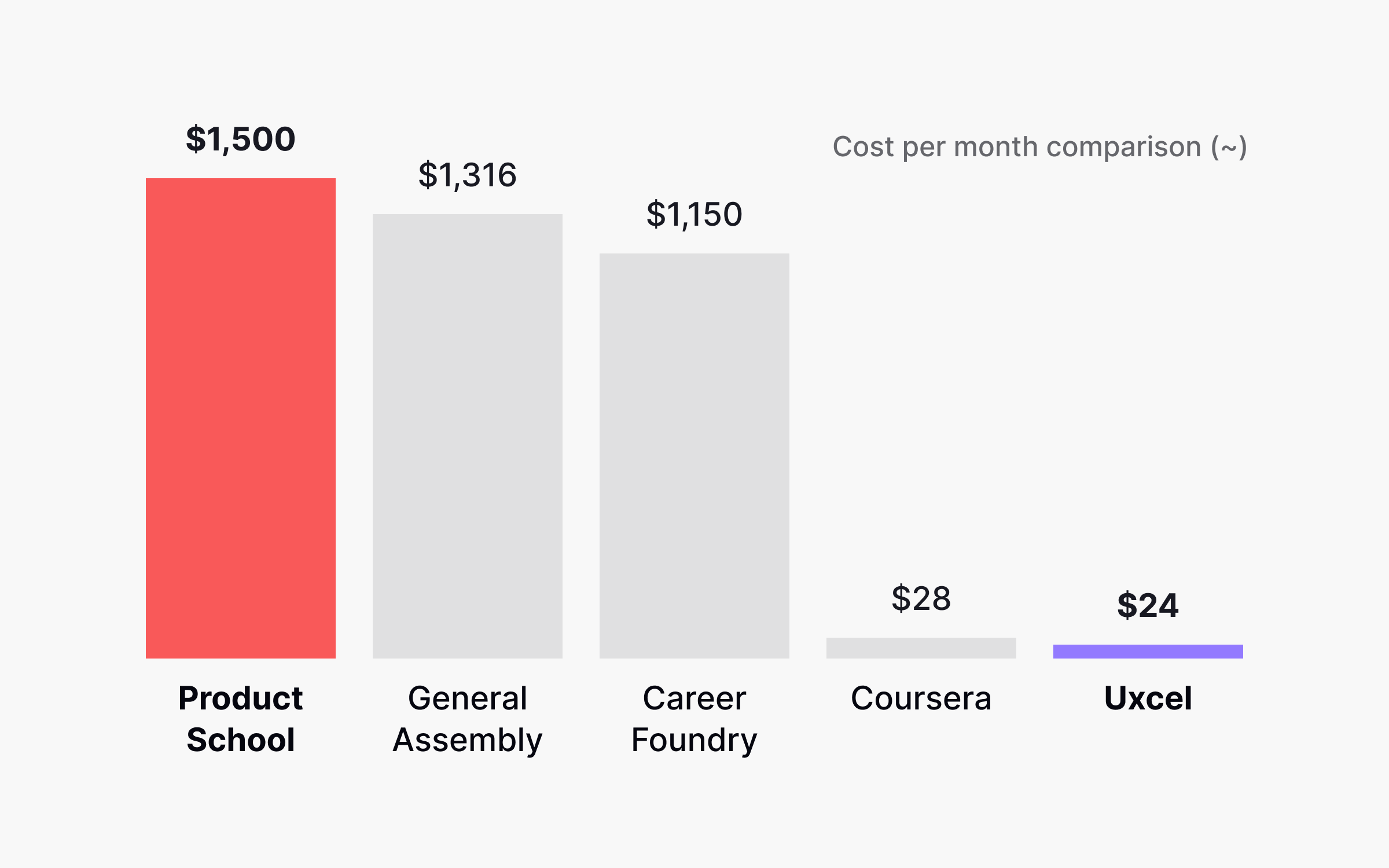
Breaking down the costs, including what they advertise and what students report paying:
Single Certification: $2,999, one-time, for one live certification course.
Pro Membership: $3,999 a year for 2 live certification courses, weekly AI workshops, on-demand content, and the alumni community.
Unlimited Membership: $4,999 a year for 10 live certification courses, a ProductCon ticket, and what Product School values at $50,000+ in AI tools.
Payment plans: Pro and Unlimited offer installment plans through the admissions team. Amounts aren't published.
Price: $2,999 one-time, or $3,999 to $4,999 a year. Prices from productschool.com/pricing.
Cost comparison breakdown:
| Program | Total cost | Duration | Live hours | Cost per hour |
|---|---|---|---|---|
| Product School | $2,999 - $4,999 | 6 weeks | 30 hours | $100-$166 |
| General Assembly | $3,950 | 10 weeks | 40+ hours | ~$99 |
| Uxcel | $288/year | Self-paced | N/A | N/A |
| CareerFoundry | $6,900 | 6-8 months | 0 (mentor) | N/A |
| Coursera | $50-$500 | Self-paced | 0 | N/A |
Hidden costs: Beyond tuition, consider:
- Time commitment: Expect a time investment of 30 to 40 hours over six weeks, which typically means 5-7 hours per week. This time commitment can impact your professional and personal schedule, so plan accordingly.
- Potential loss of billable hours if you’re freelancing
- No income during study time if you’re between jobs
- Optional ProductCon tickets if not included in your plan
Employer reimbursement: Many students get their employer to pay. Product School encourages this and even provides a template email to send to your manager requesting reimbursement. If your company offers professional development budgets or continuing education funds, this is worth pursuing. The value proposition changes entirely if you’re not paying out of pocket.
Scholarships and discounts: Product School doesn’t appear to offer significant scholarships. They occasionally run promotions or discounts, especially when enrolling multiple employees from the same company. For groups of three to ten people, they offer a discount, though the exact percentage isn’t specified.
What you get for the money:
- Six weeks of classes (30 hours live instruction)
- Pre-work modules and course materials
- Access to The Product Book (their handbook)
- Capstone project with mentor feedback
- Certificate upon completion
- Three months of job board access
- Three months of event access
- Resume review and mock interview
- LinkedIn profile optimization
- Lifetime access to the alumni community (around 2.3 million members)
How does this compare to alternatives? Product School is significantly more expensive per hour of instruction than most other product management certifications. At $2,999 for 30 hours of live teaching, that’s roughly $100 per hour of instruction time. Even accounting for the additional materials and support, the cost per value is high.
Students who felt they got their money’s worth typically had employers paying, already had adjacent roles that helped them transition to PM, or highly valued the networking opportunities. Students who regretted the cost were often paying out of pocket, found the material basic, or didn’t land a PM job afterward.
One Course Report reviewer wrote: “I wish I had just signed up for Coursera or another option at the fraction of the cost. Not worth the $5K price tag.” Another on SwitchUp said: “I’m now not only with no job as a PM but also down $4,100.”
Is Product School worth it for aspiring product managers?
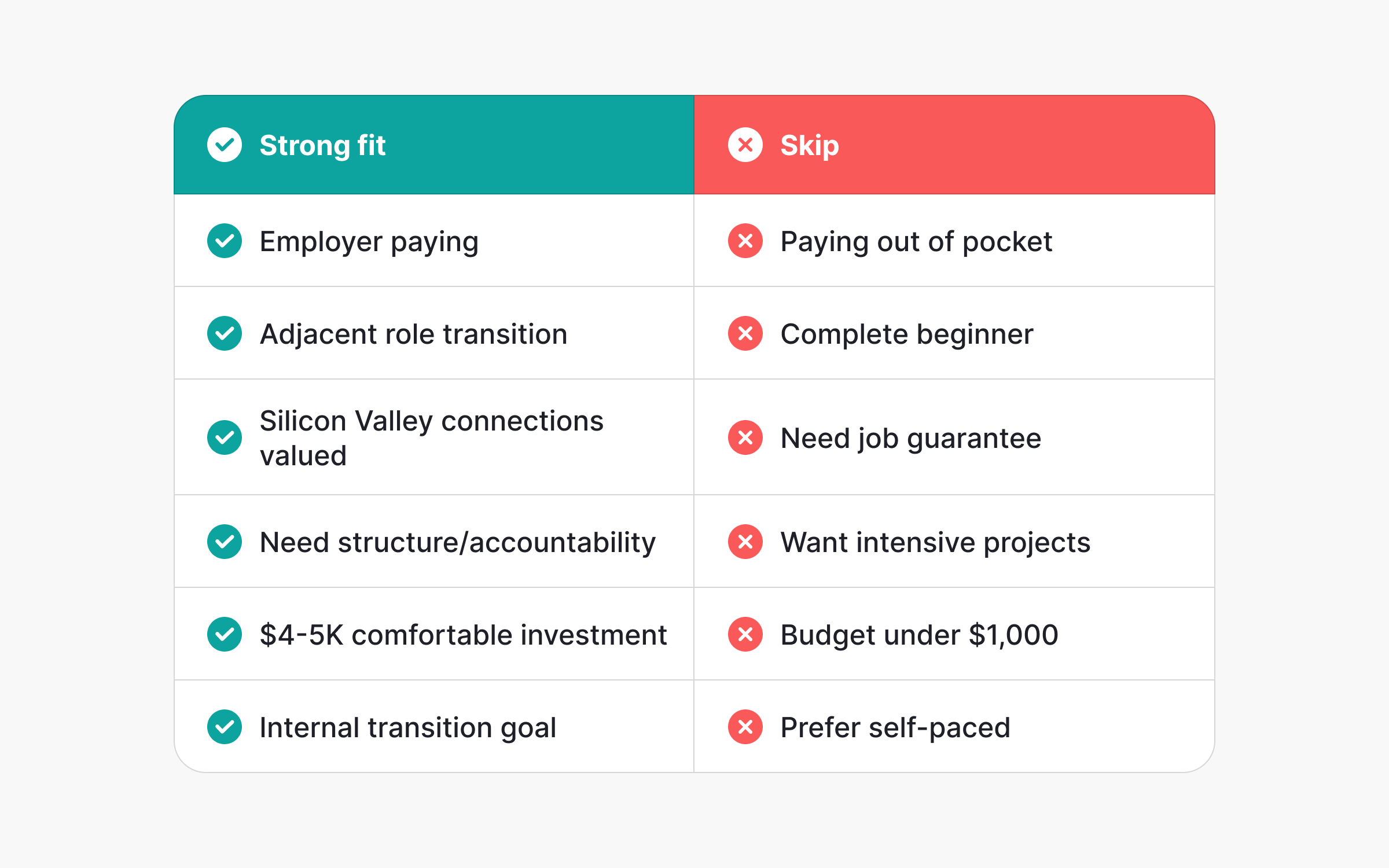
Product School works well for specific types of people and poorly for others. Here’s who should consider it and who should probably look elsewhere.
| ✅ Strong fit if: | ❌ Skip this if |
|---|---|
| Employer is paying or reimbursing | Paying out of pocket on tight budget |
| Work in adjacent role (BA, designer, PM, engineer) | Complete beginner with no tech background |
| Value Silicon Valley instructor connections | Need intensive hands-on project portfolio |
| Want structured cohort with accountability | Prefer self-paced, flexible learning |
| Goal is internal PM transition at current company | Require job guarantee or extensive career services |
| Can comfortably invest $4k-5k | Total budget under $1,000 |
You’re a strong candidate if:
You have employer reimbursement or a professional development budget. This changes the equation entirely. If someone else is paying, the value calculation shifts. You get instructor access, structured learning, and networking without the financial burden.
You’re already in an adjacent role and looking to transition. Business analysts, project managers, designers, and engineers who want to move into product management often use Product School as credibility-building. The certificate signals interest and commitment, which can help with internal transitions. One reviewer specifically mentioned using Product School to move into a PM role at their current company.
Aspiring product managers looking to break into the field may benefit from Product School if they meet certain criteria, such as having some relevant background or support from their employer.
You value structured learning with accountability. If you struggle with self-paced courses and need scheduled classes with deadlines, the cohort format provides structure. Having 19 other people going through the same experience creates accountability that YouTube tutorials don’t offer.
You want to network with Silicon Valley professionals. If access to instructors from Google, Meta, or Netflix matters to you, either for learning or networking, this is a main selling point. Some students leveraged these connections into job opportunities or mentorship.
You already understand PM basics and want formalization. People with on-the-job PM experience who never formally studied product management sometimes take Product School to fill knowledge gaps and get a recognized credential.
You’re targeting roles at companies that value Product School. If you’re applying to places where hiring managers know and respect the Product School brand, the certificate adds credibility. LinkedIn data shows graduates at Microsoft, Deloitte, Accenture, and other major firms.
You should probably skip this if:
You’re paying out of pocket and budget-conscious. At $2,999 to $4,999 for six weeks, this is an expensive way to learn PM fundamentals. Unless the certificate specifically helps you land a significantly higher-paying role quickly, the ROI is questionable. Many alternatives cost one-tenth as much.
You’re a complete beginner with no tech or product background. Several reviews suggest the program moves quickly and assumes some baseline knowledge. If you’re coming from a completely unrelated field, you might struggle to keep up and get your money’s worth.
You need a job guarantee or extensive career support. Product School offers resume reviews and mock interviews, but they don’t guarantee placement and don’t publish job statistics. If you’re counting on this program to get you employed, you’re taking a risk.
You want intensive, hands-on project work. The capstone is one group project. If you need to build an extensive portfolio with multiple case studies, look elsewhere. Product Hall, for example, offers more project-intensive work.
You prefer self-paced learning. The scheduled classes are inflexible. If you travel frequently, work irregular hours, or prefer learning at your own speed, a self-paced option like Coursera or Uxcel makes more sense.
You need intensive one-on-one mentorship. You’ll get instructor feedback during class and on your capstone project, but this isn’t a mentorship-heavy program. CareerFoundry or Springboard offer much more individualized attention.
You’re skeptical of group work. A significant portion of the learning happens in assigned groups working on the capstone. If one teammate doesn’t pull their weight, your experience suffers. Multiple reviews specifically called this out as frustrating.
You want deep technical training. This program won’t teach you SQL, Python, or data science. It’s methodology and framework focused, not technical skills focused. If you need technical depth, look elsewhere
The in-between cases:
You’re mid-career and looking to advance. This depends heavily on your specific situation. If you’re a junior PM wanting to become senior, the Senior PM Certification might help. But you could also gain that same knowledge through books, podcasts, and on-the-job experience for far less money.
You want community access. The 2.3 million member community sounds impressive, but the utility varies. Some people found the Slack channel and events valuable. Others rarely used them. Don’t enroll solely for community access unless networking is your primary goal.
You want the Product School brand name. Brand value is real but subjective. Some hiring managers recognize and respect Product School. Others don’t care or haven’t heard of it. Research whether your target companies value this credential before spending $4,000 to $5,000 on it.
What do students say?

I analyzed over 200 reviews across Course Report, SwitchUp, G2, Trustpilot, and other platforms. Trying to pin down a consistent pattern took longer than expected. Some cohorts loved their instructor. Others in the same month had completely different experiences. The feedback splits into two distinct camps, which tells you something important about this program.
Review platform summary:
| Platform | Rating | Total review | Top positive | Top negative |
|---|---|---|---|---|
| CourseReport | 4.8/5 | 220+ | Instructor quality | Cost concerns |
| SwitchUp | 4.76/5 | 234 | Networking opportunities | Lack of depth |
| G2 | 4.8/5 | 120+ | Structured learning | Platform usability |
| Trustpilot | 5/5 | 58 | Flexible schedule | No job guarantee |
The positive reviews consistently mention:
Instructor quality stands out as the most common praise. When students get a good instructor, they rave about it. Shilpa Vir (a PM at Google) gets mentioned by name multiple times as “charismatic,” “motivating,” and bringing “a lot of practical knowledge to the classes.” Another instructor named Alex was praised for bringing “material to life through practical applications and experiences.” Dr. Joel Palathinkal earned compliments for being “very energetic” and challenging students “to think on their feet.”
The networking opportunities matter to many students. ProductCon access, the alumni community, and connections made during the cohort provide value beyond the curriculum. One reviewer called it “a great place for networking with other PM professionals and aspirants.” The community of around 2.3 million product professionals came up repeatedly as a selling point.
For career transitions, several students successfully used Product School as a stepping stone. One person wrote: “I went to product school as I was making a career transition from business analysis to product management. A friend had recommended it to see if I liked it.” Another mentioned: “Attending product school allowed me to transition into a PM position internally at my old company, kickstarting my product management career.”
The structured, foundational approach helps beginners. Multiple reviews mentioned getting “a great foundational start as a PM” and “a great overview of what being a PM is like.” For people new to product management, the frameworks and structure provided clarity.
The flexible part-time format works for busy professionals. Evening classes and weekend options let people maintain their jobs while learning. “Flexible (they have online and in-person classes)” appeared as a pro in multiple reviews.
The capstone project is also highlighted in reviews as a valuable component. Many students mention that completing the capstone helps them build a strong portfolio, which is important for job seekers aiming to demonstrate their skills and stand out in the tech job market.
The critical reviews consistently mention:
Cost concerns dominate negative feedback. A Reddit user wrote: “For the +$4,000 it cost, I was expecting a much more focused and demanding experience.” Another blunt review: “I’m now not only with no job as a PM but also down $4,100.” A Course Report reviewer said: “I wish I had just signed up for Coursera or another option at the fraction of the cost. Not worth the $5K price tag.”
Lack of depth and challenge frustrated many students. The same Reddit reviewer continued: “Overall, I was disappointed in the lack of challenge this course provided. I don’t know where the many positive reviews come from.” Multiple people mentioned topics being covered too quickly or superficially.
The learning platform itself drew criticism. One reviewer on Course Report wrote: “The online learning platform is not super user friendly which is surprising for a school that supposedly is specialized in tech product mgmt.” Another mentioned the project canvases in Mural were “poorly designed and not explained well.”
Group project issues came up repeatedly. “I also found it frustrating that one of my team members did not collaborate well. Because of the structure of the class, I was stuck with them throughout.” Another reviewer echoed this: group dynamics can make or break the experience, and you have no flexibility to change groups.
The ratio of instructor-led time to independent work surprised some people. One detailed review noted: “The 36.5 hours of instructor-led learning promised in the course brochure are not instructor led (it’s you working on a group project for 90+ minutes of each 120 minute class).”
No job guarantee or unclear outcomes concerned several reviewers. “Don’t expect a job,” wrote one SwitchUp reviewer. “Only good for the certificate. No learning and disingenuous management,” wrote another. The lack of published placement rates makes it hard to assess career impact.
The pattern that emerges:
Students who succeed with Product School typically have several factors working in their favor: employer paying, good instructor assignment, already working in an adjacent role, and realistic expectations that this is foundational training not comprehensive mastery.
Students who regret Product School often made different assumptions: paying out of pocket, hoping it would land them a PM job, expecting more depth and challenge, or getting assigned a mediocre instructor or difficult group.
The program hasn’t changed dramatically according to Product School’s own blog post addressing criticism. They acknowledge that they iterate constantly but also admit that some cohorts don’t meet expectations, which they attribute to “exceptional circumstances.”
Product School has a 4.76 to 4.8 star average across platforms, which is respectable. But ratings only tell part of the story. Dive into the written reviews and you see much more nuance. People rate it highly when it works for them but feel genuinely burned when it doesn’t, especially given the price.
The reviews from 2024 and 2025 don’t show a clear positive or negative trend. The same themes appear consistently: great instructors when you get them, valuable networking, foundational knowledge helpful for beginners, but expensive, lacking depth, no job guarantee, and variable quality.
One last thing worth noting: Product School’s own response to criticism. They published a blog post called “How to Respond to Bad Product Reviews, Product School Style” addressing the Reddit criticism. Their response was professional but essentially said the program has changed since then and that was an exceptional experience. They don’t address the core concerns about cost, depth, or outcomes. That tells you something about how they think about criticism.
Can you get a job after this?
This section frustrated me more than any other. Product School doesn’t publish placement rates, and tracking down outcomes meant piecing together LinkedIn data and student stories across platforms.
Here’s what we do know:
Official job support includes:
Resume reviews and optimization. Someone on their team will look at your resume and suggest improvements, particularly focusing on how to position your Product School experience and capstone project.
LinkedIn profile reviews. They help you update your LinkedIn to emphasize your PM skills and newly earned certificate.
Mock interviews. You get practice interviews to prepare for PM job interviews. The quality of these depends on who conducts them.
Job board access for three months post-graduation. Companies post openings specifically for Product School alumni. However, the number and quality of these postings isn’t disclosed.
The Product Career Fair happens twice yearly, bringing together hiring companies and alumni. The most recent fair included 40 companies with 300 open positions and attracted 800 candidates. That’s a 2.7:1 candidate-to-job ratio, which isn’t terrible but isn’t a guarantee either. Companies include Amazon, Audible, Tinder, Microsoft, and Google.
ProductCon conferences in New York, San Francisco, and London offer networking opportunities with product leaders and potential employers.
What the data shows (or doesn’t):
Product School claims graduates work at Microsoft, Accenture, Deloitte, Oracle, Dell Technologies, Adobe, Cisco, PayPal, and Google. Their LinkedIn data shows over 6,000 alumni profiles, with over 1,400 specifically at Google, Adobe, PayPal, and Cisco. But this doesn’t tell us whether the certificate helped them get those jobs or if they already worked there.
They also claim alumni report an average salary increase of $15,045 after certification. This figure lacks context. Was this increase due to Product School or natural career progression? Did these people switch jobs, get promoted, or simply get annual raises? Without a controlled study, it’s impossible to know causation versus correlation.
Product Manager average salary is listed as $122,392 according to Indeed data that Product School cites. Entry-level PM roles average $78,908 according to ZipRecruiter. But again, earning a Product School certificate doesn’t guarantee you’ll command these salaries.
What students report:
Success stories exist. One reviewer wrote: “Attending product school allowed me to transition into a PM position internally at my old company, kickstarting my product management career.” Another mentioned using the certificate to demonstrate interest and aptitude, which helped with an internal role change.
But other students had different experiences. “I’m now not only with no job as a PM but also down $4,100,” wrote one SwitchUp reviewer. Another said: “Don’t expect a job.”
The pattern suggests Product School works better for internal transitions than external job hunting. If you’re at a company and want to move from business analyst or project manager into a PM role, the certificate gives you credibility. But if you’re unemployed or trying to break into a new company, the certificate alone won’t get you hired.
The brutal truth about PM hiring:
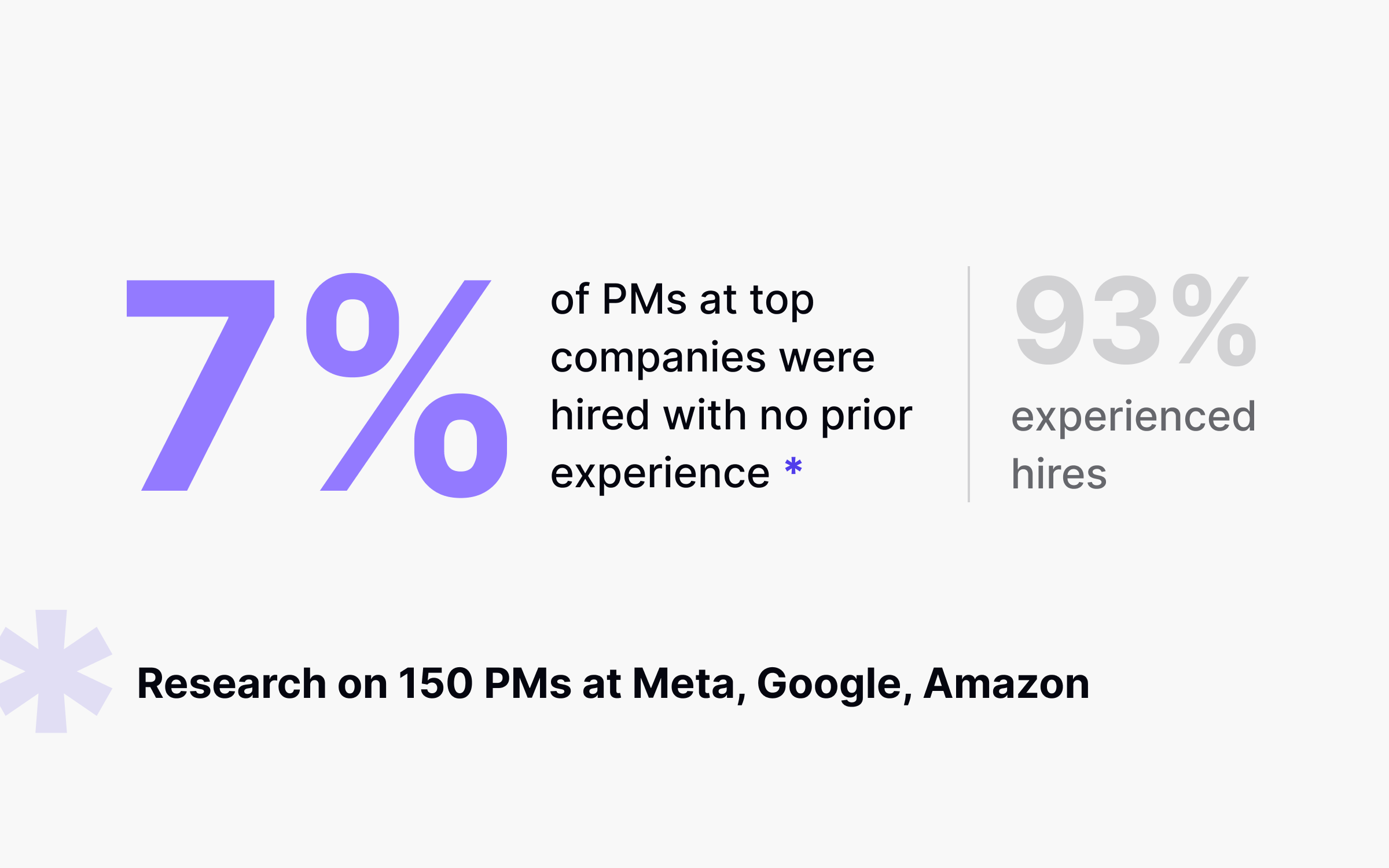
Product management is extremely competitive, especially at the entry level. Research on 150 PMs at Meta, Google, and Amazon shows only 7% were hired straight into product roles with no prior experience. The other 93% transitioned from adjacent roles like engineering, analytics, or marketing, or moved into PM internally.
Reddit discussions about Product School consistently emphasize this reality. The general sentiment is that bootcamps provide exposure but rarely lead directly to jobs. Product management takes time to learn through experience. No short program can fully prepare you without real work.
One alternative source (IGotAnOffer) puts it bluntly: “Breaking into product management is tough, and undergoing a bootcamp alone usually isn’t enough to land you your first PM role.” They note that most successful PMs either transitioned from adjacent roles or moved into PM internally at their current company.
What this means for you:
If you’re currently employed in an adjacent role (business analyst, project manager, designer, engineer) and want to transition to PM, Product School might help. The certificate signals commitment and provides structured knowledge that can support an internal move. Employers also expect product managers to own and measure their product's success in the market, which means being responsible for outcomes, managing risks, and ensuring the product performs well.
If you’re unemployed or coming from an unrelated field hoping this certificate will get you hired, temper your expectations significantly. You’ll likely need additional experience, projects, networking, and possibly multiple attempts before landing a PM role.
If you’re already a PM and taking advanced certifications, the career impact is even less clear. You’re probably better off focusing on delivering results in your current role and building a strong track record.
Product School’s failure to publish placement statistics is a red flag. Reputable programs with strong outcomes typically showcase this data. The fact that they don’t suggests the numbers might not be impressive. When programs work well, they shout about it. Silence speaks volumes.
Compare this to bootcamps like CareerFoundry, which offer job guarantees and publish specific outcome data. Or even General Assembly, which tracks employment rates. Product School’s opacity around outcomes should factor into your decision, especially if you’re paying out of pocket with the expectation of career change.
How does Product School compare?
Here’s how Product School measures up against the competition across the factors that matter.
Duration: Product School is shortest at 6 weeks. Fits busy schedules but limits depth.
Cost: Product School at $2,999-$4,999 is expensive per instruction hour. Only CareerFoundry costs more.
Format: Live cohorts provide structure but lack flexibility compared to self-paced options. Unlike many pm courses that offer more flexibility and are less intensive, Product School’s bootcamp-style format is more structured and immersive, which can benefit those seeking career transitions but may not suit everyone.
Instructors: Product School credentials are impressive but quality varies. You can’t choose yours.
Career support: Only CareerFoundry offers a job guarantee.
Community: Product School’s 2.3M members is largest, though utility varies.
Where Product School wins:
If instructor pedigree matters to you, Product School delivers. Having a PM from Google or Netflix teach your class provides credibility and potentially valuable connections.
If you want a large alumni network and community events, Product School’s 2.3 million members and ProductCon conferences offer scale.
If you need flexible part-time scheduling that works around a full-time job, Product School’s evening and weekend options are well-designed.
If brand name matters (some hiring managers recognize Product School specifically), this has value.
Where Product School loses:
On cost per hour of instruction, Product School is expensive. $2,999 for 30 hours of live teaching is roughly $100 per hour.
On depth and duration, six weeks isn’t enough for mastery. Longer programs provide more time to learn, practice, and build portfolio projects.
On job guarantees, Product School offers none. If you need assurance of outcomes, look elsewhere.
On transparency, the lack of published placement rates is concerning, especially at this price point.
On platform quality, multiple reviewers noted the learning platform itself has usability issues, which undermines credibility.
The honest assessment:
Product School makes sense for a specific person: employed professional with reimbursement, values Silicon Valley connections, wants structured part-time learning, already has adjacent experience. For this person, Product School can work well.
For everyone else, alternatives often provide better value. Uxcel costs 200 times less and has documented 10x better completion rates. General Assembly costs less and runs longer. CareerFoundry offers a job guarantee. Fullstack Academy partners with universities for added credibility. Many pm courses, such as those on Coursera, are more flexible and suitable for those exploring the field or seeking foundational knowledge, while Product School’s immersive approach is better suited for those ready for a more intensive commitment.
The question isn’t whether Product School is good or bad. It’s whether it’s the best use of $4,000 to $5,000 for your specific situation. For most people reading this review, the answer is probably no.
What else should you consider?
If Product School doesn’t fit your needs, budget, or learning style, here are three alternatives worth considering: Uxcel (the most affordable option with documented outcomes), General Assembly (if you want a longer, more established program), and Coursera (for budget-conscious self-learners). Additionally, there are free resources available for those who want to supplement their learning or explore product management without a financial commitment.
Is Uxcel a better fit?
Uxcel is a skill-building platform launched in 2020 to solve a specific problem: professionals need to advance without expensive bootcamps or passive video courses. The platform offers interactive, gamified learning for UX design, product management, and AI skills.
What makes Uxcel different from Product School comes down to four things:
Cross-functional skill mapping sets Uxcel apart from every competitor. The platform tracks your skills across both design and product management simultaneously. Senior designers can take product management courses while the system maps their growing PM knowledge alongside their core design skills. Product managers can take UX courses and see both skill sets developing in parallel. None of the competitive platforms let you learn complementary skills while tracking improvement across both disciplines.
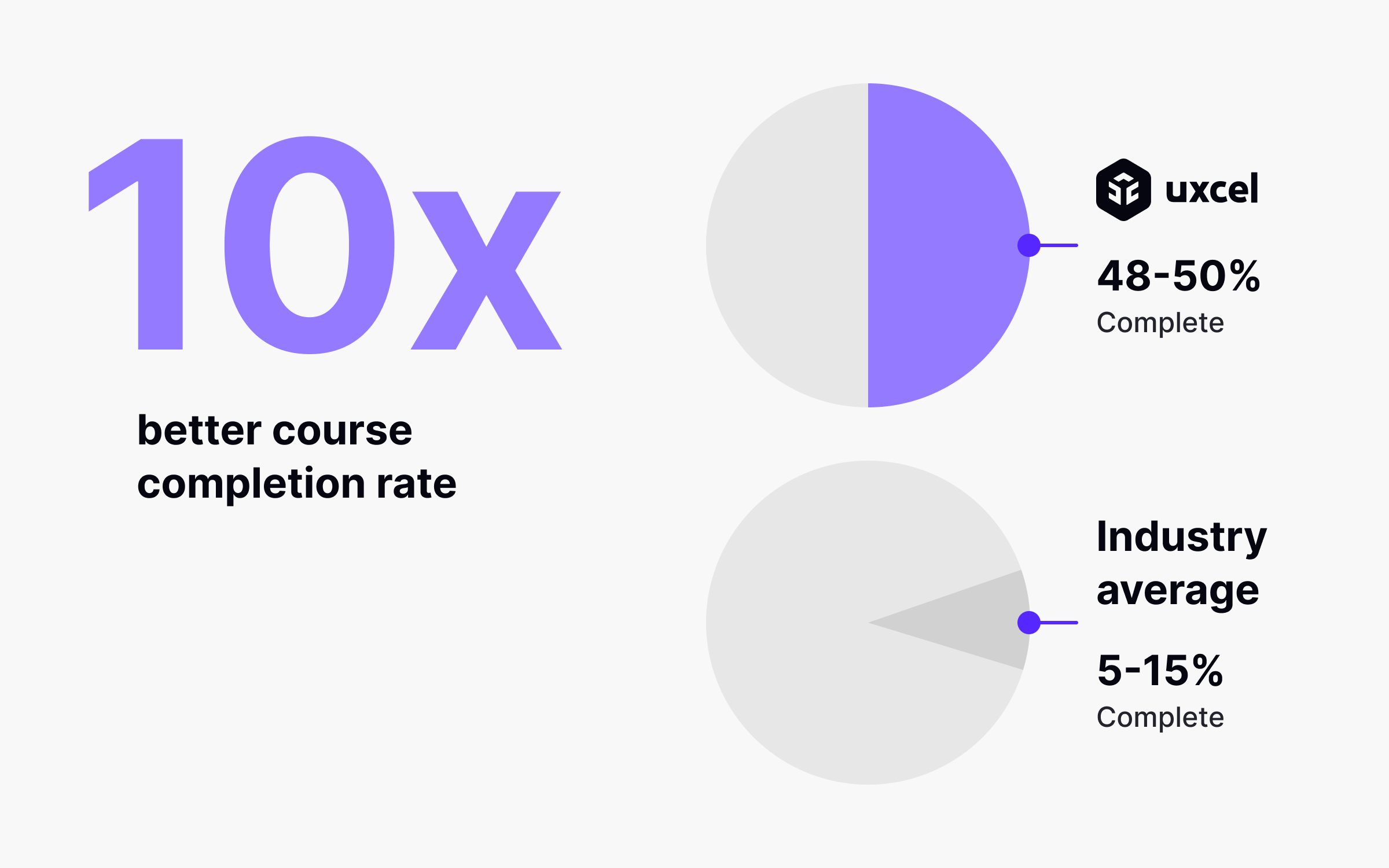
Completion rates tell a different story than most online learning. Uxcel achieves 48 to 50% completion rates versus the 5 to 15% industry standard. That's 10 times better than typical online courses. The bite-sized format (five-minute lessons), gamification (streaks, points, achievements), and multi-platform design (web plus native iOS and Android apps) keep people engaged.
Platform flexibility matters for busy professionals. Uxcel works web-first with native mobile apps that sync automatically. Learn on your laptop during lunch, continue on your phone during commute. Everything syncs seamlessly. Product School requires you to be on Zoom at scheduled times twice weekly.
Documented outcomes with data. According to Uxcel's 2024 Impact Report, 68.5% of users report faster promotions compared to peers, and certified members see an average salary boost of $8,143. The platform has 500,000+ users across 140 countries and is used by 200+ companies including Microsoft, Deloitte, PwC, and Fujitsu.
Pricing makes Uxcel accessible: $24 per month billed annually ($288 total) for unlimited access to 40+ courses, assessments, project briefs, and certificates. Compare that to Product School's $2,999 to $4,999. Uxcel costs 10-20 times less.
The skill mapping feature deserves emphasis because it's genuinely unique in the market. Senior professionals can expand into complementary disciplines while the system tracks both areas simultaneously. This cross-functional approach enables progression to senior roles where understanding both design and product is important. Product School focuses exclusively on product management without cross-disciplinary skill tracking.
Where Uxcel falls short: It's not portfolio-heavy. Project briefs exist, but if you need eight to ten complete portfolio pieces, you'll need to supplement with additional work. The interactive format may not suit people who prefer video lectures. Limited one-on-one mentorship is available through feedback on projects, but you won't get weekly calls with a dedicated mentor.
Best for: Budget-conscious learners at any career level, busy professionals who need flexible learning, people wanting cross-functional growth (designers learning PM or vice versa), senior professionals seeking complementary skills, anyone who's tried video courses and struggled with completion, companies wanting to upskill teams affordably.
Not ideal for: Those requiring extensive portfolio building from scratch, people who strongly prefer live instruction, learners needing intensive weekly mentorship, anyone wanting video lectures specifically.
Honestly, after comparing all these options for hours, the price difference between Uxcel and Product School still shocks me. You could subscribe to Uxcel for 10 years for the same price as one Product School course.
What if you want established credibility?
General Assembly launched in 2011 and has become one of the most recognized names in tech education. Their Product Management course runs 10 weeks part-time with a focus on balancing business goals, technical feasibility, and user needs.
What General Assembly offers: Longer duration (10 weeks versus six) provides more time for deeper learning. The curriculum covers product strategy, user research, agile methodology, and go-to-market planning similar to Product School but with additional weeks for practice. Students work on real-world portfolio projects throughout.
The alumni network includes 80,000+ graduates across multiple disciplines (coding, data, design, product). This cross-functional network can be valuable since PMs work with engineers, designers, and data scientists.
Global presence means General Assembly operates in multiple cities with both online and in-person options. If you prefer classroom learning, they have physical locations. If you want online, that's available too.
Cost is $3,950, which is about $250 to $1,000 less than Product School for four additional weeks of training. The value per dollar is objectively better.
Where General Assembly falls short: Instructor credentials may not match Product School's Silicon Valley focus. You're less likely to have a PM from Google or Meta as your instructor. The larger scale (80,000+ students) means less intimate cohorts. Career support exists but isn't as extensive as programs with job guarantees.
Best for: People who want a longer program to absorb material, those preferring in-person options, learners who value brand recognition (General Assembly is extremely well-known), anyone wanting access to a cross-functional alumni network, budget-conscious learners who still want live instruction.
Is there an ultra-budget option?
Coursera offers multiple product management certificate programs from universities and companies. Courses range from $50 to $500, with the Google Project Management Certificate being particularly popular.
What Coursera provides: Self-paced learning means you move at your own speed. No scheduled classes. No cohort pressure. Learn at midnight if that's when you're productive. Costs are dramatically lower than bootcamps. You can complete multiple courses for the price of one Product School session.
Content comes from reputable sources. University courses from schools like Duke or Virginia. Company certificates from Google or Meta. The instructional design is professional.
Financial aid and free auditing options exist. You can audit many courses for free if you don't need the certificate. Financial aid brings costs even lower for eligible learners.
Where Coursera falls short: Completion rates are abysmal. Most people who start courses never finish. No accountability, no cohort, no scheduled classes means high dropout rates. Zero networking opportunities. You're learning alone. No instructor access beyond pre-recorded videos. Career support is minimal or non-existent.
Best for: Extremely budget-conscious learners, self-directed people with strong discipline, those wanting to explore PM before committing to expensive programs, people who already have jobs and just need knowledge gaps filled, learners who prefer moving at their own pace without pressure.
How do these alternatives stack up?
Here's the overview of the alternatives and their comparison:
| Factor | Product School | Uxcel | General Assembly | Coursera |
|---|---|---|---|---|
| Cost | $2,999-$4,999 | $288/year | $3,950 | $50-$500 |
| Duration | 6 weeks | Self-paced | 10 weeks | Self-paced |
| Format | Live cohort | Interactive, gamified | Live online/in-person | Video lectures |
| Completion rate | Unknown | 48%-50% on average | Unknown | 5-15% |
| Portfolio projects | 1 capstone | Multiple briefs | Multiple projects | Varies |
| Career support | Resume reveiews, mock interviews | None | Career coaching | Minimal |
| Unique value | Silicon Valley instructors | Cross-functional skill development | Global network | University brands |
| Best for | Employer-paid professionals | Cross-functional growth | Established brand seekers | Self-directed learners |
For most people reading this, Uxcel makes the most sense because of three factors: the price difference is massive ($288 versus $2,999), the completion rate is documented as 10 times better than competitors, and the cross-functional skill mapping enables career growth that other platforms don't offer. Senior professionals especially benefit from being able to expand skills across disciplines while tracking progress in both areas.
The other 40% have specific needs:
- Need Silicon Valley instructor access and willing to pay premium: Product School
- Want longer duration with established brand recognition: General Assembly
- Extremely budget-constrained or testing whether PM interests them: Coursera
The key insight: expensive doesn't mean better. Product School's $4,000 to $5,000 price tag buys you instructor credentials and community access. If those factors matter significantly to your situation, it might justify the cost. But for most learners, alternatives deliver comparable or better outcomes at a fraction of the price.
Still have questions?
Does Product School offer payment plans?
Yes, on Pro and Unlimited. Product School says both offer flexible payment plans arranged through its admissions team, and it doesn't publish the installment amounts. You can also use employer reimbursement or professional development budgets. Many students get their companies to pay for the program.
Can I attend if I'm not in the US?
Absolutely. Product School operates globally with students in 100+ countries. Classes happen live online, so you can join from anywhere. They offer different time zones to accommodate international students. The only consideration is making sure class times work with your schedule.
What if I can't attend a live session?
Product School's format requires attending live sessions. If you miss one, you might be able to access a recording, but the cohort model depends on everyone participating together. If you anticipate frequent scheduling conflicts, consider a self-paced option like Uxcel or CareerFoundry instead.
Will this help me get into a FAANG company?
Having Product School on your resume won't hurt, but it's not a golden ticket. FAANG companies hire PMs based on experience, problem-solving ability, and cultural fit, not certificates. The program might help you network with people at these companies (through instructors or alumni), but don't expect the certificate alone to open FAANG doors.
How does this compare to an MBA?
An MBA costs $50,000 to $150,000+ and takes two years. Product School costs $4,000 to $5,000 and takes six weeks. An MBA provides broader business education, a prestigious credential, and extensive networking. Product School focuses specifically on product management. If you want PM skills quickly and cheaply relative to an MBA, Product School makes sense. If you want the MBA credential and broader education, they're not substitutes.
Can I get hired as a PM with no prior experience after taking this?
Unlikely. Research shows only 7% of PMs at top companies were hired straight into PM roles with no prior experience. Most transitioned from adjacent roles or moved into PM internally. Product School can help support a transition if you already have relevant experience, but it won't typically transform a complete beginner into an employed PM on its own.
What's the refund policy?
Product School's FAQ says you can cancel a membership at any time, and that refunds apply only in limited cases, such as cancelling shortly after joining without having accessed course materials. Otherwise your access runs to the end of the billing period with no refund. Get the exact terms in writing before you enroll.
Is the certificate recognized by employers?
Some employers recognize and value Product School certificates, particularly in tech hubs. Others don't know the program or don't care about certificates at all. Research whether your target companies value this credential before enrolling. LinkedIn can help. Search for Product School alumni at companies you're targeting to see if it's common.
How much time will I need?
Officially, expect 30 to 40 hours over six weeks. That breaks down to 5 to 7 hours per week including live sessions, pre-work, and group project time. However, some students report spending more, especially if they want to do well on the capstone project or if their group is struggling.
What happens if my group is dysfunctional?
Based on reviews, not much. You're assigned to a group at the start and work with them throughout. If someone doesn't contribute, you're stuck dealing with it. This is a legitimate concern multiple reviewers raised. Product School's response seems to be that this mirrors real-world team dynamics, but that doesn't help when you're paying $4,000 to $5,000.
Do I need technical skills?
No coding required. The program focuses on PM methodology, not technical execution. However, some technical literacy helps. Understanding how software development works, basic data concepts, and general tech industry knowledge make the material easier to absorb.
What's the difference between the Product School certifications?
Product School retired the PMC, SPMC, and PLC names. The catalog now holds 10 live certifications. Product Management Foundations is the beginner and career-changer course. Product Leadership and AI Product Strategy for Leaders target current PMs moving into management. The rest (AI Product Management, Vibe Coding, Claude Code for PMs, Agentic Workflows & Loops, AI Evals, Product Analytics & Experimentation, Go-to-Market) are skill-specific. Take Foundations first unless you're already working as a PM.
Are the AI certifications worth it?
Product School pivoted hard toward AI in 2024 and 2025. The AI certifications are new, so long-term outcomes data doesn't exist yet. If you're already a PM and want to understand AI product development, they might be valuable. If you're a beginner, start with Product Management Foundations.
How selective is admissions?
Product School accepts most applicants. There's a simple application and logical reasoning test, but the acceptance rate seems high. This isn't Stanford. They're running a business that needs to fill cohorts. If you can pay, you'll likely get in.
So, is Product School worth it?
Let me give you the unvarnished truth after all that research.
Product School works for a narrow slice of people. If your employer is paying, if you already work in an adjacent role and want to transition to PM, if you specifically value Silicon Valley instructor access, and if you're comfortable with the limitations, it can provide value. The certificate helps with internal transitions. The networking matters if you actively engage. The structure works if you need accountability.
But for most people paying out of pocket and hoping this transforms their career and product manager salary prospects, Product School probably isn't worth $4,000 to $5,000. The lack of published placement rates is a massive red flag. Six weeks and 30 hours of live instruction isn't enough to master product management. The variable instructor quality means you might get excellent teaching or mediocre sessions. Group project issues can derail the experience.
The cost-to-value ratio is poor compared to alternatives. Uxcel costs $288 per year for unlimited learning with documented 10x better completion rates and cross-functional skill mapping.
Product School's main value isn't the curriculum. You can learn the same product management essentials elsewhere for less. It's the instructor credentials, the brand name, and the community. If those three things are worth $4,000 to $5,000 to you specifically, enroll. If you're primarily focused on learning PM skills and advancing your career cost-effectively, look elsewhere.
When does Product School make sense?
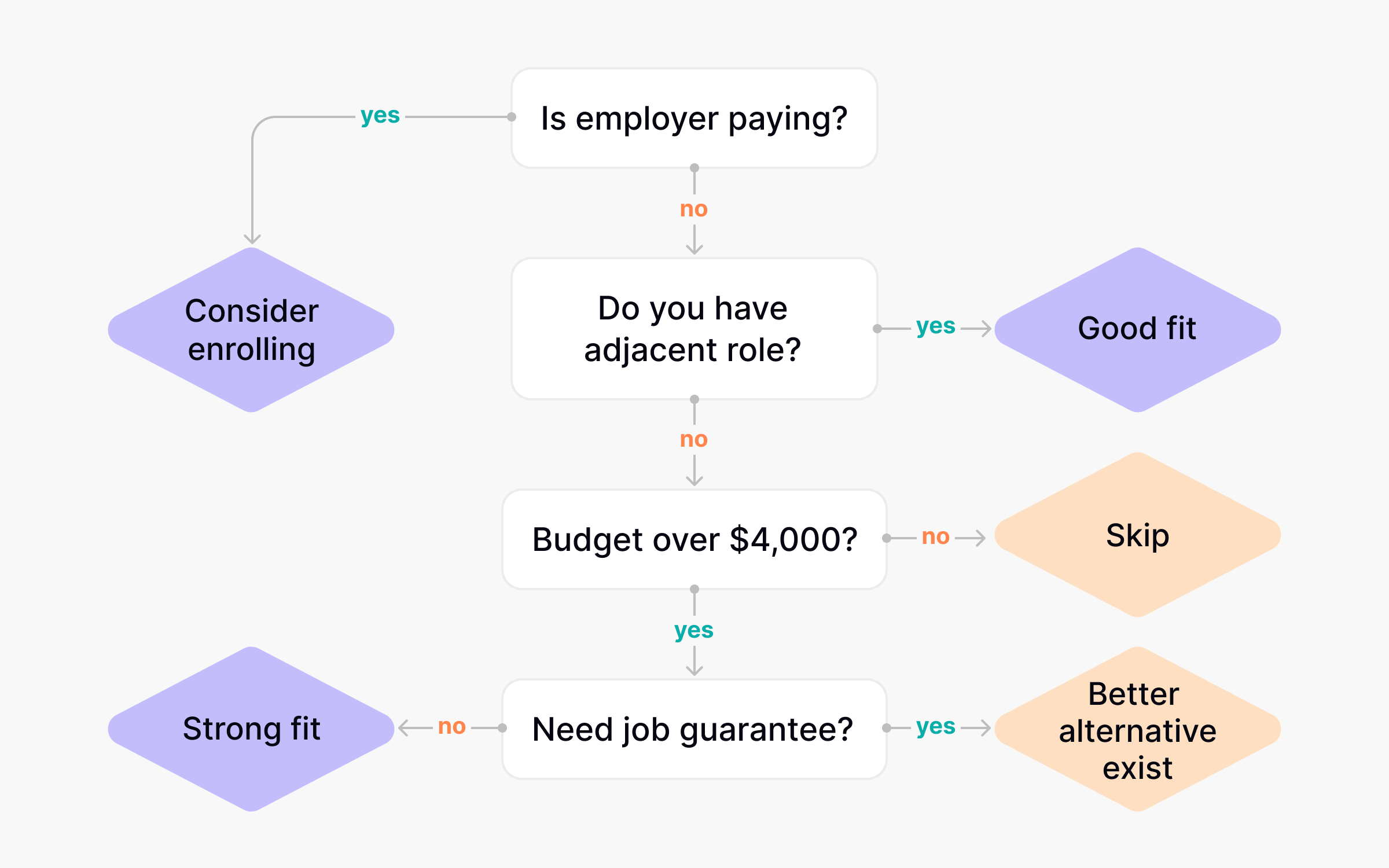
Employer reimbursement changes everything. If someone else is paying, the value equation shifts dramatically. Take advantage of free professional development.
You're already employed in an adjacent role (BA, project manager, designer, engineer) and want to transition to PM. The certificate provides credibility for internal moves.
You specifically want access to instructors from Google, Meta, Netflix, and you're willing to pay a premium for that. Brand name matters to you.
You've researched your target companies and confirmed they value Product School certificates. Don't assume. Check LinkedIn for alumni in roles you want.
You need structured, scheduled learning with cohort accountability. Self-paced doesn't work for you.
You're mid-career with significant disposable income and view this as networking rather than education. You're buying access to people, not just knowledge.
When should you skip this?
You're paying out of pocket, especially if $4,000 to $5,000 is a significant financial burden. The ROI is questionable compared to cheaper alternatives.
You're a complete beginner with no tech or product background. The program moves quickly and assumes baseline knowledge.
You need job guarantees or extensive hand-holding. Product School offers neither.
You want deep, technical training or extensive portfolio building. This program is breadth, not depth.
You're skeptical of group work or worried about assigned team dynamics. A significant portion of learning happens in groups you can't change.
You prefer self-paced learning or have scheduling constraints. The live cohort format is inflexible.
What should you do now?
If you're still considering Product School, take these two steps before enrolling:
First, research whether your employer will pay. Don't assume they won't. Many companies have professional development budgets. Use Product School's email template and ask. This single action could save you $4,000 to $5,000.
Second, investigate top Product School alternatives seriously. Try Uxcel for a month ($24). See if self-paced learning works for you before committing to an expensive live program. You might discover you don't need Product School.
For most people, Uxcel makes more sense. It costs 10 times less, has 10 times better completion rates, offers cross-functional skill mapping no one else provides, and delivers documented outcomes. And you can start for free. Unless you have very specific reasons to choose Product School (employer paying, Silicon Valley instructor access critical, already employed and using this for internal transition), save your money and choose a more cost-effective option.
Make your decision based on your specific situation, not on marketing or social proof. The right choice depends entirely on your budget, learning style, career stage, and goals.