.svg)


If you’re a mid-career professional at a company willing to pay for training, PragmaticInstitute’s Product Management Certification is probably one of your best bets. Paying out of pocket? You’ll want to look at alternatives like Uxcel's PM certification.
I got obsessed with researching this program. Started digging after seeing it mentioned constantly in product management circles, and ended up spending more hours than I want to admit reading student experiences, scrolling through job postings, and trying to figure out if $3,685 actually makes sense. Went through dozens and dozens of reviews... probably closer to 150 if I’m being honest. Lost track of time in Reddit threads. Checked the pricing multiple times because I genuinely thought I misread it.
Look, I didn’t interview 50 graduates or audit the actual courses. What I did was spend way too much time reading everything publicly available and trying to piece together whether this investment makes sense. That’s the honest scope here.
Here’s what matters: This organization has been around since 1993 (that’s 30+ years). They’ve trained over 250,000 professionals at 10,000+ companies. The certification runs $3,685 for three courses totaling 21 hours, or $1,295 per course bought separately. This is a structured certificate program awarding a professional certificate upon completion, which is recognized for its value in career advancement and as proof of achievement. Unlike most competitors, you get certified by completing courses, not by passing an exam.
Three things stuck with me. First, the Pragmatic Framework isn’t just marketing. It’s actually a comprehensive 37-area system covering the entire product lifecycle, and people genuinely use it to create shared vocabulary across teams. Second, the 36,000-member alumni community isn’t dead (I was skeptical). People actually use it for networking and continued learning. Third, that $3,685 price tag? It’s not just expensive. It’s deliberately expensive because it signals serious commitment to corporate training programs.
This review covers what you’ll learn, real student feedback, career outcomes, detailed pricing, and strong alternatives if this doesn’t fit. The program is designed to build core skills and confidence in product management decision-making and leadership.
What is Pragmatic Institute Product Management Certification?
Provider: Pragmatic Institute (founded 1993, Scottsdale, Arizona)
What you’ll pay: $3,685 total for the Product Management Certification when you enroll in all three courses together ($200 bundle discount off $3,885)
- Individual course: $1,295 each
- Three courses required: Foundations, Focus, Build
- Payment plans: Affirm financing available
- Employer sponsorship: Template letter provided
Time investment: 21 hours total (7 hours per course; live sessions run as two half-days)
- Fastest completion: 1 week (on-demand format)
- Typical completion: 2-4 weeks (live format)
- Flexible scheduling: Complete courses individually over months
How you’ll learn:
- On-demand: Self-paced, available 24/7, complete anytime
- Live online: Instructor-led virtual classroom, real-time interaction
- In-person: Select major cities, hands-on immersive training
- Private team: Custom corporate programs
- Flexible certificate program: Choose self-paced or live options to fit your schedule
Prerequisites: None required for Foundations course (recommended to complete in sequence)
How you get certified: To qualify for the certificate, you must complete all required coursework and participate in course activities (no exam required)
What’s included:
- 37-area Pragmatic Framework methodology
- Lifetime access to course materials and templates
- Access to study materials and supplementary resources to help prepare for and reinforce course concepts
- 36,000+ member alumni community (lifetime, free)
- Digital badges via Credly (shareable on LinkedIn)
- Updated resources through events and workshops
Track record:
- 32 years in operation (since 1993)
- 250,000+ certifications issued across all programs
- 10,000+ companies trained
- Clients include Microsoft, IBM, Amazon, Fortune 500 companies
Recognition: Shows up frequently in job postings nationwide alongside CSPO and AIPMM certifications. Pragmatic claims it’s “the only certification employers ask for by name.”
Notable statistic: Pragmatic Institute says certified professionals see an average 5.6% salary increase during their careers.
Who's behind Pragmatic Institute?
Pragmatic Institute has been around longer than any other PM training company out there. Founded in 1993 when most product managers were building features nobody wanted, they built their reputation around a system that integrated market research, product strategy, development, and go-to-market into one cohesive approach.
While most competitors launched in the 2010s targeting Agile or startups, Pragmatic went broader from the start to cater to B2B, B2C, SaaS, hardware, manufacturing, financial services, healthcare. They work across industries. In 2018, they acquired The Data Incubator and rebranded as Pragmatic Institute, expanding into data science and design training. They operate fully remote now (since 2020), headquartered in Scottsdale, Arizona.
The Product Management Certification has three core courses: Foundations (market-driven fundamentals), Focus (strategic planning), and Build (development alignment). Each course runs 7 hours delivered through lectures, exercises, case studies, and applying the methodology. The curriculum is designed to provide a strong foundation in product management, with concepts taught in a logical progression that builds from fundamentals to advanced strategic topics. They’re trying to give you a repeatable system and toolkit you can use immediately at work.
What makes Pragmatic different from bootcamps? No portfolio projects, no capstone, no weeks of homework. Instead: templates, systems, practical tools you can use right away. A roadmap template you can customize. A win-loss analysis approach you can run next week. A requirements document format your team can adopt immediately.
They bring in former product executives from startups and Fortune 500 companies who actually used the Pragmatic approach themselves. Not academics teaching theory. Practitioners who spent decades in the trenches teaching compressed lessons from real experience. The academic focus of the courses is on helping professionals move from tactical execution to strategic leadership roles in product management and product marketing.
The alumni community (36,000+ people) gives you lifetime access after your first course. No annual fees, no recurring costs. Regular events, updated resources, networking opportunities, and knowledge sharing. What caught me off guard is that people actually use it. I kept seeing mentions of the community in reviews, not just marketing claims but real examples of graduates connecting and helping each other. That surprised me because most certification communities are ghost towns.
Thing is, Pragmatic doesn’t offer formal accreditation. This isn’t a university program with transferable credits. It’s a professional credential valued by employers because they know what it represents: practical, system-based training in market-driven product management.
Inside the curriculum
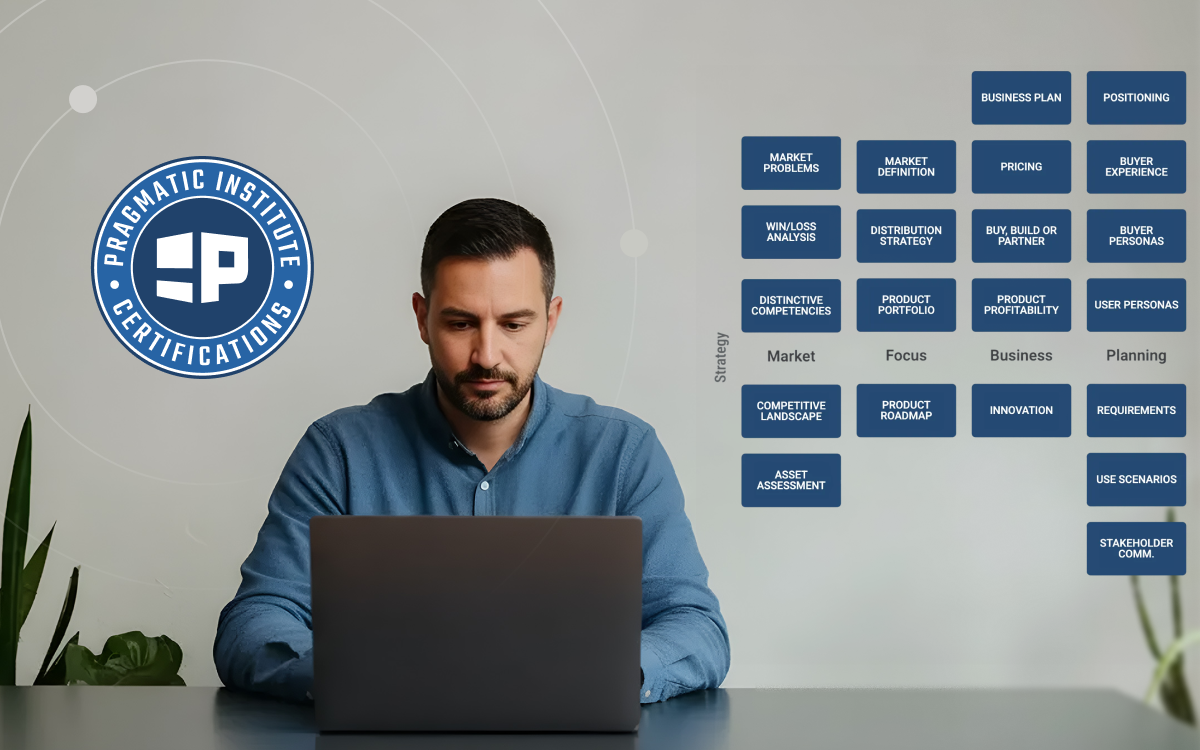
Everything’s built around the Pragmatic Framework, a 37-area methodology organized into seven categories that cover the entire product lifecycle. Think of it as a map showing what activities product managers should focus on at each stage, from initial market research through product launch and beyond. The Pragmatic Framework is a proprietary, structured approach visualized as 37 boxes, emphasizing market-driven results and a focus on solving real-world problems rather than relying on internal assumptions.
This surprised me because the approach isn’t just theory you memorize and forget. It’s practical stuff you can use Monday morning. Each course gives you templates and tools that solve actual problems. The curriculum is designed to build core skills in product management, including integrating customer insights into strategy, understanding customer needs through research and empathy, and crafting compelling value propositions that differentiate products and deliver unique benefits. The curriculum also emphasizes the creation and use of a product roadmap as a strategic tool to connect product features to overall business strategy, prioritize development tasks, and ensure team alignment throughout the product lifecycle.

Foundations course (7 hours)
This is where everyone starts, regardless of experience level. The Foundations course is designed to provide a strong foundation in product management by developing core skills and focusing on understanding customer needs and leveraging customer insights. You learn how to think like a market-driven product manager rather than an engineering-driven one. Sounds basic, but the distinction matters. Engineering-driven PMs build features they find interesting. Market-driven PMs build features customers will pay for.
You learn how to conduct effective customer interviews that reveal actual problems rather than feature requests. There’s a big difference between “I need a button that does X” and understanding why someone wants that button in the first place. They show you techniques for getting past surface-level feedback to underlying needs.
They spend a lot of time on market segmentation. Not the theoretical kind taught in business schools, but the practical kind: how to divide your market into segments you can actually serve, how to evaluate which segments offer the best opportunities, how to prioritize when you can’t serve everyone. You work through examples using real companies and markets.
The competitive analysis section shows you how to understand your competition without becoming obsessed with them. You learn how to conduct win-loss analyses (why did customers choose you or your competitor?) and how to use that information to improve your product strategy rather than just match competitor features.
You learn pricing fundamentals: value-based pricing vs. cost-plus pricing, how to set prices that reflect market realities rather than internal costs, how to think about pricing tiers and packaging. This isn’t about becoming a pricing expert (that’s a separate course), but understanding pricing strategy well enough to participate in those discussions intelligently.
Foundations introduces the Pragmatic Framework itself: the seven categories (market, focus, build, market, launch, growth, operations), the 37 activities within those categories, and how they connect to create a complete product management system. You don’t master all 37 areas in Foundations, but you understand what they are and why they matter.
The course covers key areas such as market discovery, strategy, development, launch, and sales enablement, ensuring a comprehensive understanding of the entire product lifecycle. Uxcel's product management course covers the same fundamentals in a flexible, self-paced format.
Focus course (7 hours)
This course digs deep into strategy and roadmapping. You learn how to build product strategies that get approved by executives and embraced by engineering teams. That’s harder than it sounds. Most product strategies fail because they’re either too vague (“we’ll build great products for our customers”) or too detailed (“we’ll add these 47 features in this exact order”).
You learn opportunity scoring, a systematic approach to evaluating product ideas based on market need, company fit, and revenue potential. The goal is scoring opportunities objectively rather than politically, using data to support your recommendations rather than whoever shouts loudest in meetings. For deeper coverage, Uxcel's product analytics course builds these data-driven PM skills hands-on. Evidence-led decision making, using data analysis and market research, is emphasized to prioritize projects objectively and challenge internal narratives. Product managers should be skilled in making data-driven decisions to guide product development.
They dig deep into strategic positioning. How do you position your product in crowded markets? How do you communicate your value proposition in ways that resonate with buyers? How do you differentiate without resorting to feature comparisons?
The roadmap section focuses on creating product roadmaps that communicate strategy rather than just list features with dates. Creating effective product roadmaps is a key responsibility for product managers, ensuring alignment with business goals and organizational strategy. You learn techniques for grouping features into themes, showing progress toward strategic goals, and presenting roadmaps to different audiences (executives, engineering, sales, customers) in ways that make sense for each group.
Internal selling might be the most valuable skill covered. You learn how to build credibility with stakeholders, present strategies that get funded, navigate organizational politics without becoming political, and turn skeptics into supporters. They walk you through specific techniques for handling objections, framing arguments for different audiences (CFO vs. CTO), and building coalitions around your product vision.
Build course (7 hours)
This course tackles the eternal product management challenge: how do you balance what customers want, what’s technically feasible, what’s economically viable, and what can realistically be delivered in a reasonable timeframe? The Build course teaches you how to build products and create products that meet customer needs, focusing on practical strategies for delivering value and leading product development.
They spend serious time on prioritization approaches. Not just “use MoSCoW” or “rank by value,” but practical methods that work when everything is high priority and nobody agrees on what matters most. You learn how to facilitate prioritization discussions, incorporate multiple perspectives, and make decisions that stick.
The MRD and PRD section shows you how to hand off information to development teams in ways that preserve market context without micromanaging implementation. You learn what details matter, what can be left to engineering discretion, and how to structure requirements so developers understand not just what to build but why it matters.
You learn about user stories and personas from a practical perspective. Not the theoretical “as a user, I want to…” format that creates busywork, but stories that capture market problems, user contexts, and success criteria in ways that guide development decisions. Hands-on experience and hands-on projects are integrated into the course to provide real-world application of product management skills.
Release planning is all about coordinating product, marketing, and sales around launches. You learn how to plan releases that deliver value incrementally rather than waiting for everything to be perfect, how to communicate what’s coming without overpromising, and how to coordinate across functions so everyone is ready when features ship. The course emphasizes the importance of delivering new products and features that drive business growth.
The course wraps up with development collaboration techniques. How do you work with Agile teams without slowing them down? How do you participate in sprint planning effectively? How do you balance long-term strategy with short-term velocity? They provide specific techniques for maintaining product vision while respecting engineering autonomy. Working with cross functional teams and leveraging Agile methodologies is essential for product managers to innovate and collaborate effectively.
Throughout all three courses, you get templates for everything: market segmentation worksheets, competitive analysis systems, opportunity scoring matrices, roadmap formats, requirements templates, prioritization tools. These aren’t just examples to look at. They’re editable files you can customize and use in your work starting immediately.
The approach doesn’t prescribe a specific methodology like Scrum or Kanban. It works with whatever development methodology your company uses. That’s intentional. Pragmatic Institute focuses on the product management activities that need to happen regardless of how engineering builds products. Agile methodologies in product management enhance collaboration and innovation while managing technical debt effectively.
Product managers must possess strong leadership and influence skills to align teams and drive product success, and they play a crucial role in innovation by using design thinking to create products that solve real customer problems.
Breaking down the price
The price made me wince at first, but then I realized the structure actually makes sense for how most people use this. Let me walk you through what you'll actually pay.
Base certification cost: $3,685
That's for all three required courses (Foundations, Focus, Build) when you enroll in them together. You save $200 compared to buying individually, where each course runs $1,295. Total if purchased separately: $3,885.
Price: $3,685 for the three-course certification, or $1,295 a course. Prices from pragmaticinstitute.com.
Individual course pricing: $1,295 per course
You can take courses one at a time if you want to spread out the cost or aren't sure you'll complete all three. Some people take Foundations to see if they like the approach before committing to the full certification. Others take specific courses for particular skills (like Focus for roadmapping) without pursuing the complete certification.
Payment options:
Affirm financing is available, letting you pay over time at your preferred pace. Interest rates vary based on your credit profile and chosen payment plan. Pragmatic doesn't advertise specific rates or terms publicly, so you'll see options during checkout.
Most people get their employer to pay. Pragmatic gives you a template letter you can customize for your manager explaining the certification's value and ROI. Many companies have professional development budgets that cover this expense. The high price actually works in your favor here - managers often take training seriously when it costs real money.
Additional costs: $0
You read that right. There are no hidden fees. No exam charges (you get certified by completing courses, not passing tests). No annual renewal costs. No alumni community membership fees. All course materials, templates, systems, and resources come with the tuition. Once you pay $3,685, you're done paying.
Team training pricing: Custom quotes
If you're bringing this to your company for multiple employees, Pragmatic offers team training with custom pricing. Generally, the more people you train, the lower the per-person cost. Team training can be delivered online or in-person and customized to your organization's specific needs. You'll need to contact their sales team for quotes.
Format price differences:
All formats (on-demand, live online, in-person) run the same: $1,295 per course, $3,685 for the full certification. You're not paying extra for live instruction or in-person access.
What about other Pragmatic certifications?
These prices are just for Product Management Certification (Foundations, Focus, Build). Pragmatic offers six other certification paths:
- Product Marketing Certification (different courses)
- Product Operations Certification
- Product Innovation Certification
- Product Master Certification (8 courses total, most comprehensive)
- AI Product Management Expert Certification
- AI Product Marketing Expert Certification
Each has different course requirements and costs. If you want multiple certifications, you pay for each program separately. But courses can overlap. For example, Foundations counts toward both Product Management and Product Marketing certifications.
ROI considerations:
Pragmatic Institute says certified professionals see an average 5.6% salary increase during their careers. If you're making $100,000 annually, that's $5,600 per year, which pays back the $3,685 investment in under eight months. If you're making $120,000, payback is even faster.
On PayScale, professionals with Pragmatic Marketing Certified (PMC) credentials earn between $92,500 and $164,848, with significant variation based on company, location, and role. The certification alone doesn't guarantee those salaries, but it correlates with higher compensation.
Comparison to other product management certifications:
Pragmatic Institute at $3,685 sits in the middle of the market:
- More expensive than AIPMM ($1,495 total including training and exam)
- More expensive than CSPO ($1,000 to $1,500 for two-day workshop)
- Comparable to Reforge ($2,500 to $3,000 per program)
- Less expensive than Product School ($4,500 to $6,000)
- Much more expensive than Coursera options ($200 to $300 for full certificates)
The higher cost relative to AIPMM and CSPO reflects broader coverage (21 hours vs. their shorter formats), extensive templates and systems, lifetime alumni community access, and no exam stress. The lower cost relative to Product School reflects no portfolio project component and self-paced options that require less instructor time.
Budget reality check:
$3,685 is substantial. If you're paying out of pocket without employer support, you need to be confident this investment makes sense for your situation. Can you afford it without financial stress? Will the certification directly impact your career goals? Are there cheaper alternatives that would serve you just as well?
If you're relying on employer sponsorship, factor in approval time. Getting budget approval can take weeks or months depending on your company's processes, fiscal year timing, and remaining budget. Plan accordingly.
Will this work for you?
Not everyone should take this certification, regardless of whether cost is a factor. Here’s my honest assessment of who benefits most and who should look elsewhere.
Participants can gain new skills, recognition, and career advancement through the Pragmatic Institute program. Effective product management leads to organizational success by aligning product strategies with business goals and customer needs.
You're probably a good fit if:
- You’re mid-career (2-5 years) seeking structure. You’ve been doing product management for a few years, maybe through a career transition or by taking on PM responsibilities organically. You understand the job but lack a comprehensive system for making decisions. You want systematic approaches to market analysis, prioritization, roadmapping, and stakeholder communication. Pragmatic gives you that structure, organizing what you already know and filling gaps you didn’t realize existed. The program also helps you build confidence and core skills necessary for effective product management.
- Your employer will sponsor the training. At $3,685, this makes far more sense as a corporate investment than a personal one. Companies willing to pay for training signal they value professional development and likely see Pragmatic certification as career advancement worthy. Employer sponsorship also means your company probably wants you to apply the methodology immediately, giving you real-world practice that reinforces learning.
- You work at an enterprise or established company (500+ employees). Pragmatic emphasizes stakeholder management, executive communication, cross-functional alignment, and navigating complex organizational structures. These skills matter most in larger companies with multiple layers, competing priorities, and political dynamics. Leading and collaborating with cross functional teams is especially important in these environments to deliver measurable outcomes. If you’re at a 20-person startup where everyone sits in one room, you probably don’t need a 37-area system for coordination.
- You need a shared vocabulary for your team. One underrated benefit: getting your whole product team Pragmatic certified creates a common language. When everyone understands the approach, conversations become more efficient. Instead of explaining “we should do win-loss analysis,” you can say “let’s apply box 18” and everyone knows what you mean. This matters more as teams grow.
- You value proven methodologies over experimentation. The Pragmatic approach is 30+ years old, refined through training thousands of companies. If you want battle-tested methods rather than cutting-edge experimental techniques, this fits. The system doesn’t chase trends. It provides fundamentals that work across industries and market conditions. The program also provides hands on experience through practical exercises and real-world application.
- You’re framework-oriented and methodical. Some people thrive with structure, templates, and repeatable processes. Others prefer improvisation and learning by doing. If you’re in the first camp, you’ll appreciate Pragmatic’s systematic approach. If you’re in the second camp, you might find it constraining.
- You want lifetime community access without ongoing costs. The 36,000-member alumni community includes people who completed their first course in 1995 and people who finished last week. No annual dues, no membership tiers, no upsells. You pay once, you’re in forever. For networking, continued learning, and peer support, this adds substantial long-term value.
Skip this and consider alternatives if:
- You can't afford $3,685 and lack employer sponsorship. Get real about your budget. If this investment will cause stress or require debt, look at alternatives. AIPMM offers a comprehensive certification for $1,495 total. IBM's Product Manager certificate on Coursera runs $200-$300 for the entire program. Both will teach you product management without financial strain.
- You're a complete beginner wanting portfolio projects. Pragmatic Institute doesn't build portfolios. You learn systems, strategies, and approaches, but you won't create 8-10 project case studies to show employers. If you're trying to become a product manager from an unrelated field and need tangible work samples, Product School's portfolio-focused approach might serve you better despite the higher cost.
- You need intensive mentorship and coaching. The courses provide instructor interaction during sessions, and the alumni community offers peer support, but you don't get weekly one-on-one mentor calls or personal career coaching. If you need that level of guidance, look at bootcamps with dedicated mentorship programs even if they cost more.
- You're seeking specialized, advanced tactical training. Pragmatic covers the ull product lifecycle at a solid foundational level but doesn't deep-dive into specific areas like growth hacking, analytics, pricing strategy, or technical product management. If you already have strong fundamentals and need advanced specialization in a particular domain, Reforge's focused programs might better suit your needs.
- You work primarily in Agile environments where CSPO makes more sense. If your company is heavily invested in Scrum methodology and wants product owners with Scrum Alliance certification, CSPO is the obvious choice. It's faster (two days), cheaper ($1,000-$1,500), and specifically designed for Agile product ownership. Pragmatic works with Agile but doesn't focus exclusively on it.
- You want academic credentials or transferable university credits. This is a professional certification, not an academic program. It won't give you credits toward a master's degree, and it's not accredited by educational bodies. If you want formal academic credentials, look at university programs even if they're more expensive and time-consuming.
- You're already an experienced PM with 10+ years and your own established systems. Reviews suggest experienced PMs sometimes find Foundations too basic. If you've been successfully managing products for a decade using your own approaches, you might not need someone else's methodology. That said, some experienced PMs still value having a common language to teach junior team members.
- You prefer learning through video lectures rather than interactive exercises. Pragmatic's teaching style combines lectures, discussions, and applying the methodology. It's not passive video watching. If you strongly prefer traditional lecture-based learning where you watch someone explain concepts without interactive participation, you might find the format doesn't match your learning style.
Student feedback and ratings

After reading through tons of student feedback from the past few years, (finding reviews specifically from 2025 was tougher than expected, so most of this comes from recent years), here’s what graduates are saying. I’m basing this on public reviews and student testimonials, not first-hand conversations with graduates.
Students consistently report that the Pragmatic Institute program helps them build confidence and core skills essential for effective product management. Many highlight the value of hands-on experience and hands-on projects included in the curriculum, which provide practical, real-world application of concepts.
Additionally, students love that the program helps product managers develop skills in making data-driven decisions to guide product development, preparing them for leadership roles and effective team management.
What students love:
- “The framework actually works.” This came up constantly. People apply it immediately and solve real problems. One healthcare PM mentioned using the opportunity scoring matrix the week after Focus. Another described how win-loss analysis helped them understand why they lost a major deal.
- “Instructors have genuine expertise.” Students value former product executives sharing real stories about products that failed and lessons learned. The practical experience resonates.
- “Hands-on experience and projects build confidence and core skills.” Students appreciate the hands-on experience and hands-on projects included in the courses, which help them build confidence in making strategic decisions and develop the core skills essential for effective product management.
- “Templates save massive time.” Editable templates get customized for companies within days. Someone adapted the MRD template for their SaaS product right after Build.
- “Alumni community provides ongoing value.” The 36,000-member lifetime access gets actively used for networking and advice. One review mentioned connecting with someone who faced a similar challenge at a different company.
- “Continued instructor support surprised me.” Several reviews noted instructors providing personal contact information and offering support after courses ended.
- “Content works across industries.” Reviews from software, manufacturing, healthcare, and financial services confirmed the approach translates regardless of sector.
Common complaints:
- "Cost is prohibitively high." The number one complaint. At $3,685 total, many can't justify it without employer sponsorship. One person called it "the biggest and really only con."
- "Some content is too basic for experienced PMs." Several found Foundations elementary if they'd already been doing customer research for years. More value came from Focus and Build.
- "Needs more hands-on practice." Recurring request for more application exercises beyond what's included.
- "Time zone challenges for international participants." Live sessions scheduled for US time zones created midnight endings for European students. I've been there with California-timed meetings, and yeah, it's brutal.
- "Long sessions can overwhelm beginners." The 7-hour format delivers information quickly. Some new to PM felt overwhelmed absorbing everything in Foundations.
Real student quotes:
Fortune 500 healthcare product owner: "Pragmatic Institute gave me and my teams the ability to counter opinions with data and really improved the customer relationship. This created a much better relationship with our engineering teams."
TriNet Group product manager: "The most essential need for marketing teams is to have an operational framework that includes organizational dependencies and good templates. Pragmatic Institute offers just that."
Price course graduate: "I now feel more empowered than ever to attend those 'hard' conversations about pricing. Whoever is in possession of this type of knowledge can really have a seat at the table."
One critical but balanced view: "Pros: examples from real life products/companies, templates. Cons: no option for European-friendly sessions; course ended after midnight, training wasn't adequate for my experience level; long sessions."
Pattern analysis:
Positive reviews mention practical application, organized methodology, templates, instructor expertise. Students frequently highlight gaining confidence, core skills, and hands-on experience as key benefits of the program. Negative reviews focus on cost, content level mismatch, desire for more practice. Almost nobody criticizes the system itself. Complaints are about delivery, pricing, or fit for experience level.
Course Report: 4.1 out of 5 (37 reviews). Trustpilot: 4.5 out of 5 (65 reviews). Solid ratings. Student feedback suggests this is high-quality training with proven approaches. Main barriers are cost (too high for individuals) and content level (may not match all experience levels perfectly).
Job prospects explained
To be fair, no certification guarantees a job. Let me be straight with you about what this certification does and doesn’t do for your career.
The Pragmatic Institute certification is a professional certificate recognized by employers for its value in preparing product managers to lead product development and collaborate with cross functional teams.
What this certification signals is that you understand the fundamentals of product management, including how to work with cross functional teams and lead product development initiatives. Product management is essential for creating products that customers love by integrating design, functionality, and business solutions.
In terms of career outcomes, earning this professional certificate demonstrates your ability to manage and lead within cross functional teams, and to oversee product development that supports business growth. Product managers play a crucial role in innovation by using design thinking to create products that solve real customer problems.
What Pragmatic certification signals:
You understand market-driven product management: conducting research, analyzing competition, prioritizing based on value, and communicating strategies. Companies using the Pragmatic approach value candidates who already know it, speeding time-to-productivity. The certification is a professional certificate that demonstrates your ability to lead product development and collaborate effectively with cross functional teams. The certification shows commitment to professional development.
Job market evidence:
I spent an hour just scrolling through job postings. The certification showed up way more than I expected. LinkedIn shows PM roles from $100,000 to $180,000+ listing Pragmatic alongside CSPO, SAFe, and AIPMM. I saw hundreds of jobs mentioning "Pragmatic Institute." Geographic distribution spans all major tech hubs with increasing remote positions. Browse the top product management job boards to find active openings in your area.
Example requirements:
- "Product Management certification (e.g., CSPO, SAFe POPM, Pragmatic Institute, or equivalent)"
- "Pragmatic Institute Product Manager Certification Preferred"
- "Certifications from Pragmatic Institute or Product Marketing Alliance a plus"
Notice the language: "preferred," "a plus," "or equivalent." Rarely a hard requirement but frequently a differentiator.
Salary impact:
Pragmatic Institute says certified professionals see average 5.6% salary increase during careers (statistical correlation, not guarantee). On PayScale, certified professionals earn $92,500 to $164,848 (wide range based on company, location, experience).
Salary depends far more on company size, location, industry, and experience than certification alone. The certification helps at the margins, potentially being the tiebreaker or helping negotiate slightly higher compensation.
What this WON'T do:
Won't get you your first PM job with zero experience. Career changers need experience, portfolio projects, or transferable skills. Start with our guide on how to become a product manager to map out your path. Won't replace domain expertise (SaaS, healthcare, etc.). Won't compensate for weak fundamentals in data analysis or communication. Won't guarantee promotion at your current company.
Realistic career scenarios where Pragmatic helps:
- Internal credibility: Already a PM but lack formal training. Certification provides credibility with executives questioning your decisions.
- Lateral move to better company: PM at small company wanting larger organization. Signals you understand enterprise practices.
- Transition from adjacent role: In product marketing, engineering, or design wanting PM. Shows investment in learning fundamentals.
- Team leadership preparation: Individual contributor aiming for senior PM or director role. The system provides methodology for teaching others.
Companies that value Pragmatic:
Enterprise software (high value), B2B SaaS (high value), financial services (medium-high), healthcare technology (medium-high), manufacturing (medium), consulting firms (medium). Early-stage startups (lower value, often prefer scrappy generalists).
Pattern: larger, established companies with complex stakeholder environments value it most.
Bottom line on career outcomes:
Pragmatic certification enhances credentials for people with relevant experience, domain knowledge, and fundamental skills. Think credibility building and knowledge systematization, not career transformation. Helps mid-career PMs at structured companies. Not enough alone to break into PM from unrelated field with zero experience.
Comparing Pragmatic to alternatives
Before deciding on Pragmatic Institute, you should understand how it stacks up against other major product management certifications. Here’s what actually differentiates each option beyond marketing claims.
Pragmatic Institute offers a structured certificate program that awards a professional certificate upon completion, providing comprehensive study materials to support exam preparation. However, it includes fewer hands-on projects compared to some alternatives, which may offer more opportunities for practical, real-world application of skills.
Pricing comparison:
| Certiication | Cost | Time | Format |
|---|---|---|---|
| Uxcel | $288/year | 56 hours or 2 hours | Online |
| Pragmatic Institute | $3,685 | 15 hours | On-demand / Live / In-person |
| Product School | $4,500 - $6,000 | 8 weeks / 5 days | Live online / in-person |
| AIPMM CPM | $1,495 | Self-paced + exam | Self-study + exam |
| CSPO | $1,000 - $1,500 | 2 days | Workshop |
| Reforge | $2,500 - $3,000 | 4-6 weeks | Cohort-based online |
| IBM Coursera | $200 - $300 | 3 - 5 months | Self-paced online |
What each certification emphasizes:
- Uxcel offers a structured career path consisted of courses, assessments, project briefs (project simulations), and professional certification to cement your knowledge. Uxcel is used by 500k+ users around the world, where roughly 70% of the userbase are working professionals with medium or higher seniority level.
- Pragmatic Institute offers a structured certificate program that awards a professional certificate upon completion, focusing on market-driven product management using their proprietary 37-area approach. Strength: comprehensive lifecycle coverage with practical templates. Weakness: does not include hands-on projects or portfolio projects, higher cost than some alternatives.
- Product School emphasizes portfolio building and networking with instructors from Google, Meta, Amazon. Strength: portfolio projects for job applications, active PM instructors. Weakness: highest cost, less structured methodology than Pragmatic.
- AIPMM CPM stresses globally recognized standards with rigorous examination. Strength: most affordable comprehensive option, international recognition. Weakness: exam-based (some prefer completion-based), less community support than others.
- CSPO concentrates on Agile product ownership within Scrum. Strength: fastest (two days), widely recognized in Agile environments. Weakness: narrowly focused on Scrum, limited to Agile contexts.
- Reforge targets advanced practitioners with specialized problem areas (growth, retention, monetization). Strength: executive-taught, focused deep-dives, strong for scaling products. Weakness: requires baseline PM experience, doesn’t cover fundamentals.
- IBM/Coursera provides academic backing with practical portfolio projects. Strength: extremely affordable, flexible pacing, university credential. Weakness: less recognized than others, purely online with no live interaction.
Real differentiators beyond marketing:
- Uxcel's unique value comes from content specialized
- Pragmatic Institute’s unique value is the comprehensive system and lifetime alumni community access with no recurring fees. In addition, Pragmatic Institute provides comprehensive study materials to support learners, while some alternatives emphasize hands on projects for practical experience. If your goal is systematic methodology you can teach your team, this delivers. If you need portfolio projects, look elsewhere.
- Product School’s portfolio component addresses the practical problem of “how do I prove I can do PM work?” That matters most for career changers without existing product management experience who need work samples for job applications.
- AIPMM’s global reach (65+ countries) matters for international professionals or those working at multinational companies. The certification translates across borders better than US-focused options.
- CSPO’s Agile focus makes it indispensable for Scrum environments. If your company uses Scrum and prefers Scrum Alliance certification, don’t fight that battle. Get CSPO even if Pragmatic appeals to you more.
- Reforge’s specialization serves experienced PMs facing specific challenges (how do we improve retention? how do we monetize better?). It doesn’t replace foundational training but supplements it for specific problems.
Your situation determines the right choice: budget constraints, career stage, company environment, learning preferences, and whether you need portfolio projects or prefer system-based systematic approaches. Product School is best for those needing hands-on projects, while Pragmatic Institute stands out for its robust study materials and structured curriculum.
Why Uxcel is the best Pragmatic Institute alternative worth exploring
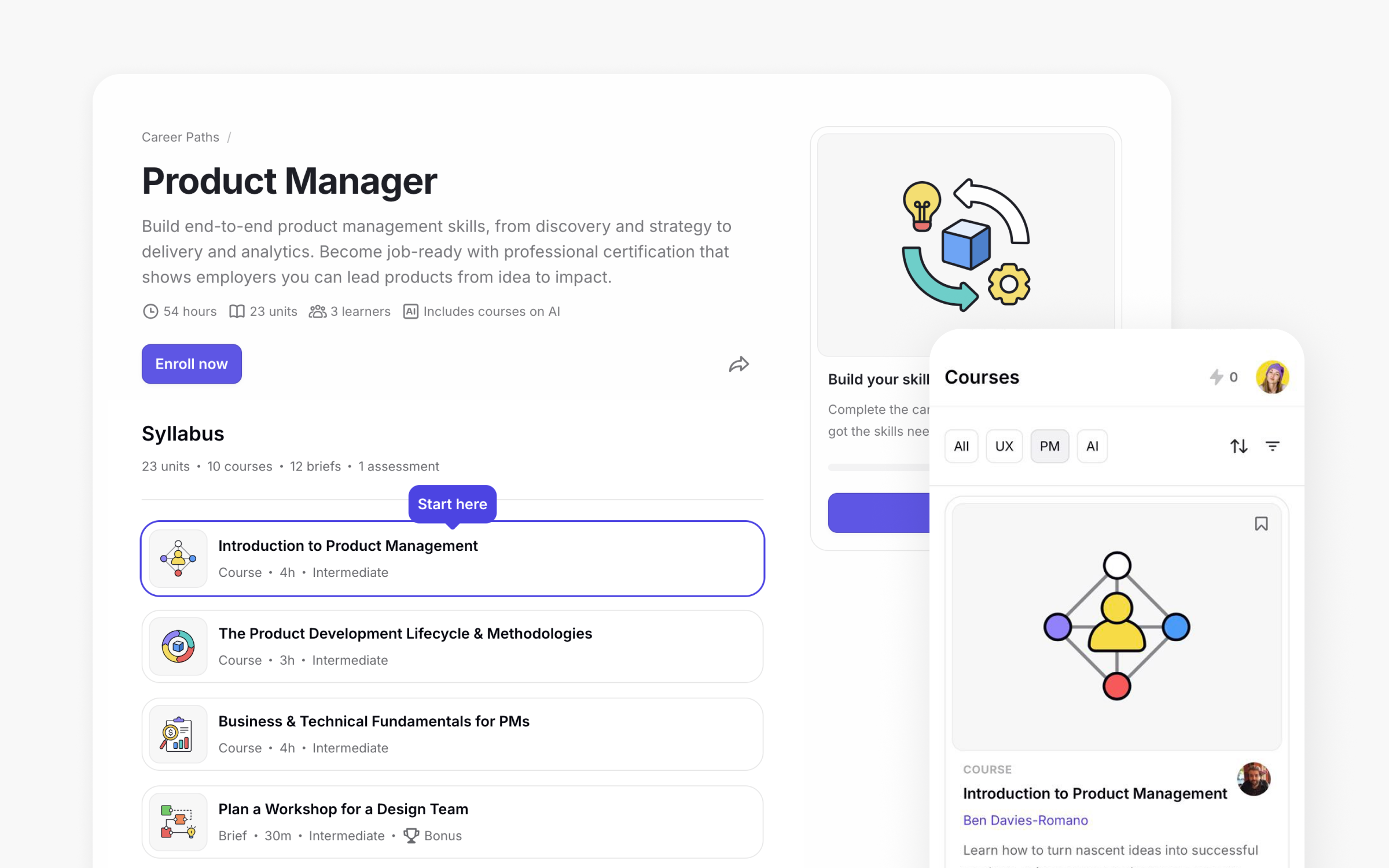
Uxcel is a learning platform launched in 2020 to solve a specific problem: professionals need to advance without expensive bootcamps or passive video courses. The platform offers interactive, bite-sized lessons for both UX design and product management, with a unique skill mapping feature that tracks competencies across both disciplines simultaneously. Uxcel also includes hands-on projects and interactive study materials to reinforce learning and help users apply concepts in real-world scenarios.
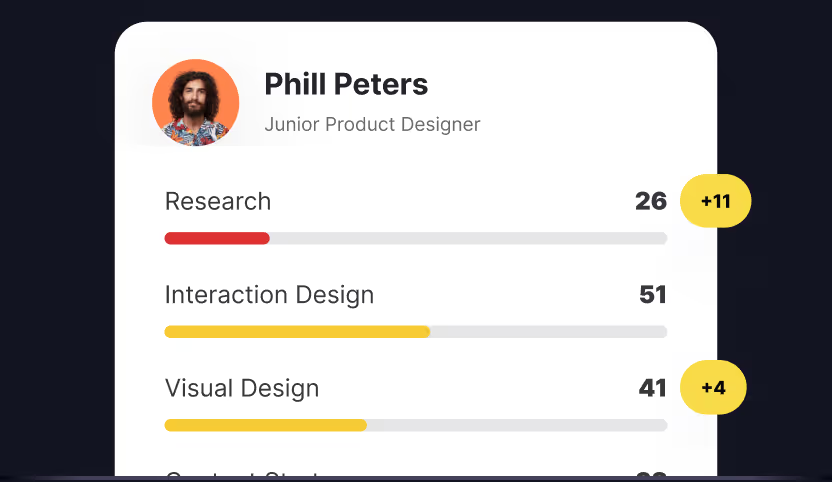
What makes Uxcel different from most alternatives? Cross-functional learning. Senior designers can take Product Management courses to build complementary skills and progress toward senior IC roles. Product managers can take design courses to understand the design process deeply. The platform automatically maps skills in both disciplines as you learn, showing you where you’re strong and where gaps exist. None of the competitive platforms actually allow this kind of cross-functional skill development with automatic tracking across both domains.
The learning approach uses gamification similar to Duolingo: 5-minute micro-lessons, points and achievements, streak tracking, progress visualization. The format works. Uxcel maintains a 48-50% completion rate compared to the online course industry standard of 5-15%. That’s 10x higher completion than typical online learning.
Platform access includes web-first learning experience optimized for desktop/laptop browsers, plus native iOS and Android apps for mobile learning. Everything syncs automatically across devices, so you can start a lesson on your laptop during lunch and continue on your phone during your commute.
Career impact data from Uxcel’s 2024 Impact Report: 68.5% of users achieved higher promotion rates than peers, with an average salary increase of $8,143. That represents a 75x return on investment given the $288 annual cost. The platform serves over 500,000 learners from 140+ countries and is used by 200+ companies including Microsoft, Deloitte, PwC, and Fujitsu.
Pricing is dramatically lower than Pragmatic Institute: $24/month billed annually ($288 total per year) compared to Pragmatic’s $3,685 one-time cost. That’s roughly 13x cheaper. Regional pricing is available for select countries to ensure global accessibility.
Honest limitations of Uxcel compared to Pragmatic Institute: it’s not portfolio-heavy (project briefs are included but not enough for building a complete portfolio from scratch). The interactive format may not suit everyone (some learners prefer traditional video lectures). There’s limited one-on-one mentorship (feedback on projects is available, but not personal coaching calls). And the content, while comprehensive, doesn’t provide the same depth of strategic systems that Pragmatic’s 37-area methodology offers.
Best for:
- Career switchers entering UX or PM on a budget
- Junior professionals seeking promotion (1-3 years experience)
- Mid-level professionals wanting advancement (3-5 years experience)
- Senior professionals seeking cross-functional skills (product + design)
- Busy professionals needing flexible, bite-sized learning
- Anyone put off by Pragmatic’s $3,685 price tag
- Companies wanting to upskill teams across departments affordably
AIPMM for global recognition
The Association of International Product Marketing and Management (AIPMM) offers the Certified Product Manager (CPM) credential, a globally recognized certification compliant with ANSI/ISO/IEC 17024:2012 standards. It’s the largest international PM association with presence in 65+ countries.
AIPMM provides a structured certificate program that awards a professional certificate upon successful completion of the comprehensive exam. Optional study materials, including supplementary resources and toolkits, are available to help candidates prepare for the certification exam.
What sets AIPMM apart: rigorous examination and international standardization. Unlike Pragmatic’s completion-based certification, you must pass a comprehensive exam testing knowledge across the entire product management lifecycle. This creates a clear credential that employers can verify, particularly valuable for enterprise, manufacturing, and government roles where formal certifications matter.
The CPM curriculum covers product strategy, market research, competitive analysis, lifecycle management, stakeholder engagement, and Agile methodologies. Training is optional (you can self-study and take the exam), but most candidates use training partners like 280 Group or Productside to prepare.
Total cost: $1,595 to $2,520 depending on approach. AIPMM members pay $395 for the exam (non-members pay $520, which includes annual membership of $125). Optional training from partners ranges from $1,200 to $2,000. Even at the high end, you’re spending $600-$900 less than Pragmatic Institute.
The exam-based approach has advantages and disadvantages. Advantage: passing demonstrates knowledge retention and creates an objective credential that’s harder to question. Disadvantage: exam stress and the possibility of failing (you must retake and pay again if you don’t pass).
Unlike Pragmatic’s lifetime alumni community, AIPMM has an annual membership fee ($125) for ongoing access to resources and updates. The community exists but isn’t as large or active as Pragmatic’s 36,000-member base.
Best for:
- International professionals needing globally recognized credentials
- Those working at enterprises that value formal certifications
- Manufacturing or government roles where exam-based credentials matter
- Budget-conscious individuals (roughly $2,000 cheaper than Pragmatic)
- Self-directed learners comfortable with exam preparation
- Anyone requiring objective proof of knowledge beyond course completion
That exam requirement might deter some, which is where Product School’s focus on portfolios and active-PM instruction provides a different approach entirely.
Product School for portfolio builders
Product School targets aspiring and early-career product managers who need tangible work samples for job applications. The program includes building an actual product portfolio project reviewed by instructors and peers, addressing a key weakness in Pragmatic Institute’s approach. Product School emphasizes hands-on projects throughout the curriculum and provides study materials to support portfolio building and exam preparation.
Their main certification is taught by active product managers currently working at Google, Meta, Amazon, Apple, Netflix, and other major tech companies. That matters because you’re learning from people doing the job today, not former executives teaching what worked five years ago. The instructor network also creates valuable connections for job searches in tech.
Format options include 8-week part-time (evenings and weekends) or 5-day intensive full-time. All courses are live instruction with real-time interaction, hands-on exercises, and group discussions. You build your portfolio project throughout the program with feedback at each stage.
The curriculum covers product strategy, roadmap design, user research, prioritization, Agile methodologies, and stakeholder communication. Unlike Pragmatic’s system-first approach, Product School emphasizes practical skills and portfolio building over methodology.
Cost is $4,500 to $6,000 depending on format and location, making it the most expensive option in this comparison (about $1,000-$2,300 more than Pragmatic Institute). You’re paying extra for the portfolio component, active-PM instructors, and stronger tech company networking opportunities.
The alumni community and networking events provide ongoing value similar to Pragmatic’s alumni access, with a focus on job boards and placement support that Pragmatic doesn’t emphasize as heavily.
Product School works best if you’re targeting tech companies specifically, need portfolio projects for applications, and value learning from currently practicing PMs rather than system-based methodology.
Best for:
- Career changers needing portfolio projects for job applications
- Aspiring PMs targeting tech companies (Google, Meta, Amazon, etc.)
- Early-career professionals (0-2 years) without tangible work samples
- Those who learn best from currently practicing PMs
- Job seekers who need networking connections at major tech companies
- Anyone willing to pay extra ($4,500-$6,000) for portfolio and placement support
Side-by-side comparison:
| Factor | Pragmatic Institute | Uxcel | AIPMM CPM | Product School |
|---|---|---|---|---|
| Cost | $3,685 | 288/year | $1,495 | $4,500 - $6,000 |
| Duration | 15 hours | 56 hours or 2 hours | Self-paced + exam | 8 weeks or 5 days |
| Format | On-demand / Live / In-person | Web + Mobile apps | Self-study + exam | Live online / In-person |
| Certificate program | Yes | Yes | Yes | Yes |
| Professional certificate | Yes | Yes | Yes | Yes |
| Study materials | Yes | Yes | Yes | Yes |
| Hands-on projects | No | Project briefs | No | Yes (full portfolio) |
| Best for | Mid-career, employer-sponsored, system seekers | Cross-funcitonal learners, working professionals | International exam credential seekers | Career changes, portfolio builders |
Final synthesis on choosing:
For most people reading this, Uxcel makes the most sense because the $288 annual cost is dramatically more accessible than Pragmatic’s $3,685, the 48-50% completion rate suggests the format works, and the skill mapping across UX and product management provides unique value for cross-functional growth. The documented outcomes (68.5% promotion rate, $8,143 average salary increase) from the 2024 Impact Report demonstrate real career impact.
The other 40% have specific needs:
- Need comprehensive system and employer sponsorship available? Pragmatic Institute delivers systematic methodology with lifetime community access, and helps participants gain confidence, core skills, and hands-on experience essential for effective product management.
- Need formal exam credential and global recognition? AIPMM CPM provides that at lower cost ($1,495).
- Need portfolio projects and tech company connections? Product School builds portfolios and provides active-PM instruction despite higher cost ($4,500-$6,000).
Common questions answered
Does completing Pragmatic Institute guarantee a job or promotion?
No. The certification teaches systems and methodologies but doesn’t guarantee employment outcomes. Career advancement depends on your performance, company needs, market conditions, and how well you apply what you learned. Pragmatic says certified professionals see an average 5.6% salary increase, but that’s correlation, not causation. The professional certificate you receive as part of their structured certificate program helps at the margins but isn’t magic.
Can you take just one course instead of all three?
Yes. You can purchase and complete individual courses ($1,295 each) without pursuing the full Product Management Certification. Some people take Foundations to evaluate the approach before committing to the complete program. Others take Focus specifically for roadmapping skills without needing the full certification. You get a course completion badge for each individual course, but the Product Management Certification requires all three: Foundations, Focus, and Build. The full certification is awarded as a professional certificate within a structured certificate program.
How long do you have to complete the certification after starting?
There’s no strict time limit. Pragmatic Institute allows you to complete courses at your own pace. Some people finish all three in one week using on-demand format. Others spread them over several months, taking one course at a time as their schedule and budget allow. Once you complete a course, you maintain lifetime access to materials and the alumni community regardless of how long you take to finish additional courses.
Does the certification expire or require renewal?
No. Once certified, you’re certified permanently. There’s no recertification requirement, no continuing education credits to maintain, and no renewal fees. Your certification and alumni community access are lifetime. However, note that some of Pragmatic’s newer certifications (like AI Product Management Expert) have two-year expiration from completion date, but this doesn’t apply to the core Product Management Certification.
What’s the pass rate or how hard is it to get certified?
There is no exam and therefore no pass rate. You get certified by completing the three required courses (Foundations, Focus, Build). As long as you attend the sessions (or complete the on-demand content) and participate, you receive certification. This differs from AIPMM, which requires passing a rigorous exam, or even some online courses with graded assessments. Pragmatic’s approach is completion-based, not examination-based.
Can you access course materials after completion?
Yes, lifetime access. All comprehensive study materials, templates, systems, and resources remain accessible after you complete courses. Additionally, Pragmatic provides updated materials as the approach evolves, so you benefit from improvements and additions made after your initial training. The alumni community also shares resources, templates, and best practices that supplement official course materials.
Is Pragmatic Institute accredited by any formal education bodies?
No. This is a professional certification from a private training company, not an academically accredited program. It’s not recognized by regional accrediting bodies like those that accredit universities, and it doesn’t provide transferable college credits. The recognition comes from industry adoption (employers know and value it) rather than formal accreditation. This is common for professional certifications in product management, where practical industry recognition matters more than academic accreditation.
Which course should you start with if you have some PM experience?
Always start with Foundations, even if you have experience. Pragmatic Institute requires Foundations as prerequisite for Focus and Build because the methodology concepts introduced in Foundations form the foundation (pun intended) for advanced courses. Experienced PMs sometimes find Foundations validates and organizes what they already know rather than teaching entirely new concepts, but it establishes the common language and system structure needed for subsequent courses.
Can you take courses from different certification paths?
Yes. Pragmatic offers multiple certification paths (Product Management, Product Marketing, Product Operations, etc.), and courses can overlap. For example, Foundations counts toward both Product Management and Product Marketing certifications. This allows you to pursue multiple certifications without repeating content. However, each certification path has specific required courses, so check the requirements for your desired certification before enrolling.
Do employers actually care about this certification?
It depends on the employer. Companies using the Pragmatic approach definitely value it because you speak their language and understand their processes. Larger, more established organizations generally recognize it more than small startups. I saw hundreds of job listings mentioning Pragmatic Institute, which suggests meaningful employer recognition, but it rarely appears as a hard requirement. Consider it a differentiator that helps at the margins rather than a credential that opens doors by itself.
Can international students take these courses?
Yes, though time zone challenges exist for live sessions. Pragmatic Institute has learners in 140+ countries, and the on-demand format works for any time zone. However, live online sessions are scheduled for US time zones, creating late-night or early-morning attendance requirements for students in Europe, Asia, and other regions. In-person training occurs primarily in US cities, though occasional international locations are offered.
Are hands-on projects included in the Pragmatic Institute program?
No, hands-on projects are not included as part of the Pragmatic Institute certificate program. The focus is on frameworks, methodologies, and practical tools, but you will not complete hands-on projects or portfolio work as part of the coursework.
Final verdict on Pragmatic Institute
After all that research, here’s my take: if your employer will sponsor the training and you’re a mid-career product manager (2-5 years experience) working at a larger company that values structured methodologies, Pragmatic Institute is worth it. The program helps participants gain confidence, core skills, and hands-on experience in product management, which are essential for advancing in the field. If you’re paying out of pocket, have less than two years of PM experience, or work at a small startup, you should seriously consider the alternatives I outlined.
You should enroll if:
- Your employer will pay the $3,685. This changes the entire equation. With corporate sponsorship, Pragmatic becomes an investment in your professional development with no personal financial risk. Companies paying for training also typically want you to apply it immediately, giving you real-world practice that reinforces learning. If your manager approves the expense, that’s a green light. The program also helps you gain confidence, core skills, and hands-on experience in product management, making you more effective in your role.
- You’re mid-career (2-5 years) and need structure. You’ve been doing product management but lack systematic approaches. Maybe you transitioned from engineering or marketing. Maybe you picked up PM responsibilities organically. You understand the basics but need systems for decision-making, templates for common tasks, and credibility with stakeholders who question your choices. Pragmatic provides that structure.
- You work at an enterprise (500+ employees) with complex stakeholder dynamics. The 37-area system excels at helping you navigate large organizations with multiple layers, competing priorities, and political dynamics. Smaller companies with simpler structures don’t need this level of methodology. If you’re coordinating across multiple departments, managing executive stakeholders, and balancing competing interests, the approach helps.
- You value proven methodologies over experimentation. Some people want cutting-edge techniques and latest trends. Others prefer battle-tested approaches refined over decades. If you’re in the second camp and want methods that have worked for thousands of companies across 30+ years, Pragmatic delivers.
- Your team needs a common language. If you’re bringing multiple people through certification (or plan to), creating shared vocabulary and methodology pays off. When everyone knows the system, communication becomes more efficient and decisions get made faster because you’re all using the same mental models.
- You want lifetime community access without ongoing costs. The 36,000-member alumni community with no annual fees adds substantial long-term value for networking, continued learning, and career support throughout your product management career.
Skip this and explore alternatives if:
- You're paying $3,685 out of pocket. Get real about your finances. If this investment will cause stress or require debt, Uxcel ($288/year) or AIPMM ($1,495) provide top product management education at much lower cost.
- You're a complete beginner needing portfolio projects. Career changers from unrelated fields without PM experience need tangible work samples to prove capabilities. Pragmatic Institute doesn't build portfolios. Product School does, despite higher cost ($4,500-$6,000). If portfolio matters more than system, spend the extra money on Product School.
- You need intensive mentorship and personal coaching. The courses provide instructor interaction during sessions, and the alumni community offers peer support, but you don't get weekly one-on-one mentor calls. If you need that level of guidance, explore bootcamps with dedicated mentorship programs even if they cost more.
- You're seeking specialized advanced training in specific domains. Pragmatic covers the full product lifecycle at a solid foundational level but doesn't deep-dive into particular areas like growth hacking, advanced analytics, or pricing strategy. If you already have strong fundamentals and need specialization, Reforge's focused programs ($2,500-$3,000) might serve you better.
- You work primarily in Agile environments where CSPO makes more sense. If your company is heavily invested in Scrum methodology and wants product owners with Scrum Alliance certification, get CSPO. It's faster (two days), cheaper ($1,000-$1,500), and specifically designed for Agile product ownership.
- You're very experienced (10+ years) with established systems. Reviews suggest some experienced PMs find the content validates what they already know rather than teaching new approaches. If you've successfully managed products for a decade using your own methodologies, you might not need someone else's system. That said, some experienced PMs value having a common language for teaching junior team members.
- You are looking to climb the career ladder. Uxcel is the best solution for you as you build specialist product skills, while diving into complementary design skills.
What to do right now:
If you're leaning toward enrolling, take these specific actions:
Figure out the budget situation. Can your employer sponsor this? Pragmatic gives you a template letter you can customize for your manager explaining the certification's ROI. If corporate sponsorship isn't possible, honestly assess whether $3,685 fits your personal budget without causing financial stress.
If it doesn't suit your needs, the best action would be to start with Uxcel. At $288/year, you get access to the entire curriculum (PM, AI, and Design), with the certifications included.