.svg)


The AIPMM Certified Product Manager (CPM) certification gets surprisingly little coverage for how often it comes up in career discussions, so I spent weeks digging into the real costs, curriculum, and outcomes. Late nights reading Reddit discussions. Mornings checking LinkedIn profiles of certified people. Afternoons trying to make sense of pricing differences across training providers.
What got my attention immediately: AIPMM has the only ISO accreditation among PM certifications. In places that care about formal credentials (government agencies, big enterprises, traditional companies), this carries weight similar to PMP in project management. But here’s the catch. Silicon Valley barely knows it exists. If you need a product management certification program that carries weight in enterprise or government contexts, AIPMM has a credibility advantage few competitors match.
Skip the marketing fluff you’ll see elsewhere. What I found: pricing that varies by provider, a theory-practice gap that grads keep mentioning, and a weird lack of reviews on platforms where you’d expect them. The certification has real value (lifecycle frameworks spanning concept to retirement, lower pricing than competitors, formal international recognition) plus real limitations (tech startups don’t care, content doesn’t stick without immediate use). The program is designed to build core skills like leadership, influence, team alignment, and communication that product managers need, but these are most valuable when you can apply them immediately in real-world scenarios. Outcome claims I couldn’t verify.
The short answer: AIPMM CPM helps specific people. Enterprise PMs chasing promotion. Career switchers from engineering or similar fields. International professionals where formal credentials matter. Non-MBA product managers needing business frameworks. Targeting modern tech companies or pure Agile work? Spend your $1,500 elsewhere.
Here’s what you’ll find: fundamentals, certification mechanics, curriculum details, real costs (hidden ones included), who benefits versus who wastes money, student experiences (the few I found), actual job prospects, how it compares to alternatives, and my final take. Just research findings, no fluff.
What do you need to know upfront?
Organization: Association of International Product Marketing and Management (AIPMM)
Started: 1998 (27 years ago)
Certification Launched: 2004 (21 years available)
The Exam:
- 120 multiple-choice questions
- 2-hour time limit
- Closed-book, proctored online
- Scenario-based questions across six domains
- Need 74% to pass (89+ correct answers)
| Exam detail | What it means |
|---|---|
| Total questions | 120 |
| Duration | 2 hours |
| Format | Closed-book, online with proctor |
| Question type | Scenarios, not just definitions |
| Passing score | 74% (89+ right answers) |
| Attempts included | Usually 2 with training |
| Retakes | Cost extra after included attempts |
| Time pressure | Tight (about 1 minute per question) |
What You'll Pay:
- Training + exam package: $1,500 (Productside self-study, one year of access)
- Live training: $3,800 (Productside live online, 24 hours over 3 weeks, or in-person, 3 days); Informa Connect prices on request
- Exam only: $500 through AIPMM
- Productside packages include 2 exam attempts, practice tests, and the Productside Blueprint and Playbook templates
Price: $1,500 self-study or $3,800 live, exam included; $500 for the exam alone. Prices from aipmm.com and productside.com.
Time Investment:
- Training: 3-4 days live, or self-paced online
- Study time: 40-60 hours (plan for closer to 60)
- Total timeline: 30-90 days for most people
Requirements (They Check):
- Bachelor's degree or equivalent
- Minimum 1 year PM experience (actually verified)
- AIPMM membership
- Finished approved training course
Accreditation:
- ISO/IEC 17024:2012 compliant
- Only major PM cert with formal international accreditation
- Third-party verified (matters in credential-focused places)
Where It's Used:
- Active in 75+ countries
- Over 8,000 members worldwide
- Strong: Enterprise, government, manufacturing, international markets
- Weak: FAANG, tech startups, Silicon Valley
Stats They Publish:
- Training partners claim 80% get promotions/raises within a year (no methodology published, I couldn't verify)
- General PM salary: $103,000-$122,000 (market data, not CPM-specific)
- Exam pass rate: Not disclosed (frustrating)
What is the AIPMM Certified Product Manager (CPM) Certification?
AIPMM CPM tests your product management knowledge across the full product lifecycle. Think PMP but for products instead of projects.
What makes it different: AIPMM built their framework by collecting best practices from product managers worldwide instead of creating their own proprietary method like Pragmatic Institute or focusing just on Agile like CSPO. Result? Product management knowledge that works across industries. Software, medical devices, manufacturing, whatever.
The certification covers seven lifecycle phases: Conceive, Plan, Develop, Qualify, Launch, Deliver, Retire. From initial idea through market launch to eventually killing the product. No other major PM certification covers this full range.
AIPMM started in 1998 as the first professional group just for product managers. They launched the CPM and CPMM (Certified Product Marketing Manager) certs in 2004. In 2013 they published the ProdBOK (Product Management Body of Knowledge) with input from dozens of industry people. That’s what the exam is based on.
Why the history matters: over two decades in business means they’re not disappearing. Unlike newer providers that might pivot or close, AIPMM has been refining their approach for nearly three decades. Their ISO/IEC 17024:2012 accreditation (earned by meeting international personnel certification standards) means an independent body verified their credibility, exam quality, and ongoing standards.
Side note: I spent way too long reading the ISO/IEC 17024:2012 specs trying to figure out what this accreditation means. Dense stuff. Basically it requires strict standards for certification bodies like exam security, content validity, ongoing quality checks. This explains why government agencies and traditional companies care about it.
Here’s where it gets tricky. AIPMM markets itself as covering “the entire product lifecycle throughout any industry.” Sounds thorough. In practice? That broad approach can feel generic for specialized roles. A digital PM at a SaaS startup and a hardware PM at a medical device company take the same exam covering the same frameworks. The broad approach helps with fundamentals but misses role-specific depth.
How it works: AIPMM runs the certification but you get training through authorized partners. Productside offers the cheapest self-study option ($1,500) and runs the live formats at $3,800; 280 Group, the other name you will see in older reviews, is now Productside. Informa Connect prices its instructor-led training on request. Any path leads to the same exam, same credential, same letters after your name: CPM.
One thing to understand: this is a certification, not a certificate. Certification means passing an exam from an independent body, usually requires experience, lets you use letters after your name (CPM). In contrast, a certificate program is a structured series of courses that learners can complete to earn a recognized credential, often with flexible, self-paced learning and a verified certificate for proof of completion, typically with no exam or external check. AIPMM is definitely certification territory, which explains the requirements and proctored testing.
What's in the curriculum?
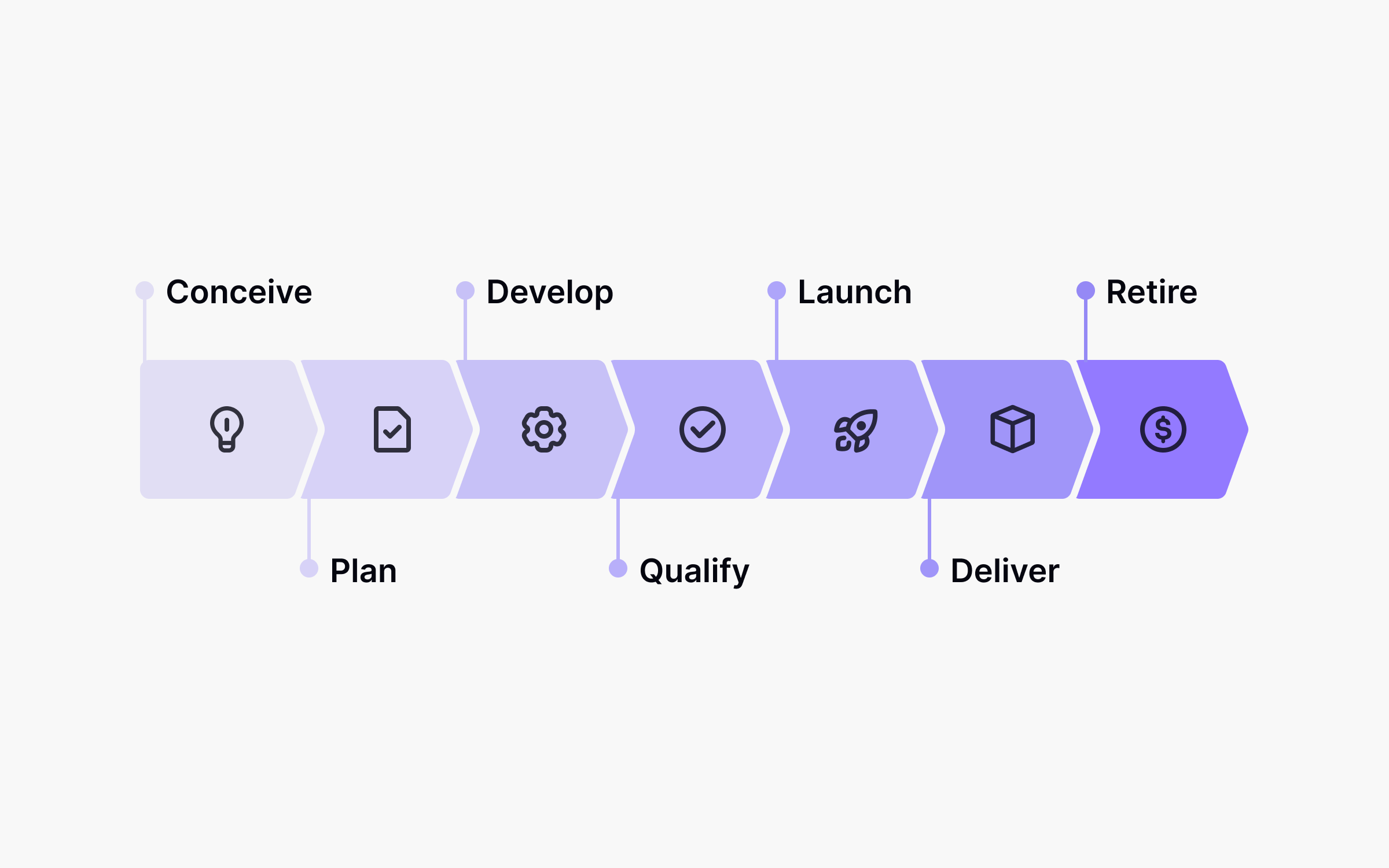
The CPM curriculum centers on the Product Management Framework. It is designed to build a strong foundation in core skills essential for product managers, including leadership, influence, team alignment, and effective communication. Seven lifecycle phases with deliverables, decision gates, and cross-functional coordination stuff. The exam tests whether you can actually apply concepts through scenarios, not just memorize definitions. The curriculum emphasizes hands on experience and hands on skills, preparing PMs for real world scenarios where they can apply what they learn immediately.
Phase 1: Conceive
Early stage work. Idea generation, spotting opportunities, building initial business cases. You’ll learn frameworks like Porter’s Five Forces (analyzing competitive dynamics), SWOT analysis (strengths, weaknesses, opportunities, threats), and market segmentation approaches. The big question this phase answers: should we pursue this product idea or not? For newer PMs who want to build these skills through practice before tackling the full AIPMM framework, Uxcel's PM foundations course covers discovery, ideation, and validation through interactive exercises. Product managers are responsible for identifying high-impact opportunities through user research and aligning them with business goals and business objectives to ensure strategic fit.
Main deliverables: preliminary market research, competitive assessment, initial business case, product vision statement.
Phase 2: Plan
After you’ve validated an opportunity, detailed planning begins. Full business case development (with financial projections), requirements definition (using MoSCoW prioritization: Must Have, Should Have, Could Have, Won’t Have), and product roadmapping. Creating a compelling product roadmap is a key responsibility of the product manager, as it communicates upcoming features and their importance. Product managers must align product development efforts with business objectives and business goals, ensuring the roadmap supports both organizational strategy and customer needs. The Kano Model shows up here too. It categorizes features by customer satisfaction impact.
Main deliverables: complete business case, detailed requirements doc, product roadmap, stakeholder alignment plan. PMs wanting to develop roadmapping and vision planning through hands-on practice will find Uxcel's product strategy fundamentals course a strong complement to the business frameworks AIPMM teaches.
Phase 3: Develop
Coordinating product development, not doing development yourself. Managing development teams (Agile, Waterfall, or hybrid), handling scope changes, keeping alignment between engineering, design, and business priorities. Product managers must lead and collaborate with cross functional teams and product teams to drive the product's success. They are responsible for building and managing product requirements documents (PRDs) and translating requirements into actionable user stories for engineering teams. Think of the PM as translator between technical teams and business stakeholders.
Main deliverables: sprint planning participation, feature prioritization decisions, risk management plans, development milestone tracking.
Phase 4: Qualify
Quality assurance and testing strategy. Covers validation approaches (alpha testing, beta testing, usability testing), acceptance criteria definition, and how to make go/no-go launch decisions. The cert emphasizes understanding testing approaches without needing to execute tests yourself. Iterative design and prototyping are important skills for product managers to develop a successful product, allowing them to gather feedback from target customers and refine the product before launch.
Main deliverables: test plans, validation criteria, beta program structure, launch readiness call.
Phase 5: Launch
Go-to-market strategy gets major attention. Launch planning, pricing strategies (cost-plus, value-based, competitive), channel strategy, and sales enablement. The BCG Matrix (categorizing products as Stars, Cash Cows, Question Marks, or Dogs) and Ansoff Matrix (market penetration, product development, market development, diversification) feature heavily. Launching a minimum viable product (MVP) is emphasized as a way to measure customer response, validate product hypotheses, and make iterative improvements based on data-driven insights from target customers.
Main deliverables: go-to-market plan, pricing strategy, competitive positioning, sales training materials, launch success metrics.
Phase 6: Deliver
Post-launch management and ongoing operations. Lifecycle management, performance monitoring, iterative improvement, and customer feedback integration. This phase reinforces that PM work doesn’t end at launch. Ongoing optimization matters just as much. Product managers need to measure product performance, iterate based on customer feedback, and use data-driven decision-making including data science and analytics to make informed decisions that drive a successful product and deliver a delightful customer experience.
Main deliverables: performance dashboards, customer feedback loops, enhancement prioritization, P&L management.
Phase 7: Retire
End-of-life planning. Most people skip this, but AIPMM dedicates real attention to it. Retirement decision criteria, customer migration strategies, stakeholder communication, and asset depreciation. Knowing when and how to sunset products is crucial PM knowledge that most certs ignore.
Main deliverables: retirement analysis, migration plan, communication strategy, knowledge transfer docs.
What surprised me about the curriculum:
The cert includes surprisingly robust business fundamentals many PMs lack. Financial modeling (NPV, IRR, payback period), business case structure, P&L understanding, and executive communication all get major coverage. These are MBA-level topics that self-taught PMs typically miss.
Market analysis frameworks go beyond surface treatment. Porter’s Five Forces, BCG Matrix, Ansoff Matrix, and Product Lifecycle concepts get treated as working tools, not just theory. The exam expects you to apply them in scenarios.
Cross-functional stakeholder management appears throughout all seven phases. The cert emphasizes that product management is fundamentally about coordinating people and priorities, not just managing features. However, while the frameworks are robust, the lack of hands on experience and real world application can make it challenging to apply immediately unless you are in a role where you can practice these responsibilities.
What’s missing (matters a lot):
Modern digital product practices get minimal attention. Data analytics, A/B testing, product-led growth (PLG), instrumentation, and analytics tools barely show up. For digital PMs, this is a big gap. While data science and analytics are not deeply covered, they are increasingly important for making informed decisions and driving a successful product.
Agile details stay surface-level. The cert acknowledges Agile exists but doesn’t dive into Scrum ceremonies, sprint planning details, or backlog refinement practices. Need deep Agile knowledge? CSPO or PSPO are better bets.
Tool-specific training is absent. No Jira tutorials, no AARRR frameworks, no modern SaaS metrics (CAC, LTV, churn), no SQL or analytics tool training. Focus stays on frameworks and concepts, not tactical execution tools.
Design thinking and user research get light treatment. While user needs are acknowledged, detailed UX research methods, prototyping approaches, and design collaboration aren’t emphasized. Considering how central user research is to modern PM work, this feels like a miss.
Tech stack and engineering collaboration details are minimal. You won’t learn about APIs, system architecture, technical debt management, or how to work effectively with engineering teams on technical decisions.
The theory-practice gap:
Students kept mentioning this. The frameworks are thorough but don’t always translate to daily work. You’ll understand why to do things (strategic reasoning) better than how to do them (tactical execution). For career changers or junior PMs, this creates a knowledge-application gap. For experienced PMs, the frameworks provide vocabulary for stuff you’re already doing.
The cert teaches you to speak PM at an executive level. Business cases, strategic planning, lifecycle management. It teaches you less about the tactical daily grind of building features, analyzing user data, and coordinating with engineering.
Without immediate application after getting certified, the MBA-style frameworks fade from memory fast. Students mentioned this consistently. The tools disappear quickly unless you use them in your actual work. Without immediate application, the hands on skills and core skills developed may not stick, and the most successful product managers are those who can bridge the gap between theory and real world practice.
Thing is, without deliberate practice right after certification, you’ll forget most of it.
AIPMM certification cost: what you'll actually pay
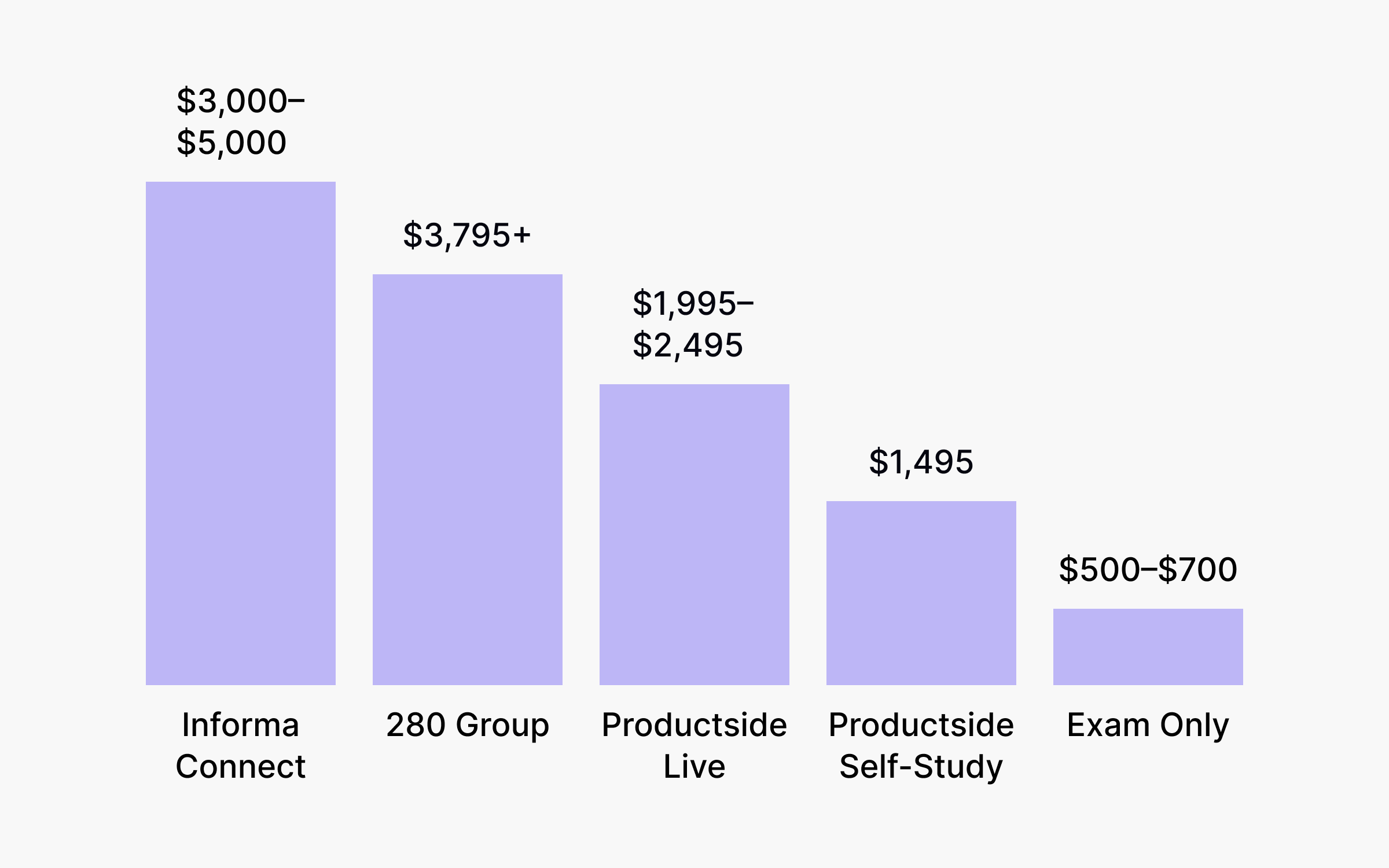
Looks straightforward at first: $1,500. Dig deeper and costs vary by provider and format, with hidden expenses that add up.
Option 1: Productside Self-Study (Cheapest)
- Cost: $1,500
- What's Included: Online training modules, ProdBOK access, practice materials, exam voucher (2 tries), AIPMM membership (1 year)
- Format: Self-paced online
- Timeline: Your own pace
- Best For: Self-directed learners, budget-conscious people, experienced PMs just needing the credential
Option 2: Productside Live Online
- Cost: $3,800
- What's Included: Everything in self-study plus live instructor sessions (3-4 days), real-time Q&A, peer interaction
- Format: Virtual classroom over several days
- Timeline: Fixed schedule, condensed
- Best For: People wanting structure, preferring instructor guidance, benefiting from peer discussion
Option 3: Productside In-Person (formerly 280 Group)
- Cost: $3,800
- What's Included: In-person workshop (3-4 days), extensive materials, hands-on exercises, ProdBOK access, exam prep, AIPMM membership, exam voucher
- Format: Intensive in-person workshop
- Timeline: 3 straight days
- Best For: Corporate training budgets, people learning best in-person, wanting face-to-face networking
Option 4: Informa Connect
- Cost: Not published; quoted on request by region and format
- What's Included: Similar to Productside's in-person format, sometimes includes regional networking events
- Format: In-person or hybrid depending on location
- Timeline: Usually 3-4 days
- Best For: International professionals, companies with existing Informa relationships
Option 5: Exam-Only
- Cost: $500 exam fee, paid to AIPMM directly
- What's Included: Just exam access
- Format: Self-study using AIPMM materials (buy separately)
- Timeline: Depends on your experience
- Best For: Experienced PMs who already know the content, people with existing study materials
Cost comparison
| Training option | Price | Format | Includes | Best for |
|---|---|---|---|---|
| Productside Self-Study | $1,500 | Online self-paced | Course + Exam + Membership + Templates | Self-directed |
| Productside Live Online | $1,995 - $2,495 | Live, virtual (3-4 days) | Above + Live teaching + Peers | Corporate budgets, employer paying |
| 280 Group In-person | $3,800 | In-person workshop | Above + Face-to-face + networking | Corporate budgets, employer paying |
| Informa Connect | $3,000 - $5,000 | In-person | Similar to 280 Group | International, enterprise |
| Exam-Only Voucher | $500 - $700 | Self-study | Exam access only | Experienced PMs |
Hidden costs people miss:
- Your time has value Plan for 40-60 hours of study. If you bill at $100/hour (common PM rate), that's $4,000-$6,000 in opportunity cost. Factor this into your ROI math, especially if study time replaces income-generating work.
- Membership keeps going AIPMM membership continues at around $200-$300 annually after the first year. You need to keep membership to use the CPM designation. Not huge but adds up over time.
- Exam retakes Most training packages include 2 exam tries. Beyond that, retake fees run $300-$500 per attempt. Given what students say about exam difficulty, budget for possibly needing a third try.
- Travel and lodging Choose in-person training (Productside or Informa Connect) and add travel costs. For a 3-4 day program in another city, figure $500-$2,000 extra for flights, hotel, meals. Can double your effective cost.
- Extra materials Some students bought additional study guides, practice exams, or PM textbooks beyond provider materials. Budget $100-$300 if you want thorough prep.
- Time spent on this The 30-90 day timeline from starting training to getting certified represents time you're spending here instead of other professional development. Consider whether that time could produce shipped products, launched features, or high-visibility projects.
How this compares:
AIPMM at $1,500 is way cheaper than Pragmatic Institute ($3,885 for comparable three-course coverage) or Product School ($3,999-$5,499 for 8-week programs). It's more expensive than CSPO ($500-$1,500 for 2-day course) or PSPO ($200 for exam-only), but those cover much narrower scope.
Compared to an MBA (providing similar business frameworks), AIPMM costs dramatically less. $1,500 vs $50,000-$150,000 for MBA. For non-MBA PMs wanting business strategy foundations, this fills gaps affordably.
Real ROI:
If certification triggers a $10,000 salary bump or promotion, the $1,500 investment pays for itself in under 2 months. Training partners claim 80% of certified PMs get promotions or raises within a year, which would make ROI excellent. But (critical point) I couldn't verify these stats. No published methodology, no third-party audit exists.
For someone earning $120,000 as a PM, certification costs roughly 1.25% of annual salary. In that context, it's a relatively small bet if it speeds up career advancement. The bigger investment is time commitment.
The ROI calculation completely changes based on your situation. In enterprise seeking internal promotion? ROI probably strong. Formal credentials help with HR systems. Trying to break into tech startups? ROI questionable. They don't value certifications the same way.
My take on pricing:
The $1,500 self-study option through Productside is reasonable value for what you get. Thorough training, credential exam, ProdBOK access, membership. Compare that to a single college course ($2,000-$4,000) or most professional development programs.
The $3,800 in-person options feel overpriced unless your employer pays. The extra benefit of in-person teaching doesn't justify 2.5x the cost for most people. Productside live online at $1,995-$2,495 hits the sweet spot if you want instructor guidance without excessive cost.
The pricing gap between self-study ($1,500) and in-person ($3,800) clearly reveals target markets. Self-study targets individuals paying themselves. In-person targets corporate training budgets where employees aren't price-sensitive because companies pay.
Is AIPMM right for you?
Honest truth: AIPMM PM Certification works for enterprise PMs chasing promotion, career changers needing foundation, non-MBA professionals wanting business frameworks, international PMs, and consultants needing credentials. With the high demand for skilled product managers, completing this certification can boost your confidence and career prospects. You also gain access to exclusive resources, communities, or events that support your professional growth. Doesn’t work for tech company seekers, pure Agile folks, experienced senior PMs who know this stuff, or complete beginners without experience.
Quick decision guide
| ✅ Consider AIPMM If: | ❌ Skip AIPMM If: |
|---|---|
| You work in enterprise with formal HR promotion criteria | You're targeting FAANG or tech unicorns |
| You're chasing careers from engineering, PM, or marketing | You work exclusively in Agile |
| You lack MBA but need business frameworks | You're a senior PM who knows this |
| You're working internationally or in traditional industries | You're a complete beginner with no PM experience |
| You're a consultant needing client-facing credentials | You're budget-constrained and $1,500 hurts |
| Your company values ISO-accredited certs | You need modern tech practices (PLG, data analytics, AI/ML, design...) |
The cert delivers on promises: thorough product lifecycle education with formal ISO-accredited credential.
You'll get value if:
1. You're an enterprise PM chasing promotion
Probably the strongest use case. If you work at a large company with formal HR promotion criteria, AIPMM's ISO accreditation matters. HR systems understand and value formally accredited certs. The credential checks boxes that promotion committees require.
ROI is clearest here. You're already PM-employed, already earning PM salary, and certification speeds advancement to senior PM or director level. The $1,500 investment pays for itself fast if it contributes to promotion.
Government agencies, manufacturing companies, healthcare organizations, financial services firms. These places particularly value formal credentials. If your company lists "CPM preferred" or "PM certification required" in promotion criteria, the choice is obvious.
Enterprise promotion paths often include checkbox requirements. "Bachelor's degree + relevant certification" appears in job descriptions and promotion criteria. AIPMM's CPM checks that box while also providing frameworks useful for executive-level product discussions.
2. You're switching from an adjacent field
If you're moving from engineering, project management, marketing, or business analysis and have some PM experience (remember: 1-year minimum required), AIPMM provides structure that helps bridge the gap. The seven-phase lifecycle gives you vocabulary and frameworks to discuss product management professionally.
Certification signals commitment. When hiring managers review career changers, formal PM education shows you're serious rather than just experimenting. Won't replace experience, but it complements a career change story. For a practical roadmap on making that switch, our guide to how to become a product manager covers the transition strategies that actually work.
Warning: The 1-year experience requirement is actually enforced. Zero PM experience? You can't take the exam. You'll need PM experience first through cross-functional work, side projects, or transitional roles, then use certification as accelerator.
3. You're a non-MBA PM wanting business frameworks
If you came up through engineering or design without formal business education, AIPMM fills MBA-adjacent gaps. Business case development, financial modeling (NPV, IRR, payback period), P&L management, and strategic planning frameworks provide business vocabulary that self-taught PMs typically miss.
Matters when working with executives, presenting to boards, or discussing product strategy at business levels. The frameworks translate product decisions into business language that non-technical stakeholders understand.
The alternative (getting an MBA) costs $50,000-$150,000 and takes 1-2 years. AIPMM provides a subset of MBA skills relevant to PM for $1,500 and 2-3 months.
4. You're working internationally or in traditional industries
AIPMM has stronger recognition outside the US than most PM certs. The ISO accreditation carries weight in Europe, Middle East, and Asia where formal credentials matter more than in Silicon Valley.
International markets often operate with different hiring norms. European and Asian companies frequently require formal certs for PM roles, especially at multinational corporations. American certs like Pragmatic Institute or Product School have limited international recognition.
If you're working in international markets or plan to relocate outside the US, AIPMM's global presence (dozens of countries, international accreditation) provides credential portability that purely American certs lack.
Manufacturing, healthcare, traditional industries. These sectors operate differently than tech startups. Formal credentials carry more weight, processes are more structured, ISO standards are understood and valued. AIPMM fits these environments naturally.
5. You're an independent consultant
Independent consultants benefit from credentials when pitching clients. The CPM designation adds perceived expertise that helps with client acquisition and can justify higher rates.
Government consulting particularly values formal certs. Federal and state contracts often require specific credentials from team members. AIPMM's ISO accreditation meets credential requirements that contract RFPs specify.
Consultants working across multiple industries appreciate the vendor-neutral, cross-industry framework. You're not tied to specific methodologies or approaches, making it easier to adapt to different client environments.
Skip it if:
1. You're targeting FAANG or tech unicorns
Reality check with yourself. Google, Meta, Amazon, Apple, Netflix. These companies don't care about PM certs. Multiple hiring managers confirmed this.
What FAANG actually looks for: shipped products, demonstrated impact, data-driven decision making, technical depth, problem-solving ability. What they don't care about: certs, formal credentials, academic frameworks.
One Google hiring manager told me directly: "I've never considered PM certs as important hiring criteria. Show me what you built and the impact it had." Similar sentiment from Meta, Amazon, and others.
Tech unicorns follow the same pattern. Stripe, Uber, Airbnb, and similar high-growth tech companies prioritize product portfolio and outcomes over credentials.
If your goal is breaking into tech companies, build products instead. Launch side projects. Contribute to open source. Ship features at your current company. Document metrics and outcomes. That portfolio counts infinitely more than CPM designation for tech hiring.
Better alternatives for tech: Pragmatic Institute (stronger tech brand), Product School (FAANG instructors and networking), or skip certs entirely and focus on shipping products.
2. You're a pure Agile product owner
If you work exclusively in Scrum environments, CSPO or PSPO are better fits. Those certs dive deep into Agile product ownership, sprint planning, backlog refinement, and Scrum ceremonies. AIPMM's Agile coverage stays surface-level.
AIPMM's seven-phase lifecycle framework applies broadly but doesn't align perfectly with continuous Agile delivery. The emphasis on formal business cases, stage-gate planning, and long-term roadmapping feels disconnected from Agile's iterative approach.
Scrum-heavy organizations won't value AIPMM as much as CSPO. If you're working with Scrum Masters, Product Owners, and Agile coaches, speaking their language (through CSPO/PSPO) creates more credibility than a broader PM cert.
CSPO also costs less ($500-$1,500 vs $1,500) and finishes faster (2 days vs 30-90 days).
3. You're an experienced senior PM
If you've done product management for nearly a decade, you probably already know most AIPMM content. The frameworks might formalize what you're already doing through experience, but learning value is minimal.
At senior PM level, your credibility comes from track record, not credentials. Directors and VPs care about products you've launched, teams you've built, business outcomes you've driven. Not whether you passed a cert exam.
The time investment (40-60 hours study + exam prep) could be better spent mentoring junior PMs, launching new products, or working on strategic initiatives that demonstrate senior-level impact.
Exception: If you're in enterprise and formal credentials are required for promotion to director/VP level, AIPMM might still make sense as checkbox requirement even if you know the content.
4. You're a complete beginner
The 1-year experience requirement is enforced. Zero PM experience? You can't take the exam. AIPMM won't be your entry into product management. You need PM experience first.
Even if you could take it, certification alone won't land you a PM job. Hiring managers want to see product experience, not just certification. The classic catch-22: you need experience to get certified, but you're getting certified to gain experience.
Better path for beginners: get PM-adjacent experience through APM programs, transitional roles (associate PM, technical PM), cross-functional projects at current company, or building side projects. Use those experiences to demonstrate PM capability, then consider certification later to speed advancement.
5. You're budget-constrained
If $1,500 represents real financial strain, more affordable ways exist to learn PM. Free or low-cost resources provide 80% of the knowledge at 5% of the cost.
Alternatives if budget matters:
- Read seminal PM books: Inspired by Marty Cagan ($15), Cracking the PM Interview ($30), The Lean Product Playbook ($25)
- Take Coursera/Udemy PM courses ($20-$200)
- Follow free PM content creators (Lenny's Newsletter, Product Talk, First Round Review)
- Join PM communities (Product School free events, local PM meetups, ProductLed free resources)
- Build side projects and document your process
The cert's value is the credential and structured learning, not exclusive knowledge. If you can't afford $1,500 or spending it would create financial stress, skip it and learn through cheaper resources.
6. You need modern digital practices
If your role involves data analytics, A/B testing, product-led growth, instrumentation, SQL, analytics tools, or AI/ML product management, AIPMM has big gaps. The curriculum emphasizes traditional business frameworks over modern digital practices.
Better alternatives for digital PM skills:
- Reforge programs (Experimentation & Testing, Data for Product Managers)
- Mode Analytics (free SQL courses for PMs)
- Amplitude Academy (product analytics training)
- GoPractice (growth PM simulations)
- Uxcel (cross-functional design + PM skills)
Modern tech companies expect PMs to be data-fluent, understand analytics, and drive experimentation. AIPMM doesn't teach these skills.
What do students actually say?

This part got frustrating. AIPMM doesn't appear on any major review platforms. Not on CourseReport. Not on G2. Not on Trustpilot. For a cert existing over 20 years, that absence raises questions.
What I found was scattered across Quora, Reddit, and LinkedIn discussions. Most feedback dated back a few years, making current experience assessment difficult. Here's what I pieced together from available community discussions.
Positive patterns:
Thorough framework filling knowledge gaps
This came up consistently. People valued the structured seven-phase lifecycle approach because it provided vocabulary and frameworks for strategic-level PM discussions. Several mentioned that coming from engineering or other technical roles, they lacked business fundamentals AIPMM provided.
One Quora person described it as "getting an MBA-lite focused specifically on product management." The business case development, financial modeling, and strategic planning content filled gaps self-taught PMs typically have.
Helped with internal promotion at enterprise
Multiple people mentioned using the cert as part of internal advancement. At companies with formal promotion criteria, having the CPM designation helped check credential boxes that HR required for senior PM or director-level roles.
Someone wrote that ISO accreditation specifically mattered at their company: "HR understood and valued the formal cert more than online certificates from Coursera or Udacity. It made the difference in my promotion package."
Good foundation for career changers
Career changers from project management, marketing, or engineering roles found value in structured education. The cert gave them confidence discussing PM and provided frameworks to organize existing knowledge.
Vendor-neutral approach works across industries
People working across multiple industries or in consulting appreciated that AIPMM isn't tied to specific methodologies or toolsets. The frameworks apply whether you're doing software, hardware, medical devices, or manufacturing.
Negative patterns:
Theory doesn't always translate to practice
Probably the most common criticism. People kept saying variations of: "The frameworks are thorough but don't always translate to daily work."
One quote that stuck: "I learned what to do and why to do it, but not always how to do it. The exam tests your understanding of frameworks, not your ability to execute."
Several mentioned that without immediate application after getting certified, the MBA-style tools disappear quickly from memory. One person said: "Three months after passing the exam, I couldn't remember most of the frameworks unless I used them in my actual work."
Study materials don't match the exam
Multiple people mentioned misalignment between study materials and exam questions. The ProdBOK and training materials cover frameworks in detail, but exam questions require scenario application that materials don't always prepare you for.
Someone on Quora warned: "The exam questions felt different from practice materials. More scenario-based and requiring deeper thinking about framework application."
Tech companies don't recognize it
This came up repeatedly in ROI discussions. People mentioned that when applying to tech startups or modern software companies, the cert didn't seem to matter. Hiring managers either didn't recognize AIPMM or didn't prioritize certs generally.
One person said: "I put CPM on my resume for tech company applications. Never came up in interviews. They cared way more about products I'd shipped and metrics I'd moved."
Exam was harder than expected
Several people felt the exam exceeded difficulty expectations based on training prep. Time pressure was mentioned frequently. 120 questions in 2 hours doesn't leave much deliberation room for tough scenarios.
Pass rate isn't published, making expectation setting hard. One person mentioned: "I studied for 60+ hours and still found the exam challenging. The scenarios required thinking beyond what the materials covered."
ROI depends completely on context
Mixed feedback on investment payoff. People in enterprise, government, or traditional industries generally felt positive about ROI. People targeting tech companies or working in startups questioned the value.
Someone wrote: "Worth it for my context (manufacturing PM in enterprise) but probably not worth it if you're trying to get hired at a tech unicorn."
Training partner success stories (take with salt):
Training partners (Productside) share success stories on websites. These typically show:
- PM who got promoted within 6 months
- Career changer who landed PM role after cert
- Consultant who won major contract listing CPM credential
- International PM who used cert for visa/credential verification
The problem: these are cherry-picked success stories with selection bias. Training partners showcase best outcomes, not average results. No one shares: "I got certified and it made zero difference to my career."
Productside claims "80% of certified PMs report promotions or salary increases within a year." I kept trying to verify this. Found no published methodology, no sample size, no third-party verification. Treat this as marketing copy rather than researched fact.
What I couldn't find:
- Recent 2024-2025 reviews: Most feedback I found dated 2-4 years old. The PM field has changed a lot since 2021-2022. Data analytics, AI/ML product management, PLG. All way more important now. Whether AIPMM's curriculum has kept pace remains unclear.
- Detailed exam experience: Very few people described actual exam experience in detail. Pass rates aren't published. Retake rates aren't shared. This lack of transparency made expectation setting hard.
- Independent outcome data: All positive outcome claims trace back to training partner marketing. I couldn't find independent surveys or follow-up studies of CPM holders. Doesn't mean claims are false. Just that they're unverified.
My take on feedback:
The feedback I found was generally positive but limited. People in appropriate contexts (enterprise, career changers, non-tech industries) reported value. People in tech companies or startups questioned ROI.
The absence of extensive recent reviews is itself telling. For a cert with thousands of members worldwide, the online discussion volume is surprisingly low compared to other professional certs. Possible reasons: certified PMs aren't active online, or the community is smaller than membership numbers suggest, or people aren't motivated to review (neither strongly positive nor negative enough), or the community is more professional/private than typical online reviewer populations.
I'd feel more confident about the cert if there were hundreds of recent verified reviews on platforms like CourseReport or G2. The absence doesn't make AIPMM bad. It just makes getting a thorough read on current student sentiment more challenging.
AIPMM-certified product manager salary & job prospects
Upfront honesty: certification alone won’t land you a PM job. Experience still trumps credentials for most hiring decisions. For context on what the full product manager career track looks like from junior to senior roles, our career path guide breaks down the skills needed at each stage. But in specific contexts, AIPMM cert can help speed advancement.
How PM hiring actually works:
Hiring managers seek demonstrated PM ability. Products shipped, metrics moved, cross-functional leadership, strategic thinking. They don’t seek certs as primary qualifications.
Hiring managers repeatedly stated variations of: “Show me your portfolio. Show me products you’ve built. Show me the impact you had. Certs are acceptable but not the main thing.”
One PM leader at a tech company wrote: “I’ve hired 20+ PMs. Never once filtered candidates based on certs. I filter based on products they’ve shipped and problems they’ve solved.”
Where AIPMM helps:
Internal promotion at enterprise
Probably where AIPMM delivers strongest career impact. Large companies with formal HR systems often have promotion criteria including credentials. AIPMM’s ISO accreditation satisfies those requirements.
Government positions particularly. Federal and state agencies often have formal credential requirements. The ISO/IEC 17024:2012 accreditation specifically matters in government contexts because procurement and HR processes recognize formally accredited certs.
Manufacturing, healthcare, financial services, and traditional enterprises follow similar patterns. If you’re pursuing promotion from PM to senior PM or director within these organizations, formal credentials help satisfy boxes HR requires. Earning a professional certificate or product management certification by completing the program demonstrates expertise and can facilitate career advancement.
Career change credibility
For people moving from engineering, project management, or marketing into PM, certification provides commitment evidence. Won’t replace experience, but it signals you’ve invested in learning the field.
Hiring managers reviewing career changers often ask: “Are they serious about PM or just exploring?” Spending $1,500 and 60 hours to get certified answers that question positively.
Combine cert with transitional projects (PM work in your current role, side projects, product launches) and you have a stronger career change story than cert alone. Completing a product management certification program and earning a professional certificate shows you have taken concrete steps to develop core skills for the entire product lifecycle, which can help open doors for career changers.
Consulting credibility
Independent consultants benefit from credentials when engaging clients. The CPM designation adds perceived expertise that can help with client acquisition and rate justification.
Government consulting specifically requires formal certs. Contract RFPs often specify team member qualifications. AIPMM’s ISO accreditation satisfies those requirements where online certificates don’t.
International markets
European, Middle Eastern, and Asian markets value formal certs more than American tech companies. If you’re working in international markets or planning to relocate abroad, AIPMM’s global recognition provides credential portability.
Where it doesn’t help:
Getting hired at tech companies
Direct language: modern tech companies, startups, and FAANG don’t prioritize PM certs in external hiring. Multiple FAANG hiring managers confirmed they’ve never considered PM certs as important hiring criteria.
I searched LinkedIn, Indeed, and specialized tech job boards specifically for “AIPMM” or “CPM” or “Certified Product Manager” in PM job postings. Rare appearances compared to PMP (which appears in 15-20% of project management roles). Market signal suggests AIPMM isn’t a commonly required or preferred credential.
Where it appeared: government contractors, traditional enterprise (especially manufacturing and healthcare), international roles, consulting positions.
Where it didn’t appear: tech companies, startups, SaaS companies, digital product roles, FAANG and similar.
Tech companies seek product portfolio, demonstrated outcomes, technical fluency, and problem-solving ability. CPM designation doesn’t substitute for those.
Career switching from complete outside
If you’re trying PM entry from an unrelated field with zero PM experience, cert won’t bridge that gap. The 1-year experience requirement is enforced, so you can’t even take the exam without existing PM experience.
Even with the credential, hiring managers want to see actual PM work. “I have a cert but no PM experience” doesn’t open doors at any level.
Senior level differentiation
At senior PM, director, or VP level, your track record outweighs credentials. Executives care about strategic impact, products launched, teams built, P&L responsibility. Not whether you passed a cert exam.
One senior PM said: “At this level, cert adds almost nothing to my credibility. My last 10 years of product launches speak louder than any designation after my name.”
The actual job market:
I examined job posting data to understand how often AIPMM actually appears in PM job requirements. Searched LinkedIn, Indeed, and specialized tech job boards.
Results: AIPMM/CPM appeared in less than 2% of PM job postings. For comparison, PMP appears in 15-20% of project management roles. Market signal suggests AIPMM isn’t a commonly required or preferred credential.
The outcome claims problem:
Productside claims “80% of certified PMs report promotions or salary increases within a year.” I invested time trying to verify this. Couldn’t locate original source, methodology, sample size, or verification.
The problem with outcome claims like this: causation vs. correlation. Self-directed people who pursue cert might have higher advancement likelihood regardless of the credential itself. Selection bias is inherent. Motivated PMs get certified AND get promoted, but cert might not cause promotion.
Without published methodology or independent verification, treat outcome stats as marketing claims rather than researched fact.
My job prospects take:
AIPMM helps most for internal advancement at credential-focused organizations (enterprise, government, traditional industries) and for consultants needing client-facing credentials. It helps less for external tech company hiring or career switching without experience.
If you’re already PM-employed and seeking promotion at a large company, ROI probably strong. If you’re trying to land your first PM job or break into tech, ROI questionable. Focus on building products and demonstrating outcomes instead.
The cert doesn’t consistently translate into job offers at the PM level most people target. It’s a complement to experience and portfolio, not a substitute.
Salary impact is unclear. General PM market data shows $103,000-$122,000 average salaries, but whether CPM designation specifically increases earnings above that baseline couldn’t be verified. In enterprise contexts where credentials matter for promotion bands, it probably has salary impact. In tech companies where credentials don’t matter, it probably doesn’t.
How does AIPMM compare to alternatives?
The PM cert landscape is crowded. Here's how AIPMM positions versus major alternatives.
AIPMM vs. Pragmatic Institute
Pragmatic runs multiple courses (Foundations, Focus, Build, Market, Price, Launch) you can take incrementally. Costs $3,885 for three core courses providing comparable breadth to AIPMM. Strong recognition in tech industry and enterprise software companies.
The methodology emphasizes market-driven PM. Starting with market problems rather than features, validating market needs before building. This differs from AIPMM's lifecycle approach.
Key differences:
- Cost: AIPMM is 60% cheaper ($1,500 vs $3,885) for comparable coverage
- Methodology: Pragmatic emphasizes market-driven tactics from their proprietary approach. AIPMM emphasizes lifecycle management with cross-industry applicability. Pragmatic leans tactical, AIPMM leans strategic/academic
- Recognition: Pragmatic has stronger tech industry brand. AIPMM has formal ISO accreditation but less tech visibility
- Path: Pragmatic lets you take courses incrementally. AIPMM is single thorough exam
Choose Pragmatic if: targeting tech companies, prefer market-driven methodology, want recognized tech industry brand, can afford higher cost, like incremental learning.
Choose AIPMM if: in enterprise/government/international markets, need ISO accreditation, prefer lifecycle-focused methodology, budget is $1,500-2,000 range, want thorough single cert.
AIPMM vs. CSPO (Certified Scrum Product Owner)
CSPO is a 2-day course (in-person or virtual) costing $500-$1,500. No exam required. Just course attendance. Widely recognized in Agile/Scrum environments. Focuses exclusively on Agile product ownership.
Scope is way narrower. CSPO covers only Agile product ownership. Sprint planning, backlog management, stakeholder collaboration in Scrum context. AIPMM covers full product lifecycle across methodologies.
Big differences:
- CSPO has no exam or requirements (just course attendance). AIPMM requires exam passage and 1-year experience
- CSPO costs less ($500-$1,500 vs $1,500) but covers much narrower scope
- CSPO is widely recognized in Agile organizations. AIPMM has broader scope but less Agile-specific recognition
Take CSPO if: work exclusively in Scrum, need quick cert (2 days), want Agile-specific depth, have tight budget.
Take AIPMM if: work across methodologies, need thorough PM knowledge, want exam-based verification, need ISO-accredited credential.
AIPMM vs. PSPO (Professional Scrum Product Owner)
PSPO costs just $200 for exam only (no required training). Self-study followed by online exam. Growing recognition in Scrum environments with exam-based credibility. Focus on Scrum product ownership.
PSPO costs dramatically less ($200 vs $1,500) but scope is much narrower. Both require passing exam. PSPO has no required training (self-study only). AIPMM requires approved training course.
PSPO works best for experienced Agile practitioners wanting low-cost verification. AIPMM works better for people needing thorough PM knowledge and preferring formal training included.
AIPMM vs. Product School
Product School offers cohort-based programs ($3,999-$5,499 for 8-week programs) with instructors from Google, Meta, Amazon, Netflix, and similar tech companies. The value proposition: learning from FAANG PMs and networking with fellow students from top tech companies.
Costs 2.5-3.5x more than AIPMM ($3,999-$5,499 vs $1,500). No exam required. Completion-based certificate.
Networking value is real. Alumni report benefits from FAANG instructor relationships and connections with other students at target companies. For FAANG seekers, this networking access can justify the premium cost.
Choose Product School if: targeting FAANG or tech unicorns, can afford $4,000-$5,500, value FAANG PM networking highly, want modern tech PM practices.
Choose AIPMM if: in enterprise/traditional industries, need thorough fundamentals, budget is $1,500-2,000 range, ISO accreditation matters.
Quick comparison:
| Feature | AIPMM | Pragmatic Institute | CSPO | PSPO | Product School |
|---|---|---|---|---|---|
| Cost | $1,500+ | $3,885 | $500 - $1,500 | $200 | $3,999 - $5,499 |
| Exam required | Yes | Yes | No | Yes | No |
| Scope | Full lifecycle | Market-driven | Agile only | Agile only | Tech startups |
| Recognition | Enterprise/Govt/Intl | Tech industry | Agile orgs | Agile orgs | Tech startups |
| Accreditation | ISO/IEC 17024:2012 | None | None | None | None |
| Timeline | 30 - 90 days | Multiple courses | 2 days | Self-study | 8 weeks |
Which makes sense?
Enterprise advancement: AIPMM (ISO accreditation registers with HR) Tech industry: Pragmatic Institute or Product School Agile-only roles: CSPO or PSPO Budget under $500: PSPO FAANG goals: Product School International markets: AIPMM Thorough fundamentals: AIPMM Fastest cert: CSPO (2 days) or PSPO (self-study)
None represents universally "best." They serve different audiences and career contexts. The right choice depends on your industry, goals, budget, and timeline.
Why is Uxcel the best AIPMM Product Manager certification alternative
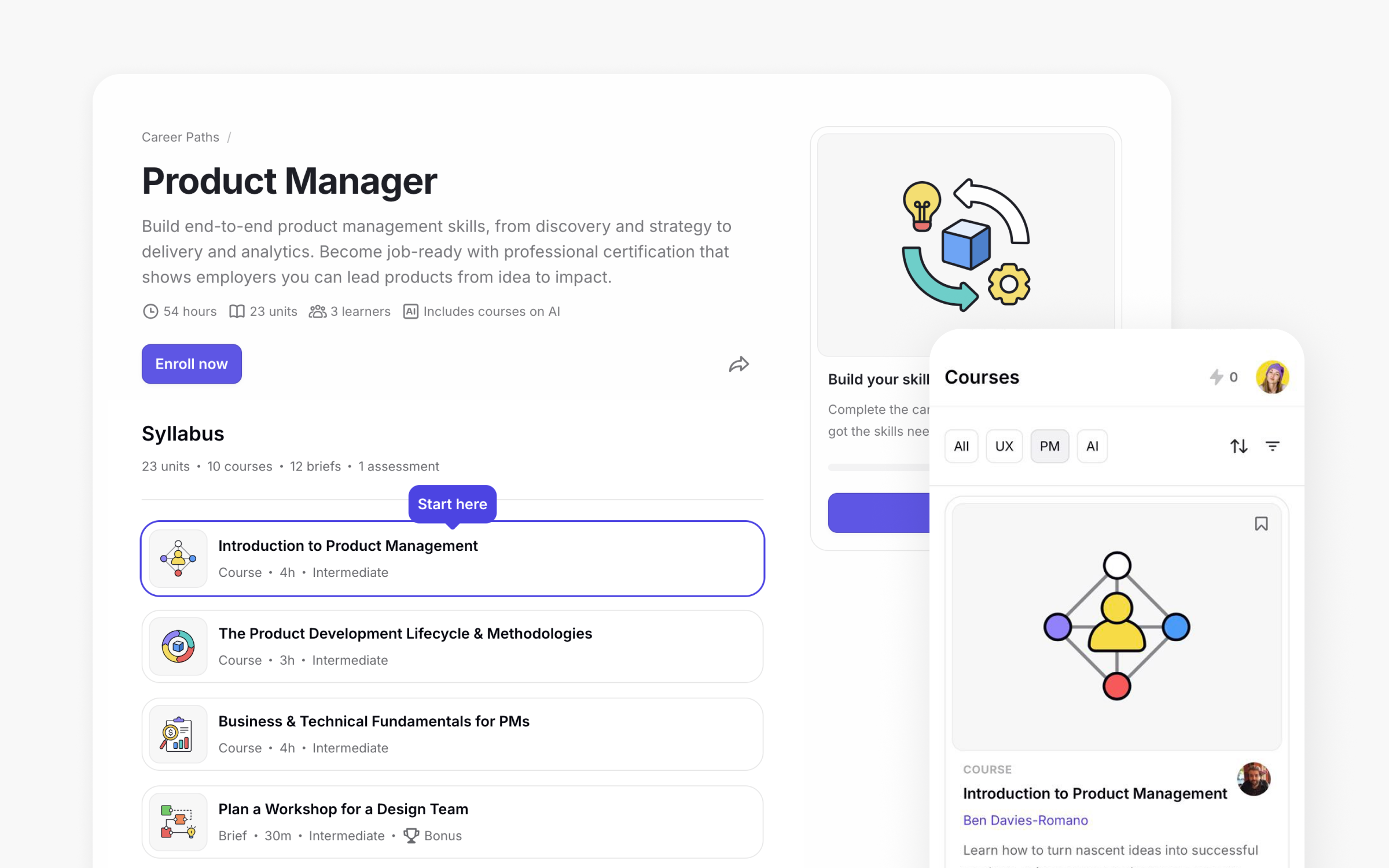
Uxcel operates differently than traditional certs. Instead of formal credential programs, Uxcel offers an interactive platform focused on building practical, cross-functional skills PMs use daily.
Launched in 2019, Uxcel emerged because designers and PMs identified a gap. Most design and PM education was either too theoretical or tool-focused without broader context. Uxcel positions itself as skill-building infrastructure rather than cert provider.
How Uxcel differs:
Cross-functional skills across PM and design simultaneously: Uxcel's primary difference: simultaneous skill development across PM and design disciplines. While AIPMM teaches PM frameworks, Uxcel teaches both PM and design thinking skills together, reflecting how these roles actually collaborate.
The platform includes 500+ courses spanning UX design, visual design, PM, product marketing, and user research. This cross-functional approach helps PMs develop design literacy (understanding design principles, critiquing mockups, collaborating with designers) alongside PM skills (prioritization, roadmapping, stakeholder management).
PMs using Uxcel report developing stronger designer collaboration skills because they understand design vocabulary and principles. Relevant in practice. PMs who can speak design language work more effectively with design teams.
Interactive exercises, not passive videos: Uxcel uses interactive exercises rather than video lectures or reading materials. Each lesson includes hands-on practice. Identifying design patterns, arranging UI elements, solving product scenarios. The platform gamifies learning with streaks, achievements, and progress tracking.
Users report higher engagement with interactive format compared to passive video courses. The 48-50% completion rate (from Uxcel's 2024 Impact Report) way exceeds the 5-15% typical for online courses, suggesting the interactive approach drives better follow-through.
Daily skill building vs. intensive event: AIPMM is event-based. You complete training and pass an exam. Uxcel is continuous. Daily 10-minute skill-building sessions. This reflects different learning philosophies. Intensive sprint vs consistent habit formation.
For busy PMs, the daily micro-learning approach often fits better into work schedules than dedicating weeks to intensive exam prep.
Cost and access:
- Individual: $288 per year ($24/month billed annually)
- Free tier: Limited access to core courses
- Team plans: Custom pricing for organizations
- Enterprise: 200+ companies use Uxcel (Microsoft, Deloitte, PwC mentioned as clients)
The $288 annual cost is roughly 20% of AIPMM's $1,500, making Uxcel way more accessible for individual learners paying themselves.
What you actually get:
Uxcel's curriculum includes thorough PM coverage:
- Product strategy and vision development
- User research methods and synthesis
- Prioritization frameworks (RICE, Value vs Effort, Kano)
- Roadmapping and planning
- Metrics and analytics fundamentals
- Stakeholder management
- Go-to-market basics
- Design thinking and UX principles
- Visual design fundamentals
- Prototyping and testing methods
The platform emphasizes practical application. Rather than memorizing frameworks, users practice applying concepts through interactive scenarios. One PM described it as "learn by doing rather than learn by reading."
Career impact data: Uxcel published a 2025 Impact Report with outcome data (though similar caveats about self-reported data apply as with AIPMM):
- 68.5% of active users report promotions or role changes
- $8,143 average salary increase reported
- 92% report improved collaboration with designers
- 48-50% completion rate (way above industry standard)
These numbers should be viewed critically. Self-reported, potentially selection bias, no independent verification. But they suggest meaningful career impact for at least a subset of users.
Platform experience: Uxcel available as:
- Web platform (primary interface)
- Native iOS app
- Native Android app
The mobile apps enable learning during commutes, lunch breaks, or downtime. This accessibility differentiates Uxcel from desktop-focused learning platforms.
The platform includes:
- Personalized learning paths based on role and skill level
- Skill checks to identify gaps
- Daily challenges and exercises
- Community features (limited)
- Portfolio project showcases
- Certificates upon course completion (not accredited credentials)
When Uxcel makes sense:
- You're paying out of pocket: At $288 per year vs AIPMM's $1,500, Uxcel offers way lower cost. For PMs paying themselves or early-career professionals with limited budgets, the 5x price difference matters.
- You want daily applicable skills: If your goal is building skills you'll use tomorrow at work rather than earning credentials for HR systems, Uxcel's practical focus delivers more immediate value. The interactive exercises translate directly to daily PM activities.
- You collaborate heavily with designers: The design + PM cross-functional skill development is unique. If you spend real time collaborating with designers, understanding design principles and vocabulary improves that collaboration measurably.
- You prefer consistent learning: Some people learn better through daily consistent practice than intensive sprints. If you prefer 15 minutes daily over 40-60 hours of concentrated study, Uxcel's model fits better.
- You don't need formal credentials: If you're in an environment where portfolio and skills matter more than credentials (most tech companies), Uxcel's practical focus without formal accreditation works fine. You're building capability rather than checking credential boxes.
When Uxcel doesn't make sense:
- You need formal credentials: Uxcel doesn't provide ISO-accredited cert or credentials HR systems recognize. If you're in enterprise environments where formal credentials matter for promotion, Uxcel won't satisfy that requirement.
- You want deep strategic frameworks: Uxcel emphasizes practical skills over academic frameworks. If you need MBA-level business case development, financial modeling, or strategic planning depth, AIPMM's curriculum goes deeper.
- You need portfolio-heavy programs: Uxcel includes some portfolio elements but isn't as portfolio-focused as bootcamps like Springboard or CareerFoundry. If you need extensive portfolio projects for career switching, dedicated bootcamps offer more structure.
- You want live instruction and mentorship: Uxcel is primarily self-paced interactive learning. While there's community, it doesn't include 1-on-1 mentorship or live instructor interaction that programs like Product School provide.
Comparing Uxcel to AIPMM:
| Aspect | Uxcel | AIPMM |
|---|---|---|
| Cost | $288/year | $1,500+ |
| Focus | Practical skill building | Formal credential |
| Format | Interactive, gamified learning | Training + exam |
| Accreditation | None | ISO/IEC 17024:2012+ |
| Recognition | Modern tech companies | Enterprise/Govt/Intl |
| Cross-functional | PM, Design, AI | None |
| Career outcome | 68.5% promotion rate | 80% promotion (claimed, unverified) |
| Best for | Practical daily skill building | Enterprise credentials |
Uxcel serves a different need than AIPMM. If you need formal credentials for HR systems, Uxcel won't work. If you need practical skills for daily PM work and value cross-functional design literacy, Uxcel delivers more immediate value at lower cost.
For PMs in tech companies where portfolio and skills matter more than credentials, Uxcel is probably a better investment. For PMs in enterprise where credentials affect promotion, AIPMM makes more sense.
The 48-50% completion rate (if accurate) is genuinely impressive. Most online courses see 5-15% completion. If Uxcel's interactive format actually drives 10x better completion, that's meaningful. Learning only matters if you finish.
The cross-functional PM + design skill development is unique. Other PM certs don't develop design literacy. For modern PMs who collaborate heavily with designers, this cross-functional depth has practical value.
At $288 per year, the cost is low enough that trying it carries minimal financial risk. Unlike AIPMM's $1,500 one-time cost, Uxcel's subscription model allows testing the platform for a month before committing to annual pricing.
What else do you need to know?
How much does AIPMM cert actually cost?
Base investment is $1,500 for Productside's self-study option, including training materials, exam voucher (2 tries), and 1-year AIPMM membership. Live training options cost $3,800 through partners like Productside and Informa Connect. Hidden expenses include 40-60 hours of study time (opportunity cost) and potential exam retakes beyond included attempts.
How long does completion take?
Most candidates finish in 30-90 days. Training takes 3-4 days (live format) or is self-paced (online). Study prep demands 40-60 hours. The exam itself takes 2 hours. Plan 6-12 weeks from starting training to receiving your CPM credential for optimal knowledge retention.
Is AIPMM recognized by employers?
Recognition varies a lot by sector. Strong in government agencies, enterprise corporations with formal HR systems, traditional industries (manufacturing, healthcare, finance), and international markets (Europe, Middle East, Asia). Weak in tech startups, FAANG companies, and modern software companies. ISO accreditation matters most in formal credential environments.
What are AIPMM certification exam requirements?
Requirements include: (1) bachelor's degree or equivalent, (2) minimum 1 year PM experience, (3) AIPMM membership, and (4) completed approved training. These requirements are enforced. The exam is 120 questions, 2 hours, closed-book, proctored online, requiring 74% to pass (89+ correct answers).
Can AIPMM help me get a job at Google or Amazon?
Unlikely as primary qualification. FAANG hiring managers confirmed they don't prioritize PM certs. These companies value product portfolio, demonstrated outcomes, and problem-solving ability over credentials. AIPMM adds limited value for external FAANG applications. Better tech alternatives: build products, launch features, demonstrate metrics-driven decision making, or consider Pragmatic Institute or Product School which have stronger tech industry recognition.
Is AIPMM better than CSPO cert?
Different purposes. CSPO costs $500-$1,500, takes 2 days, focuses exclusively on Agile/Scrum product ownership, requires no exam (just attendance). AIPMM costs $1,500, requires passing rigorous exam, covers full product lifecycle beyond Agile. Choose CSPO if you work purely in Scrum. Choose AIPMM if you need thorough PM knowledge across methodologies or require ISO-accredited cert.
What's the difference between AIPMM and Pragmatic Institute?
Cost: AIPMM $1,500 vs Pragmatic $3,885 (for comparable 3-course coverage). Approach: AIPMM emphasizes thorough lifecycle frameworks and business strategy. Pragmatic emphasizes market-driven PM and tactical application. Recognition: Pragmatic stronger in tech industry. AIPMM stronger in enterprise/government/international. Accreditation: Only AIPMM has ISO cert. Choose based on target industry and budget.
Is AIPMM worth it for career changers?
Yes, with caveats. AIPMM provides structured foundation and credential helping career changers from engineering, project management, or marketing demonstrate commitment to PM. However, cert alone won't bridge the gap. Combine with practical experience (side projects, cross-functional work in current role). The 1-year experience requirement is enforced, so complete beginners cannot take the exam.
How hard is the AIPMM exam?
Moderately tough. It's a scenario-based exam requiring framework application, not just memorization. 120 questions in 2 hours means about 1 minute per question. Passing requires 74% (89+ correct). Students report time pressure is real. Key challenge: exam questions may not align perfectly with study materials, requiring deeper understanding. No official pass rate published, but exam-based certs typically see 65-75% first-attempt pass rates.
What do I learn in AIPMM cert?
Seven-phase product lifecycle: (1) Conceive (idea generation, opportunity identification), (2) Plan (business cases, requirements, roadmapping), (3) Develop (coordination of product development), (4) Qualify (testing and validation), (5) Launch (go-to-market strategy), (6) Deliver (post-launch management), (7) Retire (end-of-life planning). Includes MBA-level frameworks: Porter's Five Forces, BCG Matrix, Ansoff Matrix, business case development, financial modeling, stakeholder management.
Does AIPMM increase salary?
Possibly, but unverified. Productside claims 80% of certified PMs report promotions or salary increases within one year, but this lacks independent verification and published methodology. General PM market: average salaries $106,000-$122,000 (Glassdoor, Indeed). Cert may help in credential-focused environments (enterprise, government) but causation unclear. Self-directed professionals who pursue cert may succeed regardless of the credential.
Can I take AIPMM without PM experience?
No. The 1-year PM experience requirement is enforced (unlike some certs with optional requirements). You also need a bachelor's degree, AIPMM membership, and completed approved training. If you're trying to break into PM, gain experience first through adjacent roles, side projects, or APM programs, then pursue cert for advancement.
Is AIPMM a scam or legitimate?
Completely legitimate. Started 1998 (nearly 30-year track record), ISO/IEC 17024:2012 accredited (international personnel cert standard), rigorous exam requirements (2-hour proctored test, 74% passing threshold). The cert is genuine and recognized in appropriate contexts. Caution: training partner outcome claims (80% promotion rate) lack independent verification, but this is marketing concern not cert legitimacy issue.
What materials do I need to study for AIPMM?
Included with training packages: ProdBOK, course materials from training partner (Productside, Informa Connect, etc.), practice exams, templates and frameworks. Supplementary (helpful): Free Coursera practice exam (120 questions), additional study groups or resources. Students report official materials "aren't as helpful as expected" on exam, so supplementing with practice questions and scenario-based learning proves valuable.
Where can I learn more about Uxcel?
For detailed info about Uxcel as an alternative skill-building platform, thorough reviews and guides are available covering their interactive learning approach on uxcel.com., 48-50% completion rates, and cross-functional skill mapping features. Uxcel offers a completely different approach (practical daily skill building vs. formal cert) at $288/year compared to AIPMM's $1,500.
So is AIPMM PM Certification actually worth it in 2026?
Context determines everything. After weeks researching this, here's my honest take broken down by situation.
Worth it in these situations:
Enterprise PM chasing promotion
Probably the strongest use case. If you work at a large company with formal HR promotion criteria, AIPMM's ISO accreditation matters. HR systems understand and value formally accredited certs. The credential checks boxes that promotion committees require.
ROI is clearest here. You're already PM-employed, already earning PM salary, and cert speeds advancement to senior PM or director level. The $1,500 investment pays for itself fast if it contributes to promotion. For current benchmarks on what senior PM roles actually pay, our PM salary guide shows the compensation ranges your career target should be aiming for.
Government agencies, manufacturing companies, healthcare organizations, financial services firms. These places particularly value formal credentials. If your company lists "CPM preferred" or "PM cert required" in promotion criteria, the choice is obvious.
Career switcher from adjacent field with some experience
If you're moving from engineering, project management, marketing, or business analysis and have some PM experience (remember: 1-year minimum required), AIPMM provides structure that helps bridge the gap.
Cert signals commitment. Won't replace experience, but combined with transitional projects and practical PM work, it strengthens your career change story.
The frameworks fill knowledge gaps career changers typically have. Coming from engineering, you might lack business strategy fundamentals. Coming from marketing, you might lack technical product understanding. AIPMM provides cross-functional foundations.
Non-MBA PM wanting business frameworks
If you came up through engineering or design without formal business education, AIPMM fills MBA-adjacent gaps affordably. Business case development, financial modeling (NPV, IRR, payback period), P&L management, and strategic planning frameworks provide business vocabulary self-taught PMs typically miss.
The alternative (getting an MBA) costs $50,000-$150,000 and takes 1-2 years. AIPMM provides a subset of MBA skills relevant to PM for $1,500 and 2-3 months.
International professional or traditional industry worker
AIPMM carries stronger recognition outside the US than most PM certs. European, Middle Eastern, and Asian markets value formal credentials more than Silicon Valley does. ISO accreditation holds weight in international contexts.
Manufacturing, healthcare, traditional industries. These sectors operate differently than tech startups. Formal credentials carry more weight, processes are more structured, ISO standards are understood and valued. AIPMM fits these environments naturally.
Independent consultant
Consultants benefit from credentials when pitching clients. The CPM designation adds perceived expertise helping with client acquisition and justifying higher rates. Government consulting particularly requires formal certs for contract qualification.
Not worth it in these situations:
Targeting FAANG or tech unicorns
Reality check with yourself. Google, Meta, Amazon, Apple, Netflix. These companies don't prioritize PM certs. Hiring managers at tech companies seek shipped products, demonstrated impact, technical depth, problem-solving capacity. Certs don't substitute for portfolio.
Multiple FAANG hiring managers confirmed they've never considered PM certs as important hiring criteria. The consistent message: "Show me what you built and the impact it had."
If your goal is breaking into tech companies, invest the time and money building products instead. Launch side projects. Ship features at your current company. Document metrics and outcomes. That portfolio opens tech company doors more than CPM designation.
Better tech alternatives: Pragmatic Institute (stronger tech recognition), Product School (FAANG networking), or skip certs and focus on shipping products.
Pure Agile product owner
If you work exclusively in Scrum, CSPO or PSPO are better fits. They dive deep into Agile product ownership with sprint-level detail. AIPMM's Agile coverage stays surface-level, and the seven-phase lifecycle framework doesn't align perfectly with continuous Agile delivery.
CSPO also costs less ($500-$1,500) and finishes faster (2 days). If your organization runs pure Scrum and you need Agile-specific depth, CSPO delivers better value.
Experienced senior PM
If you've practiced PM for nearly a decade, you probably already know most AIPMM content. Frameworks might formalize what you're already doing through experience, but learning value is minimal.
At senior level, credibility derives from track record. Products launched, teams built, business outcomes driven. Directors and VPs don't care whether you passed a cert exam. Your last 10 years of product launches speak louder.
Exception: If you're in enterprise and formal credentials are required for promotion to director/VP level, AIPMM might still make sense as checkbox requirement even if you know the content.
Complete beginner
The 1-year experience requirement is enforced. Zero PM experience? You can't take the exam. Cert won't be your PM entry.
Even if you could take it, cert alone won't land your first PM job. Hiring managers want to see product experience, not just cert. The classic catch-22: you need experience to get certified, but you're seeking cert to gain experience.
Better beginner path: gain PM-adjacent experience through APM programs, transitional roles (associate PM, technical PM), cross-functional projects, or side projects. Build portfolio first, consider cert later.
My honest take:
AIPMM delivers what it promises. Thorough product lifecycle education with formal ISO-accredited credential. The question isn't whether it's "good" or "bad." It's whether it's right for your specific situation.
The cert functions best for: enterprise PMs seeking advancement, career changers with some experience, non-MBA PMs wanting business frameworks, international professionals, consultants. It functions less well for: tech company external hiring, pure Agile contexts, senior PMs who know the content, complete beginners, budget-constrained individuals.
After weeks digging into this, the pattern kept emerging: context determines value. In enterprise/government/traditional industries where formal credentials affect advancement, AIPMM probably worth it. In tech startups where portfolio matters more than credentials, probably not.
For someone earning $120,000 as a PM in enterprise seeking promotion, the $1,500 investment (roughly 1.25% of annual salary) represents a relatively modest bet if it speeds advancement. For someone trying FAANG entry, that $1,500 would be better spent building products.
The ISO accreditation is legitimately valuable in appropriate contexts. Not marketing fluff. It represents formal international personnel cert standards that government agencies and enterprise HR systems understand and trust. Matters if you're in those environments.
The theory-practice gap is genuine. You'll learn frameworks for strategic thinking more than tactical execution. Without immediate application, the knowledge fades. Plan to use frameworks right away in your work, or they won't stick.
Student reviews are limited and hard to find, frustrating for a cert this established. The absence of extensive reviews on major platforms (CourseReport, G2, Trustpilot) makes getting a thorough read on current student sentiment challenging. The feedback I found was generally positive but dated.
Outcome claims lack independent verification. The "80% report promotions within a year" stat sounds compelling but couldn't be verified. Treat training partner marketing claims skeptically until you see published methodology and third-party verification.
Final thought: Start with what you actually need. Need credentials for HR systems? Get AIPMM. Need practical skills for daily work? Uxcel is your go-to choice.
Know your context. Choose accordingly.