
The product management bootcamp market is confusing. I spent weeks analyzing 10 programs, reading hundreds of student reviews across CourseReport, SwitchUp, Trustpilot, and Reddit, and comparing pricing, curricula, and job outcomes.
The reality? Most bootcamps promise career transformation but deliver mixed results. Some cost $10,000+ with vague job guarantees. Others offer lifetime access but require extreme self-motivation. A few stand out with exceptional mentorship and documented placement rates.
This guide breaks down what each program actually delivers, who it works for, and where it falls short. I’ve included real student quotes, documented outcomes, and honest assessments of each bootcamp’s limitations. If you’re considering a PM bootcamp, this research will save you from expensive mistakes. Many product management bootcamps are designed to accommodate people with a full time job, offering flexible schedules or self-paced options so you can balance learning with your existing career. Product management bootcamps can help accelerate your career by providing focused training and practical experience to expedite your professional growth and advancement.
What do product managers do?
Product managers sit at the intersection of business, technology, and user experience. Successful product managers possess essential skills such as user empathy, business acumen, leadership skills, and analytical skills, which enable them to drive product success and align teams around a shared vision. They don’t code the product. They don’t design the interfaces. They don’t manage people directly in most cases. So what exactly do they do?
PMs own the “what” and “why” of products while engineering teams own the “how.” You define what features get built based on user research, market analysis, and business goals. You prioritize the roadmap, using project management skills and key performance indicators to guide decisions. You work with designers to ensure solutions actually solve user problems. You collaborate with engineers and work closely with the development team to ship features on time, while managing the product lifecycle from conception to launch and beyond. You analyze metrics and user feedback to understand if what you built actually works and to inform adjustments to product features.
The day-to-day varies dramatically by company size and stage. At a startup, you might be talking to users in the morning, writing specifications after lunch, and reviewing designs before dinner. At Google, you could spend weeks on a single product decision involving multiple teams and stakeholders. Successful products result from a deep understanding of user needs and continuous improvement based on feedback and data.
Core responsibilities breakdown
Strategy and vision: You define where the product should go and why. This means developing a strategic vision that aligns the product roadmap with business objectives and market needs. Understanding market trends, the competitive landscape, and user needs deeply enough to make bets about what features will drive growth or retention is essential. You translate business objectives into actionable product roadmaps.
User research and validation: PMs talk to users constantly. You run interviews to understand pain points. You analyze usage data to see where people struggle. You validate assumptions before building anything expensive. The best PMs are obsessed with understanding the “why” behind user behavior.
Cross-functional collaboration: You work with engineering, design, marketing, sales, and executives daily. Engaging with internal stakeholders and practicing effective stakeholder management are crucial for building relationships, aligning priorities, and managing expectations throughout the product’s lifecycle. PMs don’t have direct authority over most of these people, so influence and communication skills matter more than title. You’re the glue keeping everyone aligned on priorities.
Execution and delivery: You write technical requirements, oversee the development process—including methodologies like Agile and Scrum—manage backlogs, run sprint planning, make trade-off decisions, and remove blockers so teams can ship. Good PMs are ruthlessly focused on shipping the right things rather than everything.
Skills that actually matter
Technical fluency (not coding): You need to understand how software works well enough to have credible conversations with engineers about feasibility, trade-offs, and technical debt. Most PMs can’t code production-quality software. That’s fine. But you should understand databases, APIs, basic system architecture, the technology stack, software development, software development processes, and the technical aspects of product management to effectively collaborate and articulate technical requirements.
Data analysis: Modern PM work runs on metrics. You need to design experiments, interpret A/B test results, analyze user funnels, and make decisions based on data rather than opinions. SQL helps. Statistical thinking matters more.
Communication: You explain complex ideas to different audiences constantly. Engineers need technical specifications. Executives need business impact. Designers need user context. You translate between these worlds.
Strategic thinking: PMs make hundreds of small decisions and a few big bets. The skill is knowing which decisions matter and thinking several moves ahead about how choices cascade through the product.
Developing key skills and product management skills requires a deep understanding of both technical and business domains to create successful, user-centric products.
What you can expect to earn
Junior/Associate PM (0-2 years experience):Salary range: $705,000-$95,000 at most companies
Top tech companies: $130,000-$180,000 total compensation
Startups: $70,000-$110,000 plus equity
Mid-level PM (2-5 years experience):Salary range: $1200,000-$150,000 at most companies
Top tech companies: $180,000-$250,000 total compensation
Startups: $110,000-$150,000 plus significant equity
Senior PM (5-8 years experience):Salary range: $130,000-$190,000 at most companies
Top tech companies: $230,000-$350,000+ total compensation
Startups: $140,000-$200,000 plus substantial equity
These numbers vary significantly by location (San Francisco pays more than Austin), company size (Google pays more than a Series A startup), and industry (fintech often pays more than e-commerce). Total compensation at top tech companies includes base salary, annual bonus, and stock grants that can exceed base salary at senior levels.I
If you are interested in location and region-based product management salaries, read our 2026 Product Management salary breakdown.
The product manager job description and job responsibilities can vary widely depending on company size and stage. In larger organizations, the product manager job often involves leading multiple products and coordinating cross-functional teams, while in smaller startups, the role may be broader and more hands-on. A proven ability to manage complex projects and demonstrate leadership is highly valued in any product manager job.
The catch? Breaking in is hard. Most PMs transition from adjacent roles (engineering, design, consulting, analytics) rather than landing PM jobs straight out of school or bootcamps. It's important to understand the differences between the product manager job and project manager roles—while both require strong organizational and communication skills, the product manager focuses on product vision and strategy, whereas the project manager is responsible for executing specific projects. That’s why the bootcamp decision matters so much.
What is a product management bootcamp?
Product management bootcamps are intensive training programs teaching PM skills and frameworks in accelerated timelines, typically 6-12 weeks compared to traditional education’s years-long commitment. Think of them as crash courses in product thinking, strategy, and execution designed for career changers and professionals wanting to formalize PM knowledge, while also learning about product development, product marketing, and market research.
The concept emerged around 2014 when Product School launched as the first PM-specific bootcamp. The model borrows from coding bootcamps but focuses on product strategy, user research, roadmapping, and working with cross-functional teams rather than technical skills.
Bootcamps promise faster, cheaper paths to PM careers than MBA programs costing $100,000+ and taking two years. Many bootcamps also include analyzing market data and understanding business strategy as part of the curriculum. The appeal is obvious: spend $3,000-$10,000 and 8-12 weeks instead of six figures and multiple years. But the reality is more complex.
What you'll actually learn in most bootcamps
Product fundamentals and strategy
Every bootcamp covers the basics: what PMs do, how product teams work, and the difference between product management at startups versus enterprises. You’ll learn frameworks like Jobs to Be Done (JTBD) for understanding user needs, Lean Startup methodology for validating ideas, and how to develop product vision and strategy—including identifying market opportunities and understanding market dynamics that influence decision-making.
The quality varies dramatically by program. Some bootcamps provide real-world examples from instructors currently working as PMs at tech companies. Others rely on generic case studies that feel disconnected from actual product work.
Many bootcamps also emphasize the importance of aligning product strategy with business outcomes, ensuring that product decisions drive measurable impact for the organization.
User research and validation methods
You’ll learn how to conduct user interviews, design surveys, create personas, and validate assumptions before building features. Most bootcamps have you practice interviewing real users and presenting findings, emphasizing the importance of representing user needs and perspectives throughout the process.
The hands-on component matters here. Bootcamps that make you actually talk to users (not just watch videos about user research) provide more valuable experience. You need practice asking good questions and listening for insights rather than confirmations. Usability testing and analyzing quantitative data are also integral parts of the validation process, helping ensure your product decisions are grounded in real user feedback and measurable trends.
Agile methodologies and execution
Bootcamps teach Scrum and Kanban frameworks, how to write user stories, manage product backlogs, run sprint planning, and work with engineering teams. Mastering the development process is emphasized, including incorporating competitive analysis into sprint planning to ensure your product strategy aligns with market realities. You’ll learn prioritization frameworks like RICE (Reach, Impact, Confidence, Effort) and MoSCoW (Must have, Should have, Could have, Won’t have).
This section often feels theoretical unless the bootcamp partners you with actual developers or designers. Reading about Agile differs from negotiating scope cuts with engineers who say your timeline is impossible.
Metrics, analytics, and decision-making
You’ll cover how to define success metrics, establish key performance indicators (KPIs), set up analytics tracking, run A/B tests, and leverage market data for informed decision-making. Most bootcamps introduce basic SQL and analytics tools like Mixpanel or Amplitude.
The depth varies wildly. Some programs skim the surface. Others dive into experiment design and statistical significance. If you’re non-technical, this section can feel overwhelming.
How bootcamps differ from traditional education
Speed: 6-12 weeks versus 2-year MBA programs or 4-year degrees. Bootcamps condense learning into intensive short-term commitments.
Cost: $3,000-$10,000 versus $100,000+ for MBA programs. The financial barrier is dramatically lower, though outcomes aren't guaranteed.
Practical focus: Bootcamps emphasize applied skills and portfolio projects over theory. You build case studies and product specs rather than writing academic papers.
Instructor backgrounds: Many bootcamp instructors are working PMs from tech companies teaching part-time. Traditional programs have full-time academics who may lack recent industry experience.
Network size: MBA programs offer alumni networks of thousands built over decades. Bootcamps have smaller, newer networks with less established recruiting pipelines.
Credential recognition: MBA degrees are universally recognized. Bootcamp certificates carry weight mainly at companies that already know the brand (Product School, General Assembly) or don't care about credentials (startups prioritizing skills over degrees).
What bootcamps don't teach you
Actual PM experience: You can learn frameworks and concepts in bootcamps. However, bootcamps rarely provide experience in launching innovative products or managing real product launches. You can’t replicate the experience of shipping products, dealing with engineering constraints, navigating organizational politics, or recovering from failed launches. Experience comes from doing the job, not studying it.
Company-specific processes: How Meta runs product differs from how early-stage startups operate. Bootcamps teach generic frameworks that you’ll need to adapt to whatever company you join.
Deep technical skills: Bootcamps give technical fluency, not technical expertise. You’ll understand what APIs are but not how to design them. You’ll know SQL basics but not complex database optimization.
Guaranteed employment: This is critical. Bootcamps teach skills. They don’t guarantee jobs no matter what marketing claims. The employment reality (7% of PMs at top companies hired straight into product roles with no experience) doesn’t change because you completed a bootcamp.
Pros and cons of product management bootcamps
Bootcamps work brilliantly for some people and waste money for others. The difference usually isn't the bootcamp quality but whether your situation matches what bootcamps actually deliver versus what you need.
Why you should consider a bootcamp
Structured learning path
Bootcamps provide clear curricula covering PM fundamentals in logical progression. You don't need to figure out what to learn or in what order. The structure helps if you're overwhelmed by scattered online resources and need a guided path from basics to advanced topics.
The accountability matters too. Live cohorts and scheduled classes create external motivation to show up and do the work. If you struggle with self-paced learning, this structure can make the difference between completing the education or abandoning it halfway.
Faster than self-learning
You can learn PM concepts through books, YouTube, and free resources. But this typically takes 6-12 months of inconsistent effort. Bootcamps compress the learning into 6-12 weeks of focused study. If you have money but limited time, bootcamps accelerate the process.
The tradeoff is depth versus speed. You cover material quickly but might not internalize it as deeply as slower, self-directed learning. This works fine if you're already working in adjacent roles and just need formalized knowledge to support your internal pivot.
Networking and community access
Bootcamps connect you with instructors (often working PMs at tech companies), cohort peers (people making similar career transitions), and alumni networks (graduates who can refer you or provide advice). These connections sometimes lead to job opportunities through warm introductions rather than cold applications.
The network value varies dramatically by bootcamp. Product School and General Assembly have large alumni bases. Product Hall has small cohorts creating tight-knit communities. allWomen provides access to companies actively hiring women. The networking matters most when you leverage it actively, not passively.
Credential for resume screening
Some companies recognize bootcamp credentials during resume screening, particularly when HR departments are explicitly told to consider non-traditional backgrounds. The Product School or General Assembly certificate might get your resume past automated systems at companies that would otherwise filter you out for lack of PM title.
This matters more at larger companies with formal screening processes than startups where founders review every resume personally. Know your target companies before banking on credential value.
Portfolio project development
Bootcamps force you to build portfolio projects demonstrating PM thinking. You create product specs, roadmaps, user research reports, and case studies showing how you approach product problems. These artifacts help in interviews when you lack work experience to discuss.
The quality depends entirely on how seriously you take the projects. Generic bootcamp projects don't impress hiring managers who've seen hundreds of similar portfolios. Projects solving real problems or showing creative thinking stand out.
Why you should skip bootcamps
High cost with uncertain ROI
Spending $3,000-$10,000 makes sense when it leads to $80,000-$120,000 PM jobs quickly. But if landing your first role takes 6-12 months of applications after the bootcamp, or if you never land a PM role and transition back to your previous career, the investment becomes a sunk cost.
The risk increases if you're financially stretched. Taking on debt or draining savings for bootcamp tuition makes sense only when job prospects are strong and you have relevant adjacent experience. Career changers from completely unrelated fields face much longer odds.
Job outcomes don't match marketing claims
Bootcamps advertise 80-90% placement rates. Students report very different realities. Former mentors from Springboard say only 30-50% of graduates land jobs. General Assembly students report 98% of their cohort struggling to find roles. The gap between marketing and reality is significant at many programs.
Even "job guarantees" have hidden conditions discovered after enrollment. Multiple students report being told their track doesn't qualify for refunds despite marketing suggesting otherwise. Read contracts carefully and assume placement statistics are best-case scenarios, not typical outcomes.
Content available cheaper elsewhere
Everything taught in bootcamps exists in Coursera courses ($50-$500), YouTube videos (free), books ($20-$100), and blogs (free). The information isn't proprietary. You're paying for structure, community, and credentials rather than unique knowledge unavailable elsewhere.
If you're disciplined enough for self-directed learning, you can acquire the same knowledge for 5-10% of bootcamp costs. The question becomes whether the structure and networking justify the price premium for your specific situation.
Experience matters more than education
Hiring managers care more about relevant work experience than bootcamp certificates. Engineers transitioning to PM roles succeed because they understand technical constraints and have credibility with engineering teams. Designers moving into product succeed because they understand user research and design processes.
Bootcamps can't manufacture relevant experience. They teach frameworks that make sense only when applied to real products with actual users and stakeholders. If you lack adjacent experience, the bootcamp alone probably won't bridge the gap no matter what marketing promises.
Time commitment conflicts with employment
Most bootcamps require 10-20 hours weekly for 8-12 weeks. Working full-time while completing bootcamps means sacrificing evenings and weekends. The intensity causes burnout, especially when you're already stressed from job searching or dealing with work demands.
Self-paced programs offer flexibility but require even more discipline. Without fixed schedules, it's easy to fall behind and never complete. If your work situation is unstable or demanding, adding bootcamp commitments might be unrealistic.
What do you need to know upfront about product management bootcamp programs?
Before diving into individual bootcamps, understand these critical realities about the PM bootcamp market.
The employment reality: Only 7% of PMs at Meta, Google, and Amazon were hired straight into product roles with no prior experience. The other 93% transitioned from adjacent roles like engineering (45%), analytics/business (30%), design (such as product designer) (10%), or other paths (8%). A bootcamp certificate alone won’t override this fundamental hiring reality.
Job guarantees have hidden conditions: Several bootcamps advertise money-back guarantees. Students report discovering exclusions after completion. Springboard, for example, has been criticized for telling graduates their guarantee “doesn’t apply” to their specific track. Read the fine print carefully.
Price doesn’t equal quality: You’ll pay $2,950 to $10,500 depending on the program. Product Hall charges $2,997 with lifetime mentorship and rates 4.92/5. Product School costs $4,999 with mixed value feedback. Higher prices often fund marketing, not better outcomes.
Format determines success: Self-paced programs (CareerFoundry, Springboard) offer flexibility but demand intense discipline. Product Gym has no cohort structure, making it easy to fall behind. Live cohort programs (Product Hall, allWomen) provide accountability but require strict time commitments.
Brand recognition varies dramatically: Product School and General Assembly have name recognition with HR departments. Product Hall and allWomen have exceptional reviews but limited brand awareness. Consider whether you need the credential or the education.
Quick comparison table
1. Product School

The reviews split 50/50. Half say Product School changed their careers. Half say they wasted $4,100. The difference? Which instructor you get assigned.
Product School charges $2,999-$4,999 for their foundational Product Manager Certification. That’s $100 per hour of live class time over 6 weeks. You’re paying for brand recognition and access to working PMs from Google, Meta, Netflix, and Amazon, not groundbreaking curriculum unavailable elsewhere. Product School features expert led courses taught by industry leaders from top tech companies, ensuring students receive specialized and trustworthy training.
Carlos González de Villaumbrosia, a former PM, founded the school in 2014 after recognizing traditional education didn’t prepare people for real product work. The company has grown to 2.3 million members across 100+ countries. The school operates online and at physical campuses in San Francisco, New York, Los Angeles, and London.
Product School offers three certification tracks. The foundational PMC. The Product Leadership Certification (PLC) targeting mid-level PMs. The Product Executive Certification (PEC) for senior leaders. Nine specialized AI certifications now exist covering AI product strategy to machine learning for PMs. These certifications help students develop AI skills relevant to modern product management.
The curriculum covers essential product management topics. Participants learn the full product lifecycle, from ideation to launch, including Agile and Scrum methodologies.
The business model evolved. Product School pushes an “Unlimited Membership” bundling multiple certifications for over $4,999. Individual certifications cost $2,999, positioning Product School at the premium end. That’s premium pricing. Not premium value according to many students.
I covered the most important info about Product School below. However, if you are interested in an extensive research to help you understand if it is the right bootcamp for you, head over to our in-depth Product School Review.
What you'll actually learn
The PMC covers four units over 6 weeks with 30 hours of live instruction. Students meet twice weekly for 2.5 hours. Unit 1 introduces PM fundamentals and customer-centric thinking through case studies from companies like Airbnb and Spotify. Unit 2 dives into Agile and Lean methodologies with MVP development frameworks. Unit 3 teaches product strategy, roadmapping, and prioritization using RICE and OKRs. Unit 4 covers go-to-market strategy, metrics, and product launches. The program includes practical exercises designed to help students apply concepts in real-world scenarios.
Students complete a portfolio project throughout the program. These projects are intended to build real world skills essential for product management roles. The curriculum quality depends entirely on your instructor. Some bring incredible real-world examples and actively engage classes. Others rely on PowerPoint slides without adding practical context beyond what’s written.
Side note: Every bootcamp claims their instructors are “industry experts.” Product School actually delivers on this when you get a good instructor. And that’s the catch. You won’t know until week one whether you got the passionate PM who transforms your understanding or the one reading slides.
How much does this cost?
Individual certifications run $2,999. The Unlimited Membership costs $4,999, where the value delivered (claimed) exceeds $15,000 but includes all nine certifications plus ongoing career support. Product School offers interest-free installment plans over 3-6 months. No income share agreements exist.
Your tuition covers live instruction, course materials, portfolio project feedback, and 60 days of access to recorded sessions. The Unlimited Membership includes lifetime material access and ongoing career coaching.
Career support includes resume reviews and mock interviews. Students also have access to expert mentors who provide personalized guidance throughout the program, helping with skill enhancement, interview preparation, and long-term career development. Additionally, a student advisor is available to guide students through career planning and program milestones. Students report this feels superficial. One graduate mentioned, “They reviewed my resume once via email. That was the extent of career support.”
What you don’t get: job guarantees, placement support, or extended mentor access. Product School removed their placement guarantee several years ago. The marketing emphasizes networking and credential value, not job outcomes.
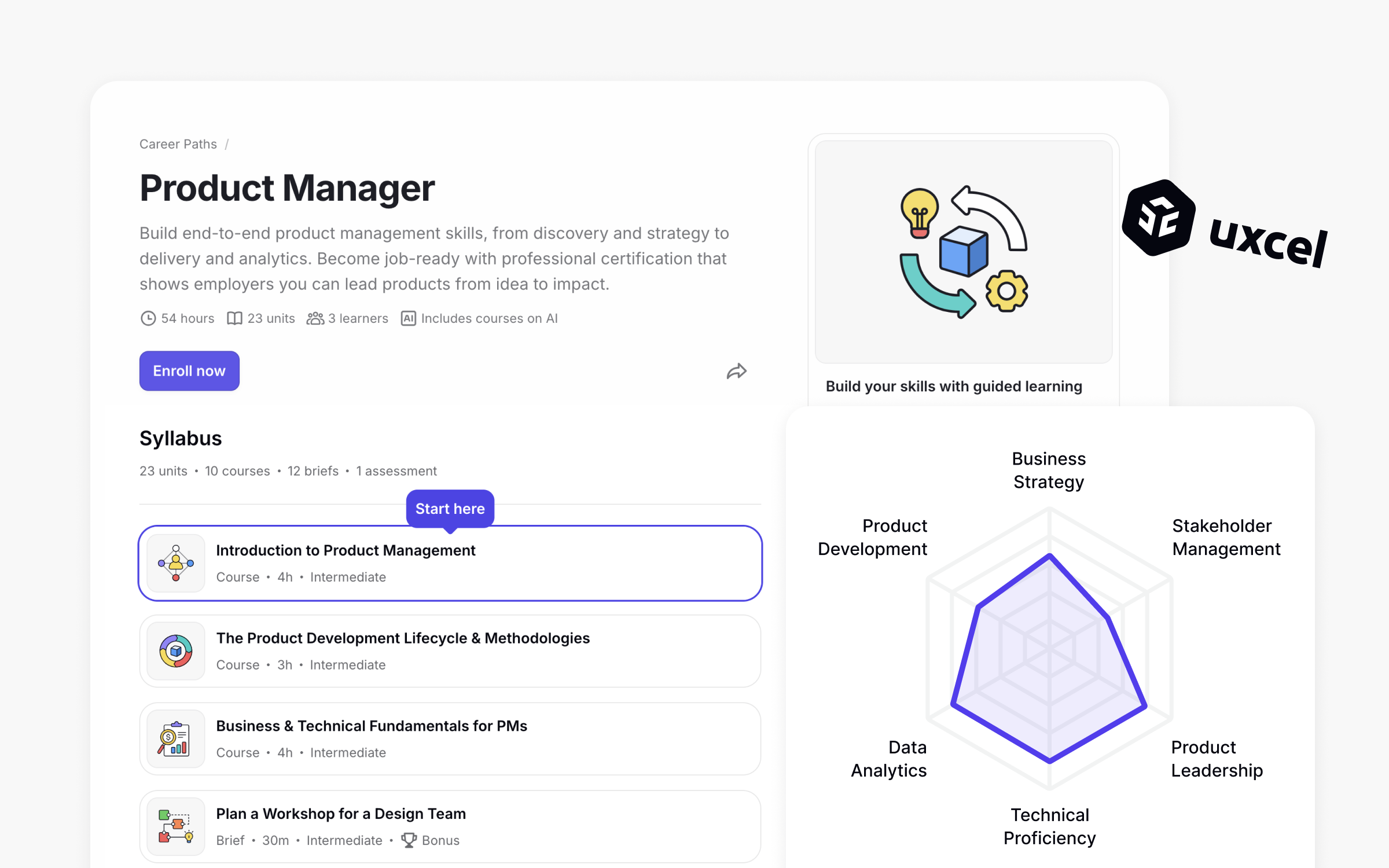
Look, I know comparing costs matters. At $2,999 for 30 hours of instruction, you’re paying roughly $100 per hour of live class time. Uxcel offers the entire curriculum for $288/year, but you won’t get live access to Silicon Valley PMs or the Product School brand name on your resume.
Student experiences tell two stories
Reviews split sharply. Positive reviews praise instructor quality when you get a good one. One graduate wrote, "Within a month of finishing, I got 5 phone screen interviews, 4 on-sites, and 2 job offers. Carlos reviewed my resume many times." The network and resume polish help some students land roles quickly.
Negative reviews focus on cost-value mismatch. Reddit user Substantial-Price969 wrote, "For $4,000+, I was disappointed in the lack of challenge. I don't know where the positive reviews come from." Another student shared, "I'm down $4100 with no PM job. The course was a poor learning experience despite promises of making me more marketable."
Common complaints pile up: content available cheaper elsewhere (Coursera, Udemy), instructor quality varying dramatically, first weeks feeling basic for experienced students, and group projects depending heavily on unmotivated peers who don't take work seriously.
Multiple students mentioned classmates "tended to fall back onto their own roles instead of putting themselves into the mindset of a PM. This stood out and unfortunately there's not much you can do about that if you have unmotivated peers."
Can you get a job after this?
Product School doesn’t publish placement statistics. This absence of transparency is telling. Legitimate bootcamps with strong outcomes publicize their numbers.
Students with existing tech experience (engineering, design, analytics) report pivoting successfully. The bootcamp helped them formalize knowledge they’d already gained through work experience. Product School can help professionals transition to a new job or even a new career in product management. The skills and network gained through the program can open up new opportunities in the tech industry. Career switchers without relevant backgrounds struggle significantly. The certification helps with HR screening at some companies but doesn’t replace experience requirements.
Here’s what makes Product School tricky: if you already work at a tech company as an engineer, designer, or analyst and need the certification to formalize PM knowledge for an internal transition, the $4,999 might pay for itself within three months through your promotion, but if you’re a teacher, accountant, or retail manager with zero tech experience expecting this bootcamp alone to transform you into a PM hire at a startup, you’re almost certainly going to be disappointed and poorer.
You're a good fit if
You have $4,000-$5,000 budgets who value brand recognition. You want Silicon Valley instructor access. You can study part-time around full-time work. You already have some PM knowledge or adjacent experience.
The brand name matters to you more than cost efficiency. You learn best in live, instructor-led environments with twice-weekly scheduled commitments. You're already employed and can study evenings or weekends without quitting your job.
Pass on this if
You need job guarantees or robust placement support. You have limited budgets. You already have deep PM experience and would find the first 2-3 weeks boring. You expect intensive hands-on projects with motivated peers. You want the cheapest path to PM fundamentals.
You're on a tight budget and $4,000+ represents significant financial strain. You can learn similar content on Uxcel for $288. Unless the brand name and live instruction specifically matter for your goals, the ROI is questionable.
2. Product Hall

Lifetime mentorship sounds too good to be true until you talk to Product Hall alumni still booking 1:1 calls with founder Quadri two years after graduating. Pay $3,100 once. Get mentor access forever, including guidance from expert mentors who offer personalized support throughout your career.
Quadri Oshibotu, a product manager with 10+ years at Shopify and RBC, started Product Hall in 2020 after observing that most PM bootcamps were expensive, impersonal, and abandoned students after graduation. The program takes a different approach.
Cohorts cap at 15-20 students. Every student gets lifetime access to 1:1 mentorship with Quadri. Not office hours. Not group coaching. Individual mentorship sessions for as long as needed after completing the program.
The bootcamp runs 10 weeks with live online classes. The curriculum consists of expert led courses designed and taught by experienced product managers. Unlike larger bootcamps with rotating instructors, Quadri teaches all sessions personally. This creates consistency but means quality hinges entirely on one person. No backup instructors exist.
Alumni receive access to a dedicated Slack channel. This online community provides ongoing networking and support, allowing graduates to connect with peers and continue learning beyond the program.
The 10-week curriculum breakdown
The program spans 60+ hours over 10 weeks with classes meeting twice weekly for 3 hours. Throughout the curriculum, students gain practical experience through hands-on projects and real-world applications, ensuring they are job-ready. Practical exercises are integrated into each module to reinforce learning and help students apply concepts in real scenarios. Progress tracking tools are available to help students monitor their advancement through the course. Weeks 1-2 cover PM foundations and day-to-day realities using examples from Quadri’s career at Shopify. Weeks 3-4 focus on customer development and research with actual user interviews students must conduct. Weeks 5-6 teach product strategy using JTBD, RICE prioritization, and roadmapping frameworks.
Weeks 7-8 cover Agile execution and working with engineering teams. Quadri walks through real sprint planning docs and standups from his work experience. Weeks 9-10 focus on metrics, launches, and career preparation. Students develop a complete product strategy throughout as their portfolio project.
The ongoing mentorship differentiates Product Hall from competitors. After 10 weeks end, you can schedule 1:1 sessions with Quadri indefinitely. One alumnus explained, “I still meet with Quadri quarterly, two years later. When deciding between job offers, he helped me think through trade-offs. That’s not something other bootcamps offer.”
Students use these sessions for interview prep, portfolio reviews, career advice, or discussing challenges in current PM roles years after graduating.
What $3,100 actually gets you
Product Hall costs $3,100 total. This includes 60+ hours of instruction, all materials, lifetime 1:1 mentorship, private alumni Slack access, portfolio feedback, and interview prep. Pay upfront ($3,100) or split into two payments ($1,550 each). No hidden costs. No upselling.
The value calculation looks compelling. At roughly $50 per hour of instruction plus unlimited lifetime mentorship, students get long-term support competitors don't offer. Compare to Product School ($4,999 for unlimited access, no ongoing mentorship) or CareerFoundry ($6,900 with 10-call mentor cap).
One alumnus calculated, "I've had probably 15 hours of 1:1 mentorship over two years since finishing. That's like getting consulting from an experienced PM for free."
What's missing: comprehensive career placement infrastructure, published employment statistics, multiple instructor perspectives, in-person networking events, and widespread brand recognition. The program is one person teaching and mentoring everyone.
What students consistently praise
Product Hall has 26 verified reviews on CourseReport rating 4.92/5. The small sample size means each review carries weight, but feedback is overwhelmingly consistent across the same specific elements.
Positive reviews emphasize personalized attention. "Unlike other bootcamps, there's no upselling. The small cohort meant I got personalized attention throughout." The lifetime mentorship delivers real value. "The ongoing mentorship after graduation has been crucial. I still work with Quadri on career decisions."
Quadri's authenticity resonates. "He shares both successes and failures from his PM career, not just textbook knowledge." The transparency about what the bootcamp can and cannot do for your career gets mentioned repeatedly. Students appreciate the honest approach versus overselling guarantees.
The honest limitations
Brand recognition is a real limitation. "Product Hall is newer, so it doesn't have brand recognition. This made it harder to leverage on my resume." HR departments at large tech companies won't recognize the credential the way they would Product School or General Assembly.
The program lacks published employment statistics. Students are taking a leap of faith based on reviews alone without hard data on graduate outcomes. No dedicated career placement infrastructure exists beyond Quadri's individual support. Being Toronto-based, some examples feel more relevant to Canadian markets than US ones.
The small cohort size (15-20 people) enables personalization but limits professional network reach compared to bootcamps with hundreds of alumni per cohort.
Job placement realities
Product Hall doesn’t publish placement statistics. Students in adjacent roles (project management, business analysis, customer success) report successfully pivoting into PM positions. The lifetime mentorship provides unusual support longevity for ongoing job search help. Product Hall supports students in landing a new job or transitioning to a new career in product management, helping them take concrete steps toward their goals.
Landing jobs takes time beyond the bootcamp. Students mention continuing to work with Quadri on applications and interview prep for several months after the program. This isn’t a “complete bootcamp, get hired immediately” situation, but the program helps unlock new opportunities and supports long-term product career growth.
The lack of employer partnerships limits direct job pipeline. Unlike larger bootcamps with hiring fairs or company partnerships, Product Hall relies on students applying individually and leveraging the alumni network for referrals.
This makes sense when
You value personalized attention over brand recognition. You want ongoing post-graduation support that actually lasts. You're self-motivated without needing rigid structure. You appreciate transparency and honesty about realistic outcomes. You have a few thousand dollars but not $10,000+ budgets.
The small cohort format appeals to you. You'd rather have deep access to one experienced PM than surface-level interaction with many. You're comfortable with a program that depends entirely on the quality and availability of one person.
Skip if you need
Well-known credentials for resume screening at Fortune 500 companies. Comprehensive placement infrastructure with dedicated career coaches and job boards. Multiple instructors with varied perspectives and company experiences. Published employment statistics to justify investment. In-person networking events in major tech hubs.
3. allWomen

Ask “stupid” questions without judgment. Connect with women facing identical challenges breaking into tech. Access companies actively hiring for diversity. allWomen built a 30,000-member community around this simple premise. This vibrant online community offers ongoing support and networking opportunities, helping students stay connected and engaged throughout their learning journey.
Laura Fernández founded the Barcelona-based platform in 2020 to help women break into tech careers through accessible, supportive bootcamps. The platform operates exclusively for women and non-binary individuals, creating learning environments specifically addressing unique challenges women face in tech.
The company runs bootcamps in PM, UX/UI, data analytics, and AI. All programs are fully online and part-time for working professionals who can’t quit jobs to attend full-time bootcamps. The PM bootcamp runs 10 weeks with 100 total hours of instruction and project work through live, interactive classes. Students benefit from expert mentors and a dedicated student advisor who provide personalized guidance, career planning, and support throughout the program.
What makes allWomen distinct is the women-only environment. Not just marketing. Students consistently mention feeling more comfortable asking questions, sharing career concerns about imposter syndrome and salary negotiation, and supporting each other in ways that felt difficult in mixed-gender tech spaces.
The 11-module curriculum
The program covers 11 modules over 10 weeks with 10 hours weekly commitment split between live classes (2.5 hours twice weekly) and homework. The curriculum includes practical exercises and hands-on projects throughout, allowing students to gain practical experience as they progress. Module 1 introduces PM roles across different company sizes and industries. Module 2 teaches design thinking methodology. Module 3 covers user research methods including interviews, surveys, and persona development.
Module 4 focuses on product strategy, competitive analysis, and value proposition design. Module 5 teaches Agile methodologies including Scrum and Kanban. Module 6 covers prototyping and wireframing basics in Figma. Module 7 teaches product roadmapping and prioritization frameworks like RICE and MoSCoW.
Module 8 covers metrics, analytics, and defining success criteria. Module 9 focuses on go-to-market strategy and product launches. Module 10 introduces AI tools for PMs including ChatGPT and prompt engineering. Module 11 prepares students for PM interviews, portfolio building, and networking strategies.
The program is designed to build real world skills that are directly applicable to product management roles, ensuring graduates are job-ready.
The Hiring Fair at cohort end gives students direct exposure to 100+ partner companies. Students present capstone projects to companies actively looking to hire women in tech roles. This provides significant advantage over bootcamps without employer partnerships.
Your $2,900 investment breakdown
allWomen charges $2,600-$2,900 for the complete bootcamp. One of the more affordable options in the market. This includes 100 hours of live classes, all materials, 1:1 career coaching, portfolio feedback, resume and LinkedIn reviews, Hiring Fair access, lifetime alumni community access, and Demo Day presentation opportunity.
Payment plans split costs across 2-3 months with terms varying by region. Regional pricing adjusts for different countries, making the bootcamp more globally accessible. Students mention the payment flexibility made the program accessible when a $2,900 upfront payment would have been prohibitive.
What you don't get: ongoing mentorship after graduation unlike Product Hall's lifetime model. Career coaching happens during the program but ends when you complete the bootcamp. You're on your own beyond the alumni community for long-term support.
allWomen reports an 80% placement rate within 6 months. This is self-reported without third-party verification. The definition of "placement" isn't specified. Students should verify these numbers and ask about methodology before assuming guaranteed outcomes.
Women praise the supportive environment
Reviews on SwitchUp (11 reviews, 4.8/5) and Career Karma (18 reviews, 4.5/5) show consistently high ratings with specific, detailed praise.
Positive feedback emphasizes the women-only environment repeatedly. "As a woman breaking into tech, allWomen provided exactly the supportive environment I needed. The women-only cohort allowed me to ask questions without fear of judgment." The Hiring Fair delivers tangible value. "I met with 15+ companies actively looking to hire women in tech roles. Three months later, I landed my first PM role at a Barcelona startup."
Laura and the team genuinely understand women's specific challenges in tech. "The 1:1 career coaching helped me navigate imposter syndrome and negotiate my salary confidently." The curriculum provides comprehensive value for $2,900. Students feel they got significant education for the price point.
The geographic reality check
The Barcelona base creates a geographic paradox where the bootcamp excels at helping women land European tech roles through the Hiring Fair connecting students to 100+ companies actively recruiting for diversity, but simultaneously limits value for women targeting Silicon Valley startups or US tech giants where neither the European company partnerships nor the Barcelona networking week provide relevant connections or opportunities.
"Being Europe-based, job support was less helpful for me targeting US roles. Most hiring partners were European companies." Students wanting roles at American companies mention struggling to leverage the European-focused network effectively.
The 80% placement rate lacks third-party verification. Without independent auditing, the accuracy and methodology remain unclear. Cohort sizes sometimes reduce individual attention. "The cohort was larger than expected, which meant less personalized attention during live sessions."
Time zone challenges affect students outside Europe. Live class times work well for European participants but can be inconvenient for those in US or Asian time zones. allWomen tries to accommodate but can't optimize for all global regions simultaneously.
Job outcomes depend on location
The claimed 80% placement rate is self-reported. No verification. Just claims. The Hiring Fair creates direct pipeline to companies unlike cold applications. The women-in-tech focus appeals to companies committed to diversity hiring. The program is designed to help students transition to a new job or even a new career in product management, supporting those looking to make a significant change. It also opens up new opportunities for women in tech, enabling participants to explore innovative career pathways and access roles that may have previously been out of reach.
Success correlates strongly with willingness to work in Europe or for European companies. Students targeting Barcelona, Madrid, London, or other European tech hubs report better outcomes than those focused exclusively on US markets.
Breaking into PM still requires relevant experience or adjacent skills. The bootcamp helps formalize knowledge and provides networking, but doesn’t magically overcome the fundamental challenge that most PM roles want 2+ years of relevant experience. Students landing jobs typically work in tech-adjacent roles, are recent technical graduates transitioning into product, or are career switchers starting at junior roles with lower compensation.
You should enroll if
You're a woman or non-binary individual wanting supportive women-only environments. You're in Europe or targeting European tech jobs. You want access to companies actively hiring women through the Hiring Fair. You value community and ongoing network access with 30,000+ members. You can commit 10 hours weekly for 10 weeks.
The European focus aligns with your career goals. You appreciate addressing imposter syndrome, salary negotiation challenges, and navigating male-dominated workplaces as core curriculum elements rather than afterthoughts.
Don't enroll if
You're in the US targeting US tech companies without willingness to relocate to Europe. You need verified third-party placement statistics before investing. You want mixed-gender learning environments to prepare for working on mixed-gender teams. You need ongoing post-graduation mentorship beyond alumni community access. You're sensitive to larger cohort sizes reducing individual attention.
4. CareerFoundry

CareerFoundry advertises a job guarantee plastered across their website. Students report discovering the guarantee has strict conditions only explained after they’ve paid $6,900. Read contracts carefully.
The Berlin-based company launched in 2013 and operates globally with completely remote, self-paced programs. The product management program targets career changers and operates on flexible timelines with milestone-based progression. The distinguishing feature is the dual mentorship model pairing students with both a mentor and tutor, plus a career specialist for job search support. Students benefit from expert mentors who provide industry insights and personalized guidance throughout the program. Additionally, a dedicated student advisor helps guide students through career planning and overcoming obstacles to achieve their academic and professional goals.
The program costs $6,900-$7,900 depending on payment timing and runs 3-6 months flexible based on student pace. CareerFoundry offers a job guarantee with full refund if no job within 6 months of graduating, backed by their claimed 90% placement rate. The self-paced format is complemented by an online community, offering valuable peer support and networking opportunities for students.
But here’s the catch that students discover too late: the guarantee requires applying to minimum numbers of jobs monthly and following career services advice. It’s not simply “money back if unemployed” as marketing suggests. The fine print has teeth.
I covered the most important info about Career Foundry below. However, if you are interested in an extensive research to help you understand if it is the right bootcamp for you, head over to our in-depth Career Foundry Review.
How the self-paced program works
The self-paced program requires hitting specific milestones to progress. Students complete four major practical achievements, each with multiple tasks. Achievement 1 covers PM fundamentals, user research, and market analysis. Achievement 2 focuses on product strategy, roadmapping, and prioritization frameworks.
Achievement 3 teaches Agile methodologies, working with development teams, and sprint planning. Achievement 4 covers metrics, analytics, go-to-market strategy, and product launches. Throughout the program, students build a portfolio with real project examples. The curriculum emphasizes practical application over pure theory, incorporating practical exercises and hands-on projects to help students gain practical experience that prepares them for real-world product management challenges.
Progress tracking tools are available to help students monitor their advancement through the course, providing a personalized and structured learning experience.
Self-pacing allows students to work around a full time job, making the program suitable for those who are employed while studying. Full-time students (30-40 hours/week) complete in 3 months. Part-time students (15-20 hours/week) finish in 6 months. But self-pacing requires discipline to maintain progress without fixed deadlines. Students report the format can feel isolating without cohort structure.
The dual mentorship model means weekly calls with a dedicated tutor helping with technical concepts plus regular check-ins with a mentor providing industry insights. The career specialist supports resume development, interview prep, and job search strategy. This three-pronged support differs from single-mentor programs.
The $6,900 price tag breakdown
CareerFoundry costs $6,900 for the 3-month full-time track (30-40 hours/week) or $7,900 for the 6-month flexible track (15-20 hours/week). Payment plans and financing options exist.
The job guarantee provides full tuition refund if unemployed within 6 months post-graduation. But conditions apply. You need to apply to minimum numbers of jobs monthly and follow their advice. Reddit users flagged that mentorship is capped at 10 calls total, not clearly advertised upfront on the website. That feels restrictive when hitting complex topics needing multiple deep discussions.
Your tuition covers self-paced curriculum access, weekly 1:1 mentor calls (capped), career coaching throughout, job guarantee on select tracks, interview preparation and resume reviews, real-world project portfolio, and capstone project.
What's missing: live cohort interaction and community learning. Being fully self-paced, students miss peer networking and collaborative learning opportunities. No in-person options exist. Everything happens remotely.
Students split on the experience
SwitchUp shows 178 PM-specific reviews rating 4.43/5. CourseReport has 1,400+ total reviews across all CareerFoundry programs.
Positive reviews emphasize the job guarantee reducing stress. "Knowing I'd get $6,900 back if I didn't land a role within 6 months provided peace of mind. Fortunately, I got a job in month 4." The dual mentorship model provides valuable perspectives. "My tutor helped with technical concepts while my mentor provided industry insights. Having both perspectives was invaluable."
Self-paced flexibility works for working professionals. "I could complete modules on weekends and evenings without quitting my job." Career specialist support is thorough. "From resume reviews to mock interviews to salary negotiation coaching, they covered everything. I felt fully prepared for job search."
Negative reviews focus on several issues. High cost. "At $6,900-$7,900, it's expensive for career changers not yet earning PM salaries." The mentorship cap at 10 calls wasn't mentioned on the website. Self-paced format feels isolating. "Without live cohort sessions, I missed peer learning and networking opportunities."
The job guarantee has strict conditions. "You need to apply to certain numbers of jobs monthly and follow their advice. It's not as simple as 'money back if unemployed.' I felt the conditions were designed to make claiming the guarantee nearly impossible."
Can the job guarantee be trusted?
CareerFoundry claims 90% placement rate. The methodology isn’t transparent. The job guarantee provides a safety net but with significant conditions students discover after enrollment. Career specialists actively support job search with tailored advice, helping students land a new job or transition to a new career in product management. The dual mentorship helps navigate both learning and career transition simultaneously, opening up new opportunities in the tech industry.
Students report the guarantee works when you meet all conditions but feels like a marketing tool more than a genuine safety net. The 6-month timeline starts after graduation, not enrollment, which seems reasonable. But the application quotas and mandatory advice-following create hoops that exclude many unsuccessful students from refund eligibility.
This works for you if
You need a job guarantee safety net even with conditions. You want dual mentorship perspectives (tutor + mentor + career specialist). You require self-paced flexibility around full-time work. You value structured milestones with career specialist support. You can afford $6,900-$7,900 without financial stress.
The self-paced format matches your learning style. You have discipline to progress without fixed deadlines. You're okay sacrificing peer community for individual flexibility.
Avoid this if
You're early career without PM-level income to justify high costs. You need unlimited mentor access without 10-call caps. You want live cohort community and peer interaction. You need in-person options. You assume job guarantee has no conditions or will be easy to claim if you don't find work.
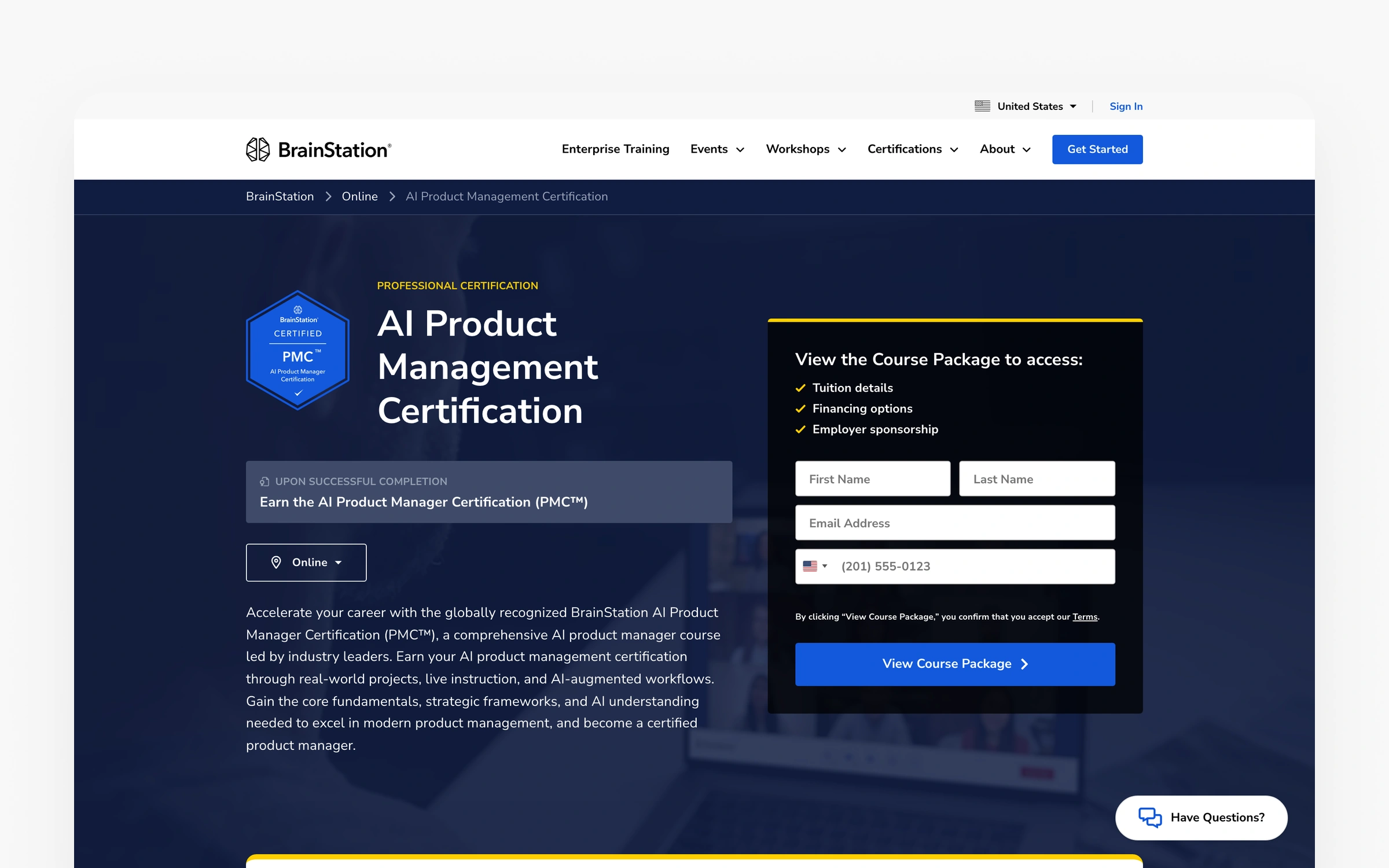
5. BrainStation

Twenty-four hours. That’s total instruction time over 8 weeks at BrainStation. Three hours weekly for $3,700-$3,900. You’re paying roughly $150-$165 per hour of live class time.
BrainStation operates as a global digital skills provider offering certifications in AI, product management, design, data, and marketing since 2012. The company has trained 35,000+ professionals globally and partners with Fortune 500 companies for corporate training. BrainStation operates both online and at physical campuses in New York, London, Miami, Toronto, and Vancouver.
The product management certification focuses on expert led courses taught by industry leaders from top tech companies such as Amazon, Meta, and Microsoft. These industry-expert instructors teach real-world applications through project-based learning. The curriculum also includes practical exercises to help students apply concepts in real-world scenarios. BrainStation targets both individual learners seeking career transformation and corporate teams needing upskilling.
I covered the most important info about BrainStation below. If you are interested in an extensive research to help you understand if it is the right bootcamp for you, head over to our in-depth BrainStation Review.
What 24 hours covers
The four-unit course covers PM fundamentals over 8 weeks. Unit 1 introduces product management including customer centricity, Lean product development, product lifecycle, and the PM role. Students learn customer discovery, product vision development, and translating research into value propositions using real case studies from companies like Airbnb.
Unit 2 dives deeper into Agile product management and Lean methodologies. Students learn how integrated product teams move quickly and iterate toward product-market fit. Topics include Agile software development practices, core principles and values, user stories, and Agile story mapping.
Unit 3 focuses on prototyping and testing. Students learn how to apply build-measure-learn frameworks to develop efficient MVPs. The unit covers incorporating Agile methodologies into product development processes to deliver solutions faster.
Unit 4 teaches go-to-market strategy and product launches. Students create comprehensive go-to-market strategies and build product launch plans. The curriculum emphasizes using common product management tools throughout. Students complete a portfolio project demonstrating mastery of product management frameworks and tools. Through this portfolio project, students gain practical experience and develop real world skills essential for product management roles.
Instructors are experienced professionals currently working in product at major tech companies. When they’re good, they bring real-world insights. When they’re not, they read slides.
Pricing and what's included
BrainStation's Product Management Certification costs $3,700-$3,900. The exact price varies based on online versus in-person delivery and specific cohort timing. Payment plans and financing options exist though details vary by program. BrainStation partners with employers to sponsor employee training, offering tuition discounts in some cases.
Your tuition covers 24 hours of live instruction, all course materials, portfolio project feedback, recorded session access, and the globally recognized Product Manager Certification (PMC™) credential.
Missing from the package: dedicated career coaching or job placement support. BrainStation offers career resources and networking events but doesn't provide intensive one-on-one job search support like Product Gym or CareerFoundry. You're largely on your own for job hunting after completing the program.
Students report mixed experiences
SwitchUp shows 313 PM program reviews rating 4.6/5. Career Karma has 200+ reviews rating 4.5/5 overall.
Positive reviews praise balanced curriculum. "Well-balanced mixture of concepts and theories, in-class activities, case studies and actual hands-on work for the final project. I learned new useful toolkits which I applied to my project. The significant value was in-depth feedback from instructor and peers."
The curriculum quality and expert instructors get consistent praise when students get good instructors. "The program was challenging but extremely rewarding, offering real-world projects that truly enhanced my skills." The global network and Fortune 500 partnerships add credibility for corporate environments.
Negative reviews mention instructor dependence being problematic. "Instructors reading a slide deck does not count as teaching. For those with base knowledge, this course had very little new information." The cost feels high compared to competitors. "I expected more hands-on projects and real-world team collaboration like other bootcamps offer."
Limited contact hours raise concerns. "24 hours total (3 hours/week × 8 weeks) felt too rushed to deeply absorb PM concepts. I would have preferred a longer, more immersive program." No cross-functional collaboration exists. "BrainStation doesn't provide working with actual developers and designers, which limits real-world applicability."
The online shift reduced networking value. "Many in-person programs moved online, reducing the networking value I expected from BrainStation's campus network."
Employment outcomes unclear
BrainStation doesn’t publish specific placement rates for PM certification. The program works best for professionals with existing tech industry experience seeking to formalize PM knowledge or pivot from adjacent roles like project management or business analysis. BrainStation helps students pursue a new job or new career in product management, providing flexible learning options for those looking to transition without leaving their current role. The program also opens up new opportunities for professionals in the tech industry by equipping them with in-demand skills.
The global alumni network of 35,000+ creates networking opportunities. Job outcomes depend heavily on individual effort. The Fortune 500 partnerships help with brand recognition in corporate environments but don’t translate to direct job pipelines or placement support.
Choose BrainStation when
You value global campus networks and Fortune 500 brand recognition. You want flexible online or in-person options. You prefer structured curriculum over self-paced learning. You already work in tech and want to formalize PM skills. You can afford $3,700-$3,900 without financial strain.
The 8-week evening or weekend format fits your schedule. You learn well in structured, instructor-led environments even with limited total contact hours.
Pass on BrainStation when
You need intensive contact hours beyond 24 total. You want cross-functional team collaboration with designers and developers. You require dedicated career placement support. You prefer programs with published employment statistics. You expect all programs to remain in-person as marketed.
6. General Assembly

General Assembly used to be good. Then a corporation bought them. Now students report 98% of their cohort can’t find PM roles, the outcomes teacher got fired mid-class via email, and campus access gets restricted after you graduate despite lifetime access promises.
The company launched in 2011 offering courses across software engineering, data science, UX design, digital marketing, and product management. General Assembly operates at 20+ global campuses plus online with 70,000-80,000+ alumni worldwide and partnerships with 2,500+ hiring companies. General Assembly's software engineering bootcamps are designed to prepare individuals for full stack developer roles, equipping them with the skills needed to build complete web applications.
The product management course runs 10 weeks part-time (2 evenings weekly or 1 weekend day weekly) or as an intensive 1-week accelerated program (Monday-Saturday, 9am-5pm). The beginner-friendly bootcamp teaches PM skills and prepares students for careers in the field. General Assembly offers expert led courses taught by industry leaders from the tech industry, ensuring students learn from recognized professionals with real-world experience.
The online learning environment includes an online community for peer support and networking, helping students stay connected and engaged throughout the program.
The program features hands-on training, and includes practical exercises to help students apply skills in real-world scenarios and reinforce their understanding.
The reality version involves inconsistent quality, frequent instructor turnover, understaffed career support, and a corporate acquisition that prioritizes profit over student outcomes.
The 10-week curriculum structure
The 10-week course covers PM fundamentals, product lifecycle, product analytics, ideation and validation, roadmapping, pricing models, prototyping, usability testing, and career success. An entire module dedicates to career preparation.
Students pick projects to work on throughout the course. Products they want to launch themselves or something they’re working on at work. As they go through course material, they apply skills learned to complete weekly assignments building up to a final presentation where they pitch products to classmates and get feedback. This approach ensures students gain practical experience and develop real world skills essential for product management roles.
The hands-on, practical training gets emphasized in marketing. The diverse learning community creates environments where engaged students ask questions and learn from each other. Students work with developers in General Assembly programs and with real “clients” which boosts portfolios. When it works, it works well. When it doesn’t, you’re out $3,950 with little to show.
What $3,950 buys you
General Assembly charges $3,950 for the product management course. Students must make down payments to secure limited program spots. Financing partners, deferred tuition options, and installment plans assist with financial burdens. General Assembly works with employers to sponsor employees seeking additional training and offers tuition discounts to women through the See Her Excel program.
Your tuition covers live instruction, course materials, portfolio project development, access to alumni network of 80,000+, career resources and networking events, and individualized instructor support.
What's missing: job guarantee or dedicated career services team. General Assembly provides career resources but students report career support feeling inconsistent and understaffed compared to marketing promises. Outcomes teachers get fired mid-program. Support quality depends entirely on which campus and cohort you join.
The brutal student feedback
General Assembly receives mixed reviews with concerning patterns in negative feedback. CourseReport and SwitchUp show positive feedback for some programs but serious concerns about others, particularly around job outcomes and career support quality.
Positive reviews emphasize diverse learning environment and engaged students. "All students were really engaged and wanted to be there. It created an environment where people asked questions and wanted to meet and learn from each other." Hands-on practical training works well. "With the product management course, you pick a project to work on throughout. As you go through course material, you apply skills learned."
Access to massive alumni network provides networking opportunities. Working with developers in GA programs and real clients boosts portfolios when executed well.
Negative reviews focus heavily on poor job outcomes. "I was lucky to get a job but it seems like 98% of students here aren't finding roles. This is largely due to the market but also deficiencies in their outcomes programs. Our Outcomes teacher was fired right in the middle of class by email." This pattern appears across multiple cohorts and campuses.
Access restrictions disappoint graduates. "You're supposed to have lifetime campus access, but once you graduate they start restricting access to parts of campus behind corporate rules and jargon." Limited curriculum depth concerns students. "A major drawback is that the curriculum/roadmap is rather limited. There are much better courses offering more in-depth learning experiences."
Quality declined after acquisition. "GA used to be good before being bought by some 3rd party corporation that only cares about milking students for maximum profit." Instructor quality varies dramatically by campus and cohort. "My teacher kept rescheduling classes or not being able to make it. It was very unprofessional. I wasn't able to secure a job after and there wasn't much support from GA."
Job prospects are unclear
General Assembly doesn’t publish specific PM placement rates. The 80,000+ alumni network creates networking opportunities in theory. Career support exists but students report it feeling inconsistent with frequent staff turnover and understaffing.
General Assembly can help students pursue a new job or new career in product management, especially for those looking to transition into the field. The program also opens up new opportunities for professionals in the tech industry by equipping them with in-demand skills.
Students landing jobs typically have relevant experience already or use General Assembly for career pivots rather than complete career changes. The brand name helps with resume screening at some companies but doesn’t compensate for lack of real PM experience.
This might work if
You value massive alumni network for networking despite quality concerns. You want recognized brand name on resume. You prefer flexible part-time or accelerated formats. You already work in tech and want to formalize PM knowledge. You can afford $3,950 without expectation of job guarantees or strong placement support.
You're willing to gamble on instructor and campus quality. You have realistic expectations about career support limitations.
Definitely skip if
You need strong job placement support and outcomes guarantees. You want comprehensive, in-depth curriculum beyond fundamentals. You expect consistent high-quality instruction across all cohorts. You need lifetime campus access as marketed. You want program that hasn't been affected by corporate acquisition changes prioritizing profit.
7. Product Gym

Product Gym doesn’t teach PM fundamentals. They teach you how to beat applicant tracking systems, ace product sense interviews, and negotiate salaries. This is scientific job hunting, not education.
Richard Chen and Cody Chang founded Product Gym (though reports suggest one co-founder stepped away), taking a different approach than traditional bootcamps. They started as recruiters for product managers, so they know exactly what resumes need and how interviews work. The program runs 12 weeks online with self-paced curriculum and flexible live class cycles. Progress tracking tools are available to help students monitor their advancement through the course.
There are no fixed cohorts. Once you join, you access all classes, community resources, and support for life. The online community provides valuable peer support and networking opportunities, helping students stay connected and engaged throughout their journey. Members spend 7-10 hours weekly on average. Product Gym costs $7,000 for lifetime membership. Six thousand dollars. Forever access.
Students also benefit from expert mentors who provide personalized guidance, supporting career development and interview preparation.
What you're actually paying for
Product Gym offers 20+ live and recorded classes covering the entire PM job search process. Topics include resume optimization to pass applicant tracking systems (ATS), crafting backstories that connect non-PM experience to PM roles, LinkedIn profile optimization, cover letter templates that get responses, networking strategies that actually work, case interview frameworks, product sense questions, technical PM interviews, behavioral interviews using STAR method, salary negotiation tactics, and managing multiple offers.
The program includes resume/LinkedIn/cover letter reviews from experienced PMs, regular small group coaching calls where you can ask questions and learn from others' situations, mock interview practice with peers and coaches, and access to the Circle community platform where members share job postings, interview experiences, and support each other.
Product Gym's teaching emphasizes that PM hiring follows specific patterns. If you learn what hiring managers look for, how to craft your story to highlight relevant experience, and how to ace each interview type, you dramatically increase your odds versus just applying randomly and hoping.
They've turned job searching into a science. Templates for everything. Frameworks for every interview type. Community sharing what questions companies actually ask. It's systematized in ways traditional bootcamps don't approach.
The $7,000 investment breakdown
Product Gym charges $7,000 for lifetime membership. One-time payment (or split across 2-3 payments totaling slightly more). The $7,000 covers all 20+ classes, all templates and frameworks, unlimited resume/LinkedIn/portfolio reviews, regular coaching calls with founders, mock interview opportunities, community access, and lifetime access with no expiration.
Income share agreements (ISAs) exist through partner Meratas. You can defer tuition until landing a PM job paying $60,000+ then pay back 6.5% or 10% over time. Private loans through Ascent Funding (up to 42 months) or Climb Credit (36 months with interest) are available.
What you don't get: job guarantee despite strong placement claims. Foundational PM education if you know nothing about product management. Cohort structure and accountability. Fast turnaround on feedback and reviews.
Students report dramatic results
Product Gym rates 4.96/5 on CourseReport (394 reviews) and 4.96/5 on SwitchUp. These are extremely high ratings. Some skepticism exists about review authenticity given the patterns.
Positive reviews emphasize career results. "Before Product Gym, I struggled to secure positions in the competitive 2023 job market. Despite competing against people with 10+ years at MAANG companies who'd been laid off, I managed to double my salary after completing Product Gym."
The scientific, systematic approach works. "Product Gym has everything about getting a PM job down to a science. How to write resumes, how to interview at every step, how to handle every interview type. If you want a product management job, this program gives you the playbook."
Community support is genuine. "The Circle community is super supportive. Everyone is rooting for your success and ready to help at all times. I've made some lifelong connections." The tools actually work. "PG gave me all the tools to craft an inspiring resume that perfectly navigates unseen filters in modern HR screening programs. This helped me average 10-15% interview rate for applications."
Negative reviews focus on cost and changing quality. "It's a lot of money for what it is. Also the program has gone downhill in the past few years after the other cofounder stepped away. It's also not a job guarantee, especially in this market."
Self-paced challenges exist. "The course is self-paced and live classes are cycled. There's really no cohorts. You won't get much out if you don't put in time. It's a 'gym' mentality - how bad do you want to make the switch?" Feedback turnaround can be slow. "The turnaround time for getting assets reviewed can be slow at times, but the fact they offer this is fantastic."
Review authenticity gets questioned. Fishbowl and Reddit users noted, "Their reviews look fraud to me. Hard to believe all paragraph-length reviews mentioning the same points are real."
Can you actually land a job?
Product Gym reports members secure 3-5 job offers within 45 days, helping members secure $25,000-$75,000 salary increases with first offers. The program is designed to help students land a new job or transition to a new career in product management, opening up new opportunities for professionals seeking career advancement. These are self-reported claims without third-party verification. Graduates have received offers from Google, Amazon, Netflix, and Facebook according to Product Gym marketing.
Students report the program works best for people with some PM experience looking to level up or land better roles. Complete beginners struggle more. The interview prep is where real value lives. Students mention Product Gym taught them how to frame their experience compellingly even when they didn’t have “PM” title previously.
You should join if
You're already in PM roles wanting better positions. You're a professional with PM-adjacent experience (project management, product owner, business analyst) looking to transition. You're self-motivated individual who can work through self-paced content without hand-holding. You're struggling specifically with interviews rather than PM fundamentals. You can afford 76,000 or qualify for ISA.
The job search process intimidates you more than the actual PM work. You need templates, frameworks, and systematic approaches to applications and interviews.
Don't join if
You need cohort structure and accountability from fixed schedules. You want foundational PM education rather than job search training. You expect guaranteed job placement. You're concerned about review authenticity. You want program with both co-founders still actively involved. You need fast turnaround on feedback and reviews.
8. Chegg Skills (ex-Thinkful)
.png)
Income share agreements sound perfect: pay nothing until you land a PM job earning $40,000+. Chegg Skills offers ISAs through partners. The catch? You might pay significantly more over time than the upfront cost.
Chegg Skills, formerly known as Thinkful before being acquired by Chegg, has been around since 2012 and became part of Chegg in 2019. It offers online bootcamps in software engineering, data science, data analytics, UX/UI design, digital marketing, and product management. The platform operates completely online with flexible full-time and part-time options designed for working professionals.
The product management bootcamp combines self-paced curriculum with mentor support and career coaching. The program is specifically designed to accommodate those with a full time job, making it possible to balance learning with existing career commitments. Chegg Skills offers a variety of online courses through its online learning platform, providing practical, hands-on learning accessible from anywhere. Students benefit from expert mentors who provide personalized guidance and support throughout the program. Progress tracking tools help students monitor their advancement through the course, ensuring a structured and personalized learning experience.
The program duration varies based on pace. Full-time students (20-25 hours/week) complete in 5 months. Part-time students (10-15 hours/week) finish in 6 months. Flexible students working at their own pace may take longer. Student experiences can differ, as the quality of courses at Chegg Skills may vary from one to the next due to the broad spectrum of offerings.
The curriculum structure
The PM bootcamp covers product fundamentals, user research methodologies, product strategy and vision, roadmap development, Agile and Scrum practices, metrics and analytics, prototyping and wireframing, go-to-market strategy, and stakeholder management.
The curriculum includes practical exercises and hands-on projects to help students gain practical experience. It is specifically designed to build real world skills essential for product management roles. Students work on real-world portfolio projects throughout the program. The curriculum emphasizes hands-on application rather than pure theory. One-on-one mentorship from industry professionals provides personalized guidance and feedback.
Career services include resume building, interview preparation, job search strategies, networking guidance, and ongoing support until landing a role. Students get assigned dedicated career coaches who work with them from enrollment through job placement.
Understanding ISA financing
Chegg Skills offers multiple payment options. Upfront payment provides tuition discount. Month-to-month payment plans spread costs over program duration. Income share agreements (ISAs) defer all tuition until students land jobs paying $40,000+/year.
ISA students pay 15% of income for 48 months with $30,000 payment cap. The flexibility of ISA financing makes Chegg Skills accessible for people without upfront capital. But ISAs can cost significantly more than upfront payment over time, especially for higher-earning graduates.
Do the math: Landing a $70,000 PM job means paying $10,500 annually (15% of $70,000) for 4 years, totaling $42,000 before hitting the $30,000 cap. That $30,000 cap might exceed what the bootcamp would have cost upfront by thousands of dollars.
Limited recent feedback exists
Chegg Skills has limited recent public reviews specific to product management. The platform receives mixed feedback across its various programs. Some students praise mentor quality and career support. Others report inconsistent experiences and challenges with job placement.
The acquisition by Chegg has led to operational changes that affected student experience. Some long-time community members mention quality declining as Chegg integrated and scaled operations.
Job outcomes remain unclear
Chegg Skills doesn’t publish specific PM placement rates. The ISA model suggests confidence in job outcomes since the company only profits when students get hired. Chegg Skills supports students in landing a new job or transitioning to a new career in product management, helping to open up new opportunities in the tech industry. However, the lack of transparency around actual placement statistics and salary outcomes makes it difficult to assess real effectiveness.
Students with existing tech experience or adjacent roles report more success pivoting into PM positions. Complete career changers without relevant backgrounds struggle more significantly.
This might work if
You can't afford upfront tuition and need ISA financing. You require maximum flexibility to work full-time while learning. You're self-motivated individual comfortable with self-paced formats. You value ongoing career support through job placement.
You've calculated the ISA costs and accept potentially paying more than upfront. You have realistic expectations about job outcomes.
Skip this if
You want published placement statistics before enrolling. You need live cohort interaction and peer community. You prefer programs with strong recent reviews and feedback. You want to avoid potentially paying more via ISA than upfront cost. You seek bootcamps unaffected by corporate acquisitions.
9. Circuit Stream

Want to manage AR, VR, or gaming products? Circuit Stream’s $10,500 program targets exactly this niche. Want general PM skills for SaaS companies? This specialization will hurt more than help.
Circuit Stream specializes in immersive technology education since 2016, offering programs in XR development, 3D modeling, game design, and product management specifically focused on emerging tech. The company partners with University of Toronto and McGill University to provide university-backed credentials.
The product management bootcamp targets professionals wanting to build careers in AR, VR, gaming, and emerging technology sectors. The program runs 21 weeks online with live classes, mentorship, and hands-on projects. Students benefit from expert mentors who provide industry-specific insights and personalized support throughout the program. Circuit Stream costs $10,500, making it the most expensive option on this list. That’s ten thousand five hundred dollars.
What distinguishes Circuit Stream is the focus on emerging tech and XR (extended reality). The curriculum consists of expert led courses designed for emerging tech product management, and students gain practical experience through hands-on projects and real-world applications. Rather than general PM education, the curriculum specifically prepares students for product roles in immersive technology companies.
I covered the most important info about Circuit Stream below. If you are interested in an extensive research to help you understand if it is the right bootcamp for you, head over to our in-depth Circuit Stream Review.
The 21-week specialized curriculum
The 21-week program covers product management fundamentals, Agile methodologies, user research for XR products, prototyping immersive experiences, metrics and analytics for emerging tech, go-to-market strategy for innovative products, and managing cross-functional teams in game/XR development.
Students complete capstone projects building product strategies for AR, VR, or gaming products. The program also includes practical exercises designed to help students develop real-world skills relevant to AR, VR, and gaming product management. The curriculum emphasizes the unique challenges of managing products in rapidly evolving technology sectors where user testing, development constraints, and market education differ dramatically from traditional software.
Mentorship from product managers working in gaming companies, XR startups, and immersive tech firms provides industry-specific insights. Students gain access to industry events, networking opportunities with emerging tech companies, and portfolio development tailored for XR/gaming roles.
The $10,500 investment
Circuit Stream costs $10,500 total for the 21-week program. Payment plans exist but specific terms vary. The university partnerships with U Toronto and McGill mean students receive university-backed certificates, adding credibility beyond typical bootcamp credentials.
Your tuition covers 21 weeks of live online instruction, industry mentor support, university certificate, portfolio project development, career coaching, and access to emerging tech job network.
What's missing: job guarantee. Given the specialized nature of the program and emerging tech market volatility, Circuit Stream doesn't offer placement guarantees.
Minimal public reviews exist
Circuit Stream has minimal public reviews for the PM program specifically. The platform has more established reviews for XR development and 3D modeling programs. The specialized nature means smaller cohorts and less public feedback overall.
Students interested in this program should request to speak with recent graduates and verify current employment outcomes before committing $10,500. The lack of public reviews makes it difficult to assess quality and results.
Job prospects depend on market
Circuit Stream doesn’t publish placement rates. The specialized focus on emerging tech means job prospects depend heavily on the XR/gaming job market health at graduation time. Circuit Stream helps students pursue a new job or new career in AR, VR, or gaming product management, making it a strong option for those seeking a career transition. The program also opens up new opportunities in the immersive tech industry, allowing graduates to explore innovative roles and career pathways. Students targeting traditional PM roles outside gaming/XR may find the specialization limiting rather than helpful.
The university partnerships add credential weight. The emerging tech focus differentiates you in a specific job market. But that same specialization narrows opportunities if the XR/gaming market contracts or you decide immersive tech isn’t your path.
Choose this program if
You specifically target PM roles in gaming, AR/VR, or immersive tech companies. You value university partnerships and credentials. You have $10,500 budgets for specialized education. You want focused curriculum rather than general PM training applicable across industries.
You're committed to emerging tech career path. The 21-week timeline works for your schedule. You're okay with limited public reviews and feedback.
Definitely skip if
You want general PM education applicable across industries. You need verified placement statistics before investing $10,500. You prefer programs with extensive public reviews. You want job guarantees. You aren't specifically interested in emerging tech sectors like AR, VR, or gaming.
10. Nuclio Digital School

Nuclio includes an in-person networking week in Barcelona connecting you with European tech companies. Perfect if you want to work in Spain or EU. Useless if you’re targeting US markets. In addition to in-person events, Nuclio offers an active online community, providing ongoing support and networking opportunities for students and alumni.
Nuclio Digital School operates out of Barcelona and Madrid, offering Master’s programs and bootcamps in digital marketing, data analytics, UX/UI design, and product management. The school targets European markets and combines online learning with in-person networking weeks in Barcelona.
The product management program runs across multiple sections with hybrid format. Students complete online coursework remotely then attend intensive in-person sessions in Barcelona for networking, workshops, and project presentations. The curriculum ensures students gain practical experience through hands-on projects focused on European product management. This European focus makes Nuclio particularly relevant for students targeting jobs in Spain or broader European markets. Students also benefit from expert mentors who provide guidance tailored to European markets.
Nuclio partners with European companies and universities to provide credentials recognized in EU job markets. The program emphasizes European business practices, regulatory environments (GDPR, etc.), and market characteristics that differ from US-focused bootcamps.
The European-focused curriculum
The PM program covers European product market fundamentals, user research methodologies, product strategy adapted for European markets, Agile and Lean practices, metrics and analytics, prototyping and testing, go-to-market strategy for European launches, and regulatory compliance (GDPR, accessibility standards).
The in-person Barcelona week provides networking with European tech companies, workshops with product leaders from Barcelona’s tech ecosystem, presentations to potential employers, and cultural immersion in Barcelona’s startup scene.
Students complete capstone projects focused on European markets or products. The program also includes practical exercises designed to help students develop real-world skills relevant to European product management. The curriculum acknowledges differences between US and European tech ecosystems in terms of funding models, growth expectations, regulatory requirements, and user behaviors.
Pricing varies by region
Nuclio's pricing varies by program track and payment timing. The school offers payment plans and accepts various financing options. Regional pricing adjusts for students in different countries.
Your tuition covers online coursework, in-person Barcelona networking week, mentorship from European PM professionals, career support focused on European job markets, and networking opportunities with Barcelona tech companies.
What's missing: US job market career support. Nuclio focuses specifically on European opportunities. Students targeting US roles will find limited relevant support.
Limited English reviews exist
Nuclio has limited English-language public reviews. Most feedback exists in Spanish on European platforms. Students praise the Barcelona networking week and connections to European companies. The European focus is both a strength (for targeting EU jobs) and limitation (for US-focused students).
Job outcomes favor European markets
Nuclio doesn’t publish placement statistics publicly. Success correlates strongly with willingness to work in Spain or broader European markets. Students wanting US roles will struggle to leverage Nuclio’s network and credentials effectively.
The Barcelona networking week creates direct connections to Spanish and European tech companies. Nuclio helps students pursue a new job or new career in European product management, supporting those looking to transition into the field. The program also opens up new opportunities in the European tech industry. The European regulatory focus (GDPR, accessibility) matters for EU product roles but less for US positions.
This works for you if
You target PM roles in Spain or European tech markets. You value in-person networking in Barcelona. You're interested in European tech ecosystem specifically. You want curriculum acknowledging EU regulatory and market differences from US ecosystems.
You're willing to travel to Barcelona for the in-person week. You prefer hybrid online/in-person formats. European credentials and connections matter for your career goals.
Don't bother if
You're targeting US tech companies exclusively. You need published placement statistics. You want fully online programs without travel requirements. You prefer English-only instruction and community. You aren't specifically interested in European markets.
What are better alternatives?
If none of these 10 bootcamps fit your needs exactly, consider these alternatives depending on your situation and constraints.
Uxcel is an interactive online learning platform offering a wide range of online courses in UX design, product management, and AI skills. The platform provides flexible, self-paced learning with guided paths, hands-on lessons, and portfolio-building opportunities accessible from anywhere. Uxcel’s progress tracking tools help users monitor their advancement and skill development, making it easy to stay motivated and structured throughout the learning journey.
Uxcel claims to have helped thousands of professionals start or level up their careers in UX design. Some users have reported achieving a 20% salary increase after completing their courses, while others have successfully transitioned to new roles, with one user reporting a 150% salary increase after completing their training.
Why is Uxcel the best alternative to bootcamps

Uxcel is a skill-building platform launched in 2020 to solve a specific problem: professionals need to advance without expensive bootcamps. The platform offers interactive courses in UX design, product management, and AI using bite-sized, gamified learning similar to Duolingo, without the unhinged moments.
With 500,000+ users across 140+ countries and 200+ enterprise clients including Microsoft, Deloitte, and PwC, Uxcel has established itself as credible alternative to traditional bootcamps. The platform costs $24/month billed annually ($288/year total), making it dramatically more affordable than bootcamps costing thousands of dollars.
Uxcel's core differentiator is cross-functional skill mapping. The platform tracks both design and product skills simultaneously, showing professionals how competencies apply across disciplines. Senior designers can take PM courses while tracking growing product knowledge. Product managers can learn design while monitoring developing design understanding. This cross-functional approach is unique in the market.
What 500+ resources include
Uxcel offers interactive courses structured as learning paths for UX Design, Product Management, and AI. Skill assessments test knowledge across design and product domains. Bite-sized lessons take just 5 minutes each, fitting into busy schedules during breaks or commutes.
Project briefs provide real-world practice opportunities. Mentor feedback is available on submitted projects. Live workshops offer interactive learning sessions. Community events create networking opportunities. The platform uses gamification elements like points, streaks, and achievements to maintain engagement.
The skill mapping automatically tracks competencies across both design and product disciplines as you learn. The system identifies complementary skills to develop, shows core versus advanced skills, provides cross-department visibility, and enables career progression tracking.
None of the competitive platforms actually allow you to learn complementary skills while keeping track of your improvement across both disciplines. Uxcel's skill mapping shows designers their design skills AND their growing product knowledge, and shows PMs their product skills AND their developing design understanding.
Why choose Uxcel over bootcamps
Uxcel makes sense when you want to test whether UX or PM work interests you before investing thousands in bootcamps. At $24/month, you can complete 2-3 courses, build a project, and see if you enjoy the work. If yes, invest in formal credentials later. If not, you're out $50-100 instead of $3,000-$16,000.
Uxcel works for professionals at all career levels seeking cross-functional growth. The skill mapping shows competencies across both disciplines simultaneously, enabling progression toward senior roles where understanding both design and product is crucial.
The platform suits self-motivated learners who don't need rigid bootcamp structure. If you can maintain daily practice without live classes and cohort accountability, Uxcel's flexibility is valuable. At $288/year versus $3,000-$16,000 bootcamps, you can continuously learn without major financial risk.
What results can you expect?
Uxcel reports 48-50% completion rate (10x the industry standard of 5-15%), 68.5% higher promotion rate than peers, and $8,143 average salary increase. These are self-reported metrics without third-party verification.
The platform works best as continuous professional development rather than career-change catalyst. Working professionals using Uxcel to expand skills alongside current roles see results. People trying to use Uxcel alone to break into entirely new careers without relevant experience will likely struggle.
Choose Uxcel when
You want to test UX or PM interest before bootcamp investments. You seek cross-functional skill development across design and product. You're self-motivated learner who maintains daily practice. You want affordable upskilling without financial risk at $24/month. You need flexibility to learn around full-time work.
Skip Uxcel if
You need intensive career coaching and job placement support. You want bootcamp credentials for resume screening. You require live cohort accountability and structure. You expect direct employer partnerships and hiring fairs. You need to completely change careers without relevant experience.
So, are PM bootcamps actually worth it?
After researching 10 bootcamps and reading hundreds of student reviews, here's my honest assessment based on patterns that emerged consistently across platforms and programs.
PM bootcamps work when: You already work in tech-adjacent roles (engineering, design, analytics, project management) and need formalized PM knowledge to pivot internally or externally. The bootcamp accelerates transitions you could make anyway but helps structure learning and provides credential validation that HR departments recognize.
You have realistic expectations about outcomes. Bootcamps teach concepts and provide projects. They don't magically transform complete career changers into PM hires at top companies. If you understand bootcamps as one piece of broader career strategy rather than guaranteed solutions, you'll use them effectively.
You choose programs matching your learning style and budget. Self-paced programs work for disciplined individuals who can maintain progress without external structure. Live cohorts suit people needing accountability and scheduled commitments. Expensive programs make sense when you value brand recognition and can afford the investment without financial stress. Affordable options work when education matters more than credentials.
PM bootcamps don't work when: You expect bootcamps alone to land jobs without relevant experience. The reality is only 7% of PMs at top companies were hired straight into product roles with no prior experience, while 93% transitioned from adjacent roles or moved into PM internally. Bootcamps won't override this fundamental pattern no matter what marketing promises.
You believe marketing promises about guaranteed outcomes without reading contracts carefully. Programs claiming "80% placement rates" or "job guarantees" often have unverified statistics or hidden conditions discovered only after enrollment and payment. The pattern of aggressive marketing followed by disappointing realities appears across multiple bootcamps.
You can't afford the investment without financial stress or going into debt. Spending $4,000-$10,000 on bootcamps when you're already financially stretched rarely pays off quickly enough to justify the risk, and the job market uncertainty means employment timelines extend beyond what marketing suggests. Consider cheaper alternatives first, build foundational knowledge, then invest in formal credentials if you're still committed to the career path.
When does each bootcamp make sense?
Choose Product School ($4,999) if: You have $5,000 budgets without stress, want Silicon Valley brand recognition and instructor access, already have some PM knowledge or adjacent experience, and value live instruction format over self-paced learning.
Choose Product Hall ($2,997) if: You prioritize lifetime mentorship over brand names, want personalized attention in small cohorts of 15-20 students, are self-motivated individual who doesn't need rigid external structure, and appreciate transparency about realistic outcomes versus overselling.
Choose allWomen ($2,950) if: You're a woman or non-binary individual wanting supportive women-only environment, target European tech jobs or companies committed to diversity hiring with access to Hiring Fair, and value community access with 30,000+ members beyond bootcamp completion.
Choose CareerFoundry ($6,900) if: You need job guarantee safety net even with conditions you've verified apply to your track, want dual mentor and tutor support providing multiple perspectives, require self-paced flexibility around full-time work, and can afford premium pricing without financial strain.
Choose BrainStation ($2,950-$3,950) if: You want global campus network and Fortune 500 brand recognition, prefer hybrid online/in-person options with physical locations available, and already work in tech seeking to formalize PM skills rather than complete career change.
Choose General Assembly ($3,950) if: You value massive 80,000+ alumni network for networking despite quality concerns, want established brand name on resume, and already have tech experience for career pivots rather than complete changes. Understand job outcomes are poor (98% of students not finding roles according to recent cohorts).
Choose Product Gym ($6,000) if: You struggle specifically with interviews and job applications rather than PM fundamentals, already have PM or adjacent experience you need to frame compellingly, are extremely self-motivated without needing cohort structure, and want lifetime access to job search resources and community.
Choose Springboard ($8,900-$16,200) if: You need absolute maximum flexibility and can't attend scheduled live classes, want intensive 1:1 mentorship from working PMs, can afford premium pricing, have extreme self-discipline for self-paced learning, and carefully verify job guarantee terms apply specifically to your track in writing before enrolling while accepting that former mentors report only 30-50% of graduates are job-ready.
Choose Uxcel ($24/month) if: You want to test PM interest before major investments, seek cross-functional skill development across both design and product disciplines with automatic skill mapping, need maximum flexibility to learn around full-time work, and can maintain self-directed daily learning practice.
What should you do now?
If you're enrolling in a bootcamp:
First, verify all claims before paying anything. Get written confirmation of job guarantee terms if that's a factor in your decision. Ask for verifiable placement statistics with methodology explained. Request to speak with recent graduates from your specific track, not just cherry-picked success stories the admissions team provides.
Second, treat the bootcamp as beginning, not end, of your PM journey. Plan to build additional projects beyond bootcamp assignments, contribute to open source products, network aggressively with working PMs through informational interviews and community events, and potentially take on PM-adjacent work alongside or after bootcamp to build real experience that hiring managers value more than certificates.
Third, set realistic timelines for job search. Landing your first PM role might take 6-12 months of consistent effort beyond bootcamp completion, not the 45-60 days some marketing materials suggest. Budget accordingly both financially and emotionally, and don't expect immediate results no matter what promises were made during enrollment.
If you're skipping bootcamps:
Try Uxcel at $24/month to test whether PM work actually interests you on a daily basis. Complete 2-3 courses and build a practice project applying what you learned. If you love the work and can envision doing it long-term, continue developing your skills with Uxcel.
Build a portfolio through side projects, volunteer work, or PM-adjacent tasks at your current company that demonstrate product thinking. Real product work, even small-scale or volunteer, matters more to hiring managers than bootcamp certificates without hands-on experience applying skills to actual products with users and constraints.
While learning on Uxcel, make sure to network intentionally with working PMs through informational interviews, PM community events like Mind the Product, ProductCon, local meetups, and relationship building on LinkedIn. Ask about their career paths, how they broke in, what skills matter most, and what they look for when hiring junior PMs. These conversations and relationships often lead to opportunities more effectively than bootcamp credentials alone, and cost nothing but your time and genuine curiosity.