Prioritization: AI Skill for Product Management
Prioritization is an AI skill that decides what to build first by deriving criteria from strategy and matching the framework to the context: RICE, ICE, MoSCoW, Kano, or Impact-Effort. Scores expose trade-offs, not false precision.
npx skills add Uxcel-Lab/product-skills --skill pm-prioritization
What this skill does
Helps an AI assistant prioritize from strategy instead of ranking by gut and letting the loudest stakeholder win.
- Derives 3 to 5 weighted criteria from strategy and traces every item back.
- Treats the backlog as a funnel, not a storage bin for every idea.
- Scores to expose trade-offs and assumptions, not to manufacture precision.
- Balances user value, business outcomes, and feasibility together.
- Names the Iron Triangle: fix two of time, scope, and quality, flex the third.
- Sequences by theme and dependency instead of shipping a ranked list.
- Says no with strategic context and keeps a parking lot for promising ideas.
- Matches the framework to the stage, since RICE misfires on brand-new products.
When to use it
Use it when you need an AI assistant to:
- prioritize a backlog or feature list;
- rank or sequence work for a quarter;
- choose a prioritization framework;
- run a RICE, ICE, MoSCoW, or Kano exercise;
- decide what to cut under a fixed deadline;
- defend a prioritization decision to stakeholders.
Decisions this skill helps you make
| Decision | Options |
|---|---|
| Which framework | RICE for existing products, ICE for speed, MoSCoW under deadlines, Kano for satisfaction bets, Impact×Effort for fast alignment |
| Scoring rigor | Data-backed scoring for irreversible bets, light passes for reversible calls |
| Confidence vs. projected value | Low confidence on a big bet means run a cheap test first |
| Roadmap horizon | Now-Next-Later by default, fixed date with variable scope when the deadline is immovable |
| Appetite vs. estimate | Set the time and shape the solution to fit; cut scope when it runs over |
| Strategic bets vs. tactical needs | An explicit capacity allocation, like 70/20/10, reviewed quarterly |
How the skill works
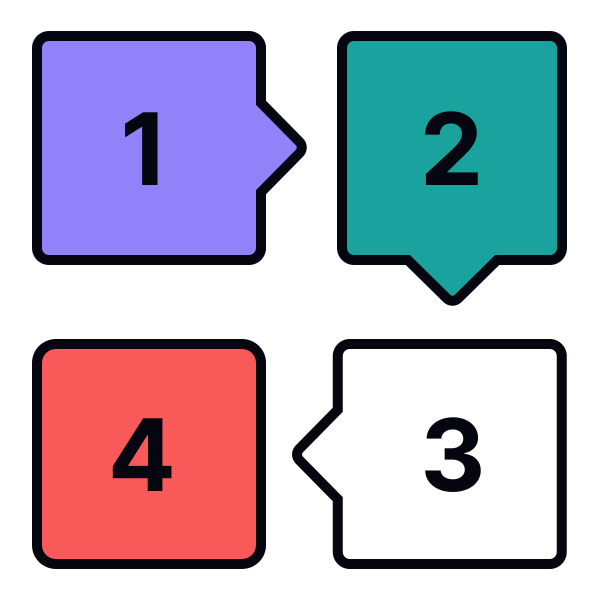
1
Establish the strategy
The skill identifies the strategy, the stage and constraints, and how reversible the decision is.
2
Score against strategy
It derives weighted criteria from strategy, picks the right framework, and scores to expose trade-offs.
3
Sequence the work
It groups work by theme, orders by dependency, and defines done beyond code deployed.
Try it with
Related skills

1.0.0
MIT
Product Management
Processes