


Most failed features were built exactly as specified. The specification was the problem: it described a solution nobody had checked against a real customer need. Product discovery is the part of product work that runs before that commitment, when changing direction costs a conversation rather than a quarter of engineering time. The teams that ship the right things are not the ones with the best ideas but the ones that kill the wrong ideas earliest, and discovery is the practice that lets them do it on purpose.
In this glossary topic:
- What is product discovery?
- How does product discovery work?
- How does product discovery differ from product delivery and UX research?
- Why does product discovery matter for product teams?
- How has product discovery changed with AI?
- What does product discovery look like in practice?
- How to learn product discovery
- FAQ

What is product discovery?
Product discovery is the work a product team does to decide what to build before committing engineering effort to building it: understanding the problems customers have, framing which opportunities are worth pursuing, generating candidate solutions, and testing the riskiest assumptions behind them cheaply enough to be wrong often. Its output is not a finished feature but a well-founded decision about which one to make next.
The word "discovery" is deliberate. The team does not start with a solution and look for evidence; it starts with a desired outcome and a customer, and finds out what stands between them. In the modern framing, associated with Teresa Torres's continuous discovery and Marty Cagan's work on empowered product teams, discovery is not a phase that ends when delivery begins but a weekly habit that runs alongside it. Discovery is a decision-making practice, not a research phase, which is why it belongs to the product trio of product manager, designer, and engineer rather than to a research department.
How does product discovery work?
Discovery follows a shape even when the tools vary. The team fixes an outcome first: a measurable change in customer behavior that the business needs, such as more first-week retention or fewer abandoned checkouts. Everything downstream has to trace back to it.
Underneath the outcome, the team maps opportunities: the unmet needs, problems, and desires that customers reveal in interviews and that, if addressed, would move the outcome. The opportunity solution tree is the usual way to hold this structure, with the outcome at the top, opportunities branching beneath it, candidate solutions under each opportunity, and experiments under each solution. Only then does the team generate solutions, deliberately several per opportunity rather than the first one that came to mind.
The final layer is testing. Every solution carries assumptions about desirability, viability, feasibility, and usability, and the team ranks them by how much damage a wrong assumption would do and how little evidence exists for it. The riskiest, least-supported assumptions get tested first, with the cheapest experiment that could disprove them: a prototype, a fake-door test, a concierge version done by hand. What survives testing earns a place in delivery.
How does product discovery differ from product delivery and UX research?
Discovery and delivery are two tracks of the same team's work. Delivery is building, shipping, and maintaining what has been decided; discovery is deciding it. Teams that treat discovery as a gate before delivery end up validating features already promised on a roadmap, which is confirmation rather than discovery. In the continuous model the two run in parallel, with the trio spending part of every week in customer conversations while the rest of the team ships.
Discovery also uses UX research heavily without being the same thing. Research is a set of methods for learning about users; discovery is the product decision process those methods feed. A researcher can run interviews for many purposes, and a product trio can run discovery with light, imperfect research as long as the decisions keep moving. Startup literature calls a similar loop customer development, and design thinking covers the same empathize-define-ideate-prototype-test arc from the designer's side. The difference is ownership and cadence: discovery is owned by the team that will ship the result, and it never finishes.
Why does product discovery matter for product teams?
Building is the most expensive way to find out an idea is wrong. A feature that takes a quarter to ship and then goes unused has cost the team the quarter, the maintenance burden, and the alternative it could have built. Discovery moves that learning forward to a point where a wrong idea costs an afternoon of interviews or a week of prototyping.
It also changes what the team argues about. Without discovery, roadmap debates are contests of conviction, settled by seniority. With a shared tree of outcomes, opportunities, and evidence, the same debates become questions about which assumption to test next. Discovery replaces "whose idea wins" with "what did customers actually do", which is a healthier fight for a team to have every week.
How has product discovery changed with AI?
Two steps have become much cheaper. Interview synthesis, once the bottleneck of continuous discovery, is now partly automated: research repositories such as Dovetail transcribe and tag customer conversations, and general assistants summarize a week of interviews into candidate opportunities in minutes. The trio still has to judge which opportunities matter, but the note-taking tax that pushed teams toward fewer interviews has largely gone.
Prototyping has shifted further. Tools that generate a working interface from a written prompt, including Figma Make, v0, and Lovable, mean a solution idea can be in front of a customer as a clickable artifact the same day it was sketched, which moves usability and desirability testing earlier in the tree. AI compresses the distance from an idea to a testable artifact; it does not tell the team which idea deserves the test, and teams that skip the opportunity mapping because prototyping is cheap end up testing many solutions to problems nobody has.
What does product discovery look like in practice?
The working artifact of discovery is the tree. The example below shows the tree's core, and reading it top down is reading the team's reasoning: these opportunities, each addressed by several candidate solutions, each waiting for the experiment that will test it.
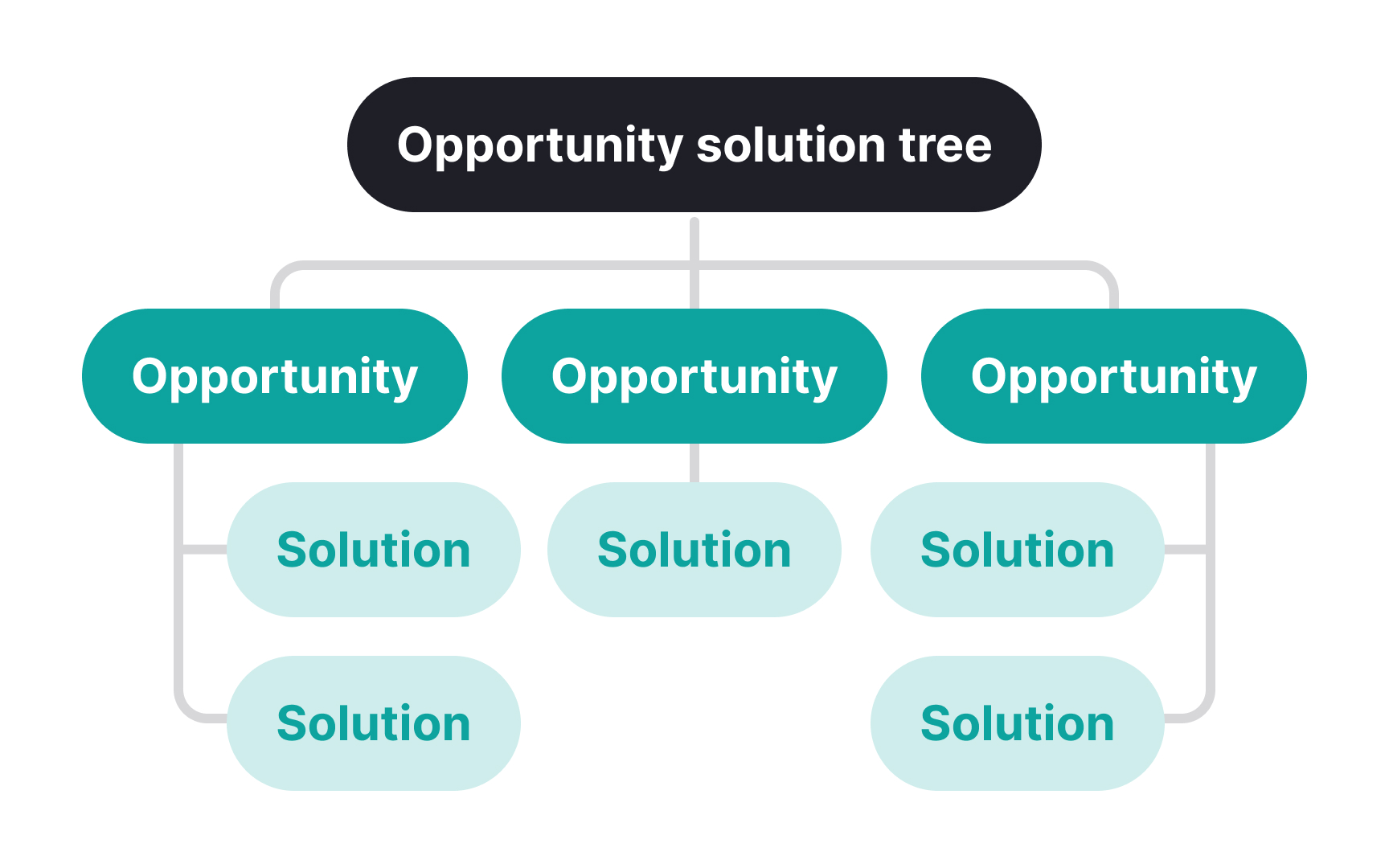
Opportunities above, solutions beneath: every solution can be traced up to the opportunity it serves, which is the test a roadmap item rarely passes. From the lesson Defining Opportunities.
Once a solution is on the tree, the team lists what would have to be true for it to work and sorts those assumptions on a grid. Assumption mapping is where discovery earns its reputation for saving quarters, because it names the one belief that, if wrong, sinks the idea, before anyone has written code around it.
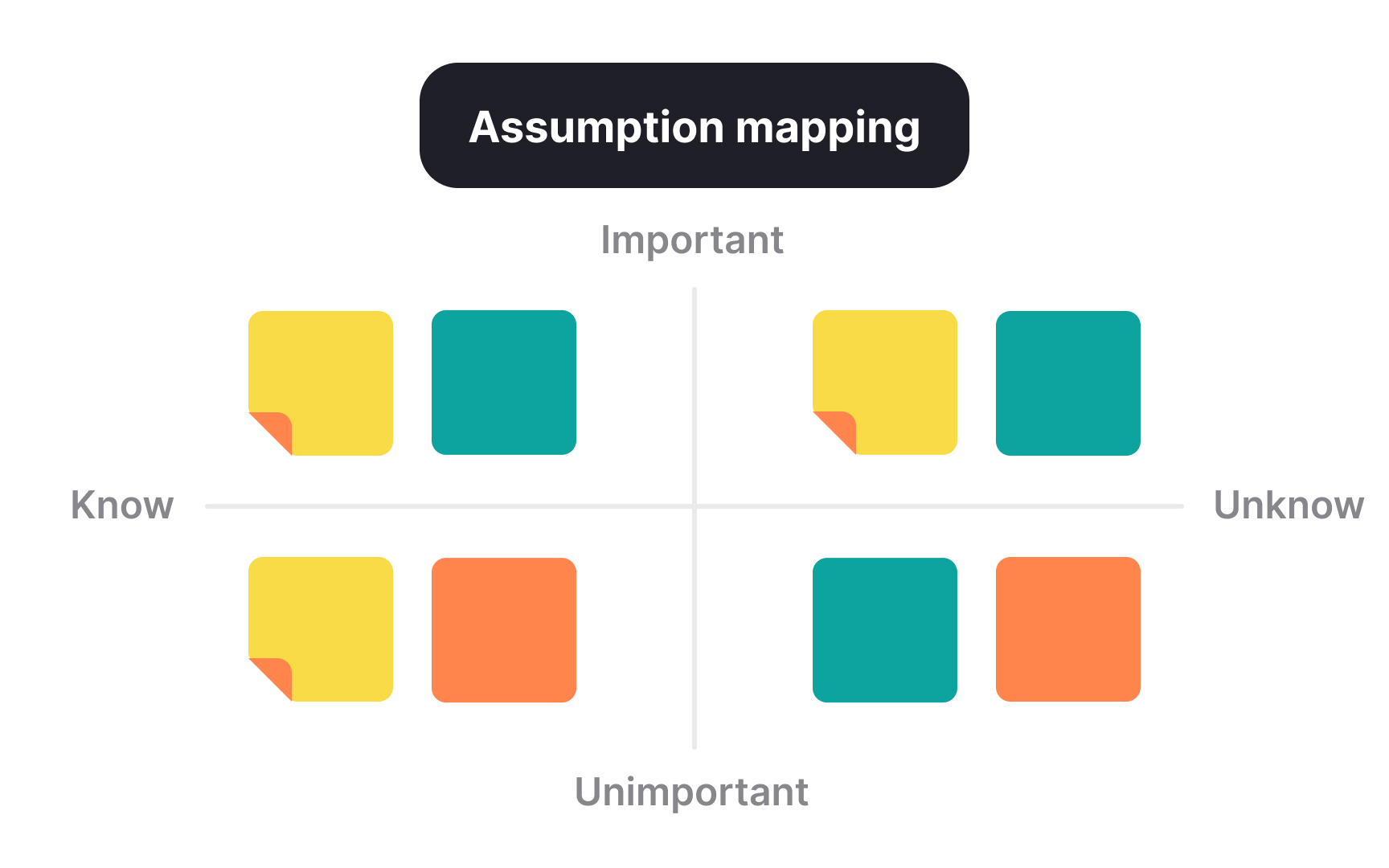
Important and unknown is the corner to test first; everything else waits until it holds.
How to learn product discovery
Foundations: what discovery is and why it never stops
Discovery starts with unlearning the idea that research is a phase. The Intro to Product Discovery lesson covers the steps involved in finding out whether a product idea has potential, and the Continuous Discovery Mindset lesson covers why weekly customer contact beats a quarterly study, and what a feature factory looks like from the inside. Seeing how discovery feeds a product strategy rather than replacing it is the framing to hold onto.
Starting from outcomes rather than features
A tree with the wrong thing at the top is a well-organized mistake. The Business Outcomes vs. Product Outcomes lesson covers translating a business goal such as revenue into a product outcome the team can actually influence, such as a change in customer behavior, and balancing user needs against business goals. The article on shifting from output-focused to outcome-focused product management is the longer argument for why a product roadmap of outcomes beats one of features.
Talking to customers every week
Opportunities come from conversations, not from the backlog. The Customer Interviews lesson covers preparing an interview, asking about specific past behavior rather than hypothetical preferences, and capturing what was heard in a form that feeds the tree. It is a specialized form of the user interview, with the emphasis on stories about the customer's own experience.
Mapping opportunities and outlining solutions
The tree is where interview notes become structure. Building an opportunity solution tree is the subject of the Defining Opportunities lesson shown above: putting the outcome at the top, structuring the opportunity space, and reframing solutions that arrived disguised as opportunities. The Outlining Solutions lesson then covers the lower half: generating several solutions per opportunity, defining criteria to compare them, and sharing the tree with stakeholders. The "How Might We" Exercise lesson supplies the ideation technique that keeps solution generation wide before it narrows.
Testing assumptions before building
Every solution is a bundle of beliefs. The Assumption Testing lesson covers generating and phrasing assumptions, mapping them by importance and evidence, and matching each to a test, and the Best Practices for Assumption Testing lesson covers running those tests so the results are trustworthy rather than flattering. A clear result here is what separates a validated idea from a minimum viable product launched on hope.
Prototyping to learn rather than to build
The last discovery skill is making things that are cheap to throw away. The Prototyping Techniques lesson covers matching fidelity to the question, from a sketch that tests whether an idea makes sense to a clickable prototype that tests whether people can use it. A prototype that answers its question and is then deleted has done its job; one that quietly becomes the production build has skipped the point.


