.svg)


Your analytics dashboard is screaming one thing. Your gut is whispering something else entirely. The A/B test says Feature A wins, but your most vocal users are asking for Feature B. Sound familiar? Welcome to the eternal product management dilemma: when should you let data drive your decisions, and when should you let it simply inform them? The answer isn't as straightforward as the "data-driven" evangelists would have you believe. Let's dig into finding the right balance.
The data-driven trap
Believe it or not, being purely data-driven can lead you straight off a cliff. Companies have invested millions in products that checked all the data boxes but still failed spectacularly. Why? Because data tells you what happened, not always why it happened or what should happen next. It's like driving, but only looking in the rearview mirror. It’s useful, but insufficient.
When data-driven goes wrong:
- You optimize for local maxima (making the current experience slightly better) instead of finding global maxima (reimagining the experience entirely)
- You miss emerging trends because they don't show up in historical data yet
- You ignore qualitative insights that could transform your product
- You become reactive instead of visionary
Let’s say your data shows users spend an average of 45 seconds on your settings page. Is that good or bad? Without context, you might optimize to reduce that time. But what if users are spending time there because they're carefully customizing their experience, leading to higher long-term engagement?
The intuition illusion
But swinging too far the other way is equally dangerous. Your intuition, no matter how experienced, comes with built-in biases.
When gut-driven fails:
- You build for yourself, not your users
- You mistake personal preferences for market needs
- You ignore warning signs in the data
- You can't justify decisions to stakeholders
Understanding the data-informed sweet spot
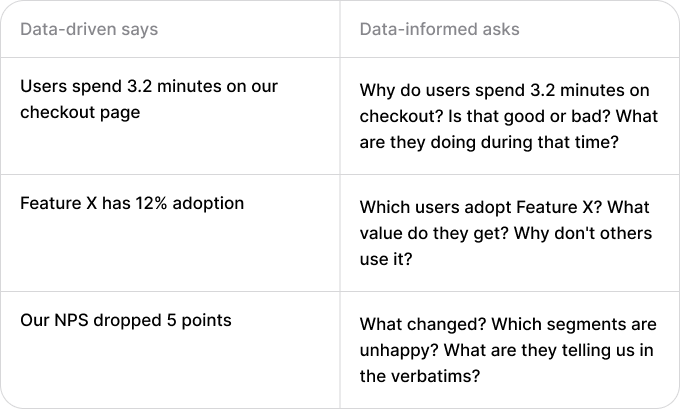
Being data-informed means using data as one input among many, not the only input. It's about combining quantitative insights with qualitative understanding, market context, and yes, some intuition. Here's how it works in practice:
When to lean heavily on data
Some decisions should be primarily data-driven. These typically involve optimization, risk mitigation, or choosing between existing options. For example:
- Pricing optimization: When you test different price points, data should drive the decision. User willingness to pay is measurable, and the impact on revenue is quantifiable.
- Performance improvements: If data shows your app crashes 5% more on Android 11, you don't need intuition; you need to fix it.
- A/B testing UI elements: Button colors, copy variations, layout tweaks; let the data decide. Users vote with their clicks.
- Resource allocation: Which features do users actually use? Where should you invest engineering time? Data provides clear answers.
- Churn prediction: Identifying at-risk users and intervention points is a data game. Patterns in user behavior predict future actions.
When to trust your gut (informed by data)
Other decisions require intuition, vision, and qualitative insights, with data playing a supporting role:
- New product development: Henry Ford's famous quote applies here: "If I had asked people what they wanted, they would have said faster horses." Data can't tell you what doesn't exist yet.
- Brand decisions: When Airbnb decided to shift from budget accommodations to "belong anywhere," data informed the decision, but vision drove it.
- Market disruption: When companies shift business models, like moving from perpetual licenses to subscriptions, the initial data often looks bad. Revenue might dip, some customers complain. But understanding market trends and long-term value can justify a short-term metric decline.
- User experience philosophy: Sometimes design decisions that test poorly in isolation work brilliantly in context. A minimalist interface might score lower in feature discoverability tests but create a calmer, more focused experience that users love over time.
The data-informed decision framework
Here's a practical framework for balancing data and intuition:
1. Start with the question, not the data
Before diving into dashboards, clearly define:
- What decision are you trying to make?
- What would convince you one way or another?
- What data would be helpful vs. misleading?
2. Gather multiple data types
- Quantitative: Analytics, metrics, A/B tests
- Qualitative: User interviews, support tickets, reviews
- Market: Competitive analysis, industry trends
- Internal: Team insights, stakeholder feedback
Our UX Research course teaches you practical methods for collecting user insights, analyzing patterns, and turning diverse data sources into actionable product direction.
3. Look for convergence and divergence
- Where do all inputs agree? That's usually a strong signal
- Where do they disagree? That's where you need a deeper investigation
- What's missing from the data? That's where intuition fills gaps
4. Consider the context
- Maturity: Early-stage products need more intuition; mature products can rely more on data
- Risk: High-risk decisions need more data; low-risk experiments can follow hunches
- Reversibility: Easy-to-reverse decisions can be more gut-driven
- Time horizon: Short-term optimization can be data-driven; long-term vision requires intuition
5. Make the decision and measure
- Document your reasoning (both data and intuition)
- Set clear success criteria
- Be ready to adjust based on new information
Real-world examples
- Spotify's discover: When Spotify noticed users had playlist fatigue and wanted music discovery, they didn't just look at play counts. They combined behavioral data with music attributes and collaborative filtering to create personalized playlists. The data-informed approach led to one of their most successful features.
- The shift to mobile-first design: When responsive design emerged, the data didn't initially support mobile-first approaches. Desktop still dominated traffic for many sites. But forward-thinking companies recognized the trend and invested in mobile before the data demanded it. Those who waited for the data to catch up found themselves playing catch-up.
Building a data-informed culture
Moving from data-driven to data-informed is, to a large extent,t about team culture, which you can build by:
- Encouraging "what if" discussions: Create space for ideas that data doesn't support yet.
- Rewarding learning, not just results: If someone makes a well-reasoned bet that doesn't pan out, celebrate the learning. This encourages innovation beyond what data suggests.
- Diversifying your inputs: Hire people with different backgrounds. Engineers bring different intuitions than designers, who see things differently than marketers.
- Questioning the metrics: Regularly ask: "Are we measuring the right things? What important aspects can't we measure?"
- Telling stories with data: Don't just present numbers. Explain what they mean, what they don't capture, and what intuition adds to the picture.
The balance in practice
Here's what data-informed decision-making looks like day-to-day:
- Monday: You notice engagement dropping 10% week-over-week (data)
- Tuesday: You dig into segments and find it's primarily new users (data)
- Wednesday: You conduct 5 user interviews and discover onboarding confusion (qualitative)
- Thursday: You remember a competitor just launched a similar feature with better onboarding (context)
- Friday: You decide to redesign onboarding, using data to prioritize which steps to fix first (data-informed)
To sum up, the goal isn't to eliminate intuition or ignore data. It's to use each tool when it's most powerful. Data tells you what is. Intuition helps you imagine what could be. The magic happens when you combine both.
To learn more about product analytics and make better data-informed decisions, check out our Product Analytics course.