


.svg)

In the MVP stage, a founder's prime directives are speed and judgment. Because AI removes the bottlenecks that used to slow a build, the failure modes here all share a theme: the brakes that once protected founders are gone, and the consequences arrive late.
This lesson examines four traps that AI makes easier to fall into, agentic technical debt, false product-market fit, zero-friction scope creep, and shipping insecure code. It also draws the line between debt that's a reasonable tradeoff and debt that compounds, and explains why each individually defensible feature still adds up to trouble.
This lesson draws on Anthropic's "The Founder's Playbook: Building an AI-Native Startup" [1].
Agentic technical debt
Because AI removes nearly every natural bottleneck that once controlled what reaches production, speed is guaranteed, and a particular kind of debt comes with it. Agentic technical debt differs from ordinary technical debt because it compounds rather than simply accumulating.
Without specs and architectural constraints written somewhere the AI can read, each session re-derives foundational decisions from scratch, and those decisions drift. The result is a codebase with no coherent mental model behind it, not because any single piece is bad, but because the pieces were never designed to fit together. That incoherence tends to surface late, when it's most expensive to fix.
False product-market fit
Early momentum is one of the most psychologically powerful experiences a founder can have. After months of validation and disciplined building, a surge of activity feels like confirmation. Agentic coding tools help reach that moment faster than ever, which makes the trap more tempting, not less.
Early traction is not the same as product-market fit. Launch energy comes from ephemeral forces: a founder's friends, an investor's portfolio companies, a Hacker News headline that drives a spike. None of those reliably predicts what happens at week six or week twelve when the initial boost fades. The question that matters is not how big the spike was, but whether anyone is still there after it passes.
Zero-friction scope creep
Scope creep has always been a startup risk, but the traditional brake on it, the real cost of engineering time, no longer works the same way when a feature takes an afternoon instead of a sprint. When building feels effortless and nearly free, there's always one more feature to add or edge case to handle.
The insidious part is that each addition is individually defensible. Of course the product should handle that case; of course some users will want that workflow. None of them feels like scope creep in the moment, but as the product sprawls beyond its original boundaries, it loses direction and momentum. The antidote is a written scope definition created before building begins.
Insecure by inexperience
Agentic coding tools generate code that works, not code that is inherently secure. Functional code is easy to verify, the feature either works or it doesn't, but security vulnerabilities are invisible until they're exploited. There's no natural feedback loop to alert a first-time founder that something is wrong.
Shipping a live MVP to real users means real data, real exposure, and real consequences if something goes wrong. Delaying security isn't unique to AI-native projects; bootstrapped startups in every era have deferred it. The difference now is the speed at which an insecure product can reach real users. A security review before anyone touches the product is the minimum responsible threshold for release.
Managed vs. compounding debt
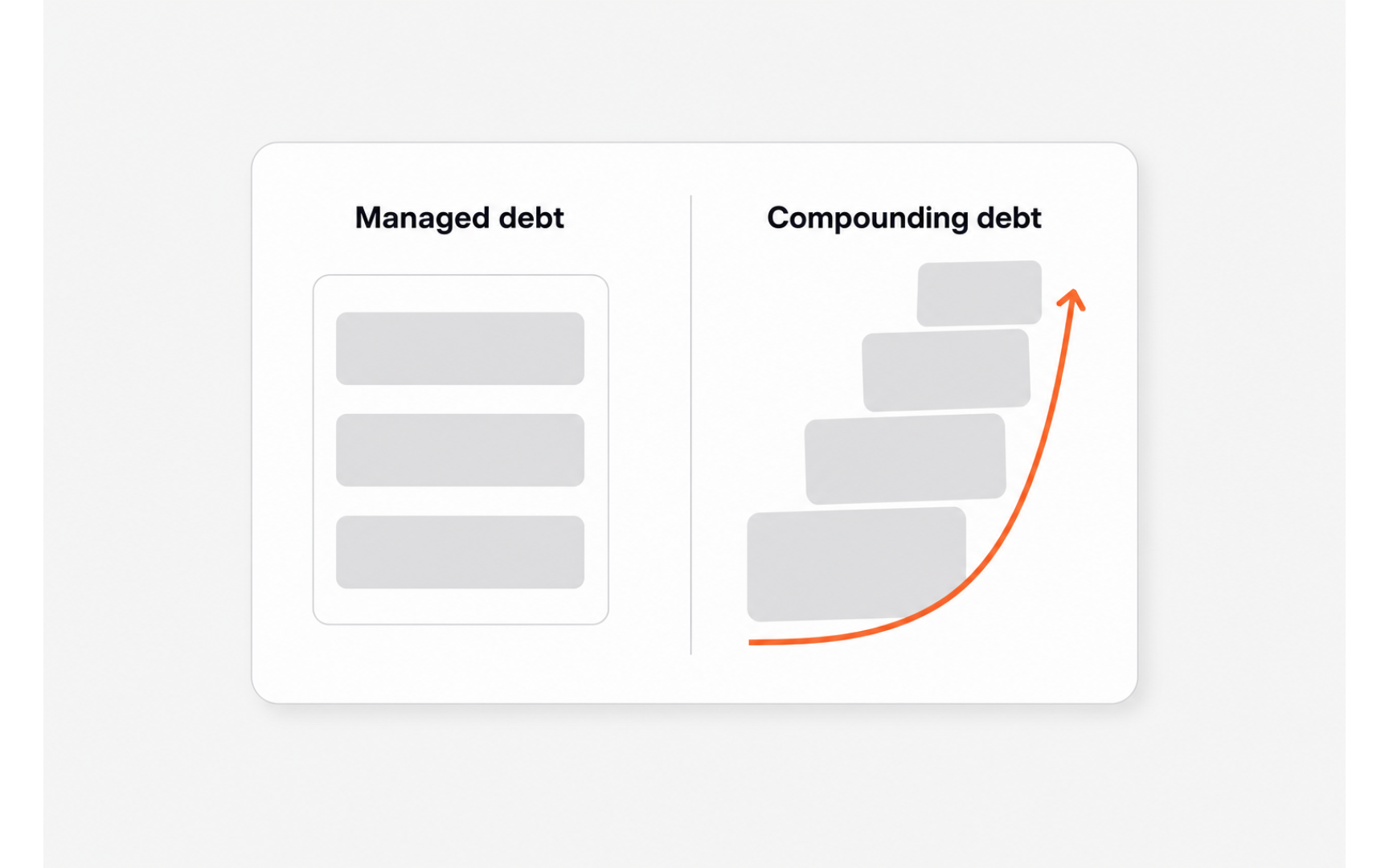
Not all technical debt is the same, and treating it as one undifferentiated risk leads founders to either panic about all of it or ignore all of it. Some debt is appropriate at the MVP stage. It builds gradually, it's taken on with the understanding that it must be cleared before scaling, and it can be paid down over time or in a dedicated sprint.
Compounding debt is the dangerous kind. It grows non-linearly because foundational decisions keep drifting without anything to anchor them, so each new layer rests on an unstable one. The practical distinction is whether the debt is known and bounded, or silent and structural. The first is a tradeoff; the second is a time bomb.
Why each addition feels defensible
The reason scope creep is so hard to catch is that the logic for each individual addition is sound. A specific user asked for it; a real edge case would otherwise break; a competitor already has it. Evaluated one at a time, almost every feature passes. The damage is cumulative, not individual, which is exactly why per-feature judgment fails to stop it.
The fix is to move the decision point. Instead of asking "should we build this?", a scope definition reframes the question as "have a critical mass of real users shown they can't get value from the product without this?". That raises the bar from plausible to evidenced, and shifts the burden from the founder's enthusiasm to the users' demonstrated need.