
.svg)




One fundamental challenge for many design teams is not their performance, but how it is measured.
We often claim to value deep thinking and genuine impact. But when it's time to actually evaluate a designer, we reach for what's easy to see: screens shipped, tickets closed, stakeholders kept happy. Measuring only the visible thing reduces design to production.
This misalignment forces designers to optimize for motion over resolution. Clarity is sacrificed for activity; features ship while core problems persist, leaving designers busy for years without actually sharpening their craft.
The goal isn’t to build a better scorecard, but to create an honest way of seeing the work that builds better designers rather than just ranking them.
That shift begins by holding two questions together: How effectively does a designer generate clarity? And does that clarity translate into measurable impact?
Answering these reveals a path to evaluate effort beyond activity, recognize impact as distinct from luck, and treat their relationship as the infrastructure for real growth.
Completeness of Thinking
Design leaders recognize a common warning sign: "The design is complete."
Polished interfaces often mask a lack of underlying logic, unaddressed problems, or missing success metrics, focusing cognitive energy on the interface instead of the actual problem. This seduction of output occurs because designers respond perfectly to what the organization measures, making the screen the ultimate obsession.
Shifting focus upstream requires design documentation, which must avoid becoming a performative tax through three fundamental shifts.
- First, match the depth to the specific class of work, ensuring rigor follows project gravity to avoid unnecessary bureaucracy.
- Second, let the structure enforce the thinking, using templates that make it impossible to bypass essential problem-space questions.
- Third, the document must serve as shared infrastructure that cross-functional partners rely on to understand the underlying logic and metrics for success.
This shift redirects energy toward understanding genuine constraints early and predefining clear, sustainable solutions. Ultimately, making the thinking visible ensures it can no longer afford to be shallow.
Other Signals: Time, Readiness, and Validation
Beyond deep thinking, clarity manifests through three additional signals: timeliness, readiness, and validation.
Timeliness
Timelines act as vital constraints that filter the depth an initiative justifies. Capable designers treat time as a fundamental dimension of the problem itself.
Discerning whether a designer is protecting necessary depth or struggling with momentum is impossible at the deadline; the distinction reveals itself early through communication. Transparent communication justifies effort, surfaces blockers early, and allows for shared adjustments mid-flight. Without it, a manager is left only with a missed date.
Readiness for Implementation
A solution's strength lies in its execution. True readiness encompasses technical feasibility, precise specifications, and mapped edge cases rather than just visual coherence. Engaging engineering early, while logic is fluid, separates resilient solutions from those that fail during the build. Design is only finished when it is built to be real.
Validation
True design must be accurate, not just persuasive. Without validation to check conviction against reality, design remains an opinion performing as output. Validation requires active signals—like critiques or usability testing—calibrated to the project's gravity. Designers must check biases to ensure they solve the actual problem identified.

Not All Work Deserves the Same Effort
Frameworks fracture when they apply uniform expectations instead of clarifying the required depth of thinking upfront. Rather than practicing performative thoroughness, teams must calibrate rigor to an initiative's gravity using a work taxonomy.
Most design challenges fall into three distinct classes:
Class 1 — High-Velocity Tasks (Low complexity, minimal risk). Obvious fixes where momentum is the primary metric and documentation is unproductive bureaucracy.
Class 2 — Core Execution (Moderate complexity, defined risk). Visible problems requiring intentional reasoning and a solution balancing speed against necessary depth.
Class 3 — High-Ambiguity Exploration (High complexity, strategic risk). Unknown problems where design drives definition, justifying deep validation to prevent expensive failures.
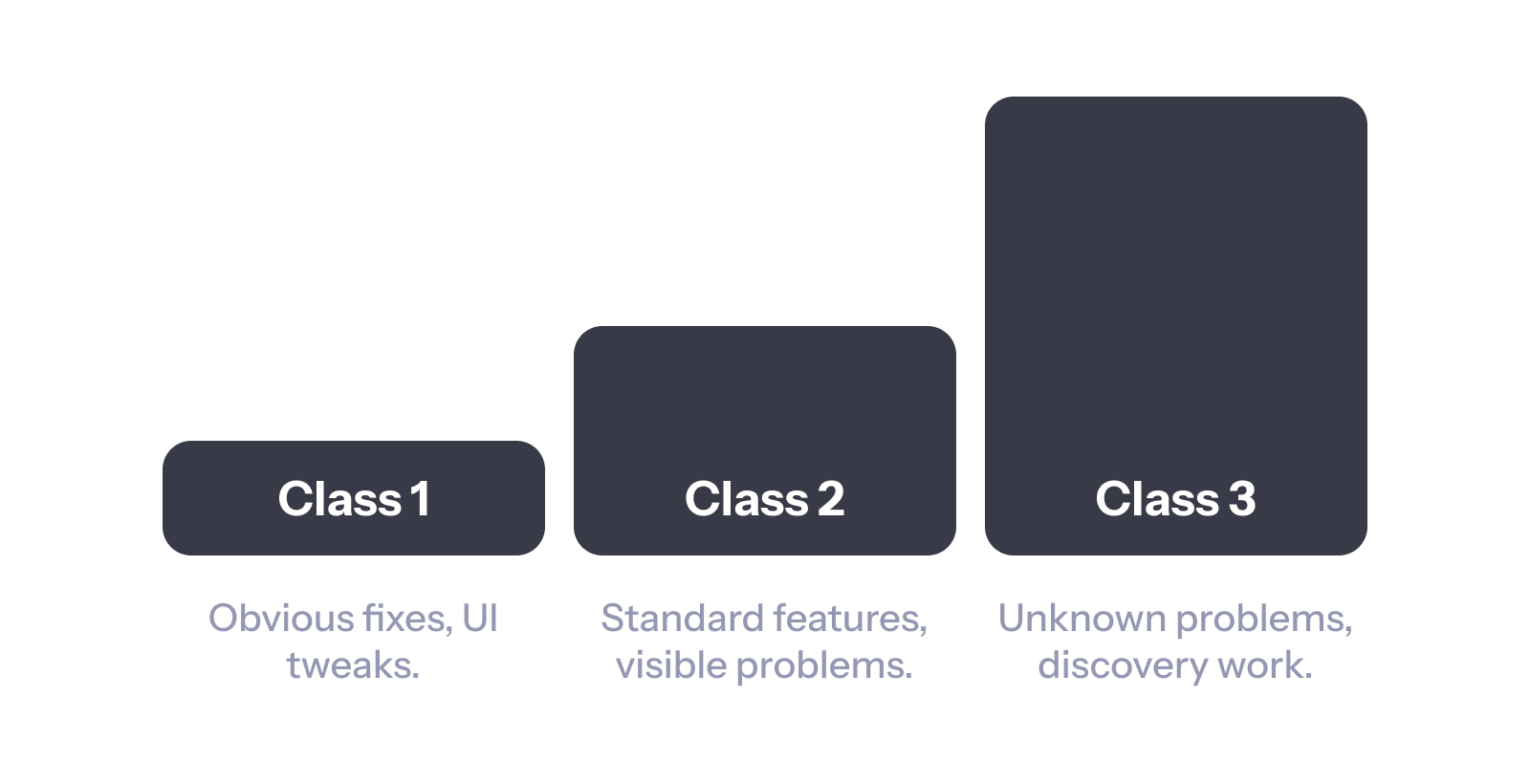
The variable across these tiers is the depth the work justifies. To ensure honest assignment and prevent the system from rotting, we rely on two anchors.
- The first is tracing the origin, as a project's source reliably signals its inherent complexity.
- The second is the shared planning brief, where cross-functional partners collaboratively define scope to create a collective understanding.
Finally, classifications must remain fluid to prioritize accuracy over rigidity. When a task changes mid-flight, the classification must shift accordingly. The goal is to maintain a shared read on the work. Justified, transparent reclassification prevents scope creep and maintains team trust.
This adaptability proves the system is working, allowing the team to adjust expectations without friction and see the work as it truly is.

Measuring Impact
While effort and the clarity a designer provides are easily appraised, clarity is only one facet of evaluation.
Performance frameworks often fail when evaluating impact, drifting either toward shallow activity ("did it ship?") or abstract business metrics. Neither offers an honest view of whether the work mattered.
Attribution is difficult because impact is rarely a solo act; adoption and revenue depend on external factors like engineering quality and market timing. Grading designers on uninfluenceable outcomes is unfair, yet ignoring outcomes entirely reduces design to measuring production. The challenge lies in balancing both.
This navigation must begin before work starts.
1. Defining Impact Upfront
Every initiative must justify how it moves the team toward its primary objective, filtering out fragile projects before work begins. This shifts the decision of a project's worth from the performance review to the point of selection, creating a shared thesis upfront.
Like design documentation defining problem success metrics, the selection filter defines organizational impact. Mastering both ensures the team is aligned and rarely blindsided by results.
Once established, impact reveals itself through three distinct layers.
Delivery. Shipping a solution against a clearly identified problem represents progress rather than mere production.
Reliability. The solution must survive the build. A feature that breaks upon shipping creates negative impact, proving that delivery requires stability.
Adoption and Growth. User engagement, usage patterns, and retention prove that the designer solved a genuine problem rather than a theoretical one.
2. The Ownership of Results
Since building is a collective bet, dealing with shortfalls requires shared ownership across design, product, and engineering, ensuring no single function becomes a scapegoat.
However, shared ownership is not an excuse for vagueness. If underperformance stems from design choices, the designer is accountable; if from a flawed business bet, the team shares it. Accountability must rest where the decision originated.
This motivates the entire team to scrutinize logic before committing to the work. When a bad bet affects everyone, shared consequences drive genuine due diligence, turning accountability into a tool for better decision-making.
While diagnosis relies on human judgment rather than perfect objectivity, the goal is an environment of honest outcome sharing. For a growing team, this honesty is far more valuable than a perfect scorecard.

Putting It Together: Effort × Impact
This system rests on two pillars: effort, defined by the clarity a designer generates, and impact, defined by tangible results. True performance exists in the friction between them; beautiful logic without results is not performing, nor is accidental success.
This relationship is often visualized as a grid:
High Effort, High Impact — the ideal trajectory.
High Effort, Low Impact — rigorous thinking, flat outcomes.
Low Effort, High Impact — fortunate but unsustainable wins.
Low Effort, Low Impact — self-evident failure.
However, the grid is often abused as a scorecard. Treating a quadrant as a final verdict reduces evaluations to the same shallow measurement we seek to dismantle.
Instead, the grid should serve as a map for conversation to diagnose the "why". "High effort, low impact" is an inquiry, not a grade: did adoption stall due to brittle design logic or a flawed business thesis? The grid opens the door, but impact analysis provides the answer.
Two anchors help maintain the system's integrity. The first is institutional memory, weighing diagnoses across multiple cycles to find recurring signals rather than single flat quarters. The second is diversity of work, tracking signals across varied project complexities to rule out luck. Finally, involving peers, stakeholders, and leads ensures the diagnosis is a collective alignment rather than a manager's private narrative.
Held with integrity, the grid ceases to be a judgment and becomes a structured lens for tracking clarity and results, revealing a real story of designer growth.
The Nature of the Shift
This rigor transforms the craft: designers own problems over interfaces because their thinking is valued. Documentation becomes an insightful tool rather than a performative tax, while depth and speed are calibrated by choice instead of anxiety. Crucially, reviews stop being defensive rituals as both the designer and their manager navigate the same territory.
Yet, the most profound change is even more fundamental.
From Measurement to Growth
Growth is impossible in a system that only recognizes output. This is the hidden cost of production-based management: a designer can deliver polished artifacts for years yet remain stagnant because the organization conflates busywork with craft. Measuring only screens deprives designers of the clarity needed to improve.
This framework bypasses superficial activity metrics in favor of growth metrics, creating an environment specific enough to make the reality of their work useful. If you measure output, you get more artifacts; but if you measure clarity and impact honestly, you build designers who think like owners and continually sharpen their craft.