
I lost track of time researching General Assembly’s product management course. What started as checking a few reviews turned into spending way more time than planned reading student experiences, digging through pricing details, and trying to figure out if this AI-First curriculum they launched is actually different or just marketing. This surprised me, I expected a clearer picture, but the reality turned out way more complicated than GA’s marketing suggests.

The course costs $4,500, promises comprehensive PM training with new AI integration, and touts access to 100,000+ alumni. It is structured as a certificate program, offering a multi-course educational experience that provides a credential upon completion. However, recent student feedback tells a messier story that most promotional materials conveniently skip over, especially when it comes to whether the content justifies the price tag or could be learned more cheaply elsewhere. One person who finished in July 2025 wrote on Trustpilot: “Content was thin for a 10-week program. Most of it could be picked up from a book.”

That criticism wasn’t isolated. Price concerns kept showing up in reviews. The course sits at 3.8/5 on Trustpilot across dozens of reviews. Yet successful outcomes exist too. The results are all over the place, which made me realize the value depends entirely on your specific situation rather than the course quality itself.

This review cuts through GA’s marketing to examine what you actually get for $4,500, who thrives in this program, and whether cheaper alternatives make more sense. I’ll cover the new AI-First curriculum (launched December 2025), real student outcomes from recent graduates, honest limitations GA doesn’t advertise, and three alternatives worth considering, including one at $24/month that might work better for most people.

What I found: complete curriculum breakdown with what’s actually covered versus what’s marketing fluff, transparent pricing analysis including hidden costs, unfiltered 2025 student reviews (positive and negative), realistic job prospects without the spin, and direct comparisons to competitors. No affiliate links, no sponsored content, just trying to help you decide if this is worth your money and time.

The essentials upfront

Program name: General Assembly Product Management Short Course
Provider: General Assembly (part of Adecco Group/LHH brand)
Founded: 2011 (Product Management course offered since early days)
Cost: $4,500 USD
Duration: 40 hours total (10 weeks part-time OR 1 week full-time)
Format: Live instruction via Zoom, online and select in-person locations
Prerequisites: None (beginner-friendly, 3-hour onboarding prep)
Certificate: Yes, professional certificate of completion recognized in the industry + LinkedIn badge
Job guarantee: No
Student rating: 3.8/5 on Trustpilot (dozens of reviews), mixed feedback on other platforms
Graduation rate: 82% (company-wide statistic)
Key update: New AI-First Product Management curriculum launched December 2025

Payment options: Upfront payment, 2-4 installment plans, 0% financing through Climb, employer sponsorship available, women’s scholarship program

Essential certificate program: This is an essential certificate program for aspiring product managers in the tech industry, designed to provide foundational skills and industry-recognized credentials.

Ideal for: Career switchers wanting brand-name credential, professionals needing structured learning, those who can secure employer sponsorship, learners interested in AI-integrated curriculum, and those seeking hands on experience through practical projects.

Not ideal for: Budget-conscious learners, experienced PMs seeking advanced depth, those wanting job guarantee, people preferring self-paced or video-based learning

Unique selling point: Large alumni network (100,000+), nearly 20,000 hiring partners, new AI-First curriculum, flexible format options, enterprise credibility, and hands on experience with real-world projects.

The curriculum is designed to help students set clear objectives for product management success, ensuring they gain the essential skills needed to thrive in the tech industry.

For more info, click or read further for additional course details.

What is General Assembly?

General Assembly launched in 2011 during the bootcamp explosion with a mission to transform careers through tech education and prepare students to create great products. Unlike coding bootcamps that focus exclusively on software engineering, GA built a portfolio approach, offering courses in web development, data science, UX design, digital marketing, and product management.

The company expanded fast. GA now runs 20 campuses worldwide with over 100,000 graduates across all programs. Adecco Group (the parent company behind the LHH brand) acquired them, which added corporate backing but also shifted their focus toward enterprise training alongside individual courses. This change that affects how they prioritize resources and support.

The Product Management Short Course specifically emerged as one of GA’s early offerings. The course has evolved significantly since launch, with the most recent transformation happening in late 2025.

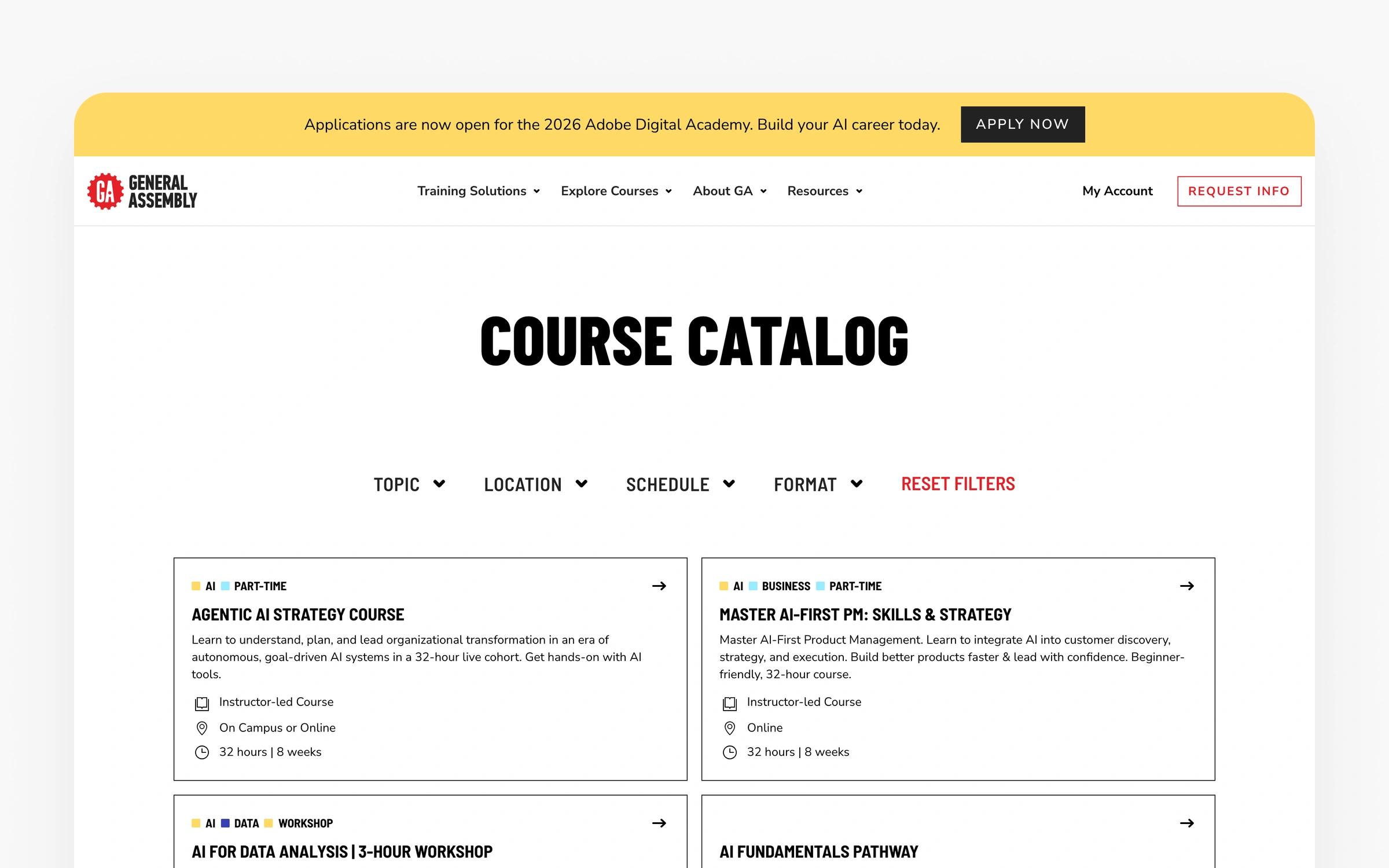
In December 2025, GA announced four new AI courses and repositioned their product management curriculum as “AI-First Product Management.” This wasn’t just rebranding. GA surveyed product managers and discovered something striking: 98% use AI at work, but only 39% received proper training for it. GA rebuilt the curriculum to integrate AI tools throughout the product life cycle, so students learn to manage every stage from concept to launch and ongoing maintenance using AI.

The structure offers flexibility. Students choose between a 10-week part-time format (two evenings per week, 4 hours per session) or a 1-week full-time intensive (Monday through Saturday, 9am to 5pm). Both formats deliver the same 40 hours of live instruction via Zoom.

Instructors come from companies like Google, Microsoft, and Amazon. GA requires minimum 5+ years of product management experience from it’s instructors, so students learn directly from experienced product leaders. 

The course centers on hands-on learning. Students complete a final project where they develop a product or feature from concept to pitch, creating documentation and presenting to the class. Teaching assistants hold office hours for individual support. The curriculum emphasizes collaborative learning, with breakout groups and peer feedback sessions.

GA maintains a Product Management Advisory Board that curates industry best practices to keep curriculum relevant. The company partners with nearly 20,000 employers and claims 200+ companies use GA for corporate training, including Microsoft, Deloitte, PwC, and Fujitsu. GA also boasts a large alumni network. Product managers occupy a key role in the tech industry and companies often compete to hire the best talent.

The certificate carries brand recognition but isn’t equivalent to formal credentials like CSPO (Certified Scrum Product Owner) or university degrees. It signals practical training and career initiative rather than academic achievement or specialized certification.

What will you actually learn?

The AI-First Product Management curriculum divides into six major modules delivered across 40 hours. The breakdown based on official materials and instructor interviews:

Module Topics covered Duration Key deliverable
Module l Problem-focused product thinking 6-8 hours Problem validation research
Module 2 Product vision and strategy 6-8 hours Vision and strategy document
Module 3 Product development and roadmapping 8-10 hours Detailed product roadmap
Module 4 Stakeholder management and collaboration 6-8 hours Stakeholder presentation
Module 5 Data-driven decision making and metrics 6-8 hours Analytics dashboard
Module 6 AI-enhanced product management 4-6 hours AI integration plan
Final project End-to-end product development Throghout Complete product pitch
Total 6 modules + project 40 hours Portfolio-ready project

Throughout the course, students will discover essential skills and concepts needed for product management, including launching new products, measuring the product’s success, and identifying the path forward after product testing and data analysis. The curriculum emphasizes that a product manager is responsible for the product's success, which begins with setting a vision for the future. Students will learn how a skilled product manager can make the difference between success and failure in the market by applying best practices and strategic thinking. Product management is essential for creating products that customers love.

Module 1: Problem-focused product thinking (6-8 hours)

This foundation module challenges students to move beyond solution-based building. You’ll learn to identify real problems versus disguised solutions, conduct user research to validate problem existence, and distinguish between what users say they want and what they actually need. The module emphasizes the importance of understanding the target customer and value propositions when validating problems, ensuring that product development is guided by the specific needs and preferences of the intended audience. The AI integration appears here through AI-enhanced customer research techniques, using tools to analyze user feedback patterns and identify problem clusters more efficiently. What caught my attention: students report this module feels basic if you’ve already done customer research work, but transformative if you’re coming from engineering or design backgrounds without user research experience.

Module 2: Product vision and strategy (6-8 hours)

The strategy module covers market analysis, competitive positioning, and vision articulation. Students learn frameworks for opportunity sizing, including total addressable market (TAM) calculations and prioritization matrices.

Product managers must articulate a winning product by defining a specific customer, a specific problem, and a solution. Product strategy is the critical link between an organization’s long-term vision and its short-term execution.

GA’s December 2025 announcement mentioned the new AI curriculum adds vision setting with AI tools that help product managers create more data-informed strategies faster, including AI-powered opportunity sizing tools for market research synthesis, competitor analysis automation, and trend identification. From alumni feedback, this module tends to generate the most diverse reactions. Some find it eye-opening, others feel it rushes through complex strategic concepts too quickly for proper understanding.

Module 3: Product development and roadmapping (8-10 hours)

This core section focuses on taking products from concept to launch. Coverage includes product roadmap creation, feature prioritization frameworks (RICE, weighted scoring, Kano model), minimum viable product (MVP) definition and validation, and agile sprint planning.

After launching a minimum viable product, a product manager needs to measure what’s working and what’s not, then make quick adjustments. The product management process involves measuring progress and making quick adjustments after launching a product. This module also highlights the importance of the product life cycle, guiding students through the iterative nature of product development and reinforcing that the process must follow the best product design and development processes to ensure successful market delivery and longevity.

Students work with real examples, often bringing products from their own companies to workshop. The AI-assisted roadmapping component teaches how to use AI tools for scenario planning, dependency mapping, and timeline estimation. This is the longest module for good reason. It’s where theoretical knowledge meets practical application, and many students mention needing extra time outside class to complete their roadmap assignments properly.

Module 4: Stakeholder management and collaboration (6-8 hours)

Product managers live at the intersection of business, design, and engineering. This module addresses the “soft skills” that determine success. You’ll learn cross-functional team dynamics, communication strategies for different audiences (executives, engineers, designers, customers), conflict resolution in product decisions, and techniques for getting buy-in from key stakeholders without formal authority.

Product managers need to craft a clear strategy and roadmap while gaining buy-in from key stakeholders. The product manager must also partner with an engineering team on a day-to-day basis as the team writes and releases code.

Guest speakers sometimes join to share real stakeholder management scenarios. Breakout exercises simulate difficult conversations like explaining delayed features to executives or pushing back on engineering timelines. Students consistently rate this as one of the most immediately applicable modules, particularly those already working in tech environments where they face these situations daily.

Module 5: Data-driven decision making and metrics (6-8 hours)

The curriculum emphasizes quantitative product management. Topics include defining product KPIs, A/B testing fundamentals, interpreting user analytics, creating dashboards for different stakeholders, and data-informed experimentation.

Product managers are accountable for building a delightful customer experience and achieving key objectives.

Students learn when to trust data, when to supplement with qualitative research, and how to avoid common analytics pitfalls. The AI integration here focuses on experimentation using AI tools to run faster test cycles and analyze results more thoroughly. Several reviews mentioned this module assumes basic analytics familiarity. Complete beginners might need supplementary learning to keep pace.

Module 6: AI-enhanced product management (integrated throughout, 4-6 hours dedicated)

This 2025-2026 addition runs as a thread through all modules plus includes dedicated sessions. GA’s announcement mentioned it covers AI-enhanced customer research, opportunity sizing, vision setting, roadmapping, Agile execution, experimentation, and pitch development, plus responsible AI frameworks.

Students learn practical AI tool usage for product managers, including how to prompt AI effectively for product work, which tasks to automate and which require human judgment, ethical considerations in AI product decisions, and building products that incorporate AI features. This is GA’s competitive differentiator right now. Most competing programs haven’t integrated AI this deeply into their PM curriculum yet, which gives the course some unique value if you’re specifically interested in AI-enhanced workflows.

Final project: End-to-end product development

The capstone project spans the entire course. Students choose a product or feature to develop, applying each module’s learning to build comprehensive documentation. Deliverables include problem validation research, product vision and strategy document, detailed roadmap with prioritization rationale, stakeholder presentation deck, and final pitch to the class.

Creating a prototype simulates the product experience just well enough to get valuable feedback from potential customers. A product manager is responsible for the product’s success, which begins with setting a vision for the future. A skilled product manager can make the difference between success and failure in the market by ensuring that every step, from vision to execution, is aligned with the product’s goals. Alumni report this project varies in quality depending on effort invested. 

What’s not covered

Several important areas receive limited attention. Technical product management (APIs, system architecture, technical debt) gets surface-level treatment. B2B enterprise product management differs significantly from consumer products, but the curriculum doesn’t deeply differentiate. Growth product management (viral loops, growth hacking, optimization) appears briefly but isn’t comprehensive.

More concerning, some students report the content itself feels thin. A July 2025 Trustpilot review stated: “Content was thin for a 10-week program. Most of it could be picked up from a book. I wouldn’t recommend it for those entering product management. I found that the Certified Scrum Product Owner (CSPO) course is more recognised and practical.”

This criticism appeared across multiple reviews. The question becomes whether 40 hours of structured learning with networking justifies $4,500, or whether self-study plus cheaper alternatives would serve better.

Job Preparation and Outcomes

The program includes mock interviews to help students prepare for product management roles, ensuring they are ready to break into the field. The curriculum also helps students identify the path forward after product testing and data analysis, supporting ongoing growth and decision-making in their product management careers.

How much does this actually cost?

The price is $4,500 USD for the Product Management Short Course as of January 2026. Breaking down the actual financial commitment and what you get for that investment:

Payment option Amount Terms
Upfront $4,500 One payment before the course
2 installments $2,250 x 2 During 10-week course
4 installments $1,125 x 4 During 10-week course
Climb 0% financing Varies 18-24 months, starts immediatelly
UK EdAid £250 + 24 payments £250 upfront, rest over 24 months

General Assembly offers four main payment approaches:

Upfront payment: Pay $4,500 in full before the course starts. Some sources mention saving $250 with this option, though current GA marketing doesn't prominently advertise this discount. Verify with admissions if upfront savings still apply.

Installment plans: Divide tuition into 2, 3, or 4 payments made while enrolled in the course. This puts payments as low as $1,125 per installment. No interest charged, but requires completing all payments during the 10-week course timeline (or 1-week for intensive format).

0% financing through Climb: This option offers the most extended payment timeline. GA partners with Climb to provide 0% interest loans over 18 or 24 months. You start paying immediately after enrollment through the Standard Pathway. Loan approval depends on credit eligibility. This option works best if you need to spread the cost over time without interest charges.

Alternative financing through Ascent: Ascent offers more flexible but potentially more expensive loans. Options include immediate repayment, deferred payments (start paying after course completion), or interest-only payments during the course. These carry interest charges, so compare the total cost carefully against 0% Climb option.

In the UK, GA partners with EdAid for 0% interest payment plans. You pay £250 upfront, then split the remaining balance over 24 monthly installments starting from day one of the course. No early repayment penalties.

Employer sponsorship: GA can send a sponsorship package directly to your employer. Many companies have professional development budgets that cover course costs. If you work at a company that values product management skills, this route could make the course free for you personally.

Scholarships and discounts: GA offers tuition discounts to women through the "See Her Excel" program. Registration fee waivers appear during promotional periods (a $100 fee waiver was advertised with code application in December 2025). Check with admissions about current discount programs.

What the $4,500 includes

Your investment covers 40 hours of live instruction, access to all course materials including lesson decks and project toolkits, teaching assistant support during office hours, a final project with instructor feedback, a certificate of completion upon passing, LinkedIn-shareable digital badge, and lifetime access to course materials for reference.

You also get access to the alumni network (100,000+ graduates across all GA programs), career workshops and networking events, exclusive alumni discounts on future courses, and connection to GA's hiring partner network of nearly 20,000 companies.

What's not included

The course doesn't provide job placement services, personal career coaching (that's separate for immersive programs), or any job guarantee. You won't get 1-on-1 mentorship beyond office hours. The certificate isn't a formal credential like CSPO, AIPMM, or Pragmatic Institute certification.

Books, additional software, or subscriptions for learning outside class come from your own budget. If you want to build a comprehensive portfolio beyond the single final project, that's extra work and potentially extra expense.

Cost comparison reality check

At $4,500, GA sits in the mid-to-upper price range for product management education. Product School charges similar rates (around $3,000-$5,000). CareerFoundry costs $6,900 but includes a job guarantee and intensive mentorship. Product HQ bootcamp is less expensive with a money-back guarantee if you don't get a job within 6 months.

On the lower end, Interaction Design Foundation offers subscription-based learning for under $200/year. Udemy courses run $10-$50 on sale. Uxcel charges $24/month ($288 annually) for comprehensive skill-building with documented outcomes (68.5% promotion rate, $8,143 average salary boost per their 2025 Impact Report).

The CSPO certification mentioned by that critical student costs around $1,000-$1,500 for a 2-day course and carries more specialized recognition in agile environments. Books and self-study cost under $100.

Is the price justified?

This question divides students sharply. Those who successfully leveraged the network, applied learning immediately at work, or transitioned careers tend to view it as valuable. Jack from Bonfyre said the course helped him "speak confidently and effectively in interviews for PM roles in the future" and expanded his responsibilities.

Critics point to the content-to-price ratio. The July 2025 Trustpilot review calling content "thin" reflects a sentiment that appeared in multiple places. If equivalent knowledge exists in books or free online resources, you're essentially paying $4,500 for structure, accountability, networking, and brand recognition rather than exclusive information.

One anonymous review on Quora stated: "I took the Product Management course last winter and I didn't finish the course because I didn't find much value in the course." Another negative Trustpilot review from December 2025 claimed: "Don't believe the fake reviews! This scam company does nothing you can't do on your own with a browser or AI."

Real-world scenario: Should Maya pay $4,500?

Consider Maya, a UX designer at a mid-size tech company who's been doing informal PM work, talking to users, prioritizing features, working with engineering, and wants to formalize this into an actual PM role. Her company has a $3,000 annual professional development budget. She's trying to decide between GA's course and alternatives.

For Maya, the calculation looks different than for someone unemployed and career-switching. Her company covers most of the cost ($3,000), she only pays $1,500 out-of-pocket. She already has relevant experience and network. The GA credential helps her pitch for an internal PM promotion. The live format keeps her accountable. In this scenario, GA might make sense.

But change one variable. Maya's company won't sponsor, she's paying $4,500 herself, and suddenly Uxcel at $24/month looks much more attractive.

The value calculation depends on what you need. If you're self-motivated and can learn from books/online resources for under $300, spending $4,500 is hard to justify. If you need structure, want the GA network, and can get employer sponsorship, the investment makes more sense. If you're paying out of pocket and need a job guarantee, General Assembly might not make sense.

Is this course right for you?

The General Assembly Product Management Short Course serves specific student profiles well while being a poor fit for others. An honest assessment based on alumni experiences and program structure:

You’re a strong candidate if you:

  • Already work in tech and can get employer sponsorship. Without out-of-pocket cost, the downside disappears. Free structured learning with networking is valuable regardless of whether content is available elsewhere.
  • Are doing product management work informally and need to formalize your knowledge. Jack’s story exemplifies this. He was doing PM tasks at Bonfyre but lacked frameworks and vocabulary. After GA, he transitioned to a Customer Solutions Architect role with formal PM responsibilities. If you’re in a similar position (doing PM work without the title, or adjacent to product teams), GA can accelerate internal mobility.
  • Need networking more than novel information. Multiple positive reviews emphasize the cohort experience. One student wrote: “All the students in the course were really engaged and wanted to be there. It created an environment where people asked questions and wanted to meet and learn from each other.” If you value peer learning and want to build relationships with other aspiring PMs, the collaborative format delivers. Companies often compete to hire the best product management talent in the tech industry, so building a strong network through GA can be a significant advantage.
  • Prefer live instruction over self-paced learning. Some people don’t finish self-paced courses. GA’s scheduled classes, homework deadlines, and cohort accountability keep you on track. If you know you need external structure, the format works.
  • Want brand recognition for career changes. The GA name carries weight. If you’re transitioning from an unrelated field and need a credential that signals “I’m serious about this,” the certificate program helps. Upon completion, you receive a professional certificate, which is recognized by employers and can support your career advancement. Combined with the network effect (GA alumni at hiring companies), it opens doors, especially in a competitive tech industry where companies are actively seeking top product management talent.
  • Are interested in AI-integrated product management. The AI-First curriculum launched December 2025 gives GA a temporary competitive advantage. If learning to use AI tools throughout the product lifecycle interests you, this updated content is relevant.

You should look elsewhere if you:

  • Are budget-conscious and paying out of pocket. At $4,500, the July 2025 Trustpilot review stating “content was thin” and “could be picked up from a book” represents a real risk. Uxcel charges $24/month with documented 68.5% promotion rate and $8,143 average salary boost. Books plus self-study cost under $100. If price matters, cheaper alternatives exist.
  • Already have PM experience and need advanced training. Several reviews mentioned the beginner-friendly approach doesn’t satisfy experienced product managers. ProductHQ’s review noted: “Some pro product managers complain that the content lacks depth.” If you’ve been a PM for 2+ years, this course probably won’t challenge you enough to justify the cost.
  • Want a job guarantee or strong placement support. GA reports 72% of job-seeking graduates find employment within 180 days (company-wide statistic), but that’s not a guarantee. CareerFoundry offers a job guarantee. Product HQ offers 100% money-back guarantee if you don’t get a PM job within 6 months. If you need that security, GA doesn’t provide it.
  • Prefer video-based learning or self-paced formats. The course requires attending live Zoom sessions at scheduled times. For part-time students, that’s two evenings per week for 10 weeks. If your schedule doesn’t accommodate fixed class times, or if you learn better watching pre-recorded videos on your own schedule, the format won’t work.
  • Need intensive 1-on-1 mentorship. Teaching assistants hold office hours, but this isn’t personalized career coaching. If you want weekly 1-on-1 calls with a dedicated mentor reviewing your work, programs like CareerFoundry or Springboard offer that structure. GA’s group instruction model doesn’t replicate intensive mentorship.
  • Are experienced and want specialized PM credentials. The GA certificate signals general PM training but isn’t equivalent to specialized credentials like CSPO, AIPMM, or Pragmatic Institute certifications. One review explicitly stated: “I found that the Certified Scrum Product Owner (CSPO) course is more recognised and practical.” If you need a specific credential for your field, GA might not be the right choice.
  • Want to build an extensive portfolio. The course includes one final project. If you’re career switching and need 5-8 portfolio pieces to demonstrate capability, one project isn’t enough. Bootcamps with extensive project focus or building your own projects independently might serve better.

The nuanced middle ground:

Some students fall between these categories. Maybe you have budget constraints but also struggle with self-paced learning. Maybe you want networking but worry about content depth. In these cases, consider:

Could you do the free Product Management 101 workshop GA offers first to test the teaching style? Can you negotiate a partial employer sponsorship (company pays 50%, you pay 50%)? Would a cheaper alternative plus independent networking (PM meetups, LinkedIn groups) achieve similar results? Is the AI-First curriculum enough of a differentiator to justify the premium price?

The honest answer is that GA works best when you have specific advantages (employer sponsorship, already working in tech, strong need for structure) rather than being a universal solution for everyone interested in product management.

What do students say about General Assembly?

Student feedback reveals a split personality for General Assembly’s Product Management course. The program earns genuine praise and harsh criticism, often for opposite reasons.

Platform Rating Key strength Main complaint
Trustpilot 3.8/5 Strong instructors, networking Value for money, content depth
Course Report Mixed Success stories Time commitment, support quality
Career Karma Positive Career transitions Price concerns
Quora Critical N/A Didn't finish, low value

Trustpilot reviews: The 3.8/5 story

General Assembly holds a 3.8/5 rating on Trustpilot based on dozens of reviews as of January 2026. The distribution tells a story: 55% gave 5 stars, 14% gave 4 stars, 7% gave 3 stars, 9% gave 2 stars, and 15% gave 1 star. This creates a polarized pattern where most people either love it or feel disappointed.

Positive experiences from 2025:

Shubhra Kannan wrote in November 2025: “Taking the online course was a great experience. It was flexible, informative, and helped me gain practical skills while learning at my own pace. I also enjoyed engaging with others and expanding my knowledge in the field.” This 4-star review highlights the flexible format and peer engagement. Many students also appreciated the hands on experience provided by the course, which helped them apply concepts in real-world scenarios.

Cody McFarland left a 5-star review in January 2026 stating simply: “Great Experience, Great Instructors.” The brevity suggests satisfaction with the instruction quality.

An anonymous student quoted on GA’s website said: “This was possibly the best course I’ve taken in the last decade. Not only were the instructors knowledgeable and able to deliver the content in an accessible way, they supplemented discussion topics with loads of real-world information from their personal experiences. The caliber of professional connections I made in the class alone made the course worth it.”

Critical feedback from 2025:

Nick Lancaster delivered the most damaging specific critique in July 2025: “Completed their product management course. Content was thin for a 10-week program. Most of it could be picked up from a book. I wouldn’t recommend it for those entering product management. I found that the Certified Scrum Product Owner (CSPO) course is more recognised and practical.” This 2-star review directly challenges GA’s value proposition.

Taylor Dixon wrote about a different GA program in July 2024 but the concerns apply broadly: “Horribly overpriced and grossly misrepresented in marketing. I was promised expert instructors and skills that could take someone from no experience to ‘job ready’. Half of the time, I was just watching videos on my own. When instructors were there, I did not feel I gained any benefit from that.” The 2-star review questions whether marketing promises match reality. While some students felt job preparation was lacking, the course does include mock interviews as part of the preparation process for aspiring product managers.

The harshest December 2025 review from eBike Adventures gave 1 star: “Don’t believe the fake reviews! This scam company does nothing you can’t do on your own with a browser or AI. My daughter has an extra $35,000 tacked onto her student loan because of these con-artists!” This extreme negative view represents a minority but reflects severe dissatisfaction.

Course Report alumni interviews:

Course Report published detailed interviews with successful GA product management alumni, offering deeper context.

Jack (September 2024) transitioned from client success to product management at Bonfyre: “After completing the product management course through General Assembly I now feel like I can speak confidently and effectively in interviews for PM roles in the future. Although I had been doing product manager work throughout my career, I never really had the vocabulary to describe that work.”

He emphasized practical application: “The product management part of my job is directly related to what I learned in the course, including speaking effectively at our roadmap meetings about what we should be doing as a team.” Jack’s story represents the ideal outcome: someone already doing PM work who needed formalization and succeeded.

Nataly (May 2024) came from finance and product management at OppenheimerFunds. She took the intensive 1-week format to prepare for entrepreneurship: “I wanted to round out my skills to be able to deliver a product plan from start-to-end and feel more confident on my own.” Her advice: “Clear the distractions, get childcare if you need it, and set expectations with work because you need time to do homework, sit and process what you’ve learned, and think about how it applies to you.”

The star alumni is Aileen Jiang, now Global Product Manager at TikTok. She credited three factors for her success: “The hands-on and practical training, the diverse learning community, and the quality of instructors.” She particularly valued the cohort diversity: “My class had an engineer who wanted to learn more about the business side of products, a UX designer who was interested in moving into product management, and a sales leader who wanted to be a strong partner to their product team. Everyone was coming to class with different perspectives.”

Quora discussions reveal doubts:

An anonymous Quora user wrote: “I took the Product Management course last winter and I didn’t finish the course because I didn’t find much value in the course. I took the course hoping to learn and apply product development and management tools and concepts in hands-on project work.” The review lists diversity as a pro but suggests insufficient hands-on work led to dropping out.

What people consistently praise:

  • Strong instructors with real-world PM experience from companies like Google, Microsoft, and Amazon. Multiple reviews credit instructor knowledge and teaching ability. Students also highlight that these instructors are product leaders from top companies, providing valuable industry insights and mentorship.
  • Cohort engagement and peer learning. Students value the collaborative environment and diverse backgrounds of classmates. The networking opportunities extend beyond the course.
  • Structure and accountability. Fixed schedules and homework deadlines help people who struggle with self-paced formats. The external pressure keeps students on track.
  • Brand recognition. The GA name carries weight in tech circles, particularly among the 20,000+ hiring partner companies. Alumni report the credential opens doors.
  • Flexibility options. Both part-time (10 weeks) and intensive (1 week) formats accommodate different schedules and learning preferences.

What people consistently criticize:

  • Value for money at $4,500. This dominates negative feedback. Multiple reviewers question whether the content justifies the cost when similar knowledge exists in books or cheaper resources.
  • Content depth for experienced professionals. The beginner-friendly approach leaves those with 2+ years PM experience underwhelmed. The “thin” criticism appears repeatedly.
  • Marketing overselling versus reality. Some students feel promises about job-readiness or career transformation don’t match the actual course experience and outcomes.
  • Support quality varies. Part-time course students report lower support levels compared to GA’s full-time immersive programs. Teaching assistant availability is limited.
  • No job guarantee creates risk. Without placement assurance, career switchers paying out of pocket face significant financial risk if they don’t land PM roles.

The honest synthesis:

Student satisfaction correlates strongly with starting point and goals. Those already working in tech, with employer sponsorship, or needing structure tend toward positive experiences. Those paying out of pocket, with significant PM experience, or seeking job guarantees lean negative.

The 3.8/5 rating accurately reflects a program that works well for some people and poorly for others, rather than being universally mediocre. Your outcome likely depends more on your specific situation (budget, experience level, learning style, career context) than on the course quality itself.

Overall, students value the hands on experience, the opportunity to learn from product leaders, and the inclusion of mock interviews for job preparation. These elements help prepare graduates for real-world product management roles. Ultimately, product management is essential for creating products that customers love, and many students find that General Assembly’s course provides a solid foundation for this goal.

Can you actually get a job after this?

Job outcomes for General Assembly’s Product Management course are difficult to assess definitively because GA doesn’t publish program-specific placement data. The company reports 72% of job-seeking graduates find employment within 180 days, but that’s a company-wide statistic across all programs (software engineering, data science, UX design, product management, etc.).

What I could verify about career outcomes:

Official statistics and limitations:

The company doesn’t break down what percentage of product management course graduates specifically get PM jobs, how many were already employed and stayed at their current company versus new placements, what salary ranges graduates achieve, or how many leverage the course for internal promotions versus external job searches. This lack of specificity makes evaluating ROI challenging. A $4,500 investment that leads to a $10,000 salary increase within 6 months is excellent. The same investment that doesn’t move the employment needle is questionable.

Verified success stories:

Aileen Jiang represents the best-case scenario. She completed GA’s certificate program and became Global Product Lead at Google before becoming a PM at TikTok. However, Aileen had a strong foundation (NYU business degree, experience at Buzzfeed and Huffington Post, sales role at Google). The certificate program helped her transition within Google rather than landing the Google role itself.

Jack at Bonfyre expanded his role from client success to include formal product management responsibilities. The certificate program gave him “the vocabulary to describe that work” and helped him “speak confidently and effectively in interviews for PM roles.” But Jack stayed at his existing company where he already had relationship capital.

Nataly used the certificate program to prepare for entrepreneurship rather than job hunting. She wanted to “feel more confident” in delivering product plans end-to-end.

These three Course Report success stories share a pattern: they weren’t unemployed people trying to break into product management cold. They were professionals with relevant experience using the certificate program to formalize knowledge or transition within existing networks.

What hiring managers actually care about:

Job market data GA cites shows product manager job postings increased 50% over five years (as of 2023) with 1.9 million postings requiring PM skills. The median salary is around $120,000. LinkedIn ranks product management skills in the top 20 most in-demand capabilities.

But here’s the disconnect: job postings rarely specify “General Assembly professional certificate required” or “GA graduates preferred.” The market wants PM skills and experience. Product managers are responsible for the product's success, starting with setting a vision for the future. The professional certificate signals you learned those skills but doesn’t replace work history.

I searched LinkedIn and Indeed for jobs specifically requesting GA credentials. The results were sparse. Employers hire product managers based on demonstrated ability to solve product problems, work with cross-functional teams, make data-driven decisions, and ship features. A professional certificate helps prove you understand frameworks, but portfolio projects and work experience matter more.

The network effect:

GA’s strongest employment asset is the alumni network (100,000+ graduates) and hiring partner relationships (nearly 20,000 companies). Multiple sources mention Microsoft, Google, Visa, L’Oréal, Adobe, and other major companies employ GA alumni.

This network can work two ways. If you’re already at one of these companies and use the certificate program for upskilling, internal mobility becomes easier. If you’re trying to break in from outside, alumni connections might lead to referrals. But the network is diluted across all GA programs, not just product management.

GA also partners with 200+ companies for enterprise training. If you work at Microsoft, Deloitte, PwC, or Fujitsu (companies mentioned as enterprise clients), employer sponsorship and internal recognition are more likely.

Job search support included:

The certificate program includes access to career workshops, networking events, and the ability to attend additional career-focused sessions. You get help with LinkedIn profile optimization, interview preparation, and mock interviews to help you prepare for product management roles. But this isn’t the intensive career coaching that immersive bootcamps provide.

GA’s immersive programs (12-week full-time software engineering, data science, UX design) include dedicated career coaches and more structured job search support. The 10-week part-time product management certificate program doesn’t reach that level of career services.

Comparison to programs with job guarantees:

CareerFoundry offers a job guarantee for their product management program. If you don’t get a job within 6 months after completing their program and fulfilling the job search requirements, they refund your tuition. That’s $6,900 with a safety net.

Product HQ (PMHQ) provides a 100% money-back guarantee if you don’t get a PM job within 6 months after graduation. Their bootcamp costs less than GA and includes weekly 1-on-1 mentorship.

GA provides neither. You pay $4,500 without outcome assurance. If you don’t land a PM role, you’ve invested money in education but carry the full employment risk yourself.

Realistic outcome scenarios:

Best case: You’re employed in tech, take the certificate program with employer sponsorship, apply learning immediately at work, expand your role to include PM responsibilities, leverage the network for internal mobility, and increase your salary within a year. The certificate program accelerates an already-positive career trajectory.

Good case: You’re career switching with relevant transferable skills, complete the certificate program, build a strong portfolio project, network actively with cohort and alumni, apply to 50+ PM jobs over 3-6 months, land an entry-level PM role, and see positive ROI within a year.

Neutral case: You complete the certificate program, gain knowledge and framework understanding, add the professional certificate to LinkedIn, apply for PM jobs but compete against candidates with more experience, take longer than expected to land a role, and eventually get a PM position but can’t directly attribute it to GA.

Worst case: You invest $4,500 out of pocket, complete the certificate program, realize you could have learned the material independently, apply for PM jobs but don’t get interviews because you lack practical experience, and end up in your original role without career advancement or financial return.

What increases your odds:

Your success probability improves if you already work in tech or adjacent industries, have transferable skills (project management, design, engineering, marketing), can demonstrate results from your final project convincingly, network proactively during and after the certificate program, apply learning immediately in your current role, and have realistic expectations about entry-level PM salaries and responsibilities.

Your odds decrease if you’re completely new to tech with no relevant background, expect the professional certificate alone to open doors, don’t build portfolio projects beyond the single final assignment, approach job hunting passively, or need the course to replace years of missing experience.

The honest assessment:

The certificate program can help you get a product management job, but it’s not a guaranteed path. Success depends heavily on what you bring to the table (existing skills, network, work ethic, market conditions, geographic location) alongside what the certificate program provides, and frankly, whether you’re already positioned to succeed with or without the formal education credential. The product management process also involves measuring progress and making quick adjustments after launching a product, so developing these skills is key for job success.

If you need a job guarantee, choose CareerFoundry or Product HQ. If you’re already employed and using this for skill development, employment risk is lower. If you’re unemployed and betting $4,500 on breaking into PM, understand you’re taking an educational risk without safety nets.

Why is Uxcel the best alternative to General Assembly

Uxcel is a learning platform launched in 2020 to solve a specific problem: professionals need to advance without expensive bootcamps or passive video courses. The platform has grown to 500,000+ users across 140+ countries, with 200+ companies (including Microsoft, Deloitte, and PwC) using Uxcel for team training.

The platform differs from General Assembly fundamentally. Where GA offers time-bound cohort-based instruction for $4,500, Uxcel provides ongoing skill development for $24/month ($288 annually). Instead of 40 hours over 10 weeks, you get 500+ learning resources accessible whenever you want across both UX design and product management disciplines.

What makes Uxcel different:

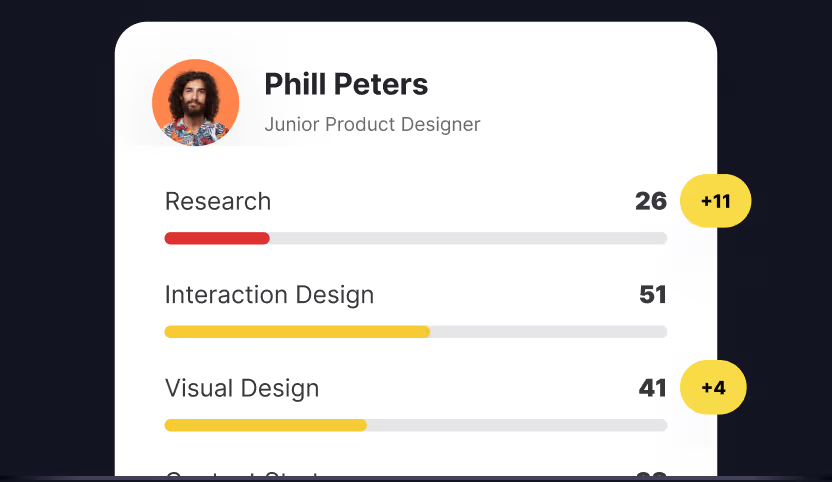
The platform's biggest differentiator is cross-functional skill mapping. Uxcel automatically tracks your competencies across both design and product management as you learn. This matters because senior roles require understanding both disciplines. A senior designer learning product management skills can see both skill sets mapped simultaneously. A product manager taking design courses understands how their design knowledge grows alongside PM expertise.

None of the competing platforms offer this. General Assembly teaches product management, but doesn't map your skills across complementary disciplines. Uxcel shows you exactly where your skills are strong, where gaps exist, and which adjacent capabilities to develop next.

The learning approach is bite-sized and gamified. Lessons take 5 minutes, making daily practice realistic even with a full-time job. The platform works web-first with native iOS and Android apps, so you can learn on your laptop at home, continue on your phone during commute, and have all progress sync automatically. This "Duolingo for UX and Product Management" model explains why Uxcel achieves 48-50% completion rates compared to the 5-15% industry standard for online courses.

Documented outcomes that matter:

Uxcel's 2025 Impact Report shows 68.5% of users got promoted (compared to their peers), with an average salary increase of $8,143. That's a 75x return on investment based on the $288 annual subscription cost. These outcomes are documented and publicly available rather than anecdotal.

The completion rate alone makes Uxcel notable. When 48-50% of people actually finish courses (versus 5-15% for typical online learning), the education works. People stick with Uxcel because the format fits into busy lives, gamification maintains motivation, and immediate feedback keeps engagement high.

What Uxcel doesn't provide:

The platform isn't portfolio-heavy. While project briefs and mentor feedback exist, you won't graduate with 8-10 portfolio pieces. If you're career switching and need extensive portfolio work, bootcamps with project focus serve better.

There's no traditional video lectures. The learning is interactive, not passive watching. Some people prefer instructor explanations on video. If that's your learning style, Uxcel's interactive exercises may not click.

Intensive 1-on-1 mentorship isn't included. You can get feedback on projects you submit, but this isn't weekly coaching calls. If you need someone reviewing your work consistently and guiding your career path, programs like CareerFoundry offer that structure.

Who thrives with Uxcel:

Career switchers entering PM or UX without bootcamp budgets find the $24/month pricing accessible. Junior professionals seeking promotion (1-3 years experience) use the skill mapping to identify gaps and fill them systematically. Mid-level professionals wanting advancement (3-5 years experience) build cross-functional capabilities that senior roles require.

Senior professionals seeking complementary skills benefit most. A senior designer can take product management courses to build toward senior IC roles requiring both skill sets. A senior PM can take design courses to understand the design process deeply. The automatic skill tracking across both disciplines makes this unique.

Busy professionals needing flexibility appreciate learning during commute, lunch breaks, or whenever they have 5 minutes. Budget-conscious learners avoiding expensive bootcamps see the value in $288/year with documented 68.5% promotion rate. Companies wanting to upskill teams across departments can use Uxcel enterprise plans to develop cross-functional knowledge.

The price difference is staggering:

General Assembly charges $4,500 for 40 hours of instruction. Uxcel charges $288 annually for unlimited access to 500+ resources. That's a 15.6x price difference.

Even if you subscribe to Uxcel for 2 full years ($576), you're spending less than 13% of GA's cost. The question becomes: can you learn equivalent product management skills through Uxcel's courses, achieve the 68.5% promotion rate they document, and save $4,200+ compared to GA?

For many people, especially those already employed and seeking to level up rather than break into PM completely cold, Uxcel delivers better value. The cross-functional skill mapping, 10x higher completion rates, documented promotion outcomes, and dramatically lower cost make it a compelling alternative.

Common questions answered

How long does the course take to complete?

The part-time format runs 10 weeks with classes meeting twice per week for 2-hour sessions (4 hours of class time per week). You'll spend an additional 4-6 hours weekly on homework, readings, and project work. Total commitment is 8-10 hours per week for 10 weeks.

The full-time intensive format compresses everything into 1 week. Classes run Monday through Saturday from 9am to 5pm (8 hours per day). This totals 48 hours of instruction plus homework completed in the evenings. You need to clear your calendar completely for this week.

Some students report needing extra time beyond the course end date to polish their final project before submitting for the certificate. Plan for 1-2 additional weeks for final project refinement if you want a portfolio-quality deliverable.

Can I work full-time while taking the part-time course?

Yes, the part-time format was designed specifically for working professionals. Classes meet in the evenings (typically 6-8pm or 7-9pm depending on time zone) to accommodate 9-to-5 jobs. Multiple reviews mention successfully balancing full-time work with the course.

The challenge isn't the class time (4 hours per week) but the homework (4-6 additional hours per week). If you have a demanding job, family responsibilities, or other commitments, those 8-10 total hours per week can feel tight. 

What if I miss a class session?

GA provides resources to help you catch up if you miss a session or two. Instructors record classes, so you can watch later. Course materials (lesson decks, readings, toolkits) remain accessible. Teaching assistants hold office hours where you can ask questions about missed content.

However, the collaborative nature of the course means missing multiple sessions hurts your experience. Group discussions, breakout exercises, and peer feedback happen live. Recordings capture lectures but not interactive elements. If you know you'll miss significant portions, consider a different start date or the self-paced alternatives like Uxcel.

Do I need technical skills or coding knowledge?

No. The course requires zero technical background. Product management is non-technical (though understanding technical concepts helps). You won't write code or learn programming languages.

That said, you will work with data. The curriculum covers analytics, metrics, and A/B testing. Basic spreadsheet skills (Excel or Google Sheets) help for analyzing data. Familiarity with tools like Google Analytics, Mixpanel, or Amplitude is useful but not required.

The AI-First curriculum introduces AI tools for product managers. You'll learn to prompt AI effectively and use AI for research, analysis, and planning. This doesn't require machine learning expertise. It's about productively using AI as a tool in your PM workflow.

Is the certificate recognized by employers?

The certificate signals you completed product management training but isn't equivalent to formal credentials like CSPO, AIPMM, or Pragmatic Institute certifications. Employers recognize the GA brand (the company has been around since 2011 and is part of Adecco Group).

Nearly 20,000 companies partner with GA as hiring partners. If you apply to one of these companies, the certificate carries weight. GA alumni work at Google, Microsoft, Visa, L'Oréal, Adobe, and others. The network effect matters more than the credential itself.

But here's the reality: most PM job postings don't require or prefer specific certificates. Employers want demonstrated ability to solve product problems, work with teams, and ship features. The certificate helps you signal capability, but portfolio projects and work experience matter more.

One critical July 2025 Trustpilot review stated: "I found that the Certified Scrum Product Owner (CSPO) course is more recognised and practical." If you're in an agile-heavy environment, CSPO may carry more recognition. For general product management, GA's certificate is respected but not transformative on its own.

Can I get employer sponsorship for this course?

Yes, and this dramatically changes the value equation. GA can send a sponsorship package directly to your employer. Many companies have professional development budgets ($2,000-$10,000 annually) that cover external training.

If your company pays the $4,500, your only investment is time. Even if the content "could be picked up from a book" (as critics suggest), free structured learning is worthwhile. The networking alone justifies zero out-of-pocket cost.

Approach your manager with specific reasoning: explain how PM skills will help you contribute more effectively to current projects, show how other companies invest in employee development, request sponsorship as part of performance review discussions, or propose splitting costs (company pays 50-75%, you pay remainder).

Companies at higher likelihood of sponsorship include those already using GA for corporate training (Microsoft, Deloitte, PwC, Fujitsu, etc.), tech companies with established L&D programs, firms trying to retain employees through development opportunities, and organizations with formal professional development budgets.

How does the AI-First curriculum work in practice?

General Assembly rebuilt the product management curriculum in late 2025 to integrate AI throughout. This wasn't just adding an "AI module." GA's December 2025 announcement mentioned it teaches "how today's PMs use AI to work smarter, move faster, and deliver with confidence."

The integration appears in every module. In customer research, you learn AI-powered tools for analyzing feedback patterns, synthesizing user interviews, and identifying problem clusters. In opportunity sizing, you use AI for market research synthesis, competitor analysis automation, and trend identification. In roadmapping, you apply AI tools for scenario planning, dependency mapping, and timeline estimation. In experimentation, you leverage AI to run faster test cycles and analyze results.

A dedicated 4-6 hours covers responsible AI frameworks, including ethical considerations in AI product decisions, bias and fairness in AI systems, privacy implications, and building products that incorporate AI features.

This 2025-2026 update gives GA a temporary competitive advantage. Most competing programs haven't integrated AI this deeply yet. If learning to use AI in your PM workflow matters to you, this updated curriculum is relevant. But remember: AI tools are available to anyone. GA teaches you how to use them in PM context, but these aren't proprietary tools requiring the course.

What happens after I complete the course?

You receive a signed certificate of completion and LinkedIn-shareable digital badge. The certificate goes on your resume, LinkedIn profile, and portfolio. You maintain lifetime access to course materials for reference (lesson decks, toolkits, recordings).

You get invited to GA alumni events, career workshops, and networking opportunities. The alumni network (100,000+ across all programs) becomes accessible through GA's platform and LinkedIn alumni groups. Some cities have regular alumni meetups.

However, you don't get ongoing career coaching or job placement services beyond the workshops. This isn't like the immersive bootcamps where career coaches work with you monthly until you're placed. Once the 10 weeks end, ongoing support is limited to what you proactively seek out.

Many alumni report the most valuable post-course resource is their cohort connections. The relationships built during the 10 weeks often lead to job referrals, collaboration opportunities, or informal mentorship years later.

Is there a refund policy?

GA's refund policy varies by location and is subject to specific terms and conditions. Generally, you can cancel within 7 days of enrollment for a full refund. After course start, refunds are prorated based on how many sessions you've attended.

The critical point: there's no outcome-based refund. Unlike CareerFoundry (job guarantee with tuition refund) or Product HQ (money-back guarantee if you don't get a PM job in 6 months), GA doesn't refund based on employment outcomes. If you complete the course but don't land a PM role, you paid $4,500 for education without recourse.

Read the specific terms before enrolling. One December 2025 Trustpilot review claimed: "paid $3000, got refunded $2900 back" due to dissatisfaction, suggesting partial refunds are possible but not full recovery of investment.

So, is General Assembly's product management course actually worth it?

The answer depends entirely on your specific circumstances. For some people, this $4,500 investment accelerates careers and delivers strong ROI. For others, it's an expensive path to knowledge available more cheaply elsewhere.

This course makes sense when:

  • You're already employed in tech and can get employer sponsorship. Without out-of-pocket cost, the downside disappears. Free structured learning with networking is valuable regardless of whether content is available elsewhere.
  • You're doing product management work informally and need to formalize your knowledge. Jack's story exemplifies this. He was already at Bonfyre doing PM tasks but lacked frameworks and vocabulary. The course helped him transition to a formal PM role within his company. If you're in a similar position, GA can accelerate internal mobility.
  • You need networking and structure more than novel information. If you struggle with self-paced learning, the fixed schedule and cohort accountability keep you on track. If building relationships with other aspiring PMs matters for your career, the collaborative format delivers. The 100,000+ alumni network and nearly 20,000 hiring partners create connection opportunities.
  • You're interested in AI-integrated product management and want current training. The AI-First curriculum launched December 2025 is genuinely new. If learning to use AI tools throughout the product lifecycle is a priority, GA's updated content provides structured training in this emerging skill area.
  • You value brand recognition for career transitions. The GA name carries weight in tech circles. If you're switching from an unrelated field and need a credential that signals seriousness, the certificate helps (though it's not equivalent to specialized certifications like CSPO).

Skip this course when:

You're budget-conscious and paying out of pocket. At $4,500, the July 2025 Trustpilot review stating "content was thin" and "could be picked up from a book" represents a real risk. Uxcel charges $24/month ($288/year) with documented 68.5% promotion rate and $8,143 average salary boost. Books plus self-study cost under $100. If price matters, cheaper alternatives exist.

Many people fall between clear yes and no. You might have budget constraints but struggle with self-directed learning. You might want networking but worry about content depth. You might need structure but question the price.

Consider these strategies: start with GA's free Product Management 101 workshop to test the teaching style before committing $4,500. Negotiate partial employer sponsorship (company pays 50%, you pay 50%) to reduce personal investment. Try Uxcel for 2-3 months ($72) to see if self-paced learning works for you before spending 15x more on GA.

What should you do now?

If you're leaning toward GA, request a call with admissions to discuss employer sponsorship options. Ask specific questions about AI curriculum implementation, recent job placement rates for PM course specifically (not company-wide), and whether you can speak with recent graduates. Clarify refund policy terms in writing.

If this doesn’t fit your needs, try Uxcel's $24/month subscription first. In 2-3 months ($72 total), you'll know whether self-paced learning works for you and whether the cross-functional skill mapping delivers value. If it doesn't, you've spent less than 2% of GA's cost to learn that.

The final verdict:

General Assembly's Product Management Short Course is a legitimate educational product with genuine success stories, strong brand recognition, and meaningful networking opportunities. The new AI-First curriculum demonstrates adaptation to market needs. For people with employer sponsorship, existing tech roles, or specific need for structure and networking, it works.

But at $4,500 with mixed 2025 reviews (3.8/5 on Trustpilot), no job guarantee, and criticism that content "could be picked up from a book," this isn't a universal solution. The value equation heavily depends on who's paying (you versus employer), what you bring to the table (experience level, existing network), and what alternatives you've considered.

For most people, Uxcel makes more sense. The $288/year price, 68.5% promotion rate, cross-functional skill mapping, and 10x higher completion rate deliver better value unless you have specific needs that require GA's live cohort model and enterprise credibility.