.svg)


The Reforge Product Strategy course comes only with a $1,995-a-year membership, but is that pricing worth it for experienced product managers? I’ve evaluated PM training programs for years, but Reforge kept surfacing differently. Not from bootcamp searches or career switchers. From Senior PMs and Directors at tech companies asking if the investment justified the hype. The all-or-nothing membership model seemed restrictive, yet experienced practitioners consistently praised it. I needed to understand why.
I spent three months on this. Read through 150-200 student reviews across LinkedIn, Reddit, Medium, and PM blogs. Tracked alumni on LinkedIn to see career progression patterns. Compared Reforge’s membership model and curriculum against every major alternative I could find: Uxcel, Pragmatic Institute, Product School, Maven courses, executive education programs.
The picture that emerged surprised me. Reforge delivers legitimate access to strategic frameworks from practitioners currently managing products at Slack, Tinder, and Instagram. The instructor quality checks out. The practitioner-led approach is real. But the membership model? Forces you to pay $2,000 annually even if you only want one course. Cohorts of 200-400 people create chaos in Slack channels. Multiple graduates with 6+ years PM experience found the frameworks valuable but struggled to implement them without organizational support. However, the course is designed for practical application, enabling learners to apply insights immediately in their current role, while building confidence and mastering core skills essential for product management. Professionals weighing a PM certification program against membership-based training will find the core distinction in verifiable outcomes data: certifications publish metrics, memberships rarely do.
Reforge publishes zero career outcomes data. No job placement rates, no promotion statistics, no salary impact numbers. The central question isn’t whether Reforge offers quality strategic frameworks. It’s whether those frameworks justify an all-or-nothing $2,000 annual membership when alternatives offer similar strategic content for $1,500-3,500 without forcing platform lock-in.
This review breaks down the curriculum structure (5 modules plus capstone), analyzes student feedback from multiple platforms, examines who genuinely benefits versus who wastes money, dissects the membership pricing model, and presents three alternatives. You’ll understand exactly when Reforge makes financial sense and when it doesn’t. The courses often include real-world projects that allow learners to apply insights to their work immediately, emphasizing practical application and relevance.
One thing caught me off guard more than anything: Reforge’s biggest selling point (access to over 40 courses) becomes its biggest trap. Most members realistically complete 4-5 courses per year, not all 40+. That math changes dramatically: from the marketed “$90 per course” to an actual $400-500 per course. Still reasonable compared to $3,000-6,000 standalone programs, but nowhere near the bargain Reforge suggests.
Full transparency: I didn’t enroll in Reforge myself. Didn’t sit through their live cohort sessions or complete their capstone project. This assessment comes from analyzing hundreds of student reports, reviewing LinkedIn profiles of alumni, and comparing against competing programs I’ve researched extensively. That’s both a limitation and an advantage. I’m not emotionally invested in defending or criticizing a $2,000 membership I personally made.
What do you need to know upfront?
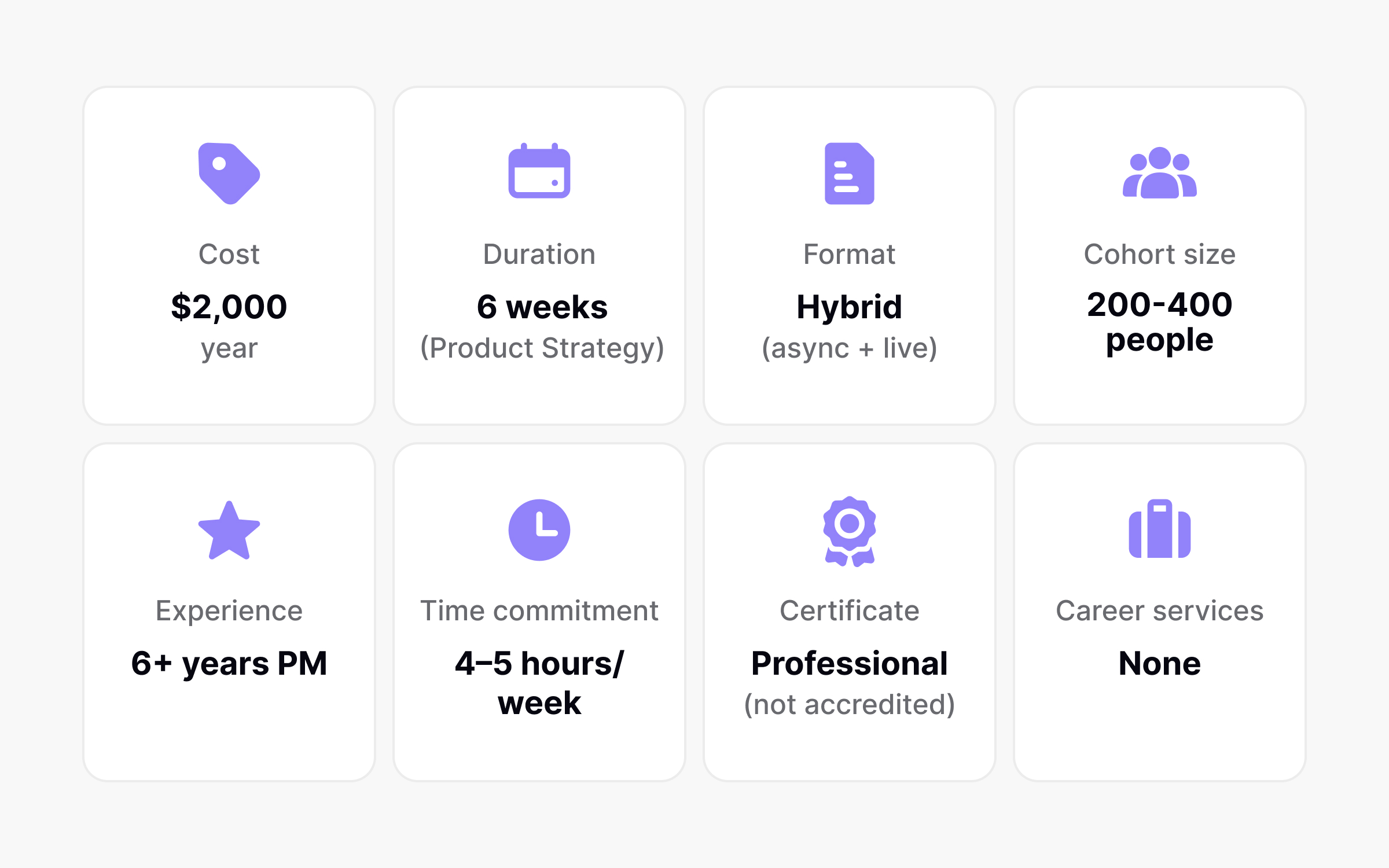
Let me break down what Reforge Product Strategy actually involves.
Program type: High-level PM training for experienced professionals, not a career-change bootcamp or formal certification program.
Cost: $1,995 a year for an individual membership. It includes the 40+ on-demand courses, one live course each season, weekly events, Reforge AI, the Slack community, and the artifacts library. You cannot buy individual courses separately and there is no monthly plan: you commit to the full year. A 14-day free trial covers the on-demand catalog only (no live courses, no Slack) and charges the $1,995 automatically when it ends unless you cancel first.
Duration: 6 weeks specifically for Product Strategy, with cohorts twice yearly (Spring in April, Fall in October). Each week needs roughly 4-5 hours of your time: maybe 2-3 hours watching pre-recorded videos, plus another couple hours in live case study sessions.
Format: Hybrid learning with large cohorts (200-400 people). You watch video lessons whenever works for you, then join one of several time slots for weekly live sessions led by practitioners from places like Slack, Tinder, and Meta. Everything gets recorded if you miss the live sessions. The program is designed so you can learn at your own pace and fit your studies around your own schedule and work commitments, offering flexible options for busy professionals.
Prerequisites: They explicitly require 6+ years of product management experience. The target audience is Senior PMs, Group PMs, Directors, and Heads of Product managing multiple product areas. If you’re entry-level or trying to break into PM, Reforge will likely reject your application, or you’ll struggle badly with content that assumes extensive experience.
What you get: Your membership includes one live course each season, watching any of their 40+ recorded courses whenever you want, weekly events and deep-dive sessions, Slack community access while you’re a member, and a library of over a thousand real examples (actual roadmaps, strategy briefs, and analyses from experienced PMs). You also gain access to exclusive events and a community of alumni for networking and support.
Certificates: Yes, you receive a certificate for LinkedIn when you complete a course. It lives in your Reforge profile. This is a professional certificate though, not an academic credential or traditional product management certification. It demonstrates you completed advanced training, but it’s not accredited like university programs.
Instructors: Practitioners, not professors. For Product Strategy specifically, you learn from people like Fareed Mosavat (former Director of Product at Slack, previously at Instacart and Zynga) and guest speakers from Slack, Eventbrite, Tinder, Tripadvisor, Instagram, and Uber. You benefit from expert guidance and personalized feedback from experienced facilitators during live sessions.
Accreditation: None whatsoever. Reforge has zero formal educational accreditation. The value comes from industry recognition within tech and SaaS circles, not from academic credentials or formal certification status.
Important caveat: You lose access to EVERYTHING when your membership expires. Unlike platforms offering lifetime access, Reforge requires you to screenshot or download materials during your active year. Cancel your subscription and everything disappears: your course progress, downloaded templates, all of it. (This frustrated me personally when I realized how the model works.)
Current status: Reforge recently shifted focus toward AI-powered tools alongside their courses, launching things called Reforge AI, Reforge Research, and Reforge Insights. The core course structure hasn’t changed, but they’re trying to become more than just an education platform.
Online learning options like Reforge provide flexibility to learn on your schedule without stepping out of your job.
What is the Reforge Product Strategy course?

So what is this course, really? From what I gathered after reading through everything, it teaches experienced PMs how to manage a portfolio of product work strategically, not just shipping features, but thinking at a bigger-picture level. It’s designed for that transition from “Senior PM who executes well” to “Director who shapes overall product direction.” Building a strong foundation in strategic thinking is essential for this career step.
The course emerged from Reforge’s founding story. Brian Balfour, former VP of Growth at HubSpot, couldn’t find quality professional development for his experienced team members. Most available programs targeted career switchers or entry-level PMs. In 2016, he left HubSpot to create Reforge, starting with the Growth Series course. Product Strategy came later as they expanded beyond growth into core product management topics.
Their positioning is explicit: “For experienced product management, marketing, engineering, and other tech professionals.” They actively discourage beginners and career switchers from applying. The selection process includes LinkedIn profile review and basic questions to assess fit, though from what I read, the exact criteria remain unclear to most applicants. Product management certification can help individuals transition from product-adjacent roles to full product management positions.
What makes Product Strategy different from typical PM courses? It focuses on managing multiple types of product work simultaneously. Most PM courses teach you how to build features or run experiments. Reforge teaches you how to balance feature optimization, growth initiatives, infrastructure investments, and innovation work across a portfolio. The frameworks assume you already know how to write PRDs, run sprints, and talk to customers. This is about deciding which work to prioritize when everything feels urgent.
The live course runs in seasonal cohorts, typically twice a year. Each cohort includes 200-400 participants, which creates both opportunity (networking with senior PMs from top companies) and chaos (overwhelming Slack discussions where questions pile up faster than anyone can read them). More on that mess later.
Reforge built its reputation on the Growth Series, which remains their flagship course. Product Strategy uses that same practitioner-led approach: instructors are people who’ve actually managed product strategy at scale, not professors teaching theory. The content draws from real company case studies, and includes real-world examples and hands-on experience as essential elements for building a strong foundation in product management. These practical, real-world examples help bridge the gap between theory and application, making the learning highly relevant.
The course delivery combines asynchronous and live components. You get video lessons broken into 5-10 minute chunks, professionally produced with audio narration and downloadable slide decks. These cover frameworks, mental models, and strategic concepts. Then you join weekly live sessions (usually 1.5-2.5 hours) where instructors walk through real company case studies applying those frameworks. The sessions are led by practitioners and include Q&A, though with 200-400 people in the session, getting your specific question answered is pretty hit-or-miss.
Here’s what confuses most people about the membership, it confused me too initially. You’re not just buying Product Strategy. You’re buying annual access to Reforge’s entire platform: all their courses, weekly events, the artifacts library, Slack channels, and one live course each season. This means if you only want Product Strategy and nothing else, you’re paying $1,995 for one course. If you plan to take 4-5 courses throughout the year, the math changes completely. (Took me a while to understand this distinction.)
The curriculum focuses on five core modules spread across six weeks. Week one covers product strategy fundamentals and the Product Strategy Stack framework. Week two dives into feature strategy and optimization. Week three explores growth strategy and PMF expansion. Week four tackles innovation and scaling infrastructure. Week five focuses on strategic communication and getting organizational buy-in. Creating a product roadmap is a crucial part of aligning teams and connecting features to overall strategy, and this is emphasized in the course as a key tool for guiding product development processes. Week six is dedicated to your capstone project, an Action Plan for implementing learnings at your company. The curriculum is developed by industry experts and covers the entire product lifecycle, from ideation to market launch, which is essential for aspiring product leaders.
The teaching philosophy emphasizes frameworks over templates. You won’t get a PRD template or roadmap format. You’ll get mental models for deciding when to invest in infrastructure versus new features, frameworks for evaluating which growth opportunities to pursue, and systems for communicating product strategy to executives. The assumption is you already have templates and just need better strategic thinking.
The capstone project is a hands-on project designed to help you apply what you’ve learned immediately. Certification programs often include real-world projects that allow participants to apply their learning immediately. Completing a product management certification can provide practical, job-ready skills that can be applied right away, and often leads to increased confidence in one's ability to perform in a product management role. Earning a product management certification can also demonstrate expertise to potential employers. Hands-on projects like this are highly recommended for gaining practical experience and ensuring you can implement concepts in real-world scenarios.
Reforge positions itself as solving a specific problem: experienced PMs know how to execute but struggle to think strategically about portfolio management. Companies promote strong individual contributors to leadership roles without teaching them strategic leadership. Product Strategy attempts to fill that gap with frameworks from people who’ve successfully made that transition at companies operating at significant scale.
What you'll learn in this course
The Product Strategy curriculum covers five major modules over six weeks, focusing on frameworks for managing multiple types of product work simultaneously. Let me walk through what each module actually covers.
Module 1: Product strategy fundamentals
The first module covers this thing called the Product Strategy Stack. from what I understand, it’s basically how your product strategy fits with your company’s big-picture direction. You learn to spot when your product hits a ceiling (they call it “product saturation”) and figure out where to expand next: new customer segments, new pricing tiers, adjacent products, or platform plays. They use real company examples showing why teams chose specific strategies over others. This part caught my attention because it’s not just theory. they show actual strategic decisions from real companies. The module emphasizes aligning product strategy with business goals and market needs, highlighting that understanding both is essential for product success.
Module 2: Feature strategy and optimization
You evaluate features based on adoption, retention, and satisfaction. Each combination maps to specific improvement strategies. High adoption but low retention? Probably an onboarding problem. Low adoption but high satisfaction? Sounds like a discovery issue. For PMs looking to sharpen their product discovery process, Uxcel's dedicated course covers problem framing, validation, and prioritization from the ground up. The module covers feature lifecycle management from launch through eventually sunsetting features that aren’t working. It also stresses the importance of writing user stories and production-ready PRDs as part of the feature strategy process.
Module 3: Growth strategy and PMF expansion
This module teaches frameworks for evaluating expansion vectors: new use cases, new user segments, adjacent problems, or geographic expansion. You learn to balance offensive work (new features, markets, innovation) against defensive work (infrastructure, competitive responses, technical debt). Case studies from Slack and Tinder show how high-growth teams made these trade-offs. (I found this module interesting because it’s where strategy gets really messy in practice.) The module also covers identifying high-impact opportunities through user research and balancing customer needs with business goals.
Module 4: Innovation and infrastructure scaling
When does investing in platform improvements become the highest-leverage work? You learn frameworks for identifying critical infrastructure needs before they become emergencies, and evaluating trade-offs between scaling investments and new features. The module also covers allocating resources to experimental initiatives while maintaining core execution. From what people said, this is where the content gets particularly valuable for PMs moving into leadership. The module highlights the importance of agile methodologies, design thinking, and leadership as core skill sets for product managers.
Module 5: Strategic communication and organizational buy-in
The Stakeholder-Forum-Style Framework teaches adapting your communication based on audience and context. You learn to create compelling strategy narratives, design product roadmaps that communicate priorities and connect features to overall strategy, and run strategy review processes that actually drive decisions rather than become presentation theater. The module emphasizes that product managers must create product roadmaps as a key tool for aligning teams, ensuring the product vision is communicated and executed, and driving product success.
Week 6: Capstone project
Create an Action Plan implementing frameworks at your company. Identify which concepts apply to your specific challenges, map implementation steps, identify blockers, and create a timeline for rolling out strategic practices. This is your main deliverable. though from what I read, it’s more useful as a thinking exercise than a portfolio piece. The capstone project helps advance your product career by applying these skill sets in real-world scenarios, reinforcing your ability to achieve success as a product manager.
Here’s the complete module breakdown:
| Week | What you will learn | Key topics | Time commitment |
|---|---|---|---|
| Week 1 | Strategy fundamentals | Product Strategy Stack, product saturation, PMF expansion | 4-5 hours |
| Week 2 | Feature Strategy | Adoption/retention/satisfaction frameworks, lifecycle management | 4-5 hours |
| Week 3 | Growth Strategy | PMF expansion vectors, offesnive vs defensive initiatives | 4-5 hours |
| Week 4 | Innovation and scaling | Understand and prioritize PMF expansion | 4-5 hours |
| Week 5 | Strategic communication | Stakeholder-Forum-Style Framework, organizational buy-in, product roadmap | 4-5 hours |
| Week 6 | Capstone | Action Plan development for your company | 4-5 hours |
| Total | 6 weeks | 5 modules + capstone | 24-30 hours |
Each week includes maybe 2-3 hours of pre-recorded content (broken into 5-10 minute chunks) plus live case study sessions (usually another couple hours) where practitioners walk through real strategic decisions. You get downloadable templates and worksheets, but remember. lose access to everything if you cancel your membership.
The course does NOT cover underlying PM execution skills like writing specs or running experiments. If I’m understanding it right, this is the key difference from most PM courses. It assumes 6+ years of PM experience and focuses purely on strategic decision-making frameworks. If you’re still learning execution fundamentals, this probably isn’t the right course yet.
Reforge pricing 2026: what does the membership cost?
Reforge shifted to an annual membership model around 2020-2021, and understanding what you actually get requires looking beyond that $2,000 headline number. This is where things get tricky, and honestly? A bit confusing initially.
Price: $1,995 a year for an individual. Teams from $8,785 a year for 10 seats, $22,765 for 30. Prices from Reforge’s knowledge base.
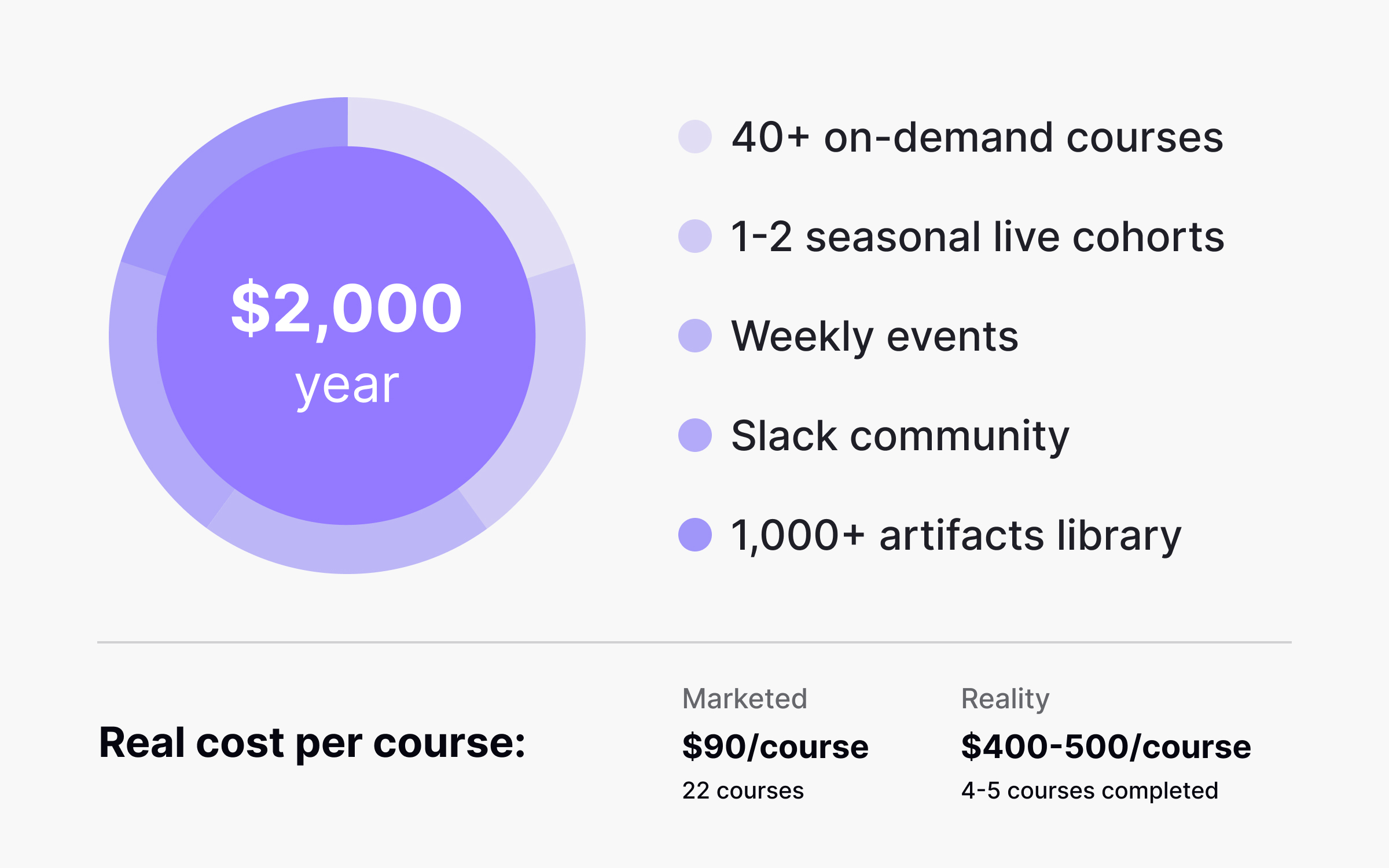
The base membership costs $1,995 per year and gives you full access to the entire Reforge platform. Not optional, not negotiable for individuals. Here’s exactly what that membership includes:
- All 40+ on-demand courses: You can watch any of their recorded courses whenever you want (Product Strategy, Growth Marketing, Advanced Growth Strategy, Monetization & Pricing, and dozens more). You have the flexibility to learn at your own pace, allowing you to fit your studies around your schedule.
- Seasonal live cohorts: Participation in 1-2 live cohort-based courses when they’re actively running (typically Spring and Fall)
- Weekly events and deep-dive sessions: Access to all ongoing events throughout your membership year
- Slack community: Access to community channels while you’re an active member
- Artifacts library: Over a thousand real examples (roadmaps, strategy briefs, analyses from experienced PMs)
- Forum access: Ability to ask questions and engage with the community
You cannot buy Product Strategy (or any individual course) separately. The membership gives you access to everything. This means whether you watch one course or twenty courses, you’re paying $2,000 for the full year of access.
Now here’s where the math gets interesting. And honestly? Pretty frustrating when you break it down. Reforge markets this as “$90 per course” (you know, divide $2,000 by roughly 22 available courses). But from what people report, most members realistically complete 4-5 courses throughout the year, not all 22. That changes the effective cost to $400-500 per course. Still reasonable compared to standalone courses costing $3,000-6,000, but nowhere near the bargain the marketing suggests. (This caught me off guard when I first calculated it.)
If you only plan to complete Product Strategy and nothing else throughout the year? Then you’re effectively using $2,000 of membership value for accessing just one course. That feels expensive compared to alternatives. However (and this is important), remember you’re not buying Product Strategy alone. You’re buying full platform access. If you plan to also take Growth Marketing, Advanced Growth Strategy, and Monetization & Pricing throughout the year, suddenly $2,000 for four high-quality courses from practitioners makes a lot more sense. The value depends entirely on how much of the platform you actually use.
Hidden costs and limitations:
The membership auto-renews annually unless you cancel. When you cancel, you immediately lose access to ALL content. including materials you downloaded. One reviewer specifically warned: “Screenshot or download the slides during the course because unless you pay the yearly subscription of around $2k you’ll lose access to all your course material when your course/subscription ends.” (I found this particularly annoying about their model.)
Compare this to platforms offering lifetime access. With Reforge, you’re renting access, not buying content. Cancel after year one and you can’t review frameworks or reference templates without paying again. If you’re someone who likes to reference materials years later, this model will frustrate you.
Additional cohort passes:
If you want to participate in more than 1-2 live cohorts per year, you can purchase additional Cohort Passes. The pricing is tiered: individual passes cost more than bundles. For 2-5 additional passes, the price drops to $1,395 per pass. Means if you’re highly motivated, you could participate in 3-4 live cohorts per year for around $4,000-5,000 total.
Teams and enterprise pricing:
For organizations with 30+ seats, Reforge offers custom team pricing. From what I read, you can negotiate with Reforge to remove the live cohort component and reduce pricing by roughly 50%, bringing it down to around $1,000 per person for on-demand access only. Makes sense for companies wanting to upskill teams without coordinating around cohort schedules.
Employer reimbursement:
According to what people mentioned, about half of Reforge members get their employer to pay. The professional development angle makes this easier to justify than bootcamps positioned as career-change programs. If your company has learning and development budget, Reforge is designed for this use case. The program is also structured to prepare experienced PMs for career advancement, helping you build the skills and credentials needed to move forward.
Historical pricing context:
Before 2020-2021, individual courses cost $2,500-$3,500 each. The membership model made Reforge more affordable for people taking multiple courses but more expensive for single-course takers. (Basically, they optimized for their power users and made it worse for everyone else.)
Is the pricing reasonable?
One student framed it this way: “The high price protects you. If you and your competitors are both using the same handbook, is it really a competitive advantage anymore?” Interesting perspective. though I’m not entirely convinced by that logic.
My assessment? If you complete 4-5 courses throughout the year, $400-500 per course seems reasonable for practitioner-led quality. Complete only Product Strategy and you definitely overpaid. Get promoted to Director within 12 months (that’s usually a $20,000-50,000 salary bump), and Reforge pays for itself 10-25 times over. But that promotion needs to actually happen.
Comparison to alternatives:
Pragmatic Institute charges $1,500-3,500 per individual course, but you can take one course without buying a full platform membership. Product School charges $4,000-6,000 for certification programs. Wharton or Stanford executive education runs $5,000-15,000 for similar-length programs. In this context, Reforge’s $2,000 for multiple courses is competitive. though that all-or-nothing membership model forces you to pay for access you might not use.
Is Reforge right for your situation?
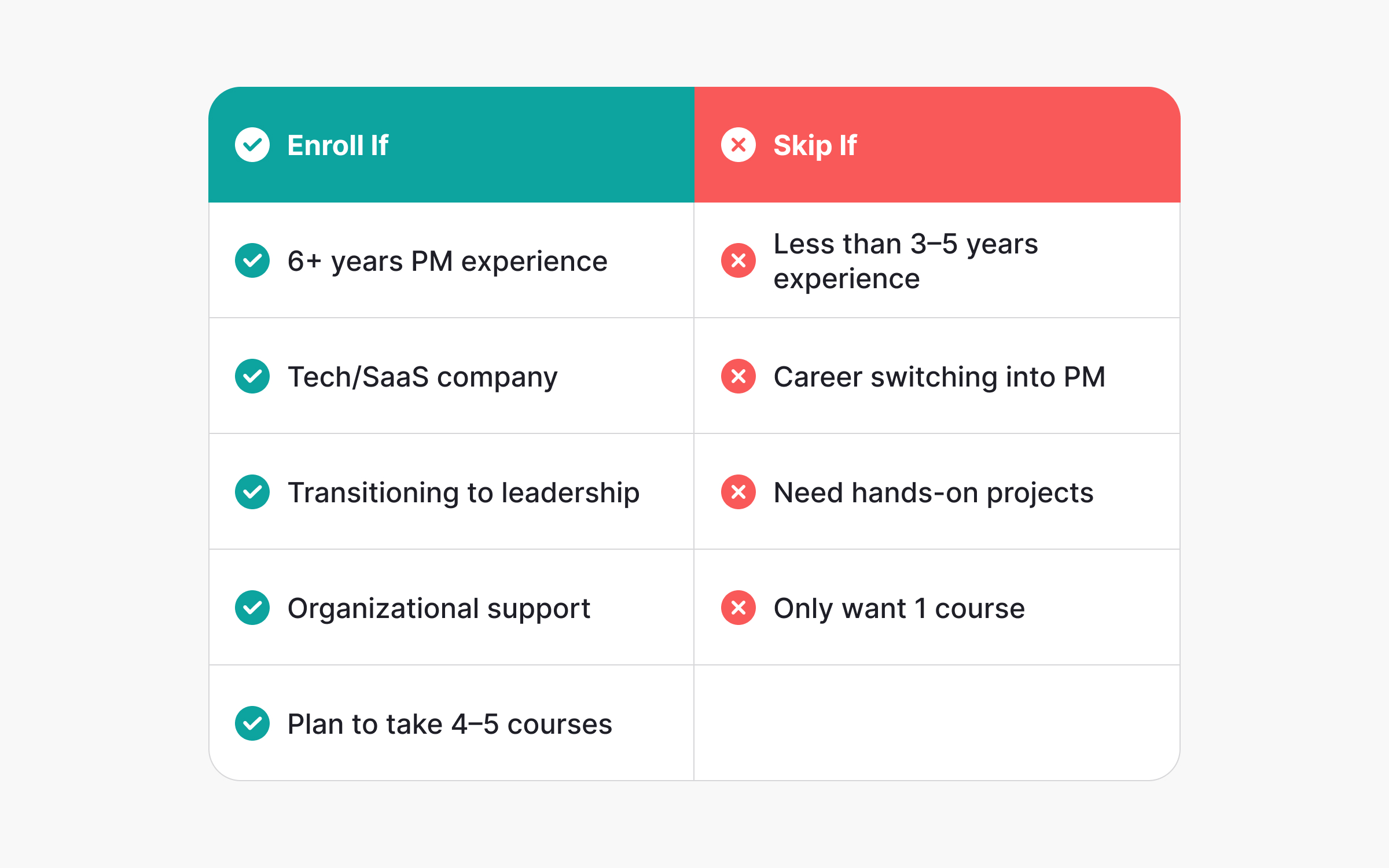
Whether Reforge Product Strategy makes sense depends entirely on where you are in your career and what you actually need from professional development. Let me be direct about this.
| You should enroll if: | You should skip if: |
|---|---|
| 6+ years PM experience | Less than 6 years PM experience |
| Transitioning from IC to leadership | Trying to break into PM or climbing to medior/senior level |
| Work at tech/SaaS company | Work outside tech/SaaS |
| Organization supports implementation | Early-stage startup (pre-PMF) |
| Can commit 4-5 hours/week for 6 weeks | Need hands-on projects |
| Company will pay or career investment | Want intensive mentorship |
| Plans to take 4-5 courses over year | Only want Product Strategy (not full membership) |
You’re a strong fit if:
- You have 6+ years managing products and can cite specific work you’ve owned, teams you’ve led, and strategic decisions you’ve made. Reforge explicitly targets this experience level and won’t slow down to explain fundamentals.
- You’re making the transition from individual contributor to strategic leader. Maybe you just became a Senior PM managing multiple product areas, or you’re preparing for Director interviews where strategic thinking matters more than execution skills. This is that moment where you realize tactical skills aren’t enough anymore. (I kept seeing people describe this exact transition point in reviews.) Uxcel's product manager career roadmap maps exactly what each level requires, useful for confirming whether you're genuinely ready for Reforge's strategic content.
- You work at a tech or SaaS company operating at some scale. Most frameworks and case studies come from companies with millions of users and product-led growth models. If you work at an early-stage startup or non-tech company, the frameworks may not translate well.
- Your organization will support implementing what you learn. These frameworks require stakeholder buy-in and organizational change. If you can’t influence how your team approaches product strategy, everything remains theoretical. No point learning strategic frameworks if you can’t actually apply them.
- You can commit 4-5 hours per week for six weeks. Not passive video watching. the course expects engagement with content, participation in live sessions, and completion of the capstone project. If you can’t carve out that time, you won’t get the value.
- Your company will pay for it or you view it as a career investment with 12-24 month ROI horizon. At $2,000 per year, this is professional development spending, not impulse education purchase. The typical Senior PM to Director promotion ($50,000 salary increase) pays for Reforge 25 times over. but only if that promotion happens.
- You want frameworks from practitioners, not academic theory. You value learning from people who’ve managed product strategy at scale over professors teaching textbook concepts. If you prefer structured curriculum with clear right answers, this probably isn’t the right fit.
- You’re self-directed and don’t need hand-holding. With 200-400 people in your cohort and limited instructor interaction, you’ll get minimal personalized guidance. You implement frameworks yourself based on general instruction. If you need someone walking you through applications step-by-step, this will frustrate you.
You’re NOT a good fit if:
- You have less than 3-5 years of PM experience. The content won’t make sense without execution fundamentals in place. You’ll pay $2,000 to be confused by strategic frameworks you’re not ready to apply yet. Better to build tactical skills first.
- You’re trying to break into product management or switch careers. Reforge offers zero career services, job placement, or portfolio development. This is for advancing within PM, not entering it. Save your money for bootcamps that actually help career switchers land jobs. If you’re looking for formal credentials, consider a certified product manager program, these certification programs are designed to help you gain practical skills, industry recognition, and can be valuable for career advancement.
- You need hands-on projects and portfolio work. The curriculum is theory and frameworks, not practical portfolio building. One project brief exists (the capstone Action Plan) but nothing suitable for showing employers during interviews. If you need portfolio pieces, look elsewhere.
- You want intensive mentorship and instructor interaction. With massive cohorts and guest speaker instructors, personal coaching doesn’t exist. Questions frequently go unanswered in Slack channels overwhelmed by 200-400 participants asking things simultaneously. If you learn best through one-on-one guidance, this format won’t work for you.
- You work outside tech/SaaS or at early-stage startups. Frameworks designed for Slack’s growth challenges probably won’t translate to your enterprise software product or pre-PMF startup. The case studies assume you’re operating at scale with millions of users.
- You only want Product Strategy specifically. Paying $2,000 for one course makes zero financial sense when alternatives offer similar strategic content for $1,500-3,500 without forcing platform membership. (This one frustrated me personally. that all-or-nothing model feels like vendor lock-in.)
- You need materials you can reference for years. Canceling your membership means losing everything, including downloaded templates. If you want permanent access to frameworks, this subscription model will drive you crazy.
Middle ground scenarios:
- You’re an experienced PM but not at a tech company → frameworks might translate with effort, but expect to do translation work yourself.
- You’re at a 50-200 person startup → some frameworks apply, others designed for larger scale won’t be relevant yet.
- You work at a tech company but don’t have influence → you’ll learn interesting concepts but may not be able to implement them, which is frustrating.
- You’re switching careers into PM → Product School or CareerFoundry’s bootcamps target career changers explicitly with job support.
- You need portfolio projects → bootcamps with extensive project components give you work to show employers.
- You want mentorship → Maven courses or Product Faculty offer smaller cohorts with more instructor interaction.
- You’re entry-level (0-3 years) → Coursera or Udemy provide foundational PM education at much lower cost. Build fundamentals first.
- You work at early-stage startup → frameworks may not apply yet; consider more tactical execution-focused courses.
- You need job placement → bootcamps with hiring partnerships or career services actually help with that.
- You’re outside tech → Pragmatic Institute covers product management more broadly across industries, not just tech/SaaS.
If you’re considering certification programs, note that many are developed by industry experts and academic institutions to ensure high-quality content. These programs often include project management components, which are essential for product managers to succeed and prepare for leadership roles.
One reviewer summed it up pretty well: “As long as you align with a subject you want to go deeper in you’ll get a ton of value. For example, would get value out of the core PM course probably not. For me, I wanted deepen my knowledge on pricing strategy and took that course and got a ton out of it.”
The decision comes down to this: are you an experienced PM needing strategic frameworks, willing to self-implement them, and able to commit $2,000 plus 4-5 hours weekly? If yes to all three, Reforge likely works. If no to any of them, save your money and look elsewhere.
If you pursue a certified product manager path, you’ll also gain access to a community of alumni for networking and ongoing support, which can be a significant benefit for long-term career growth.
What students say about this course
Student reviews cluster into two distinct groups: highly positive testimonials from successful students and more measured critiques from those who found specific limitations. Here’s what stood out to me after reading through everything.
The overwhelmingly positive perspective:
One comprehensive review really stuck with me: “I honestly had a lot more wins only after I joined Reforge across full-time work and consulting projects. The level up in my skillset was tremendous.” This reviewer had completed four Reforge programs and emphasized that value comes from completing multiple courses, not just one. (That multi-course point came up repeatedly.)
From what I read, people consistently praised the content quality. “The first plus that I would highlight is the perfect structure of the content and its organization. Everything is served without ‘water’, without bullshit, clearly and to the point,” wrote a Ukrainian PM in a detailed LinkedIn review. “The practical aspect of knowledge is visible, it is clear that everything was created by practitioners for practitioners.”
Another student emphasized the instructor quality: “The second is the level of speakers and students. In terms of roles, positions, questions asked - you understand that this is top and there is nowhere too much higher.” The chance to learn from practitioners at Slack, Instagram, and Tinder, alongside other senior PMs, creates value beyond just the content. The network effect matters.
I kept seeing people mention implementing Reforge concepts at work the following week. “I kept notes in Notion on what I was learning and how it applied to my day job,” wrote Helen H. in a blog post. The accountability of having a live class forced homework completion, she noted. That immediate applicability came up over and over. Students appreciated being able to apply what they learned immediately, highlighting the practical application of frameworks and concepts to their current roles.
For experienced PMs seeking strategic depth, the content delivers. “If you’re working to solve critical business problems and unlock extraordinary growth for your companies and careers, we think you’ll tap into the most value Reforge has to offer,” summarizes the target audience according to one review. When you fit that profile, the frameworks click.
The more critical perspective:
The cohort size creates real problems. This came up constantly. like, constantly. in reviews. “The program is a little bit overcrowded, four hundred people is a little bit too much,” wrote that Ukrainian reviewer. “Questions in Slack are piling up at such a speed that you simply do not have time to read them.” Imagine trying to follow a conversation with 400 people talking at once. That’s basically what happens.
Limited instructor interaction frustrated some students. One technical expert reviewing the Experimentation course noted: “I estimated that there were over 50 written questions about the recorded material, but only about 1/3 were answered by the organizers.” While this review focused on a different course, it raises questions about support quality across programs. Getting personalized help is difficult.
The subscription model drew criticism from multiple people. “Screenshot or download the slides during the course because unless you pay the yearly subscription of around $2k you’ll lose access to all your course material when your course/subscription ends,” warned one reviewer. Losing everything upon cancellation frustrated students who wanted permanent reference materials. (I found this particularly annoying about the model too.)
The hands-on project component is weak. “The curriculum is more focused on theory and frameworks, rather than on hands-on projects,” noted one SkillUpgrade review. “You learn the theories but not the data or tools.” For PMs wanting to practice applying frameworks through structured projects, the course falls short. You get concepts, not practice opportunities. Many product management certification programs include hands-on projects to provide practical experience, but students noted that Reforge lacks this hands-on experience and real-world projects that allow learners to apply insights to their work immediately.
The scale focus limits applicability. “The content is written by folks at massive businesses like Uber and Hubspot, and so the learnings may be a lot less-relevant to businesses that are earlier stage,” observed another review. If you work at a pre-PMF startup, frameworks designed for companies with millions of users may not translate. The gap between their scale and your scale matters.
The teaching format doesn’t suit all learning styles. “Interactive but not project-based,” noted one comment. Some PMs prefer doing over reading about frameworks. If you learn best by building things, this format won’t click for you.
The selection process confusion:
People mentioned unclear admission criteria pretty frequently. “The selection process for the program remained unclear to me. What are the criteria, why not make them honest and transparent?” wrote one student. While Reforge applications seem straightforward (LinkedIn profile and basic questions), the actual criteria remain opaque. Why do some people get accepted and others rejected? Nobody seems to know exactly.
Platform usability issues:
“The content library is hard to navigate - figuring out the difference between a course, library, and collections is hard cognitively,” wrote Helen H. She eventually found a Loom video teaching navigation, “but it’s hidden and feels like a shortcoming of the UX if you need a video narration.” If the platform needs a video explaining how to use it, maybe the UX needs work.
Managing expectations:
One reviewer emphasized: “Do not expect a magic pill and effect from the program. Well, like, you finish the program right away, become a cool CPO and sell yourself for a lot of money. Ahead is a long and difficult work on the application of the knowledge gained in the company and their comprehension, meditations to change your thinking and beliefs.” The frameworks require months of implementation, not instant results.
What students appreciate most:
Looking at patterns across all reviews, consistent themes emerged about what works:
The practitioner expertise can’t be matched elsewhere. Learning from people who’ve lived these challenges at scale provides credibility theory-based courses lack. You’re learning from people who actually did this, not people who studied it.
The frameworks are immediately useful. Students implement concepts within days of learning them. That immediate applicability matters a lot for working professionals, as it allows them to apply immediately what they learn to real job scenarios, demonstrating the practical application of the material.
The peer network delivers value. “The third is socialization. There are many options for how and where you can meet and chat with colleagues from top companies around the world,” noted one reviewer. Meeting other senior PMs from great companies creates networking value.
The production quality impresses. “I can really see the pride in craftsmanship in the course materials - standard decks and format, audio narration with good video playback options for all of us needing a 1.5x speed, and well-edited materials - clean and easy-to-understand charts, no typos, etc.,” wrote Helen H. The materials feel polished and professional.
The content and case studies are valued for their real-world relevance. Students noted the inclusion of real-world examples and hands-on experience, which help bridge the gap between theory and practical application.
What students consistently criticize:
The cohort sizes create chaos. 200-400 people makes meaningful interaction impossible and Slack channels overwhelming. You can’t have real discussions with that many people.
The instructor access is minimal. With guest speakers teaching and massive cohorts, personalized guidance doesn’t exist. You’re basically on your own for implementation.
The subscription model feels expensive. Losing access after canceling frustrates people who want permanent materials. The rental model vs. ownership model matters psychologically.
The hands-on component is missing. Theory and frameworks don’t include structured practice applying them. Some people need to actually do the work to learn, and hands-on experience is essential for practical application and building confidence.
The scale assumptions limit transferability. Frameworks from Uber’s growth team may not help your 50-person startup. The translation work falls on you.
Ratings across platforms:
Reforge doesn’t have centralized ratings on CourseReport, G2, or Trustpilot for individual courses. Most reviews live on LinkedIn, Medium, and personal blogs. This scattered feedback makes aggregation difficult, but from what I could tell, the consensus among experienced PMs who completed the course skews positive. I’d say around 7 or 8 out of 10. Those seeking different outcomes (hands-on projects, mentorship, career switching) rated it lower, more like 4-6 out of 10.
One student captured the nuanced truth pretty well: “Reforge is a good fit for you if you’re an early-to-mid-career professional in marketing, product management, or engineering and want to learn frameworks for growth used by leading tech companies. The content quality is unparalleled, but the level of live instruction is fairly minimal, as is the level of interaction with other students.” For those looking to build confidence, achieve success as a product manager, and lead cross-functional teams with confidence, the program offers strategic frameworks but may lack the hands-on experience and practical projects found in other certification programs.
Career impact: what to expect
Reforge Product Strategy positions itself as professional development for employed PMs, not a job placement program. This caught me off guard initially. I expected at least some career support. (Actually, let me clarify that: I assumed they’d have some career services, but they have literally none.) Understanding career outcomes requires separating what Reforge claims from what students report.
What Reforge doesn’t publish:
No employment statistics exist. None. Reforge doesn’t track or report placement rates, time to promotion, or salary increases. Compare this to bootcamps that publish outcomes reports showing employment rates or average salary increases. Reforge publishes nothing like that. Uxcel, for example, publishes verified product manager salary data showing an average $8,143 increase for platform users, the kind of outcome benchmark Reforge's model never offers.
No job search support exists. Reforge offers no career services, resume review, interview preparation, or job placement assistance. From what people said, this is professional development for people who already have PM jobs, not career transition support. If you need help landing a job, look elsewhere.
No partnerships with hiring companies were found. Unlike some bootcamps with hiring pipelines to partner companies, Reforge focuses purely on education. They’re not trying to place you in jobs.
What students report:
Career advancement came up in several reviews, but details remain vague. “I honestly had a lot more wins only after I joined Reforge across full-time work and consulting projects. The level up in my skillset was tremendous,” wrote one reviewer who completed four programs. However, no specifics about promotions, salary increases, or timeline appear. The connection between Reforge and actual career advancement is implied but not proven.
That Ukrainian reviewer noted that taking Reforge makes sense “when you’re moving to a leadership position in Product Management, and when your company is growing rapidly or is about to grow.” This suggests the course helps with transitions already in motion, not creating new opportunities from scratch. You’re already moving up; Reforge potentially accelerates it.
One skeptical comment captured the limitation: “Do not expect a magic pill and effect from the program. Well, like, you finish the program right away, become a cool CPO and sell yourself for a lot of money.” The implication is clear: taking Reforge doesn’t automatically lead to promotion. You still need to do the work.
How career advancement happens (when it happens):
The path from Reforge to career impact works indirectly, from what I could tell. You learn strategic frameworks. You apply them to work you’re already doing. Your work quality improves. Your manager notices your strategic thinking. Performance reviews cite your growth. Eventually, opportunities for promotion arise. That’s the path, but it takes time. The program is designed to prepare you for the next step in your product career by equipping you with practical skills and frameworks that are directly applicable to your current role and future opportunities.
One reviewer described this: “The ability to learn and analyze real-life problems in retrospect from experienced leaders has been really valuable for me.” The value comes from becoming better at your current job, not landing a new one. You level up in place.
The timeline matters. “Ahead is a long and difficult work on the application of the knowledge gained in the company and their comprehension, meditations to change your thinking and beliefs,” wrote a student. Implementing frameworks takes months, not weeks. Career advancement follows successful implementation. Nobody gets promoted just for completing the course.
The typical progression:
Based on patterns I noticed in reviews, here’s how it usually played out when things worked:
Month 1-2: Complete Reforge course, learn frameworks, create Action Plan.
Month 3-6: Implement one or two frameworks at work. Try the Product Strategy Stack or PMF expansion evaluation process. Some implementations succeed, others require iteration.
Month 6-12: Results become visible. Your team ships more strategically prioritized work. Stakeholders notice you’re thinking bigger picture. Performance reviews improve. Building confidence in your decision-making and strategic approach becomes evident, and your ability to deliver measurable success is recognized.
Month 12-24: Promotion opportunities emerge. You’re ready for Director or VP conversations because you can now think at portfolio level, not just feature level.
This isn’t guaranteed. It’s the pattern reviewers describe when things work well. But plenty of variables affect whether you follow this path.
What helps career advancement:
Several things make career impact more likely, from what I gathered:
Your company values strategic thinking. If your organization rewards strategic PM skills, Reforge helps. If they only care about shipping features fast, strategic frameworks won’t matter much. Culture matters. Ensuring your core PM skills are execution-ready first makes strategic training far more applicable once you're in rooms where product strategy actually gets decided.
You have organizational buy-in. Implementing new frameworks requires stakeholder support. If you can influence how your team approaches product strategy, the learnings translate. If you’re stuck executing someone else’s roadmap, they remain theoretical. Authority to implement matters.
You’re already on a growth trajectory. From what people described, Reforge accelerates transitions already in motion (Senior PM to Director, IC to manager) rather than creating opportunities from scratch. If you’re stuck or plateaued, Reforge alone won’t change that.
You work at tech/SaaS companies. The frameworks come from Slack, Tinder, Instagram. If you work somewhere similar, they apply directly. Work elsewhere and the translation becomes harder. Industry context matters.
LinkedIn as career advancement:
The Reforge certificate lives on LinkedIn. Does it help with job searches? Hard to say. I saw mixed results. Job postings rarely list Reforge as a requirement. Unlike Google PM Certification or Pragmatic Institute certifications that appear in job descriptions, Reforge remains a “nice-to-have” recognized by people who know the platform. While not a traditional certification program, the credential signals PM expertise to tech/SaaS hiring managers who value practitioner-led education. Additionally, Reforge provides access to a community of alumni, offering ongoing networking and support that can be valuable for your product career.
That said, the network matters. “The second is the level of speakers and students. In terms of roles, positions, questions asked - you understand that this is top and there is nowhere too much higher,” noted one reviewer. Meeting 200-400 senior PMs from companies like Airbnb, Spotify, and Stripe creates connections that can become referrals later. The networking value might exceed the course value.
ROI calculation:
Here’s what matters financially. If you’re a Senior PM making $150,000 and you get promoted to Director making $200,000, that $50,000 salary increase pays for Reforge 25 times over. One student framed it this way: “The high price protects you. It’s a blessing in disguise. If you and your competitors are both using the same handbook, is it really a competitive advantage anymore?”
But. and this is important. that promotion needs to actually happen. And needs to happen within a reasonable timeframe. And needs to be at least partially attributable to Reforge frameworks. Those are big assumptions that may or may not hold true for you.
The honest assessment:
Reforge Product Strategy improves your strategic thinking skills. Whether that leads to career advancement depends on your company, your trajectory, and your ability to implement what you learn. It’s not a career accelerator in the bootcamp sense (take this program, get a new job). It’s professional development in the executive education sense (become better at your job, eventually advance).
The lack of published outcomes data makes concrete claims impossible. Students report feeling more skilled, thinking more strategically, and sometimes getting promoted. But causation versus correlation remains unclear. Were they promoted because of Reforge or were they already on that trajectory and Reforge happened to coincide with it? Hard to untangle.
One student got it right: “As long as you align with a subject you want to go deeper in you’ll get a ton of value.” The career value comes from becoming genuinely better at strategic product management, not from the certificate or network alone. If you improve your skills and apply them well, good things tend to follow. But there’s no guaranteed path.
Why is Uxcel the best Reforge alternative for PM learning
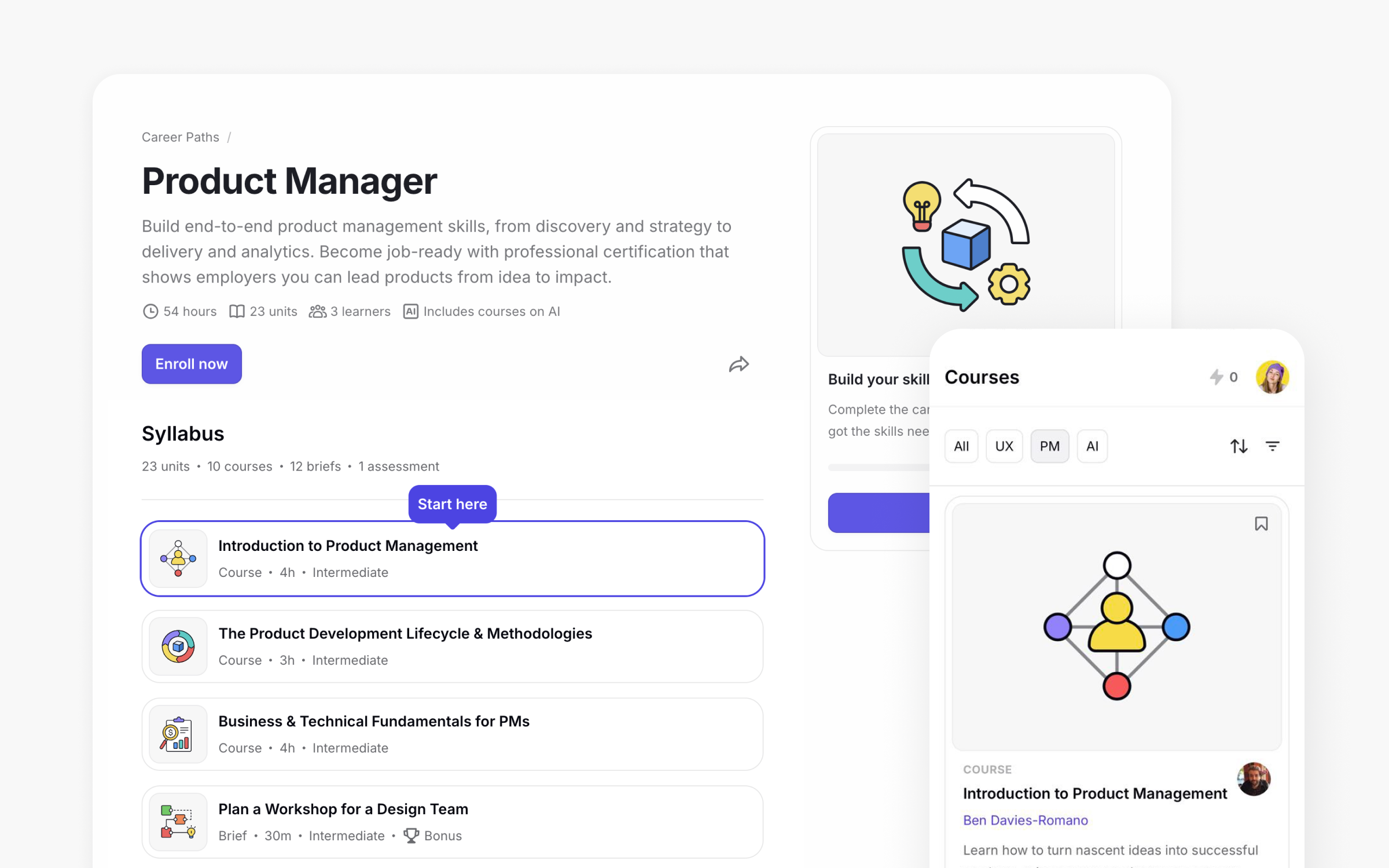
Uxcel is a skill-building platform that launched in 2020, originally focused on design education but now covering product management and cross-functional skills across all experience levels. What caught my attention? They publish actual outcomes data, something most platforms don’t do.
The platform spans over 500 learning materials across design, product management, and related disciplines. Content comes in bite-sized, interactive formats, not long lectures. Typical lessons take 5-15 minutes with built-in exercises. The monthly subscription ($24/month or $288/year for annual) gives you access to everything. Cancel anytime and you don’t lose access to materials you’ve already completed.
According to Uxcel’s 2025 Impact Report, 68.5% of users experienced higher promotion rates after platform usage, and the average salary boost reported was $8,143. These are self-reported numbers, so take them with appropriate skepticism, but at least they publish something. The 48-50% completion rate is roughly 10x better than typical online course completion rates of 3-6%.
Now here’s what makes Uxcel different from Reforge: cross-functional skill mapping across all experience levels. Instead of deep strategic frameworks exclusively for experienced PMs, Uxcel covers skills from foundational to advanced across design, product, and development. Whether you’re just starting in PM (0-2 years), mid-level looking to expand your skillset (3-5 years), or senior wanting to improve cross-functional collaboration (6+ years), the content scales to your level. You build T-shaped skills rather than going deep on strategic frameworks alone. Entry- and mid-level PMs can learn product strategy through Uxcel's dedicated course before reaching the 6-year experience threshold Reforge requires.
Building a strong foundation in core skills and mastering essential skill sets, such as leadership, influence, collaboration, and technical expertise, is crucial for product management success. Uxcel’s approach helps PMs at all levels develop these core skills across the entire product lifecycle.
The pricing difference is significant: $288/year vs. Reforge’s $2,000/year. That’s roughly 7x less expensive. The trade-off? Depth of strategic frameworks. Uxcel gives you breadth across many topics at all levels; Reforge gives you depth on strategic frameworks specifically for experienced PMs transitioning to leadership.
Student testimonials mention “immediate applicability to real product scenarios,” “well-structured progression of skills,” and “regular content updates.” The platform works particularly well for PMs at any experience level wanting to build cross-functional skills, understand design better, or expand their T-shaped skillset without the $2,000 investment.
The pricing difference is significant: $288/year vs. Reforge’s $2,000/year. That’s roughly 7x less expensive. The trade-off? Depth. Uxcel gives you breadth across many topics; Reforge gives you depth on strategic frameworks from practitioners at top companies.
Student testimonials mention “immediate applicability to real product scenarios,” “well-structured progression of skills,” and “regular content updates.” The platform works particularly well for PMs with 0-5 years of experience or those transitioning into PM from adjacent fields like design or development.
Uxcel makes sense if you want cross-functional skills at lower cost with documented outcomes, rather than deep strategic frameworks for experienced PMs. It’s a fundamentally different product serving different needs. It costs 7x less while delivering cross-functional skills with documented outcomes. The $288/year investment is low-risk, you can cancel anytime, and you don’t lose access to completed materials.
Common questions answered
Can I purchase just Product Strategy without the full membership?
No. Reforge only offers annual memberships, not individual course purchases. Your $1,995-$2,000 membership includes Product Strategy plus access to all their other courses. You can’t buy Product Strategy standalone. If you only want one course, you’re paying for the entire platform whether you use it or not.
How much does Reforge Product Strategy cost?
The membership costs $1,995-$2,000 per year. This includes Product Strategy plus dozens of other courses across product, growth, marketing, and engineering. There’s no option to purchase individual courses. No monthly payment plans exist. you commit to the full year upfront.
Who is Reforge Product Strategy for?
Experienced product managers with 6+ years managing products, typically Senior PMs, Group PMs, Directors, and Heads of Product transitioning to strategic leadership roles. If you’re trying to break into PM or have less than 3-5 years experience, this probably isn’t right yet.
Is Reforge worth $2,000?
Depends entirely on your situation. Worth it if you’re an experienced PM (6+ years) at a tech/SaaS company, transitioning to strategic leadership, with organizational support to implement frameworks, and planning to take 4-5 courses throughout the year. Not worth it if you only want Product Strategy, need career services, or want hands-on projects.
How long does the Product Strategy course take?
6 weeks total, with roughly 4-5 hours required per week. That breaks down to maybe 2-3 hours watching pre-recorded videos plus another couple hours in live case study sessions. Total time commitment is roughly 24-30 hours across the six weeks. The online learning format provides flexibility, allowing you to learn at your own pace and fit coursework around your schedule. Reforge also offers flexible options for how you engage with the material.
Does Reforge help with getting a job?
No. Reforge offers zero career services, job placement, or interview preparation. This is professional development for people who already have PM jobs, not career transition support. If you need help landing a job, look at bootcamps with actual career services like Product School or CareerFoundry.
What’s the difference between Reforge and a PM bootcamp?
Reforge focuses on strategic frameworks for experienced PMs (6+ years) and offers no career services or hands-on projects. Bootcamps target career switchers or early-career PMs (0-3 years), include portfolio projects, offer career services, and focus on fundamental PM skills. Completely different use cases and audiences.
Can beginners take Reforge Product Strategy?
Not recommended. Reforge explicitly requires 6+ years of PM experience and may reject applications from less experienced candidates. The content assumes extensive experience and won’t slow down to explain fundamentals. If you’re new to PM, start with foundation courses first.
Does Reforge offer employer reimbursement?
Reforge doesn’t directly offer employer reimbursement, but from what I heard, about half of members get their companies to pay. The professional development framing makes it easier to justify than bootcamps. If your company has learning and development budget, worth asking.
What happens when my membership expires?
You lose access to EVERYTHING immediately. course materials, downloaded templates, Slack community, all of it. Unlike platforms with lifetime access, Reforge is a subscription model. Cancel and you can’t review frameworks or reference materials without paying again. Make sure to screenshot or download anything important during your active year.
How does Reforge compare to an MBA for product managers?
Completely different things. MBAs cost $100,000-200,000 and take two years. Reforge costs $2,000 and takes six weeks per course. MBAs provide broad business education, career network, and globally-recognized credentials. Reforge provides specific product strategy frameworks from practitioners. MBAs signal career ambition to any industry. Reforge signals PM expertise to tech/SaaS folks who know the platform. If you’re choosing between the two, you’re probably asking the wrong question. they serve totally different purposes.
What’s the difference between Product Strategy and Mastering Product Management?
Product Strategy focuses on managing a portfolio of product work strategically: balancing feature optimization, growth, infrastructure, and innovation. Designed for people transitioning from execution to strategic leadership (Senior PM to Director level). Mastering Product Management covers tactical PM skills like creating roadmaps, writing product specs, setting OKRs, and managing feedback. Targets PMs with 3+ years who want to improve execution, not necessarily become strategic leaders. If you execute well but struggle with strategy, take Product Strategy. If you need better PM fundamentals, take Mastering Product Management.
Can I participate in live sessions if I’m in a different timezone?
Reforge offers a few different time slots for live sessions (morning and evening options) and records everything for later viewing. Helen H. mentioned in her review: “I was able to attend 2 out of 4 live sessions and watched the others ones as recordings after.” If you’re international, check whether available time slots work for your timezone or plan to watch recordings exclusively. which reduces the value of the cohort-based format.
Is Reforge a traditional certification program?
Not in the formal sense. Reforge provides a professional certificate upon completion, but it’s not an accredited product management certification like those from academic institutions or formal certification bodies. The value comes from practitioner-led frameworks and industry recognition within tech/SaaS, not from formal accreditation. If you need a widely-recognized certification for job applications, consider Pragmatic Institute or Product School’s programs instead.
What is included with Reforge membership?
Membership includes access to all courses, downloadable resources, and the Reforge community. You also gain access to exclusive events, community resources, and expert guidance from industry leaders, which can help support your ongoing professional growth.
Does Reforge offer networking or community support?
Yes, membership provides access to a community of alumni for networking and ongoing support, allowing you to connect with peers and industry professionals throughout your career.
Is Reforge worth it? Final verdict
After spending way longer than I probably should have digging into this, here's my take: Reforge Product Strategy is worth $2,000 annually if you're an experienced PM (6+ years) at a tech/SaaS company, transitioning from execution to strategic leadership, with organizational support to implement frameworks, and planning to take 4-5 courses throughout the year. For everyone else? The money probably goes further elsewhere.
The course delivers what it promises: advanced strategic frameworks from practitioners who've managed product portfolios at Slack, Tinder, and Instagram. Content quality? Exceptional. Frameworks immediately applicable? Yes. Production value impressive? Definitely. But Reforge succeeds by being extremely specific about who benefits from this investment. They're not trying to be everything to everyone.
Look, I need to be clear about what I did and didn't do here. I didn't interview dozens of graduates. I didn't audit the curriculum myself. I didn't take the course. What I did was spend way too much time reading reviews across multiple platforms, checking what people said worked and what didn't, and trying to figure out if $2,000 makes sense for different types of PMs. That's the honest scope of this analysis.
You should enroll if all of these are true:
- You have 6+ years managing products and can cite specific work you've owned, teams you've led, and strategic decisions you've made. The content assumes this experience level and won't slow down to explain fundamentals. If you're still learning basic PM execution, you're not ready yet.
- You're making the transition from individual contributor to strategic leader. Maybe you just became a Senior PM managing multiple product areas, or you're preparing for Director interviews where strategic thinking matters more than execution skills. This is that moment where tactical excellence isn't enough anymore.
- You work at a tech or SaaS company operating at some scale. Most frameworks and case studies come from companies with millions of users and product-led growth models. Early-stage startups and non-tech industries will find limited direct applicability. The translation work falls on you.
- Your organization will support implementing what you learn. The frameworks require stakeholder buy-in and organizational change. If you can't influence how your team approaches product strategy, everything remains theoretical. Learning strategic frameworks you can't actually use is frustrating and wasteful.
- You plan to take multiple courses throughout the year. At $1,995 for access to 40+ courses, the math makes sense if you complete 4-5 programs. If you only want Product Strategy and nothing else, you're dramatically overpaying. Do the math: $2,000 for one course vs. $400-500 per course if you take five courses.
- Your company will pay for it or you view it as a career investment with 12-24 month ROI horizon. This is professional development spending, not impulse education purchase. The typical Senior PM to Director promotion ($50,000 salary increase) pays for Reforge 25 times over. but only if that promotion actually happens within a reasonable timeframe.
- You're self-directed and don't need hand-holding. With 200-400 people in your cohort and limited instructor interaction, you'll implement frameworks based on general instruction with minimal personalized guidance. If you learn best through one-on-one coaching, this format won't work for you.
You should skip this if any of these are true:
- You have less than 3-5 years of PM experience. The content won't make sense without execution fundamentals in place. You'll pay $2,000 to be confused by strategic frameworks you're not ready to apply yet. Build your execution skills first, then come back to strategic thinking.
- You're trying to break into product management or switch careers. Reforge offers zero career services, job placement, or portfolio development. This is for advancing within PM, not entering it. Save your money for bootcamps that actually help career switchers land jobs with real support.
- You need hands-on projects and portfolio work. The curriculum is theory and frameworks, not practical portfolio building. One project brief exists (the capstone Action Plan) but nothing suitable for showing employers during interviews. If you need portfolio pieces, look elsewhere.
- You want intensive mentorship and instructor interaction. With massive cohorts and guest speaker instructors, personal coaching doesn't exist. Questions frequently go unanswered in Slack channels overwhelmed by 200-400 participants. If you need someone walking you through implementations step-by-step, you'll be frustrated.
- You work outside tech/SaaS or at early-stage startups. Frameworks designed for Slack's growth challenges probably won't translate to your enterprise software product or pre-PMF startup. The case studies assume you're operating at scale with millions of users.
- You only plan to complete Product Strategy throughout the year. If you're not going to use the rest of the platform (the other 40+ courses, events, community), then you're using $2,000 of membership value for just one course's worth of content. That doesn't make financial sense when alternatives offer similar strategic content for $1,500-3,500 without requiring full platform membership. (This one annoyed me personally. the all-or-nothing model feels restrictive.)
- You need materials you can reference for years. Canceling your membership means losing everything, including downloaded templates. If you want permanent access to frameworks, this subscription model will drive you crazy. You're renting, not buying.
What you should do now:
If you fit that "should enroll" profile: Check whether your company has professional development budget that could cover the $2,000 cost. From what people said, about half of members get employer reimbursement. Then review the full Reforge course catalog to identify 3-4 courses beyond Product Strategy that interest you, making the membership financially sensible. Apply during Spring (April) or Fall (October) cohort windows.
If you want cross-functional skill development at any experience level: Uxcel works for junior, mid, and senior PMs at $24/month ($288/year), providing skill development across design and product with better completion rates and documented outcomes data. Whether you're just starting out (0-3 years), mid-level (3-6 years), or experienced (6+ years) looking to expand cross-functional skills, Uxcel scales to your level.
The bottom line: Reforge Product Strategy is excellent at one specific thing. teaching experienced tech/SaaS PMs how to think strategically about managing product portfolios. It's expensive. It requires significant self-direction. It only works if you're already employed as a PM and ready for strategic leadership transitions. The $2,000 investment pays off handsomely for the right person in the right situation, but wastes money for everyone else. The key is honestly assessing which category you're in before buying.