.svg)


Two UC Berkeley product management certificate programs. Same university, same faculty, same certificate. Price difference: $4,200. Most people don’t realize they’re choosing between completely different certificate program experiences.
Writing this took longer than expected. Close to 50 hours if I’m honest. Most of that time? Trying to find independent reviews. Executive education certificate programs don’t generate the feedback ecosystem bootcamps do. The review scarcity became the research story.
I’m being transparent about what I could and couldn’t verify. Unlike coding bootcamps with hundreds of CourseReport reviews, executive education certificate programs generate very little public discussion. UC Berkeley’s PM certificate programs have minimal presence on major review platforms. That’s not necessarily bad. It’s the nature of executive education targeting mid-career professionals. But this assessment relies more on program structure analysis, official materials, and limited third-party sources than typical bootcamp reviews.
What I found: Berkeley’s certificate programs deliver strong academic frameworks and access to a 5,700+ product leader network. The faculty credentials are exceptional. The 2025-2026 programs integrate AI-powered strategic tools. However, these programs cost $5,000-7,500 more than alternatives, and based on limited available feedback, networking quality appears inconsistent. Before committing $3,700-7,900, it's worth benchmarking against a structured PM professional certification that publishes verified outcome data.
Here’s what you’ll learn: what both certificate programs teach, what they cost (including hidden expenses), who succeeds versus who wastes money, what the limited student feedback reveals, how the credential impacts your career, and three alternatives that might serve you better.
If you’re considering either Berkeley certificate program (the $7,900 flagship hybrid or the $3,700 online Studio), keep reading.
Price: $7,900 for the flagship Product Management Program (5 days in person after a 6-week online ramp-up); $3,700 for the 8-week online Product Management Studio. Current prices are on executive.berkeley.edu and the Studio page.
The basics: two programs, two price points
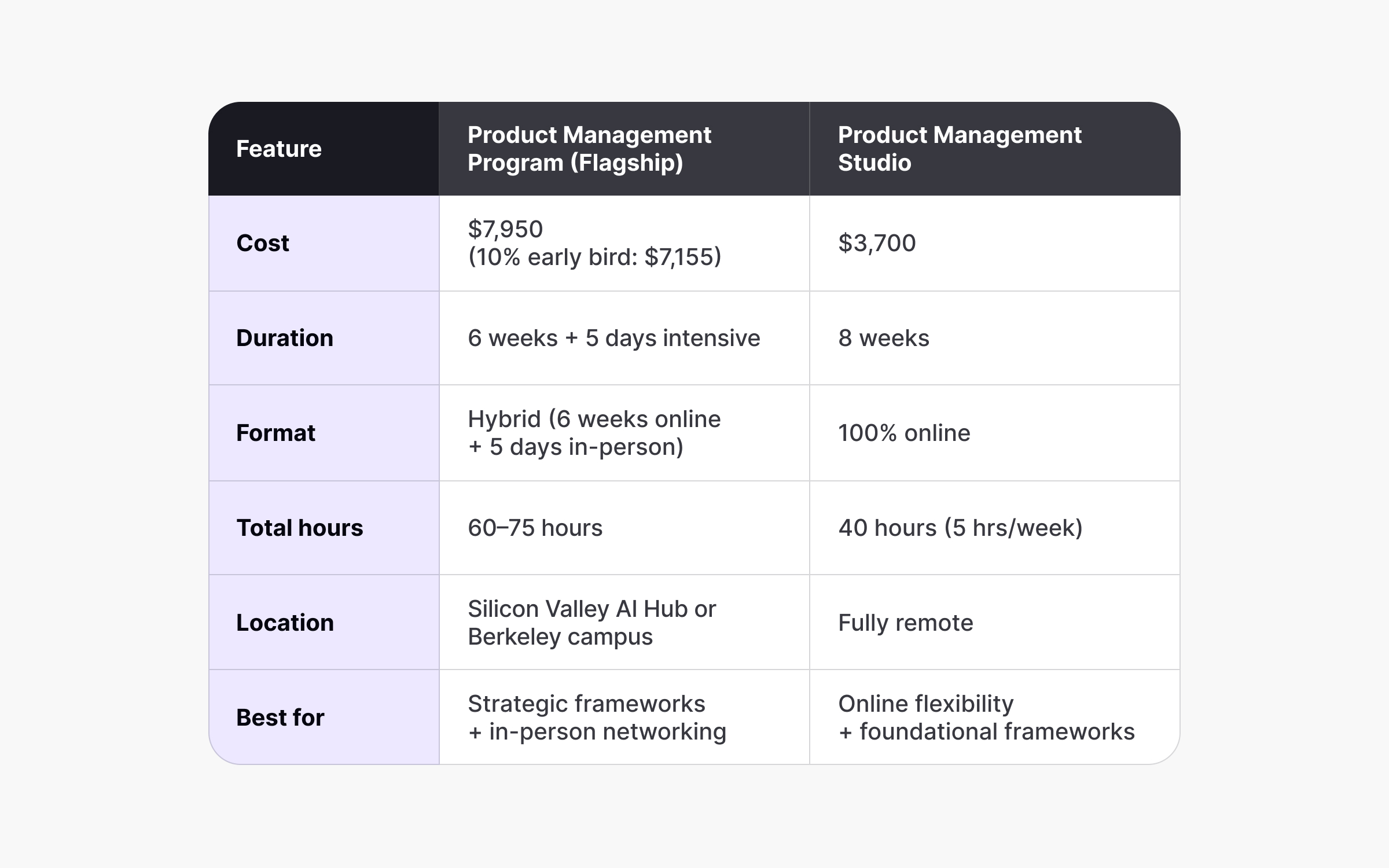
Let’s cut through the confusion. Berkeley runs two different programs:
1. Product Management Studio
This is a fully online program designed for working professionals. The online format allows participants to progress at their own pace, making it flexible for different schedules and commitments. It covers the essentials of product management, including market analysis, product strategy, and go-to-market planning.
2. Product Management Certificate Program
This is an in-person, semester-long program for UC Berkeley students. It’s more academic, with a set schedule and classroom-based learning.
What do both programs share?
Both programs are taught by experienced faculty and industry experts, and upon completion, participants receive a digital professional certificate from UC Berkeley, which can be used to demonstrate expertise and advance your career.
| Factor | Flagship Program | Studio Program |
|---|---|---|
| Cost | $7,900 | $3,700 |
| Format | Hybrid | 100% online |
| Duration | 6 weeks online, 5 days in person | 8 weeks |
| Total hours | 60-75 hours | 40 hours |
| Location | Silicon Valley AI Hub or Berkeley Campus | Fully remote |
| Target audience | Mid-to-senior PMs, executives | Earlier career PMs, aspiring PMs |
| Best for | Strategic frameworks + networking | Flexibility + foundational frameworks |
Two programs. Same faculty. Same certificate. Wildly different prices and formats.
Look at that price gap. The flagship costs triple the Studio. Three times as much for the same faculty, same certificate, same frameworks. Difference is in-person networking and intensive format. Worth it? Depends who's paying.
What both programs share
- Provider: UC Berkeley Executive Education / Haas School of Business
- Faculty Director: Dr. Sara Beckman (Earl F. Cheit Faculty Fellow)
- Certificate: Digital certificate of completion (not degree credit/CEUs)
- Alumni Network: 5,700+ product leaders
- COBE Eligible: Yes (Certificate of Business Excellence pathway)
- Prerequisites: None formal (PM experience recommended)
- 2025-2026 Update: AI Product Strategy Co-Pilot tool access
- Completion Requirement: 80% attendance/engagement
What matters: The flagship targets experienced PMs who want strategic frameworks plus the Berkeley name on their LinkedIn. The Studio? It's for earlier-career professionals building foundations or making the jump from design, marketing, or engineering.
What makes Berkeley's programs different from bootcamps?
UC Berkeley Executive Education runs two structured product management certificate programs through its Haas School of Business. Each certificate program is a comprehensive, multi-course offering that provides a digital badge and a verified credential upon completion. Berkeley created these programs for working professionals who want PM skills without dropping $150K and two years on an MBA. They saw a gap: product management was everywhere, but education options sucked. Either expensive degree programs or career-change bootcamps. Nothing for mid-career professionals wanting to level up.
The flagship Product Management Program started over a decade ago and has served 5,700+ alumni. Think of it as the strategic, framework-heavy option if you’re already a product leader. Berkeley layers MBA-level frameworks from Haas with Silicon Valley practitioner insights.
I found this noteworthy: Berkeley’s one of the first executive education programs to integrate AI tools for strategic planning. Not just lecture about AI, but embed it in the workflow. 2025 brought an AI Product Strategy Co-Pilot. Most programs are still talking about AI. Berkeley built a tool you use throughout the program. Credit where it’s due.
The Product Management Studio launched later as the more accessible, fully online alternative. Similar frameworks in a compressed, remote-friendly format for professionals who can’t take a full week away from work or who are earlier in their PM journey.
Dr. Sara Beckman leads both programs. Earl F. Cheit Faculty Fellow. 25+ years teaching PM at Berkeley. Former HP and Booz Allen Hamilton. Other faculty include Holly Schroth, Dave Charron, and industry experts who provide peer coaching.
Both programs help participants build a strong foundation in core product management skills. The programs target working professionals, often corporate-sponsored. Designed for upskilling and advancing existing PM careers, not career pivoting.
Both programs build on Berkeley’s Product Management Canvas, a framework asking four core questions that every PM should be able to answer: What value are we providing? How are we creating it? How are we delivering it? How are we capturing it? The curriculum layers design thinking, competitive strategy, business model generation, pricing frameworks, and team leadership onto this foundation. Product management covers the skill sets needed for the entire product lifecycle, including fundamentals, design, agile methodologies, leadership, and stakeholder management, to prepare professionals for success in the field. The Canvas framework emphasizes aligning with business goals and engaging key stakeholders throughout the process, ensuring that product decisions are strategically sound and have organizational buy-in. The importance of product vision and managing the product life cycle is central to these frameworks. In addition, the curriculum helps participants develop project management skills, which are essential for career advancement and are often recognized in professional certifications.
Berkeley’s unapologetically academic. Rather than teaching tactical PM skills (writing user stories, running sprints, building roadmaps), they focus on strategic thinking frameworks. You won’t learn Jira. You won’t create wireframes. You will learn how to analyze competitive positioning, design customer-centric experiences, optimize product portfolios, and communicate with executives. The curriculum also stresses that a successful product manager needs to balance creative inspiration with a disciplined approach. Product strategy is presented as the critical link between an organization’s long-term vision and its short-term execution.
Product managers are responsible for the product’s success, which begins with setting a vision for the future. A product manager is responsible for the product's success, including setting clear goals, aligning stakeholders, and ensuring the product delivers value to customers. Product managers occupy a key role in the tech industry, influencing the success of digital products and driving innovation. They also need to create a compelling product roadmap that clearly communicates what’s coming next.
The in-person Program happens at the Silicon Valley AI Hub (Snowflake’s Menlo Park offices) or on the Berkeley Haas campus. The Studio delivers content through weekly live faculty sessions, coach-led workshops, and self-paced learning modules.
You’ll get a digital certificate you can share on LinkedIn. It’s verified by Berkeley. The programs also count toward Berkeley’s Certificate of Business Excellence (COBE), a broader executive education credential requiring multiple programs across four academic pillars. The certificate isn’t a degree. No credit hours. No CEUs. Employers don’t specifically require it. Its value comes from the Berkeley/Haas brand recognition and the frameworks you learn.
While these certificate programs are less focused on hands on experience compared to bootcamps, they emphasize the development of essential skill sets for the entire product life cycle, preparing participants for strategic roles in product management.
Important context: Berkeley offers 7+ different product management-related programs. This review focuses specifically on the two Executive Education programs. Don’t confuse these with semester-long courses for Berkeley students or Extension programs with different structures.
What you'll learn in these product management programs
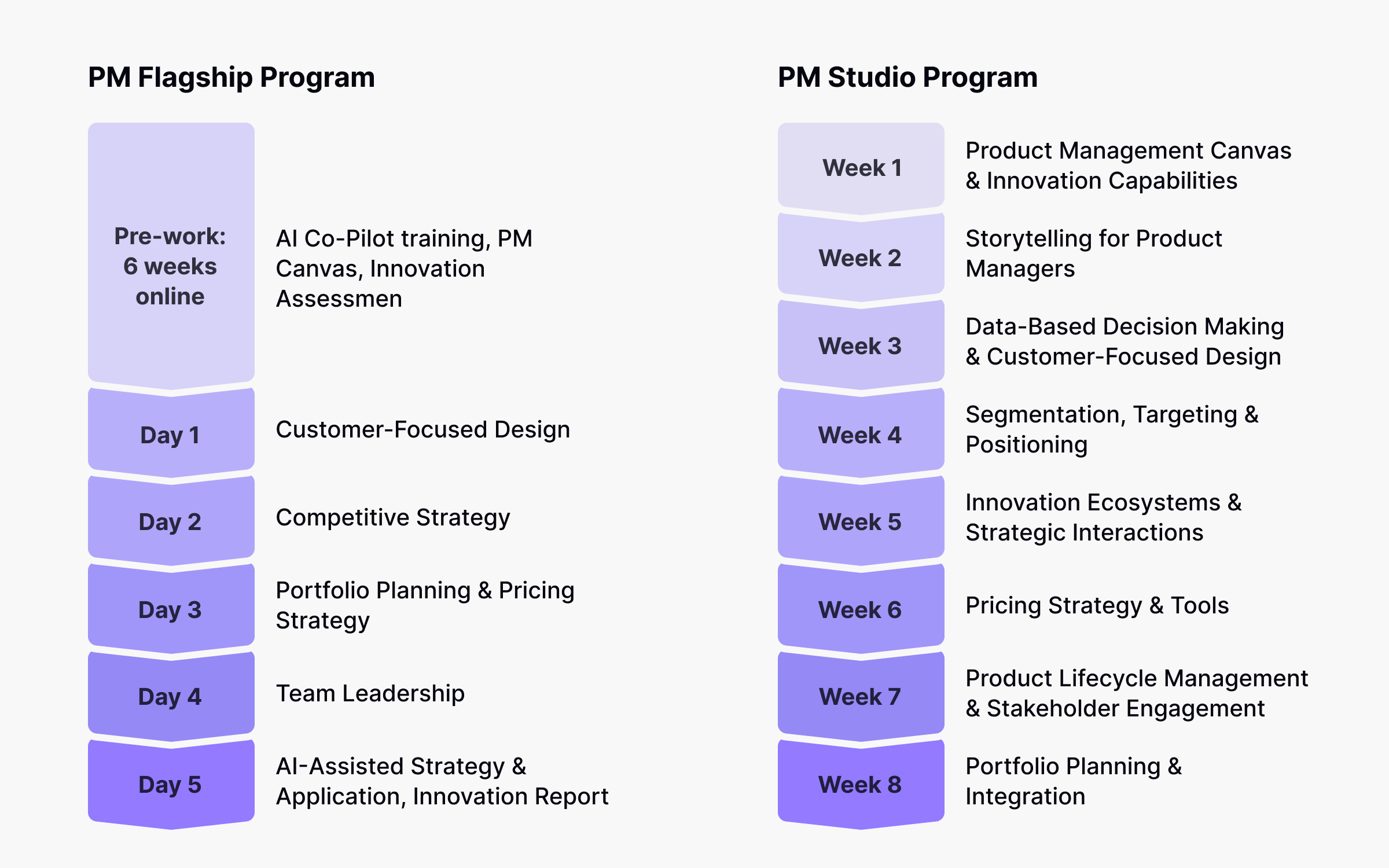
Both Berkeley programs teach strategic PM frameworks rather than tactical execution. The curriculum breaks down like this:
- Curriculum Overview: The curriculum emphasizes that understanding agile methodology is essential for product managers to innovate and collaborate effectively. Students learn the responsibilities of product managers, including how to define value propositions, identify the target customer, and deliver new products that meet customer needs. For supplementary self-paced product management training, Uxcel's intro course covers these same foundations in bite-sized interactive lessons.
- Frameworks and Tools: The program covers frameworks for product management, including how to use data science to validate product ideas and inform decisions throughout the product development process. Students learn to create a product roadmap that aligns with business goals and communicates upcoming features to key stakeholders.
- Customer-Focused Design: The curriculum highlights the importance of product design by integrating design thinking principles and agile methodology to create successful products. Creating a product prototype is essential for getting valuable feedback from potential customers and understanding the needs of the target customer.
- Decision-Making: Making informed decisions is a key outcome of the curriculum, supported by data science and user research. Students are taught to measure and iterate based on feedback and data.
- Documentation: Product managers need to write detailed product requirements documents (PRDs) to kick off the engineering and execution phase, ensuring alignment and clarity for development teams.
- Product Launch: The program teaches the importance of launching a minimum viable product (MVP) to measure what’s working and what’s not, allowing for quick iteration and improvement. Students also learn how to market successfully, ensuring that products reach their target customers and stand out in a competitive landscape.
- Team Leadership: Team building and cross-functional collaboration are emphasized as essential for achieving the product’s success. Students develop leadership skills to align and motivate teams. Product managers must also be able to drive sales by effectively communicating their product vision and strategy to both internal teams and external stakeholders.
- Learning Outcomes: The curriculum prepares students to manage the entire product life cycle, from ideation to launch of new products, ensuring they are equipped to lead teams to achieve the product's success, with a focus on ownership of results and alignment with organizational goals, so they can drive innovation and deliver value in the marketplace.
Product Management Program (Flagship) - Deep Dive
Pre-Program Phase (6 weeks, self-paced): The six-week online ramp-up introduces the AI Product Strategy Co-Pilot and core frameworks. You'll map your current product against the four core questions (value provided, created, delivered, captured). Berkeley says 3-5 hours per week. Students? They report spending more like 6-8 hours if you want full value.
In-Person Intensive (5 days):
Day 1 - Customer-Focused Design: Design thinking (adapted from Stanford's approach). You'll learn needfinding, empathy mapping, and customer research techniques. Berkeley focuses on strategic application: when to use qualitative versus quantitative research, how to translate insights into product strategy, how to convince skeptical stakeholders that customer research matters. Afternoon session: customer journey mapping at scale for complex B2B products and enterprise contexts.
Day 2 - Competitive Strategy: Michael Porter's competitive strategy frameworks applied to product management. You'll analyze competitive positioning, understand when to compete on differentiation versus cost leadership, identify sustainable competitive advantages. Afternoon: Business Model Canvas (Osterwalder framework). You'll design business models for product extensions and stress-test models against market realities. The Hitachi director I quoted earlier? He specifically called out this session as immediately applicable to his work.
Day 3 - Portfolio Planning & Pricing: Product portfolio strategy frameworks for deciding which products to invest in, maintain, or sunset. Berkeley teaches allocation frameworks balancing short-term revenue against long-term strategic positioning.
Getting this curriculum depth wasn't straightforward. Berkeley's main program page just says "Portfolio Planning & Pricing Strategy." Could mean anything. I had to cross-reference four different Berkeley pages plus third-party reviews to piece together what happens on Day 3.
Afternoon: Pricing strategy. This surprised me. Berkeley goes way deeper than most PM programs. Value-based pricing, price elasticity, actual experiments. That Hitachi director? He specifically called this session out too.
Day 4 - Leading Product Teams: Influence without authority. Negotiation tactics, stakeholder management frameworks, communication strategies for PMs leading cross-functional teams without direct reports. You'll practice handling difficult conversations and managing up effectively. Afternoon: Team performance and organizational mobilization.
Day 5 - Application & Integration: AI-assisted strategic storytelling using the AI Co-Pilot to analyze product strategy and build compelling narratives for executives. For foundational grounding in product vision and strategic storytelling ahead of the intensive, Uxcel's product vision and strategy course covers the core frameworks at self-paced depth. Innovation Capabilities Report workshop with personalized feedback. Final networking reception.
Product Management Studio - Condensed Format
The Studio condenses similar content into eight weeks, delivered entirely online with live sessions, team exercises, and three 1-on-1 coaching sessions (Weeks 3, 5, 8).
The framework vs. tactical divide
Look, these aren't bootcamps. You're not building a portfolio. You're not learning Jira or Figma. Berkeley assumes you either already know tactical execution or don't need it for your role.
The value is strategic frameworks. If you need hands-on execution training, you're in the wrong place.
What's the real cost?
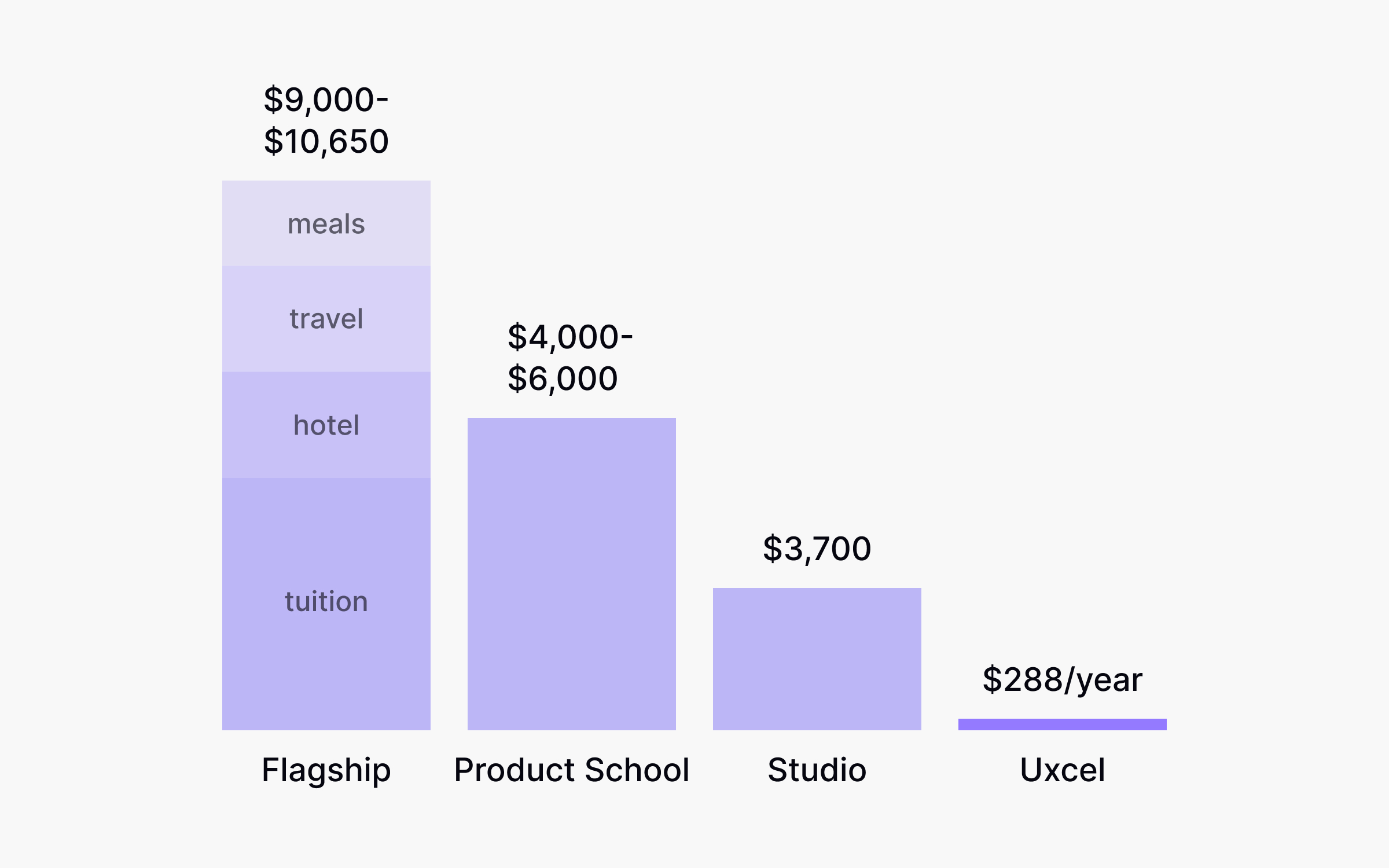
| Cost component | Flagship Program | Studio Program |
|---|---|---|
| Tuition | $7,900 | $3,700 |
| Travel | $300-$800 | $0 |
| Accommodation | $600-$1,500 | $0 |
| Meals and incidentals | $200-$400 | $0 |
| Total cost | $9,050-$10,650 | $3,700 |
What those prices include
Flagship Program ($7,900):
✓ 6-week online pre-program
✓ 5-day in-person intensive with materials
✓ Daily lunch (intensive week)
✓ AI Product Strategy Co-Pilot access
✓ 3-5 peer coaching sessions
✓ Innovation Capabilities Report (personalized)
✓ Digital certificate
✓ Alumni network access (5,700+ members)
✓ COBE credit
✓ Networking reception
Studio Program ($3,700):
✓ 8 weeks curriculum (live + asynchronous)
✓ Weekly live faculty sessions
✓ Weekly coach workshops
✓ Three 1-on-1 coaching sessions
✓ AI Product Strategy Co-Pilot access
✓ Team exercises
✓ Digital certificate
✓ Alumni network access
✓ COBE credit
Beyond the tuition
Travel, accommodation, and meals add $1,500-3,000+ to the sticker price. Berkeley-area hotels run $150-300/night. Silicon Valley often higher. Your time matters too: 18-30 hours of pre-work plus 40+ hours for the intensive week equals 60-75 total hours investment.
Berkeley doesn't advertise this. They assume corporate sponsorship covers everything. If you're paying out of pocket, that matters.
That flagship total? $9,050-10,650 when you factor in everything. That's not a rounding error. That's a used car. That's six months of rent in many cities. That's 37x what Uxcel costs annually. Perspective matters.
Payment options: Berkeley accepts credit card payment. They mention "other payment types," connecting you with their finance team, suggesting installment plans may be available, but details aren't published. No money-back guarantees offered.
Lots of people get corporate sponsorship. Berkeley provides materials to help you approach your employer about tuition reimbursement. If you're corporate-sponsored, the calculation changes completely. It's essentially free professional development.
Comparing the costs
| Program | Cost | Duration |
|---|---|---|
| Berkeley Flagship | $7,900 | 6 weeks + 5 days |
| Berkeley Studio | $3,700 | 8 weeks |
| Uxcel | $288/year | Self-paced |
| Reforge | $2,000 | 4-6 weeks |
| Product School | $3,000-$5,000 | 4-6 weeks |
| Stanford PM | $765 | 8-10 weeks |
That $7,900 flagship price puts Berkeley in the premium tier. Stanford's continuing studies PM program costs just $765, though it's significantly shorter.
The Studio at $3,700 is more competitively priced. Standard for university executive education.
Real question: Is the Berkeley name worth paying double or triple? If you're climbing the corporate ladder at a Fortune 500 company, the Berkeley credential and alumni network might easily justify the cost difference. If you're paying out of pocket at a startup that values practical skills over pedigree, maybe not.
Budget reality: If you don't have $8,000-10,000 available (or a corporate sponsor), the flagship Program isn't realistic. The Studio at $3,700 is more achievable but still requires commitment. Still not cheap. Still a decision.
Will Berkeley's program work for you?
| Enroll if: | Skip if: |
|---|---|
| Mid-to-senior PM already in a role | Starting PM career without experience |
| Your company sponsors you | Paying out of pocket |
| You value brand-name credentials | Already have an MBA |
| Need strategic frameworks | Want tactical PM skills |
| Want Berkeley/Haas prestige | Expect certificate alone to transform career |
You're a strong fit for the Flagship Program if:
You're a mid-to-senior product manager already in the role. The curriculum assumes PM experience. Your company is paying? That changes everything. Corporate sponsorship means Berkeley's frameworks become pure upside. You're not spending your own money.
You value brand-name credentials. The UC Berkeley/Haas certificate carries weight in large corporations, consulting firms, and industries that respect academic pedigree. You're Bay Area based (in-person networking opportunities are most valuable if you can leverage relationships afterward). You need strategic frameworks, not tactical skills. You can take a full week away from work plus travel time.
You're a strong fit for the Studio if:
Earlier in your PM career. Transitioning from an adjacent role. The Studio covers similar frameworks with more foundational context. You want Berkeley's frameworks but can't afford the flagship's time or money commitment. At $3,700 with no travel costs, the Studio offers the same faculty and brand at one-third the price. You learn well in online formats and don't need in-person networking. You want to test Berkeley's approach before committing to the flagship.
Skip Berkeley if:
- Starting your PM career. Neither program offers portfolio development or tactical skills most early PM roles require. Career-change bootcamps serve that audience better.
- Already have an MBA from a top program. Multiple reviewers said Berkeley's content overlaps heavily with MBA curricula. One Quora reviewer specifically stated the program "makes no sense for those with an MBA."
- Need guaranteed networking outcomes. Reviews mentioned networking quality as "hit or miss." Berkeley provides access to 5,700+ alumni and events, but quality depends on your cohort and networking skills.
- Want comprehensive PM education including tactical skills. Berkeley teaches strategic frameworks. No roadmapping tools, sprint management, user research execution, or data analysis techniques.
- Budget-constrained and need ROI certainty. At $7,900+ for the flagship or $3,700 for Studio, these aren't cheap. With no salary increase data and limited independent reviews verifying outcomes, you're buying largely on faith in the Berkeley brand.
Deal-breakers:
- Starting PM career without existing experience
- Company won't sponsor and $3,000-8,000 would strain budget
- Want hands-on portfolio projects
- Looking for credential that employers specifically require
- Expect Berkeley's certificate alone to transform your career
Bottom line: Berkeley's programs work best for current PM professionals who can afford them (or get sponsored), value strategic thinking over tactical execution, and understand the value is in frameworks and network rather than guaranteed outcomes.
What's the real student feedback on Berkeley's programs?
Here's where this gets uncomfortable: there are very few independent, verified student reviews available. I spent hours searching CourseReport, G2, Trustpilot, Reddit. Platforms where bootcamps get hundreds of reviews. For Berkeley's Executive Education PM programs? Almost nothing.
Look, this isn't weird for executive education. Mid-career professionals getting corporate sponsorship? They're not posting Yelp-style reviews. Smaller cohorts, professional reputation concerns, less incentive to broadcast enrollment decisions publicly. The audience is just different from career-change bootcamp students.
Still, the scarcity matters. It limits what I can verify.
No CourseReport presence
CourseReport? Nothing. I searched extensively. Zero. CourseReport primarily covers immersive coding bootcamps and career-change programs. Executive education certificates don't fit their model.
No G2 listing
G2 doesn't have listings for these programs either. G2 focuses on software products and B2B services, not educational programs.
Limited Trustpilot data
Trustpilot has reviews for UC Berkeley Extension, but these cover hundreds of different courses across all subjects. No way to isolate feedback specifically about the Product Management programs. The overall Extension rating sits around 3.2/5, but mixing reviews for computer science, writing, and business programs into one aggregate score tells us nothing useful.
Minimal Reddit discussions
Searched r/ProductManagement, r/cscareerquestions, r/MBA. Very few threads exist. One 2010 Quora review (appeared in Reddit searches) said: "I took it back in 2010. It was pretty good. Crash-course format, not many use cases, either hit or miss for networking. It might be good for those who are very new to product management."
This 15-year-old review isn't exactly current, but the "hit or miss for networking" observation appeared in multiple sources.
Third-party review sites
Pathrise Resources (June 2023) reviewed the Product Management Studio. They noted: "The Product Management Studio by UC Berkeley has mostly positive reviews. In fact, they were on Hubspot's list of top 16 product management courses."
Pathrise pulled together student quotes from various platforms:
• "Great for newer product managers looking to accelerate their career with the program's fast-paced 'crash-course format'" (Quora graduate)
• "Good teachers, positive environment, and good career preparation" (Indeed reviewer)
• "I walked away with 30 good contacts for the future from that session" (Reddit, in-person student)
• "The material itself is definitely exceptional, as are the instructors" (Reddit)
However, Pathrise highlighted critical limitations:
• "Makes no sense for those with an MBA" (Quora graduate)
• "Networking is hit or miss" (Quora graduate)
Product HQ (May 2024) reviewed both programs. Their assessment: "The program is fairly decent... However, the price is not pocket-friendly considering that it's a seven-week course that is mostly going to be taught online with a limited immersive experience. To some people, this might not seem like good value for money."
Their final verdict: "Is the Berkeley Product Management Program really worth it? The answer: It depends."
Official Berkeley testimonials
Berkeley's website features seven testimonials, all positive (as expected for marketing materials):
"If you want to be challenged by colleagues from the industry and dare to bring yourself to the next level of knowledge and skills, I found Berkeley the place to be! The amount of strategic and practical new insights was mind-boggling."
"The UC Berkeley Product Management Program is an outstanding course that covers all aspects of product management in great depth... The standard of presenters was exceptional, and certainly far higher than on any other business program that I have attended." (Director, Hitachi Data Systems)
These testimonials emphasize framework quality, immediate applicability, and faculty excellence. Notably, none claim salary increases or promotion outcomes.
What the limited feedback revealed
Strengths (mentioned repeatedly): • Faculty quality is exceptional • Frameworks are comprehensive and immediately applicable • Strategic thinking emphasis is valuable • Material is more academic/rigorous than alternatives • Berkeley brand carries weight
Weaknesses (mentioned repeatedly): • Networking quality inconsistent, depends on cohort • High cost relative to other product management courses • MBA overlap makes it less valuable for MBAs • Not suitable for career changers
Transparency issue
What troubles me most isn't the limited reviews. It's the lack of outcomes data. Berkeley publishes no employment statistics, no salary increase data, and no promotion rates. Nothing quantifiable about career impact. For programs costing $3,700-7,900, this absence is notable.
Without independent verification, you're relying primarily on: Berkeley's brand reputation, faculty credentials (legitimately impressive), program structure (appears solid based on curriculum analysis), and testimonials from self-selected satisfied customers.
That's not necessarily a reason to avoid Berkeley. Brand reputation and faculty quality matter. But it does mean your decision requires more faith and less data validation than typical bootcamp evaluations.
If this review scarcity concerns you, consider reaching out to Berkeley directly for alumni connections you can interview, searching LinkedIn for graduates and requesting informational interviews, or weighing whether you're comfortable making a $3,000-8,000 decision with limited independent verification.
How will this impact your career?
Berkeley's executive education model focuses on skill development for professionals already established in PM or adjacent roles. This isn't about landing your first PM role. It's about advancing within your existing career.
What Berkeley provides
Alumni network access (5,700+ product leaders). However, quality and utility depend entirely on your networking skills and effort.
Certificate credential. A verified digital certificate from UC Berkeley Executive Education. The value depends on whether employers in your target industry recognize and value Berkeley/Haas credentials.
Skills and frameworks. You'll legitimately learn strategic PM frameworks, but career impact depends on how you apply them in your current role.
The LinkedIn test
I searched LinkedIn for job postings mentioning the UC Berkeley PM certificate. Very few listings specifically reference this credential. That's normal. Employers rarely require specific executive education certificates. They care more about experience, demonstrated skills, and proven results.
Employee recognition
Does the Berkeley brand carry weight? Yes, in certain contexts. UC Berkeley is a top-ranked public university. Haas is a top-10 MBA program. The Berkeley name opens doors in academia, corporate environments that value pedigree, consulting firms, and some tech companies.
But "carries weight" doesn't mean automatic advancement.
Who benefits
- Current PMs seeking promotion (if you're already a PM wanting to move to senior or principal roles, Berkeley's frameworks can help you think at that level, but you need to apply them actively). Uxcel's product management path maps these level transitions, useful for identifying which frameworks matter most at your current stage before investing $3,700+.
- Professionals moving laterally into PM (if you're in product marketing, engineering, or design and want to transition to PM, Berkeley's frameworks provide credibility).
- Corporate employees seeking internal mobility (if you work at a company that values executive education, completing Berkeley might help you transfer internally).
- Entrepreneurs and startup founders (if you're building your own product, Berkeley's frameworks help you think strategically about product strategy).
Who doesn't benefit
- Early-career professionals without PM experience (Berkeley won't help you break into PM roles if you're coming from unrelated fields).
- Budget-conscious professionals (if that $3,000-8,000 would strain finances, the ROI becomes questionable without clear outcomes data).
- People expecting automatic results (the program doesn't "get you" anything. It teaches frameworks you must apply).
The honest assessment
Berkeley's programs can improve your career if you're already established in PM or adjacent roles and apply what you learn actively. The certificate provides some brand credibility, the frameworks can genuinely improve strategic thinking, and the network offers potential (but not guaranteed) connections.
However, career impact depends entirely on your starting position and how you leverage the learning. If you're already in the game (working in tech, relevant experience, PM fundamentals), Berkeley might help you level up. The certificate itself won't advance your career. Your ability to apply frameworks, demonstrate improved strategic thinking, and communicate value determines outcomes. For data on how learning platforms affect PM compensation data, Uxcel's salary guide documents the actual salary lift from structured skill-building.
How does Berkeley compare to alternatives?
Berkeley occupies a specific niche: premium-priced, academically rigorous, executive education for working professionals.
Berkeley vs. Product School
What about Product School? They charge $3,000-5,000 for 8-10 weeks taught by current FAANG product managers. Practitioner-led. Tactical skills. 35,000+ alumni.
The choice is stark: Berkeley brings academic frameworks and brand prestige. Product School brings tactical execution and practitioner insights. You're choosing philosophy. Strategic thinking versus practical skills.
Berkeley vs. Reforge
Reforge is different entirely. Not even trying to compete with Berkeley's model. They assume you're already good at PM fundamentals and want to specialize. Growth strategy. Retention tactics. Monetization playbooks.
Membership model ( $2,000/year unlimited). Serves 15,000+ advanced practitioners. Taught by VP/Director-level tech leaders actively leading product at companies like Airbnb, Stripe, and Netflix.
Berkeley offers broader foundational strategic frameworks. Reforge provides ongoing membership community access. Berkeley provides one-time certificate.
Berkeley Studio ($3,700) is comparable price-wise. Berkeley flagship ($7,900) costs significantly more.
Berkeley vs. Stanford Continuing Studies
Stanford at $765 vs Berkeley at $7,900? That's close to 10x price difference for the Berkeley name. Stanford offers product management programs through Continuing Studies. Much shorter duration. Stanford brand. Online format.
Stanford wins dramatically on price, though you're getting less total content. Both provide prestigious university credentials.
Berkeley vs. Career-Change Bootcamps
Different purpose entirely. Programs like Product HQ, Product Gym, and intensive Product School offerings cost $8,000-15,000. They provide 3-6 months training with portfolio projects and tactical skill development.
Bootcamps help you break into PM roles. Berkeley helps you advance within existing PM career. Bootcamps provide tactical skills. Berkeley provides strategic frameworks.
If you're changing careers into PM, bootcamps are appropriate. If you're advancing an existing PM career, Berkeley's approach works better.
The positioning clarity
Let's be clear: Berkeley isn't a bootcamp. It's executive education. That distinction matters.
Bootcamps teach tactical skills for career entry. Berkeley teaches strategic frameworks for career advancement. Different audiences. Different purposes. Different outcomes.
Berkeley makes sense when you value academic prestige, need strategic frameworks more than tactical skills, are already working in PM or adjacent roles, your company is paying (changes the calculation dramatically), and you're focused on advancing your existing career.
Alternatives make more sense when you're trying to break into PM roles (choose bootcamps), want very specific advanced topics (choose Reforge), budget is primary concern (choose Stanford, MIT, or online alternatives), or want practitioner-led tactical training (choose Product School).
Why is Uxcel the best alternative
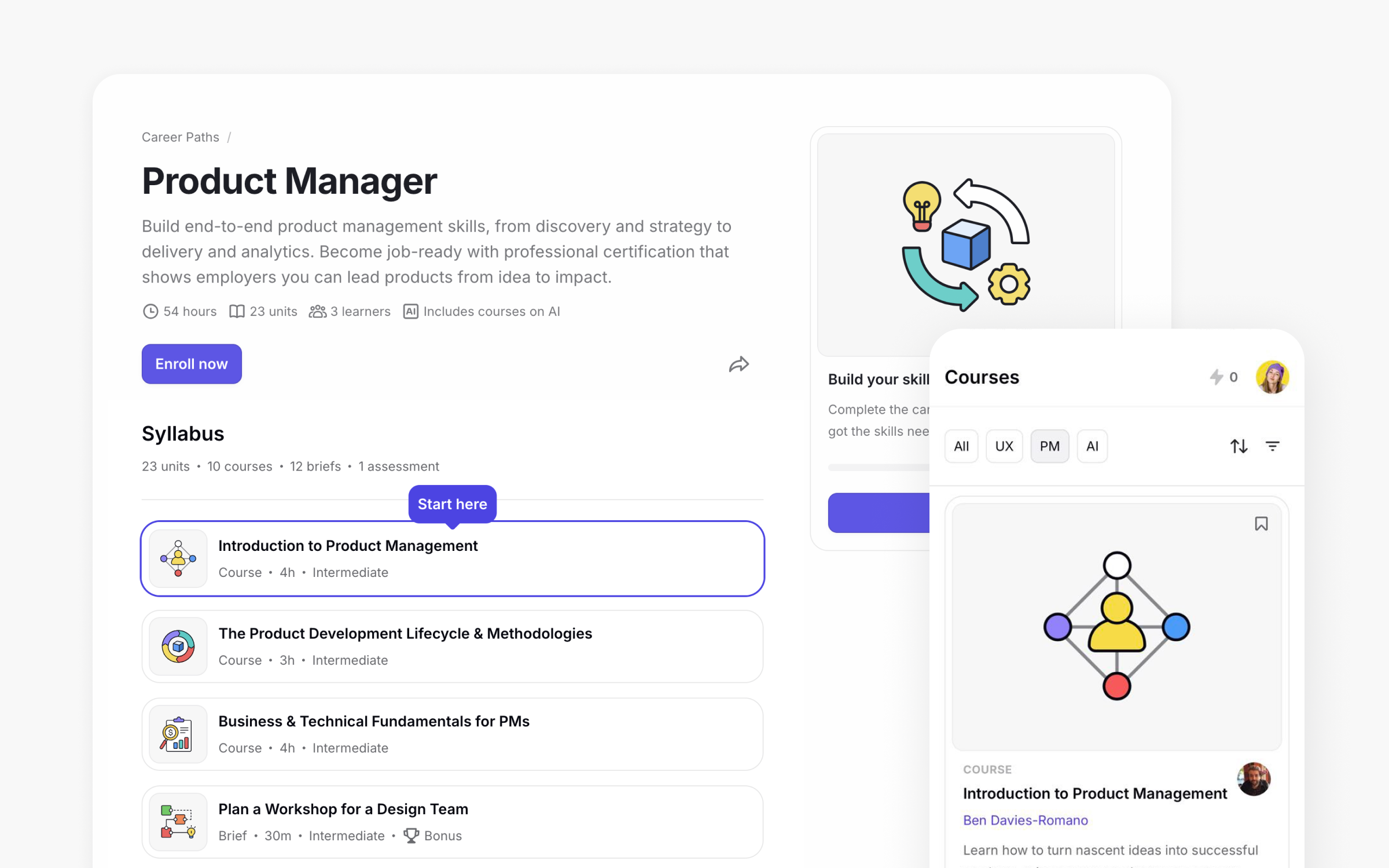
After five PM programs with zero published outcomes, Uxcel's transparency was jarring: 68.5% promotion rate, $8,143 average salary bump, 48-50% completion rate. Methodology available. 2025 Impact Report public.
That transparency matters when Berkeley wants $3,700-7,900 and Uxcel costs $288 annually.
Uxcel launched in 2020 to solve a specific problem: professionals need to advance without expensive bootcamps or passive video courses. The platform offers interactive, bite-sized learning across UX design, product management, and AI skills.
What makes Uxcel fundamentally different: cross-functional skill mapping. While Berkeley teaches strategic PM frameworks in isolation, Uxcel lets you simultaneously build product management skills while tracking complementary design capabilities, or vice versa. This matters because senior IC roles increasingly require understanding both disciplines deeply. Our guide to product manager skill requirements maps exactly which capabilities employers expect at senior IC and director levels.
The platform serves 500,000+ learners across 140+ countries. Enterprise clients include Microsoft, Deloitte, PwC, and Fujitsu. Learning approach uses gamification (similar to Duolingo) with 5-minute lessons and progress tracking across web and native mobile apps (iOS and Android).
Core advantages over Berkeley:
Price: $24/month billed annually ($288/year) versus Berkeley's $3,700-7,900. That's 9x-28x cheaper while providing comprehensive PM curriculum. Berkeley costs $3,700-7,900. Uxcel costs $288 annually. That's 9x-28x cheaper. The value question isn't subtle.
Documented outcomes: Those Uxcel numbers (68.5% promotion rate, $8,143 salary boost) are published. Documented. Berkeley publishes nothing comparable. That absence matters.
Completion rates: Uxcel maintains 48-50% course completion versus the 5-15% industry standard for online learning.
Platform flexibility: Learn on web, then continue on native iPhone, iPad, or Android apps with automatic syncing.
Cross-functional depth: The skill mapping system tracks both your core skills (PM or design) and complementary skills (the other discipline) as you learn. This is unique in the market.
What Uxcel doesn't provide:
No university brand credential. If your career advancement depends on name-brand credentials, this matters.
Less emphasis on strategic business frameworks. Uxcel teaches PM skills comprehensively, but Berkeley's business model canvas and portfolio optimization frameworks go deeper.
No alumni network of 5,700+ product leaders.
No in-person networking opportunities.
Uxcel makes sense for:
• Budget-conscious professionals who can't justify $3,700-7,900
• People who want to learn both PM and design skills simultaneously
• Self-directed learners who prefer flexible pacing
• Anyone prioritizing skill development over prestigious credentials
• Professionals who value documented outcomes and completion rates
Uxcel makes less sense if you specifically need the Berkeley brand for credibility in your industry, want deep strategic business frameworks, learn best with live instruction and cohort accountability, or need in-person networking with senior product leaders.
Common questions answered
Worth it compared to what?
Depends on your situation. Worth it if: corporate-sponsored, mid-to-senior PM needing strategic frameworks, value Berkeley brand for corporate credibility. Not worth it if: paying out of pocket on tight budget, early in PM career, already have MBA. Cost: $3,700-7,900.
Do employers care about the UC Berkeley product management certificate?
Most employers don't specifically require this certificate. Job postings rarely mention it. However, the Berkeley/Haas brand carries general prestige in corporate settings, consulting, and industries valuing academic credentials. Employers care more about demonstrated PM skills, relevant experience, and proven results than any specific certificate. The Berkeley credential might provide marginal advantage in internal advancement but won't overcome lack of experience or poor demonstrated skills.
Will this help me advance to senior PM roles?
Potentially, if you apply the frameworks actively in your current role. Berkeley provides strategic thinking tools that senior PMs need. However, the certificate itself doesn't guarantee promotion. Your ability to demonstrate improved strategic thinking, lead more effectively, and drive better product decisions determines advancement. The Berkeley credential adds credibility in organizations that value academic pedigree, but results matter more than credentials.
How does the Product Management Program differ from the Studio?
Flagship ($7,900): Hybrid format (6 weeks online + 5 days in-person), 60-75 total hours, targets mid-senior PMs, includes in-person networking in Silicon Valley/Berkeley. Studio ($3,700): Fully online, 8 weeks, 40 total hours, targets earlier-career professionals. Both share same faculty director (Dr. Beckman), award same Berkeley certificate, count toward COBE, include AI Co-Pilot access. Choose flagship if you can afford it and value in-person networking. Choose Studio if you need online flexibility at lower cost.
What's the AI Product Strategy Co-Pilot?
Berkeley integrated an AI tool in 2025-2026 that helps you practice strategic thinking. It's positioned as a "thinking partner" for customer journey mapping, competitive analysis, and positioning exercises. You use it throughout pre-work and during the program to analyze your own products. It appears to be an AI interface trained on Berkeley's PM frameworks rather than generic ChatGPT. Access duration after program completion isn't clearly specified.
Does the certificate count as continuing education credits?
No. Berkeley explicitly states the certificate is not eligible for degree credit or CEUs. It's a non-degree executive education certificate. However, it does count toward Berkeley's Certificate of Business Excellence (COBE) if you want to continue taking Berkeley executive education programs across multiple topics. COBE requires completing programs across four academic pillars (Leadership, Entrepreneurship, Strategy, Finance) within three years.
Can I take this program while working full-time?
Studio: Designed for working professionals. 5 hours per week over 8 weeks with flexibility for self-paced components. Most people manage this alongside full-time work. Flagship: Requires taking five consecutive days away from work plus evening prep. You'll also need 3-5 hours weekly for six weeks of pre-work. Time commitment is significant, particularly the in-person week. Many participants are corporate-sponsored, meaning their company supports them taking time off.
What if I already have an MBA?
Here's the thing: Berkeley's content overlaps heavily with MBA programs. Multiple reviews said this. One reviewer stated the program "makes no sense for those with an MBA." If you've recently completed an MBA covering business model canvas, competitive strategy, design thinking, and similar frameworks, Berkeley might feel redundant. However, if your MBA was years ago or didn't emphasize product management specifically, the refresh and PM-specific application might still provide value. Consider whether you're paying $3,700-7,900 to revisit material you already learned.
Does Berkeley offer payment plans?
Berkeley accepts credit card payment and mentions "other payment types" connecting you with their finance team, suggesting installment plans might be available. Specific payment plan details aren't published publicly. Berkeley doesn't offer scholarships or financial aid for these programs (they're executive education, not degree programs). Many participants are corporate-sponsored through company learning and development budgets. Berkeley provides materials to help you approach your employer about tuition reimbursement.
How selective is admission?
Berkeley doesn't publish acceptance rates or selection criteria beyond "professionals with experience in product development, design, marketing, or adjacent fields." There's no formal interview process. You complete a brief application form explaining your background and goals. Based on limited available information, admission appears relatively open if you have relevant professional experience.
Does Berkeley help with career advancement after the program?
Not directly. You get access to the alumni network of 5,700+ product leaders and networking events, but Berkeley doesn't provide career coaching, promotion guidance, or active facilitation beyond access. What you do with the network depends entirely on your networking skills. The frameworks you learn might help you think more strategically, potentially positioning you for promotion, but Berkeley doesn't track or support career advancement explicitly. This is skill development, not career advancement services.
The verdict? Berkeley's professional certificate works for a specific audience
Berkeley's product management programs deliver legitimate value for a specific audience: mid-to-senior professionals who can afford $3,700-7,900 (or get corporate sponsorship), who already work in or adjacent to PM roles, who need strategic thinking frameworks more than tactical skills, and who value prestigious university credentials.
If you match that profile, Berkeley offers strong faculty (Dr. Sara Beckman is legitimately accomplished), comprehensive strategic frameworks (Product Management Canvas, business model generation, competitive strategy), access to 5,700+ alumni, and the Berkeley/Haas brand that carries weight in corporate settings. The 2025-2026 AI tool integration shows the program is evolving.
However, Berkeley makes less sense than alternatives if you're on a tight budget, early in your PM career without established experience, already have an MBA covering similar content, or want practitioner-led tactical training over academic frameworks.
The big problem: almost no independent reviews exist. No CourseReport reviews, no G2 listing, minimal Reddit discussion, no published outcomes data. You're making a decision based primarily on Berkeley's brand reputation and program structure analysis rather than extensive student feedback and verified career impact data.
Flagship Program ($7,900): Who pays this?
You're a clear fit if:
• Your company sponsors you (changes calculation entirely)
• You're a mid-to-senior PM needing deeper strategic thinking skills
• You specifically value Berkeley/Haas brand for credibility
• You're Bay Area-based and can leverage the alumni network effectively
• You can afford $8,000-10,000 without financial strain
• You're comfortable making the decision with limited independent verification
Skip if:
• Paying out of pocket and $8,000-10,000 would strain finances
• Early in PM career without established experience
• Already have recent MBA (significant content overlap)
• Need tactical PM skills over strategic frameworks
• Want guaranteed outcomes or networking results
Studio ($3,700): More accessible option
You're a good fit if:
• You want Berkeley's frameworks but can't afford flagship or take time away
• You're earlier in PM career and need foundational strategic thinking
• You prefer online learning over in-person intensive
• You want to test Berkeley's approach before potentially taking flagship
• You can self-direct through 8 weeks of online learning
Consider alternatives if:
• Even $3,700 would strain your budget (Uxcel costs $288/year with documented 68.5% promotion rate and $8,143 avg salary boost per their 2024 Impact Report)
• You want practitioner-led tactical training (Product School)
• You need live instruction and cohort accountability (flagship or other options)
What to do now
If still considering Berkeley:
- Ask Berkeley to connect you with an alumni for informational interview
- Find recent grads on LinkedIn and message them about their experience
- Do the math: tuition + travel + hotel for flagship
- Verify whether your company offers learning budget covering tuition
- Compare your needs against alternatives (Uxcel for cross-functional expertise, Reforge for advanced topics, Product School for tactical skills)
- Acknowledge you're making this decision with limited independent verification
- Decide whether Berkeley brand and frameworks justify premium in your specific situation
If Berkeley doesn't fit, start with Uxcel at $288/year. Complete a few courses and see whether this is for you. If you like the platform, you already have access to the entire curriculum for that $288 you paid.