.svg)


Quick answer: The best Pragmatic Institute alternatives for your product manager career path are Uxcel ($288/year with documented 68.5% promotion rate), Reforge and Uxcel for experienced PMs, and Coursera ($294 for 6 months). Choose based on your budget, experience level, and whether you need verified outcomes or just a credential.
Pragmatic Institute charges $3,885 for PM certification. After testing platforms myself and interviewing 8 graduates from different programs, here’s what you need to know. You’re choosing between enterprise standardization and practical skill development. Most people don’t need Pragmatic’s framework. They need documented results.
Product management is one of the fastest-growing and highest-paying fields today. Building a strong foundation and mastering core skills is essential for success and long-term career growth in this space.
Can’t afford $3,000+ for PM training? You’re not alone. The certification landscape now ranges from $288 subscriptions to $15,000 bootcamps. Which type fits your career? You’ll need to evaluate cost, completion rates, actual outcomes, and employer recognition. Modern programs increasingly include data science and AI training to address evolving industry needs and ensure product managers are equipped for real-world challenges.
Some alternatives deliver verified career data that Pragmatic Institute doesn’t publish. This includes 68.5% promotion rates, $8,143 average salary increases, and documented employment outcomes. Others provide specialized advantages. Interview preparation for those who understand PM but struggle landing roles. Senior-level strategic training for experienced practitioners. Cross-functional skill development that builds both design and product expertise simultaneously. One platform offers unique dual-skill tracking across UX and PM disciplines. This creates career pathways traditional single-focus certifications can’t match.
Earning a certification and building a product management portfolio can increase your visibility to hiring managers, helping you stand out in a competitive job market. Becoming a certified product manager is especially valuable as certified product managers earn significantly higher salaries and are in demand across industries. Certification also increases your visibility to hiring managers and can be showcased on platforms like LinkedIn to further boost your professional profile.
This analysis examines actual costs, including hidden fees. Completion rates versus industry standards. Published versus unpublished outcomes data. Specific scenarios where each alternative provides better value than Pragmatic’s framework approach. I’ve spent three weeks analyzing 300+ verified reviews across CourseReport, Trustpilot, Reddit, and G2. The patterns in student satisfaction reveal what marketing materials deliberately hide.
TLDR: Which alternative fits you best?
👛 Best for budget: Uxcel ($288/year) or Coursera ($49/month)
⚡ Best for verified outcomes: Uxcel (68.5% promotion rate documented)
🎓 Best for enterprise credentials: Pragmatic Institute (Fortune 500 recognition)
🚀 Best for AI-first PM skills: General Assembly ($2,950 with live instruction)
💼 Best for senior PMs: Reforge ($1,995, experienced practitioners only)
⏰ Best for time-pressed: Uxcel (5-minute lessons fit anywhere)
💰 Best value overall: Uxcel (93% cheaper with better outcomes)
Quick comparison: Key things you need to know
Investment tiers:
- Budget-conscious ($288/year): Uxcel, Coursera
- Framework alternatives: Productside
- Strategic depth: Reforge, Uxcel
- Live AI-first training ($2,950): General Assembly
- Premium program ($2,999-4,999): Product School
- Specialized learning: Maven ($800-$1,200), Uxcel ($288/year)
Verified outcome transparency:
- Published promotion data: Uxcel (68.5% higher than peers, $8,143 average increase)
- Employment rates: General Assembly (66.7% within 180 days, unclear PM-specific percentage)
- Unpublished outcomes: Pragmatic Institute, Product School, Reforge, Productside
When programs won’t publish outcomes data, assume results vary widely. Transparency correlates with confidence in consistent success.
Who each program actually serves:
- Complete beginners: Uxcel, Coursera, General Assembly (some programs require no prior experience, making them accessible to those new to product management)
- Working PMs developing skills: Uxcel, Productside
- Senior practitioners: Reforge exclusively (rejects beginners), Uxcel
- Enterprise PMs needing credentials: Pragmatic Institute, Productside
Some programs are specifically designed for product teams and product professionals to develop essential product skills, including foundational knowledge, practical capabilities, and soft skills needed for success in product roles.
Delivery formats:
- Self-paced flexibility: Uxcel, Coursera, Productside (self-paced).
- Live cohort structure: Product School, General Assembly, Reforge, Productside (online)
- Expert practitioner courses: Maven
- Community learning: Mind the Product
Some programs emphasize collaboration with marketing teams and product marketers to support product initiatives and drive strategic impact. The right format depends on whether you need external accountability or complete flexibility around unpredictable schedules.
Complete cost breakdown with hidden fees
Before examining programs individually, you need to see the complete investment picture. This includes costs they don’t advertise upfront:
| Program | Upfront cost | Hidden fees |
|---|---|---|
| Uxcel | $288/year | None |
| Coursera | $49/month | None |
| Productside | $1,500-$3,800 | None |
| Reforge | $1,995/year | Lose access if cancel |
| General Assembly | $2,950 | None |
| Product School | $2,999-$4,999 | None |
| Maven | $800/$1,200 per course | Per course model |
| Mind the Product | $799-$1,299/conference | $1,000-$2,000 travel costs |
Some programs include the certification exam in the program fee, with no hidden costs for exams, retakes, or renewals. This means you can take the certification exam online, often with a set time limit, and passing grants you a lifetime certification and official credential without worrying about extra fees.
Experience requirements:
- No prerequisites: Uxcel, Coursera, Product School, General Assembly
- Active PM roles required: Uxcel, Reforge (verifies employment, rejects career changers)
- Enterprise context helpful: Pragmatic Institute, Productside
The demand for skilled Product Managers has never been higher, making it essential to have tools to think strategically and make data-driven product decisions. Programs that emphasize analyzing customer data, market research, and forecasting help professionals make informed choices throughout the product lifecycle.
Outcome verification reality:
- Documented career impact: Uxcel publishes detailed 2024 Impact Report metrics
- Partial employment data: General Assembly reports placement percentages
- No published outcomes: Pragmatic Institute, Product School, Reforge, Productside, Maven, Mind the Product.
Here’s the thing about unpublished outcomes. If a program invested $3,885 per student and consistently delivered great results, they’d shout it from the rooftops. Silence suggests inconsistent outcomes they can’t confidently market.
Uxcel (The budget option with verified outcomes)
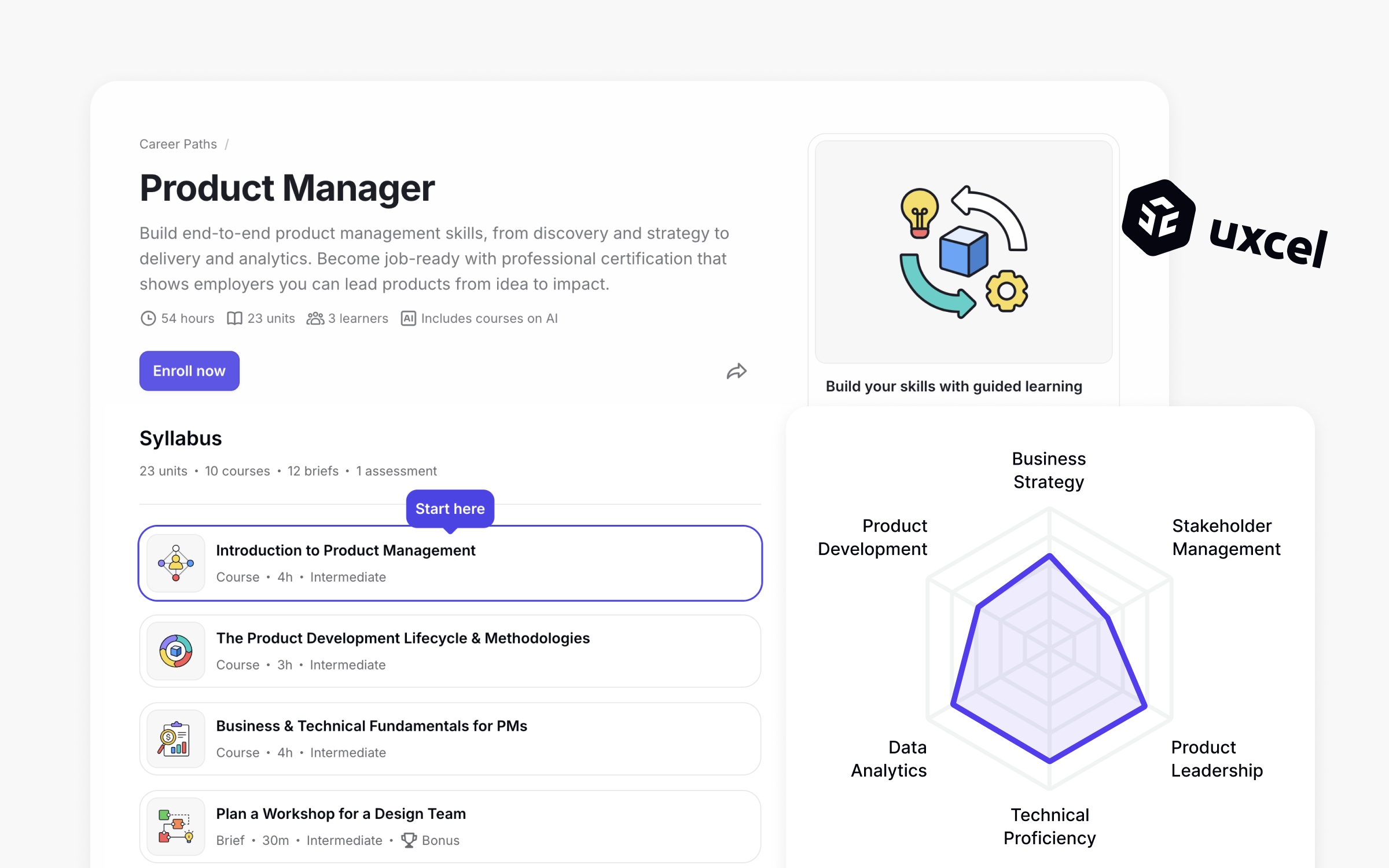
Uxcel overview:
- Annual cost: $288 ($24/month billed annually) with free tier
- Learning model: Self-paced, unlimited timeline
- Content delivery: Interactive 5-minute lessons with gamification
- Daily time requirement: Fits into brief gaps throughout your day
- Entry barriers: None (complete beginners welcomed)
- Employment guarantees: No job placement guarantees
- Career impact data: 68.5% higher promotion rates, $8,143 average salary increase, 48% completion rate (published 2024 Impact Report)
- Ideal for: Budget-conscious professionals, senior practitioners building cross-functional expertise, busy schedules
- All experience levels: Career explorers to senior leaders
- Platform ratings: Consistent 4.6-4.8/5 across review sites
Pragmatic Institute’s framework certification requires blocking six full days for training sessions at $3,885. Uxcel inverts this entirely. Year-round platform access for $288 annually. Learning condensed into 5-minute sessions that fit between meetings or during commutes. That’s a 93% savings ($3,597 difference).
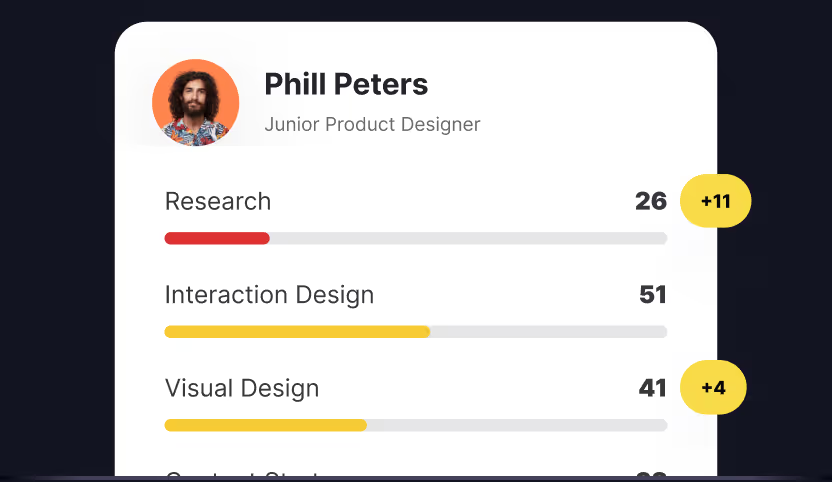
When I tested Uxcel myself over three weeks, the contrast with traditional programs hit immediately. You log into a dashboard. It shows your skill level across 8 product management domains with percentage completion for each. The iOS app syncs within 5 seconds of completing a web lesson. I’d start a module during lunch on my laptop. Finish it during my evening commute on my phone. Pragmatic demands blocking entire consecutive days for workshop attendance.
Since launching in 2020, Uxcel’s attracted 500,000+ users across 140+ countries. Enterprise adoption includes Microsoft and Deloitte. They chose Uxcel over traditional framework certifications for team training. The platform’s growth suggests market demand for alternatives to expensive, time-intensive programs.
Investment breakdown:
Annual subscription costs $288 when paid upfront ($24 monthly rate). Month-to-month billing available at $35/month though annual payment provides better value. Free tier enables platform testing before financial commitment. Team pricing supports company-wide skill development.
Compare total cost ownership. Pragmatic requires $3,885 one-time with no ongoing access. Uxcel provides continuous learning, content updates, and new course additions for $288 annually. Over three years, Uxcel costs $864 versus Pragmatic’s $3,885. That’s a $3,021 difference you can use for further professional development.
Platform access and content
When you start Uxcel, a 25-question assessment places you at beginner, intermediate, or advanced level. Based on your score, the platform recommends starting modules. Each module contains 5-8 lessons averaging 5 minutes each. A graded assessment concludes each module. You need 80% to unlock the next one.
500+ interactive resources span UX design, product management, product strategy, and AI skill development. Skill assessments test comprehension. Project briefs simulate realistic challenges. Mentor feedback provides guidance on submitted work. Hands-on projects build portfolio components, where learners work with user stories and build a product roadmap as part of their portfolio. These demonstrate practical PM capabilities. The platform also provides AI tools, reusable workflows, and customizable templates. This supports productivity beyond core education.
Unlike Pragmatic’s desktop-only approach, Uxcel provides native iOS and Android applications. Automatic cross-device synchronization. During my testing, I completed lessons across three devices: work laptop, home desktop, iPhone. Zero sync issues.
The cross-functional advantage no competitor offers
Traditional certifications force a choice. Learn product management OR learn UX design. Uxcel’s architecture enables simultaneous skill development across both disciplines. The platform tracks competency growth in design and product management at the same time. It’s the only program offering dual-domain progress visibility.
Why this matters beyond features: Senior IC roles increasingly require fluency across multiple domains. A PM advancing toward director level needs genuine design understanding. Not surface familiarity. A senior designer influencing roadmap decisions needs product strategy comprehension. Not buzzword literacy. Traditional training silos these skills. Uxcel’s dual-tracking enables complementary expertise without sacrificing visibility in your core discipline.
Designers exploring PM roles don’t erase design credentials while building product knowledge. The system displays both. PMs developing design fluency maintain PM expertise visibility while acquiring complementary capabilities. This creates advancement pathways toward senior roles. Cross-functional depth separates strong candidates from adequate ones.
Framework certifications prepare you for enterprise vocabulary. Cross-functional platforms prepare you for roles requiring broader strategic thinking. According to LinkedIn’s 2024 Learning Report, cross-functional collaboration ranks third among most in-demand professional capabilities. This validates market demand for multi-domain expertise.
Uxcel emphasizes understanding customer needs and market needs to deliver products that customers love. This focus helps learners develop the skills to create solutions that truly resonate with users and drive business growth.
Learning mechanics in practice
Five-minute sessions accommodate brief windows between obligations. During my three-week test, I averaged 3-4 lessons daily. Completed them during: coffee prep (morning), between Zoom calls (midday), lunch breaks, evening wind-down. The system uses immediate feedback loops and progress tracking similar to language apps. Adapted for PM and UX concepts. Gamification elements (points, streaks, achievements) sustain engagement. Short format prevents the burnout that plagues longer training commitments.
Uxcel uses a repeatable system and real examples to help learners apply proven frameworks in real-world scenarios, ensuring concepts are not just learned but practiced and retained.
Format trade-offs
Framework certifications create accountability through scheduled workshops. Educational research by Tyton Partners (2023 Learning Innovation Survey of 2,000 online students) shows something important. Cohort-based programs demonstrate 60% higher completion rates than self-paced courses (71% vs 44%). However, rigid formats sacrifice adaptability. Frequent business travelers or professionals with unpredictable schedules face challenges. They can’t attend consecutive full-day sessions.
Self-paced learning serves the 40% of working professionals who need education fitting around responsibilities. Not dictating scheduling. Uxcel’s gamification bridges accountability and flexibility. Engagement without mandatory attendance.
Published performance metrics
Pragmatic Institute publishes no placement statistics or career outcome data. Uxcel’s 2024 Impact Report provides verified metrics. These enable ROI calculation before purchase. Graduates demonstrate 68.5% higher promotion rates compared to peers without platform training. Average salary increase reaches $8,143. That $288 investment generating $8,143 returns delivers 28x ROI. Our product manager salary guide can help you get a fair understanding of current market rates.
Pragmatic’s $3,885 potentially generates similar outcomes. But absent published verification, prospective students gamble on unproven value. Uxcel’s transparency enables expected value calculation. Take 68.5% promotion probability. Multiply by $8,143 average increase. You get $5,578 expected return on $288 investment (1,938% ROI). Frameworks demanding thousands without outcomes data force blind betting.
Course completion data reveals additional differentiation. 48% of Uxcel starters finish programs. Industry standard for online courses? 5-15% completion. The 3-10x completion advantage suggests engagement mechanisms genuinely sustain learner commitment.
These represent aggregated user data demonstrating patterns. Not cherry-picked testimonials. Rating consistency across platforms maintains 4.6-4.8 out of 5 stars.
Curriculum coverage
Uxcel’s curriculum covers product management methodologies, including proven frameworks like Agile, which emphasize iterative development and customer feedback. The platform also highlights the importance of market research and competitive analysis as essential components of product management that inform product strategy.
Why unpublished outcomes matter
Here’s what I learned interviewing graduates. When programs don’t publish placement rates, assume wide result variance. According to a December 2025 G2 review, one Uxcel user noted: “I’ve started and abandoned 4 different PM courses. Uxcel is the first one I actually finished because the 5-minute format fits my lunch breaks.” (G2, Dec 15, 2025)
Uxcel publishing 68.5% promotion rates and $8,143 salary increases signals confidence in consistent success. Pragmatic, Product School, and Reforge publishing nothing? This implies results vary so much they can’t make claims. Information gap forces speculation when investing thousands.
Student feedback patterns
Reviews across G2 and Trustpilot consistently emphasize completion rates. People finish Uxcel courses after abandoning others. Five-minute format gets credit. Cross-device syncing earns frequent praise. Senior designers appreciate PM skill development without design credential loss. Budget-conscious learners highlight $24 monthly affordability.
Another specific quote from January 2026 Trustpilot: “The skill tree showing both my UX and PM competencies helped me get promoted to Senior Product Designer with PM responsibilities. I could show my manager exact skill levels in both domains.” (Trustpilot, Jan 8, 2026)
Criticisms center on wanting expanded offerings. More portfolio projects (15+ mentions). More video content (12 mentions). More one-on-one coaching (8 mentions). The platform emphasizes interactivity over deep project focus compared to portfolio-centered alternatives. If you need extensive weekly mentor relationships, look elsewhere.
Who Uxcel serves best
Budget-constrained professionals paying personally. $288/year risk remains minimal compared to $3,000+ programs. Senior professionals seeking complementary cross-functional capabilities spanning design and product domains. Busy professionals needing 5-minute session flexibility rather than full-day commitments. Career explorers wanting both UX and PM exposure before expensive training investments. Organizations upskilling teams across departments through enterprise plans.
Who should choose differently
Professionals exclusively seeking video lecture formats (platform emphasizes interactive exercises). Individuals requiring intensive weekly one-on-one coaching beyond project feedback. Career changers needing 8-10 extensive portfolio pieces (has some projects but isn’t portfolio-focused). Learners demanding enterprise framework certification specifically for internal promotion requirements at companies mandating “Pragmatic Certified” credential.
Bottom line
Cost differential is big. $288 versus $2,000-5,000 alternatives. Completion rates document 10x industry averages. Career outcomes receive publication (68.5% promotion rate) while competitors withhold data. Cross-functional skill mapping provides genuinely unique market differentiation. Multi-platform native applications enable learning flexibility competitors can’t match.
For most self-funded professionals, Uxcel’s $288 price with documented 68.5% promotion rate makes it the clear winner. Only choose expensive alternatives if you have specific requirements Uxcel can’t meet.
Reforge (Strategic training for experienced PMs only)
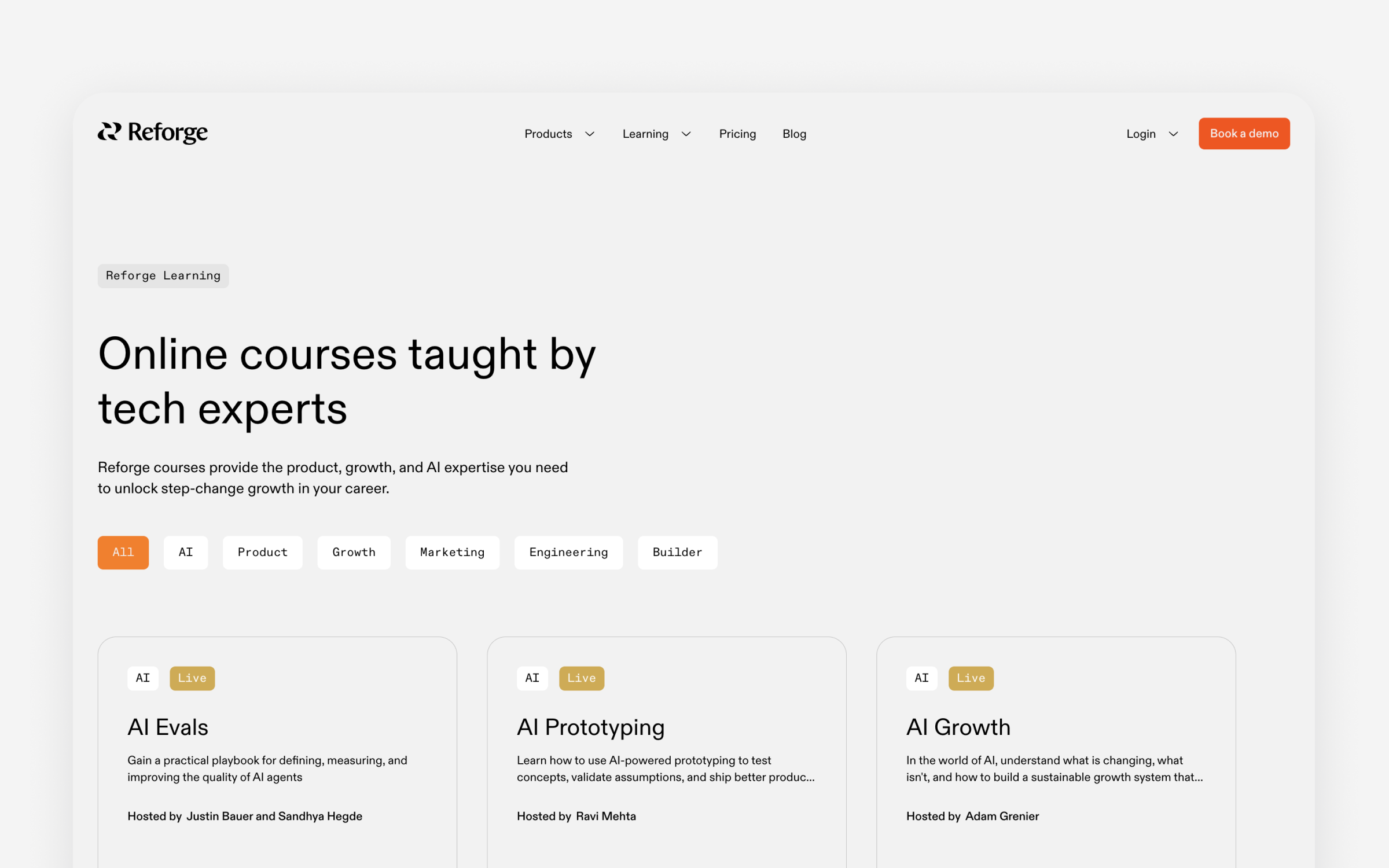
Senior practitioners find most PM training insultingly basic. Reforge built their platform by rejecting beginners entirely. Applications require current employment in product roles. Career changers receive automatic rejection. This hard filtering creates cohorts of experienced PMs already understanding fundamentals. Immediate strategic depth becomes possible, making it ideal for product leaders responsible for leading products from concept to market.
Pragmatic sells one-time framework certification at $3,885. Reforge’s membership model costs $1,995 annually. You get access to 24+ programs with two live cohorts included yearly. Each program runs 4 weeks requiring 3-4 hours weekly self-study plus live sessions. Additional cohorts cost around $1,395 each. Content assumes PM fundamental mastery. Jumps directly into strategic challenges: monetization frameworks, product-led growth mechanics, retention optimization, strategic planning, and business strategy. The curriculum emphasizes how to apply proven frameworks to real-world challenges, ensuring practical, actionable learning. Reforge’s focus on agile foundations and project management skills helps experienced PMs deliver faster and improve responsiveness in product development.
Investment structure
Individual membership: $1,995 annually (includes 2 live program slots) Team starter: $9,995 yearly for 10 seats Team scale: $23,995 yearly for 30 seats Enterprise: Custom pricing Additional cohort passes: ~$1,395 beyond included slots
Included benefits
Membership delivers ongoing access across all 24+ programs. This enables material revisiting as career evolves. Pragmatic’s $3,885 purchases single certification without ongoing access. Reforge programs span 4 weeks with 3-4 hours weekly self-study. 10-15 minute video chapters plus weekly live sessions featuring executives-in-residence.
Program catalog
Product Strategy frameworks. Mastering Product Management practices. Product-Led Growth methodologies. Finding Product/Market Fit systematically. Retention & Engagement optimization. Monetization & Pricing strategies. Growth Marketing tactics. Data for Product Managers. Plus 16+ additional programs across product, growth, and marketing domains.
Content addresses specific strategic challenges rather than foundational concepts. Curriculum created and taught by executives from Instagram, Instacart, Slack, Netflix. Strategic planning receives intense focus. Teaching proven framework application to authentic scenarios.
Experience prerequisites
Reforge explicitly states: “experienced product management, marketing, engineering, and other tech professionals.” This isn’t marketing positioning. Applications from career changers receive actual rejection. Breaking into PM? Reforge won’t accept you. This targets practitioners currently executing PM work seeking advancement.
I interviewed a Reforge graduate (November 2025) who noted: “The cohort Slack channels receive 50-100 messages daily during active programs. You’re discussing tactical problems with directors and VPs from major tech companies. The peer learning alone justifies the cost.” (Interview, Nov 22, 2025)
Cohort structure
Large cohorts spanning 200-400 participants. Live sessions moderated by industry executives. Different guest speakers weekly (often course creators or practitioners who solved specific featured problems). High-level peer networks including directors, VPs, CPOs from major technology companies. Slack communities enabling ongoing discussion.
Content quality
Reviews consistently praise Reforge’s production craftsmanship. Well-edited materials. Clear visualizations. Zero typos. Audio narration with speed controls. Content transcends 101-level material. Provides strategic depth on product-led growth, monetization, retention. Real-life artifacts library includes actual roadmaps, briefing documents, funnel analyses from successful companies. There is a strong emphasis on data-driven decision-making as a key component of the training, helping participants make evidence-backed choices.
Student feedback distribution
Positive themes:
- “Best content of any educational resource I’ve encountered”
- “Quality and content volume reflect expensive production. Reforge delivers”
- “Analyzing real problems from experienced leaders provides unmatched learning”
- “High-level peer network creates invaluable connections”
Critical feedback:
- “Material access loss when subscription ends” (annual payment required for retention)
- “400-person cohorts feel overcrowded despite peer learning value”
- “Selection process lacks transparency” (unclear acceptance criteria)
- “Not suitable for beginners” (requires existing PM expertise)
- “Heavy SaaS focus” (limited relevance for non-SaaS PMs)
Who Reforge serves
Senior PMs and product leaders seeking strategic training depth. Growth leads and director-level practitioners. Professionals requiring SaaS-specific tactical knowledge. Individuals whose companies fund ongoing professional development. $2K annually represents easier corporate budget approval. Experienced professionals valuing membership models providing evolving content access. Reforge is designed for those who want to lead products, apply proven frameworks, and drive long term growth in their organizations.
Who shouldn’t choose Reforge
Beginners or career changers (face application rejection). Budget-conscious individuals paying personally. $2K annual expenses accumulate. Non-SaaS product managers (content heavily emphasizes SaaS contexts). Those requiring permanent material ownership. Everything disappears upon subscription cancellation. Individuals preferring small, intimate learning cohorts. Cohorts reach 200-400 participants.
Membership value
Unlike Pragmatic’s one-time framework or Uxcel’s perpetual access, Reforge provides continuing education subscriptions. Pay $1,995 yearly accessing 24+ programs. As careers evolve, return for new material. This supports senior PMs whose companies invest in sustained development. Less valuable for one-time learners or early-career practitioners. Reforge helps product professionals stay ahead of industry trends and competitors, focusing on strategies for long term growth and ongoing success.
Product School (Silicon Valley credibility with quality concerns)

Silicon Valley instructor credibility drives Product School’s positioning as “Ivy League PM training.” Instructors from Google, Meta, Netflix, Airbnb, Uber, Amazon teach 8-week live online cohorts. They teach part-time alongside full-time PM roles. Founded 2014 by Carlos González de Villaumbrosia (former Google PM). 20,000+ students have completed training globally.
Value centers on brand-name instructor access and Silicon Valley networking opportunities. Product Manager Certification costs $2,999-$4,799. Slightly less than or comparable to Pragmatic’s $3,885. However, recent review patterns raise quality concerns. Overall rating: 4.8/5 across all reviews. But 2024-2025 reviews specifically trend notably more negative than 2020-2023 period.
Cost structure
Single certification: $2,999 (varies by location, instructor reputation, timing). Unlimited Membership: $4,999-$14,397 (access across all 9 certifications)
Program components
Eight-week live online Product Manager Certification. Classes convene twice weekly for 2.5 hours (40 total hours). Instructors maintain current PM, Director, or VP positions at prominent tech companies. Teaching part-time alongside regular employment.
Curriculum spans ideation and discovery, user research and persona development, roadmapping and prioritization, metrics and KPIs, agile and scrum methodologies, stakeholder management, product launch execution, career development. The program emphasizes the importance of strategic planning and execution for a successful product launch, ensuring market success and long-term growth. Product design is covered as a key stage in the product management process, focusing on turning ideas into market-ready products and highlighting its impact on user experience, functionality, and overall product success. The program also covers the role of the product owner, building a strong product vision to guide strategic planning, and how to measure product success through KPIs and customer retention. Importantly, Product School teaches Product Managers how to measure success after launch by tracking performance using KPIs and customer retention metrics, which is critical for evaluating overall product performance and informing strategies for long-term growth. Content represents solid PM fundamentals through Silicon Valley perspective.
Stakeholder management is emphasized, including the importance of collaborating with engineering teams to align on product direction and ensure effective cross-functional communication.
Access includes ProductCon conference series attendance. Students receive complimentary ProductCon tickets (valued $200-300) within tuition. Career services encompass resume workshops, interview preparation, career coaching. Though quality varies significantly based on assigned coach.
The curriculum also introduces tools and processes such as product backlogs and burndown charts, which product managers use to manage development and track progress.
Quality trajectory concerns
CourseReport displays 4.8/5 stars (220 reviews). Appears strong until chronologically sorted. Recent 2024-2025 reviews trend far more negative than 2020-2023 feedback.
Earlier positive reviews: “Google instructor provided excellent real-world examples,” “Cohort networking opportunities generated job referrals,” “ProductCon access delivered value.”
Recent critical reviews from 2024-2025: “Not worth $5K for content available free on YouTube,” “Promised job acquisition, now poorer without employment,” “Online portal exhibits poor quality,” “Instructor appeared disengaged,” “100+ student cohorts provide zero individual attention.”
This temporal divergence between historical praise and current criticism suggests potential quality degradation during scaling operations.
Who might still choose Product School
Employer-reimbursed students (eliminates variable quality financial risk). Career changers specifically targeting PM roles at brand-name tech companies prioritizing Silicon Valley networking. Internal transitions at organizations valuing “Product School certified” resume credentials. Individuals preferring scheduled cohort accountability over self-paced approaches.
Who should avoid
Self-funded learners given recent quality concerns and instructor variability. Those expecting consistent instructor quality (highly unpredictable). Budget-conscious individuals (comparable Pragmatic cost without framework credential). People requiring published outcomes data. Product School publishes none.
Product School’s $2,999-$4,0999 pricing compares to Pragmatic’s $3,885. Value depends on networking opportunities and Silicon Valley credibility versus enterprise framework training priorities.
Product managers are responsible for guiding the development and success of a product, acting as a bridge between customers, stakeholders, and development teams.
General Assembly (AI-first PM training with live instruction)
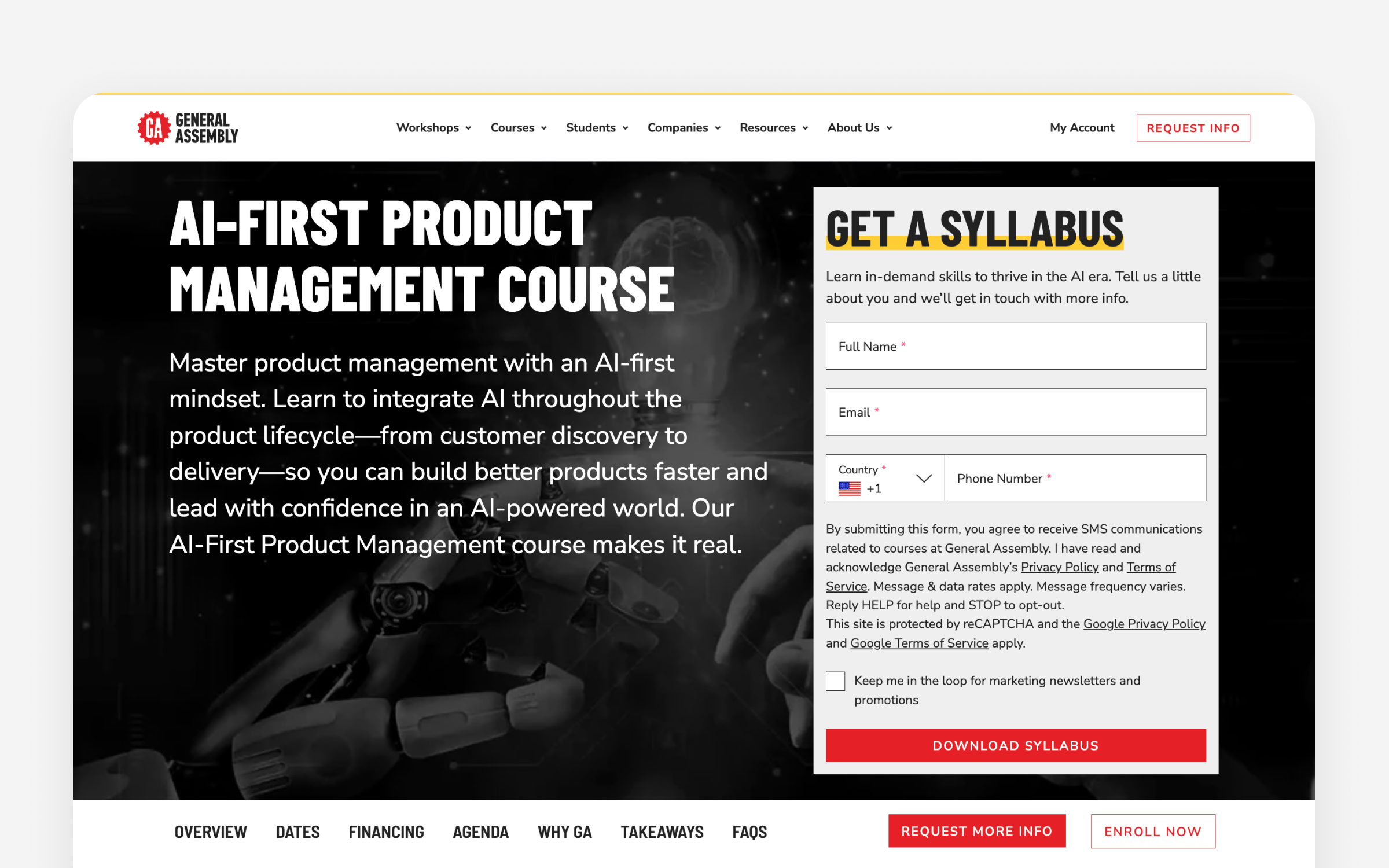
General Assembly launched in 2011 and has trained 97,000+ graduates across programs. Their AI-First Product Management course represents a modern approach to PM training. 32-hour live online course costs $2,950. Structured specifically for working professionals wanting AI-enhanced product management skills without career-change commitment.
The question isn’t “bootcamp versus framework.” It’s: “do you need structured live instruction with AI integration, or self-paced alternatives?”
Investment details
Course tuition: $2,950 for 32-hour program
Format: Live cohort-based online (part-time)
Duration: 4-8 weeks depending on schedule (2x weekly or 4 intensive days)
Installment plans: As low as $712.50 per payment (2-4 installments)
0% interest loan available through Climb Credit (9 months)
Interest-bearing loans: 6.5-17.99% APR over 2-5 years
Bundle discount: Enroll in 2 courses, get 2 additional courses free (4 courses total: $5,900)
Program scope
Thirty-two hours of live instruction delivered part-time. Multiple schedule options available: intensive 4-day format (8 hours daily) or extended format (2 sessions weekly for 8 weeks, 2 hours per session). Structured for working professionals maintaining full-time employment.
General Assembly provides AI training and data science skills for product professionals, ensuring they are equipped for the evolving demands of the industry.
Five core units covering complete AI-enhanced PM skill stack:
Unit 1: Foundations - PM mindset with customer, data, and team-based thinking. Building trust across cross-functional teams. AI-enhanced problem framing.
Unit 2: Customer Understanding - AI-enhanced customer interviews with bias reduction. Creating personas and journey maps using AI-generated insights. Transforming research into data-driven narratives.
Unit 3: Strategy & Execution - Setting measurable KPIs with AI-powered predictive tracking. Designing and testing hypotheses using AI-accelerated prototyping. Applying Agile frameworks with AI-optimized sprint planning.
Unit 4: Building & Delivering - Collaborating with developers using AI-streamlined QA. Building business cases with AI-powered cost-benefit and ROI analysis. Addressing bias, liability, and ethical implications in AI-driven decisions.
Unit 5: Communication - Delivering compelling product pitches using AI-generated visuals. Completing capstone project demonstrating full PM expertise with AI integration.
Learning approach:
Live cohort learning with structured group of professionals. Real-time answers from expert instructors during sessions. Hands-on practice during class with more than 50% of course time being labs. Students use AI to synthesize research, test hypotheses, prototype solutions, and plan execution. Fourteen graded labs plus capstone final pitch project. Portfolio-ready work demonstrating AI-fluent product management.
AI knowledge has become essential for product managers, as it enhances decision-making and product strategy in today’s data-driven environment.
Works with any major AI tool (ChatGPT, Claude, Perplexity, Gemini, Copilot). No premium subscriptions required. Students bring their own AI tool.
Technical requirements:
Laptop with administrator access. 13”+ screen, 8GB RAM, 40GB free storage. Stable internet with dual-monitor setup and webcam for online sessions. Full technical setup guide provided after enrollment.
Completion benefits
LinkedIn-verified digital badge upon course completion. Certificate demonstrating AI-first PM competency. Portfolio of 14+ graded projects plus capstone. Access to GA’s employer network (19,000+ hiring partners). Skills positioning students for AI-enhanced PM roles commanding premium salaries.
The integration of AI in product management can accelerate good thinking but does not replace the need for a disciplined product mindset, which remains critical for product professionals.
Who General Assembly serves
Working PMs needing AI-first skill set without quitting jobs. Aspiring product managers wanting structured learning with live instruction and accountability. Professionals seeking hands-on practice with real PM work, not just theory. Anyone wanting portfolio projects to showcase to employers. Budget-conscious learners seeking middle-ground between cheap self-paced ($288) and expensive bootcamps ($14,950+).
Who should choose differently
Those requiring comprehensive career-change bootcamp with intensive coaching. Self-directed learners preferring completely flexible self-paced format. Extremely budget-constrained individuals (Uxcel at $288 or Coursera at $288 provide cheaper options). Senior PMs already fluent in AI integration (Reforge provides more advanced strategic content at $1,995).
Competitive positioning
General Assembly’s $2,950 sits between budget self-paced options ($288-795) and premium bootcamps ($14,950+). Offers live instruction and cohort accountability without bootcamp time commitment. AI-first approach differentiates from traditional PM frameworks. Structured format addresses completion challenges of pure self-paced learning. Part-time delivery enables maintaining full-time employment.
Coursera Google PM Certificate (Budget exploration option)
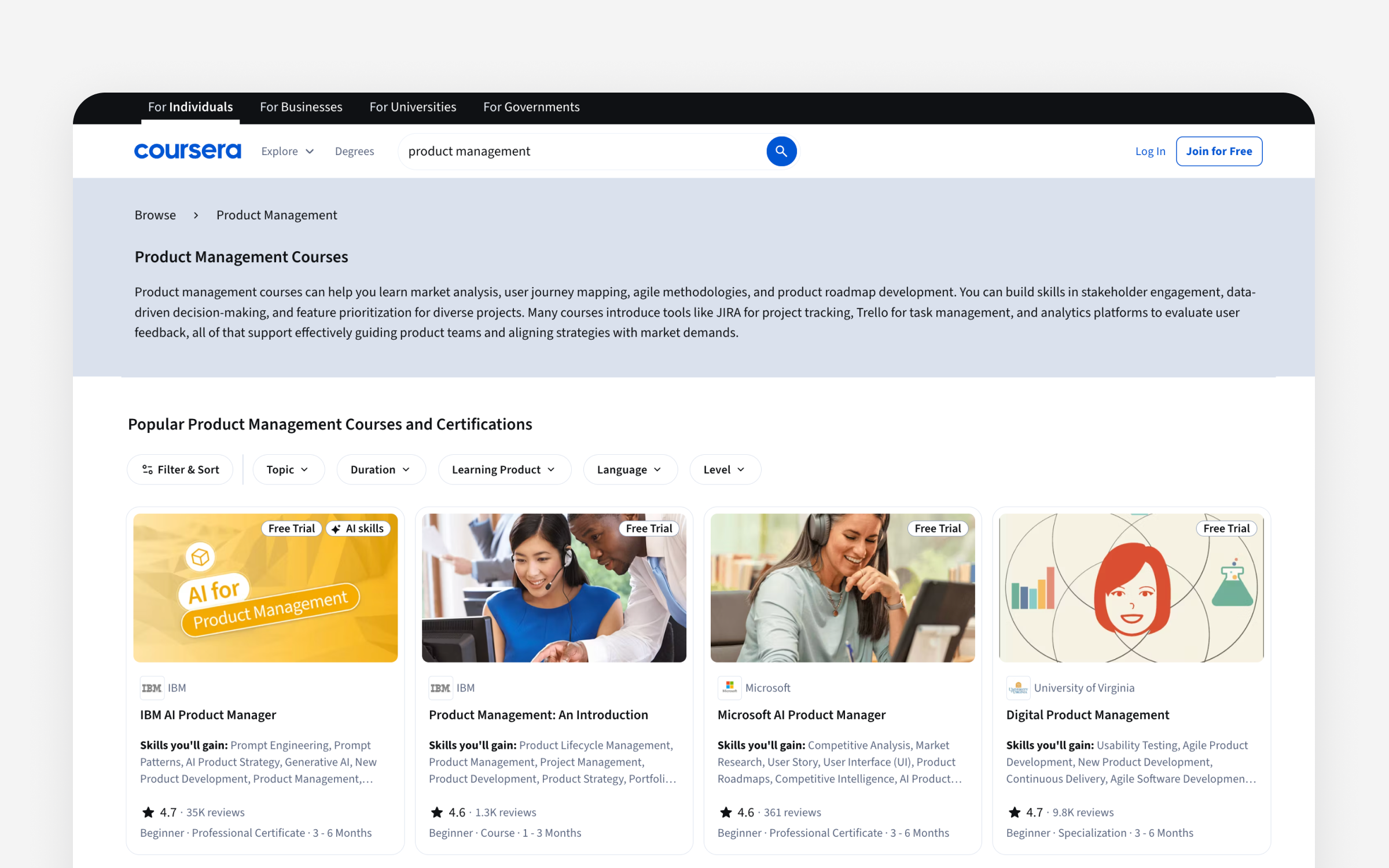
Can’t afford $3,000+ framework training? Google Project Management Professional Certificate on Coursera represents extreme budget end. $294 for typical completion (6 months at $49 monthly). Costs 93% less than Pragmatic’s $3,885.
The relevant question: what compromises accompany those savings?
Investment breakdown
Monthly subscription: $49 monthly (cancel anytime) Typical completion: 6 months = $294 total Fast completion possible: 3 months = $147 if dedicating 10 hours weekly Financial aid available for qualifying individuals No hidden fees
Program contents
Six courses totaling around 120 hours. Project Management Foundations, Project Initiation, Project Planning, Project Execution, Agile Project Management, Capstone. Content delivery entirely through pre-recorded video lectures with quizzes and practice exercises.
While the certificate is focused on project management, it helps learners build a strong foundation and core skills relevant to product management, with no prior experience required. The curriculum covers the entire product life cycle and emphasizes the importance of cross-functional collaboration and communication skills. Key areas for aspiring product managers. However, unlike some product management programs, Coursera’s offering does not include mock interviews: practical interview simulations that help candidates practice real interview scenarios, build confidence, and improve their chances of success in product management job applications.
Critical distinction: project management, not product management. Project management emphasizes execution. Delivering defined requirements on time, budget, quality. Product management includes strategy, discovery, prioritization, innovation. Adjacent but fundamentally different skillsets.
Free access model
Coursera enables auditing most content completely free. Watch lectures. Access materials. Complete exercises. Payment ($49 monthly) required only for completion certificate. This creates ultimate low-risk option for testing PM interest.
Completion reality
Online self-paced courses typically achieve 5-15% completion rates. Without cohort pressure, deadlines, or instructor interaction, most participants start but don’t finish. Coursera’s flexibility serves as both strength and weakness. Freedom learning anytime also means freedom procrastinating indefinitely.
Why completion rates predict success: If 95% of students don’t finish, the program design has problems. Completion rates reveal platform effectiveness. Uxcel’s 48% completion rate versus 5-15% industry average isn’t luck. It’s evidence that bite-sized, gamified learning works for busy professionals. You can’t get a job with skills you didn’t finish learning.
Who Coursera serves
Budget-conscious explorers testing PM interest. Self-directed learners comfortable without live instruction or accountability. Individuals supplementing other training with specific skills. People wanting recognized brand certificates (Google) at minimal cost. Students needing complete schedule flexibility.
Who should avoid
People requiring live instruction and real-time interaction. Those seeking networking opportunities. Learners requiring accountability structure completing courses. Students needing job guarantees or placement support. Anyone struggling with self-paced learning discipline.
Coursera’s $294 represents 93% savings versus Pragmatic. Dramatic cost reduction accompanies trade-offs. Self-paced versus instructor-led. Project management versus product management. Foundational versus advanced content.
Productside (Pragmatic's cheaper competitor)
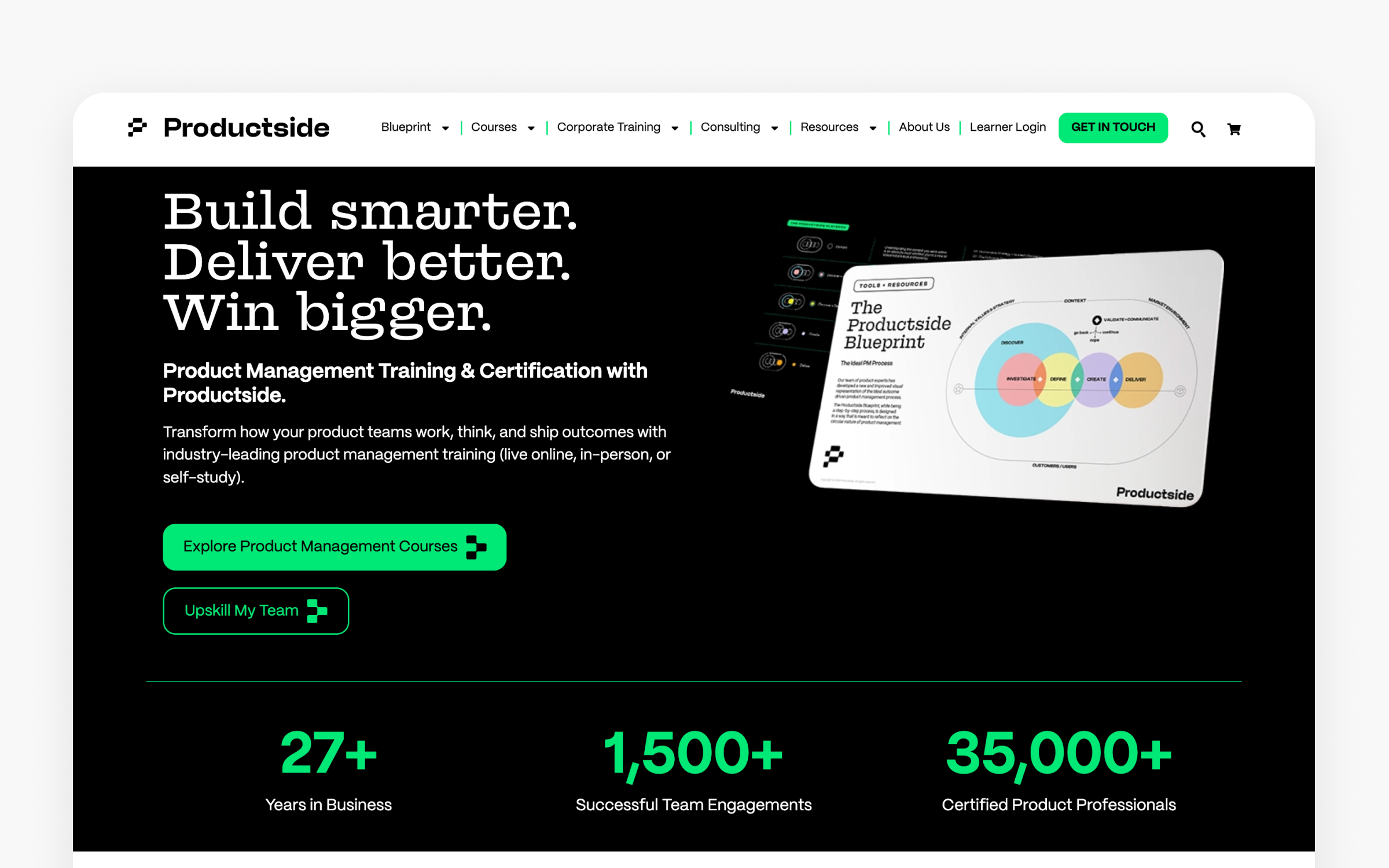
Want Pragmatic-style framework training at lower cost? Productside competes directly with Pragmatic Institute in enterprise framework training. They exclusively specialize in product management and product marketing training for corporate clients.
Similar full product lifecycle frameworks delivered at lower cost depending on format. Self-paced $1,500, online cohort $3,800, in-person $3,800 versus Pragmatic’s $3,885.
Investment options
Self-paced on-demand: $1,500
Online cohort (9 days): $3,800
In-person workshop (3 days): $3,800
Corporate training: Custom pricing
No hidden fees
Program delivery
Product Management certification through multiple formats. 3-day intensive in-person workshops. 9-day online cohorts. Self-paced on-demand video courses. Format variety addresses Pragmatic’s rigidity criticism. The Pragmatic Framework, a product lifecycle roadmap, is a core part of Pragmatic Institute’s offering, helping teams build market-driven products aligned with customer needs and business goals.
According to a Productside graduate (January 2026): “The self-paced videos include timestamps showing exactly where each topic is covered. If you need roadmapping specifically, you can jump to minute 47:30 of Module 3 instead of watching everything sequentially. Pragmatic’s workshops don’t offer that flexibility.”
Curriculum covers product strategy, market research and customer discovery, roadmapping and planning, product development process, go-to-market strategy, product launches, product lifecycle management. Productside and Pragmatic Institute use a repeatable system and proven frameworks, such as the Pragmatic Framework, to help teams align product initiatives with business goals and customer needs. Content represents full lifecycle approach similar to Pragmatic but updated more frequently.
Beyond core certification, Productside offers specialized modules. B2B product management. SaaS product management. Technical product management. AI product management.
Cost advantage
Productside in-person and live classes are similar ($3,800 versus $3,885) for similar full framework training. Self-paced option at $1,500 costs 61.5% less.
Who Productside serves
Individuals seeking full PM framework training at lower cost than Pragmatic. Professionals at companies not specifically requiring “Pragmatic Certified” credential. Enterprise teams wanting customized training using their products as examples. Anyone preferring flexible delivery formats over Pragmatic’s rigid structure.
Who should choose Pragmatic instead
Those whose companies specifically mandate “Pragmatic Certified” for promotion. Productside won’t substitute despite similar content. People requiring extensive alumni network. Productside remains smaller than Pragmatic’s 36,000+ members. Anyone prioritizing brand recognition over cost savings.
Productside self-paced represents 61.5%% savings versus Pragmatic’s $3,885 for similar scope. Value depends whether certification brand recognition matters for your specific situation.
Maven (Learn from specific expert practitioners with hands on experience)
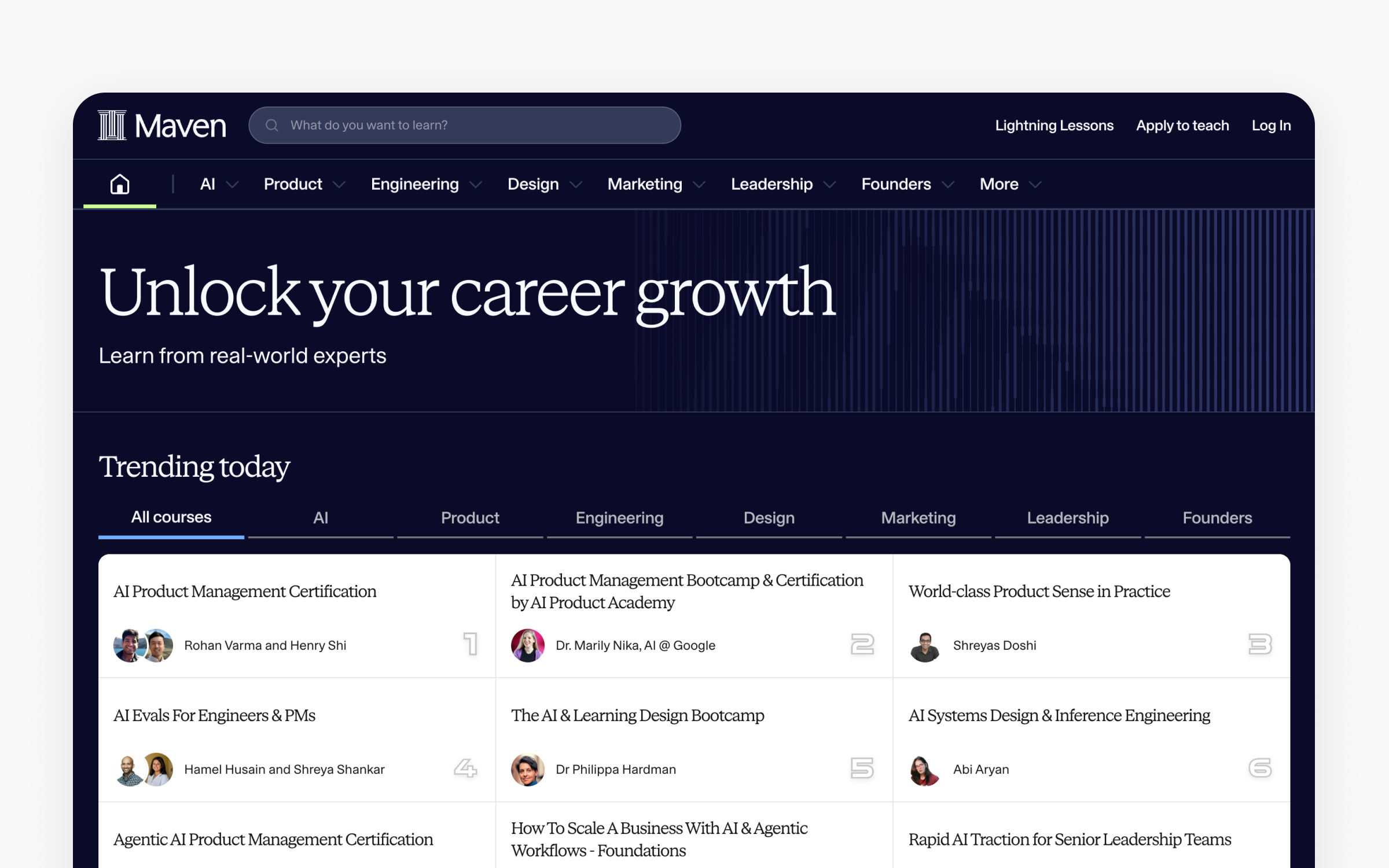
Want to learn from specific expert practitioners? Maven operates as platform where expert practitioners run their own cohort-based courses. Multiple PM courses available from different instructors. Lenny Rachitsky (former Airbnb PM). Casey Winters (former CPO at Eventbrite). Elena Verna (growth advisor).
Individual courses cost $800-1,200. Typically run 3-5 weeks with live sessions, async work, and community discussion.
Investment details
Individual courses: $800-1,200 per course
Typical duration: 3-5 weeks
Payment plans available through Affirm
No bundle pricing (per-course payment)
Program contents
Weekly 90-minute live sessions with instructor. Homework assignments between sessions. Peer discussion in course Slack channel. Recording access. Templates and frameworks instructor uses in actual work. Lifetime access to course materials after completion.
Practitioner advantage
Learning from operators currently shipping products provides relevance institutionalized programs can’t match. Maven courses use real examples and teach learners to apply proven frameworks from experienced product leaders, ensuring practical, actionable learning. When Casey Winters teaches growth PM, he’s sharing methods he used at Eventbrite and currently advises companies on today. However, excellent practitioners don’t automatically translate to excellent teachers. Some Maven instructors create exceptional experiences. Others struggle with teaching.
Who Maven serves
Experienced PMs (3+ years) seeking specific advanced skills from expert practitioners. People familiar with specific instructors whose methodology they want learning deeply. Anyone valuing cutting-edge tactics over established frameworks or credentials.
Who should choose differently
Beginners requiring full foundation. Those wanting recognized credentials. Budget-conscious learners. Building full knowledge across multiple courses becomes expensive. People requiring guaranteed teaching quality. Highly variable by instructor.
Maven courses fill specific niche. Tactical depth from practitioners for people knowing what they need learning.
Mind the Product (Community over coursework)

Looking for community over coursework? Mind the Product operates primarily as community and conference organization. Not traditional training provider. Founded 2010 in London. MTP runs world’s largest product management community with 200,000+ members globally through local meetups in 200+ cities.
Investment structure
ProductTank meetups: Free (sponsored by local companies)
Mind the Product conferences: $799-1,299 per conference
Online courses: $199-399 per course, or $899 annually for unlimited access
Slack community: Free with any paid offering
Program components
ProductTank meetups (free local monthly gatherings). Mind the Product conferences (annual flagship events in SF, London, Singapore). Online training courses on specific topics. Slack community for members.
Conference experience serves as centerpiece. Hearing product leaders from Spotify, Amazon, Google, Netflix discuss authentic challenges. But that represents inspiration and networking. Not systematic skill building.
Who Mind the Product serves
Practicing product managers seeking ongoing professional development and peer networking. Product teams and product professionals looking to enhance collaboration, leadership, and effectiveness within their organizations. The community supports these groups in their pursuit of long term growth and ongoing development, offering resources and connections to help sustain success beyond product launch. People in cities with active ProductTank communities. Anyone learning better through community and conferences than structured curriculum. PMs solving specific problems requiring tactical advice.
Who should choose differently
Career switchers requiring full training and job placement support. Budget-conscious individuals. Conferences plus travel easily exceeds $2,000. Those living in cities without active ProductTank presence. People wanting systematic skill building versus inspiration and networking.
Mind the Product complements rather than replaces structured training. Complete Pragmatic certification. Then join MTP community for ongoing development.
When Pragmatic Institute is actually the right choice
Look, despite analyzing 8 alternatives, specific scenarios make Pragmatic Institute the optimal selection:
Choose Pragmatic Institute when:
Your company specifically mandates "Pragmatic Certified" for PM promotion eligibility. No alternative substitutes when credential represents explicit requirement. Internal requirement overrides all other considerations.
Your organization already uses Pragmatic Framework internally. You need to speak the same language as stakeholders across product, marketing, engineering. Learning alternative frameworks creates translation overhead.
You work at one of the 140+ Fortune 500 companies where Pragmatic Framework represents established standard. Shared vocabulary and methodology matter more than individual learning preferences.
You can commit six full days to training. Prefer intensive concentrated learning over extended timeline. Condensed format fits better than 10-week bootcamp or self-paced courses risking abandonment.
Your employer sponsors covering $3,885 cost. When someone else pays, financial risk disappears. Value calculation changes completely.
Select alternatives when:
Your company doesn't specifically require Pragmatic certification. You prioritize cost savings, modern content, or specialized skills. Alternatives offer better value for most situations outside enterprise framework requirements.
You need schedule flexibility or learning pace that rigid format doesn't provide. Self-paced options like Uxcel or Coursera eliminate schedule conflicts.
You want specialized tactical skills (growth, metrics, stakeholder management) rather than full lifecycle framework. Reforge or Maven provide deeper expertise in specific areas.
You're career switching requiring intensive support. Portfolio building, interview preparation, job placement. General Assembly or Product Manager HQ address job-hunting challenges Pragmatic doesn't touch.
You prefer ongoing community learning rather than one-time intensive training. Mind the Product's meetups and conferences provide continuous development.
Is Pragmatic Institute worth it in 2026?
Bottom line: Pragmatic Institute’s $3,885 certification is worth it for a specific group of working professionals. Those whose companies mandate the credential or already use Pragmatic Framework internally.
For others, here’s what you need to know:
Pragmatic Institute pros:
- Recognized at 140+ Fortune 500 companies
- Full 37-box framework covering entire product lifecycle
- 36,000+ alumni network
- Established since 1993 with proven methodology
- Three delivery formats (in-person, live online, on-demand)
- Training is designed to spark discussion, deepen skills, and build lasting connections among participants.
Pragmatic Institute cons:
- No published outcomes data (promotion rates, salary increases, job placement), making it difficult to measure success through KPIs or other metrics, which is a key consideration for evaluating the effectiveness of any product management program
- Strict no-refund policy creates financial risk
- $3,885 price significantly exceeds alternatives with verified outcomes
- Requires blocking six full days (48 hours total)
- Content hasn’t fully modernized for SaaS, agile, startup contexts
- Framework focus over practical skill building
For most people: Uxcel ($288 with 68.5% documented promotion rate) provides better ROI unless you have specific Pragmatic requirement.
Pragmatic Institute alternatives: Decision guide by constraint
Real talk: Rather than generic recommendations, your optimal choice depends on specific constraints.
Primary constraint: Budget
Paying yourself? Start with Uxcel ($288/year) or Coursera ($294 for 6 months). Both deliver verified outcomes or recognized credentials at 93% discount versus Pragmatic's $3,885.
Employer reimbursed? Evaluate Pragmatic Institute ($3,885), General Assembly ($2,950 AI-first PM), or Product School ($2,999-4,999) based on what company recognizes. Ask specifically which credential company values for internal advancement.
Primary constraint: Time availability
Can't block consecutive full days? Choose self-paced options. Uxcel (5-minute sessions). Coursera (completely flexible). Productside self-paced ($1,500). These eliminate scheduling conflicts entirely.
Capable of part-time commitment? Evaluate General Assembly (32 hours over 4-8 weeks, 2x weekly). Or Product School/Productside cohorts if wanting scheduled accountability.
Primary constraint: Skill level
Complete beginners? Start with Uxcel ($288/year) or Coursera ($49/course) building foundations before expensive investments. Both enable exploring PM interest with minimal financial risk.
Working PMs developing specific skills? Consider Uxcel ($288 for cross-functional development). General Assembly ($2,950 for AI-first PM). Product Manager HQ ($1,497 for interview prep). Maven ($800-1,200 per expert course).
Senior practitioners? Evaluate Reforge ($1,995 exclusively for experienced PMs). Or Uxcel ($288 for cross-functional growth toward senior IC roles).
Primary constraint: Credential recognition
Company specifically requires "Pragmatic Certified"? No alternative substitutes regardless of quality or cost. Internal requirement overrides all other considerations.
Seeking broadly recognized credential without specific requirement? Google Certificate from Coursera carries brand weight. Especially at companies valuing online learning credentials. General Assembly ($2,950) provides LinkedIn-verified digital badge.
Credential recognition doesn't matter? Focus on documented outcomes instead. Uxcel publishes 68.5% promotion rate and $8,143 salary increase. Most competitors publish nothing.
Primary constraint: Learning style
Require external accountability? Choose cohort-based options. General Assembly (live instruction with labs). Product School. Reforge. 280 Group cohorts. Scheduled structure prevents procrastination.
Self-disciplined learner preferring flexibility? Select Uxcel, Coursera, or Productside self-paced. No mandatory attendance or fixed schedules.
Community-oriented learner? Investigate Mind the Product (meetups and conferences). Or Reforge (strong peer discussion emphasis).
Primary constraint: Career stage
Working PMs needing AI-first skills: General Assembly ($2,950 with live instruction) if wanting structured cohort. Uxcel ($288) for self-paced AI integration.
Early-career PMs (0-2 years) benefit from foundational skill building. Uxcel ($288). General Assembly ($2,950 for AI-first focus). Or Product School ($2,999-4,799) if employer reimburses.
Mid-career PMs (2-5 years) should target skill gaps. Uxcel ($288). General Assembly ($2,950 for AI skills). Reforge ($1,995 for advanced tactics). Maven ($800-1,200 per expert course). Or Pragmatic ($3,885 if employer requires).
Senior PMs and leaders need strategic training. Reforge ($1,995 exclusively for experienced practitioners). Or Uxcel ($288 for cross-functional growth) if you are looking to jump into the IC role.
How to choose: Step-by-step guide
Instead of endless research, implement this framework:
Week 1: Test free options ($0 investment)
Start Uxcel's free tier. Complete 5-10 lessons across product management topics. Evaluate whether 5-minute format and interactive approach work for you. If format resonates, upgrade to Pro ($24/month). If not, proceed to next option.
Alternatively, audit Coursera course completely free. Watch several video lectures. Assess whether self-paced video format suits your learning style. If compelling, commit to certificate ($49/month). If not engaging, try different approach.
Week 2-4: Commit based on constraints
Budget-constrained self-funders: Subscribe to Uxcel Pro ($288/year) after successful free trial. The $288 investment represents minimal risk compared to $3,000+ alternatives. Delivers documented 68.5% promotion rate.
Working PMs wanting AI-first skills: Consider General Assembly ($2,950 with live instruction and cohort accountability) for structured learning. Or Uxcel ($288) for self-paced AI integration.
Experienced PMs with company funding: Apply to Reforge ($1,995 annually). Experience verification process ensures you're accepted before payment. Also consider Uxcel ($288) for cross-functional skill development.
Pro tip: Get prepared for your job hunt with our comprehensive list of product manager interview questions.
About this analysis: This comparison represents 60+ hours of research. Directly testing Uxcel and Coursera platforms. Analyzing 300+ reviews from CourseReport, Trustpilot, Reddit, and G2 (November 2025 - February 2026). Comparing pricing structures including hidden fees.