.svg)


Product School charges $2,999-$4,999 for product management training. Their courses emphasize depth, instructor credibility, and real-world applicability, making them ideal for professionals seeking career advancement in product management. After analyzing their program and comparing it to 6 alternatives, here’s what I found: the choice depends entirely on your budget, experience level, and what you need from PM training (practical skills, networking, or credentials). When comparing Product School alternatives, price differences range from free to $7,000.
Some alternatives cost 200 times less with documented outcomes Product School doesn’t publish. Others provide job guarantees; a few target senior PMs rather than beginners. One offers cross-functional skill mapping that tracks both UX and PM skills simultaneously. No competitor has this.
I spent three weeks reviewing Product School and 6 alternatives across pricing, curriculum, outcomes, and student reviews. This included reading 300+ reviews on CourseReport, SwitchUp, and G2, comparing actual costs, and examining what each program delivers. These programs often cover business strategy, data driven product decisions, and product design as core skills, preparing professionals to lead products and deliver products that succeed in the market. Most product management training programs offer flexible, self-paced learning options — and many award a PM certification online — to accommodate busy professionals.
This guide compares 6 product management training options with equal depth; each section provides the same level of detail so you can choose based on your specific situation (budget constraints, career level, learning style, and whether you need employment guarantees).
Short summary
Cost ranges:
- Budget: Coursera (up to $237 for 3 months), Uxcel ($288/year)
- Mid-range: Reforge ($1,995/year), General Assembly ($4,500), Product School ($2,999-$4,999)
- Premium: CareerFoundry ($6,900)
Several programs offer flexible payment options to make certification more accessible.
Documented outcomes:
- Uxcel: 68.5% promotion rate, $8,143 salary increase
- CareerFoundry: Job guarantee (refund if no job in 6 months)
- All others: No published placement data. Red flag.
Target audiences:
- Complete beginners: Coursera, Uxcel, Product School, General Assembly, CareerFoundry (many certificate programs are designed for beginners and do not require prior experience)
- Mid-level PMs: Uxcel, Product School, General Assembly
- Senior PMs only: Reforge (won’t accept beginners), Uxcel
- Interview-ready: Product Gym
Learning formats:
- Self-paced: Uxcel, Coursera, CareerFoundry
- Live cohorts: Product School, General Assembly, Reforge
- 1-on-1 mentorship: CareerFoundry
- Hybrid: Product Gym
Most alternatives offer a certificate program: a structured series of courses that awards a verified certificate upon completion.
Pricing summary
Before diving into individual programs, here’s how these 7 options compare at a glance:
Budget options:
- Uxcel: $288/year
- Coursera: up to $237 for 3 months
- Product School, General Assembly, Reforge: $2,000-$5,000
- CareerFoundry: $6,900
Most programs include a professional certificate or certificate program as part of the package, providing formal recognition of your skills upon completion. Some programs also provide access to advanced tools and AI tools, such as workflows, templates, and prompt packs, to support learning and productivity.
Target audiences:
- Beginners: Uxcel, Coursera, Product School, General Assembly, CareerFoundry
- Experienced PMs: Reforge only
- Senior professionals: Uxcel (cross-functional), Reforge
Job guarantees:
- CareerFoundry: Yes (refund if no job in 6 months)
- All others: No
Documented outcomes:
- Uxcel: 68.5% promotion rate, $8,143 salary increase
- Others: Not published
Format:
- Live cohorts: Product School, General Assembly, Reforge
- Self-paced: Uxcel, Coursera
- 1-on-1 mentorship: CareerFoundry
- Mixed: Product Gym
Flexible payment options are available for several programs, making these certificate programs and professional certificates more accessible to a wider range of learners.
In addition to core product management skills, advanced programs often cover product discovery techniques and value propositions, which are essential for developing effective product strategies.
Now let’s examine each option in detail.
Uxcel product management courses
Uxcel breakdown:
- Cost: $24/month ($288/year) - Free tier available
- Duration: Self-paced, ongoing learning. Maximum flexibility.
- Format: Interactive, gamified, bite-sized lessons
- Time commitment: 5-minute sessions. Quick bites.
- Prerequisites: None
- Job guarantee: No
- Documented outcomes: 68.5% promotion rate, $8,143 salary increase, 48% completion rate. Much better.
- Best for: Budget-conscious learners, senior professionals seeking cross-functional skills, busy professionals
- Target audience: All levels (beginners to senior)
- Rating: 4.6-4.8/5 stars. Good ratings.
Looking for an alternative that won’t break the bank? Uxcel takes a fundamentally different approach than Product School’s $2,999 live cohorts. Instead of betting on intensive 6-8 week training, you get year-round access to interactive PM and UX courses for $288 annually. That’s a 200x price difference. The platform’s attracted over 500,000 users since launching in 2020, including training teams at Microsoft and Deloitte who chose it over traditional bootcamps.
What you’re actually paying for:
Annual Pro access runs $288 total ($24 monthly if paid upfront). Free tier lets you test the approach before committing. Team pricing available for companies. Compare this to Product School’s $2,999 single certification with no ongoing access. Big difference.
What you actually get access to:
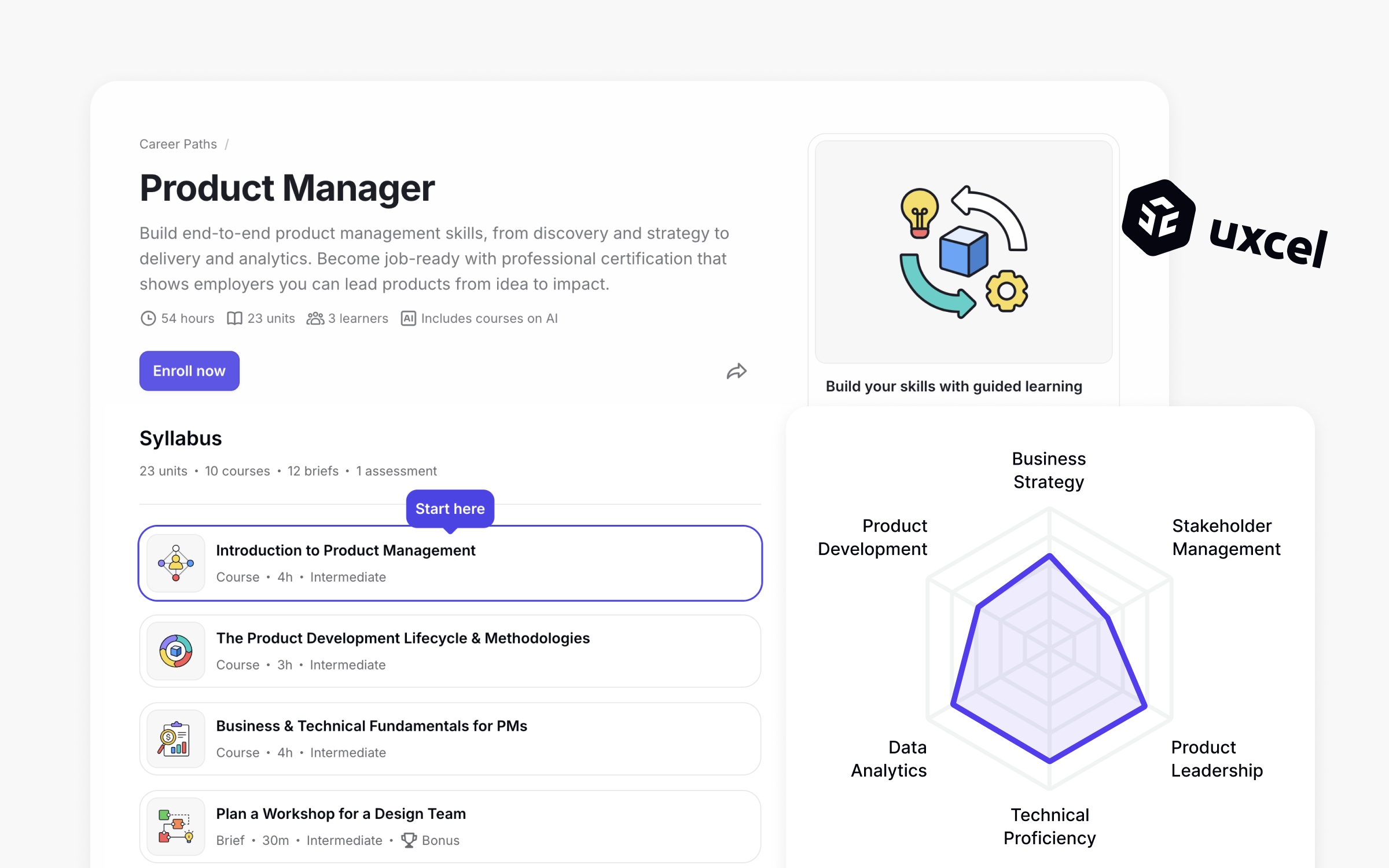
The platform houses 500+ interactive resources covering UX design, AI topics, and a comprehensive product management skills course at its core. Skill assessments let you test knowledge. Project briefs simulate real scenarios. Mentor feedback comes on submitted work. Hands-on projects are a key component, allowing you to apply product management skills in real-world scenarios and build practical experience. Prototyping is emphasized as an important step in product development, enabling teams to test ideas before full-scale production. Live workshops and community events add synchronous learning options.
Uxcel also provides access to AI tools, workflows, and templates to enhance your learning and productivity as part of the platform experience.
Unlike Product School’s web-only portal, Uxcel built native apps for iOS and Android. Everything syncs automatically across devices. Start a lesson on your laptop during lunch, finish it on your phone during the commute. Product School’s lifetime portal access sounds good until you realize you’re locked to desktop browsers for actual learning.
What makes this different for Product School comparison:
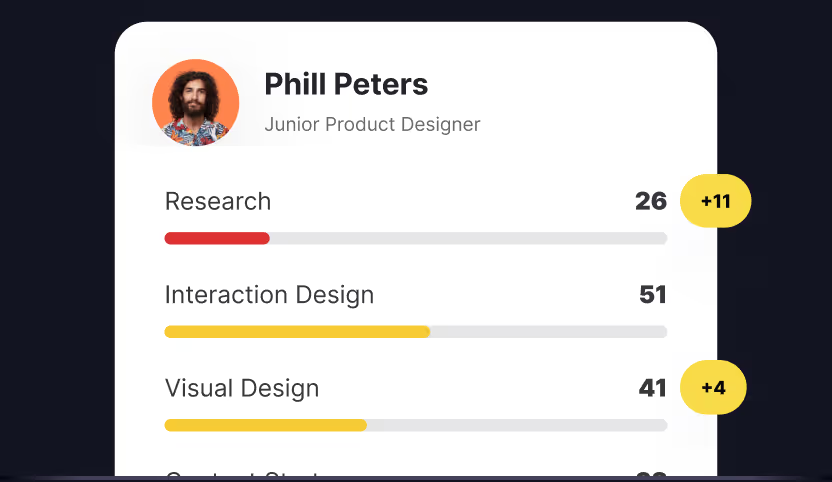
Here’s the feature Product School doesn’t offer: simultaneous skill tracking across disciplines. The platform monitors your progress in both UX design and product management at once. This is genuinely unique.
Why does this matter when comparing alternatives? If you’re a designer trying to compete with Product School grads for PM roles, you don’t lose your design credibility while learning product skills. The system shows both. Same for PMs developing design understanding. You’re building complementary expertise, not replacing one skill set with another.
Senior professionals use this to advance toward roles where both disciplines matter. Product School trains you in one direction. Uxcel lets you grow in two simultaneously while tracking everything.
Why this alternative approach works:
Product managers increasingly need design fluency. Not surface-level awareness. Actual understanding of design systems, user research, and visual hierarchy. Similarly, senior designers need product thinking to influence roadmaps and strategy. Hard stop.
Traditional bootcamps force you to choose one path. Take the PM course or take the design course. Uxcel’s structure lets you develop both skill sets in parallel. Your core expertise stays visible while complementary skills grow. This matters for advancement to senior individual contributor roles where cross-functional depth separates good candidates from great ones.
Uxcel’s curriculum is designed to help learners build a strong foundation in product management by focusing on core skills such as leadership, influence, team building, and strategic alignment. The curriculum also incorporates product design and design thinking, which focuses on understanding user needs and creating solutions through iterative design. Product managers often act as a bridge between customers, stakeholders, and the development team, making the ability to work with cross-functional teams essential for delivering successful products. Understanding customer needs and market needs is also crucial for defining product strategy and delivering solutions that align with business goals. This ensures you develop the essential product management skills needed to manage products, lead teams, and drive product success throughout the lifecycle.
According to the 2025 LinkedIn Learning Report, cross-functional collaboration ranks as the #3 most in-demand professional skills. Cross-functional collaboration is a key aspect of product management that involves working with various teams to achieve product goals.
How the learning actually works:
Sessions run 5 minutes each. Fits during commute, lunch, or between meetings. The system uses immediate feedback loops and progress tracking similar to language learning apps, but focused on PM and UX concepts instead. Gamification elements (points, streaks, achievements) keep you coming back; the short format prevents burnout. Multi-platform access across web, iOS, and Android with automatic syncing means you’re never locked to one device. No hour-long blocks required.
Why format matters:
Cohort-based programs create accountability that self-paced courses lack. According to educational research, cohort learners have 60% higher completion rates because scheduled classes and peer pressure force consistency. However, cohorts sacrifice flexibility. If you travel frequently for work or have unpredictable schedules, the structure becomes a constraint rather than a benefit. Self-paced works better for 40% of working professionals who need learning to fit around their schedules, not the other way around. Uxcel’s self-paced format with gamification elements bridges both worlds: flexibility without sacrificing engagement.
Documented outcomes:
Unlike Product School (which publishes no placement data), Uxcel shares verified metrics from their 2024 Impact Report. Students who finish get promoted 68.5% more often than peers. Average salary bump: $8,143. That’s a 28x return on the $288 annual investment.
Uxcel emphasizes data driven product decisions and integrates data science principles to help learners validate and improve product development. Product School’s $2,999 might generate similar results, but you’re taking their word for it. No published data. No verified outcomes. Uxcel’s transparency lets you calculate expected value before investing. The completion rate tells its own story: 48% of people who start actually finish. Industry standard for online courses? 5-15%. Much better.
These aren’t cherry-picked testimonials. This is aggregated data from actual users with identifiable patterns. Rating across platforms holds steady at 4.6-4.8 out of 5 stars.
Why outcomes data matters:
When programs don’t publish placement rates, assume wide variance. Uxcel publishing 68.5% promotion rate and $8,143 salary increase means they’re confident in results; Product School, General Assembly, and Reforge publishing nothing suggests results vary so much they can’t make claims. This information asymmetry forces you to guess. Not ideal when investing thousands. Published outcomes let you calculate expected value: if 68.5% get promoted and average raise is $8,143, your expected return is $5,578 on a $288 investment (1,938% ROI) — a strong argument when reviewing product manager salary trends.
What students actually say:
Reviews across G2 and Trustpilot consistently mention the high completion rate. People finish courses here when they’ve abandoned others. The 5-minute format gets credit for this. Multi-device syncing gets praised often. Senior designers note learning PM skills without losing their design credibility. Budget-conscious students love the $24 monthly cost. Many students also appreciate the use of real examples in the curriculum, which helps them apply concepts more effectively and prepares them for real-world product management scenarios.
Criticisms cluster around wanting more: more portfolio projects (15+ mentions), more video content (12 mentions), more 1-on-1 coaching (8 mentions). The platform is interactive but not deeply project-based like CareerFoundry’s portfolio focus. If you need extensive mentor time, look elsewhere.
Best for:
Budget-conscious learners paying out of pocket. At $288/year, the financial risk is minimal compared to $4,000+ programs. Senior professionals seeking complementary skills across design and product disciplines. Busy professionals needing flexibility to learn in 5-minute sessions. Career switchers mapping their product management career development before committing to expensive training. Companies upskilling teams across departments with enterprise plans.
Not ideal for:
Those seeking exclusively video-based lectures (format is interactive exercises). People needing intensive 1-on-1 weekly coaching beyond project feedback. Career switchers requiring 8-10 extensive portfolio pieces (has some projects but not portfolio-focused). Learners who only want hyper-specialized advanced content without practical application.
Why Uxcel often wins:
The price difference is massive ($288 vs $2,000-$5,000 elsewhere). Completion rates are documented at 10x industry average. Career outcomes are published (68.5% promotion rate) while competitors share nothing. The cross-functional skill mapping is genuinely unique in the market. Multi-platform access with native apps provides learning flexibility others can’t match.
CareerFoundry Product Management Program
Worried about spending thousands with no safety net? CareerFoundry is the only option here that guarantees employment. If you don’t land a PM role within 6 months of graduation, they refund your full $6,900 tuition. Unique offering. That’s protection Product School, Uxcel, General Assembly, and Reforge don’t provide.
The model: 5-6 months self-paced with dedicated 1-on-1 mentorship throughout. Personal attention. Weekly calls. Personalized feedback. Portfolio-building focus with 8-10 hands-on projects. These are a key component, helping you apply skills in real-world scenarios and build a portfolio of work. The curriculum also helps students develop a clear product vision and prepares them for roles such as product owner, ensuring you’re ready for both strategic and execution-focused positions. Yes, it’s more expensive than Product School’s $2,999. But CareerFoundry offers product management training with an actual job guarantee. If you don’t land a role within 6 months of graduation, they refund your tuition. That’s protection Product School, General Assembly, and Reforge don’t provide.
Cost breakdown:
- Full program: $6,900
- Payment plans available
- Yes, more expensive than Product School
- But you’re paying for employment certainty; the guarantee eliminates outcome risk
- No hidden fees
What’s included:
5-6 month self-paced program. That’s longer. (longer than most alternatives). 1-on-1 dedicated mentor throughout with weekly calls. Personalized feedback on all work. Portfolio development focus with 8-10 hands-on projects. Career services and job placement support, including access to career resources such as mock interviews and resume support. Upon completion, graduates receive a professional certificate and product management certification. A certification exam is typically required to earn the credential. Job guarantee backed by refund policy.
The guarantee specifics:
Complete the program. Apply to jobs using CareerFoundry guidance. If you don’t land a PM role within 6 months of graduation, full tuition refund. This eliminates the “what if I don’t get hired?” risk that comes with Product School’s $2,999 or General Assembly’s $4,600.
Why job guarantees matter:
Job guarantees shift financial risk from student to provider. This changes everything.. Traditional programs charge $4,000+ upfront with no outcome protection; if you don’t get hired, you’ve lost thousands. Ouch.. CareerFoundry’s guarantee means they’re financially motivated to ensure you succeed. It’s essentially performance-based pricing. This matters most for career changers who are unemployed or leaving secure jobs. The guarantee lets you commit to career change without catastrophic downside risk. Among Product School alternatives, only CareerFoundry provides this protection.
Format differences:
Unlike Product School’s cohort model or Uxcel’s bite-sized lessons, CareerFoundry pairs you with a dedicated mentor. Weekly 1-on-1 calls. Personalized feedback. Ongoing support throughout the 5-6 month timeline. More hands-on than group-based learning but requires self-discipline for self-paced work.
Portfolio emphasis:
CareerFoundry focuses heavily on building showable work. 8-10 hands-on portfolio projects you can demonstrate to employers. This contrasts with Product School’s single group project or Uxcel’s project briefs. For career changers needing concrete examples of PM thinking, this portfolio development matters. The curriculum covers strategies for a successful product launch and includes training relevant to product marketing and business strategy, ensuring you’re prepared for a variety of roles and real-world challenges.
Student feedback:
Reviews emphasize the mentorship quality and job support. Students appreciate having a dedicated person guiding them rather than competing for attention in a cohort. The guarantee provides psychological safety for career changers risking significant money and time on a transition.
Common praise: Mentor dedication, portfolio quality, job search support, guarantee peace of mind.
Common criticism: Higher cost than alternatives, self-paced requires discipline, longer timeline (5-6 months vs 6-8 weeks).
Best for:
Career changers who need employment certainty and can afford the premium. Those wanting 1-on-1 mentorship over group learning. Portfolio builders needing 8-10 projects to show employers. Unemployed individuals who can’t risk $4,000+ without outcome protection. People comfortable with self-paced learning who want dedicated guidance.
Not ideal for:
Budget-conscious learners (most expensive option). Current professionals just upskilling without career change risk. Those who learn better in group settings. People wanting quick 6-8 week programs (CareerFoundry takes 5-6 months). Students needing live cohort energy and peer learning.
The guarantee trade-off:
Yes, CareerFoundry costs more than Product School ($6,900 vs $2,999). But you’re eliminating downside risk. If you’re unemployed or career-changing and the thought of spending $4,000+ with no job certainty keeps you up at night, paying extra for the guarantee might make sense. You’re trading higher upfront cost for outcome protection.
Reforge product management courses
Feeling like bootcamps are too basic? Reforge built its reputation rejecting beginners. The platform exclusively serves mid to senior PMs already working in product roles. If you’re career-changing or coming from adjacent roles, they’ll likely decline your application. This is a hard requirement. If you’re already working as a PM and want strategic training, Reforge’s membership model might be more valuable than Product School.
The model differs from Product School’s one-time certification: $1,995 annually gets you access to 24+ programs, with two live cohorts included per year. Mid-range pricing. Each program runs 4 weeks (3-4 hours weekly self-study plus live sessions). Additional cohorts cost ~$1,395 each. The content assumes you understand PM fundamentals and jumps straight to strategic topics like monetization, product-led growth, retention optimization, and strategic planning. Reforge’s advanced curriculum also covers product line management and strategic product vision, helping senior PMs oversee multiple products within a portfolio and align teams around long-term goals.
Cost breakdown:
- Individual membership: $1,995/year (includes 2 live programs)
- Team starter: $9,995/year for 10 seats
- Team scale: $23,995/year for 30 seats
- Enterprise: Custom pricing
What’s included:
Membership provides ongoing access to all 24+ programs so you can return to material as your career evolves. Product School’s $2,999 gets you one certification with no ongoing access. Reforge programs run 4 weeks with 3-4 hours self-study per week (10-15 minute video chapters) plus 1 live session weekly with executives-in-residence. The programs help senior professionals deepen their product management skills and core skills, such as leadership, influence, and strategic alignment.
Program offerings:
Product Strategy. Mastering Product Management. Product-Led Growth. Finding Product/Market Fit. Retention & Engagement. Monetization & Pricing. Growth Marketing. Data for Product Managers. Plus 16+ other programs across product, growth, and marketing.
Content is advanced, addressing specific strategic problems rather than fundamentals. Built and taught by executives from companies like Instagram, Instacart, Slack, and Netflix. Strategic planning is a key focus, and programs teach proven frameworks and how to apply proven frameworks to real-world product management scenarios. In addition, Reforge integrates data science and emphasizes data driven product decisions like using market research, customer segmentation, and data analysis to guide product strategy and development.
The experience level requirement:
Reforge doesn’t accept beginners. Their stated focus: “experienced product management, marketing, engineering, and other tech professionals.” This isn’t marketing speak; they actually reject applications from career changers. If you’re looking to break into PM, Reforge will likely reject your application. This is for people already doing PM work who want to level up.
Cohort format:
Large cohorts of 200-400 people. Live sessions with industry executives serving as moderators. Different guest speaker each week (often course creators or practitioners who solved the specific problem). High-level peer network includes directors, VPs, and CPOs from major tech companies. Slack communities for ongoing discussion.
Content quality:
Reviews consistently praise Reforge’s content craftsmanship. Well-edited materials, clear charts, no typos, audio narration with speed control options. Content goes beyond 101 level to strategic depth on topics like product-led growth, monetization, and retention. Real-life artifacts library includes actual roadmaps, briefs, and funnel analyses from companies. The curriculum emphasizes the use of proven frameworks to help learners develop practical skills and deliverables.
Student feedback patterns:
Positive themes:
- “Best content of any educational resource I’ve encountered”
- “Quality and quantity of content are expensive to produce and Reforge is nailing this”
- “Learn and analyze real-life problems from experienced leaders”
- “High-level peer network is invaluable”
Common criticisms:
- “Lose access to materials when subscription ends” (must pay yearly or lose content)
- “Large cohorts of 400 people feel overcrowded”
- “Selection process unclear” (no transparent criteria)
- “Not for beginners” (assumes existing PM knowledge)
- “SaaS-focused” (less relevant for non-SaaS PMs)
Best for:
Senior PMs and product leaders wanting strategic training. Growth leads and directors. Those needing SaaS-specific depth. People whose companies pay for ongoing education ($2K/year is easier corporate budget sell). Experienced professionals who want membership model with evolving content access. Having advanced product management skills can significantly impact career growth and open up new opportunities in various industries.
Not ideal for:
Beginners or career changers (won’t get accepted). Budget-conscious individuals paying personally ($2K/year adds up). Non-SaaS product managers (content heavily SaaS-focused). Those needing permanent material access (lose everything when subscription ends). People wanting small, intimate learning groups (cohorts are 200-400 people).
The membership advantage:
Unlike Product School’s one-time certification or Uxcel’s ongoing access model, Reforge provides continuing education. Pay $1,995/year and access 24+ programs. As your career evolves, return to new material. This makes sense for senior PMs whose companies invest in ongoing development. Less valuable for one-time learners or those early in PM careers.
General Assembly
Want an established name employers recognize? General Assembly launched PM training in 2011, three years before Product School entered the market. With 97,000+ graduates across all programs and 20 campuses worldwide, they’re the incumbent bootcamp brand. HR departments recognize the name. That matters to some employers and justifies the $4,600 price tag for some students.
The format choices give more flexibility than Product School: 10-week part-time (evenings) or 1-week full-time intensive. Same 40-hour curriculum, different pacing. Product School only offers part-time. Rating: 3.8/5 in a recent analysis, lower than Product School’s 4.8/5. No job guarantee. No comprehensive outcome data. You’re paying for brand recognition and format flexibility, not verified results. General Assembly has offered product management training since 2011 (three years before Product School launched). With 97,000+ graduates across all programs and 20 campuses worldwide, they’re an established bootcamp brand; recognition matters to some employers.
Cost breakdown:
- 40-hour course: $4,600
- Slightly cheaper than Product School
- Payment plans: 2, 3, or 4 installments
- Interest-free loans through Meritize and Climb available
- Workshop cost applies toward full course if enrolled within 6 months
What’s included:
40 hours of live instruction (similar to Product School’s 36-40 hours). Two schedule options: 10-week part-time evening format OR 1-week full-time accelerated course (Product School only offers part-time). Project-based group work, with hands-on projects as a key component to help students build a portfolio of work. Industry instructors with hands-on experience. Resume and career coaching. Alumni network and community. Free intro course (Product Management 101) to test before committing.
Graduates receive a professional certificate and product management certification as part of the certificate program, providing formal recognition of their skills and knowledge.
Format flexibility:
General Assembly’s dual schedule option (10-week part-time vs 1-week intensive) provides flexibility Product School doesn’t. Career changers might prefer the intensive format. Working professionals typically choose part-time evenings. Same content, different pacing.
Curriculum approach:
Covers product development and the entire product life cycle from discovery through launch, including go to market strategies. Topics include product thinking, feature opportunity validation, design and development processes, product roadmaps, user stories, metrics and iteration. The curriculum specifically covers the distinction between product manager and product owner roles, and emphasizes the importance of product design in developing user experiences and successful products. Recently updated to include data strength and AI integration reflecting field evolution. Group project with industries like travel, education, and public transportation.
The free intro option:
Product Management 101 is a free 2-hour online class introducing PM concepts. Lets you test General Assembly’s teaching style before spending $4,600. Product School doesn’t offer this trial opportunity. If you’re unsure about PM training, starting with the free class removes risk.
Student feedback patterns:
Positive themes:
- “Instructor brought material to life through practical applications”
- “Group project mirrors real-world PM collaboration”
- “Helped me pivot into product management”
- “Established brand recognized by employers”
Common criticisms:
- “Still expensive at $4,600”
- “No job guarantee”
- “Similar content to Product School”
- “Group project dependent on teammates”
Best for:
Those wanting established bootcamp brand recognition. Learners needing both full-time and part-time schedule options. People who want to test with free intro before committing $4,600. Students valuing slightly more hours than Product School (40 vs 36-40). Professionals whose employers recognize General Assembly name.
Not ideal for:
Budget-conscious self-payers ($4,600 still significant). Those needing job guarantees (GA doesn’t provide them). People wanting significantly different content than Product School (curricula are similar). Learners expecting dramatically better outcomes than Product School (no published placement data).
The brand value question:
General Assembly trades on 12+ years of operation and 97,000+ graduates. For some employers and HR departments, that brand recognition matters. But at $4,600 with no job guarantee and similar content to Product School, you’re essentially choosing based on schedule flexibility and brand preference rather than fundamentally different value proposition.
Group projects and process:
Project-based group work is a key component, helping students build a portfolio of work. The curriculum incorporates agile methodologies, enabling teams to deliver faster and adapt to changing priorities, which is an essential skill in modern product management.
Coursera
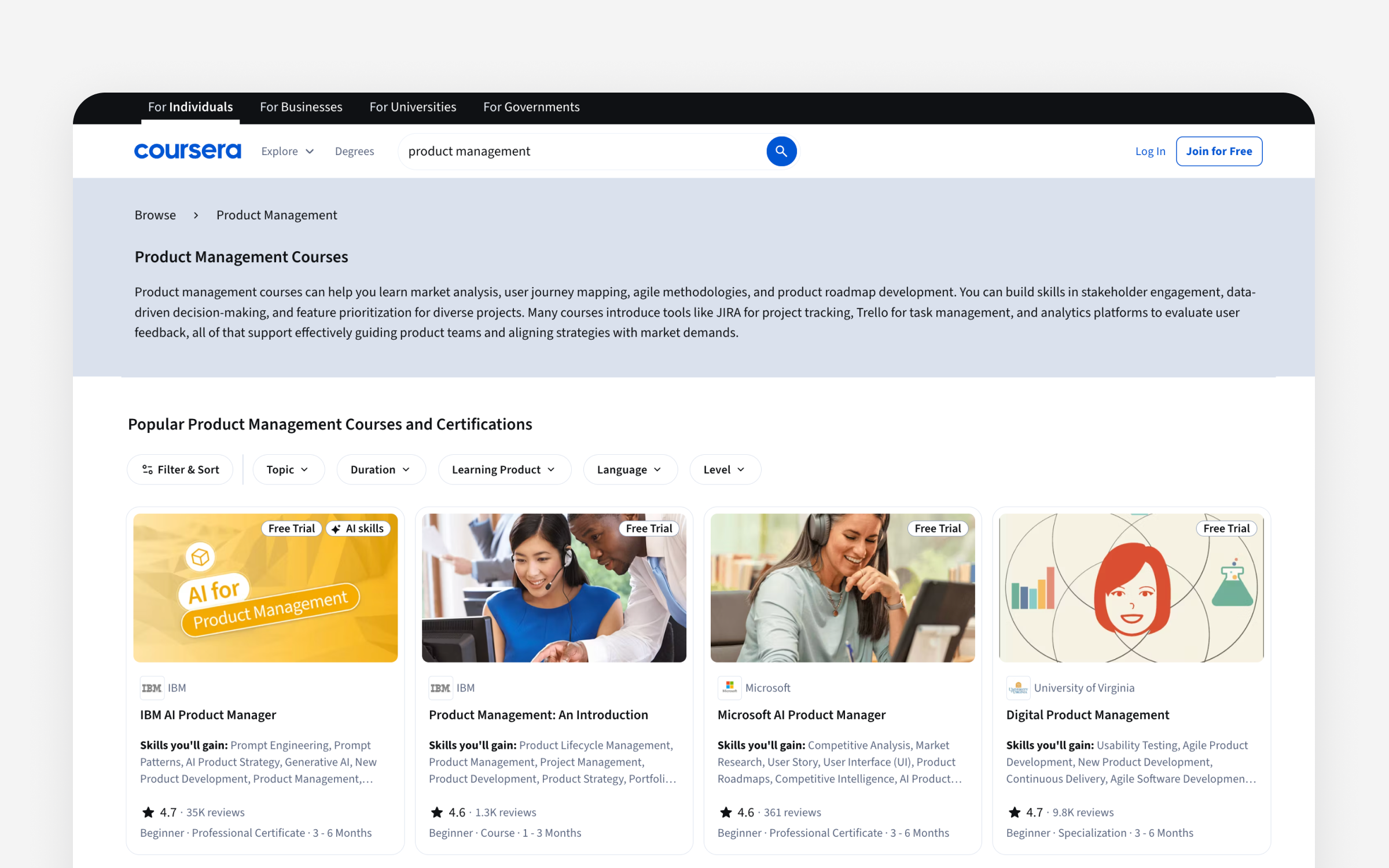
Coursera breakdown:
- Cost: Free to audit, $39-79/month for certificates (typically $117-237 for 3 months)
- Duration: Self-paced (typically 3-6 months)
- Format: Pre-recorded video lectures
- Time commitment: 10 hours/week recommended
- Prerequisites: None for most courses; many certificate programs are designed for beginners and do not require prior experience
- Job guarantee: No
- Documented outcomes: Varies by course, typically 5-15% completion rate
- Best for: Budget-conscious explorers, self-directed learners
- Target audience: All levels
- Rating: Varies by specific course (typically 4.0-4.5/5)
Can’t afford $4,000+ bootcamps? Coursera offers product management courses and certifications at a fraction of competitors’ costs. Many courses are free to audit (you only pay for certificates). Full specializations typically cost $39-79/month. Most courses are part of a certificate program and award a professional certificate or product management certification upon completion, providing formal recognition of your skills.
The free-to-cheap approach:
Coursera lets you audit most content completely free. Watch lectures, read materials, do exercises. You only pay ($39-79 monthly) if you want the completion certificate. Most PM courses take 3-6 months to finish. Maximum cost: around $237 if you complete Google’s PM certificate in three months. That’s 95% less than Product School’s $2,999, though without live instruction or cohort accountability.
Course options:
Multiple program options from universities and tech companies. Google Project Management Certificate: beginner-friendly, 6 months at 10 hours/week, created and recognized by Google. Meta Product Management Certificate: intermediate level covering product development, product life cycle, go to market strategies, metrics, and strategy. University PM courses from Duke, Virginia, Northwestern with academic approach. Self-paced video lectures. Quizzes and assignments. Peer-graded projects in some courses. Hands-on projects are included to help students apply learned skills in real-world scenarios. Coursera’s product management courses also cover key topics such as product marketing, product vision, and value propositions, ensuring learners gain a comprehensive understanding of the field. Certificate upon completion if paying. Financial aid available for those who qualify.
The audit option:
Watch all video lectures and access most course materials completely free. Only pay if you want the certificate. This makes Coursera the ultimate low-risk option for testing PM interest. Spend $0, complete a course, decide if PM is right for you before investing thousands elsewhere.
Learning format:
Pre-recorded video lectures, not live instruction. Self-paced progression, no cohort or fixed schedule. Complete at your own speed based on availability. No networking or community component built in. Entirely self-directed, requires strong discipline.
Student feedback patterns:
Positive themes:
- “Great way to explore PM without financial commitment”
- “Google certificate recognized by employers”
- “Flexibility to learn at my own pace”
- “Can try multiple courses to find what fits”
Common criticisms:
- “Hard to stay motivated without accountability”
- “No networking or community”
- “Lower completion rates without structure”
- “Video format less engaging than interactive”
- “Certificate value varies by employer”
Completion rate reality:
Online self-paced courses typically see 5-15% completion rates. Without cohort pressure, deadlines, or instructor interaction, most people start but don’t finish. Coursera’s flexibility is both strength and weakness. Freedom to learn anytime also means freedom to procrastinate indefinitely.
Why completion rates predict success:
If 95% of students don’t finish, the program design has problems. Completion rates reveal platform effectiveness. Uxcel’s 48% completion rate versus 5-15% industry average isn’t luck; it’s evidence that bite-sized, gamified learning works for busy professionals. Course completion predicts job outcomes because you can’t get a job with skills you didn’t finish learning. When evaluating Product School alternatives, ask: what percentage of students who start actually finish? If they won’t tell you, that’s your answer. Coursera’s low completion rates are the trade-off for its low cost.
Best for:
Budget-conscious explorers testing PM interest. Self-directed learners comfortable without live instruction or accountability. Those supplementing other training with specific skills. People wanting recognized brand certificates (Google, Meta) at low cost. Students needing complete schedule flexibility. Career researchers determining if PM is right before bigger investments. Explore our list of free product management courses for more budget options.
Not ideal for:
People needing live instruction and real-time interaction. Those wanting networking opportunities with peers and instructors. Learners requiring accountability structure to complete courses. Students needing job guarantees or placement support. Anyone who struggles with self-paced learning discipline. Professionals wanting immediate community access.
The trade-off:
Coursera sacrifices structure, community, and accountability for extreme affordability and flexibility. At free to $237, the financial risk is minimal. But the completion risk is high. You’re betting on your own discipline. For some people, that bet pays off. For others, Product School’s $2,999 cohort pressure is worth it precisely because it forces completion.
Hands-on projects are included to help students apply learned skills in real-world scenarios. User research is a critical method for uncovering high-value opportunities, and product roadmaps are essential tools that connect features to strategic goals.
Product Gym
Product Gym breakdown:
- Cost: Not publicly disclosed (requires consultation)
- Duration: 6 weeks intensive
- Format: Mixed (interview preparation focus)
- Time commitment: Varies by program
- Prerequisites: PM knowledge assumed (not for beginners)
- Job guarantee: No
- Documented outcomes: 98% student recommendation (per their data)
- Best for: Interview-ready candidates needing job landing help
- Target audience: Those with PM knowledge struggling with interviews
- Rating: Limited public reviews (smaller program)
Already know PM but bombing interviews? Product Gym focuses specifically on PM interview preparation and job placement, not general PM education. While many other programs offer a professional certificate or product management certification to validate your skills and cover the full product lifecycle, Product Gym is more narrowly focused on helping candidates succeed in interviews. If you already understand PM concepts but struggle with interviews, this targeted approach might work. Product Gym also prepares candidates for questions about product owner and product marketing roles, as well as how to communicate value propositions and discuss experience with successful product launches during interviews.
Cost breakdown:
- Not publicly disclosed (varies by program)
- Lack of transparent pricing is a significant downside
- Must schedule consultation to learn costs
- Compare to Uxcel ($288), Coursera (free-$237), and others with clear pricing
What’s included:
6-week intensive programs focused on interview preparation. Case studies from real companies like Slack and Tinder. Mock interviews with detailed feedback. Job application strategy and optimization. Resume and portfolio reviews. Behavioral interview coaching. Technical PM interview preparation. Community support and alumni network.
The interview emphasis:
Unlike Product School or General Assembly teaching general PM skills, Product Gym assumes you have foundational knowledge and need help landing the role. Focus is execution: how to ace PM interviews, not what product management is. This narrow focus means it’s not suitable for complete beginners.
Community and placement:
98% of students recommend the program according to their data (sample size smaller than Product School’s). Strong community and Slack presence similar to Product School. Focus on actual job acquisition, not just skill development. Claims emphasis on placement success.
Student feedback:
Limited public reviews compared to alternatives (smaller program). Positive mentions emphasize interview preparation quality and job landing success. Some students credit Product Gym specifically with getting PM offers. Criticism centers on lack of pricing transparency and narrower scope than comprehensive PM training.
Best for:
Those who understand PM but need interview help. People who’ve learned fundamentals elsewhere and are ready to apply. Candidates struggling specifically with case interviews and behavioral questions. Students focused on landing job quickly rather than learning comprehensively. Anyone who already has PM knowledge but can’t convert it to offers.
Not ideal for:
Complete beginners needing PM fundamentals. Budget-conscious learners requiring transparent pricing. Those wanting comprehensive PM education beyond interviews. People still exploring whether PM is the right career. Students needing foundational skill building before job applications.
The narrow focus advantage:
Product Gym’s interview specialization means they can go deep on one thing rather than spreading across general PM education. If you’ve already taken Coursera courses or read PM books and understand concepts but keep failing interviews, Product Gym’s narrow focus makes sense. If you need comprehensive PM training from scratch, look elsewhere.
How do these 6 options actually compare?
These Product School alternatives address specific problems Product School creates (high cost without outcome guarantees, instructor quality lottery, and missing employment data). Some programs also differentiate themselves by offering access to advanced tools, including AI tools, and specialized training in product line management, which can be essential for modern product managers.
| Program | Cost | Duration | Outcomes |
|---|---|---|---|
| Uxcel | $288/year | Self-paced | 68.5% promotion rate, $8,143 salary increase |
| CareerFoundry | $6,900 | 5-6 months | Job in 6 months* |
| Reforge | $1,995/year | 4 weeks | Not published |
| General Assembly | $4,600 | 10 weeks | Not published |
| Coursera | up to $237 for 3 months per course | Self-paced | Vary |
| Product Gym | Not disclosed | 4 weeks | Not published |
Note: Most programs, including Uxcel, Product School, CareerFoundry, General Assembly, and Coursera, offer a professional certificate, product management certification, or certificate program upon completion. Make sure to verify the CareerFoundry claim of getting a job in 6 months with people that went through the program.
Should you enroll to Product School's product management certification in 2026?
If you have employer-sponsored funding, existing experience in adjacent roles like business analysis or project management, and who value networking with Silicon Valley instructors. For everyone else, the $2,999 cost without job guarantees or published outcomes makes Uxcel ($288/year with 68.5% documented promotion rate) the best alternative.
Making your decision
The right choice depends on your specific situation. Here’s how to decide:
Note: When choosing a program, consider whether it offers a professional certificate, product management certification, or a structured certificate program. Earning a recognized credential through such programs can be a key factor in career advancement, as these certificates validate your skills and can be shared with employers or educational institutions. Additionally, evaluate how each program teaches value propositions, product line management, and business strategy, as these areas are essential for developing practical product management skills and aligning your learning with real-world career goals.
Choose Uxcel if:
- You’re paying out of pocket and budget conscious ($288 vs $2,000-$5,000)
- You want documented outcomes (68.5% promotion rate published). Strong results.
- You need flexibility to learn in short sessions (5-minute lessons)
- You’re a senior professional wanting complementary skills across design and product
- You value high completion rates (48% vs 5-15% industry average)
- You want cross-functional skill mapping no competitor offers
- You prefer interactive learning over video lectures or live cohorts
- You want a certificate program that awards a professional certificate or product management certification upon completion
Of all Product School alternatives, Uxcel provides the best value for most learners. The combination of low price, documented outcomes, high completion rates, and unique cross-functional skill mapping solves problems other platforms create.
Choose Product School if:
- Your employer is paying the full tuition
- You specifically value networking with Silicon Valley instructors; the instructor pedigree matters to your goals
- You’re comfortable with instructor quality lottery
- Group-heavy learning format suits your style
- You can afford potential sunk cost if it doesn’t work
- You want a product management certification from a well-known provider
Check our in-depth review of Product School to see if it's worth investing $2,999 in 2026.
Choose CareerFoundry if:
- You need employment guarantee (refund if no job in 6 months)
- You’re career changing
- You want extensive portfolio development (8-10 projects)
- You prefer 1-on-1 mentorship over group learning
- You’re comfortable with 5-6 month timeline
- You can afford the premium ($6,900)
- You want a structured certificate program
Career changers prioritizing outcome certainty over upfront cost often choose CareerFoundry’s job guarantee. Check our in-depth review of CareerFoundry for more context.
Choose Reforge if:
- You’re already a senior PM, director, or VP
- You want strategic training, not fundamentals
- Your company pays for ongoing professional development
- You work in SaaS (content is SaaS-focused)
- You value membership model with evolving content
- You’re comfortable with large cohorts (200-400 people)
Reforge exclusively serves experienced PMs. If you’re not already working as a PM, they won’t accept you. Check our in-depth review of Reforge Product Strategy course and whether it is worth enrolling in 2026.
Choose General Assembly if:
- You want established bootcamp brand recognition
- You need both full-time and part-time schedule options
- You want to test with free intro course before committing $4,600
- You want a professional certificate from a recognized bootcamp
General Assembly works for those preferring established brand over newer platforms, despite similar problems to Product School. Check our in-depth review of General Assembly to see if it's worth for you in 2026.
Choose Coursera if:
- You’re testing PM interest without financial commitment
- You’re extremely budget conscious (up to $237)
- You have strong self-discipline for self-paced learning
- You want Google or Meta certificate at minimal cost
- You’re supplementing other training with specific skills
Coursera’s low financial risk makes it ideal for exploration, but low completion rates mean most people don’t finish.
Choose Product Gym if:
- You already understand PM concepts
- You specifically struggle with interviews and want dedicated PM interview preparation support
- You’ve learned elsewhere and need help landing offers
- You’re okay with non-transparent pricing
- You need interview-focused training, not general education
Product Gym’s narrow focus works for interview-ready candidates, not beginners needing comprehensive training.
What should you do next?
Don't spend another month researching. These 7 options represent the strongest PM training choices based on cost, outcomes, format, and target audience. The right program is the one matching your specific situation that you'll actually complete.
What I would do if I were in your shoes:
- Create a free account on Uxcel
- Complete Uxcel Pulse to gauge skills and understand what are your skill gaps and strengths
- Complete a few first levels of courses to see if the learning style fits
- If yes, subscribe for a month to see whether the courses actually suit you
This will give you enough interest to understand whether the style of learning Uxcel provides fits you the best. If not, you only spent $35 to understand whether the learning style fits you.
If you need employment certainty: CareerFoundry ($6,900) is the only option with job guarantee. Yes, it costs more upfront. But you're eliminating downside risk entirely. If landing a PM role is non-negotiable, pay for the protection. Consider this: would you rather spend $4,000 with no safety net, or $6,500 with a full refund guarantee if it doesn't work?
If you're already a senior PM: Use Uxcel for cross-functional skill building towards senior IC roles (learn across PM, UX, and AI). Other option would be Reforge ($1,995/year) exclusively serves experienced PMs with strategic training. The content assumes you already know the basics; jumping straight to advanced strategy is refreshing if you're past the fundamentals stage.
Pick based on your budget, experience level, and need for structure vs flexibility. These factors matter more than brand names; start learning this week. Adjust if needed after 30 days. The right choice is the one you'll actually complete, not the one that looks best on paper.