


Every product team eventually gets asked where its growth comes from and where it stops, and the AARRR funnel is the shared vocabulary most of them reach for. The model is old by software standards and still in daily use because it separates the question of attracting people from the questions of keeping, monetizing, and multiplying them. It is a diagnostic frame, not a growth plan, and the teams that get the most from it treat the five stages as five places to look rather than five things to do.
In this glossary topic:
- What is the AARRR funnel?
- What does each AARRR stage measure?
- Why is AARRR a funnel?
- How does product and design work map onto the AARRR funnel?
- How does the AARRR funnel differ from a marketing funnel and a journey map?
- What are the variants and criticisms of the AARRR funnel?
- What does the AARRR funnel look like in practice?
- What does the AARRR funnel mean for designers and product managers?
- FAQ

What is the AARRR funnel?
The AARRR funnel is a five-stage model of how a product grows: Acquisition, Activation, Retention, Referral, and Revenue. Each stage names something a person does with a product, from first arriving to paying for it and bringing others in, and each gets a metric, so that growth reads as a series of conversion rates rather than one top-line number.
Investor Dave McClure introduced the model in a 2007 presentation titled "Startup Metrics for Pirates", and the nickname pirate metrics stuck because the acronym sounds like a pirate's growl. The intent was corrective: early-stage companies reported whatever was easy to count, usually visits and sign-ups, and McClure argued that a startup should track one or two metrics at each stage of a customer's life with the product. The model's value is that it makes the middle of the funnel visible, the stretch between a sign-up and a paying, returning customer, where most products quietly lose the people they worked hard to attract.
What does each AARRR stage measure?
Acquisition measures how people arrive: visits, sign-ups, and the cost of each by channel, which is where customer acquisition cost is calculated. Activation measures whether a new user reached the first moment of value, defined by the team as a specific action such as creating a first project; the metric is the share of sign-ups that reach it within a set window.
Retention measures whether people come back. The usual form is the share of a sign-up cohort still active after a period, a day, a week, or a month depending on the product's rhythm, with its inverse reported as churn. It is the stage that most reliably separates a product people need from one they tried.
Referral measures whether existing users bring in new ones: invitations sent, the share of sign-ups that came from another user, or a viral coefficient, the average number of new users each existing user brings. Revenue measures monetization: conversion from free to paid, average revenue per user, and lifetime value. Each stage has one job, and a metric that measures two stages at once is measuring neither well, which is why a blended growth rate is less useful than the five numbers behind it.
Why is AARRR a funnel?
The stages are drawn as a funnel because fewer people pass each one. Every sign-up came from a larger group of visitors, every activated user from a larger group of sign-ups, and so on. The ratio between adjacent stages is a conversion rate, and the drop between any two stages is a measurement of where the product is losing people. The Product Management Terms for Growth Frameworks & Strategy lesson sets the model alongside the other growth frameworks a team meets.
The reason to draw it this way is that the largest drop is usually the cheapest to fix. The funnel points at the bottleneck, the stage where improvement would carry the most people through to the stages after it, and it says that pouring more into acquisition while activation leaks is paying to lose people faster. A funnel reading is a diagnosis of where to look, not a prescription for what to change.
How does product and design work map onto the AARRR funnel?
Each stage is owned by a different kind of work. Acquisition belongs mostly to marketing: campaigns, search, content, and landing pages. Activation is where onboarding design lives: the first-run experience, the empty states, the setup steps, and the path from a blank account to the first result that proves the product is worth returning to.
Retention is the territory of the core loop and habit design: the repeated action the product exists for, the triggers that bring people back to it, and the notification decisions around those triggers. Referral is where sharing features live, from invitation flows to anything that puts the product in front of someone who has not signed up. Revenue is the pricing page, the paywall, and the billing flow. Designers tend to own activation and retention, and those are the two stages the model cares about most, because they decide whether the acquisition spend was worth it.
How does the AARRR funnel differ from a marketing funnel and a journey map?
A marketing funnel describes the path to a purchase: awareness, interest, consideration, intent, and conversion. It ends where the sale happens, and its stages are states of mind as much as actions. AARRR starts near where a marketing funnel ends: acquisition roughly covers the marketing funnel's whole length, and the other four stages describe what happens after a person has become a user. The marketing funnel is a model of demand; AARRR is a model of a product's life with a user.
A customer journey map differs in kind rather than in scope. It is a qualitative artifact: a timeline of what a persona does, thinks, and feels across every touchpoint, built from research to find moments that need design attention. AARRR is quantitative and aggregate, five numbers about everyone. A journey map explains why a funnel stage leaks; the funnel says which stage is leaking, and teams that keep both use the funnel to pick the stage and the map to pick the fix.
What are the variants and criticisms of the AARRR funnel?
The best-known variant is RARRA, which reorders the stages as Retention, Activation, Referral, Revenue, Acquisition. The argument is that where acquisition is cheap or already solved, growth is capped by retention, so a team should prove people stay before it spends to bring more in. The reordering changes no definitions, only priorities.
The criticisms are mostly about what the model leaves out. It says nothing about which stage to work on, so a team still has to diagnose. The stages blur for subscription products, where revenue arrives at sign-up and retention and revenue are nearly the same measurement, and for products where churn happens before any referral is plausible. Revenue can precede referral, and often does. And the model is silent on the quality of what it counts: an activation event chosen for convenience shows a healthy funnel for a product nobody needs. The Introduction to Churn Metrics and Analysis lesson covers the retention measurements that carry most of the model's weight. The model is a vocabulary, not a growth plan, and criticism of it is usually criticism of teams that mistook the one for the other.
What does the AARRR funnel look like in practice?
Drawn out, the model is a funnel diagram with five bands narrowing from top to bottom, one stage on each. The picture is simple on purpose, so that everyone in a company can point at the same stage and mean the same thing.
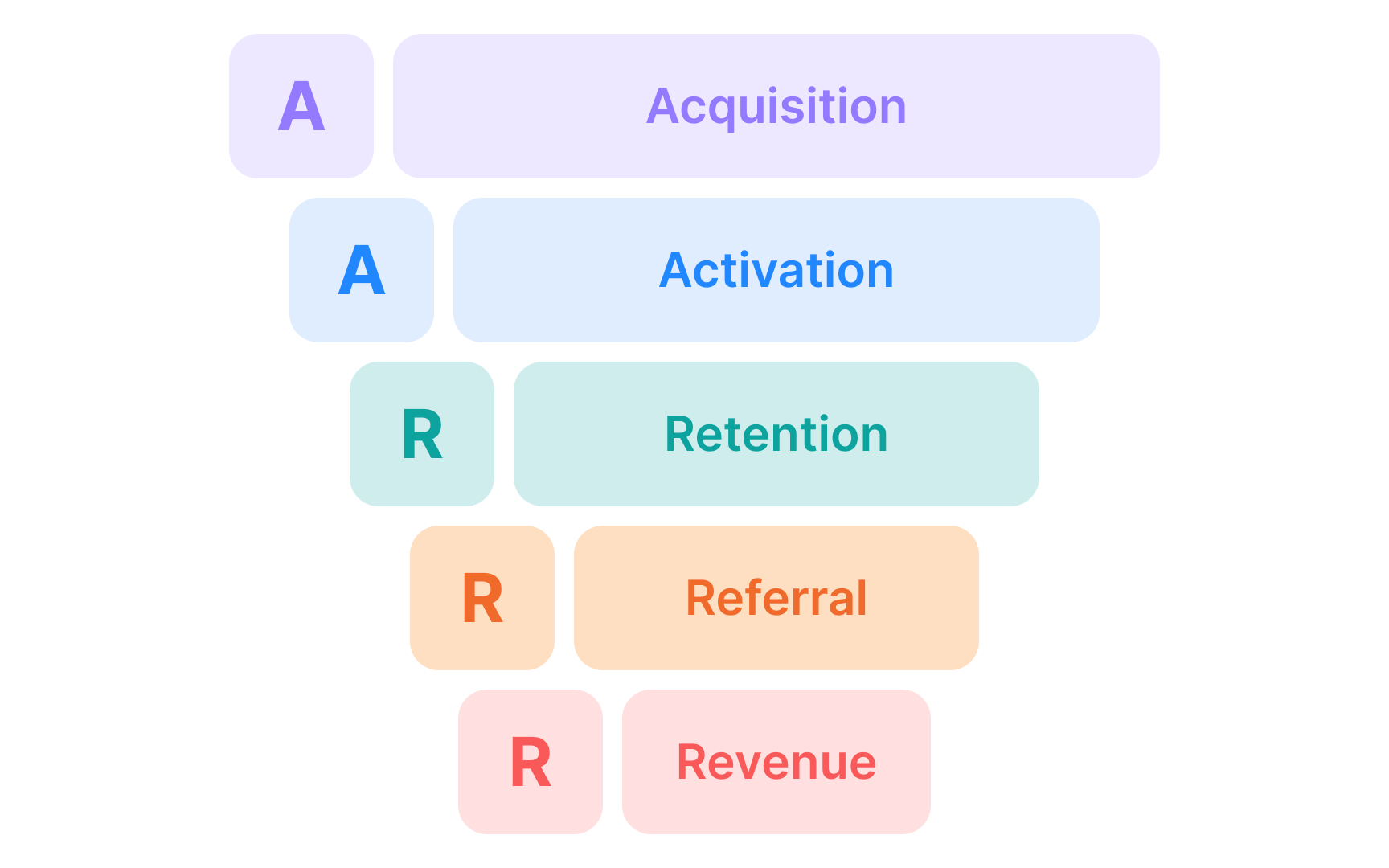
The five AARRR stages as a narrowing stack: each bar is shorter than the one above it, and the drop between two bars is the bottleneck a team reads the funnel to find. From the lesson Bottleneck Metrics.
What does the AARRR funnel mean for designers and product managers?
For a product manager, the discipline the model asks for is one owner and one metric per stage. A stage with no owner is nobody's problem, and a stage with four metrics invites reporting whichever looks best this month. Defining activation is the hardest of the five, because it means deciding what the product's first moment of value is, and that decision shapes onboarding, instrumentation, and what counts as a good first week.
For a designer, the funnel is a way to state what a piece of work is for. An onboarding redesign targets activation and is judged on the share of new users who reach the activation event; a notification redesign targets retention rate and is judged on return visits in the following weeks. Naming the stage before starting the work fixes the metric the work will be judged by, and stops a successful activation change being called a failure because revenue, three stages down, did not move. Picture a team that argues for a month about whether its product has product-market fit without ever agreeing which retention number would settle it.


