


.svg)

The most common go-to-market mistake is not a bad tactic. It is a good tactic applied at the wrong stage. A company with 8 customers that hires a VP of Sales, launches a reseller program, or invests in brand advertising is not being ambitious. It is misallocating resources in ways that are hard to recover from. The tactics that work at scale are not just premature at an early stage. They actively undermine the learning that early-stage companies need most.
Company maturity is not measured by age or headcount. It is measured by what you know, what you have proven, and what your organization can actually sustain. A SaaS company with 3 enterprise contracts worth €150,000 each is at a fundamentally different maturity level than a consumer app with 3 paying users at €10 per month, even though both have 3 customers. Context determines stage, and stage determines what you should be doing next. The 4-stage model gives founders a clear framework for diagnosing where they actually are, not where they wish they were.
Each stage has a distinct focus, a distinct set of appropriate tactics, and a distinct set of traps that look appealing but create real damage. Moving through them in order is not a constraint. It is the mechanism by which each stage prepares you for the next one.
The 4 company maturity stages
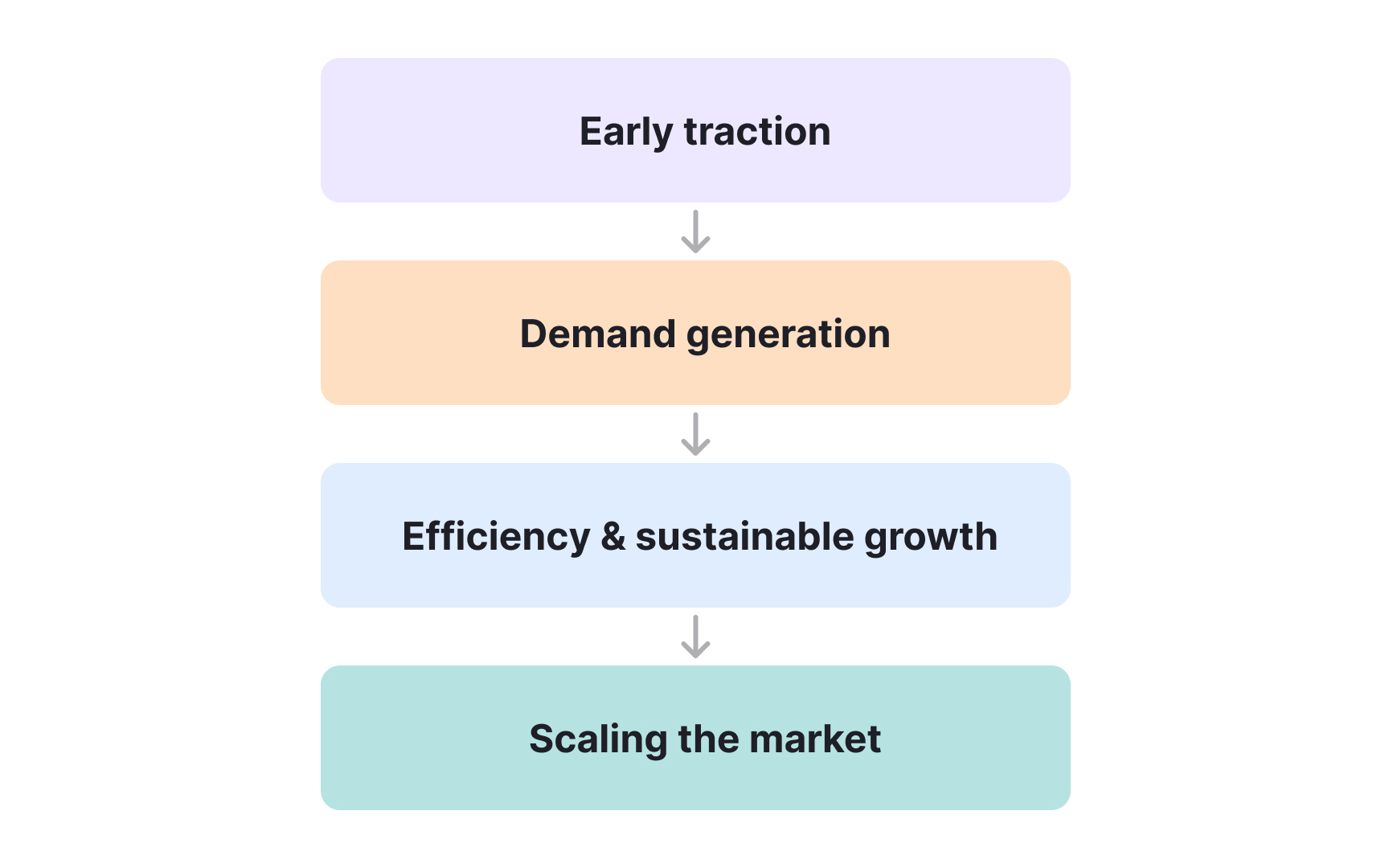
Most go-to-market frameworks treat a company as a static entity. The maturity model treats it as a living system that moves through distinct phases, each with its own rules. Understanding what those phases are is the foundation for every tactical decision that follows. There are 4 levels:
- Level 1 is early traction, typically 3-5 customers, where the entire focus is on understanding why people buy and making sure they succeed. Everything is done manually. You are in the market to learn, not to scale.
- Level 2 is demand generation, roughly 5-25 customers, where the question shifts from "can we get customers" to "can we find them through a repeatable process."
- Level 3 is efficiency and sustainable growth, around 25-100+ customers, where the challenge is making proven channels work at scale without the business decaying around you.
- Level 4 is scaling the total addressable market, where you are managing multiple product lines or markets and making platform-level decisions.
Each stage has a fundamentally different set of priorities, and each one builds directly on the one before it. A company cannot run an efficient multi-channel strategy at Level 3 without having identified which channel works at Level 2. It cannot identify which channel works at Level 2 without the direct customer learning that only Level 1 forces you to do.[1]
Pro Tip! The shift from Level 1 to Level 2 is about repeatability, not volume. A company with 6 customers through pure hustle may still be at Level 1.
Level 1, Early Traction: manual selling and pattern recognition
Level 1 is the stage most founders want to leave quickly and the one they need to stay in long enough to actually learn from. With roughly 3-5 customers, the entire focus belongs on two things: making those customers genuinely successful and understanding exactly why they bought and why they stay.
Everything at Level 1 is done manually. Your sales process is you having conversations. Your onboarding is you personally walking customers through the product. Your support is your direct contact. This feels slow and unscalable, and that is the point. Manual execution at this stage forces you into the details that you will eventually need to systematize. A founder who automates too early ends up systematizing their assumptions rather than their learning. When something goes wrong with a manually delivered experience, you know immediately and can fix it. When something goes wrong with an automated one, you may not find out for months.
The goal at Level 1 is not efficiency. It is pattern recognition. Every customer conversation, every objection, every moment of confusion during onboarding is a data point that will shape your sales playbook, your pricing, your channel strategy, and your product roadmap. None of that learning is available if you hand off the selling before you understand what you are selling and why people buy it.[2]
Pro Tip! Keep a running log of every objection you hear during Level 1 sales conversations. The patterns that emerge will become your sales playbook for Level 2.
Level 2, Demand Generation: building a repeatable demand engine
Level 2 of the company maturity begins with a shift in the central question. At Early Traction, the question is "can we get customers?" At Demand Generation, it becomes "can we find more customers through a process that does not depend entirely on our personal network and hustle?" The goal is repeatability, not volume.
At this stage, with roughly 5-25 customers, you start experimenting with channels. The keyword is experimenting. You are not building a multi-channel infrastructure. You are testing one additional channel alongside your proven direct approach and measuring what happens. A founder at Demand Generation might add a content marketing effort, run a focused outreach campaign to a new segment, or pilot a simple affiliate arrangement. They do not abandon direct selling while they do it. Direct is still the primary revenue driver. The new channel is a test.
Pricing also moves from reactive to intentional at Demand Generation. At Early Traction, pricing was essentially "whatever they agreed to pay." At Demand Generation, you have enough customer feedback to begin testing price points with purpose, looking for the combination of price and positioning that converts the right customers consistently.[3]
Pro Tip! At Demand Generation, a channel experiment that generates zero customers is not a failure if you learn the channel does not fit your customer profile.
Level 3, Efficiency and Sustainable Growth: scaling what works
Efficiency and Sustainable Growth companies have proven they can generate demand. The challenge now is whether they can do it sustainably, without the business breaking under the pressure of its own growth. Customer churn, team burnout, and operational chaos are the specific enemies at this stage. With roughly 25-100+ customers, multi-channel becomes a real operating reality at Efficiency and Sustainable Growth. But it looks nothing like the reflexive "let's try everything" approach that destroys resources at earlier stages. A company at this level is running 2 or 3 channels that have already demonstrated results, optimizing each one, and managing the interactions between them. A customer might discover the product through content, evaluate it through a self-serve trial, and close through a direct sales conversation. That is not a pipeline problem. It is a channel coordination challenge that requires intentional management. The operational work that felt optional at Demand Generation becomes urgent at Efficiency and Sustainable Growth. Sales handoffs, onboarding processes, customer success programs, and data infrastructure all need to mature alongside the channel strategy. Growth at this stage without operational maturity produces customers who churn at the same rate as new ones come in. Revenue stays flat while the team works harder than ever.[4]
Pro Tip! If your churn rate is rising as your customer count grows, you have an Efficiency and Sustainable Growth operations problem, not a product problem. Fix the operational layer before investing more in acquisition.
Level 4, Scaling the Total Addressable Market: platform-level decisions
Scaling the Total Addressable Market is the stage most early-stage founders are imagining when they make premature decisions. Understanding what it actually requires is as important as understanding what it offers, because the gap between where you are and where this level demands you to be is precisely the space where stage-skipping causes damage.
At Scaling the Total Addressable Market, you have multiple product lines or markets, and your organizational structure has to evolve to match the scale and complexity of growth. You are making platform-level decisions, not individual sales decisions. Channel strategy at this stage includes things like enterprise partnership agreements with major platforms, dedicated channel teams managing reseller networks, and significant investment in brand-level advertising. These are also competitive decisions. You are not just finding customers. You are positioned in a market where other mature players are operating, and channel exclusivity, preferred partner arrangements, and strategic co-marketing become relevant considerations.
The reason it matters for Early Traction and Demand Generation founders to understand Scaling the Total Addressable Market is simple. Many of the decisions that damage early-stage companies are Level 4 tactics applied years before the company has the foundation to support them. Recognizing what belongs to this level makes it easier to resist the temptation to shortcut toward it.[5]
Pro Tip! The clearest sign of a Level 4 tactic applied too early is that it requires organizational infrastructure that does not yet exist to make it work.
Why context determines stage
Customer count is a starting point for diagnosing the stage, not a conclusion. Two companies with identical customer counts can be at completely different maturity levels depending on who those customers are, what they pay, and what the relationship requires. A SaaS company with 3 enterprise contracts worth €150,000 each already needs to think about account management, renewal cycles, and expansion within existing accounts. Its sales cycle was long, its deal complexity was high, and its customer relationships required ongoing management.
A consumer app with 3 paying users at €10 per month needs to understand whether 3 is a fluke or a signal, and whether the product is creating enough recurring value to generate more. Same customer count. Entirely different stages. Different tactics, different priorities, and different definitions of what "success at this stage" actually means. Business model, customer type, ticket size, and relationship complexity all contribute to a company's effective stage. A high-volume, low-ticket consumer business moves through stages differently than a low-volume, high-ticket enterprise business. Applying one company's stage playbook to another is one of the most common reasons GTM tactics fail despite looking correct on paper.[6]
Pro Tip! 3 enterprise customers paying €150k each and 3 consumer users paying €10/month are not at the same stage, even though the customer count is identical.
The cost of skipping stages
Stage-skipping is one of the most reliably destructive patterns in early-stage go-to-market. It does not look like recklessness. It looks like ambition. An Early Traction company that signs a partnership with a major distributor, or a Demand Generation company that launches a reseller network before proving direct sales, feels like it has dramatically accelerated its trajectory. What it has actually done is create a dependency on a structure it does not yet have the knowledge, product quality, or organizational bandwidth to sustain. The sequential logic is tight. You cannot build a repeatable process at Demand Generation without understanding what you are making repeatable, which only comes from the manual work of Early Traction.
You cannot scale what works at Efficiency and Sustainable Growth without having identified what that is, which only comes from the experiments of Demand Generation. You cannot run premium, complex channel strategies at Scaling the Total Addressable Market without the organizational infrastructure that comes from successfully managing simpler channels first.
Partners are a specific trap here. A common belief is that a partner relationship will solve a sales problem. In practice, partners amplify what already works. If your direct sales motion is struggling, a partner channel does not fix it. It amplifies the struggle, at scale, in a relationship where you have less control and visibility than you do with your own sales process.[7]
Pro Tip! Partners expose broken sales motions rather than fixing them. Adding a channel makes the underlying problem harder to diagnose.
Spot a stage-tactic mismatch
Recognizing stage-tactic mismatches in real situations is harder than recognizing them in theory. The mismatched tactic usually comes with a compelling rationale. A founder building a reseller network at Early Traction is not being careless. They have a logical story: "We cannot scale direct sales alone, and this partner has access to hundreds of our ideal customers." The logic sounds reasonable. The timing is the problem. A useful diagnostic approach is to ask what would need to be true for this tactic to succeed, and then ask honestly whether those conditions exist right now. A reseller network succeeds when:
- The direct sales motion is proven and documented
- The product is stable enough that partners can sell it without constant support from the founding team
- There is enough organizational bandwidth to invest in partner enablement
None of those conditions typically exist at Early Traction. The same test applies to every common premature move: hiring a VP of Sales before there is a repeatable process to manage, investing in paid acquisition before understanding why existing customers convert, or launching brand advertising before the target customer is clearly defined. In each case, the tactic is not wrong in isolation. It is wrong for the stage.
Pro Tip! When a tactic sounds exciting precisely because it feels like a shortcut to a later stage, that feeling is the signal to slow down and ask whether the foundation for it actually exists.
Design the progression from Early Traction to Demand Generation
Moving from Early Traction to Demand Generation is not a milestone you reach by hitting a customer count. It is a transition you earn by completing the work of Early Traction. Specifically, you need to know 3 things before Demand Generation begins:
- Why customers bought
- Why they stay
- What the experience of making them successful actually requires
Without those 3 answers, the repeatable process you try to build at Demand Generation will repeat the wrong things. The transition happens when direct selling has produced enough pattern recognition to work from. You have heard the same objections enough times to handle them without thinking. You know which customer characteristics predict success and which predict churn. You have a rough sense of how long the sales cycle takes and what moves it forward. These are not outputs of a planning exercise. They are outputs of doing the Early Traction work manually and paying attention. Designing the progression means deciding what to carry forward and what to experiment with. The direct sales motion carries forward. The deep customer involvement in onboarding carries forward. What you add is one focused channel experiment: a specific outreach approach, a content strategy aimed at a defined audience, or a single partnership with a clear hypothesis behind it. You measure what happens, and you let the evidence decide what comes next.
Pro Tip! Write down the 3 things you know about your customers before you start any Demand Generation channel experiment. If you cannot fill in all 3 clearly, you are not done with Early Traction yet.
Topics
References
- Why Most Go-To-Market Strategies Fail at the Earliest Stage | Entrepreneur
- How to Build a Successful Founder-Led Sales Strategy | Heavybit | Heavybit
- Founder-led sales 101: Actionable strategies for early stage startup founders
- Why is premature scaling still the biggest startup killer? - Duet Partners
- Why Most Go-To-Market Strategies Fail at the Earliest Stage | Entrepreneur
- https://s3.amazonaws.com/startupcompass-public/StartupGenomeReport2_Why_Startups_Fail_v2.pdf