


A price is the first thing many people learn about a product and the last thing they see before committing to it. It sets expectations before a single screen loads, and it turns pricing pages, paywalls, and upgrade prompts into some of the most consequential surfaces a product team designs. Price is a design decision as much as a finance decision, because how a number is framed, compared, and presented changes what people believe it is worth.
In this glossary topic:
What is price in the context of product design?
Price is the amount a customer pays for a product or service. At its simplest it's a number, but in practice it's one of the most powerful signals a product sends about what it is and who it's for.
Price communicates positioning before a user experiences a product. A premium price signals quality, exclusivity, or sophistication. A low price signals accessibility, volume, or value-focused positioning. Neither is inherently better; both are legitimate strategies that shape expectations. The problem arises when a product's price and its actual experience don't match: a premium price creates expectations that a mediocre experience can't meet, and a price positioned as a bargain can undermine perception of an otherwise strong product. The Pricing as a Positioning Signal lesson covers how that signal is set deliberately.
For product and UX teams, pricing is directly relevant to how pricing pages, upgrade prompts, paywall moments, and in-product commerce flows are designed. The experience of discovering, evaluating, and committing to a price is a UX problem, and poor design of these moments meaningfully affects conversion and retention.
How are prices set?
Several frameworks guide pricing decisions, and most products use elements of multiple approaches simultaneously.
- Cost-plus pricing starts from the cost of producing the product and adds a margin. It ensures profitability per unit but says nothing about what customers are willing to pay. Products priced this way sometimes leave money on the table by charging less than customers would pay, or lose sales by charging more than the product is perceived to be worth.
- Value-based pricing asks how much a customer values the outcome the product delivers and sets price accordingly. This is often the most effective approach for differentiated products because it connects price to the benefit received rather than to the cost structure. A product that saves a business 2 hours of work per week can be priced based on what that time is worth to the customer, not on what it cost to build.
- Competitive pricing anchors decisions around what comparable products charge. It's a reasonable starting point for commodity or crowded markets where customers actively compare alternatives, but it makes differentiation harder and can lead to price compression over time as competitors undercut each other.
- Penetration pricing sets a deliberately low price to gain market share quickly, with the expectation of raising prices later. This works when network effects or switching costs make early adoption valuable.
How does pricing design affect user experience?
The moment a user encounters a price, they make a rapid judgment about whether the price feels fair given what they understand the product to be. UX design influences this judgment significantly.
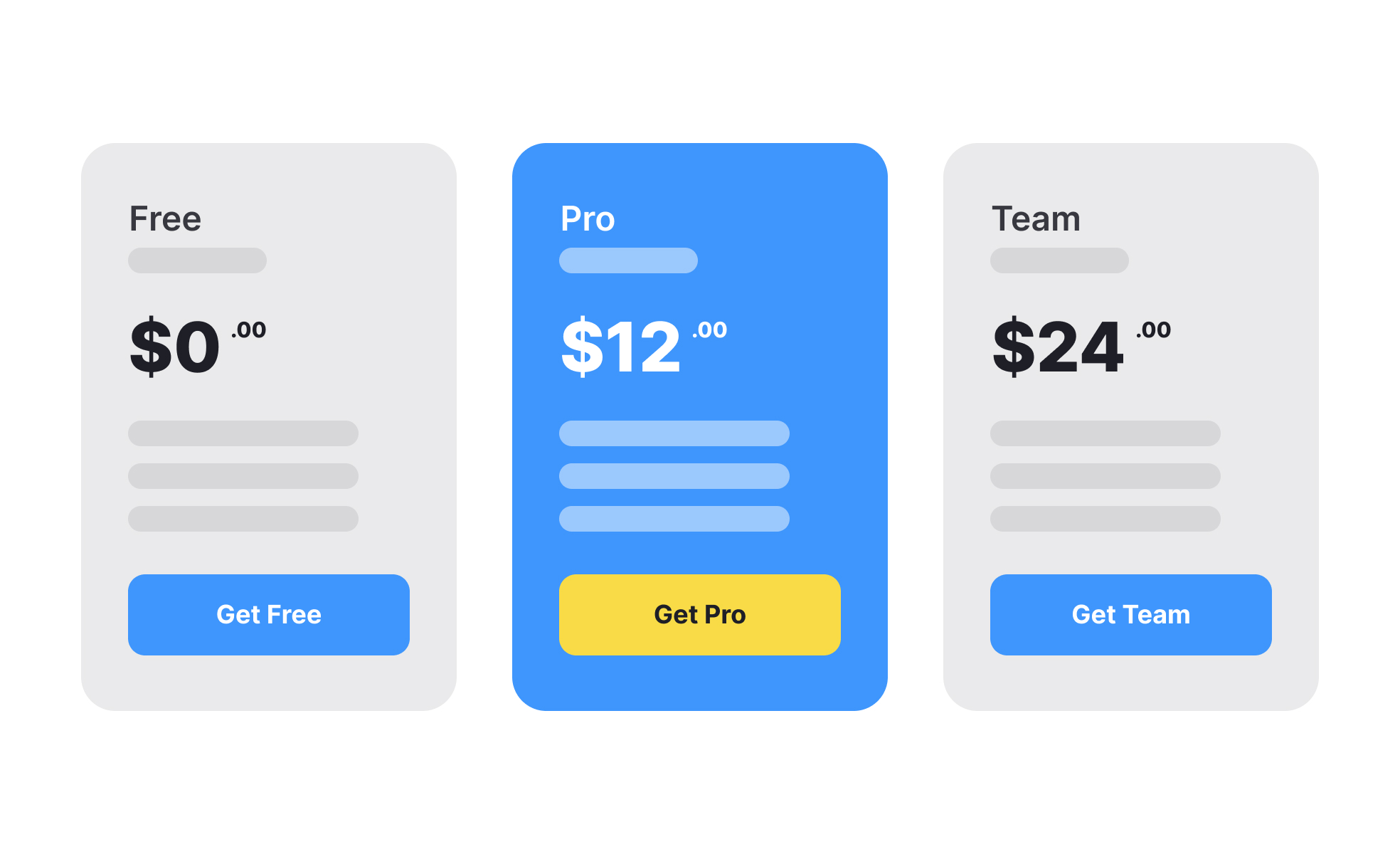
Pricing page design is one of the highest-leverage design surfaces in a product. The way tiers are labeled, the comparison structure, the emphasis on which plan is recommended, the framing of value at each tier, and the visual hierarchy of the page all affect how users evaluate their options. Pricing pages that don't communicate the concrete value of each tier force users to make decisions based on price alone, which pushes them toward the cheapest option. The Best Practices for Designing Pricing Pages lesson works through each of those decisions.
Anchoring is a well-documented cognitive effect: people evaluate options relative to a reference point. Showing a higher-priced plan first makes mid-tier options seem more reasonable by comparison. This is why many subscription products show three tiers with the highest-priced option on the left or listed first.
Upgrade prompts in freemium products are UX moments where pricing and product experience intersect directly. A prompt that appears when the user has just succeeded at a task, felt genuine value, and understood why a feature they want requires a paid plan converts better than one that appears arbitrarily or interrupts a failing task.
What pricing models are common in digital products?
Digital products have expanded the range of viable pricing models significantly compared to traditional software licensing.
- Freemium gives users access to a core set of features for free and charges for additional capabilities. The model works when the free tier is genuinely useful (which drives adoption and network effects) and when the paid tier offers a clear improvement that a meaningful percentage of free users will want. Freemium fails when the free tier is so limited it doesn't create real value, or when the paid upgrade is so obvious it makes the free tier feel like a hostage rather than a product.
- Subscription pricing charges users on a recurring basis, typically monthly or annually, for ongoing access. It creates recurring revenue for the business and lowers the barrier to first purchase compared to a large upfront fee. Annual discounts reward commitment and improve the company's cash position. Subscription fatigue, where users cancel services they're not actively using, is a real retention challenge that product design can address by ensuring users regularly encounter and remember the product's value.
- Usage-based pricing charges based on how much of a product a user consumes. This aligns cost with value for customers who have variable needs and removes the ceiling on revenue from heavy users. The UX challenge is that usage-based pricing creates uncertainty about monthly costs, which some users find uncomfortable. Pricing calculators and spend dashboards that help users predict and monitor their costs are standard companion features in usage-based products.
- Tiered subscription pricing offers multiple fixed plan levels. This is the most common model for SaaS products. Tier design, which features go in which tier and what the tier names and prices are, is a significant product decision that affects both revenue and how users perceive the product's value structure.
How do psychological pricing techniques work?
Several well-documented cognitive patterns affect how users evaluate prices, and product teams regularly use these pricing psychology techniques in pricing design.
- Charm pricing sets prices just below round numbers: $9.99 instead of $10, $49 instead of $50. Users process the leftmost digit first, so $9.99 feels meaningfully cheaper than $10 even though the actual difference is 1 cent. The effect is smaller for sophisticated B2B buyers but remains significant in consumer contexts.
- Decoy pricing introduces a third option positioned to make one of the other two seem like better value. A streaming service might offer individual, family, and premium family plans where the premium family plan is priced so close to the family plan that most users choose the family plan, which was the intended outcome. The premium plan's role is to make the family plan feel like a deal.
- Price framing affects perception even without changing the price itself. A $120 annual subscription feels different from a "$10/month" subscription even at identical cost. The monthly framing makes each payment feel smaller and the commitment feel lighter. Many subscription products offer both framings.
- Bundling combines features or products that would cost more if purchased separately. It increases perceived value without necessarily reducing price, and it can expose users to parts of a product they hadn't discovered individually.


