


Ten years ago a digital product passed through a UX designer, then a UI designer, then a developer, with a handoff and some lost intent at each step. The product designer title grew out of teams deciding that one person should carry the work from the problem to the shipped screen and stay accountable for whether it worked. The title has since spread across design job boards and is applied to a wide range of actual jobs, which is why the question of what a product designer is keeps getting asked. A product designer is a generalist by design: broad across research, structure, interface, and delivery, deep in one or two of them.
In this glossary topic:
- What is a product designer?
- What does a product designer do day to day?
- How does a product designer differ from a UX designer or a UI designer?
- What skills does a product designer need?
- How has the product designer role changed with AI?
- What does a product designer's work look like in practice?
- How to learn the skills of a product designer
- Building a product designer career
- FAQ

What is a product designer?
A product designer is the designer who owns a digital product's experience from problem framing through interface and launch, balancing what users need against what the business needs and what engineering can build. The title marks a generalist: one person who researches, structures, sketches, prototypes, designs the final screens, and stays with the work through release, rather than a chain of specialists handing off to each other.
The same words also name an older profession, the industrial designer who shapes physical goods, and the two share a philosophy but almost nothing in daily practice. In software companies the term settled on its current meaning in the 2010s, as the UX designer and UI designer roles merged and picked up a share of product thinking on the way. Companies still vary in what they mean by it: at some the product designer is a senior generalist, at others the title covers every designer on a product team.
What does a product designer do day to day?
The work follows the product cycle, and a product designer is present at every stage of it. In discovery, they sit with the product manager to understand the problem, read the research, and sketch competing directions before anyone commits. In definition, they map the flow, structure the information, and draw wireframes that make the direction concrete enough to argue about. In design, they build the high-fidelity screens inside the design system, prototype the interactions, and put the prototype in front of users. In delivery, they specify the details for engineers, review the build against the design, and fix what the constraints changed. After launch, they read the analytics and the feedback and start the next round.
Around the cycle sit the standing duties that keep a design team coherent: presenting work in critique, contributing to the design system, writing interface copy when no writer is on the team, and defending design decisions to stakeholders with evidence rather than taste. A product designer's week is measured in decisions made with the product trio, not in screens produced.
How does a product designer differ from a UX designer or a UI designer?
A UX designer owns the structural half of the experience: research, user flows, information architecture, wireframes, and usability. A UI designer owns the visible half: typography, color, layout, components, states, and motion. A product designer covers both halves and adds a third thing the specialist titles do not imply, which is product thinking: an understanding of the metrics the feature has to move, the business model it lives inside, and the trade-offs the team is making. The product designer is in the room when the team decides what to build, not only how it should look and work.
The titles are not standardized, which muddies the comparison. Many job posts use "product designer" for what other companies call a "UX/UI designer", and a small startup's product designer may do what a large company splits across four people. The difference is less the skill set than the accountability: a product designer answers for whether the feature worked, not only for whether the design was good.
What skills does a product designer need?
The craft skills are the foundation: visual design fundamentals such as typography, color, layout, and grids; interaction design; information architecture; wireframing and prototyping; working within and contributing to a design system; and designing for accessibility from the start rather than as a fix. Research literacy sits alongside: running a usability test, moderating an interview, and reading analytics well enough to know what a drop in a funnel does and does not prove.
The product skills are what turn a strong visual or UX designer into a product designer: framing problems before solving them, prioritizing with the product manager, understanding the metrics and business constraints behind a request, and writing clearly, since much of the job is explaining a decision to someone who was not in the room. Collaboration skills round it out, above all the working relationship with engineers through specification, handoff, and review. Figma is the industry default tool, but the tool is the least of it. Hiring managers describe the ideal as a T-shape, broad competence across the whole process with real depth in one or two areas.
How has the product designer role changed with AI?
The production layer of the job is compressing. Figma has added AI features that generate first-draft layouts from a prompt, rename and tidy layers, and search a file by meaning, and prompt-to-app tools such as Lovable, v0, and Bolt turn a written description into a working front end, so a product designer can now test a concept in code without waiting for engineering time. Image generation fills in placeholder content and explores visual directions in minutes. Screens that once took a day to produce take an hour, and the time goes back into the decisions before and after them.
The second change is in what product designers design. Products with AI features behave differently for every user, produce output that can be wrong, and need interfaces for trust, feedback, correction, and graceful failure that the deterministic products of the past did not. That has become a design specialty in its own right. When anyone can generate a plausible interface in a minute, the product designer's value shifts to knowing which interface the problem actually calls for.
What does a product designer's work look like in practice?
The shape of a product designer's involvement is the shape of the design process itself. The Double Diamond below, from the Design Council, separates the work into discovering the problem, defining it, developing solutions, and delivering one, with the diamonds widening where the team explores and narrowing where it decides. A UX or UI specialist typically owns one diamond or one half; a product designer is present across all four phases.
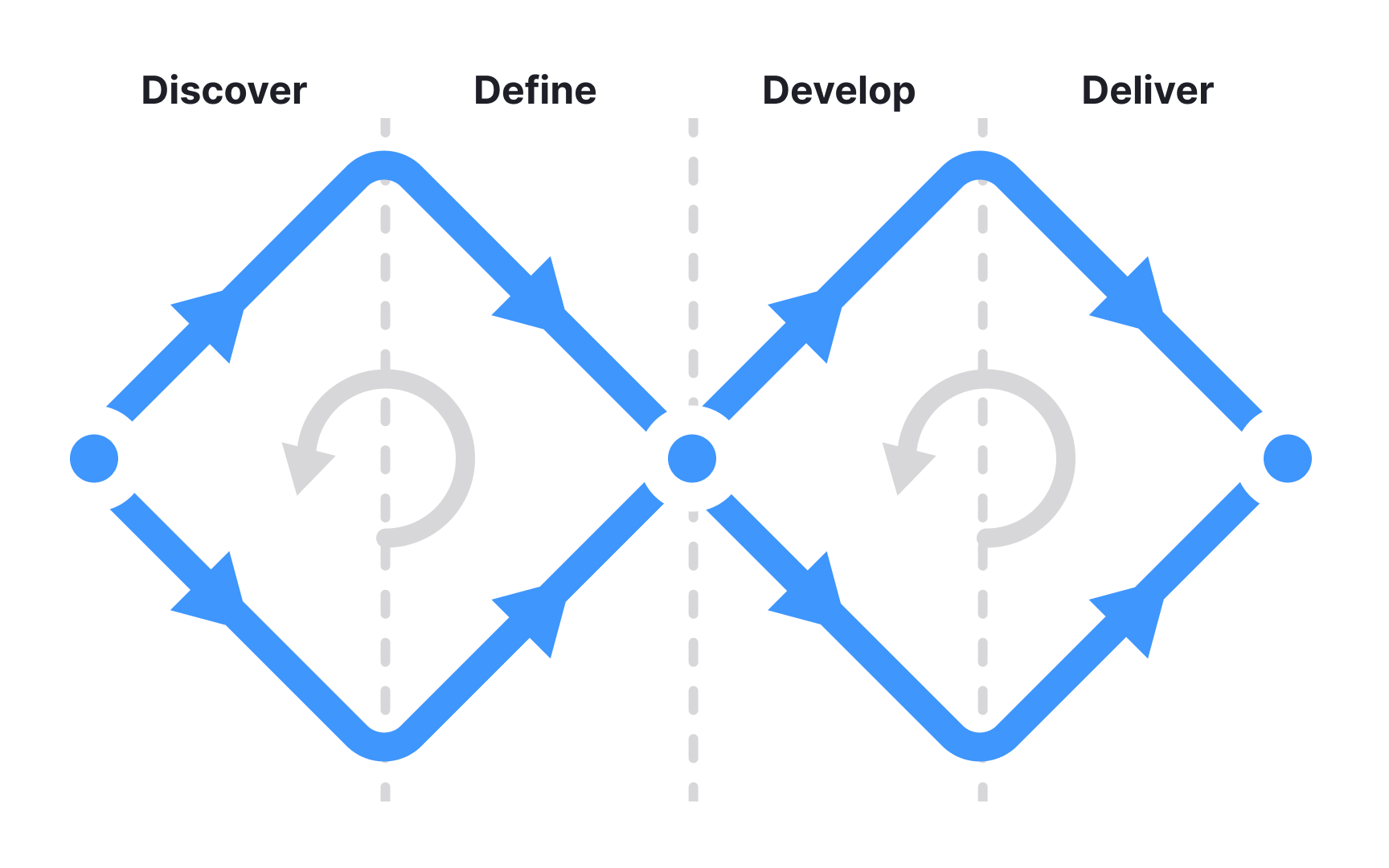
Two rounds of divergence and convergence: first to find the right problem, then to find the right solution. A product designer's accountability runs the full width. From the lesson UX Design Processes & Research Methods.
The right-hand end of the second diamond is where product designers spend more of their time than any other design role. Handoff is not the moment the design leaves the designer; it is the moment the designer starts working with engineers instead of for them. The second figure shows a design handoff, the specifications, measurements, and component references that let a developer build what was designed rather than an approximation of it.

The annotations are the contract between design and engineering; a product designer is judged on the build that comes out of them, not on the mockup that went in.
How to learn the skills of a product designer
Foundations of UX and the design roles
The generalist role is easiest to learn by first seeing the specialties it combines. The What is UX Design? lesson covers the discipline the whole path builds on, and the Common Designer Roles lesson sets the product designer next to the UX, UI, interaction, and visual designers it overlaps with. The UX design and UI design entries cover the two disciplines the role merges.
Visual and interface craft
Screens are still the most visible thing a product designer makes. The Elements of UI Design lesson covers the building blocks of the interface layer, and the Common UI Components Part I lesson begins the catalog of controls every product uses. Fluency in visual design, UI components, and design systems is what lets a designer work fast without reinventing the basics.
Structuring and prototyping the experience
Before the screens come the structure and the flow. The Intro to Wireframing lesson covers low-fidelity thinking and when to stay there, and the Intro to Information Architecture lesson covers organizing content so people can find it. Wireframes, user flows, information architecture, and prototypes are the working artifacts of this stage, and a product designer moves between them daily.
Research and problem framing
Product designers do a large share of their own research. The What is Design Thinking? lesson covers the problem-first approach the role is built on, and the Guide to Developing User Empathy lesson covers observation and interviewing as a designer rather than a specialist. Grounding in design thinking, user research, and usability testing is the difference between designing for a real problem and a plausible one.
Product thinking for designers
This is the layer that separates the title from UX/UI. The What PMs Actually Do lesson covers the product manager's world from the designer's side, and the Thinking in Outcomes, not Features lesson covers connecting design decisions to measurable results. Speaking the language of product management and product discovery is what earns a designer a seat in the decision rather than a brief after it.
Shipping, measuring, and iterating
The role does not end at handoff. The Learning from Your Launches lesson covers reading what happened after release and turning it into the next iteration, and the A/B Testing lesson covers the experiment method product teams use to settle design arguments with data. Knowing where design sits in the product development cycle, how A/B testing works, and how accessibility is verified in a shipped build closes the loop the role is responsible for.
Building a product designer career
Product design is one of the broader design titles and one of the more accessible ones to move into from UX, UI, graphic, or front-end backgrounds. The blog covers each step of the route in depth:
- How to become a product designer: the routes in, the skills to build first, and the tools to learn
- Top product designer skills: what hiring managers actually screen for
- Product designer interview questions: how the role is assessed, from portfolio review to whiteboard challenges
- Product designer salary guide: what the market pays by level and region
For a structured sequence of the courses these lessons come from, from design foundations through research, product thinking, and analytics, the product designer career path covers the whole journey in order.


