


Every product team is eventually asked what its work did for the business, and the answer has to be given in the company's own numbers: revenue, churn, acquisition cost, and the rates between them. That vocabulary has moved out of finance and into product reviews, analytics dashboards, and design critiques, where a feature is argued for by the metric it should move. Design and product decisions get funded in the currency of business metrics, so the people making those decisions need to read the numbers even when they don't own them.
In this glossary topic:
- What are business and growth metrics?
- What are the main families of business and growth metrics?
- How do business metrics map to the AARRR funnel?
- How do the core business metrics relate to each other?
- How do business metrics differ from UX and design metrics?
- What is the difference between leading and lagging business metrics?
- What do business and growth metrics look like in practice?
- What do business and growth metrics mean for designers and product managers?
- FAQ

What are business and growth metrics?
Business and growth metrics are the numbers a company uses to track how it acquires customers, keeps them, and earns from them: revenue and its growth, the cost of winning a customer, the share of customers who leave, and the value a customer returns over time. They describe the health of the business as a whole, which sets them apart from measures of a single interface or team.
Most of them are rates or ratios rather than raw counts: revenue per customer, churn rate, and acquisition cost are relationships between counts, and the relationships are what make one period comparable with another. A business metric is useful in proportion to how directly it connects a product decision to money, which is why the same handful of measures appears in investor updates and product reviews alike. The Terms for Revenue & Business Metrics lesson walks through the core vocabulary one definition at a time.
What are the main families of business and growth metrics?
Acquisition metrics count how people arrive: visitors, sign-ups, and the conversion rate from one to the next, usually split by channel. Customer acquisition cost, or CAC, is the sales and marketing spend of a period divided by the number of new customers won in it. Activation metrics count how many arrivals reach a first moment of value: finishing onboarding, creating a first project, or making a first purchase.
Retention and revenue metrics describe what happens after that. Monthly recurring revenue totals the subscription revenue a company expects every month, and annual recurring revenue is that figure times twelve; churn is the share of customers, or of revenue, lost over a period; lifetime value estimates what an average customer will return before leaving; and gross margin, the share of revenue left after the direct cost of delivery, decides how much of that value is kept.
Referral metrics count customers who bring in others: invitations sent and accepted, referral sign-ups, and Net Promoter Score as a proxy for willingness to recommend. Each family answers a different question about the same customers, and a company that reports only revenue can't tell whether growth comes from new customers or from old ones staying longer.
How do business metrics map to the AARRR funnel?
The AARRR funnel, which Dave McClure proposed in 2007 under the name "startup metrics for pirates", arranges the families as stages: acquisition, activation, retention, referral, and revenue. Each stage has a count of people who reached it, and the ratio between adjacent stages is a conversion rate, so the funnel is a way of reading the whole set of metrics at once rather than a new set of metrics.
The arrangement is diagnostic. When revenue stalls, the funnel shows whether fewer people arrived, fewer of them activated, or more of the activated customers left, and each has a different owner and a different fix. A drop in revenue is a symptom; the stage where the funnel narrowed is the cause, and teams that track only the bottom of the funnel learn about problems last.
How do the core business metrics relate to each other?
The metrics aren't independent, and the relationships are where the insight lives. Monthly recurring revenue grows when new customers are added or existing ones upgrade, and shrinks when customers leave or downgrade, so MRR growth is the net of acquisition, expansion, and churn.
Churn rate, in its simplest form, is the number of customers lost in a period divided by the number at the start of it. A small rate compounds: a customer base losing five percent a month has lost nearly half of itself after a year.
Lifetime value and acquisition cost are a pair. Lifetime value is commonly approximated as the average revenue per customer per period, multiplied by gross margin, divided by the churn rate for the same period, so a product with lower churn has a higher lifetime value without charging more. CAC payback period is the number of months a customer takes to repay the cost of acquiring them: CAC divided by the monthly margin per customer. Growth is only worth funding when a customer's value exceeds what it cost to win them, and both halves of that comparison are themselves products of other metrics.
How do business metrics differ from UX and design metrics?
UX and design metrics measure how well a person can use an interface: task success, time on task, error rate, satisfaction. Business and growth metrics measure what the company got out of it. The two sit at different distances from a design decision. A clearer checkout raises completion rate within days; its effect on revenue arrives later, diluted by pricing, marketing, and seasonality, and shared with every other change shipped that quarter.
That distance is why design work is usually argued for with design metrics and judged, eventually, by business metrics. Neither replaces the other: a design metric that never shows up in a business metric was measuring something the company didn't need, and a business metric with no design metric beneath it can't say which part of the product to change.
The connection runs through the funnel. Activation is the stage design influences most directly, since it's made of onboarding flows and first-use moments; retention comes next, through the usefulness of the core product; acquisition is mostly marketing's, and revenue belongs to pricing. The design metrics worth tracking are the ones one step upstream of a business metric the company already reports, and the Product Metrics & KPIs lesson covers how to choose that pair for a feature.
What is the difference between leading and lagging business metrics?
A lagging metric records an outcome after it has happened: revenue for the quarter, churn for the month, lifetime value for a cohort that has run its course. A leading metric moves earlier and predicts the lagging one: activation rate predicts retention, weekly active use predicts renewal, and qualified trials predict next quarter's new revenue.
A team can only act on a metric it can read in time. By the time annual churn is known, the customers are gone; the leading signals, a drop in logins or in use of a core feature, were visible months earlier. A metric set with no leading indicators can only explain the past, so a workable set pairs each lagging outcome with the earlier behavior that predicts it, and checks that the prediction holds.
What do business and growth metrics look like in practice?
The clearest picture of how the metrics depend on each other is the payback formula. Acquisition cost sits on top. Underneath, monthly revenue per user, ARPU in the diagram, multiplied by gross margin gives the margin a customer returns each month, and the division gives the number of months until that customer has paid for their own acquisition. Every lever a product team has moves one term of that fraction: a cheaper channel lowers the cost on top, a better plan mix or stronger monetization raises revenue per user, and a cheaper way of delivering the service raises the margin.
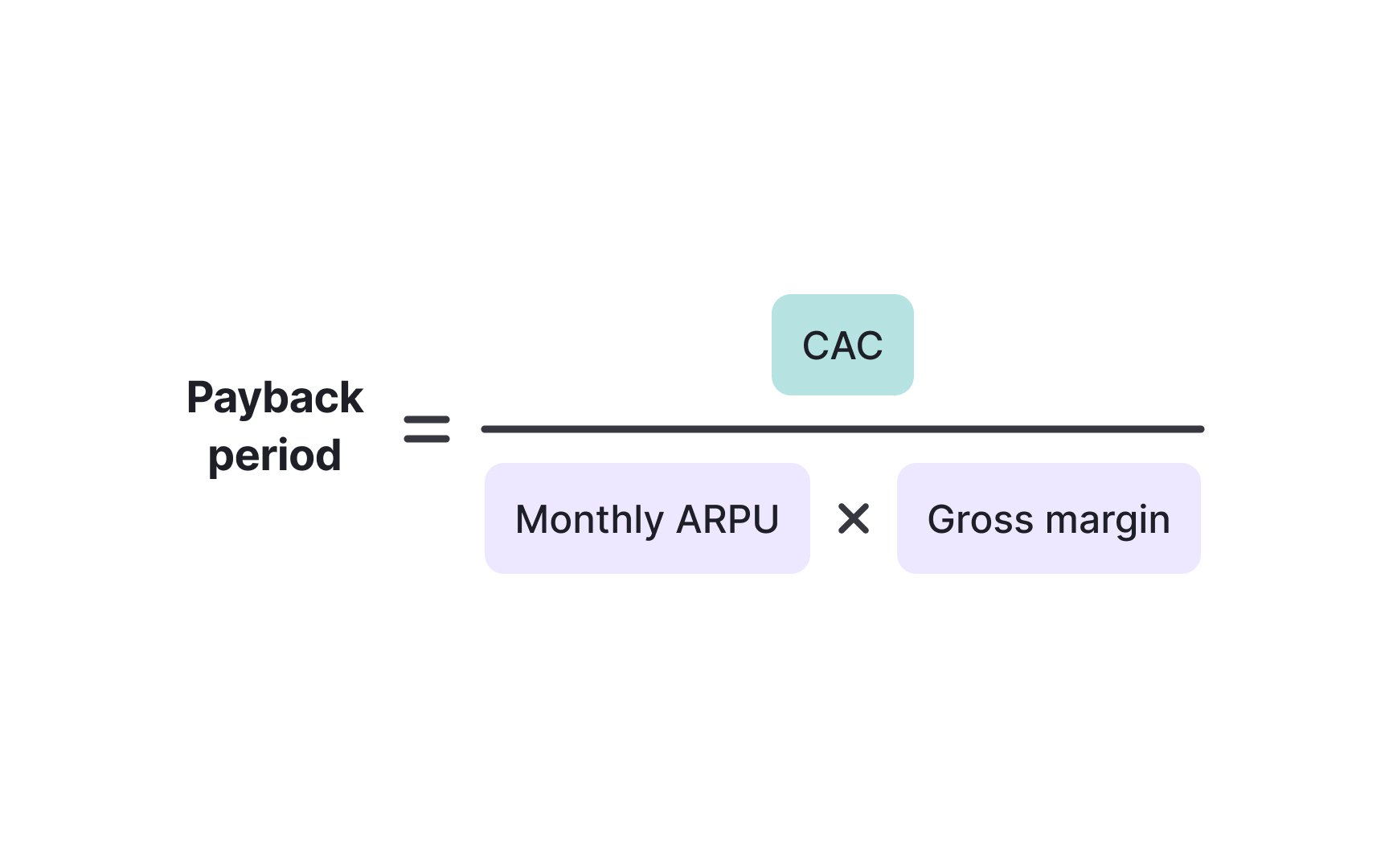
The CAC payback period as a single fraction: the cost of acquiring a customer divided by the margin that customer returns each month. Three figures from different parts of the business, acquisition, revenue, and cost of delivery, combine into one number a team can act on. From the lesson Unit Economics & the CAC-to-LTV Ratio.
What do business and growth metrics mean for designers and product managers?
For a product manager, the metrics are the shared language with finance and leadership, and the job is translation in both directions: turning a revenue goal into the funnel stage and the behavior that would move it, and turning a shipped feature back into a change in a reported number. Picture a roadmap where every item names the metric it's meant to move and the earlier signal that will show whether it's working; the items that can't name either are the ones to question first.
For a designer, the metrics explain which work gets funded. An onboarding redesign is an activation project, a feature for long-standing customers is a retention project, and each is judged against a different number on a different timescale. A designer who can say which business metric a design metric feeds, and roughly when the effect should show, is making an argument the company already knows how to weigh. Business metrics don't measure design quality, but they decide which design problems are worth solving, and a KPI is the handful of these numbers the company has chosen to be judged by.


