


Few metrics travel as far on as little as NPS: one survey question, one subtraction, and a number that boards, investors, and support teams all recognize. That reach is why the score turns up in product reviews and executive dashboards, and why it is so often read for more than it can carry. The score is a thermometer, not a diagnosis, and the design decisions around when, where, and how the question is asked shape the number as much as the product does.
In this glossary topic:

What is Net Promoter Score?
Net Promoter Score (NPS) is a customer loyalty metric derived from a single survey question: "How likely are you to recommend this product or company to a friend or colleague?" Respondents answer on a scale from 0 to 10. Those who answer 9 or 10 are counted as promoters, 7 or 8 as passives, and 0 to 6 as detractors. The score is the percentage of promoters minus the percentage of detractors, which gives a number between -100 and +100.
Fred Reichheld introduced the metric in a 2003 Harvard Business Review article and developed it with Bain & Company and Satmetrix. The pitch was that willingness to recommend predicted a company's growth better than conventional satisfaction scores, because recommending something puts a person's own reputation on the line in a way that being satisfied does not. NPS measures loyalty as a behavior someone claims they would perform, not a feeling they report, and that distinction is what separated it from the satisfaction surveys it replaced in many companies.
How is NPS calculated and collected?
The arithmetic is deliberately simple. If 100 people respond, 50 give a 9 or 10, 30 give a 7 or 8, and 20 give 6 or below, the score is 50 minus 20, or +30. Passives count toward the total but not toward the score, which is why two products with the same share of promoters can have different scores depending on how many unhappy customers each has.
The question is asked in two modes. Relational NPS surveys a customer base on a regular cadence, quarterly or twice a year, and asks about the relationship as a whole; it is the number that gets reported upward. Transactional NPS asks right after a specific interaction, a support ticket, a purchase, an onboarding flow, and reads as a measure of that touchpoint. Mixing the two modes in one trend line produces a number that means nothing, because a score taken after a successful support call and a score taken cold in a quarterly email are not measuring the same thing. Nearly every NPS survey adds a second, open question asking why the person gave that score, and that follow-up carries most of the insight; the Creating Surveys for UX Research lesson covers the wording and ordering traps that apply to it.
How should an NPS score be read?
The number alone is thin. A score of +30 says promoters outnumber detractors by 30 points and nothing about why, so the verbatim answers to the follow-up question are where reading starts. Grouping those comments by theme and by segment, new customers against long-standing ones, free against paid, turns a single figure into a map of what is working and for whom.
Benchmarks vary widely by industry, country, and survey method, so a company's own score over time is a better comparison than a published average, and a change of a few points is often noise rather than signal. Sample size matters: with a few hundred responses the margin of error is wide, and a four-point move may be no move at all. Response bias matters more. The people who answer are more engaged than the people who ignore the email, and people who have just left rarely answer at all. A rising NPS among those who stayed can coexist with rising churn among those who left, which is why the score should be read next to churn and retention, not instead of them.
How does NPS differ from CSAT and CES?
The three are routinely confused because all are short survey scores, but they ask different things. Customer Satisfaction Score (CSAT) asks how satisfied someone was with a specific product, feature, or interaction, usually on a 1 to 5 scale, and reports the share of positive answers. It is a measure of a moment. Customer Effort Score (CES) asks how easy it was to get something done, on the theory that reducing effort predicts loyalty better than delighting people does. It is a measure of friction in a task.
NPS asks about the relationship as a whole and about future behavior, which makes it the slowest to move and the hardest to attribute to any one change. CSAT tells a team whether the last thing it shipped landed; CES tells it whether a task is too hard; NPS tells it whether the sum of all of that has earned loyalty. The Customer Satisfaction Measurement lesson works through the three side by side. Most products that take measurement seriously run some combination, with CSAT or CES at the touchpoint level and NPS across the whole customer experience, so that the fast signal explains the slow one.
What are the criticisms of NPS?
The critique has four strands. The first is compression: an eleven-point scale collapsed into three bands throws away information, so moving every customer from 6 to 7 changes nothing while moving a few from 8 to 9 lifts the score. The second is gaming: because the score is tied to bonuses and board reports, teams learn to survey after the moments that go well, to prompt for a 9 or 10, or to exclude customers who complained.
The third is evidence: the original claim that NPS predicts growth better than other measures was contested in later academic work, which found the link held in some industries and not in others. The fourth is culture: people in some countries rarely give extreme scores on any scale, so the same product can post a markedly lower score in one market than another for reasons that have nothing to do with the product. None of these make the metric useless; they make it a metric that needs context around it, and a team that reports the score without the response rate, the segment breakdown, and the verbatims is reporting a number it cannot defend.
What does NPS look like in practice?
The most recognizable piece of NPS is the prompt itself: one question and a 0 to 10 scale, with the detractor, passive, and promoter bands applied to the answers afterwards. The thresholds are fixed by convention, not by any property of the product, which is why the bands look identical whether the survey is about software, airlines, or a dentist.
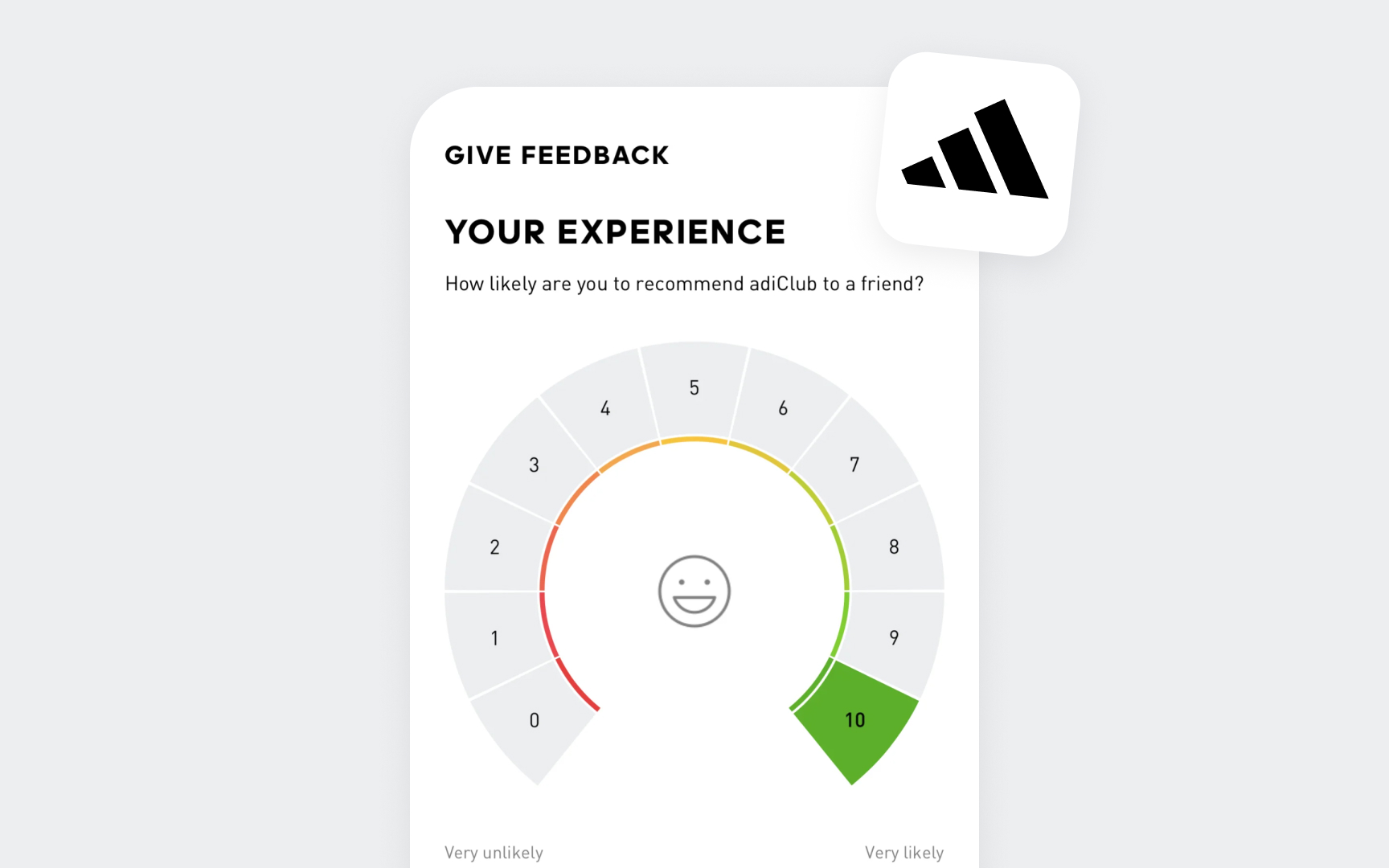
An in-product NPS prompt: the single recommend question sits above a 0 to 10 dial that shades from red to green, and the user has picked 10. The bands are applied afterwards, so what the team learns comes from the follow-up question and the segment breakdown, not from this one number. From the lesson Feedback Loops and Continuous Improvement.
What does NPS mean for designers and product managers?
The survey is a piece of the product, and its placement is a design decision. An in-product NPS prompt that interrupts someone mid-task collects a score about the interruption; one that appears after a completed action, with a visible way to dismiss it, collects a score about the product. Timing matters as much: asking in the first session measures onboarding, asking months later measures the habit. Picture a prompt that fires the moment a free trial expires, and the detractor it creates.
For a product manager, the detractor verbatims are a research backlog waiting to be read. Tagging them by theme, closing the loop with the people who left a comment, and checking whether the theme shows up in customer retention data is what turns the score into decisions. A detractor comment is a usability finding that arrived without a recruiting cost, and the quickest path from it to a fix is to hand it to user research as a prompt for interviews, not to file it as a number. Treated that way, NPS becomes one KPI among several rather than the one that explains everything.


