


Every growth plan rests on one number: what it costs to win a customer. Customer acquisition cost puts that number next to what each customer later pays back, so growth spend can be judged rather than assumed. A product with strong retention can afford a high CAC, and a product that leaks users cannot afford even a low one, which is why the metric belongs in product reviews as much as in finance ones.
In this glossary topic:

What is customer acquisition cost?
Customer acquisition cost is a metric that measures how much money a company spends to bring in one new customer. It is calculated by summing all costs associated with acquisition, typically marketing spend, sales team costs, and related tools and operational expenses, over a specific period, then dividing by the number of new customers acquired during that period.
The formula is: CAC = Total acquisition costs / Number of new customers acquired
For example, if a company spends $100,000 on marketing and sales in a month and acquires 200 new customers, its CAC is $500. That number is only meaningful in context: whether $500 is acceptable depends on how much revenue those customers generate over time.
CAC is one of the most important unit economics metrics in product development and business strategy. It answers a foundational question: does the cost of acquiring customers scale sustainably relative to the value those customers create?
What costs are included in CAC?
The scope of what counts as an acquisition cost significantly affects the resulting number and its usefulness.
A narrow definition includes only direct marketing spend: paid advertising, sponsored content, events, and similar line items. This produces a lower CAC number but understates the true cost of acquisition, since it excludes the people and tools that make those efforts possible.
A broad definition includes all sales and marketing team salaries and benefits, the tools and platforms used by those teams (CRM, marketing automation, analytics), content production costs, any overhead attributable to sales and marketing operations, and the cost of sales processes including demos, trials, and onboarding.
The most meaningful CAC for decision-making is fully loaded: it includes everything that contributes to acquiring customers, not just the most visible line items. A company with a 20-person sales team has significant acquisition cost embedded in those salaries that doesn't appear if CAC is calculated only from ad spend.
When CAC is used to compare channels (which acquisition method is most efficient?), each channel should have its costs attributed specifically: the budget spent on paid search attributed to paid search CAC, the content team's time attributed to content-driven CAC, and so on.
How does CAC relate to customer lifetime value?
CAC in isolation tells a company how much it spends. The strategic question is whether that spending produces customers whose value justifies the cost. This is where customer lifetime value (LTV) enters.
LTV is the total revenue a customer generates over the full period they remain a customer. A customer who pays $50 per month for 24 months before churning has an LTV of $1,200, minus the cost of serving them.
The LTV to CAC ratio is one of the most commonly cited benchmarks in SaaS and subscription businesses. A ratio of 3:1, meaning LTV is three times CAC, is often cited as a healthy baseline. Ratios below 1:1 mean the company is spending more to acquire customers than those customers are worth, which is unsustainable. Ratios significantly above 3:1 may indicate underinvestment in growth.
Payback period, the time it takes to recoup the CAC from a customer's revenue, is a complementary metric. A 12-month payback period means the customer's revenue has covered their acquisition cost after one year. Shorter payback periods reduce the cash flow risk of aggressive growth.
What does CAC look like in practice?
The metric is simplest to read as a single division: everything spent on sales and marketing in a period, over the customers that spending brought in. The denominator is where most calculation errors hide, because a count that includes returning customers, free sign-ups, or customers won by a channel the costs exclude will flatter the number.
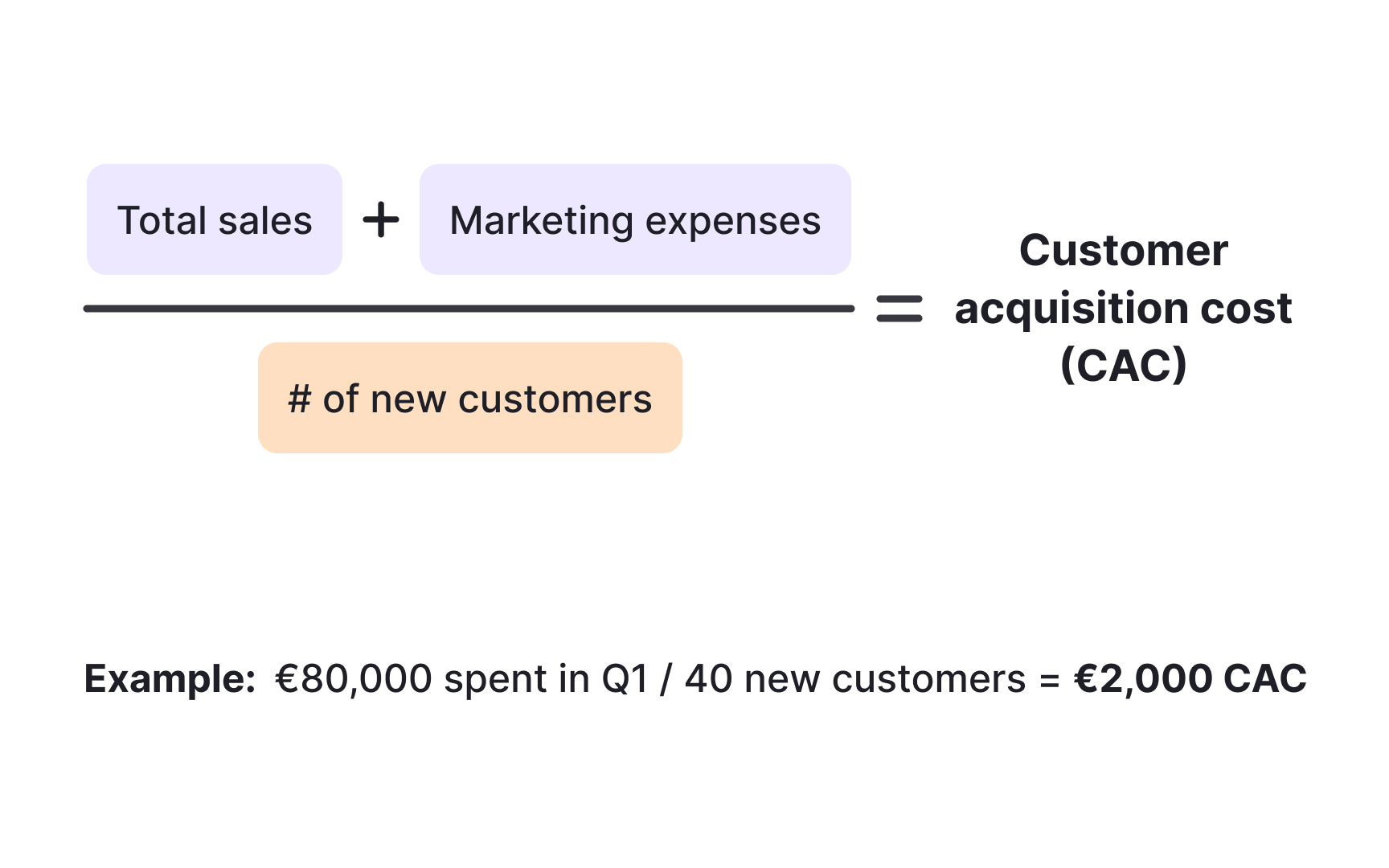
The formula with a worked example: total sales and marketing spend divided by the customers it won, so 80,000 euros spent in a quarter that brought in 40 customers gives a CAC of 2,000 euros. From the lesson The Customer Acquisition Cost (CAC).
What does CAC mean for product and UX decisions?
CAC is not only a finance and marketing metric. It connects to product decisions in several specific ways.
- Activation and onboarding design directly affect whether acquired customers become active users who generate LTV, or whether they churn before generating meaningful revenue. A high CAC combined with low activation rate means the company is spending significantly to acquire customers who never engage with the product. Improving onboarding is a way to improve the return on acquisition investment without reducing acquisition cost.
- Feature design affects retention, which affects LTV, which affects the acceptable CAC ceiling. A product that retains users for 36 months supports higher acquisition spending than one that retains them for 8 months. Product teams that understand LTV can calculate how much improvement in retention translates to how much additional acquisition budget the business can sustain.
- Pricing and tier design affect conversion rates from free to paid tiers in freemium models, which affects how many acquired users become paying customers and thus how CAC is calculated. A freemium product that converts 3% of free users to paid has effectively multiplied the cost of acquiring a paying customer by 33x relative to acquiring the free user.
- Referral features and viral mechanics can reduce effective CAC by creating acquisition loops where existing customers bring in new ones. Products like Dropbox built significant growth on referral mechanics that made their effective paid customer acquisition cost a fraction of pure paid marketing alternatives.


