


Every product decision rests on a belief about the market: that enough people have the problem, that they will pay to solve it, and that the incumbents have left room. Market analysis is how a team checks those beliefs before the roadmap depends on them, and it has become routine in product work rather than a strategy-team specialty. A sizing nobody can defend is worse than no sizing at all, because it carries the authority of a number without the evidence behind one.
In this glossary topic:

What is market analysis?
Market analysis is the systematic study of a market: how large it is, how it divides into segments, who the customers are and what they need, who else serves them, and which trends and rules are changing the picture. Its output is a set of conclusions a team can act on, such as which segment to enter first, how to position against incumbents, and what price the market will bear. The analysis is interpretive by nature. It takes data from many sources and turns it into an argument about where an opportunity exists and how big it is.
The practice comes from strategy and marketing, where it supports decisions about market entry, investment, and expansion. Product teams adopted it because the same questions sit underneath every roadmap: whether enough people have the problem, whether they already pay someone to solve it, and whether a new entrant can win them. A market analysis exists to replace an assumption with an argument, and a good one states its sources and its uncertainty as plainly as its conclusions.
What does a market analysis cover?
Most analyses work through the same five areas, in roughly this order.
Market size is the usual starting point, expressed as three nested figures. The total addressable market (TAM) is the revenue available if every possible customer bought; the serviceable available market (SAM) is the share a product's model, geography, and channels can actually reach; and the serviceable obtainable market (SOM) is the share a team can realistically win in a planning horizon given its competitors and resources. The three numbers are estimates built on stated assumptions, and the assumptions matter more than the decimals.
Segmentation divides the market into groups that buy for different reasons, by industry, company size, use case, or behavior. Customer segmentation is where an analysis gets specific, because a market that looks uniform from a distance usually contains one segment that is underserved and several that are not.
The competitive landscape maps who serves each segment, how they price, where they are strong, and where customers complain about them. Trends and regulation cover what is changing: technology shifts, buying habits, new rules, and the economic conditions that affect budgets. Customer needs tie the other four together by asking what each segment is trying to accomplish and what it would switch for. Any one of the five areas without the others produces a confident answer to the wrong question, which is why they are read as a set.
How does market analysis differ from market research and user research?
The three terms overlap, and teams often use them interchangeably, but each answers a different question. Market research is the broader discipline of gathering data about a market: surveys, industry reports, interviews, sales data, and competitor monitoring. It produces inputs. Market analysis is what happens to those inputs: the synthesis that turns a pile of findings into a sizing, a segmentation, and a recommendation. Research can be commissioned and delivered; analysis has to be argued.
User research is narrower in scope and closer to the product. It studies how specific people behave with a product or a task, through interviews, usability tests, and observation, and it informs design decisions about flows and features. Market analysis studies the population those people belong to and informs decisions about which product to build and for whom. User research explains why a feature fails; market analysis explains why a product does. A team needs both, and confusing them leads to building a usable product for a market that was never large enough to sustain it.
How do product and design teams use market analysis?
Product managers draw on it in four places. Product positioning depends on knowing which competitors the target segment already considers and what they lack, so the analysis sets the terms of the comparison. Roadmap bets depend on opportunity sizing: a feature aimed at a large, underserved segment earns a different priority from one aimed at a segment the market leader already owns. Pricing context comes from the competitive map and from what segments currently pay for substitutes. And a go-to-market strategy borrows the analysis almost wholesale, since the segments, channels, and competitors it names are the ones the strategy has to work through.
Designers meet it earlier than many expect. A segmentation decides whose workflows get researched first, a competitive map decides which conventions a product should match and which it should deliberately break, and an opportunity sizing explains why a redesign for one customer type gets funded while another waits. The analysis sets the frame that every later design decision is made inside, and a designer who has read it can argue for scope with the same evidence the roadmap used.
What does market analysis look like in practice?
Picture a team sizing the market for a scheduling tool aimed at independent clinics. The total addressable market counts every clinic that books appointments; the serviceable market narrows to the countries and practice sizes the product can support; the obtainable market narrows again to the share a new entrant can win from the incumbents over the planning horizon. The diagram is simple and the arguments inside it are not, because each ring depends on an assumption that has to be written down and defended. Pressure-testing those assumptions before the numbers harden is the subject of the Discovery and Competitive Mapping lesson.
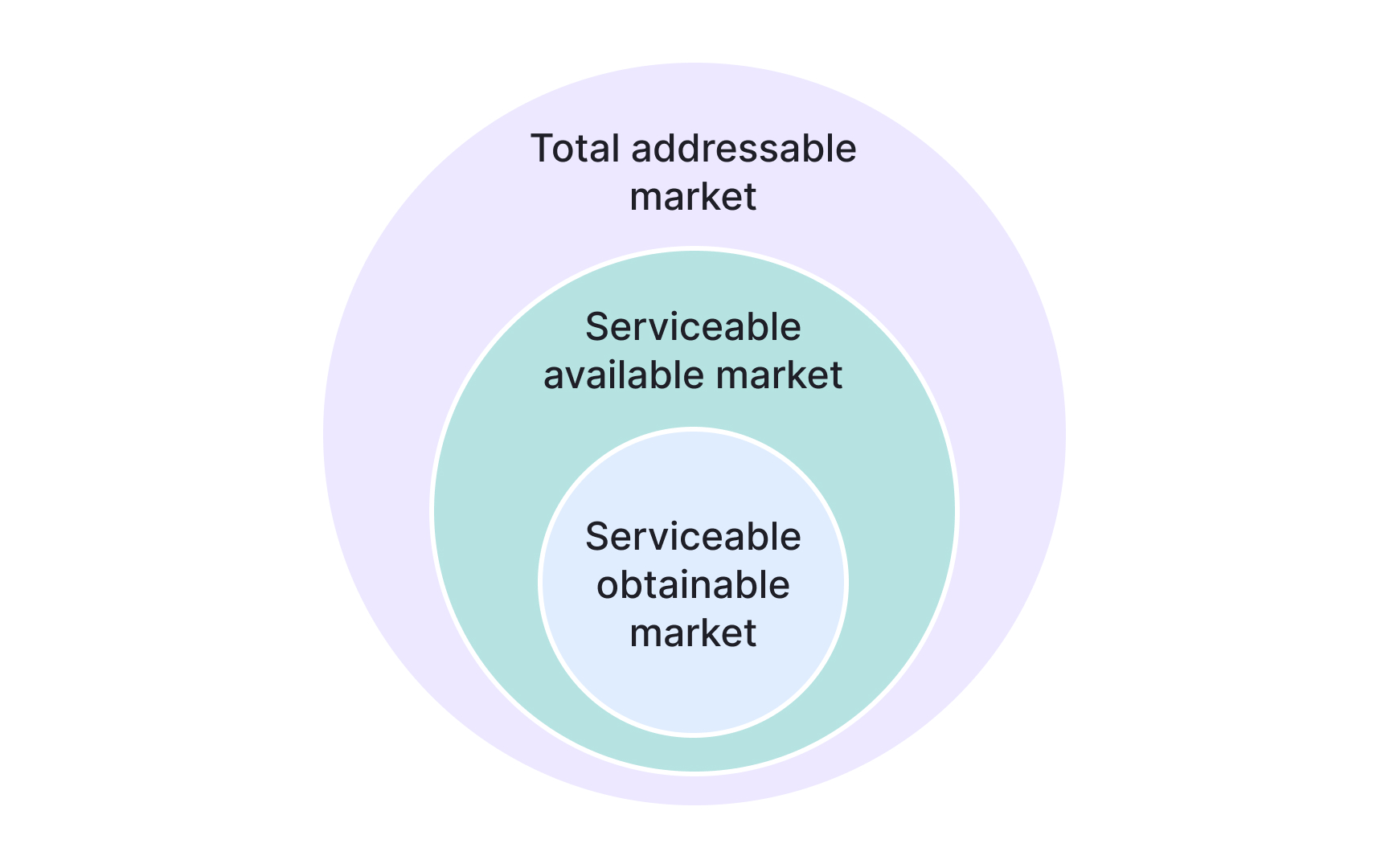
Market sizing as three nested circles: the total addressable market on the outside, the serviceable available market the product could actually reach inside it, and the serviceable obtainable market it can realistically win at the center. Each inner figure inherits the assumptions of the one outside it, so the method behind each ring matters more than the number on it. From the lesson Market Analysis & Competition.
What are the common weaknesses of a market analysis?
Three failures recur. The first is top-down sizing without validation: multiplying a population by an assumed price produces a large number that nobody has checked against a single real customer. A bottom-up estimate, built from the customers a team can name and the channels it can reach, is smaller and far more believable, and the gap between the two is itself a finding. Profiling competitors and building an industry overview from evidence rather than impression is the work the Market Research and Competitive Analysis lesson practices.
The second is treating the competitors as the market. A landscape full of similar products shows where demand has already been served; it does not show the people solving the problem with spreadsheets, manual work, or nothing at all, and those non-consumers are often the larger opportunity. Whether a specific product satisfies a specific segment is the question of product-market fit, and it cannot be read off a competitor list.
The third is treating the analysis as finished. Markets move with technology, regulation, and competitor pricing, and an analysis written for a funding round or an annual plan decays quietly while the roadmap keeps citing it. A market analysis is a dated document, and the date is part of the finding. Teams that revisit the sizing and the competitive map when a major assumption changes keep the analysis useful, and the moment product-market fit is confirmed or denied is usually the moment the sizing most needs a second look.


