


Most prioritization debates die in scoring spreadsheets nobody trusts. The 2x2 matrix survives because it asks only two questions and answers them in one picture. Its power is not precision; it is that everyone in the room can see why something lost.
In this glossary topic:

What is a 2x2 prioritization matrix?
A 2x2 prioritization matrix is a decision tool that compares options on two dimensions at once, one per axis, producing four quadrants that each imply an action. The classic pairing is value against effort, but the axes flex to whatever trade-off the decision hinges on: urgency and importance, risk and reward, reach and confidence.
How does a 2x2 matrix work?
Each option gets placed relative to the others, not scored absolutely, which is what keeps the exercise fast. With value and effort as the axes, the quadrants name themselves: quick wins (high value, low effort) get done first, big projects (high value, high effort) get planned properly, fill-ins get slotted into spare capacity, and time sinks get declined out loud.
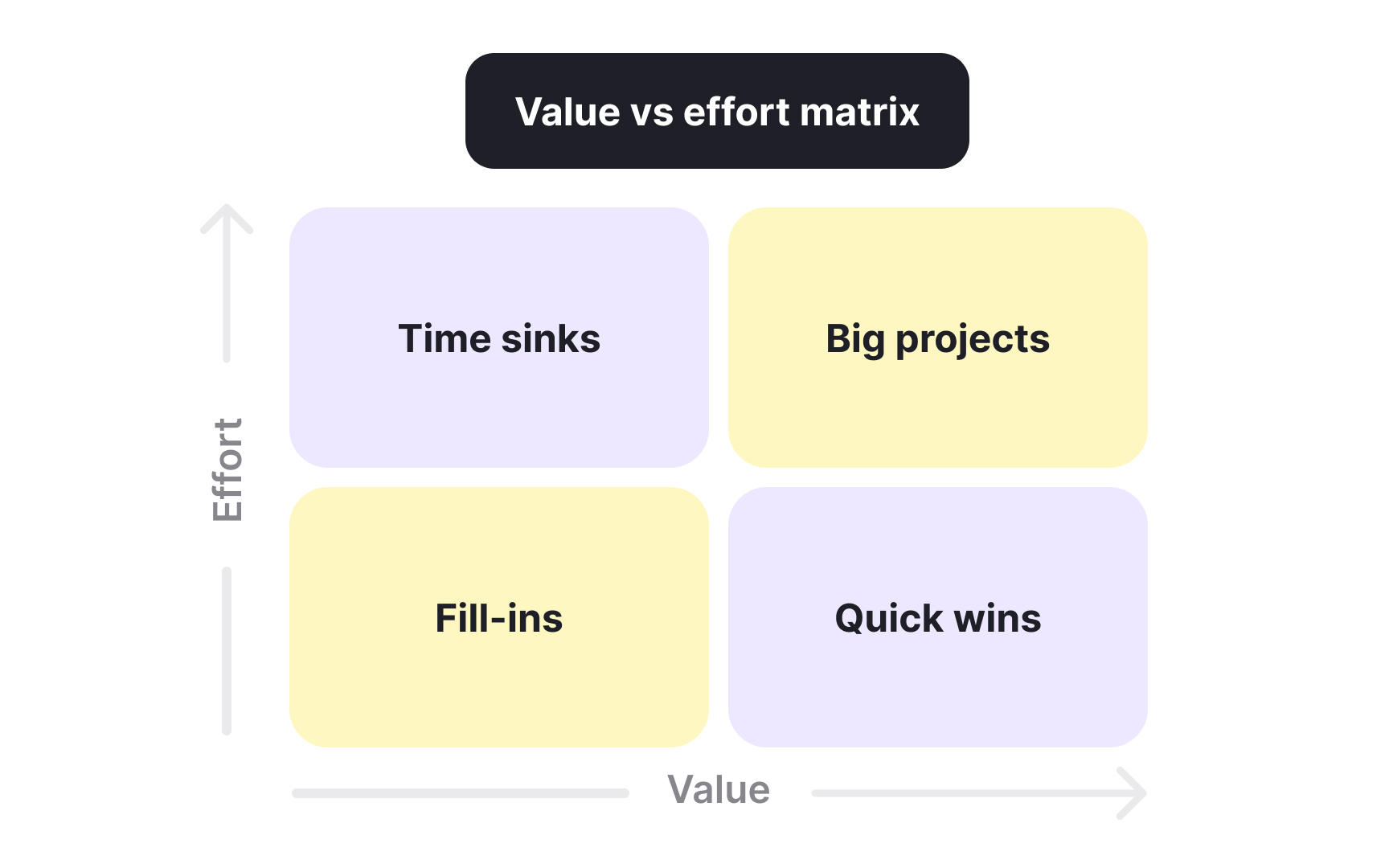
The value-effort version of the 2x2: four quadrants, four default actions. The placement debate is the actual prioritization work, and the diagram is its record. From the lesson Prioritization Terms in Product Management.
When should teams use a 2x2 matrix?
The 2x2 fits early-stage triage: a backlog of mixed ideas, a workshop that needs shared judgment fast, or any decision where two factors genuinely dominate. It fits less well when options are close together or the stakes justify more rigor, which is where scoring models like RICE and satisfaction-based frameworks like the Kano model take over. A 2x2 sorts the obvious; the frameworks with math exist for the non-obvious.


