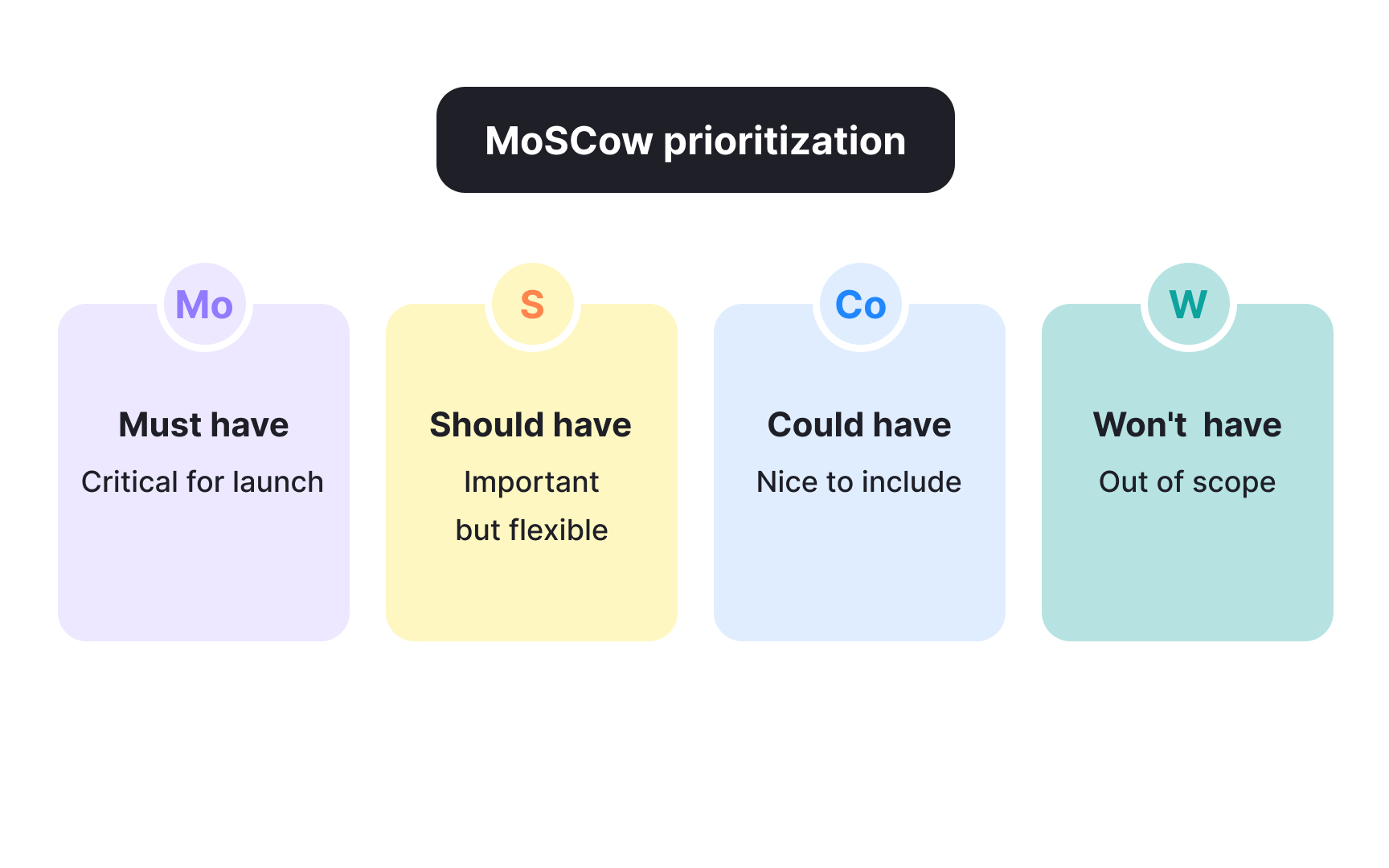


What is MoSCoW Prioritization?
Your product backlog feels overwhelming because every feature seems important and stakeholders can't agree on what to build first, leading to analysis paralysis and poor resource allocation that prevents focused development on high-impact capabilities.
Most teams struggle with feature prioritization because they lack systematic frameworks for evaluating relative importance, missing opportunities to focus development effort on features that create the most user value and business impact.
MoSCoW prioritization is a structured decision-making framework that categorizes features and requirements into Must have, Should have, Could have, and Won't have (this time) to create clear development priorities based on business impact and resource constraints.
Teams using MoSCoW prioritization achieve 60% better resource allocation, 45% faster development decision-making, and significantly improved stakeholder alignment because priority discussions become systematic rather than based on personal preferences and political influence.
Think about how successful product companies use structured prioritization to focus development on features that actually drive user adoption and business growth, or how startups use prioritization frameworks to maximize impact with limited development resources.
Why MoSCoW Prioritization Matters
Your development resources get scattered across too many competing priorities because stakeholders can't agree on what's truly essential, leading to partially completed features and missed opportunities to excel in core capabilities that matter most.
The cost of poor prioritization compounds through every development cycle where resources are allocated inefficiently. You get feature bloat, delayed time-to-market, stakeholder conflicts, and products that do many things adequately rather than excelling at what users actually need most.
What effective MoSCoW prioritization delivers:
Clearer stakeholder agreement on development priorities because systematic categorization forces explicit discussions about relative importance rather than hoping consensus emerges from informal conversations and assumptions.
When prioritization is structured, stakeholder disagreements become productive discussions about trade-offs rather than endless debates about competing preferences without resolution criteria.
Better resource allocation and development focus through clear distinction between essential features and nice-to-have capabilities that enable concentrated effort on high-impact development rather than spreading resources too thin.
Faster development decision-making because MoSCoW categories provide clear framework for evaluating new features and scope changes without starting prioritization discussions from scratch for every decision.
Enhanced scope management and timeline predictability as Must-have features define minimum viable scope while Should-have and Could-have categories provide flexibility for scope adjustment based on development progress and constraints.
Improved stakeholder communication and expectation management through shared understanding of priority levels that prevent misaligned expectations about what will be delivered in specific timeframes and development cycles.
Advanced MoSCoW Prioritization Strategies
Once you've established basic MoSCoW capabilities, implement sophisticated prioritization and decision-making approaches.
Dynamic Prioritization and Regular Re-evaluation: Create processes for updating MoSCoW categories based on changing market conditions, user feedback, and business priorities rather than treating prioritization as static decision-making.
Stakeholder-Weighted Prioritization: Adapt MoSCoW approaches to account for different stakeholder importance and expertise rather than treating all stakeholder input equally without consideration of decision-making authority and domain knowledge.
Resource-Constrained Prioritization: Use MoSCoW categories to optimize development planning based on actual team capacity and timeline constraints rather than ideal prioritization without implementation feasibility consideration.
Cross-Product Prioritization: Apply MoSCoW frameworks across multiple products or features to optimize portfolio-level resource allocation rather than just individual product prioritization without strategic coordination.