


Someone on every product team has to decide what the team will not build, and live with the consequences. That person is the product manager, a role that has spread from software into banks, hospitals, and governments as more of what those organizations offer became a product. The title is applied loosely, which is why so many searches for it are really asking what the job is. A product manager is judged not on how much the team shipped but on whether shipping it changed anything the business or its users can measure.
In this glossary topic:
- What is a product manager?
- What does a product manager do day to day?
- How does a product manager differ from a product owner or a project manager?
- What skills does a product manager need?
- How has the product manager role changed with AI?
- What does a product manager's work look like in practice?
- How to learn the skills of a product manager
- Building a product manager career
- FAQ

What is a product manager?
A product manager is the person on a product team accountable for what gets built, for whom, and why. The role sits where user needs, business goals, and technical possibility meet, and its job is to keep the three in balance: deciding which problems are worth solving, in what order, and what success will mean once the work ships. The output is not code or design but decisions, along with the roadmaps, specifications, and conversations that carry them to the people who build.
The shape of the role varies with the company. In a startup the product manager may be a founder holding the whole product in their head. In a large company one product manager owns a slice of a larger product, reports into a product leadership chain, and works with a dedicated designer and engineering team. Product management as a discipline describes the practice; the product manager is the person accountable for it on a given product.
What does a product manager do day to day?
A product manager's calendar is mostly conversations, and the conversations follow a cycle. Upstream, the work is discovery: talking to customers, reading support tickets and usage data, studying competitors, and turning what comes back into a view of which problems matter most. Midstream, it is definition: writing the problem down as a specification or a set of user stories, working with the designer on the solution and with the engineering lead on what is feasible and how long it will take, and deciding what gets cut when the estimate comes back too high. Downstream, it is delivery and learning: shipping, measuring against the metric named at the start, and feeding what was learned into the next round.
Around that cycle sit the standing duties: stakeholder updates, roadmap reviews, prioritization sessions, sprint rituals, and a steady stream of requests from sales, support, and leadership that each need a considered no. The job is less about having ideas than about deciding which ideas the team will not pursue, and explaining that decision to the people whose ideas they were.
How does a product manager differ from a product owner or a project manager?
A product owner is a role defined by the Scrum framework: the person who owns and orders the product backlog, writes and accepts user stories, and stays available to the development team from sprint to sprint. In many companies the product manager is the product owner. In others, especially larger ones running scaled agile frameworks, the two are split, with the product manager facing outward toward the market, customers, and strategy and the product owner facing inward toward the backlog and the team. Either way, the product owner's duties are a subset of the product manager's, scoped to delivery.
A project manager owns the how and when of a defined piece of work: schedule, budget, dependencies, risk, and delivery to plan. The product manager owns the what and why. A project can be delivered on time and on budget and the product still fail, because the wrong thing was built, and that failure lands on the product manager. On small teams the product manager does the project management too, but the accountability is different. A project manager is judged on delivering the plan; a product manager is judged on whether the plan was the right one.
What skills does a product manager need?
The skills fall into three clusters. The first is understanding customers and markets: interviewing users, reading analytics without being fooled by them, framing problems precisely, and sizing opportunities against competitors. The second is strategy and decision-making: holding a vision, positioning the product, using prioritization frameworks honestly, weighing trade-offs, and knowing enough about business models, pricing, and unit economics to see which decisions the business will care about. The third is execution and influence: writing clear specifications, running the delivery cadence with engineering, managing stakeholders, and persuading people who do not report to the product manager.
Technical literacy runs through all three. A product manager does not need to code, but does need to have an honest conversation about feasibility, understand what is cheap and what is expensive to build, and read a system diagram. The rarest skill in the set is writing: a clear one-page problem statement saves more engineering time than any framework.
How has the product manager role changed with AI?
Two shifts are visible. The first is in the tools. Writing assistants draft specifications and release notes, feedback tools summarize hundreds of support tickets into themes, analytics products answer questions asked in plain language, and prompt-to-app tools such as v0, Lovable, and Bolt turn a written idea into a working front end without an engineer. A product manager can now put a clickable concept in front of users before asking for a sprint, which moves validation earlier and makes the specification more evidence-based when it is finally written.
The second shift is in what is being built. Many products now contain AI features, and a product manager shipping one has to understand model capabilities and limits, how to evaluate output quality, and the fact that the same feature behaves differently for different users. Requirements, quality bars, and success metrics all have to be written differently for probabilistic features, and "AI product manager" has become a distinct job title with that expertise as its core. What has not changed is the judgment about which problem is worth solving. AI lowers the cost of building the wrong thing, which makes the decision about what to build more consequential, not less.
What does a product manager's work look like in practice?
The classic picture of the role is a triangle. Business viability, user experience, and technology each pull in their own direction, and the product manager stands in the middle making sure no single pull wins by default. The figure below is that triangle as the Introduction to Product Management course draws it, with the three concerns a product manager has to hold at once.
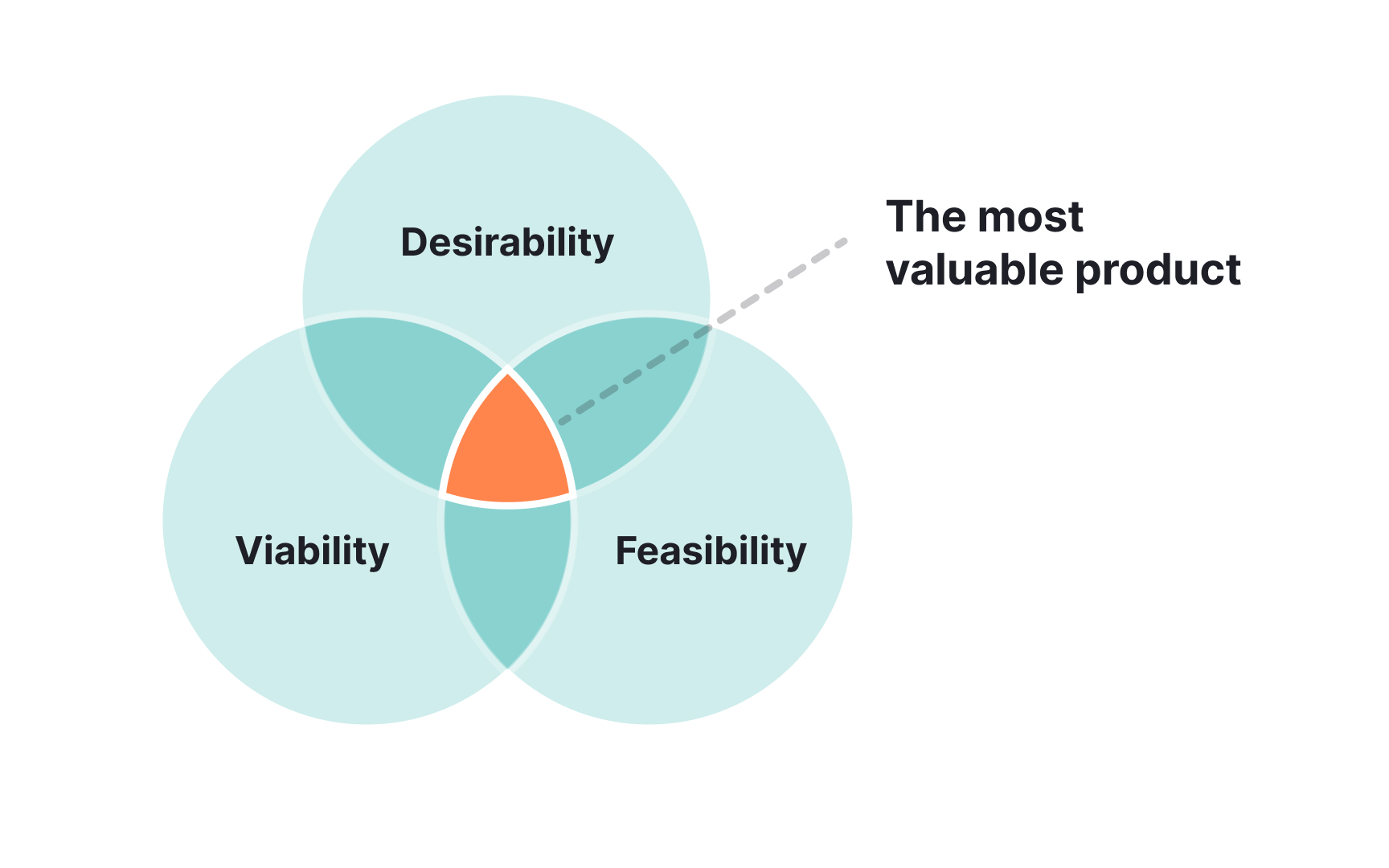
Every product decision trades one circle against the other two; the product manager's job is to make the trade deliberately and keep the work inside the overlap. From the lesson What is Product Management?.
In practice the triangle is staffed by people. Modern product teams organize around a trio, a product manager, a designer, and an engineering lead who own discovery and delivery together, rather than around a product manager who hands requirements down. The second figure shows that trio and how the three roles share decisions.
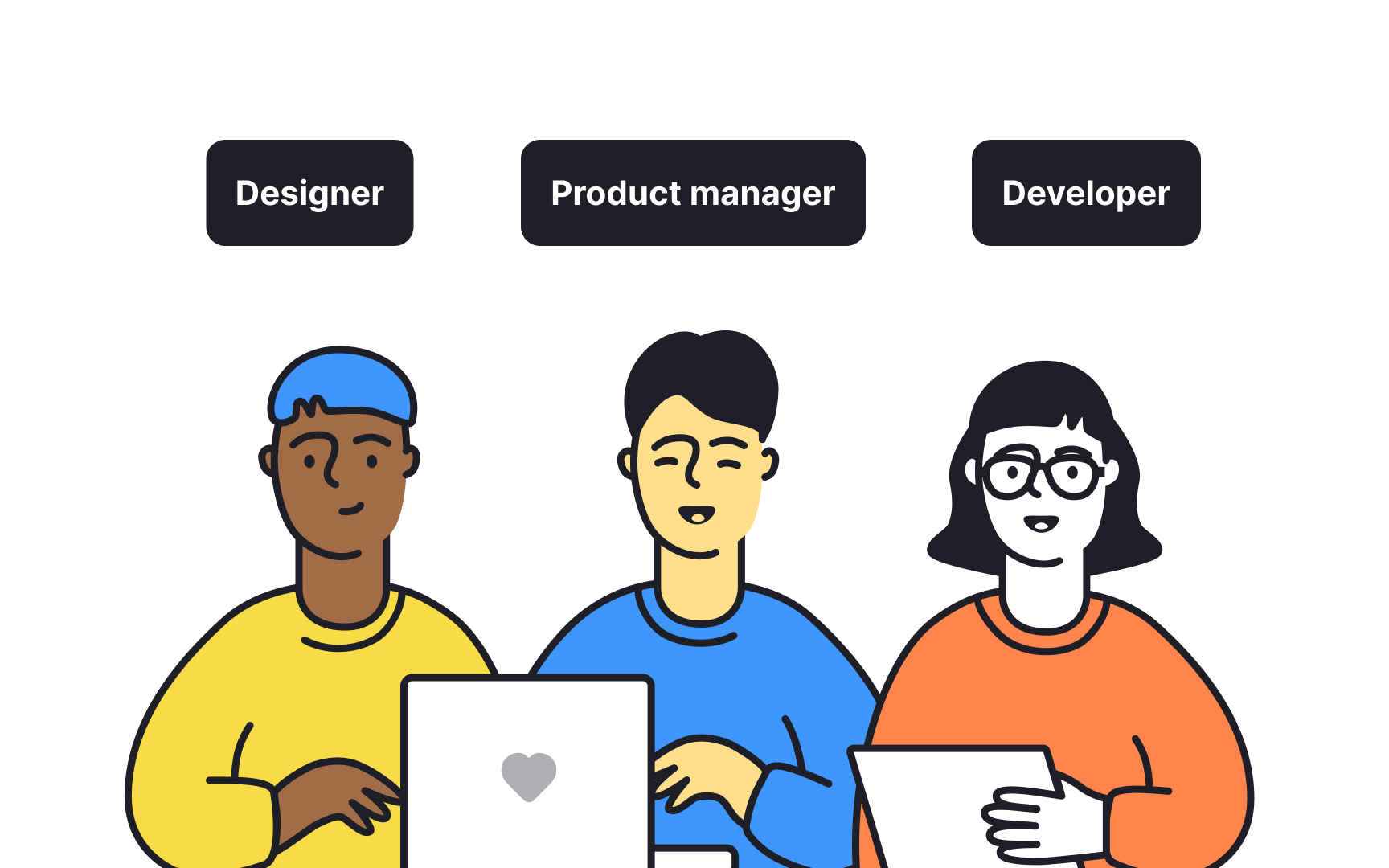
The trio model makes the product manager one voice among three in discovery, which is why influence matters more than authority in the role.
How to learn the skills of a product manager
Understanding the role
The first step is separating the job from the folklore about it. The Core Responsibilities of a Product Manager lesson walks through the duties from strategy to measurement, and the What PMs Actually Do lesson, written for the designers who work alongside product managers, shows the role from the outside. The product management entry covers the discipline the role practices.
Setting vision and strategy
Everything downstream depends on a clear answer to where the product is going and why. The Defining the Product Vision lesson covers crafting a vision teams can rally around, and the What Is Product Strategy? lesson covers turning that vision into the set of choices that decide what the team will and will not do. The product vision and product strategy entries define the two artifacts.
Discovering what to build
Good product managers spend more time on the problem than on the solution. The Intro to Product Discovery lesson covers the practice of testing whether an idea is worth building before building it, and the Market and Competitor Research lesson covers the outward-facing half of that work. Together with user interviews and market analysis, this is how product discovery replaces guessing.
Prioritizing and building roadmaps
The visible output of a product manager is a ranked list and the story behind it. The Roadmaps and Prioritization lesson covers the main frameworks and the roadmap formats teams use, and The Art of Prioritization lesson goes deeper into the judgment calls the frameworks cannot make. The product roadmap and prioritization entries are the reference companions.
Writing specifications and delivering with the team
A decision only counts once engineers can build from it. The Understanding Product Specifications lesson covers what a spec has to contain to be a shared blueprint, the Cross-Functional Collaboration lesson covers the working relationship with design and engineering, and the Stakeholder Management lesson covers everyone outside the team who has a claim on the roadmap. The product requirements document, user stories, and stakeholder management entries define the working vocabulary.
Measuring outcomes
The cycle closes when the product manager can say whether the work did what it was meant to. The Measuring Success lesson covers choosing metrics that reflect the goal rather than the activity, and the OKRs, KPIs, and North Star Metrics lesson covers the three layers most companies use to connect team work to company goals. A working knowledge of KPIs and A/B testing is what lets a product manager argue from results instead of opinions.
Building a product manager career
Product management has no single entry route, which is why the career questions around it are so common. The blog covers each of them in depth:
- How to become a product manager: the routes in, from engineering, design, business, and adjacent roles
- Top product manager skills: what hiring managers actually screen for
- Product manager interview questions: how the role is assessed
- Product manager salary guide: what the market pays by level and region
For a structured sequence of the courses these lessons come from, from the introduction through discovery, specifications, roadmapping, and metrics, the product manager career path covers the whole journey in order.


