


A product rarely dies because the team built it badly. It dies because the head of sales promised a customer something else, legal saw the flow 2 days before launch, or the executive who sponsored it stopped showing up to reviews. Stakeholder management is the work of making sure the people with power over a product, and the people it will land on, are known, heard, and aligned before those moments arrive. Most "communication problems" on a product team are stakeholder problems that nobody mapped early enough, and mapping them is a learnable practice rather than a personality trait.
In this glossary topic:
- What is stakeholder management?
- Who counts as a stakeholder on a product team?
- How does stakeholder management work?
- How does stakeholder management differ from stakeholder analysis and stakeholder engagement?
- Why does stakeholder management matter for designers and product managers?
- What does stakeholder management look like in practice?
- How to learn stakeholder management
- FAQ

What is stakeholder management?
Stakeholder management is the practice of identifying everyone who can affect a product or will be affected by it, understanding what each of them needs and fears, and keeping them informed, consulted, and aligned as the work moves from idea to release. It covers the executive who funds the work, the engineering lead who has to build it, the support team who will answer for it, and the customer who has to live with it.
The practice exists because product decisions are never made by one person. A designer can produce the right solution and still watch it stall, because a director never agreed to the problem, or a compliance team was consulted last. Stakeholder management is the difference between a good decision and a decision that survives contact with the organization. It borrows its vocabulary from project management, where the stakeholder register and the power-interest grid were formalized, but on a product team it is a continuous relationship discipline rather than a planning document.
Who counts as a stakeholder on a product team?
Anyone with a stake, which is broader than anyone with a title. Stakeholders sort into a few useful groups.
- Decision makers hold formal authority over scope, budget, or launch: a sponsoring executive, a product director, a client.
- Contributors do the work or supply what it needs: engineering, design, research, data, and content teams, plus vendors and partners.
- Gatekeepers can stop or delay the work without owning it: legal, security, compliance, brand, accessibility, and procurement.
- Affected parties feel the result without shaping it: customer support, sales, operations, and the end users themselves.
Two groups are routinely missed. Hidden stakeholders sit outside the org chart's obvious lines, such as the finance analyst whose forecast depends on a pricing change, and emerging stakeholders acquire a stake partway through, such as a regional team once the product localizes. The stakeholder a team fails to identify is the one who shows up in the last review with a veto.
How does stakeholder management work?
The practice runs as a loop rather than a checklist. It starts with identification: listing every person and group with a stake, then recording them in a stakeholder register with their role, interest, influence, expectations, and preferred way of being kept informed.
Mapping comes next. Plotting stakeholders by power and interest, or by influence and impact, sorts them into engagement levels: those to manage closely, those to keep satisfied, those to keep informed, and those to monitor. Role-clarity tools such as a RACI chart settle who is responsible, accountable, consulted, and informed for each decision, so approvals stop drifting between people who all assumed someone else owned them.
The third movement is understanding motivation. Models such as David Rock's SCARF frame stakeholder behavior in terms of status, certainty, autonomy, relatedness, and fairness, and explain why a reasonable proposal can trigger resistance when it threatens one of them. The loop closes with communication and conflict work: regular updates at the cadence each group needs, active listening when concerns surface, early detection of the signals that a conflict is forming, and structured routes to buy-in and sign-off. Every stage feeds the register, and a register nobody updates is the first sign the practice has lapsed.
How does stakeholder management differ from stakeholder analysis and stakeholder engagement?
The three terms nest. Stakeholder analysis is the diagnostic step: identifying who the stakeholders are and assessing their influence, interest, and expectations, usually producing a map or register. It is an input, and it is finished when the map is drawn.
Stakeholder engagement is the ongoing relationship work that follows: involving people, listening, negotiating, and building trust. The Project Management Institute has moved toward this word in its more recent guidance, partly because "managing" people who outrank the project lead reads as presumptuous and partly because the goal is partnership rather than control. Stakeholder management is the umbrella that holds both, from the first list of names to the final sign-off. In practice the word matters less than the sequence: analyze first, engage continuously, and never mistake the map for the relationship.
Why does stakeholder management matter for designers and product managers?
Design and product work is judgment work, and judgment needs sponsorship. A research finding, a redesign, or a roadmap cut is only as good as the organization's willingness to act on it, and that willingness is built in the weeks before the decision, not in the meeting where it is made. Teams that manage stakeholders well get their decisions approved faster because fewer people are surprised by them.
It also protects scope. Late-arriving requirements, reversed approvals, and shifting priorities are almost always the trace of a stakeholder who was consulted late or not at all. A product team's velocity is capped by the slowest stakeholder it forgot to include, and stakeholder management is how the team removes that cap without adding meetings. For designers specifically, it is the skill that turns a strong portfolio of concepts into a record of shipped work.
What does stakeholder management look like in practice?
The two artifacts below carry most of the practice's day-to-day weight. The first sorts people into how much attention they need; the second sorts decisions into who owns them.
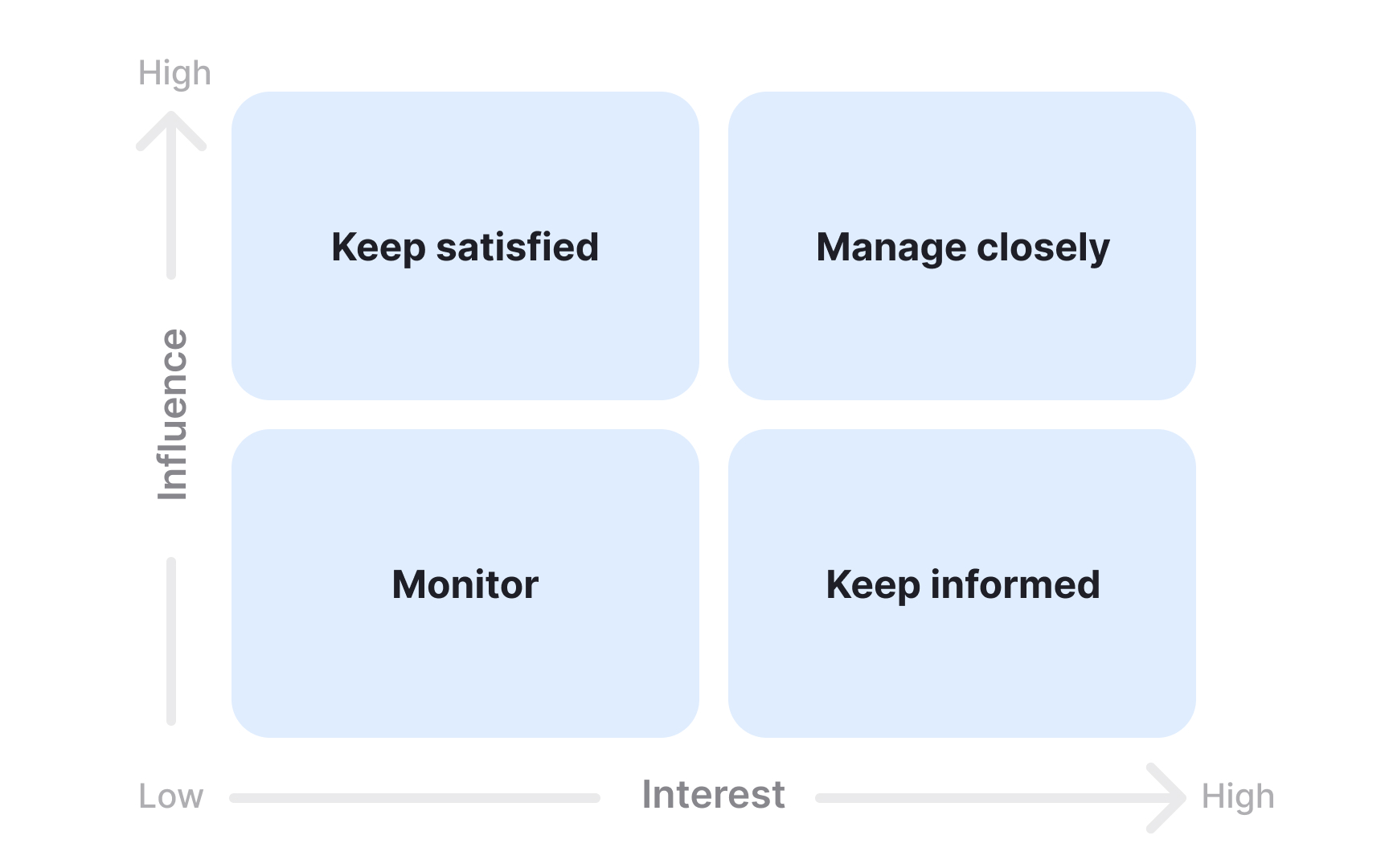
The grid turns a list of names into an engagement plan. The high-influence, high-interest quadrant gets weekly conversations; low influence and low interest gets a newsletter. From the lesson Mapping Influence, Impact, and Interest.
A power-interest grid answers who to talk to; a RACI chart answers who decides. Without the second, a well-mapped stakeholder group can still stall a launch because 3 people each believed another one held the approval.
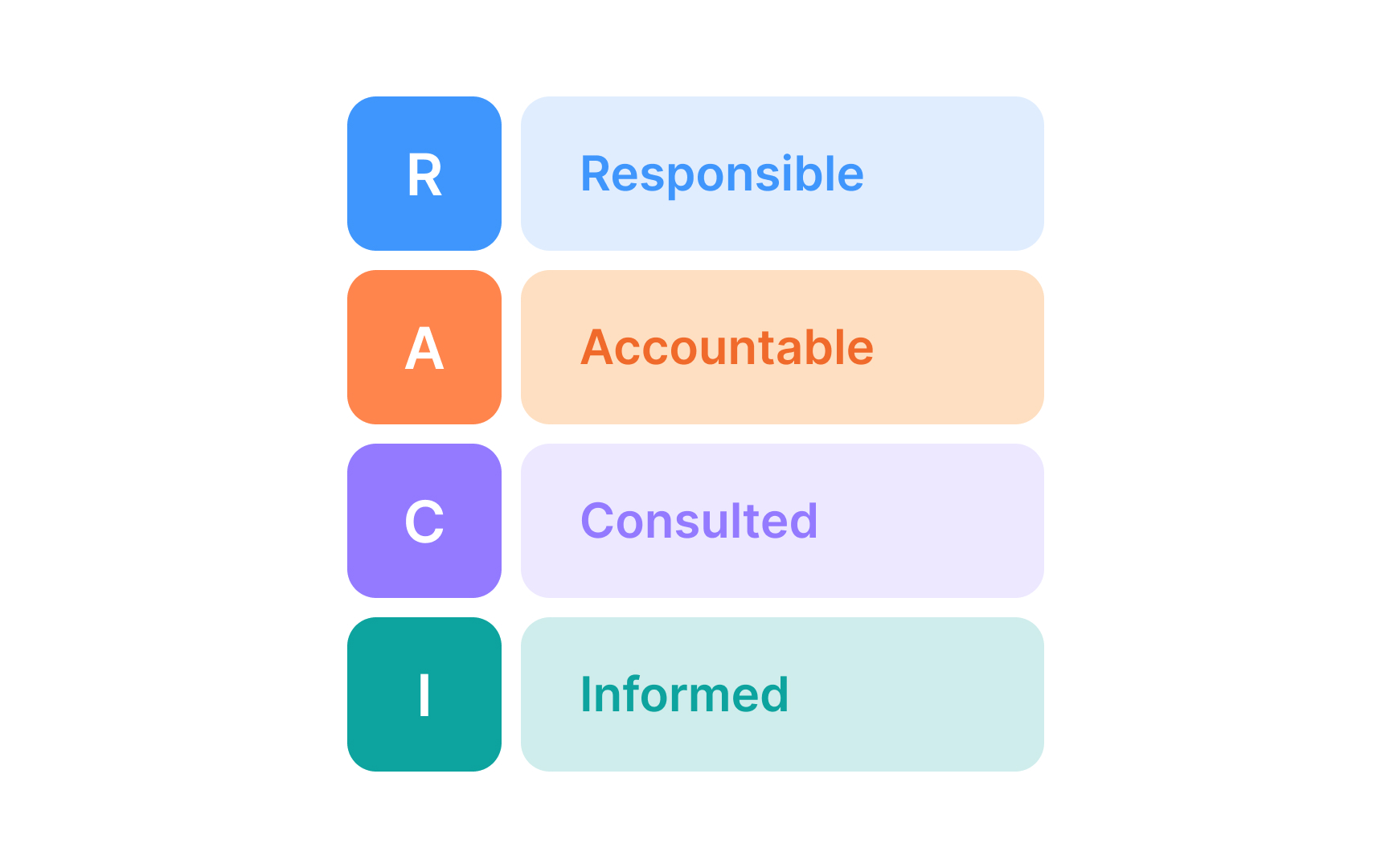
Four roles, and one rule that makes the model work: exactly one accountable name per task. Two is a negotiation waiting to happen, none is a launch with no owner.
How to learn stakeholder management
Foundations: identifying who has a stake
The practice begins with a list, and most lists are too short. The Defining Stakeholder Roles and Influence lesson covers recognizing who holds influence and how roles shape outcomes, and the Building Accurate Stakeholder Lists lesson covers the techniques for finding everyone rather than everyone obvious. This is the ground that stakeholder analysis stands on, and the part of the practice that project management formalized first.
Mapping influence and building the register
Names become a plan once they are placed. The grids themselves are the subject of the Mapping Influence, Impact, and Interest lesson shown above; the Creating the Stakeholder Register lesson covers turning the map into a living document with expectations and communication preferences per person, and the Identifying Hidden and Emerging Stakeholders lesson covers the people the first pass always misses.
Clarifying roles and decisions
Ambiguity about who decides is the most common source of late reversals. The Applying the RACI Model for Role Clarity lesson covers building the matrix, keeping it current, and the alternatives such as DACI for decision-heavy teams. A clear chart is also what lets a product requirements document name its approvers instead of "leadership."
Understanding what motivates people
Resistance is information. The Understanding motivations through the SCARF model lesson covers reading a stakeholder's reaction as a threat or reward response to status, certainty, autonomy, relatedness, or fairness, and adjusting how a proposal is framed; the Behavioral Analysis Using DISC Profiles lesson covers adapting communication style to how different people prefer to receive information. Both are structured forms of the empathy designers already practice with users, pointed at colleagues.
Communicating and resolving conflict
Conflict arrives with warning signs, and the skill is catching them early. The Common Causes and Early Signs of Conflict lesson covers the patterns that precede a blow-up, and the Steps to Resolve Stakeholder Conflict Constructively lesson covers a repeatable route from disagreement to a decision both sides can live with, built on the active listening and communication loops the course teaches alongside it.
Earning buy-in and sustaining trust
Alignment is earned in increments and lost in one surprise. The Transparency-Trust Cycle in Stakeholder Relationships lesson covers why openness about risks and trade-offs compounds into credibility, and the Gaining Buy-In, Commitment, and Sign-Off lesson covers structuring a proposal so stakeholders can agree with confidence, the moment where stakeholder presentations do their work. For the designer's version of that moment, the article on articulating design decisions to stakeholders is the long form. The Leading Through Change and Sustaining Collaboration lesson closes the arc with keeping alignment intact when priorities shift.


