


Products rarely fail because the engineering was bad; they fail because something nobody needed was built well. Every launch is the end of a chain of decisions about what to build, who checks it, and when it is ready to ship, and the quality of the result depends on how early the risky questions get asked. The stage teams most often skip is discovery, and it is the one whose mistakes cost the most to undo.
In this glossary topic:

What is product development?
Product development is the full process of bringing a product from concept to market. It spans everything from the earliest recognition that a problem exists, through research, design, engineering, testing, and launch, to the ongoing improvements that follow release.
In physical product industries, product development often refers to the creation of manufactured goods: consumer electronics, medical devices, packaged goods. In digital product contexts, which is where most designers, product managers, and UX practitioners operate, it refers to the creation and improvement of software products: apps, platforms, services, and the features and systems within them.
The distinction between product development and product management is worth making explicit. Product management is a specific role and discipline within the development process, primarily concerned with strategy, prioritization, and ensuring the team is working on the right things. Product development is the broader process that product management, design, engineering, and research all participate in together. Product managers don't own product development; they're one of several functions that contribute to it.
What are the main stages of product development?
Product development follows a recognizable sequence of stages, though the specific language and structure varies by methodology and organization.
- Discovery and research is where development begins. The team works to understand who the potential users are, what problems they face, what alternatives already exist, and whether the product concept addresses a real need. This phase draws on user research methods including interviews, contextual observation, surveys, and competitive analysis. Discovery prevents the most expensive mistake in product development: building something no one needs.
- Ideation and concept definition translates research findings into product concepts. It involves generating possible approaches, evaluating them against user needs and business constraints, and arriving at a defined product concept specific enough to design and build from. This is where product strategy, design thinking, and business modeling intersect.
- Design and prototyping gives the product concept a tangible form. UX designers structure the information architecture and user flows. UI designers create the visual interface. Prototypes, from rough paper sketches to interactive high-fidelity mockups, are created to test and refine the design before engineering investment begins. Prototyping is one of the most cost-effective activities in product development because problems found at this stage cost a fraction of what they cost to fix post-launch.
- Engineering and development translates the design into a working product. Engineers build the software systems, APIs, infrastructure, and front-end interfaces that realize the design specifications. In modern Agile teams, design and engineering often work in parallel, with design running slightly ahead so engineers always have validated direction ready.
- Testing and quality assurance validates the product against both functional requirements (does it work as specified?) and user experience criteria (can real users accomplish their goals with it?). This includes technical QA, usability testing with real users, accessibility auditing, performance testing, and security review.
- Launch and release brings the product to users. In digital products, launch is often iterative: a limited beta release, a phased rollout to specific user segments, or a gradual ramp to full availability rather than a single launch moment. The launch phase includes marketing, user communications, and monitoring for post-release issues.
- Post-launch iteration is where most of a product's development actually happens. Initial launches rarely get everything right. Monitoring user behavior, gathering feedback, analyzing metrics, and shipping improvements is continuous rather than a one-time cycle.
Who participates in product development?
Product development is a cross-functional effort that requires coordination across multiple disciplines, each contributing distinct expertise.
- Product managers are responsible for the product's strategy, vision, and roadmap. They define what the team should build and why, translate user and business needs into prioritized work, and ensure that the development effort stays aligned with the product's goals.
- UX designers are responsible for the product's user experience: the structure, flow, and design of the interfaces that users interact with. They lead the research that informs design decisions and test prototypes to validate that the design works for real users.
- UI designers are responsible for the visual and interactive layer: the specific appearance of components, the color and typography system, and the design language that makes the product feel coherent and on-brand.
- Software engineers build the product. Front-end engineers implement the user-facing interface. Back-end engineers build the systems, databases, and APIs that power the product. Full-stack engineers work across both layers.
- UX researchers conduct structured research activities: user interviews, usability studies, surveys, and data analysis that generate the evidence design and product decisions are based on.
- Data analysts and engineers instrument the product to measure user behavior, build the pipelines that collect and process that data, and surface the insights that drive product iteration.
In smaller teams, these roles overlap significantly. A startup's founding team might consist of a product-engineer who does both design and development, and a CEO who functions as product manager. The functions are still present; they're just concentrated in fewer people.
How does product development connect to UX and design?
Design is not a phase in product development; it's a continuous practice that operates throughout the entire lifecycle.
Discovery research is design work. Information architecture is design work. Interaction design and visual design are design work. Prototype testing is design work. Post-launch usability analysis is design work. Each of these activities requires design expertise and contributes to the quality of the product experience.
The relationship between design and engineering in product development has historically been one of sequential hand-off: design finishes, then engineering begins. Modern practice has moved significantly away from this model. In integrated Agile teams, designers and engineers work in the same team, participate in the same planning and review processes, and collaborate on decisions that sit at the boundary of design and engineering (like how a complex interaction should work, or what's technically feasible within a design's constraints).
Design also plays a strategic role in product development that extends beyond interface decisions. Design research generates the user insights that inform what the product should do. Design thinking frameworks provide structure for the ideation phase. Prototyping and user testing validate product concepts before engineering investment commits. The earlier design expertise is applied in the development process, the higher the return on that expertise.
What does product development look like in practice?
Most teams draw the process as a sequence of stages even though the work loops back on itself after launch. The diagram is useful less for the order it shows than for the handoffs it makes visible, because that is where delays and rework tend to appear.
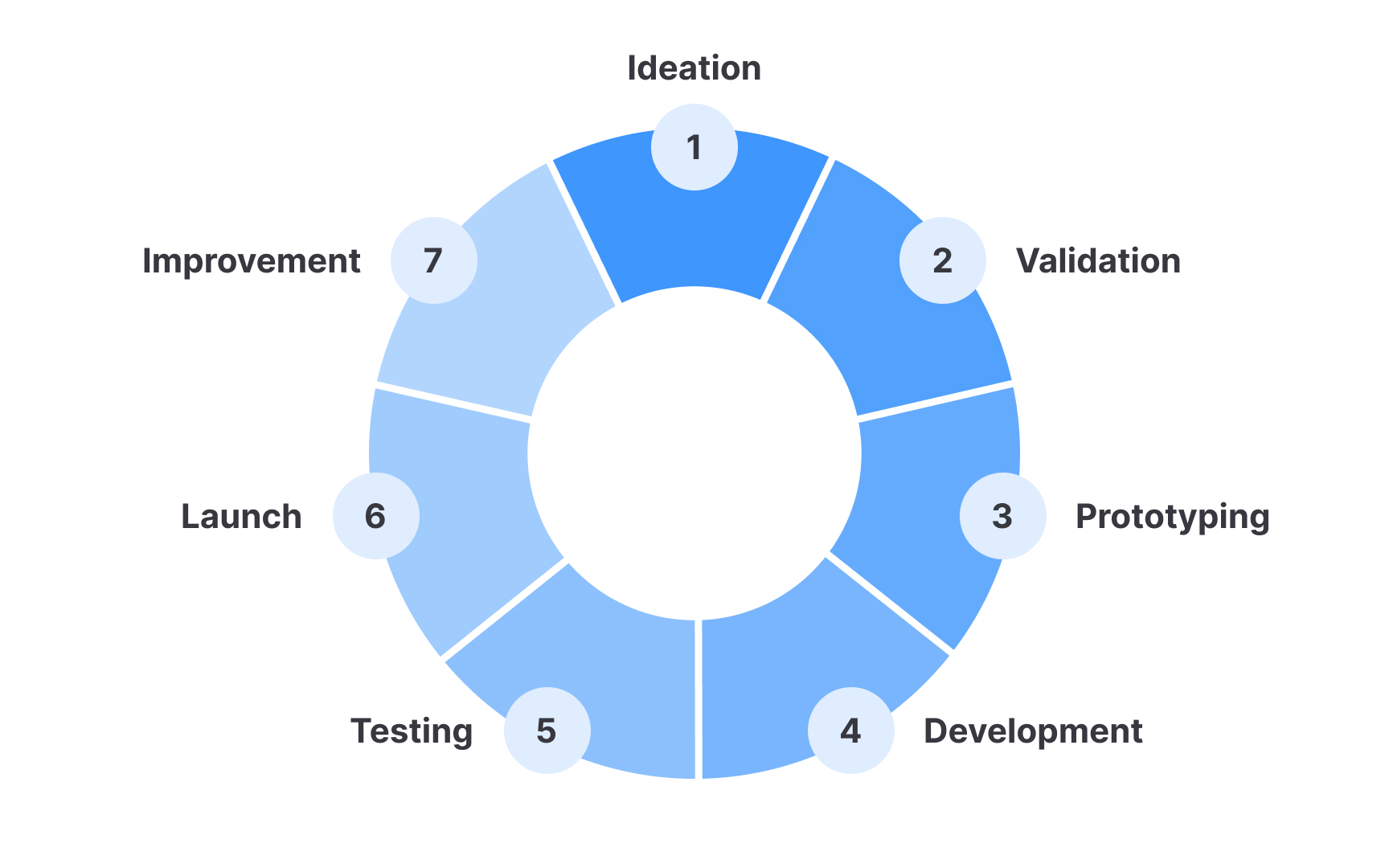
The lesson's seven-stage product development lifecycle drawn as a ring: Ideation, Validation, Prototyping, Development, Testing, Launch, and Improvement, with the loop closing back into the next idea, the same arc the stages section above describes. From the lesson Product Development Lifecycle.
How is product development changing with AI?
AI has introduced practical changes at nearly every stage of the product development process, and the pace of change has accelerated significantly since 2024.
In discovery and research, AI tools are automating significant portions of research synthesis. Platforms like Dovetail use AI to cluster themes across interview transcripts, surface recurring patterns, and summarize findings across large research datasets. Teams that previously spent days in synthesis are completing similar analysis in hours.
In design and prototyping, AI tools like Figma Make, Uizard, and Google Stitch generate interface designs from text prompts or rough sketches. This compresses the time from concept to testable prototype and expands the volume of design directions a team can explore before converging on one. The limitation is that AI-generated designs tend toward familiar patterns, which requires human judgment to evaluate whether generated outputs actually serve the specific user and product context.
In engineering, AI code assistants like GitHub Copilot, Cursor, and Claude Code accelerate development by generating code suggestions, completing functions, and synthesizing documentation. McKinsey estimates that generative AI could add $2.6 to $4.4 trillion to the global economy, with software development among the highest-impact areas. Reddit's CPO noted that new feature definition, prototyping, and testing that once took weeks can now happen in parallel within days.
In testing, AI-powered QA tools are shifting quality assurance from reactive to predictive. Machine learning models can identify potential failure points in code before they manifest as bugs. Automated test generation reduces the manual work of writing test cases.
The overall effect is a compression of the product development cycle: the time from idea to validated prototype, from prototype to working product, and from product to market has shortened considerably for teams that have integrated AI tooling throughout their workflow.


