


Every screen makes a bet about how people perceive, decide, and remember, whether or not the team knows the research behind it. Designers who do know it can predict where attention lands first, where errors cluster, and what brings someone back. Psychology is the difference between a layout that looks organized and one that is read as organized.
In this glossary topic:

What does psychology mean in the context of product design?
Psychology in product design refers to applying what is known about human cognition, perception, emotion, and behavior to decisions about how a product is structured, presented, and experienced. Rather than designing based purely on functional requirements or aesthetic preferences, a psychology-informed approach asks: how do people actually process this? What will they notice first? What will confuse them? What motivates them to continue or to stop?
This isn't a soft or abstract concern. Cognitive psychology and behavioral economics have produced a body of well-tested, replicable findings about how humans perceive visual information, make decisions under uncertainty, form habits, and respond to feedback. These findings are directly applicable to interface design, information architecture, onboarding, and the dozens of micro-decisions that determine whether a product feels intuitive or frustrating.
The most useful psychological principles in product design are not tricks or manipulation techniques; they're descriptions of how human perception and cognition work that allow designers to work with those tendencies rather than accidentally against them.
What are the core psychological principles applied in design?
Several frameworks and principles appear consistently across product design practice and have strong empirical grounding.
- Gestalt principles describe how humans organize visual information into coherent wholes rather than collections of individual elements. The principle of proximity holds that elements placed close together are perceived as related. The principle of similarity holds that elements with similar visual properties (same color, shape, or size) are grouped perceptually. Closure describes the tendency to perceive incomplete shapes as complete. Continuity describes the tendency to follow a smooth path through a visual field. These principles explain why grouping, alignment, and visual consistency feel organized: they're working with perceptual tendencies rather than against them.
- Hick's Law states that decision time increases with the number of options presented. Each additional choice a user must evaluate adds to the cognitive work required to make a decision. This explains why reducing the number of options in navigation, form fields, and checkout flows consistently improves task completion: fewer choices means faster, more confident decisions. It doesn't mean fewer options are always better, but it means additional options always have a cost that should be justified.
- Fitts's Law describes the relationship between a target's size and distance and the time required to move a cursor or pointer to it. Larger targets that are closer to the current cursor position are faster to activate. This principle underlies the design guidance to make primary action targets large and positioned near where users' attention and cursor are most likely to be, and it's why mobile touch targets have minimum size requirements.
- Cognitive load theory addresses the limits of working memory. Humans can hold approximately seven items in working memory at once, and complex or unfamiliar interfaces quickly exceed this capacity. Designs that chunk information, provide clear visual hierarchy, use progressive disclosure to reveal complexity gradually, and use familiar patterns that reduce the need for new learning are all strategies for reducing cognitive load.
How do emotion and motivation affect product design?
Behavioral patterns in products are driven not only by cognitive processing but also by emotional states and motivational structures.
- Variable reward schedules, identified in behavioral psychology through research on reinforcement learning, describe why inconsistent or unpredictable rewards can drive more sustained behavior than consistent ones. Social media feeds and notification systems are often designed around this principle: the possibility of something interesting or rewarding in the next scroll or notification creates continued engagement. This is a powerful mechanism that product teams should apply with transparency and ethical consideration rather than exploiting it to drive engagement at the expense of user wellbeing.
- Goal gradient effects describe how effort and motivation increase as users get closer to completing a goal. Progress bars, step indicators, and streaks in onboarding and habit-forming products use this: showing users how close they are to completion increases the likelihood they'll follow through. The progress bar that fills as a user completes their profile, even if it starts partially filled to create initial momentum, is a deliberate application of goal gradient psychology.
- Social proof is the tendency to look to others' behavior as a signal of what's correct or desirable. Testimonials, usage counts, star ratings, and "people also bought" features all apply social proof. The principle is most effective when the referenced group is similar to the user and when the behavior being cited is specific and credible.
- Loss aversion, from prospect theory, describes the finding that people are more motivated by the prospect of losing something they have than by the prospect of gaining something equivalent. Subscription renewal flows that emphasize what a user will lose by canceling (saved preferences, accumulated history, access to a team workspace) apply loss aversion more effectively than ones that only describe what the paid tier offers.
What does psychology in product design look like in practice?
Hick's Law is the principle that shows up most directly in layout decisions, because the number of visible options is something a designer controls on every screen. The fix is rarely to remove functionality; it is to limit what is visible at once and group the rest so a decision has fewer branches.
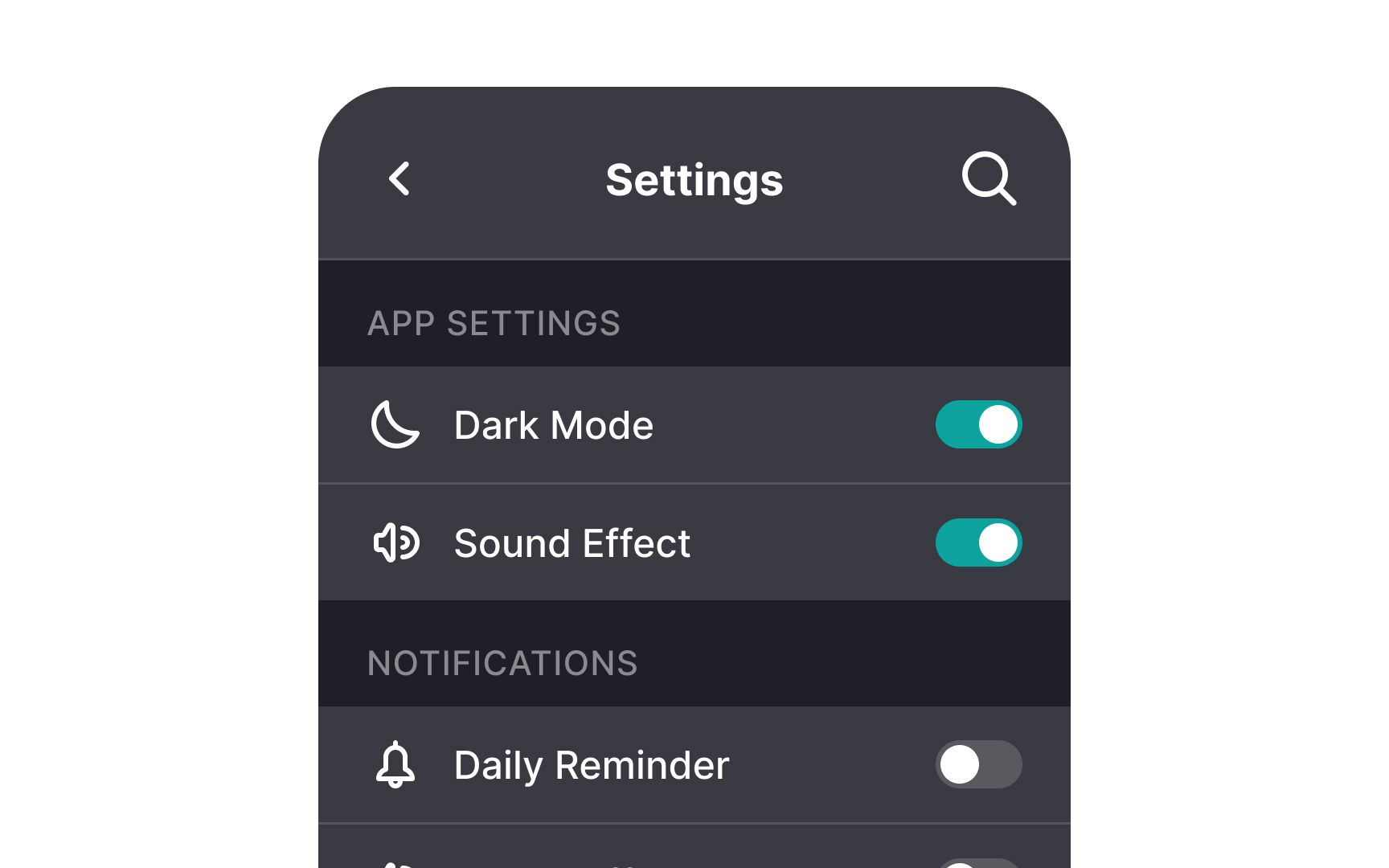
Hick's Law in a settings screen: a short list of toggles grouped under App Settings and Notifications, so the user scans a few labeled rows in a category instead of one long unsorted list, and the decision takes less time. From the lesson UX Laws.
How do psychological principles connect to ethical design?
The same mechanisms that make products more intuitive can also be used to manipulate users against their own interests. This distinction is important for product teams to hold clearly.
Designing navigation that aligns with Gestalt grouping principles to help users find what they need is applying psychology ethically. Designing a cancellation flow with multiple obfuscated steps, guilt-tripping language, and deliberately difficult-to-find options to prevent users from canceling is applying psychological pressure against user intent. The first serves the user's goals. The second serves the business's goals at the user's expense.
Dark patterns, a term coined by UX researcher Harry Brignull, describes design choices that use psychological principles to deceive or coerce users into actions they didn't intend: hidden subscription renewals, pre-checked opt-ins, trick questions, and confusing language that makes unsubscribing seem risky. These practices are increasingly subject to legal regulation in multiple jurisdictions and damage long-term user trust even when they produce short-term metric improvements.
The ethical application of psychology in product design consistently asks whether a given design choice helps users accomplish their goals more easily, or whether it's engineering behavior that serves the product at the user's expense.


