


.svg)

Product-market fit is a judgment call, but it's one that should rest on evidence chosen before the results arrive. Founders who decide what counts as success only after launch tend to read every number generously, which is how false fit slips through.
This lesson covers building a measurement framework in advance, setting activation and retention benchmarks, defining what a false positive looks like, and applying the Sean Ellis test and the effort test. It closes on reading the data honestly enough to know when to adjust, pivot, or return to validation.
This lesson draws on Anthropic's "The Founder's Playbook: Building an AI-Native Startup" [1].
The measurement framework
Founders who mistake early traction for product-market fit are usually the ones who started tracking data after launch, choosing metrics that showed what was working rather than surfacing what wasn't. The antidote is to establish the measurement framework before the first user shows up.
Defining metrics in advance removes the temptation to grade on a curve once results arrive. Before release, a founder sets which metrics matter for this specific product, what the benchmarks are, and what patterns would constitute genuine fit versus flattering noise. Deciding what counts as success while the outcome is still unknown is what keeps the eventual read honest.
Activation and retention benchmarks
A useful framework names specific thresholds before launch, not vague hopes. Activation criteria define the moment a new user has actually experienced the core value, not just signed up. Retention benchmarks define how many users should still be active at defined checkpoints, commonly Day 7 and Day 30.
Setting these in advance turns ambiguous results into clear verdicts. Without a Day 30 target, a retention curve is just a shape a founder can interpret optimistically. With one, the curve either clears the bar or it doesn't. The benchmarks should reflect what genuine value looks like for this particular product, since a daily tool and a quarterly one have very different healthy retention shapes.
Defining a false positive
Before the data arrives, it helps to define what a false positive looks like for this specific product, the pattern that would feel like success while actually signaling its absence. Common false positives include signups without activation, revenue without retention, and initial enthusiasm without repeat usage.
Naming these in advance is a guard against self-deception. Once numbers start climbing, every founder is tempted to read them generously, and a pre-committed definition of what doesn't count makes that harder. When the data does arrive, a useful move is to ask AI to make the adversarial case against the traction: what would a skeptic say about these numbers?
The Sean Ellis test
The Sean Ellis test is a survey-based litmus test for product-market fit. It asks active users a single question: how would they feel if they could no longer use the product? If more than 40% answer "very disappointed," that's a meaningful indicator of fit [2].
The test works because it measures dependence rather than approval. A user who would be only "somewhat disappointed" likes the product but isn't anchored to it; one who would be "very disappointed" has woven it into how they work. No single test confirms fit on its own, but the 40% threshold is a widely used signal that a real, identifiable group would feel a genuine loss without the product.
The effort test
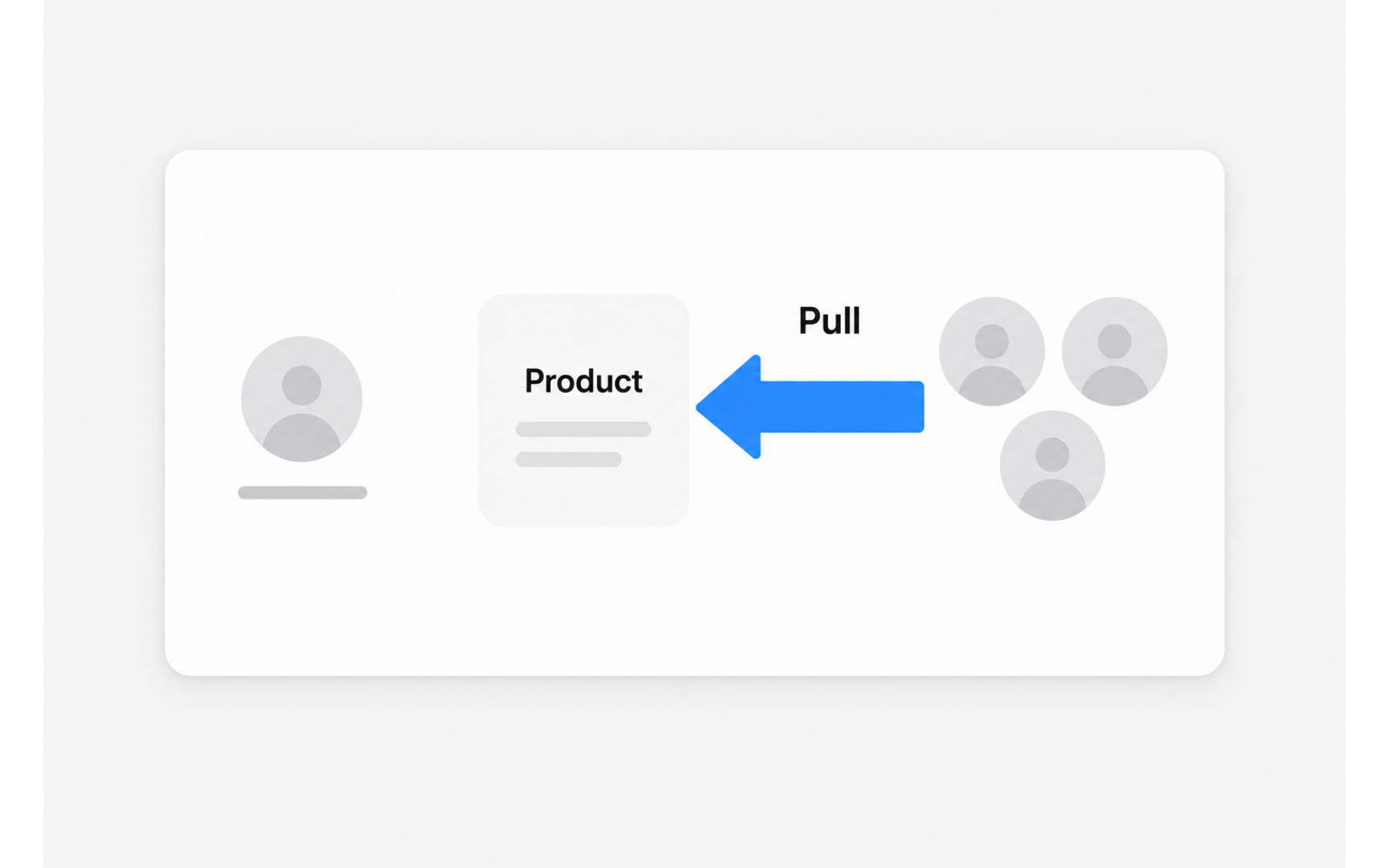
The effort test reads the direction of force between founder and product. Before product-market fit, retention requires constant intervention: frequent outreach, incentives, personal follow-up, and a lot of heroic founder energy to keep users engaged. The founder is pushing.
After product-market fit, the product starts doing that work on its own. Users return without being prodded, and growth begins to pull rather than push. That shift in where the effort lives is one of the clearest signals that something real has changed. When things begin pulling instead of pushing, the product has started to carry its own weight.
Pivot when evidence demands it
When the work doesn't lead to product-market fit, that result isn't failure; it's the MVP stage doing its job, surfacing the information before a founder over-invests in the wrong answer. The disciplined response is to ask what the data is actually saying. Often the right audience is already in the data, just underweighted, so exploring alternative segments comes first. Sometimes the audience is right but the value proposition isn't landing, which onboarding, messaging, or feature emphasis can fix without changing what's built.
After three or more iteration cycles without meaningful movement, a structured diagnostic helps: is a segment responding differently than the rest? Is the gap a positioning problem or a product problem? What would have to be true for the current product to find fit, and is that realistic? The answers decide whether to adjust, pivot, or return to the idea stage.
Topics
References
- The founder's playbook: Building an AI-native startup | Claude by Anthropic | Claude
- Archive of old posts | Startup Marketing Blog - By Sean Ellis | Unlocking Startup Growth