.svg)


After a week of research, we think it’s safe to say that finding reliable UX research career information online feels like conducting a usability test where nothing works. One site says $80K, another says $150K, and job postings either hide compensation entirely or list ranges wide enough to drive a truck through. So we did what any good researcher would do: we gathered data from multiple sources. This guide combines numbers from Glassdoor, PayScale, Levels.fyi and thousands of anonymous submissions from our community of 500,000+ design and product professionals. Average and median salary figures were calculated from these aggregated data sources. Then we triangulated everything against industry reports to separate signal from noise.
What you’ll learn from this article:
- Actual UX Researcher salaries across five major markets: US, UK, Germany, France, and Poland
- How compensation shifts as you move from junior to senior roles
- The career ladder in UX research and where the money really is
- Practical moves that translate into higher paychecks
Why do companies pay UX researchers well?
The simple answer: bad product decisions are expensive. Really expensive.
UX researchers prevent companies from building features nobody wants, launching products that frustrate users, and making assumptions that tank conversion rates. They interview users, run usability tests, analyze behavioral patterns, and turn messy qualitative data into clear recommendations that product teams can act on.
Consider what happens without research. Teams build based on hunches. Stakeholders argue about what users want without actually asking users. Products launch, users struggle, metrics disappoint, and expensive redesigns follow. Research catches these problems before they cost real money.
This work sits at the intersection of psychology, data analysis, and business strategy. Most researchers bring backgrounds in psychology, HCI, anthropology, or sociology, though plenty have made successful transitions from journalism, academia, and other research-heavy fields. What matters is the ability to ask good questions, synthesize findings, and communicate insights that change how products get built.
The role has grown in importance as digital products have become central to how companies operate and compete. Research isn't a nice-to-have anymore. It's how competitive companies make better decisions faster than their competitors.
UX researcher salary and benefits
UX researchers play a pivotal role in helping companies understand user needs, shape better products, and drive business success. As a result, their compensation reflects both the complexity of their work and the growing demand for research skills across industries. According to collected data, the average salary for a UX researcher in 2026 sits around $119,000, with the median annual salary ranging from $93,000 to $196,000 depending on several factors, most notably experience level, location, and company size.
For those just starting out, a junior UX researcher can expect to earn around $85,000, while senior UX researchers at top companies can see base salaries reach $150,000 or more. These figures can climb even higher when you factor in bonuses, stock options, and other benefits, especially in competitive markets like San Francisco or New York. Company size and industry segment also play a significant role: larger tech companies and those in high-growth sectors tend to offer higher annual salaries and more comprehensive benefits packages.
Beyond base salary, UX professionals often enjoy a suite of benefits designed to attract and retain top talent. Health insurance, paid vacation, retirement plans, and stock options are common, and many companies offer performance-based bonuses that can significantly boost total compensation. For researchers who thrive on flexibility, freelance UX research is a viable path, with hourly rates typically ranging from $50 to $200 depending on experience, project scope, and client budget. While freelance work offers the potential for higher earnings, it also comes with less predictability and requires strong negotiation skills to secure competitive rates and benefits.
The job market for UX researchers remains highly competitive, with hiring managers seeking candidates who bring a blend of research skills, UX design expertise, and data analysis capabilities. A strong understanding of user experience design, psychology, and the ability to conduct user interviews and synthesize insights from data are all highly valued. While a degree in human-computer interaction, psychology, or a related field can be advantageous, many successful researchers come from diverse educational backgrounds. What matters most is the ability to identify user needs, translate findings into actionable recommendations, and demonstrate measurable impact on products and services.
Location continues to be a major factor in determining researcher salary, but the rise of remote work has opened new doors for UX researchers worldwide. Companies are increasingly open to hiring talent from different locations, allowing researchers to access higher-paying roles regardless of where they live. This global talent pool means that UX professionals can negotiate for competitive salaries and benefits, especially if they bring in-demand skills like AI research, advanced data analysis, or deep domain expertise in industries such as healthcare, finance, or education.
Job titles in UX research, ranging from junior UX researcher to lead or principal researcher, reflect varying levels of responsibility, from conducting user interviews and usability tests to leading research teams and shaping company-wide strategy. Each step up the ladder brings increased earning potential, but also greater expectations for leadership, communication, and business impact.
To maximize earning potential and career satisfaction, UX researchers should focus on continuous skill development. Staying current with the latest tools, methodologies, and industry trends, whether through online courses, certifications, or active participation in the UX community, can set you apart in a crowded job market. Platforms like Uxcel offer guided learning paths, skill assessments, and certifications that help researchers build and demonstrate the competencies hiring managers value most.
In summary, UX researcher salaries and benefits are shaped by a complex mix of factors, including experience level, location, company size, industry, and skill set. By understanding these dynamics and investing in ongoing professional growth, UX researchers can negotiate better compensation, access more rewarding opportunities, and build a career that’s both financially and intellectually fulfilling. For companies, offering competitive salaries and benefits is key to attracting and retaining the UX talent needed to deliver exceptional user experiences and drive business success.
UX researcher salaries by country
| Country | Entry-level | Mid-level | Senior-level |
|---|---|---|---|
| United States | $50,000 - $88,000 | $90,000 - $130,000 | $120,000 - $200,000+ |
| United Kingdom | £24,000 - £36,000 | £45,000 - £65,000 | £65,000 - £100,000+ |
| Germany | €34,000 - €48,000 | €55,000 - €75,000 | €75,000 - €110,000+ |
| France | €35,000 - €56,000 | €48,000 - €70,000 | €70,000 - €97,000+ |
| Poland | 80,000 - 140,000 zł | 120,000 - 186,000 zł | 186,000 - 243,000+ zł |
The median annual salary for a UX researcher is $121,000, and in the US, it is approximately $121,000.
These salary figures help measure how compensation for UX researchers compares to industry benchmarks and current market trends.
UX researcher salary in the United States
No surprise here: American companies pay UX researchers more than anywhere else on the planet. The gap between US and European salaries remains substantial even after adjusting for cost of living differences.
What might surprise you is how much the numbers bounce around depending on your source. These differences come down to who's responding to surveys, different methodologies, and the fact that geography matters enormously within the US itself.
Speaking of geography: San Francisco researchers earn $130,000-$180,000. Seattle sits at $115,000-$155,000. New York ranges from $110,000-$150,000. Los Angeles comes in at $105,000-$145,000. Austin and Chicago hover around $90,000-$130,000. Living in a tech hub means earning 15-30% above the national average, though housing costs often eat that premium and then some.
Industry matters too. Information Technology leads at $165,724 median total pay. Healthcare follows at $128,056. Financial Services rounds out the top three at $126,358. If you're optimizing for compensation, knowing where the money flows helps you target your job search.
The remote work question complicates everything. Some companies adjust pay based on where you live. Others pay flat rates regardless of location. If you can land a remote role at San Francisco rates while living in Austin, you're effectively getting a massive raise through cost-of-living arbitrage.
Junior-level UX researcher salary in the United States

Starting salaries in American UX research land between $50,000 and $88,000 annually.
What gets you hired at this stage? Not years of experience, obviously. Hiring managers look for demonstrated curiosity about users, basic familiarity with research methods, and communication skills that suggest you can eventually present findings without putting stakeholders to sleep. A portfolio showing academic research, personal projects, or bootcamp work helps tremendously.
Daily work at this level means supporting senior researchers. You'll recruit participants, schedule sessions, take notes during interviews, help with transcription and analysis, and gradually take on more responsibility as you prove yourself. Most companies won't let junior researchers run studies solo until they've shown they understand the fundamentals. Titles typically include "Associate UX Researcher" or "Junior UX Researcher."
The encouraging news: this bracket sees the fastest salary growth. Demonstrate you can conduct quality research and the raises come quickly. Two years of solid performance often translates to 30-40% higher compensation.
Mid-level UX researcher salary in the United States
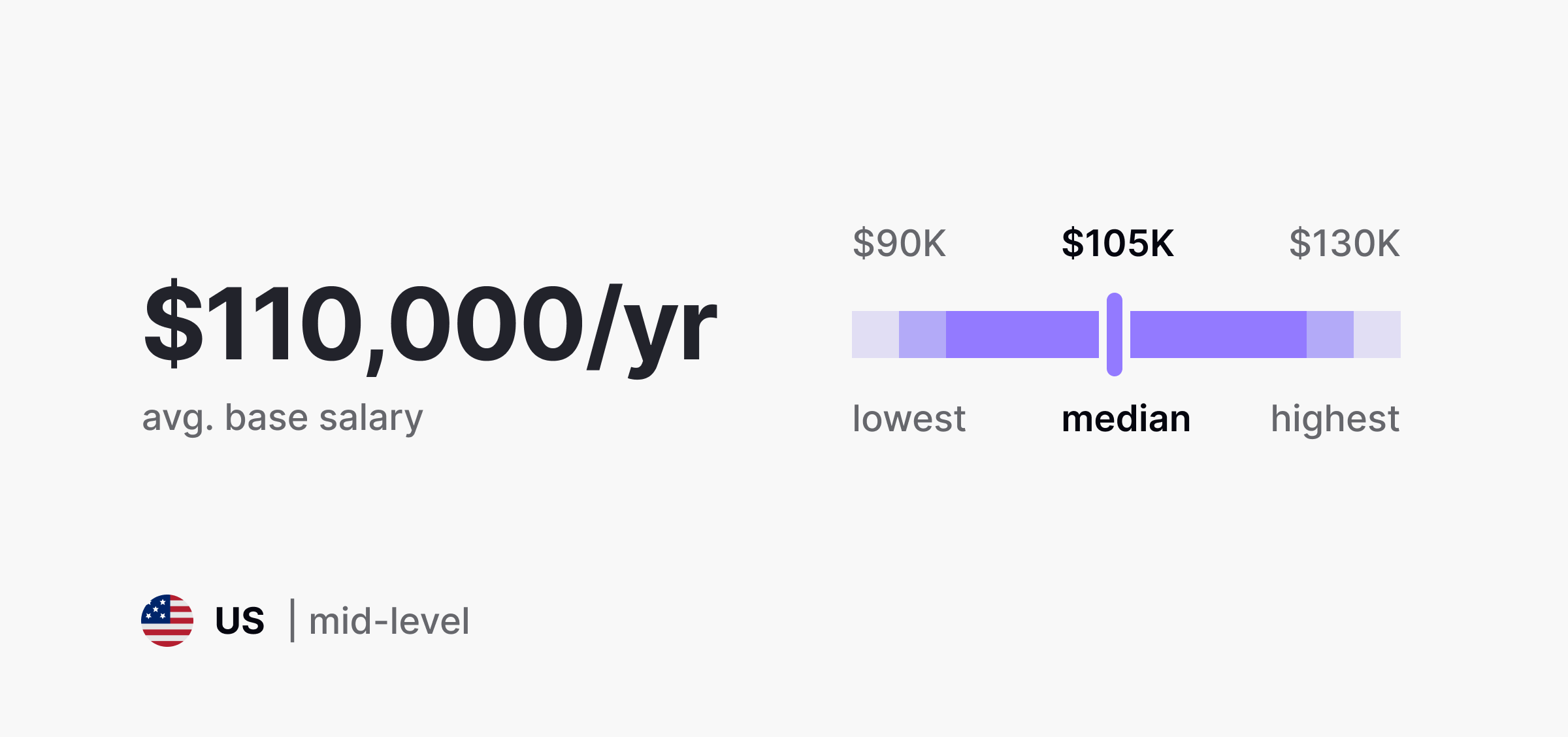
Researchers with three to seven years of experience earn between $90,000 and $130,000 in the US market. The midpoint hovers around $105,000, though company size, location, and industry create enormous variance within that range. These figures climb steadily as more experience is gained, since more experience typically leads to higher salaries, greater responsibilities, and advancement into senior or specialized roles. Researchers develop specialized expertise or take on additional responsibilities as their experience accumulates.
This is where the job fundamentally changes. Mid-level researchers own projects end-to-end. Nobody’s checking your interview guide before sessions anymore. You’re expected to identify research questions worth answering, select appropriate methodologies, recruit the right participants, conduct studies, analyze data, and present findings that actually influence product decisions.
The skills that matter shift too. Junior researchers need to execute well. Mid-level researchers need to think strategically about what to study and why. You’re making judgment calls about when to use surveys versus interviews, how many participants you need, and how to prioritize competing research requests. Getting this wrong wastes time and resources. Getting it right makes you invaluable.
Many researchers plateau at this level. The jump to senior requires showing business impact, not just completing studies. Start tracking how your research influenced product decisions, improved metrics, or prevented costly mistakes. You’ll need this evidence when pushing for promotion.
Senior-level UX researcher salary in the United States

Senior researchers command $120,000 to $200,000+ in base salary. At companies like Google, Meta, Apple, and Microsoft, total compensation packages regularly exceed $250,000 when you factor in equity grants and bonuses. This data suggests that organizations place a significant premium on senior UX researcher roles, reflecting both the scarcity of talent and the strategic impact these professionals have.
What justifies these numbers? Senior researchers don’t just conduct studies. They shape research strategy for entire product lines. They mentor junior team members. They present to executives and influence company-wide decisions. They build research operations and establish methodological standards. The scope expands dramatically.
Employers hiring at this level want proof you’ve done this before. Job descriptions consistently ask for evidence that your research moved real business metrics. Abstract claims about “user advocacy” won’t cut it. You need concrete examples: research that changed a roadmap, identified a market opportunity, prevented a failed launch, or improved key performance indicators.
The bar is high, but the compensation reflects genuine scarcity. Researchers who combine deep methodological expertise with business acumen and leadership skills are rare. Companies pay premiums to secure them.
UX researcher salary in the United Kingdom
British UX research salaries run roughly 20-30% below American equivalents, even accounting for exchange rates. That gap looks different when you factor in the NHS, stronger employment protections, mandated vacation time, and lower healthcare costs. Raw salary comparisons miss important context.
Data shows UK researchers averaging £44,000 annually, with a range spanning £26,000 to £84,000. London skews these numbers upward significantly.
Here's a statistic that puts UK research salaries in perspective: the median UX researcher salary is 91% higher than the national median wage. Relative to what most British workers earn, UX research pays exceptionally well. The profession sits comfortably in the upper tiers of UK compensation.
Junior-level UX researcher salary in the United Kingdom

Entry-level researchers in the UK earn £24,000 to £36,000 per year. London roles trend higher, with starting salaries in the capital typically ranging £30,000-£41,000.
The UK produces plenty of qualified graduates through its university system. Competition for entry-level positions can be fierce, especially in London. Standing out requires a portfolio demonstrating actual research work, whether from academic projects, internships, or self-directed studies.
One notable difference from the American market: UK employers tend to emphasize formal qualifications more heavily. Degrees in psychology, HCI, or related fields carry weight. That said, career changers with demonstrated research aptitude absolutely can break in, particularly at smaller companies and startups willing to take chances on potential.
Early-career work mirrors the US pattern. You'll support senior researchers, learn methodologies, build foundational skills, and gradually earn opportunities to run studies independently. Proving you can execute reliably opens doors to greater responsibility and higher compensation.
Mid-level UX researcher salary in the United Kingdom

Researchers with established track records earn £45,000 to £65,000 in the UK. The average sits around £52,000, with fintech and enterprise software companies paying at the top of that range.
Compensation at this level diverges based on employer type. Agency and consultancy roles tend to cluster toward the lower end. In-house positions at tech companies and well-funded startups pay better. If maximizing salary matters to you, knowing where the money is helps focus your job search.
What's expected? Autonomous project ownership. UK employers at this level want researchers who can plan studies, execute them, and deliver insights without constant supervision. Building relationships across product, design, and engineering teams becomes increasingly important. Research that never influences decisions isn't valuable, regardless of methodological rigor.
Senior-level UX researcher salary in the United Kingdom

Senior UK researchers earn £65,000 to £100,000+, with exceptional performers at top firms reaching £120,000 or more. London-based senior researchers earning £103,000-£120,000, particularly in fintech and at major tech companies, is quite common too.
London averages £48,873 for UX researchers overall, with senior roles pushing significantly higher. The London premium reflects both the concentration of tech companies and eye-watering living costs. Whether the salary bump adequately compensates for renting a shoebox flat in Zone 2 is a personal calculation.
Responsibilities at this level extend beyond individual research projects. Senior researchers set strategy for their teams, mentor junior colleagues, and navigate complex organizational dynamics to ensure research actually influences decisions. Many manage direct reports. Some build research operations from scratch at companies establishing research functions for the first time.
UX researcher salary in Germany
Germany has evolved into a legitimate European tech hub, with Berlin attracting startups and Munich housing major enterprise players. Compensation is competitive within Europe, and the non-salary benefits add substantial value, often helping employees save on living expenses such as healthcare, transportation, and paid time off.
Data reports an average of €49,424 for German UX researchers. Geographic variation within Germany is significant, with Munich commanding the highest salaries and Berlin offering a better salary-to-cost-of-living ratio for many workers.
Beyond raw numbers, German employment comes with serious perks: typically 25-30 days of vacation, comprehensive healthcare, strong labor protections, and employment stability that American workers can only dream about. These benefits add €10,000-€15,000 in equivalent value to total compensation.
Junior-level UX researcher salary in Germany

Entry-level researchers in Germany earn €34,000 to €48,000 annually. Berlin startups typically offer €42,000-€50,000, while Munich enterprise companies start around €45,000-€55,000.
German employers value methodical, systematic approaches to research. Academic backgrounds in psychology, sociology, or HCI carry weight. Technical rigor matters here, perhaps more than in some other markets.
Good news for international candidates: English-language roles are common, especially in Berlin's startup ecosystem. You don't necessarily need German fluency to land a research position, though it certainly helps for roles at traditional German companies.
The work at this level resembles entry-level positions elsewhere: supporting senior researchers, learning methodologies, and building foundational skills. German companies tend to invest in training and development, creating clearer pathways from junior to mid-level roles.
Mid-level UX researcher salary in Germany

Researchers with established experience earn €55,000 to €75,000 per year. The median for mid-level researchers falls between €60,000 and €80,000 depending on location and company type.
German companies often expect stronger methodological depth at this level than American counterparts. Job descriptions frequently mention mixed-methods expertise and the ability to conduct both qualitative and quantitative research. Comfort with statistical analysis and survey design gives you an advantage.
Career progression in Germany tends to be more structured than in the US. Changing jobs is less common, which means internal development and annual raises play larger roles in salary growth. Building a reputation within your organization matters for long-term compensation.
Senior-level UX researcher salary in Germany

Senior German researchers command €75,000 to €110,000+ in base salary. Top performers at major tech companies exceed €120,000.
City matters significantly at this level. Berlin averages €59,000 for researchers overall, with top earners reaching €80,000. Munich jumps to €94,764 average, reflecting its status as Germany's most expensive city and home to numerous automotive and tech giants.
That Munich premium comes with a catch: living costs run 37% higher than the German average. Berlin offers better value for most researchers, with a growing tech scene and relatively affordable living, though that's shifted as the city has gentrified over the past decade.
UX researcher salary in France
Paris has emerged as a serious European tech hub, with a growing startup ecosystem alongside established companies. French salaries are competitive within the EU, though generally below German and UK levels.
The average is €70,873 for French UX researchers, though this skews toward experienced professionals. Mid-level researchers more typically fall between €42,000 and €55,000 annually.
French employment brings substantial non-salary benefits: a minimum of five weeks of vacation, a 35-hour workweek standard, comprehensive social protections, and labor laws that strongly favor employees. These factors make raw salary comparisons with the US particularly misleading.
Junior-level UX researcher salary in France

Entry-level researchers in France earn €35,000 to €56,000 annually, with Paris roles commanding the higher end. French companies place significant weight on formal education. Master's degrees in relevant fields carry real hiring power. Several excellent HCI and design programs at French universities create a pipeline of qualified candidates.
French fluency helps considerably for most roles, though English-only positions exist at international companies and some Paris-based startups. Building a portfolio that demonstrates research conducted in the French market shows you understand local context.
Mid-level UX researcher salary in France

Researchers with established track records earn €48,000 to €70,000 per year. French work culture values expertise and craftsmanship. Researchers who develop deep methodological knowledge are rewarded more than generalists who stay surface-level across many methods. Specialization pays off here.
Building relationships across departments becomes increasingly important for career advancement. Research impact depends on organizational influence, and French companies tend to have clear hierarchies that require navigation.
Senior-level UX researcher salary in France

Senior French researchers earn €70,000 to €97,000+, with top performers exceeding €100,000. Paris-based senior researchers average €78,830 in gross salary, including typical bonuses of €2,862.
Paris dominates the French tech market. Most major companies, startups, and agencies maintain their French headquarters in the capital. Remote work has expanded options somewhat, but many employers still prefer candidates who can work from Paris at least part-time.
Living costs in Paris run 50% above the French average, which partially explains why the tech industry concentrates there despite the expense. Lyon, Bordeaux, and Toulouse offer growing alternatives with lower costs, though opportunities remain more limited.
UX researcher salary in Poland
Poland represents an increasingly attractive option for both researchers and companies. Strong technical education, lower costs, and a growing tech ecosystem have put cities like Warsaw, Kraków, and Wrocław on the map. Polish UX specialists earn an equivalent of $35,559 USD annually with a median of 144,117 zł (about 12,010 zł monthly).
Here's the purchasing power reality: Polish living costs run 59% below US levels, while salaries are about 74% lower. This means your money goes further for daily expenses, groceries, and housing. International travel and imported goods remain relatively expensive, but the local quality of life can be excellent on a Polish researcher's salary.
Junior-level UX researcher salary in Poland

Entry-level researchers in Poland earn 80,000 to 140,000 zł annually. Many entry-level Polish roles combine research with design responsibilities. Smaller teams require more flexibility, so pure research positions are less common than in larger markets. This can be advantageous for building diverse skills early in your career.
English proficiency is often required, as many Polish researchers work with international clients or on distributed teams. The ability to conduct research in both Polish and English expands your options considerably.
Mid-level UX researcher salary in Poland

Researchers with established experience earn 120,000 to 186,000 zł annually. At this level, many Polish researchers work for international companies, either remotely or at local offices. These positions often pay above local market rates while still costing employers less than hiring in Western Europe or the US. It's a win-win that has fueled Poland's tech growth.
Companies expect autonomous research planning and execution. The ability to communicate findings to international stakeholders, often across time zones and cultural contexts, matters for career advancement.
Senior-level UX researcher salary in Poland

Senior Polish researchers command 186,000 to 243,000+ zł annually. The Polish tech scene has matured significantly. What started as a nearshoring destination now includes homegrown companies, venture-backed startups, and sophisticated product organizations. This evolution has increased demand for senior research talent and pushed salaries upward.
Warsaw offers the highest compensation, with Kraków and Wrocław following as secondary hubs. Many senior researchers lead distributed teams or manage research for products serving global markets, making the role genuinely international despite the Polish location.
The future looks bright for Polish UX research. As more companies recognize the talent available and infrastructure continues improving, compensation will likely continue rising toward Western European levels. Remote work opportunities with Western companies have already started closing the gap for many researchers.
What a UX research career path looks like
UX research careers don’t follow a single trajectory. The traditional ladder exists, but plenty of researchers take lateral moves, specialize in particular methods, or transition into adjacent fields. UX, more broadly, encompasses a wide range of roles and skills, including user research, UI, and product strategy. Understanding your options helps you make strategic decisions about where to focus.
User research is a core component of the field and is essential for understanding user needs and behaviors. UX researchers should be familiar with both qualitative and quantitative research methods. Qualitative research techniques, like conducting in-depth interviews, are essential for gaining deep insights into user motivations. UX researchers also need to work collaboratively with colleagues across departments, including data analysts and market researchers, to ensure comprehensive findings.
Critical thinking and analysis skills are important for UX researchers, as is curiosity, a vital trait for exploring a wide variety of topics. The ability to dig deep to understand the nuances of user behavior is crucial. Engaging with academic research is also an important skill, helping researchers stay current and connect their work to a larger body of research developed by their organizations.
The UX research job market is experiencing rapid growth and is on a positive trajectory after post-pandemic setbacks. Roles are now available across a wide variety of industries, including government, nonprofits, and the private sector. Hiring timelines for UX specialists are currently longer, with companies being more selective about candidates, and there is a growing expectation for advanced degrees, such as master's or doctoral degrees. The number of job listings for UX researchers is increasing, indicating a rising demand for these roles.
UX researchers often work on websites to improve user experience and may develop skills in adjacent areas like UI design.
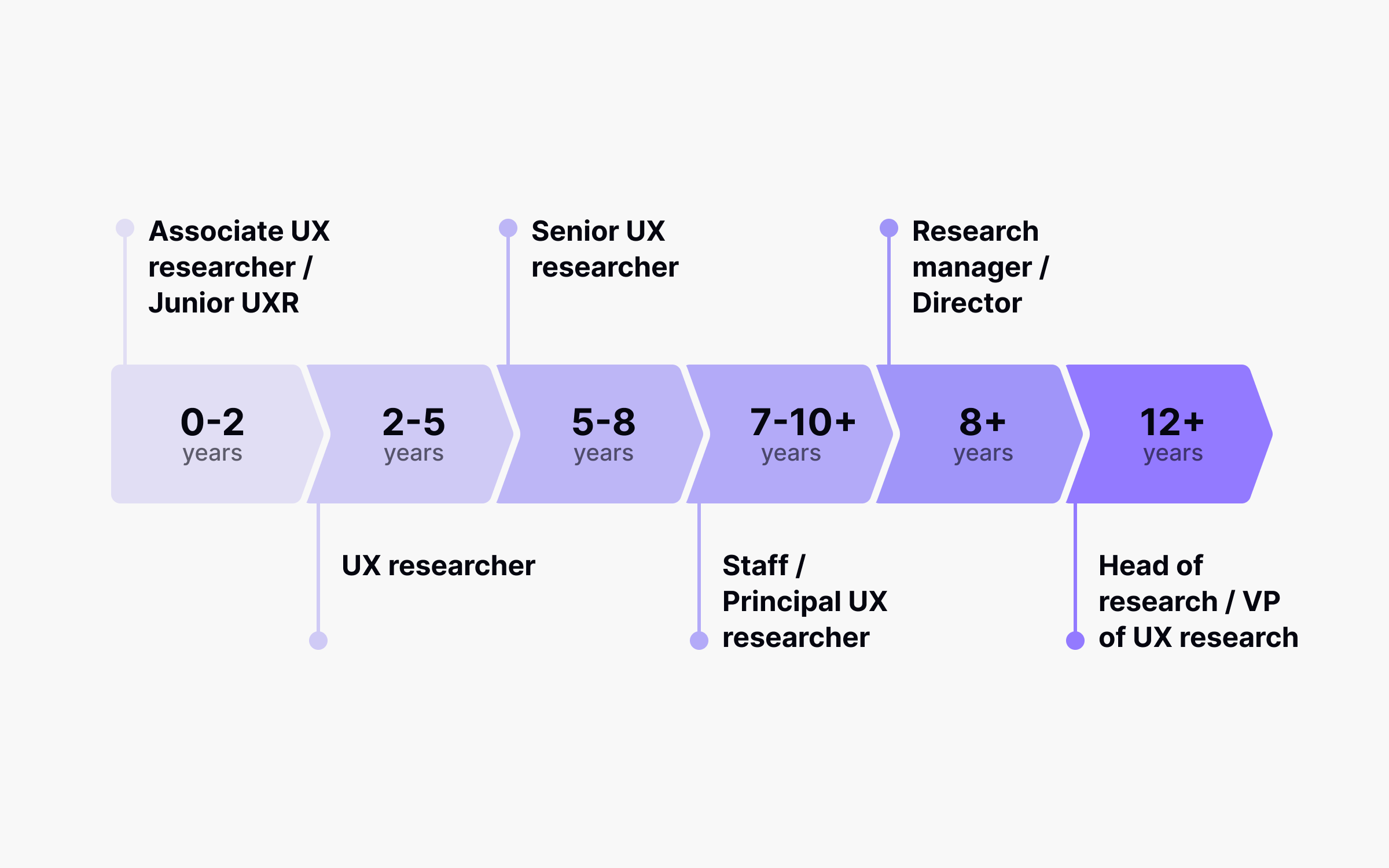
Associate UX researcher / Junior UXR (0-2 years) The learning phase. You’re absorbing methodologies, building foundational skills, and proving you can execute research reliably. Most of your work supports senior researchers. Success means demonstrating curiosity, attention to detail, and the ability to synthesize information clearly. Don’t expect to lead projects independently yet, but pay attention to everything happening around you.
- UX researcher (2-5 years): Independence arrives. You own projects from planning through presentation. Methodology selection becomes your call. Stakeholder relationships require cultivation. This is where you discover what kinds of research energize you and where your particular strengths lie. Some researchers gravitate toward generative work, exploring problems. Others prefer evaluative studies, testing solutions. Both paths are valid.
- Senior UX researcher (5-8 years): Strategic influence expands. You’re shaping what gets researched, not just how. Mentoring junior team members becomes part of the job. Executive presentations require business language, not just research findings. Many researchers specialize at this stage, developing deep expertise in particular methods or domains. The ability to say no to low-value research requests matters as much as executing the work.
- Staff / Principal UX researcher (7-10+ years): Organizational scope grows. You’re influencing research practices across multiple teams, setting standards, and contributing to company-wide strategy. Some principal researchers maintain hands-on work. Others focus primarily on leadership and coordination. At this level, you’re often defining what research excellence looks like for your entire organization.
- Research manager / Director (8+ years): People management becomes central. Hiring, developing, and retaining research talent takes priority. You’re building teams, securing resources, and ensuring research has organizational impact. Many managers balance team leadership with some hands-on research, though finding time for both gets harder as teams grow.
- Head of research / VP of UX research (12+ years): Executive leadership. You’re setting vision for how research shapes product development across the entire company. Board-level communication, organizational design, and strategic planning dominate. The role is less about conducting research and more about building research culture and securing research’s seat at the decision-making table.
Not everyone wants to climb this ladder. Some researchers prefer staying hands-on throughout their careers, becoming deeply specialized individual contributors. Others transition into product management, design leadership, or independent consulting. The skills transfer well across many paths, and there’s no shame in choosing the trajectory that fits your life.
A good place to start is Uxcel’s UX Researcher career path, which builds competencies that matter at every level: research methods, interviewing techniques, usability testing, data analysis, and communication skills. The platform tracks progress and identifies gaps, helping you develop strategically rather than randomly.
7 tips to increase your UX researcher salary
1. Quantify your impact obsessively. Vague claims about "advocating for users" won't get you raises. Track specific outcomes: recommendations that changed roadmaps, usability issues caught before launch, metrics that improved after research-informed changes. Build a running document of concrete wins throughout the year. When review time comes, you'll have evidence instead of assertions. The researchers who get promoted fastest are the ones who can point to specific business outcomes their work enabled.
2. Add quantitative methods to your toolkit. Qualitative researchers who can also design surveys, analyze behavioral data, and interpret A/B test results command 15-25% salary premiums. You don't need to become a statistician, but understanding when quantitative methods are appropriate and executing them competently makes you more valuable. The qual-quant combination is increasingly what employers want. Take a statistics course. Learn to use analytics tools. Your future self will thank you.
3. Develop genuine domain expertise. Generalists compete with everyone. Specialists compete with far fewer people. Deep knowledge of healthcare, fintech, enterprise software, or another complex domain creates barriers to entry that justify higher compensation. Domain experts understand regulatory requirements, industry dynamics, and user contexts that generalists have to learn from scratch. Pick an industry that interests you and go deep. Getting a UX research certification from a reputable source can be an added bonus.
4. Get comfortable with executive communication. Senior roles require presenting to people who don't care about methodology. They want business implications. What should we build? What will happen if we don't? How much money is at stake? Researchers who translate findings into strategic recommendations influence decisions. Those who only report data get ignored. Practice framing everything in terms of business impact, even when talking to other researchers.
5. Build AI research expertise now. Products increasingly incorporate machine learning. Researching AI features, understanding user mental models around algorithmic systems, and identifying potential harms requires specialized knowledge. Researchers with this expertise currently earn 20-30% premiums because supply is limited. That gap will narrow as more people develop these skills, so moving early creates advantage. Understanding prompt engineering, AI ethics, and human-AI interaction patterns positions you for the roles companies will need to fill.
6. Change jobs strategically, not randomly. Internal raises cap at 5-10% annually for most companies. External moves can deliver 15-25% increases. But timing matters. Move after shipping significant research you can reference. Build a portfolio of wins before jumping. Having competing offers strengthens negotiation leverage considerably. That said, job hopping every six months looks bad on a resume. Aim for meaningful tenure at each stop.
7. Invest in continuous skill development. Stagnation shows. Employers value researchers who keep growing. Uxcel's Impact Report shows 68.5% of active learners report promotions. The platform's 48-50% completion rate compared to the 5-15% industry average means you'll actually finish courses and build demonstrable skills. At $24/month, the ROI makes itself obvious pretty quickly when you're targeting salary increases measured in thousands of dollars.
What you should do next
The data tells a clear story: UX research pays well across every major market we examined. UK researchers earn 91% above the national median wage. American senior researchers regularly exceed $200,000 in total compensation. Even in lower-cost markets like Poland, purchasing power makes researcher salaries genuinely comfortable.
More importantly, demand for research skills continues to grow. Companies have learned that building products without understanding users leads to expensive failures. That lesson isn't getting unlearned. As products become more complex and competition intensifies, the value of genuine user insight only increases.
Researchers who combine methodological expertise with business acumen and communication skills will remain valuable. The ones who can also navigate quantitative methods, develop domain expertise, and adapt to AI-powered product development will command the highest premiums.
The profession rewards genuine curiosity about people, analytical rigor, and the ability to influence decisions through evidence. If those qualities describe you, the financial outcomes tend to follow.
Ready to build skills that translate directly into higher compensation? Start the UX Researcher Career Path on Uxcel. The platform offers practical, skill-focused learning in research methods, user interviewing, usability testing, and data analysis. Progress tracking helps you identify gaps and develop strategically.
Common questions about UX researcher salaries
How much does a UX researcher make in 2026?
It depends entirely on where you work and how long you’ve been doing it. US researchers earn $50,000-$200,000+, depending on experience. UK salaries range £24,000-£100,000+. German researchers make €34,000-€110,000+. The spread is wide because geography, company type, and seniority all matter enormously.
Is UX research a high-paying career?
Compared to most professions, yes. UK researchers earn 91% above the national median wage. American senior researchers regularly clear $200,000 in total compensation at top tech companies. Even entry-level positions pay above average for knowledge work. The field rewards expertise generously.
Do UX researchers make more than UX designers?
Generally slightly more at equivalent experience levels, though the gap is small and varies by company. Both roles compensate well in tech. Some organizations pay them identically. The bigger factor is company type and location rather than which discipline you’re in.
What’s the salary difference between startups and big tech?
Big tech typically offers higher base salaries plus substantial equity. A senior researcher at Google or Meta might earn $180,000-$250,000+ in total compensation. Startups often pay 10-20% below market on base salary but offer larger equity percentages. The startup equity is riskier but potentially more valuable if the company succeeds.
Can you negotiate UX researcher salaries?
Absolutely. Most offers have 10-15% negotiation room, sometimes more for senior roles. Research market rates before negotiating. Come prepared with competing offers if you have them. Focus on the value you bring rather than what you need. Companies expect some back-and-forth.
Does remote work affect UX researcher pay?
Depends on company policy. Some employers pay location-adjusted salaries, reducing compensation for researchers in lower-cost areas. Others pay flat rates regardless of where you live. Remote researchers working for US companies from Europe often earn significantly more than local market rates. Understanding a company’s remote compensation policy matters.
What skills increase UX researcher salaries the most?
Quantitative research methods command the biggest premiums right now. Researchers who can design surveys, analyze large datasets, and work with experimentation frameworks earn more than purely qualitative researchers. Domain expertise in healthcare, fintech, or enterprise software also justifies higher compensation. AI research skills are increasingly valuable.
For more resources and to explore career path videos about UX research, check out YouTube for visual guides and insights.
Your next salary bump starts with better skills. Join 500,000+ designers and researchers building real competencies on Uxcel.
Disclaimer: Salary data compiled from Glassdoor, PayScale, Indeed, Built In, ERI SalaryExpert, Uxcel community submissions, and User Interviews' UX Salary Report. All figures represent base salary estimates as of early 2026 and may vary based on individual circumstances. Exchange rate fluctuations can affect international comparisons.