


Every team has a design process whether it names one or not; the difference is whether the sequence is deliberate or improvised under deadline. Naming the stages is what lets a team see when research was skipped, when a prototype went straight to engineering, and when a decision rested on opinion rather than evidence. The process is not a guarantee of a good design, but it is the only reliable way to find out early that a design is wrong.
In this glossary topic:

What is the design process?
The design process is a structured sequence of stages that helps teams move from a vague problem to a tested, viable solution. It gives shape to work that could otherwise become chaotic, ensuring that design decisions are grounded in evidence rather than assumptions.
The process isn't a single fixed method. Different teams and methodologies describe it differently. Design Thinking, popularized by IDEO and Stanford's d.school, organizes it into 5 stages: Empathize, Define, Ideate, Prototype, and Test. The Double Diamond, developed by the UK Design Council, breaks it into Discover, Define, Develop, and Deliver. What most frameworks share is a rhythm: diverge to explore, converge to decide, repeat as needed.
The specific methodology matters less than the discipline of following one. A process keeps teams from jumping straight to solutions before they understand the problem.
What are the main stages of the design process?
Most design processes move through 5 core stages, though the labels vary by methodology and team.
- Research is where the process begins. Designers conduct user interviews, usability tests, surveys, and market analysis to understand who they're designing for and what problems actually exist. This stage prevents what practitioners call "solutionizing," where teams spend time building something that solves the wrong problem. The output is typically a set of insights, personas, or a clearly framed problem statement.
- Ideation opens up the solution space. Brainstorming sessions, sketching, competitive analysis, and collaborative workshops generate a wide range of possible approaches before any single direction is committed to. The goal isn't to find the answer immediately. It's to surface enough options that the best one can be identified and refined.
- Prototyping gives ideas a tangible form. Low-fidelity sketches and paper prototypes are quick to make and easy to discard. Higher-fidelity interactive prototypes come later, once a direction has been validated enough to warrant the investment. The critical principle here is that prototypes exist to be tested and revised, not to be preserved.
- Testing puts prototypes in front of real users. Observing how people interact with a design, where they hesitate, what confuses them, and what works intuitively, generates the evidence that either validates the direction or triggers a revision. This stage is where iteration happens most visibly.
- Implementation bridges design and development. Clear specifications, annotated designs, and handoff tools ensure that what was designed actually gets built as intended. Collaboration between designers and engineers is especially important here: details that seem obvious in a design file often require explicit documentation to translate correctly into code.
Is the design process always linear?
No. The process looks like a sequence on paper but functions more like a loop in practice.
Teams regularly revisit earlier stages based on what they discover later. A round of usability testing might reveal that users misunderstood the core concept, sending the team back to the ideation stage. New business requirements introduced mid-project might require fresh research before decisions can be made. This is expected, not a sign of failure.
The iterative nature of the process is one of its most valuable features. Catching problems at the prototype stage costs far less than catching them after a product has shipped. Each cycle of testing and refinement reduces the risk that the final product will miss the mark.
How does the design process connect to collaboration?
A design process isn't something designers run in isolation. Its stages create natural touchpoints where cross-functional teams align.
Research findings are shared with product managers, engineers, and stakeholders to create a shared understanding of the user problem. Ideation sessions often include people from outside the design team, because diverse perspectives surface solutions that a homogeneous group wouldn't generate. Prototype reviews bring engineers in early to flag technical constraints before a direction gets too locked in. Handoff is itself a collaborative moment, not a one-way transfer.
Product managers rely on the design process to stay oriented. Research grounds the work in user needs and connects it to product strategy. Ideation creates options to evaluate against business priorities. Testing provides evidence that can justify or challenge roadmap decisions. The process gives non-designers visibility into how design decisions get made, which builds trust and speeds up alignment.
How is AI changing the design process?
AI has become a meaningful presence across every stage of the design process, and the changes are practical rather than theoretical.
In research, tools like Dovetail's AI features and Maze AI now automate significant portions of synthesis work. Teams that previously spent 3 or 4 days analyzing interview transcripts and grouping themes are completing the same work in under an hour, with more consistent pattern recognition than manual analysis typically produces.
In ideation, AI tools like Uizard and Figma Make let designers generate multiple interface directions from text prompts or rough sketches within minutes rather than days. This doesn't replace the judgment required to evaluate which direction is right. It removes the blank-canvas friction that slows the early stages of exploration.
In prototyping, tools can now generate interactive flows from described user journeys, and Figma Make allows anyone to move from a prompt to a clickable prototype without significant design experience. This has expanded who can participate meaningfully in design reviews.
In testing, AI-driven platforms can analyze user session recordings at scale, detecting friction points and usability patterns across thousands of interactions in the time it would previously take to manually review a handful of sessions.
The consistent thread is that AI is absorbing the time-consuming, process-heavy parts of design work. What it doesn't absorb is the judgment, empathy, and strategic thinking that determine whether a design is actually the right one. According to Figma's 2025 AI report, 78% of designers and developers believe AI boosts their efficiency. Fewer than half felt it makes them better at their jobs. That gap is where human expertise still matters most.
What does the design process look like in practice?
The Double Diamond below is the most widely reproduced picture of the process. The first diamond opens on the problem and narrows to a definition of it; the second opens on possible solutions and narrows to the one that ships. The width of each diamond is the point: the process deliberately spends time generating options before it spends time choosing between them.
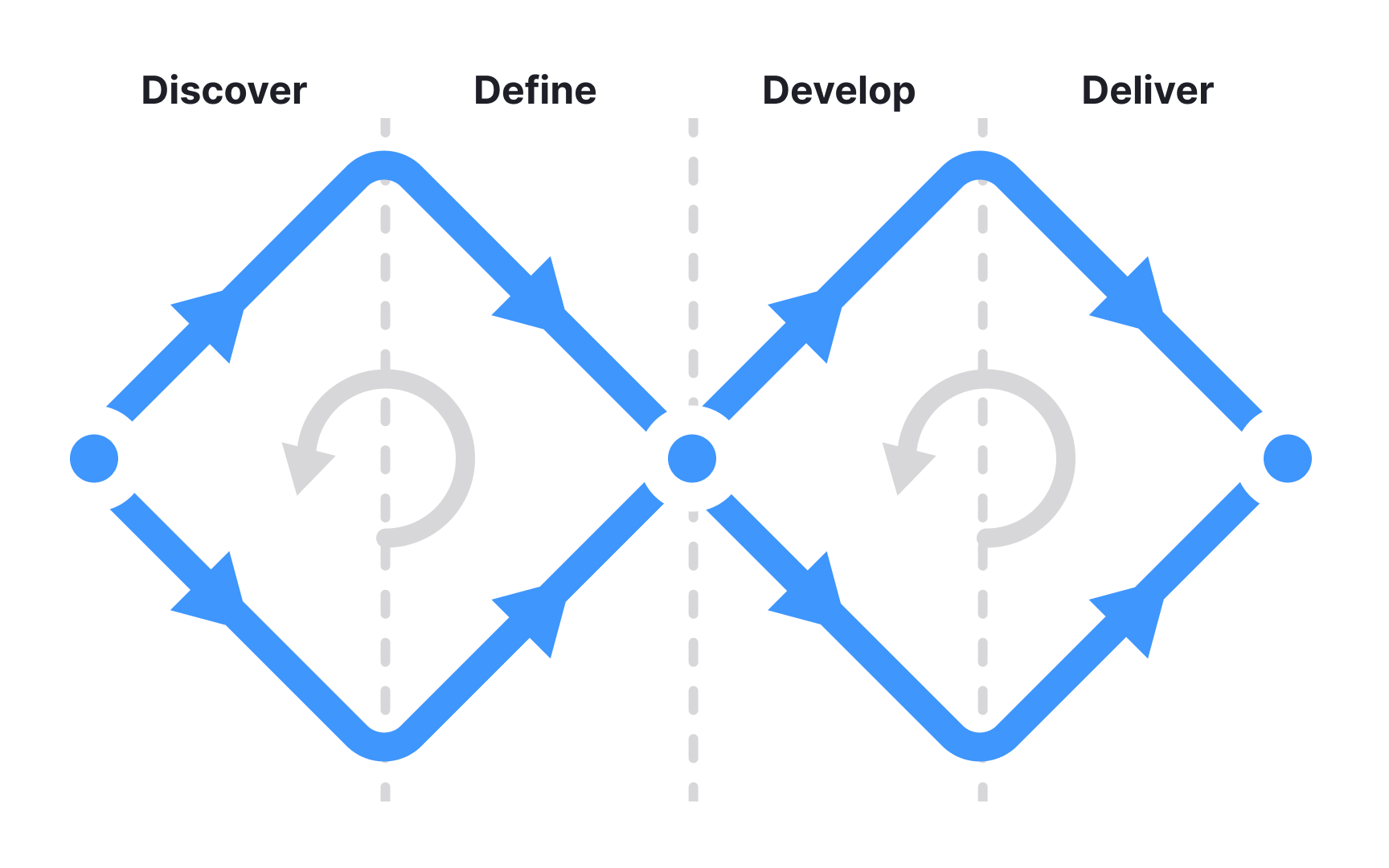
Discover, define, develop, deliver: two rounds of divergence and convergence, first to find the right problem and then the right solution. From the lesson UX Design Processes & Research Methods.


