
.svg)


If you just Googled “CareerFoundry product design bootcamp review,” I need to tell you something before you read another word. CareerFoundry is gone. The Berlin-based bootcamp, also known as Career Foundry, a well-known online educational platform offering tech-focused courses like UX Design, Data Analytics, Full-Stack Web Development, and Product Management, filed for bankruptcy in October 2025 and officially ceased all operations on February 28, 2026. No new enrollments. No continuing programs. Students who were mid-course got left without a path to completion. The domain is live again under CF Training GmbH, which bought the trademark and learning content, so old course pages still show prices and apply buttons. Don’t be fooled: the company’s own closure notice is unambiguous. Operations ceased on February 28, 2026, no new courses are offered, and existing programs are not being continued.
I know that’s not what you came here to read. Maybe you had CareerFoundry on your shortlist. Maybe someone recommended it last month. Maybe you’re halfway through comparing it to Springboard or Designlab and just noticed the site looks different. Whatever brought you here, the plan you were building for a product designer career path just changed.
This review still matters, though. Not as a buying guide for a program you can’t buy, but as something more useful: an honest breakdown of what CareerFoundry’s product design program actually was, what it got right, where it fell short, and most importantly, what your options look like now. I went through hundreds of student reviews across Course Report, SwitchUp, Trustpilot, and Career Karma. I cross-referenced the company’s claims with what graduates actually reported. And I looked at what happened in the months leading up to the bankruptcy filing, because those details matter if you’re trying to figure out which programs are built to last and which ones might follow the same path.
Here’s the full picture: the curriculum, the real costs, what students loved, what frustrated them, the controversial job guarantee, the closure timeline, and three alternatives that are still standing.
One quick note on scope before we get into it. I didn’t take this program myself. I didn’t interview individual graduates or sit in on lessons. What I did was go wide across every public source available: official program pages (cached versions, since most now redirect to the closure notice), review platforms, student blogs, financial records, and third-party analyses. Where information conflicts between sources, I’ll flag it.
CareerFoundry product design program: key details at a glance
Before we get into the details, here’s the essential snapshot of what CareerFoundry’s product design program looked like before it shut down.
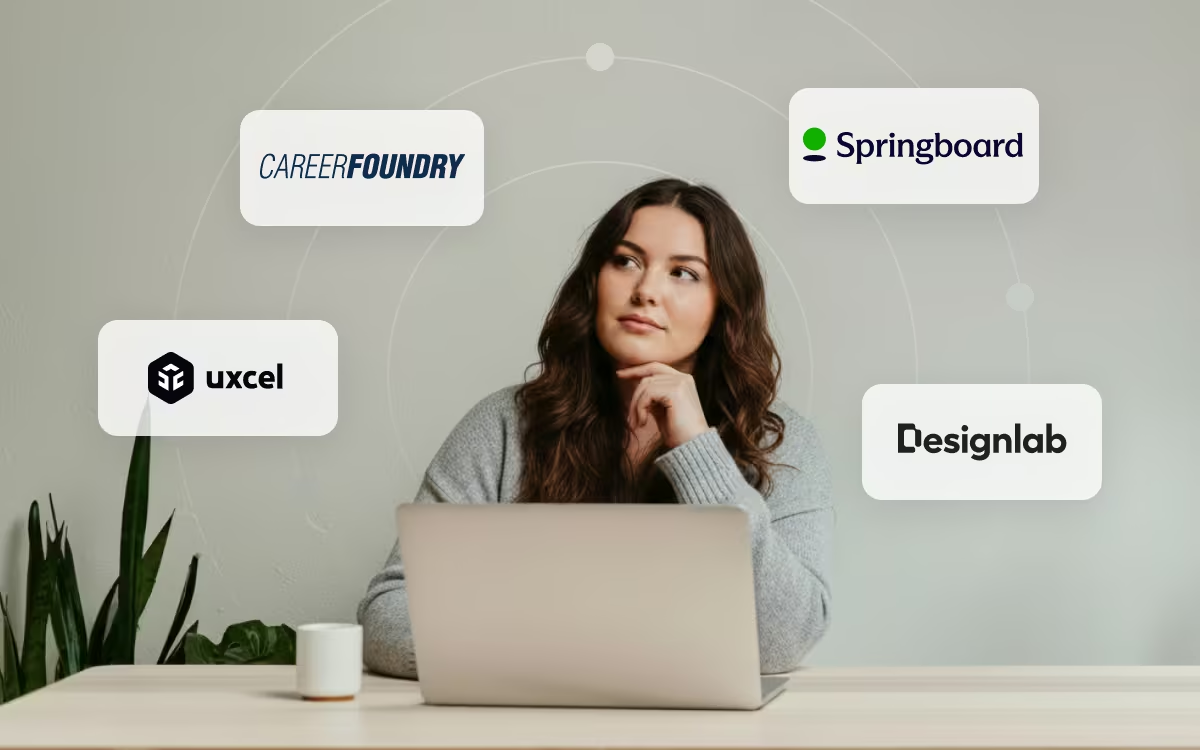
Program name: CareerFoundry Product Design Program
Current status: Closed (ceased operations February 28, 2026)
Cost (when operational): $7,900 in installments, or roughly $7,110 with the 10% upfront discount
Duration: 5 to 10 months depending on your pace (15-40 hours per week)
Format: 100% online, asynchronous, self-paced with milestone deadlines
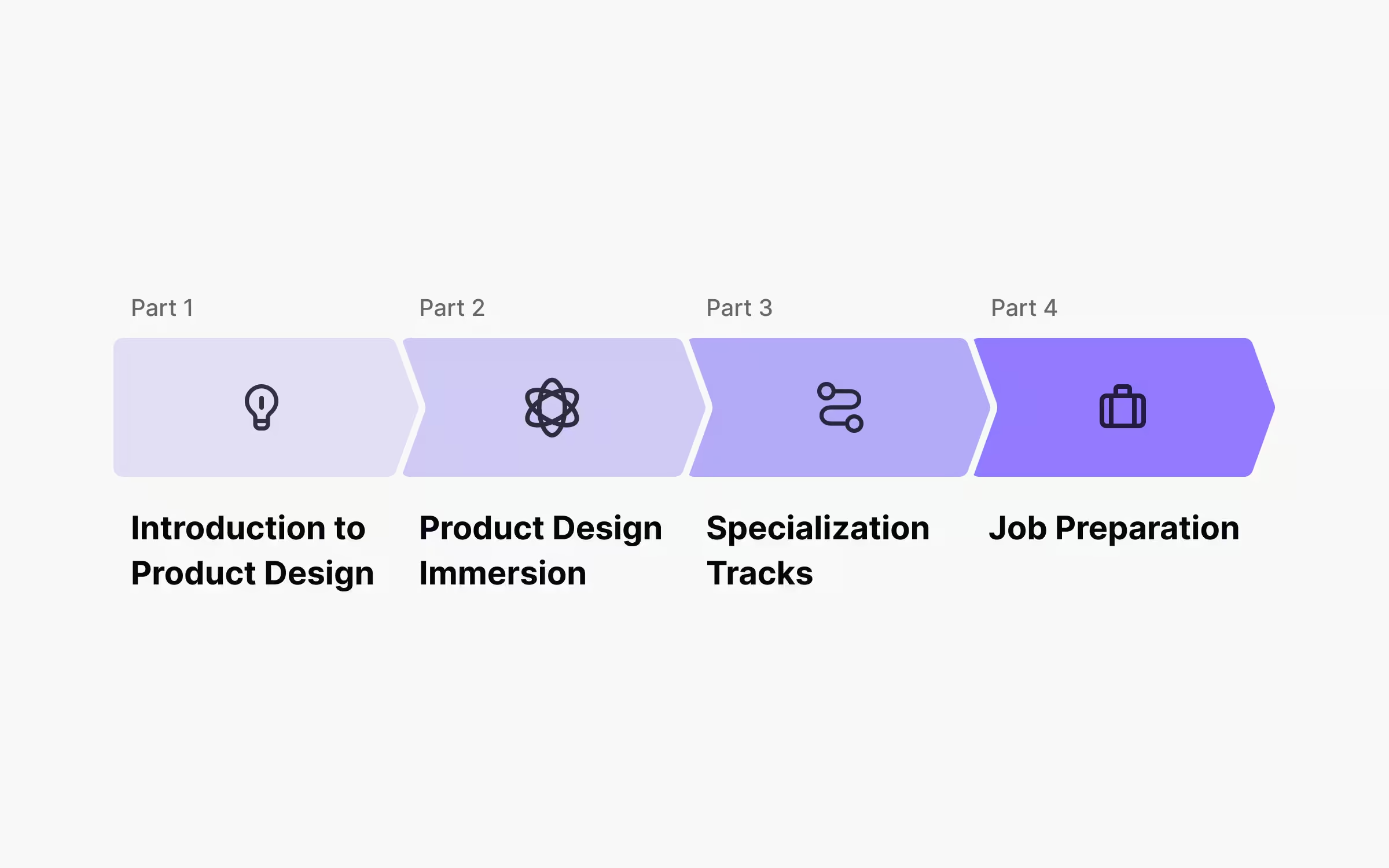
Structure: Four parts (Intro to Product Design, Product Design Immersion, Specialization, Job Preparation)
Mentorship: Dual model with a dedicated mentor, tutor, student advisor, student advisors, and career specialist
Job guarantee: Full tuition refund if no qualifying job within 6 months of graduation (strict eligibility requirements)
Review ratings: 4.66/5 on Course Report (1,531 reviews), 4.42/5 on SwitchUp Claimed placement rate: 96% within 180 days (self-reported, not independently verified)
Headquarters: Berlin, Germany (founded 2013, filed for bankruptcy October 2025)
One thing worth flagging immediately. Several of these numbers, particularly the 96% placement rate, came directly from CareerFoundry’s own reporting. With the company now closed through insolvency proceedings, those claims can no longer be verified or updated. Take them as context, not gospel.
What was CareerFoundry's product design program?
CareerFoundry launched in 2013 as an online career academy focused on helping people break into tech without traditional degrees. Co-founded by Raffaela Rein and headquartered in Berlin, the company built its early reputation around UX design and web development bootcamps before expanding into product design, UI design, data analytics, digital marketing, and product management.
The product design program was structured as a career-change package. Everything about it, from the curriculum to the mentorship model to the job preparation course, was designed for people coming from completely unrelated fields. Former pastors, taxi drivers, architects, chefs, and cashiers all went through the program. No design background required. No tech experience expected.
The company raised around $11.4 million in funding from investors including Tengelmann Ventures, IBB Ventures, and Verdane (which acquired CareerFoundry in April 2018). At its peak, CareerFoundry offered seven different programs and had built a global student base with graduates working at companies like Google, Apple, Amazon, and PayPal.
What made CareerFoundry different from more intensive bootcamps like Flatiron School or General Assembly was the pacing model. There were no fixed class times. No synchronous lectures. Students worked through the curriculum at their own speed, checking in with mentors and tutors along the way. The company called this “flexibly-paced,” and for working professionals who couldn’t quit their jobs to attend a full-time program, it was a genuinely practical approach that allowed students to maintain their current job while upskilling.
The dual mentorship model was the other signature feature. Every student was paired with two people: a tutor who reviewed assignments within 24 hours, and a senior mentor who provided career guidance and portfolio feedback. Add a student advisor for logistics and a career specialist for the job search phase, and each student technically had four support contacts throughout the program.
This four-person support structure was CareerFoundry’s answer to one of the biggest problems in online education: accountability. Self-paced courses have notoriously low completion rates (typically 5-15%). By surrounding each student with multiple touchpoints, CareerFoundry aimed to keep people engaged and progressing. The 24-hour tutor feedback loop was particularly important. When you submit an assignment at 10 PM and have feedback by the next evening, it creates a rhythm that keeps you moving forward. Delay that feedback by a week and momentum dies.
The mentor relationship worked differently. Mentors were senior product design professionals with 8+ years of experience. They didn’t review your daily assignments. Instead, they met with you weekly (or biweekly) to discuss your career direction, review your portfolio pieces at a high level, and provide insight into what the day-to-day reality of design work actually looked like. For career changers who had never worked in tech, this perspective was often cited as the most valuable part of the program.
The program earned approval from DEKRA (a German quality certification body) and was eligible for Germany’s Bildungsgutschein, an educational voucher from the employment agency that could cover the full cost for unemployed German residents.
CareerFoundry product design curriculum breakdown
The program broke into four distinct parts, each building on the last. Careerfoundry's curriculum is comprehensive and portfolio-focused, offering project-based learning with personalized mentorship throughout the course. The total timeline ranged from about five months at an intensive pace (30-40 hours per week) to ten months at a standard part-time pace (15-20 hours per week).
Part 1: Introduction to product design
This was an eight-lesson introductory course spanning roughly half a month to one month. The course was designed to introduce key components of product design, including the design thinking process and how to create a high level project plan. It covered design thinking fundamentals, user-centered solutions, and high-level project planning. Students who weren’t sure about committing to the full program could take this section standalone for $690, with a $590 credit toward the full program if they continued.
The intro section served a dual purpose. It gave complete beginners a foundation in how product designers think about problems, and it worked as a filter. Students who realized product design wasn’t for them could step away early without paying full tuition.
Part 2: Product design immersion course
This was the core of the program, running approximately 3.5 to 5.5 months depending on pace. Students completed six achievements that built on each other, producing a final product by the end.
The curriculum covered user research and analysis (including personas, journey maps, and task analysis), mobile strategy and site mapping, the foundations of UI design, building a design system, prototyping from low-fidelity sketches through high-fidelity clickable prototypes in Figma, interaction design, responsive design, emotional and visual design, usability testing, including how to usability testing develop prototypes through structured processes, and design handoff.
Figma was the primary tool, though the program was designed to be tool-agnostic. Students who preferred Adobe XD or Sketch could use those instead. The curriculum also integrated ethical use of generative AI tools in design workflows, a relatively recent addition that reflected the industry’s rapid shift.
The immersion phase was project-based. Students weren’t just reading about design concepts; they were applying each skill to build real portfolio pieces. Assignments included design thinking tasks such as creating user journey map based deliverables and gathering user feedback to inform iterations and improvements. Tutor feedback came within 24 hours of submission, which kept momentum going for students who were pushing through the material quickly.
One thing that stood out in reviews about this phase: the progression felt natural. Students described starting with research (interviewing users, building personas) and gradually layering on design skills until they were producing polished, clickable prototypes. By the end of the immersion, most students had produced at least two substantial portfolio pieces, with a third coming through the specialization.
That said, several reviews noted that the immersion phase was where the real time commitment kicked in. The intro course felt manageable. The immersion phase required sustained effort over months. Students who underestimated this often fell behind on milestone deadlines and had to request extensions.
Part 3: Product design specialization tracks
After completing the immersion, students chose one of three specialization tracks: User Interface Design for Designers, Frontend Development for Designers, or Voice User Interface Design. Each track was designed to help students gain specialized knowledge and the business skills required for advanced product design roles, ensuring they are prepared for real-world challenges.
The UI design specialization was the most popular choice, since UX/UI combined roles dominate the job market. Frontend development appealed to students who wanted to bridge the gap between design and code. Voice UI was the niche option, relevant but narrower in job market applications. In each specialization, students developed business skills relevant to their chosen focus area, such as market analysis, project planning, and stakeholder communication.
Part 4: Job preparation and career coaching
The final month focused entirely on career transition. A dedicated career specialist worked one-on-one with each student on resume refinement, LinkedIn optimization, portfolio presentation, mock interviews, networking strategy, and application processes. In addition, the career services team provided comprehensive career services, including guidance on the job search process and offering job search guidelines to help students secure employment.
This phase was directly tied to the job guarantee. Students who didn’t complete the Job Preparation Course weren’t eligible for the money-back guarantee, which created strong incentive to push through even when motivation flagged.
CareerFoundry product design program cost and payment options
The headline price was $7,900 paid in installments. But the real cost depended on which payment path you took.
If you paid the full tuition upfront, CareerFoundry applied a discount (sources vary between 5% and 10%, with BootcampRankings reporting 10% and Avocademy citing 5%). At the 10% discount, that brought the price down to roughly $7,110. At 5%, it was approximately $7,505.
For monthly installments, the structure was typically a $1,400 deposit followed by monthly payments over the remainder of the program. Loan financing was available through Ascent Funding, with repayment plans that included options to start payments before the program, pay reduced rates during, or defer until after graduation. Interest rates varied by credit profile.
CareerFoundry also offered a job guarantee refund: if a graduate did not secure a job within 180 days of graduation, and met all required application and engagement criteria, they could receive a full tuition refund. Eligibility depended on fulfilling specific conditions set by CareerFoundry.
German residents had an additional option. CareerFoundry was DEKRA-certified and approved for the Bildungsgutschein, an educational voucher from the German Employment Agency. Unemployed residents who qualified could take the entire program at no personal cost. This was a significant advantage for the company’s Berlin-based market.
For U.S. military personnel and veterans, CareerFoundry offered a tuition reduction, though the exact percentage wasn’t consistently published.
The program did not accept GI Bill benefits or offer income share agreements. No full scholarships were available on a regular basis, though periodic partial scholarships appeared occasionally.
How CareerFoundry's pricing compared to other bootcamps
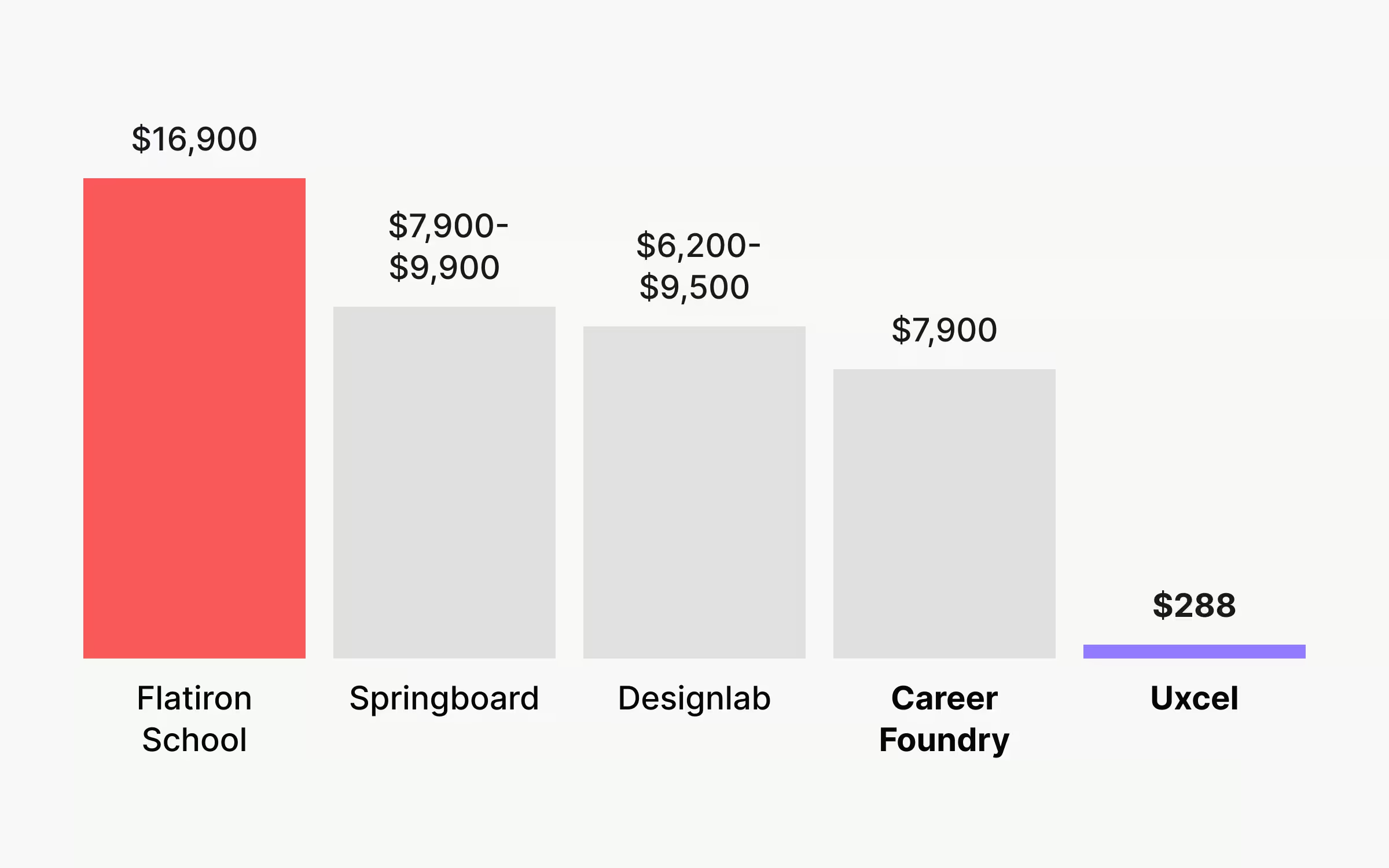
At $7,100-$7,900, CareerFoundry sat in the middle of the bootcamp price spectrum. Flatiron School's product design bootcamp ran $16,900. General Assembly's UX design immersive charged similarly. Springboard's programs range from $7,900 to $9,900. On the more affordable end, platforms like Uxcel charge $24/month ($288 annually), though that's a fundamentally different learning model focused on continuous skill building rather than a one-time career change program.
The hidden cost that most reviews don't mention: time. A 5-10 month program at 15-40 hours per week represents a massive investment of personal time, especially for career changers juggling existing jobs. At the minimum commitment of 15 hours weekly over 10 months, that's roughly 600 hours. At the intensive pace, it's about 800 hours in 5 months. The financial cost is what shows up on the invoice, but the time cost is what determines whether you actually finish.
There's also the opportunity cost to consider. During those months of studying, you're not earning overtime, building side projects, or investing that energy into other professional development. For someone making $50,000 a year, 600 hours of study time has an implicit cost that rivals the tuition itself.
CareerFoundry's 14-day cancellation policy offered a full refund if you changed your mind early. A prorated refund was available if you were 60% or less through the program duration. Beyond that point, you were committed.
Price: no longer sold. CareerFoundry ceased operations on February 28, 2026.
Who was CareerFoundry's product design program best for?
The program worked best for a specific type of learner. Understanding who thrived here (and who didn't) is useful even now, because the same patterns apply when evaluating alternatives.
The program worked well for people who:
- Were making a genuine career change from an unrelated field. The curriculum assumed zero design knowledge and built from the ground up. People from non-technical backgrounds (teaching, hospitality, healthcare, administration) found the on-ramp accessible.
- Needed flexible scheduling around existing commitments. Working professionals, parents, and anyone who couldn't attend fixed class times benefited from the asynchronous model. The ability to study at 6 AM or 11 PM, on weekdays or weekends, was a real differentiator.
- Valued structured guidance over pure self-direction. The dual mentorship model, milestone deadlines, and career specialist support provided accountability that pure self-paced platforms don't. Students who had tried (and abandoned) free online courses often found CareerFoundry's structure was what they actually needed.
- Could self-motivate through long stretches of independent work. Despite the support system, you were still alone with the curriculum for most of the day-to-day work. Consistency mattered more than bursts of intensity. Students who established regular study routines (same time, same place, every day) reported better outcomes than those who studied when they "felt like it."
- Had realistic expectations about the career transition timeline. The program took 5-10 months, but the job search often added another 3-6 months after that. Students who understood this upfront were more satisfied than those who expected to be employed immediately after graduating.
The program struggled with people who:
- Learned best through live, synchronous instruction. There were no live classes, no real-time cohort discussions, no in-person workshops. If you needed to watch an instructor work through problems in real time, this format didn't deliver that.
- Wanted collaborative, team-based design experience. Product design in the real world is deeply collaborative. You're working with engineers, product managers, stakeholders, and other designers constantly. CareerFoundry's curriculum produced individual portfolio projects, but the actual experience of designing as part of a team was missing.
- Were relying on the job guarantee as a financial safety net. We'll get into this in detail, but the eligibility requirements were strict and the refund process was increasingly controversial in the months before closure.
- Lived outside major metropolitan areas in eligible countries. The job guarantee only applied in metro areas with populations above 200,000 in the US, Canada, EU/EFTA, UK, Australia, and New Zealand. If you lived in a smaller city or an ineligible country, the guarantee was meaningless.
CareerFoundry product design reviews: what students said
I spent more time reading reviews for this article than I probably should have. Across Course Report (where over 1,500 people left reviews, averaging 4.66 out of 5), SwitchUp (4.42/5), Trustpilot (close to 200 reviews), and Career Karma, the picture that emerged was more complicated than any single rating suggests. Many students reported that they gained all the job skills and practical job skills necessary for the job market, and praised the clear and engaging presentation of the curriculum.
What students liked about CareerFoundry
The mentorship model came up more than anything else. People described their tutors and mentors as responsive, knowledgeable, and genuinely invested. The 24-hour turnaround on assignment feedback got mentioned over and over as a factor that kept them engaged. One pattern that stood out: students who proactively scheduled regular mentor calls reported significantly higher satisfaction than those who treated mentorship as optional.
Curriculum structure and quality earned consistent praise. Students described the material as logically progressive, well-organized, and practical. The project-based approach meant skills were applied immediately rather than just studied in theory. Several reviewers specifically mentioned that the curriculum was regularly updated, which they valued.
Flexibility was the third major positive. Students managing full-time jobs, family responsibilities, or both appreciated that they could adjust their pace without penalty. The milestone deadlines provided enough structure to prevent drift without creating the rigid pressure of synchronous programs.
The career change focus resonated deeply with students who felt intimidated by the tech industry. CareerFoundry's marketing and community explicitly welcomed people from any background, and students reported that this inclusive positioning matched the actual experience.
Common complaints about CareerFoundry's program
The job guarantee controversy is impossible to ignore. And honestly, this is what bothered me most in the research. Multiple recent reviews across platforms describe a pattern: students completing 100% of coursework, maintaining documented job searches with biweekly check-ins, applying to five or more jobs per week for six months, and then having their refund requests denied. One particularly detailed review on Course Report describes sending 15 emails to the program director and receiving zero responses. Another reviewer on Trustpilot called the guarantee a “marketing promise, not reality.” Some students went further, describing the refund process as indicative of a 'scam business model,' citing concerns about denied refunds and a lack of accountability when it came to fulfilling the job guarantee.
These aren’t isolated complaints. The eligibility requirements were genuinely stringent. You needed to live in a qualifying metro area, complete every component including the specialization, host your portfolio on a specific type of platform, and document everything precisely. Some students allege that criteria were applied retroactively or inconsistently. Others say requirements appeared during the refund process that were never mentioned during enrollment or in the program itself.
One student’s account stood out: they described having all four portfolio projects approved by their mentor, maintaining six months of documented job searching, and still being told they didn’t qualify. The reason given reportedly involved portfolio hosting requirements that weren’t part of the original terms they signed. Whether that specific claim is fully accurate, the pattern across multiple independent reviews is consistent enough to be concerning.
It’s also worth noting what the reviews don’t tell you. Students who landed jobs quickly had no reason to test the guarantee, so the positive outcomes and the guarantee complaints represent different populations. But for anyone who might have needed that safety net, the evidence suggests it wasn’t as reliable as the marketing implied.
Online learning isolation was the other recurring criticism. The asynchronous format, while flexible, meant students were essentially working alone most of the time. Collaborative tasks like user research, which are inherently team-based in the real world, had to be done individually. Several reviewers mentioned feeling lonely, especially during longer stretches between mentor calls. CareerFoundry tried to address this with an active Slack community and periodic events, but for some students, that wasn’t enough to replace the energy of learning alongside peers.
Mentor quality varied. While most reviews were positive, some students reported being assigned mentors who were unresponsive or lacked expertise in relevant areas. In a program that charged nearly $8,000, inconsistent mentor quality was a meaningful complaint. The mentorship model depended entirely on the individual match, and there’s no way to guarantee that every mentor-student pairing will click.
Some reviews of other CareerFoundry programs (particularly web development) flagged outdated content and deprecated code in exercises. The product design program, being newer, generally avoided this criticism, but it’s worth noting as a systemic issue that may indicate the company was struggling to maintain and update its content library even before the financial troubles became public.
Is a CareerFoundry certificate still worth anything?
While the CareerFoundry Product Design Bootcamp is no longer available, it’s worth noting that when it was offered, the program did not require previous experience in design or related fields. This made it accessible to beginners and career changers looking to break into product design. The certificate provided by the bootcamp was recognized by employers and could help demonstrate your commitment and foundational skills in product design.
CareerFoundry's job placement rates and salary claims
The company reported a 96% job placement rate within 180 days of graduation. They broke this down as 58% through direct application, 27% through networking and referrals, and 15% through recruiter outreach. Throughout the job hunt, the program provided students with resources and guidance to support their transition into new roles. The average salary increase for graduates was $13,725, with 47% reporting increases between $10,000 and $20,000. Graduates reportedly landed roles at companies including Google, Apple, Amazon, PayPal, Netflix, and Volkswagen. The average time from graduation to employment was 75 days.
How reliable were CareerFoundry's outcome statistics?
That 96% figure applied to "eligible graduates," meaning those who completed the full program including the Job Preparation Course and met all job guarantee requirements. It didn't count students who dropped out, paused indefinitely, or finished the curriculum but skipped the job prep phase. The real completion-to-employment rate across all enrolled students was certainly lower, though CareerFoundry never published that figure.
These were self-reported outcomes. No independent third party verified the numbers. With the company now closed through insolvency, there's no mechanism to audit or update these claims.
What to do if you already have a CareerFoundry credential
Your certificate doesn't disappear because the company closed. The skills you learned, the portfolio you built, and the projects you completed are yours. In practice, most hiring managers care far more about your portfolio and practical skills than about which bootcamp's name appears on your resume.
That said, the certificate carries less weight going forward. A credential from a company that went bankrupt doesn't signal the same thing as one from a program that's still building its reputation. The good news is that product design hiring has always been more portfolio-driven than credential-driven. Your case studies and design process matter more than your diploma.
If you're currently job hunting with a CareerFoundry background, focus your energy on strengthening your portfolio, continuing to build skills through other platforms, and networking within design communities. The training you received was real even if the company isn't.
What CareerFoundry's closure means for bootcamp credentials
CareerFoundry's collapse fits a pattern that anyone evaluating design education should understand. Thinkful was absorbed by Chegg and then shut down. Lambda School rebranded as BloomTech and then collapsed. General Assembly was acquired by Adecco and underwent significant restructuring. Now CareerFoundry. The intensive-bootcamp-with-job-guarantee model has proven fragile at this price point, particularly when company financials are strained.
The timeline tells a story. CareerFoundry filed for bankruptcy on October 1, 2025, through the Local Court of Charlottenburg in Berlin. By February 28, 2026, all operations had ceased. The company's intangible assets, including its brand, curriculum content, and certifications, were sold to CF Training GmbH, a separate entity that explicitly stated it would not continue CareerFoundry's business. That last detail matters. When a company sells its assets in bankruptcy, the buyer gets the intellectual property but not the obligations. No continuation of student programs. No honoring of job guarantees. No access to the same mentors and career specialists.
The fact that CareerFoundry's own official closure notice had to clarify that CF Training GmbH would not continue operations suggests that some confusion existed. Students may have hoped the program would continue under a new name. It won't.
This doesn't mean all bootcamps are risky. But it does mean the job guarantee, which was often the primary reason people chose these programs over cheaper alternatives, needs to be evaluated skeptically. A guarantee from a company that might not exist in two years isn't much of a guarantee. When you're evaluating programs, pay as much attention to the company's financial health and longevity as you do to the curriculum.
Common questions about CareerFoundry’s product design program
Is CareerFoundry still accepting students?
No. CareerFoundry ceased all operations on February 28, 2026, following insolvency proceedings that began in October 2025. The company’s website now shows only a closure notice. No new courses are being offered and existing programs were not continued.
What happened to students who were mid-program?
CareerFoundry’s closure statement does not describe any continuation path for enrolled students. Selected intangible assets (trademark rights, learning content, and certifications) were sold to CF Training GmbH, but that company explicitly stated it would not continue CareerFoundry’s operations. Students who were mid-program at the time of closure were effectively left without a completion path and should contact the insolvency administrator for guidance on their specific situation.
Is the CareerFoundry job guarantee still valid?
For anyone affected by the closure, the job guarantee is effectively void. The company that would need to process a refund no longer operates. Students with pending refund claims should contact the insolvency administrator, though recovery of funds through insolvency proceedings is typically limited.
Were CareerFoundry certificates accredited?
CareerFoundry’s programs were not university-accredited. The Product Design Program was ZFU-approved (a German distance-learning quality certification) and DEKRA-certified, which qualified it for the German Bildungsgutschein program. These were professional training certifications, not academic degrees.
How long did the program take to complete?
The standard timeline was 10 months at a part-time pace of 15-20 hours per week. Students who could commit 30-40 hours weekly completed it in approximately 5 months. Two deadlines built into the program helped students stay on track.
Can I still access CareerFoundry course materials?
This is unclear. CF Training GmbH acquired some of CareerFoundry’s intellectual property, including learning content, but stated it would not continue the business. Students who previously had access may want to download or save any materials they can still reach, as long-term access is not guaranteed.
Did CareerFoundry offer a free trial or intro course?
Before closure, CareerFoundry offered a free five-day product design short course and a standalone Intro to Product Design course for $690 (with $590 credit toward the full program). Neither is currently available.
What tools did the program teach?
Figma was the primary design tool, though the program was tool-agnostic (students could use Adobe XD or Sketch instead). The curriculum also covered ethical use of generative AI tools in design workflows. Students received free trials and discounts for various industry-standard tools through CareerFoundry’s partnerships. The program prepared students to become a ux designer through a comprehensive ux design course that included hands-on design thinking workshop experiences and opportunities to facilitation learn diverse methodologies.
Were the portfolio projects any good?
Reviews were generally positive about portfolio quality. Students produced multiple case studies spanning user research, wireframing, prototyping, and final designs. The projects followed a realistic product design process. However, some graduates noted that the projects felt somewhat formulaic and that employers wanted to see additional work beyond what the program produced. Students who supplemented the curriculum with independent projects or redesigns of real products fared better in the job market.
How did CareerFoundry compare to Flatiron School?
Flatiron School’s product design bootcamp cost $16,900, more than double CareerFoundry’s price. Flatiron offered both synchronous and in-person options with a studio-based immersion model. CareerFoundry was entirely asynchronous and self-paced. Both offered job guarantees, though both have also faced scrutiny on guarantee fulfillment. Flatiron has since withdrawn its product design bootcamp entirely; as of 2026 its catalog covers only AI and data science, software engineering, and cybersecurity.
What did the course content include?
The curriculum covered the full product design process, including user research, ideation, prototyping, and usability testing. Students learned market research techniques and had the opportunity to learn market research techniques as part of the curriculum.
What other programs did CareerFoundry offer?
In addition to the Product Design Program, CareerFoundry also offered a digital marketing program for those interested in marketing skills.
Best CareerFoundry alternatives for product design in 2026
If CareerFoundry was on your shortlist, you need a new plan. The good news: the skills you were going to learn there haven’t changed. User research, prototyping, design systems, usability testing, Figma. Those fundamentals are platform-independent. The question is which learning model fits your life, your budget, and your goals.
Alternatives also include a stack web development program for aspiring web developers, as well as a data analytics course designed to prepare students to become a qualified data analyst.
Here are three alternatives worth considering: Uxcel (for continuous, affordable skill development with documented career outcomes), Springboard (if you want the mentored bootcamp structure CareerFoundry offered), and Designlab (if portfolio-focused projects with expert feedback are your priority).
Uxcel: affordable, continuous product design skill building
Uxcel is a gamified learning platform launched in 2020 that takes a fundamentally different approach to design education, including a product design certificate for learners who want a credential alongside the skills. Instead of a one-time bootcamp you complete and move on from, Uxcel treats skill development as an ongoing practice, something more like Duolingo for design and product management.
If you’re interested in digital marketing, Uxcel also offers a digital marketing immersion track that emphasizes hands-on, real-world learning. This phase is designed to deeply immerse students in practical digital marketing skills through experiential projects as part of a structured curriculum.
The platform difference matters here. CareerFoundry charged $7,900 for a single program that might take 10 months. Uxcel costs $24 per month ($288 annually). That’s not a typo. The pricing gap reflects a different philosophy: bite-sized, interactive lessons you work through in five-minute sessions rather than a structured multi-month curriculum.
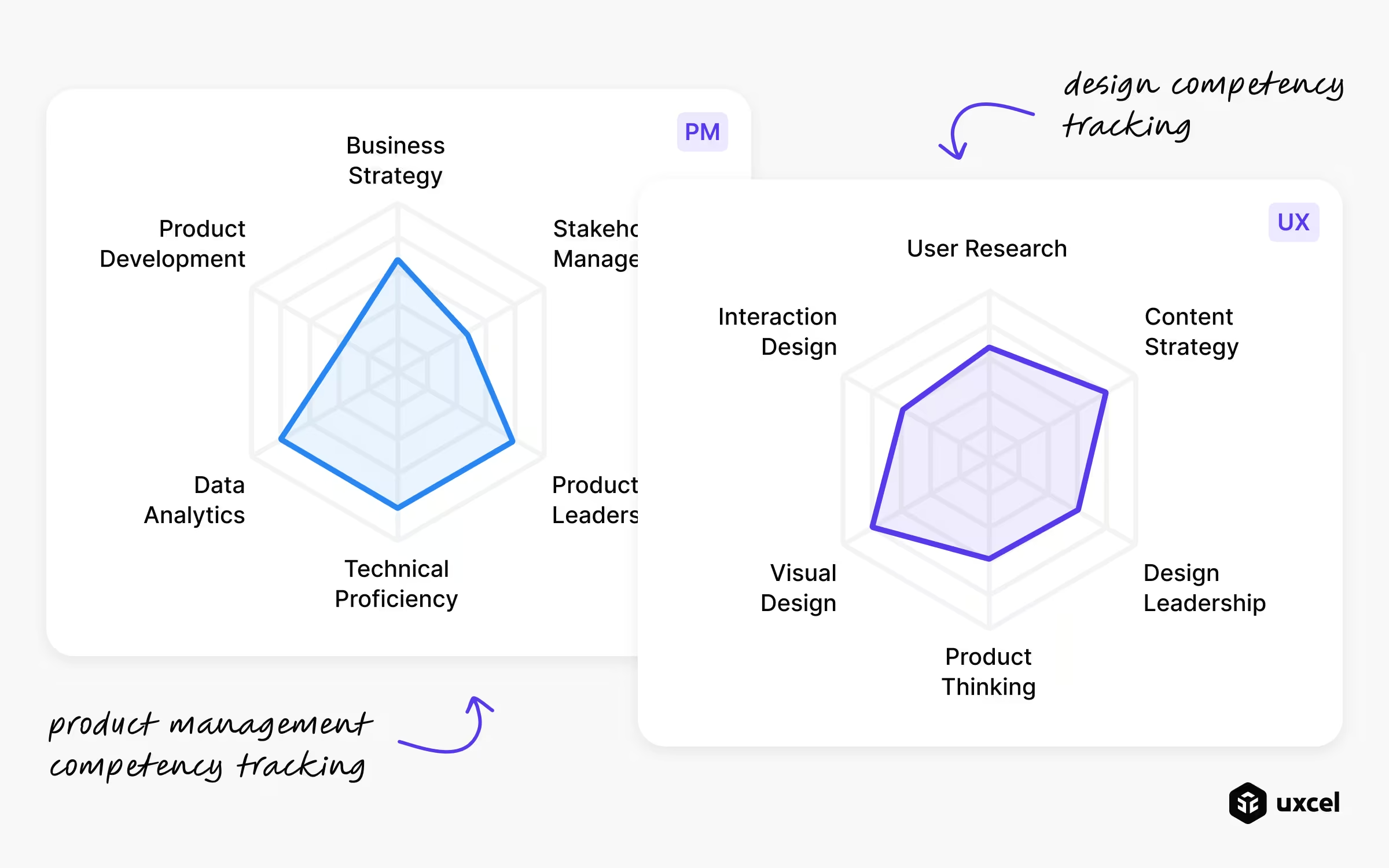
What makes Uxcel genuinely different from other platforms is the cross-functional skill mapping. The system tracks your competencies across both UX design and product management simultaneously, showing you exactly where your strengths are and which skills to develop next — useful if you want to learn product management as a designer without leaving your current discipline. No other platform does this. For someone who wants to understand how design and product strategy connect, that’s a meaningful feature.
The outcomes data is worth noting. According to Uxcel’s Impact Report, 68.5% of users report getting promoted after using the platform, with an average salary increase of $8,143. The completion rate sits at 48-50%, which is roughly 10 times the industry standard for online courses. Over 500,000 users across 140 countries use the platform, and enterprise clients include Microsoft, Deloitte, and PwC.
Uxcel works across web browsers and native iOS and Android apps, with progress syncing across all devices. That flexibility means you can study during a commute, on a lunch break, or at a desktop, and nothing gets lost.
Honest limitations: Uxcel is not a bootcamp replacement for someone who needs a structured, mentor-guided career change program with portfolio projects and 1-on-1 career coaching. It doesn’t build out a full portfolio for you. It doesn’t pair you with a senior designer for weekly calls. If you need that kind of intensive hand-holding during a complete career transition from a non-technical field, you need something with more scaffolding.
The platform also doesn’t offer live instruction. Everything is interactive and self-directed. For some learners, that’s perfect. For others who need a human guiding them through concepts in real time, it’s a gap.
That said, what Uxcel does offer is something no bootcamp provides: ongoing, affordable skill development that doesn’t end when you “graduate.” The design industry evolves constantly. Tools change. Best practices shift. Having a platform you can return to daily for $24 a month is fundamentally more sustainable than paying $7,900 once and hoping those skills stay relevant.
Uxcel works best for working professionals who want to build or sharpen design and product skills without committing $7,000+ and 10 months. Career changers who want to test whether they want to become a product designer before investing in a bootcamp. Mid-level and senior designers who want to expand into product management (or vice versa), taking advantage of the cross-functional skill mapping that tracks competencies across both disciplines. Teams and companies looking to upskill designers and PMs together. Anyone who’s tried expensive programs that didn’t stick and wants something that actually builds daily learning habits.
That limitation, the lack of intensive 1-on-1 career coaching, is exactly where Springboard excels.
Springboard: structured mentorship with a job guarantee
Springboard offers a UX design bootcamp with a career-change focus that's close to what CareerFoundry provided. The program includes 1-on-1 mentorship, a project-based curriculum, and career coaching with a job guarantee.
Springboard's pricing sits around $7,900 to $9,900 depending on the program and payment method. The format is online and self-paced with a structured timeline, typically 6 to 9 months. Students get weekly mentor calls, regular career coach check-ins, and access to a student community.
The curriculum covers UX research, interaction design, visual design, and prototyping. Students build multiple portfolio projects throughout the program. The job guarantee offers tuition reimbursement if you don't land a qualifying role within six months of graduation.
Springboard's key advantage is that it's still operational and has a longer track record of honoring its job guarantee. The company has been around since 2012 and has maintained a more diversified course catalog. The mentor matching process is generally well-reviewed, with students consistently praising the quality of their 1-on-1 sessions.
The downside is the higher price point and the fact that, like CareerFoundry, it's an asynchronous format that can feel isolating. Some students also report that the curriculum moves slowly in early modules, covering material that more motivated learners could get through faster. The job guarantee also comes with strict requirements similar to CareerFoundry's, so read those terms carefully before treating it as a safety net.
One thing to verify before enrolling: Springboard's current pricing and guarantee terms. Bootcamp pricing changes frequently, and the specific conditions of any job guarantee should be confirmed directly with the provider. Don't rely on outdated review articles (including this one, eventually) for current pricing.
Springboard works best for career changers who can afford the investment and need the structured accountability of a bootcamp format with real career support. If what you liked about CareerFoundry was the combination of self-paced study with dedicated mentorship, Springboard is the closest active replacement.
Designlab: portfolio-focused UX design program
Designlab runs a UX Academy program centered on building a professional portfolio through hands-on projects with expert mentor feedback. The program lasts about 6 months with a commitment of roughly 20-25 hours per week.
Pricing is around $6,200 to $9,500 depending on the payment plan. The program pairs students with industry mentors for weekly 1-on-1 sessions and includes career preparation support. Designlab offers a tuition reimbursement policy (their version of a job guarantee) for graduates who meet eligibility requirements.
What sets Designlab apart is the emphasis on portfolio depth. Students produce multiple case studies with detailed mentor feedback throughout the process. The focus is less on theoretical breadth and more on producing work that demonstrates your abilities to hiring managers. In a market where portfolios matter more than credentials, this approach has real value.
Designlab's mentors are practicing designers, not career coaches who happen to know about design. The weekly 1-on-1 sessions are structured around reviewing student work, which means feedback is specific and actionable rather than generic. Students describe the experience as closer to an apprenticeship than a traditional course.
The downsides: Designlab requires more weekly hours than CareerFoundry's minimum commitment, the pricing is comparable to a full bootcamp, and the program expects some baseline design aptitude going in. Complete beginners from non-visual fields may find the learning curve steeper than CareerFoundry's beginner-friendly approach. The self-paced flexibility exists but is less forgiving than CareerFoundry's model, with more structured expectations around weekly deliverables.
There's also a narrower scope. Designlab focuses heavily on UX/UI design rather than the broader "product design" umbrella that CareerFoundry covered. If you're specifically interested in the strategic, business-oriented side of product design (stakeholder management, product strategy, cross-functional collaboration), Designlab is less focused on those areas.
Designlab works best for people who already have some design interest or aptitude and want to focus on building a strong portfolio with expert guidance. If CareerFoundry appealed to you primarily because of its portfolio projects and mentorship, Designlab delivers those same elements with arguably more intensity.
CareerFoundry alternatives compared: Uxcel vs. Springboard vs. Designlab
| Feature | Uxcel | Springboard | Designlab |
|---|---|---|---|
| Cost | $24/month ($288/year) | $7,900-$9,900 | $6,200-$9,500 |
| Duration | Ongoing (self-paced) | 6-9 months | \~6 months |
| Format | Bite-sized interactive lessons | Online, self-paced with mentorship | Online, mentor-guided projects |
| Completion rate | 48-50% | Not publicly reported | Not publicly reported |
| Portfolio projects | Project briefs available | Multiple included | Core focus of program |
| Career support | Skill mapping, assessments | Job guarantee, career coaching | Tuition reimbursement, career prep |
| Best for | Continuous skill building, affordability | Career changers needing structure | Portfolio-focused learners |
Looking at these side by side, the choice depends on what you actually need. If CareerFoundry's price was already a stretch, Uxcel removes the financial barrier entirely. If you specifically need the bootcamp structure with career coaching, Springboard is the closest replacement. If your primary concern is building a portfolio that gets you hired, Designlab is purpose-built for that.
The comparison also reveals something important about the current state of design education. The market has shifted away from the one-size-fits-all bootcamp model toward more specialized options. You don't have to choose a single program and hope it covers everything. You can combine a continuous learning platform for foundational skills with targeted portfolio projects, community involvement for networking, and free resources for supplementary learning. That modular approach is often more effective and significantly cheaper than any single bootcamp.
Consider this combination as an example: start with Uxcel's design courses ($24/month) to build and validate your design skills through interactive exercises and assessments. Use the skill mapping feature to identify specific gaps. Then invest in a focused portfolio-building program or work on independent case studies using real products. Supplement with free resources from YouTube, design blogs, and community events. Total cost: a fraction of any bootcamp, with arguably better long-term outcomes because you're building habits that continue beyond graduation.
For most people reading this, roughly six out of ten, Uxcel makes the most sense. It costs a fraction of a bootcamp, the completion rates are documented and exceptional, the skill mapping is unique in the market, and it works around any schedule. The other four have specific needs: intensive career coaching and accountability during a full career transition (Springboard), portfolio-first learning with deep weekly mentor feedback (Designlab), or in some cases, a combination approach where you start with Uxcel to build foundations and add a focused program later when you know exactly what gaps to fill.
What about the product management program?
The bankruptcy took CareerFoundry's Product Management Program down with everything else. It sold for $6,900 with a dual mentorship model, a senior PM mentor plus a dedicated tutor, and a job guarantee within six months of graduation. The guarantee died with the company, which is the risk nobody prices into a bootcamp decision.
We reviewed that program in depth while it was alive, and the honest summary is that it charged almost double what comparable bootcamps asked without outcomes to match. If you were considering the PM track, the decision now works the same way as design: pick a living provider and verify it the same way. Our comparisons of product management certifications and product management courses cover the current options, with prices checked in August 2026.
Final verdict
Was CareerFoundry's product design program worth it? Well, no. Since it doesn't exist anymore.
But the question behind the question, whether the type of education CareerFoundry provided was valuable, has a more complicated answer.
What CareerFoundry did well
The dual mentorship model was a genuinely good idea that students consistently praised. Having separate people for assignment feedback (tutor) and career guidance (mentor) addressed different needs without overloading any one person. The flexible pacing was ahead of its time and remains the format that works best for working professionals making career transitions. The curriculum was comprehensive, regularly updated, and practical. Students who completed the program came out with real skills and portfolio work.
At its best, CareerFoundry represented what online education could be: accessible to anyone regardless of background, flexible enough to fit real life, and supportive enough to carry people through the inevitable hard moments of learning something new.
The company's Berlin roots and global reach also meant a genuinely diverse student body. Graduates came from over a dozen countries, bringing perspectives from fields as varied as hospitality, healthcare, education, and the arts. That diversity enriched the Slack community and, according to multiple reviews, made the learning experience feel less like a tech bubble and more like a genuine cross-section of people trying to build better futures.
Why CareerFoundry shut down
The business model was fragile. Charging $7,900 per student with a job guarantee in a tightening job market creates enormous financial exposure. When graduates can't find jobs (partly due to market conditions outside anyone's control), refund obligations stack up. When the company struggles to honor those refunds, trust erodes. When trust erodes, enrollment drops. When enrollment drops, revenue falls. That's the spiral that ended in insolvency.
There's a structural problem with the job guarantee model that extends beyond CareerFoundry. These guarantees work beautifully in a hot job market. Companies can afford to offer them because most graduates land jobs quickly, so refund payouts are minimal. But when the market cools, as it did across tech in 2023-2024, the math inverts. More graduates trigger the guarantee. Refund costs climb. And the company has to choose between honoring expensive promises and staying solvent. I kept thinking about this while reading through the timeline. It's almost predictable in hindsight.
The timing mattered too. CareerFoundry had raised $11.4 million in funding over its lifetime. It was acquired by Verdane, a Nordic private equity firm, in 2018. The pressure to show returns on that investment likely drove decisions about growth, pricing, and the aggressiveness of the job guarantee marketing. When market conditions shifted, the gap between what the company promised and what it could deliver widened.
The job guarantee controversy also damaged trust before the closure. Whether or not CareerFoundry was technically correct in denying specific refund claims, the pattern of student complaints created a narrative that the guarantee was more marketing than substance. In an industry built on trust and word-of-mouth, that's fatal. Prospective students research programs heavily. They read reviews. When they see multiple people describing the same pattern of denied refunds, they choose a different program. And each lost enrollment makes the financial situation worse.
What CareerFoundry's closure means for your decision
If you were planning to enroll in CareerFoundry, redirect that energy. The skills you wanted to learn are available through multiple active platforms at various price points and commitment levels. The specific combination of flexible pacing, mentorship, and career support that CareerFoundry offered can be assembled through alternatives, sometimes at a lower total cost.
If you already graduated from CareerFoundry, your training was real and your skills are valid. Focus on your portfolio, continue learning through platforms like Uxcel, and build your professional network. The company's closure doesn't erase what you learned.
And if there's a broader lesson here, it's this: be cautious about programs where the job guarantee is the primary selling point. A guarantee is only as strong as the company behind it. Skills, portfolio work, and genuine learning, those stay with you regardless of what happens to the institution that provided them.
What to do next if you were considering CareerFoundry
If you came here researching bootcamps, here's the practical path forward.
First, get clear on what you actually need. Are you a complete beginner who needs a structured, mentor-guided career change? Or are you someone with adjacent skills (graphic design, marketing, development) who mainly needs to fill specific gaps? The answer determines whether you need a full bootcamp or whether a platform like Uxcel combined with self-directed portfolio projects would get you where you're going faster and cheaper.
Second, check the financial health of any program you're considering. Look for signs of stability: consistent enrollment, active alumni community, transparent outcomes reporting, and positive trajectory. The red flags are usually visible before a closure, if you look for them. Delayed responses from admissions, sudden staff changes, course material that hasn't been updated, and students reporting communication issues with administration.
Third, don't put all your eggs in one basket. Even if you choose a bootcamp, supplement it with ongoing learning through platforms like Uxcel for daily skill practice. Build your network independently through design communities, local meetups, and LinkedIn. Develop your portfolio with projects beyond what any program assigns. The students who succeeded with CareerFoundry, and who will succeed with whatever comes next, are the ones who treated the program as one tool among many, not the entire toolkit.
Disclaimer: This review is based on independent research conducted in April 2026 using publicly available data. Information such as pricing, curriculum, and outcomes may change over time. Uxcel is included as one of several alternative learning options for comparison.