
Flatiron School Product Design Bootcamp Review

If you're researching Flatiron's product design bootcamp, you're probably weighing a $16,900 decision during one of the trickiest job markets the design industry has seen in years. Before committing that kind of money, it helps to understand what a career as a product designer actually demands and whether an intensive bootcamp is the fastest way in. That's not a small thing.

The bootcamp landscape looks different than it did even two years ago. AI tools have reshaped daily design work. Several well-known programs have shut down or quietly gutted their career support. Hiring has slowed across tech, and junior roles are harder to land than the glossy testimonial pages suggest. Flatiron has held up better than most through all of this, but "better than most" isn't the same as "perfect for everyone."

So here's what this review actually does. I went through 200+ student reviews across Course Report, SwitchUp, Career Karma, Reddit, and Quora. I cross-referenced Flatiron's published outcomes data with third-party sources. I compared their pricing, curriculum, and career support against every major competitor still operating in 2026. And I looked at all of it through the lens of today's job market, not 2019's.

What I found is that the full-time program genuinely delivers for the right person. The career services are strong, the studio phases simulate real work in ways most bootcamps don't, and the cohort experience matters. But the Flex program has real problems, the price is steep when solid alternatives exist at a fraction of the cost, and the job placement numbers don't tell you as much as Flatiron implies.

This review covers the full picture: curriculum breakdown, honest student feedback, real costs (including the ones Flatiron doesn't advertise), job market realities, who this works for, who it doesn't, and what to consider instead. Everything you need to make a decision you won't regret.

What do you need to know upfront?

Before we dig deeper, here are the basics:

Program name: Flatiron School UX/UI Product Design Bootcamp

Provider: Flatiron School (founded 2012, New York City)

The Flatiron School program is one of several rigorous and selective programs offered by Flatiron School.

Duration: 15 weeks full-time (Live) or 40 weeks part-time (Flex)

Cost: $16,900 standard tuition (promotional pricing as low as $9,500 for select cohorts)

Format: Online and on-campus (New York City, Denver)

Prerequisites: No prior design or coding experience required

Career support: 180 days of 1:1 career coaching post-graduation

Job placement: Around 86-90% of job-seeking graduates placed within reporting period (all programs combined)

Average starting salary: $72,000-$75,000 (all programs combined)

Ratings: 4.7/5 Career Karma (322 reviews), 4.46/5 Course Report, 4.59/5 SwitchUp

Acceptance rate: Around 5-8% (selective admissions)

Alumni network: 20,000+ graduates across all programs

Scholarships: Available for underrepresented groups (over $10 million awarded total)

Flatiron School's product design bootcamp quick facts

Flatiron School's product design bootcamp is part of a broader curriculum that also includes software engineering, data science, and cybersecurity engineering.

Flatiron School offers a range of programs for aspiring tech professionals. Flatiron School courses cover software engineering, data science, cybersecurity, and product design, providing comprehensive training across these disciplines.

Note: Program and eligibility requirements apply for both scholarships and admissions. Be sure to review the specific criteria and application process if you’re considering applying.

One thing to flag immediately: those job placement and salary figures cover all Flatiron programs, not just product design. The school doesn’t publish design-specific outcomes data. That’s a transparency gap worth noting before we go further.

What exactly is Flatiron School's product design program?

Flatiron School launched in 2012 as a coding bootcamp in a small walk-up in Manhattan. Adam Enbar, a venture capitalist, and Avi Flombaum, a self-taught programmer, built it around one idea: give people practical tech skills that actually lead to jobs. Over a decade later, they’ve grown to 20,000+ alumni, campuses in New York and Denver, and four core programs: software engineering, data science, cybersecurity, and product design.

The school has built a reputation for transparency. They’ve published independently verified jobs reports every year since 2014, which was a first in the bootcamp industry. They’ve also committed over $10 million in scholarships for underrepresented groups, partnered with organizations like GitHub, and maintained selective admissions (around 5-8% acceptance rate historically). Companies like Google, Amazon, Netflix, and Apple employ Flatiron alumni, though that stat spans all programs, not just design.

The Flatiron School program is known for its competitive and highly selective admissions process, which contributes to its strong reputation and rigorous standards. With a low acceptance rate, gaining admission is considered by many to be "flatiron school hard," and the program attracts applicants who are ready for a challenge.

The admissions process consists of five steps, starting with the application. After you apply, a member of the admissions team will reach out to discuss your goals and help guide you through the next stages. Applicants are required to complete a 15-minute critical thinking and problem-solving admissions assessment, which is a key part of the evaluation. The admissions team assesses your suitability for the program and provides personalized support throughout the process, making the journey to enrollment both thorough and competitive.

The Product Design program is the newest addition. It launched in 2021, replacing an older UX/UI Design immersive that forced students to specialize in either UX or UI. The school scrapped that approach after market research and hiring manager feedback made one thing clear: employers want designers who can do both.

Giovanni Difeterici, who directs the Product Design program, explained the shift in a Course Report interview. The old program produced graduates with either a UX portfolio or a UI portfolio. Hiring managers wanted people who could handle end-to-end product design, from research through visual execution. So Flatiron rebuilt the curriculum from scratch using what they call “backward design,” starting with what junior product designers actually do on the job and working backward to figure out what students need to learn.

Joshua Robinson, Director of Product Design, described the process in a Career Karma interview. The team met directly with hiring managers and companies building design teams. They asked to see the actual work these companies expected from junior and associate product designers. Then they built the curriculum to match. The school continues to validate the program with hiring partners, showing them student work and asking whether it meets their expectations. That ongoing feedback loop is something most competitors don’t publicize.

The curriculum is organized into five phases. The first two phases teach foundational UX and UI skills. Phases three and four are studio projects that simulate a real work environment, with instructors acting as your “manager” rather than your teacher. Phase five focuses on building your portfolio and preparing for the job search.

This structure is one of Flatiron’s genuine differentiators. The studio phases don’t just have you completing assignments. They put you in situations where you need to manage deadlines, incorporate feedback from a lead, and make judgment calls about your design process. That mirrors what entry-level designers actually face on the job, which is a step beyond what most lecture-based bootcamps offer.

The program is available in two formats: full-time (Live) and part-time (Flex). Full-time runs 15 weeks, roughly 8 hours a day, Monday through Friday. You attend live lectures, work with a cohort, and move through the curriculum on a fixed schedule. The part-time Flex option stretches to 40 weeks with recorded lectures, optional live sessions, and a self-paced approach.

What will you actually learn?

The curriculum spans five phases, and each one builds on the last. Flatiron School’s product design bootcamp features an industry aligned curriculum, ensuring students acquire relevant skills for the job market. Both the online and on-campus programs follow the same curriculum, so students receive consistent, high-quality instruction regardless of format. Here’s what’s inside.

Flatiron PD bootcamp curriculum


Students start by learning the essential components of the User Experience Design process, including tools, best practices, and research methods. This phase is structured to provide a strong technical foundation, focusing on user empathy, interaction design, and the fundamentals of creating digital products.


This phase covers the user interface process, where students learn to design digital products such as websites and mobile apps. The curriculum emphasizes design patterns and their importance in building effective user interfaces. Students also explore creativity and analytics, both of which are essential skills for product designers.


Students participate in two studio sessions that focus on practical application. Here, they work on real world scenarios and complete coursework that simulates actual job tasks, emphasizing real-world problem-solving and effective communication of design choices to stakeholders. These sessions result in product design deliverables and help students build a comprehensive education in both UX and UI design.


In the final phase, students complete a portfolio of projects and at least one case study, demonstrating their skills and knowledge. The program emphasizes job readiness as a key outcome, preparing students for roles such as product designer, UX designer, and UI designer.

Flatiron School’s product design bootcamp allows students to choose between full-time and part-time options, offering flexibility for those with other commitments. The curriculum is designed to prepare students for various roles in the tech industry, with a focus on both creativity and analytics, and is aligned with industry standards to ensure graduates are ready for the job market.

Phase 1: The UX process

This is where you learn to think like a researcher. You'll cover user empathy, problem discovery, research methodologies, and how to turn insights into actionable design decisions. Flatiron recently added generative AI as a research analysis tool in this phase, which is a smart nod to how the industry is actually working right now.

You'll learn about the artifacts UX designers create, from user personas to journey maps to research reports. The goal is understanding how to identify problems, validate assumptions, and communicate findings to stakeholders. Students learn multiple types of research: exploratory, market, and evaluative. The emphasis here is on process, not tools. You're learning how UX professionals think about problems before you start pushing pixels.

A key detail: the pre-work you complete before Phase 1 (around 20-40 hours) is meant to put everyone on equal footing regardless of background. You'll already have a working knowledge of basic UX and UI concepts and Figma fundamentals before day one. That means Phase 1 can move fast without leaving total beginners behind.

Phase 2: The UI process

Phase 2 shifts to visual execution. You’ll work with design principles, typography, layout, design systems, and interaction patterns. A core focus of this phase is building effective user interfaces for digital products such as websites and mobile apps. You’ll learn about design patterns and how they guide the creation of functional mockups and user interface development. Figma is the primary tool, which tracks with what the industry uses. You’ll also get into responsive design for different screen sizes and learn to design mobile apps for both iOS and Android. The curriculum emphasizes both creativity and analytics, which are essential skills for product designers.

This phase also introduces HTML and CSS. That might surprise you for a design bootcamp, but it’s intentional. Flatiron’s hiring manager research found that even entry-level product designers benefit from understanding basic web development. It helps with developer handoff and makes you more competitive in the job market. You won’t become a front-end developer, but you’ll understand the basics of how your designs get built, and that matters to the engineers you’ll work with.

You’ll also cover ethical and inclusive design, which Flatiron positioned as a foundational element of the curriculum, not an afterthought. That includes accessibility, privacy considerations, and designing for underrepresented groups. In a market where companies face increasing scrutiny around digital accessibility (and in some regions, legal requirements), this is a practical skill, not just a values statement.

Phases 3 and 4: UX UI design studios

This is where the program gets interesting. Instead of more lectures and assignments, you get simulated work projects that immerse you in real-world scenarios. The instructor becomes your “manager.” You receive briefs, manage your time, make design decisions, and present your work for review. During these studio phases, students complete coursework that simulates actual job tasks, requiring them to apply both UX and UI processes in practical settings.

Flatiron School’s product design bootcamp includes a UI process course, a UX process course, and two studio sessions for practical application. Students complete these two studio sessions, resulting in product design deliverables that can be showcased in a portfolio.

Phase 3 is your first pass at this format. The briefs are guided, the expectations are clear, and there’s more support. Phase 4 ramps up the complexity. You’re expected to lead projects more independently, handle ambiguity, and produce work that would hold up in a portfolio review.

What this looks like day to day: you might receive a problem statement on Monday, conduct research and ideation Tuesday and Wednesday, build prototypes Thursday, and present your work Friday for feedback. Your instructor isn’t grading you like a teacher. They’re giving you the kind of qualified feedback a design lead would give a junior designer on their team. The deadlines are real. The requirements are specific. And you have to make judgment calls about prioritization, something that purely self-paced courses never simulate.

Multiple students highlight these studio phases as the most valuable part of the program. The shift from “student doing coursework” to “junior designer doing real projects” is significant, and it’s something that purely self-paced or lecture-based alternatives simply can’t replicate. Bani Phul-Anand, the central lecturer, has described the program’s philosophy bluntly: this is the beginning of a journey, not the end. Students who leave understanding that their growth hasn’t stopped but has just started get the most from the experience.

One thing I noticed in the reviews: students who struggled with the studio phases often cited time management as the issue, not content difficulty. The transition from guided instruction to self-directed work is a real adjustment, and it mirrors what new designers face in their first jobs.

Phase 5: Portfolio and career prep

The final phase is all about getting job-ready. As part of your learning experience, you’ll compile a portfolio of projects, building an online portfolio with a minimum of three projects and at least one detailed case study. The case study is meant to show a hiring manager your complete thought process, from problem identification through final design execution. This phase is focused on job readiness, ensuring you have the skills, knowledge, and portfolio to demonstrate your capabilities to potential employers.

Career prep runs in parallel. You’ll work with Flatiron’s Career Services team to identify your target roles, build your LinkedIn profile, prepare for interviews, and start the job search. The career prep component actually begins before Phase 5, with initial meetings happening during the program itself.

You’ll also deepen your HTML and CSS skills during this phase to make your portfolio more competitive. And you’ll cover product strategy basics, including Agile and Lean methodology, plus how to work cross-functionally with engineering, product management, and marketing teams.

Tools you'll use

Figma is the primary design tool. You'll also work with InVision, Webflow, and basic web technologies. The program has recently integrated AI tools for research analysis, keeping the curriculum aligned with how teams actually work in 2026.

How much does Flatiron's product design bootcamp actually cost?

The standard tuition is $16,900. That’s the same flat rate Flatiron charges for all its immersive programs except software engineering (which runs $17,900).

But the sticker price isn’t necessarily what you’ll pay. Flatiron has been running promotional pricing through partnerships. In early 2025, they offered tuition as low as $9,500 through a GitHub partnership for select cohorts. That’s a significant discount, though it comes with application deadlines and cohort-specific availability.

Flatiron School’s upfront tuition for every immersive program is $16,900, except for software engineering, which costs $17,900. Students can pay for Flatiron School with several payment options and financial assistance, including upfront payment, private loans, monthly installment plans, or scholarships.

How much does Flatiron's product design bootcamp actually cost?

Here’s how the payment options break down:

Upfront payment: Pay the full $16,900 (or current promotional rate) before classes start. You’ll need a $99-$500 deposit to hold your spot.

Interest-free installments: Spread the cost over 12 months through EdAid. No interest, which is a genuine advantage over loan financing.

Loan financing: Flatiron partners with lenders like Skills Fund and Climb for 36-42 month repayment terms. These do carry interest, so the total cost will be higher than the sticker price.

Scholarships: Flatiron has awarded over $10 million in scholarships, primarily targeting underrepresented groups in tech (women, minorities, veterans). The school maintains a dedicated scholarship budget, which is distributed across initiatives like the Access Scholarship and Women Take Tech Scholarship to support underrepresented groups and women in tech. The Access Scholarship is available for individuals from underrepresented groups in tech, providing a partial scholarship of $2,000, with additional funds available in some cases. Some scholarships offer tuition credit, which can reduce your overall cost. Worth applying for, even if you’re not sure you’ll qualify.

One important note: Flatiron no longer offers Income Share Agreements (ISAs). They discontinued those in January 2021. If you’ve seen older reviews mentioning ISAs, that option is off the table.

Putting the cost in context

$16,900 is a lot of money. Full stop. To decide whether it's worth it, you need to compare it against alternatives and potential outcomes.

If you land a product design role at the average starting salary Flatiron reports ($72,000-$75,000 across all programs), the tuition represents roughly 23% of your first-year salary. That's a reasonable return if you're making a career change from a lower-paying field.

But here's the other side: a platform like Uxcel, with interactive lessons and design skill assessments, costs $24/month ($288/year). The Google UX Design Certificate on Coursera runs under $300. You can get meaningful design education for a fraction of Flatiron's price.

The question is what you're paying for beyond the curriculum. With Flatiron, a significant chunk of that $16,900 goes toward career services (180 days of coaching), the cohort experience, structured accountability, and employer partnerships. If you need that structure and support to make a career transition, the premium may be justified. If you're more self-directed, you can get similar knowledge for much less.

Hidden costs to consider

Tuition isn't your only expense. If you go full-time for 15 weeks, that's nearly four months without income unless your employer supports the transition. Add in a laptop capable of running Figma smoothly, potential software subscriptions, and living expenses. The true cost of the full-time program could easily exceed $25,000-$30,000 when you factor in lost wages and living costs.

For the Flex program, the financial picture is different. You can keep working while studying, which reduces the opportunity cost. But 40 weeks is a long time to maintain motivation alongside a full-time job, and the reviews suggest the Flex experience may not justify the same $16,900 price tag.

There's also the cost of supplemental learning after graduation. Most Flatiron alumni report needing to keep building skills, working on portfolio projects, and learning new tools independently. Budget for at least a few months of additional learning tools or courses after you finish. Platforms like Uxcel ($24/month) or specific tool-focused tutorials are common supplements alumni mention.

Is the ROI realistic?

Let's run the numbers two ways. In the best-case scenario, you land a full-time product design role within three months at $70,000. Your annual earnings increase by $70,000 (assuming a career change from an unrelated field), and the $16,900 tuition pays for itself within the first three months of employment. Add in lost wages during the program (roughly $15,000-$20,000 for someone previously earning $50,000-$60,000), and you're still ahead within your first year.

In the worst-case scenario, you take six months or longer to find work, accept a contract or part-time role at $35-$40/hour, and spend several months underemployed while building experience. The payback period extends to 12-18 months, and the financial stress of having spent $16,900 plus living expenses without immediate return can be significant.

Most graduates fall somewhere in between. The realistic expectation: plan for a 3-6 month job search after graduation, budget accordingly, and understand that the career coaching helps but doesn't guarantee speed.

Is Flatiron's product design bootcamp right for you?

You're a good fit if...

  • You're making a career change and need structure. If you're transitioning from an unrelated field (food service, banking, dental tech, education), the immersive format forces you to commit fully. Several Flatiron alumni made exactly these transitions successfully. Wendolyne Barrios went from a decade in food service to opening her own design agency. Sabrina Hernandez pivoted from seven years as a dental tech.
  • You learn best in a cohort environment. The live program puts you in a group of peers all learning at the same pace. You get daily touchpoints, group work, pair programming sessions, and community support. Students consistently cite the cohort experience as one of the best parts.
  • You need career transition support. If you don't have a tech network or know how to navigate the design job market, Flatiron's 180-day career coaching, employer partnerships, and job search framework add real value. They help with everything from resume building to salary negotiation.
  • You can afford the tuition and the time commitment. Full-time means 15 weeks of 8-hour days. You need the financial runway and the life flexibility to make that work.

You might want to skip this if...

  • You're on a tight budget. At $16,900, this is among the most expensive design bootcamps on the market. If cost is a primary concern, platforms like Uxcel ($24/month) or the Google UX Design Certificate (under $300) offer substantial learning at a fraction of the price.
  • You prefer the part-time option. I have to be direct here: the Flex (part-time) program receives notably worse reviews than the full-time Live option. Multiple students report strict deadlines that contradict the "flexible" branding, dismissals for needing extensions, and insufficient online support. If full-time isn't possible for your situation, you might get more value from a platform designed for self-paced learning from the start.
  • You want deep specialization. The 15-week curriculum covers a lot of ground: UX research, UI design, HTML/CSS, product strategy, Agile methodology, mobile design, and portfolio building. The trade-off is breadth over depth. If you want to go deep on UX research or advanced interaction design, you'll need to supplement beyond the bootcamp.
  • You're looking for ongoing skill development. The bootcamp is a one-time event. Once you graduate, there's no built-in system for continuing education, skill tracking, or staying current with the field. For ongoing growth, you'd need a separate learning platform.
  • You already have some design experience. The program is designed for beginners and career changers. If you already have UX/UI fundamentals, the first two phases might feel redundant, and you'd get more value from targeted skill development rather than starting from scratch.
  • You're outside the US. While Flatiron's online program is technically accessible globally, the career services and employer partnerships are heavily US-focused. International students can benefit from the curriculum, but the career transition support may not carry the same weight outside the American job market.
  • You need flexibility in your schedule. The full-time program demands 40+ hours per week with no wiggle room. The Flex program offers scheduling flexibility in theory, but the reviews tell a different story. If your life requires genuine flexibility (childcare, a job you can't leave yet, health considerations), a truly self-paced platform may serve you better.

What do students actually say?

I dug through reviews on Course Report, SwitchUp, Career Karma, BootcampRankings, Reddit, Quora, and Yelp. Honestly, this took longer than expected because the feedback is all over the map. Here’s what the picture looks like when you get past the marketing.

Many students report that the community at Flatiron School is motivating and fosters collaboration. Especially in on-campus programs, there are plenty of opportunities to connect and network with fellow students through events and group activities.

Flatiron School's students have developed impressive projects and applications during their studies, showcasing their skills and practical experience. Group projects are a key part of the learning experience, helping students build collaboration skills and gain hands-on practice with real-world scenarios.

The praise that keeps coming up

  • The community is real. This shows up in nearly every positive review. One Course Report reviewer noted that Flatiron emphasizes selecting “social, awesome people” as a conscious effort to build supportive cohorts. Students describe their classmates as friends, not just peers, and highlight opportunities to connect and collaborate with fellow students during the program. That sense of community extends beyond graduation through alumni networks and events.
  • Career services deliver. Students consistently highlight the career coaching as a standout feature. Weekly meetings with a dedicated coach, help with LinkedIn profiles, mock interviews, salary negotiation advice. One reviewer specifically credited career services with getting them connected to 1-2 interviews per week. The employer partnerships team actively advocates for graduates.
  • Instructors (mostly) care. Many reviews praise instructors with real industry experience who stay after hours to help struggling students. The program has a two-tier instruction model: central lecturers who deliver core content and delivery team instructors who support lab work and projects.
  • The work-simulation model resonates. Students who’ve gone through the studio phases say the shift from classroom learning to simulated work felt like the most valuable part of the experience. It bridges the gap between theory and practice in a way that lecture-based learning doesn’t.

The criticism you should know about

  • The Flex program is a problem. This is the most consistent negative theme I found. Students report being dismissed from the Flex program for needing more time, despite it being marketed as flexible. One reviewer wrote that they were processed for dismissal because they needed more time to finish coursework, which directly contradicts the concept of a flex program. Multiple reviews describe online support as unhelpful and deadlines as unreasonably strict.
  • Some instructors fall short. While many instructors get praise, others are described as lacking professional experience or teaching background. A few reviewers mention limited access to instructors, especially in the Flex program. The quality appears inconsistent.
  • The curriculum is available elsewhere. Several reviewers point out that the actual content can be found online for free. The value proposition is the structure, community, and career support, not proprietary knowledge. If you're paying $16,900, understand that you're paying for the experience and support system, not exclusive content.
  • Job search can be longer than expected. Despite strong career services, some graduates report extended job searches, especially in the 2024-2026 market. Reddit threads include Flatiron graduates who spent months searching, with some questioning whether the bootcamp credential alone is sufficient.
  • Review authenticity concerns. This is uncomfortable but worth mentioning. A few sources (Quora, Reddit) suggest that leaving positive reviews may be encouraged during the program. I noticed a pattern of very similar-sounding positive reviews across platforms. That's not unique to Flatiron (it's common across the bootcamp industry), but it made me read the glowing testimonials with an extra grain of salt.

The rating breakdown

Across major review platforms, Flatiron School maintains strong but not perfect ratings. Career Karma shows 4.7 out of 5 across 322 reviews. Course Report has a 4.46 rating. SwitchUp shows 4.59. BootcampRankings gives them 8.5 out of 10. The general pattern: most students are satisfied, a significant minority has serious complaints (particularly about the Flex program), and the outlier negative reviews tend to be detailed and specific.

What the patterns tell you

After reading through everything, a few patterns became hard to ignore. First, the full-time Live program and the part-time Flex program might as well be different schools. Full-time students overwhelmingly report positive experiences. Flex students are split, with a vocal group describing the experience as frustrating and inflexible despite the name.

Second, and this stuck with me, satisfaction correlates strongly with career services engagement. Students who actively worked with their career coaches, attended networking events, and used the employer partnerships report better outcomes. Students who treated the program as purely academic and expected jobs to materialize had worse experiences.

Third, the most negative reviews tend to cluster around specific cohorts or time periods, which suggests that instructor quality and cohort dynamics play a bigger role in the experience than the curriculum itself. That's worth thinking about because you can't pick your cohort. Flatiron's response to negative Course Report reviews is generally professional, which at minimum shows they're monitoring feedback.

One more thing worth noting: several students describe the program as a "jumping off point," not a comprehensive education. The bootcamp gives you enough to get started and build a foundation, but you'll need to keep learning independently after graduation. Multiple reviewers emphasize that the value is in learning how to learn and building a professional network, not in mastering product design in 15 weeks.

Can you actually get a job after Flatiron's product design bootcamp?

This is the question that matters most, and honestly, it’s where the picture gets complicated.

A key outcome of the Flatiron School Product Design Bootcamp is job readiness. The program is designed to equip students with the technical skills, portfolio projects, and practical experience needed to confidently pursue roles in product design, UX design, and UI design.

Flatiron School offers a proven job search framework to support graduates as they enter the workforce. This includes structured career coaching, resume review services, interview preparation, and ongoing support from the Career Services team. The school also connects students with a vast employer network, giving them access to numerous hiring partners and opportunities in the tech industry.

Nearly all job-seeking students at Flatiron School secure fulfilling tech careers, with 86% of 2019 graduates landing jobs in the field. Flatiron School graduates earn an average salary of $74,625 per year after completing their programs. Notable companies that hire Flatiron School graduates include Google, Apple, and NASA.

While Flatiron School does not offer an employment guarantee, its career coaching and job search framework are tailored to today’s job market challenges, helping students maximize their opportunities and efforts after graduation.

What the data shows

Flatiron School has published independently verified jobs reports since 2014. That alone sets them apart from most bootcamps. Here are the key numbers across all programs:

The 2020 Jobs Report covering 2019 graduates showed 86% of job-seeking graduates landing qualifying roles within the reporting period. In 2022, that number climbed to 90%. The average starting salary has ranged from $71,000 to $75,000, depending on the year and whether graduates attended on-campus or online.

Older data (2017) showed even stronger numbers: 97% placement with an average starting salary around $76,000. But the market conditions in 2017 were very different from today.

The caveats you need to understand

This part frustrated me. Trying to get a clear picture of product design outcomes specifically was harder than it should be.

  • These numbers aren't product-design-specific. Flatiron reports outcomes across all programs combined. Software engineering and cybersecurity graduates likely skew the salary and placement numbers. There's no way to isolate how product design graduates specifically perform.
  • "Qualifying job" is broadly defined. It includes full-time salaried positions, part-time roles, contracts, internships, apprenticeships, and freelance work. Not all qualifying jobs are full-time design positions at $75,000.
  • The job market has shifted. The 2024-2026 tech landscape is more competitive than when most of this data was collected. Layoffs across the tech industry, hiring freezes, and AI disruption have made entry-level design roles harder to land. Flatiron's historical data may not reflect current conditions.
  • Career services help, but you still do the work. Flatiron provides coaching, employer connections, and mock interviews. But as the school itself states, you need to come prepared and committed. The career services team supports your job search; they don't hand you a job.

What roles can you expect?

Product design graduates are prepared for a range of positions: product designer, UX designer, UX researcher, UI designer, visual designer, interaction designer, communication designer, and information architect. Some graduates have also moved into adjacent roles like content strategist, UX writer, and product owner.

Flatiron's employer network includes companies like Microsoft, WeWork, Infosys, and BlackRock. The Employer Partnerships team actively works to connect graduates with hiring opportunities.

A realistic timeline

Based on available data and student reports, most Flatiron graduates who actively engage in the job search find a qualifying role within 2-6 months after graduation. Some secure offers faster (within 30 days), while others take significantly longer, especially in the current market. The 180-day career coaching window aligns with this realistic timeline.

But "qualifying role" includes a wide range. Some graduates land full-time salaried product design positions at established companies. Others accept contract roles, internships, or freelance work. And some pivot to adjacent positions (like content strategy or project coordination) that leverage their new skills without being pure design roles. All of these count in Flatiron's reported outcomes.

The job search after a bootcamp is a hustle. Flatiron alumni blog posts make this clear. Crystal Ma credits her mentor's advice to heavily edit case studies and favor visual assets over dense text in her portfolio. Taras Sarvas used downtime to design an e-commerce site for a family business, turning a real project into a portfolio piece. Alexandra Grochowski connected her banking background to her new UX skills to define a unique value proposition.

The common thread across success stories: graduates who supplemented their Flatiron training with independent projects, active networking on LinkedIn, and continuous learning after graduation found jobs faster. The bootcamp opens doors, but walking through them requires sustained effort on your end.

What the current market looks like

It would be dishonest to ignore what's happening right now. The tech industry has gone through layoffs, hiring freezes, and restructuring. Junior design roles are more competitive than they were when Flatiron published its strongest placement numbers. AI tools have changed some hiring calculations, with some companies expecting designers to handle tasks that previously required larger teams.

That said, I kept running into evidence that product design remains a growing field. The demand for people who can bridge research and visual design is real. Entry-level roles exist, but competition is fierce. Having a bootcamp certificate is a starting point, not a finish line. Your portfolio, your ability to articulate your design process, and your willingness to keep learning will matter more than any credential on your resume.

How does Flatiron stack up against other options?

Flatiron isn't your only option for learning product design, and understanding where it fits in the broader landscape helps you make a smarter decision.

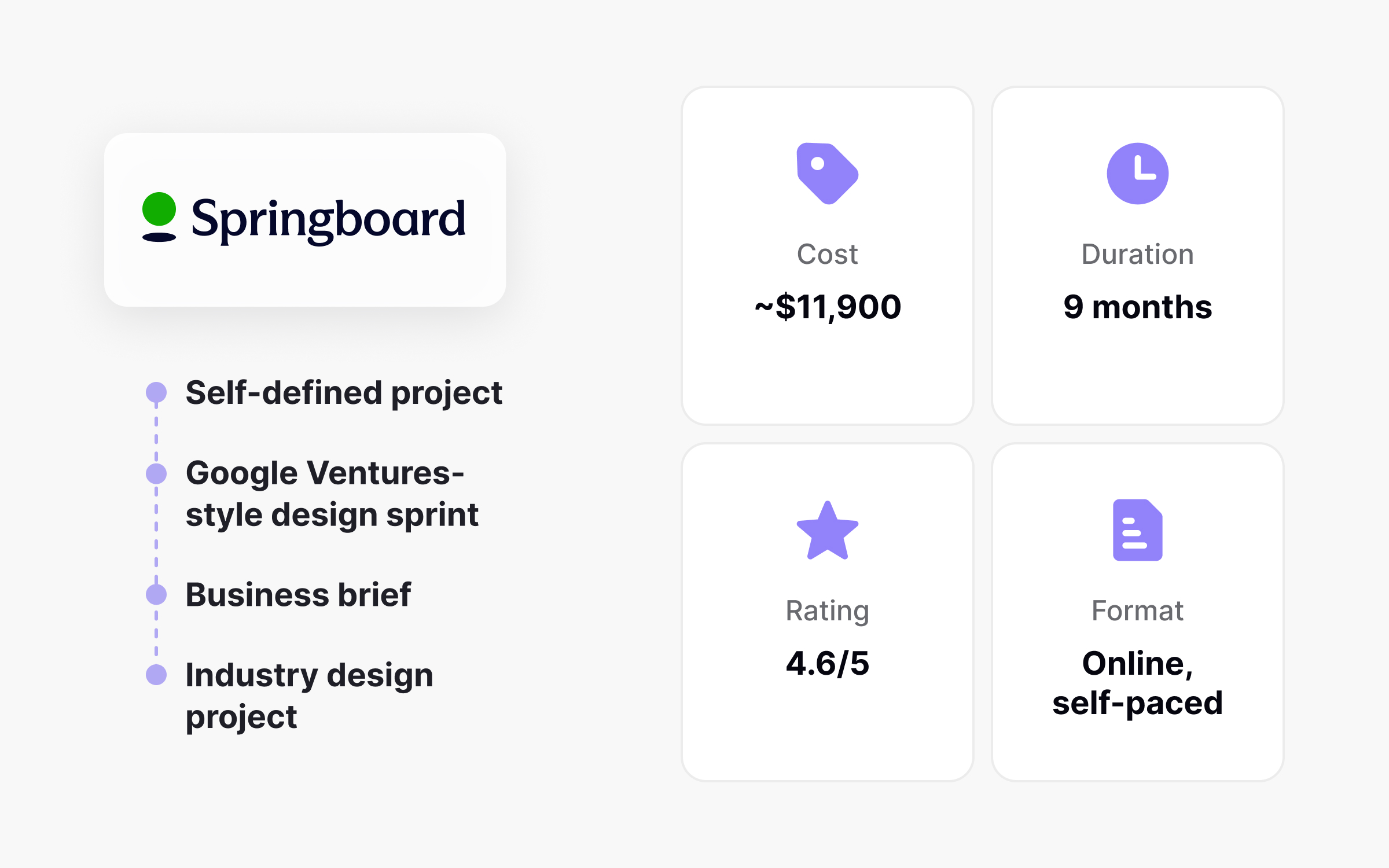
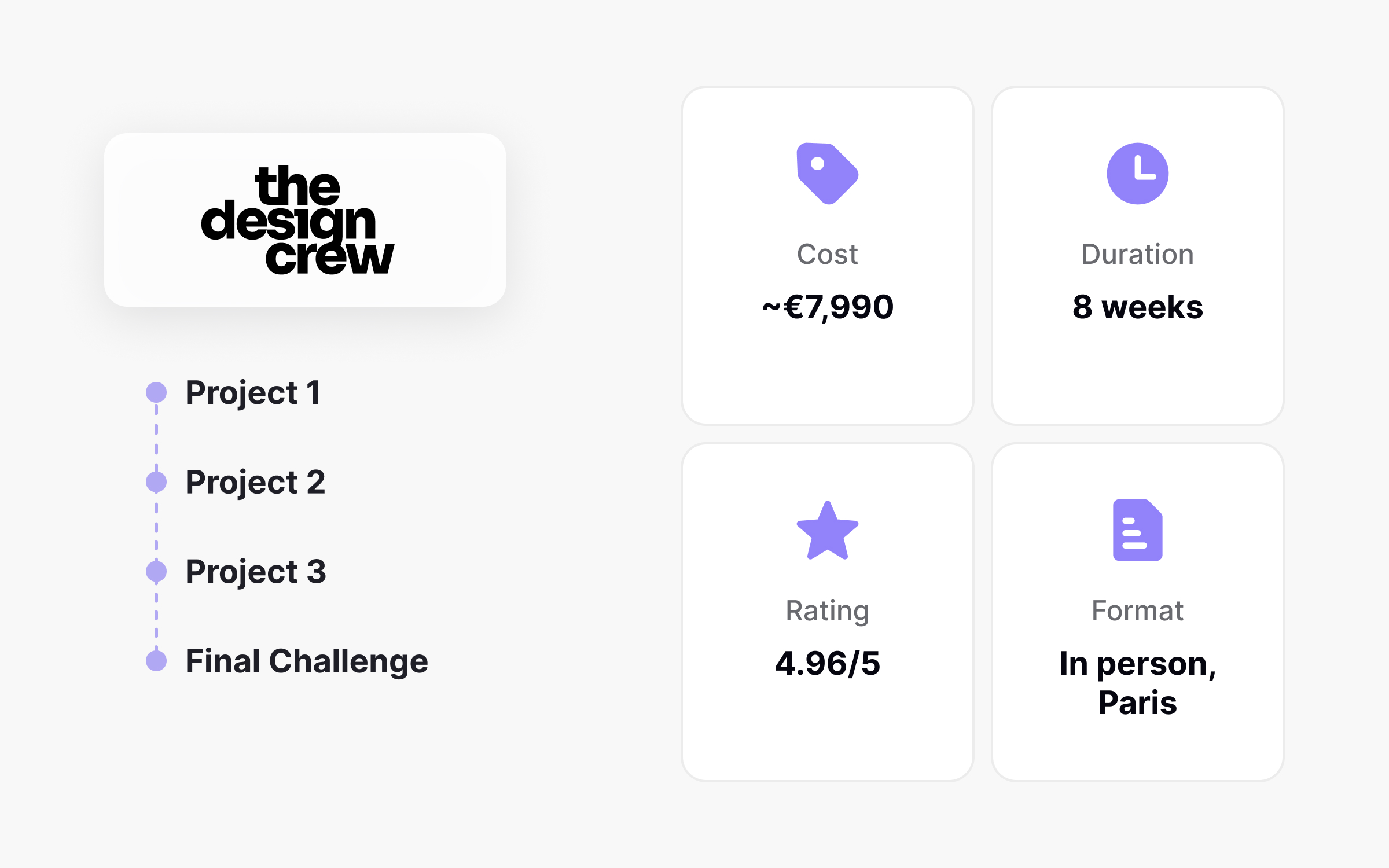
At the premium end, General Assembly offers UX Design Immersive programs at comparable pricing with broader geographic reach (campuses in multiple countries). Their curriculum is similar in scope, though they don't emphasize the work-simulation model. Springboard sits in the middle with UX/UI career tracks around $9,900, also with a job guarantee.

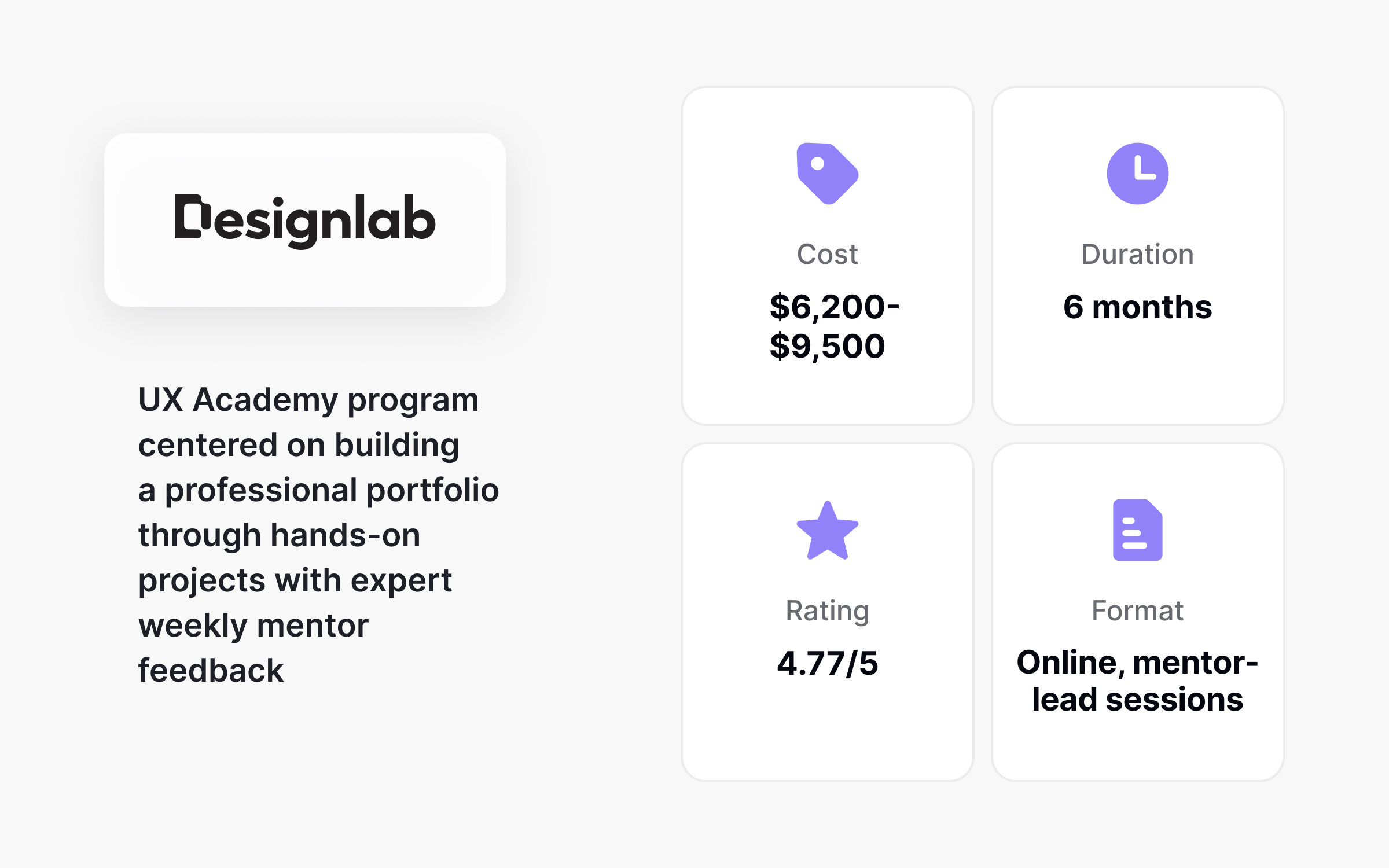
At the budget end, the Google UX Design Certificate on Coursera runs under $300 and has massive brand recognition, though it lacks mentorship, portfolio feedback, and career coaching. YouTube, free tutorials, and open courseware can get you the raw knowledge for nothing, but without structure, community, or accountability.

And then there's the ongoing learning category, where platforms like Uxcel operate on a subscription model ($24/month) that keeps you learning throughout your career rather than concentrating everything into one intensive window.

The key differentiators for Flatiron are the work-simulation studio phases, the depth of career services (180 days of 1:1 coaching), and the established brand recognition. The key disadvantage is cost, particularly when self-paced alternatives can deliver similar knowledge for a fraction of the price.

For a detailed look at specific alternatives, see the next section.

What else should you consider?

If Flatiron's price tag, format, or approach doesn't match your situation, here are three alternatives worth considering: Uxcel (the most affordable option with documented career outcomes), and Springboard (if you need a job guarantee).

Could Uxcel work instead?

Uxcel is an interactive, gamified learning platform launched in 2020 to solve a specific problem: professionals need to build and maintain design skills without committing to expensive bootcamps or sitting through passive video courses. The platform covers UX design, product management, and AI through bite-sized, interactive lessons that take about five minutes each.

What sets Uxcel apart from Flatiron (and every other bootcamp on this list) is its approach to ongoing skill development. Where Flatiron gives you 15 weeks of intensive training and then you're on your own, Uxcel provides a continuous learning system of self-paced design courses you can use throughout your career. The platform is web-first with native iOS and Android apps, so you can learn on your commute, during lunch, or whenever you have a few spare minutes. Everything syncs across devices automatically.

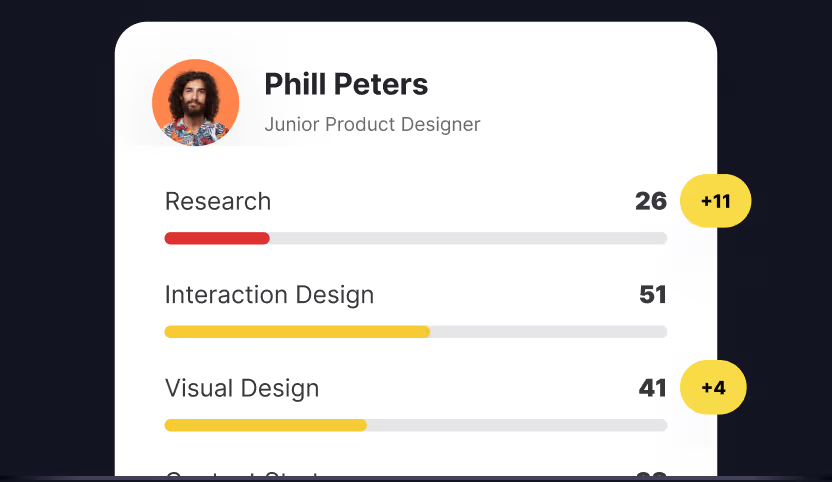
The skill mapping feature is genuinely unique in the market. As you complete courses and assessments, Uxcel automatically maps your competencies across both design and product management disciplines. This cross-functional tracking means a senior designer learning product management can see both their core design skills and their growing PM knowledge in one place. No other platform offers this kind of dual-discipline visibility.

The outcomes data is documented. According to Uxcel's Impact Report, users see a 68.5% higher promotion rate compared to peers, with an average salary increase of $8,143. The platform maintains a 48-50% completion rate, which is roughly 10 times the industry average for online courses (5-15%). Over 500,000 learners from 140+ countries use the platform, and 200+ companies (including Microsoft, Deloitte, and PwC) use it for team development.

At $24 per month billed annually ($288 per year), Uxcel costs less than 2% of Flatiron's tuition. Regional pricing makes it even more accessible in select markets.

The honest limitations: Uxcel is not a bootcamp. It won't give you a cohort of classmates or simulated work projects with instructor feedback acting as a manager. The platform includes project briefs and mentor feedback, but it's not portfolio-heavy enough to build a complete career-change portfolio from scratch. It's also interactive and text-based rather than video-lecture-based, which doesn't suit every learning style. And while 200+ companies use it for team development and it's trusted by names like Microsoft and Deloitte, the platform doesn't offer the kind of intensive career coaching that Flatiron provides.

For someone who's never touched design before and needs to make a complete career transition in the shortest time possible, a bootcamp's intensity and career infrastructure may still make sense. But for the far larger group of people who want to build design skills alongside their current work, explore whether product design is the right path, or continue developing after a bootcamp, Uxcel's model is hard to beat at $24/month.

Uxcel works best for: Working professionals who want to build or sharpen design skills alongside their current job. Career changers who want to explore product design before committing thousands. Mid-level or senior designers expanding into product management or building cross-functional skills. Teams and companies investing in upskilling. Anyone who's tried (and abandoned) longer-form online courses before.

That limitation, the lack of intensive portfolio-building and cohort accountability, is exactly where Springboard excels.

What if you want a job guarantee?

Springboard offers UX/UI Design Career Tracks with a job guarantee: if you don't land a qualifying role within six months of graduation, they refund your tuition. That's a level of financial protection Flatiron no longer provides (they dropped their money-back guarantee).

The program runs 6-9 months of self-paced, mentor-led learning. You get a dedicated 1:1 mentor (a working industry professional), weekly calls, career coaching, and portfolio reviews. The curriculum covers UX research, UI design, and includes capstone projects. Tuition runs around $9,900, which is lower than Flatiron but higher than Uxcel.

The downsides: the self-paced format means completion depends heavily on your discipline. Without a cohort moving through material together, some students lose momentum. The job guarantee comes with conditions (you need to meet specific job search requirements), and the program doesn't include the work-simulation studio model that Flatiron offers.

Springboard works best for: Career changers who want financial protection through a job guarantee. Self-motivated learners who thrive with 1:1 mentorship. People who need to work while studying.

How do these alternatives stack up?

Feature Flatiron School Uxcel Springboard
Cost $16,900 $24/month ($288/year) ~$9,900
Duration 15 weeks FT / 40 weeks PT Ongoing 6-9 months
Format Online + on-campus Web + native mobile apps Online, self-paced
Completion rate Not published separately 48-50% Not published
Portfolio projects 3 projects, 1 case study Project briefs available Capstone projects
Career support 180 days 1:1 coaching Skill mapping, certificates Job guarantee + mentorship
Best for Career changers needing structure Ongoing skill development Career changers wanting job guarantee

Looking at these options side by side, the right choice depends entirely on what you need right now. Flatiron's strength is structure and career services. Uxcel's strength is affordability and long-term skill development.

For most people reading this, roughly 6 out of 10, Uxcel makes the most sense. It's the lowest-risk option: you can explore design, build real skills, and track your progress for less than the cost of a single Flatiron application fee each month. If you discover that product design is your path, you can always invest in a more intensive program later with a much clearer sense of what you need.

The other 40% have specific needs. If you need full-time immersion and hands-on career transition support, Flatiron delivers that. If you want a job guarantee, Springboard can provide financial protection that Flatiron doesn't.

Still have questions?

Is Flatiron School's product design bootcamp worth the money?

When considering flatiron school worth, it comes down to whether the program is a good investment for your goals and situation. If you’re making a career change, can commit full-time, and need structured support with career coaching, the $16,900 tuition can pay off. Graduates across all Flatiron programs report average starting salaries of $72,000-$75,000, which means the tuition represents roughly one quarter of a first-year salary. The career services alone (180 days of coaching, employer partnerships) justify a portion of the premium. But if you’re budget-conscious, self-directed, or unable to commit full-time, more affordable alternatives like Uxcel deliver substantial design education for a fraction of the cost.

Do you need prior experience to apply?

No. Flatiron’s product design program is designed for complete beginners and career changers, and no previous coding experience is required. Applicants do not need prior experience to apply. There are no prerequisites in design, coding, or tech. You’ll need to complete a non-technical admissions interview and a 15-minute problem-solving assessment. Before your first day, you’ll work through around 20-40 hours of pre-work covering design basics, Figma, and UX/UI fundamentals.

How selective is the admissions process?

Gaining admission to Flatiron School is considered challenging, many prospective students search "flatiron school hard" to understand the difficulty of getting in. Flatiron School has a highly selective admissions process with a low acceptance rate, historically around 5-8%. They’re looking for motivation, problem-solving aptitude, and cultural fit, not technical skills. The application involves submitting a written application, completing a virtual admissions interview, and passing a critical thinking assessment. You’ll receive your decision within four business days.

Can you work while attending the full-time program?

Realistically, no. The full-time Live program runs roughly 8 hours per day, Monday through Friday, for 15 weeks. That's a full-time commitment. If you need to keep working, the Flex (part-time) option stretches to 40 weeks with a self-paced format, though be aware that the Flex program receives less favorable reviews from students.

Does Flatiron offer a job guarantee?

Not anymore. Flatiron previously offered a money-back guarantee for graduates who didn't find employment within six months. That's been discontinued. They also stopped offering Income Share Agreements in January 2021. Current students rely on the career coaching and employer partnerships to support their job search, but there's no financial guarantee attached.

What tools will you learn?

Figma is the primary design tool. You'll also work with InVision, Webflow, and basic HTML/CSS. The program has recently integrated AI tools for research analysis. These align with what most product design teams use in 2026, though some employers may also expect familiarity with tools like Adobe XD, Sketch, or Framer, which you'd need to pick up independently.

How does Flatiron's program compare to a college degree?

A bootcamp and a four-year degree serve different purposes. Flatiron provides focused, practical training for career entry in 15-40 weeks at $16,900. A design degree offers broader education, deeper theory, and traditional credentials over 4 years at significantly higher cost. Most entry-level product design jobs care more about your portfolio and skills than your degree, which is why a focused product design certificate can carry real weight. The bootcamp route is faster and cheaper, but the degree provides more depth and broader career flexibility over time.

Are the job placement statistics reliable?

Flatiron deserves credit for publishing independently examined jobs reports since 2014. That's rare in the bootcamp space. However, the data covers all programs (not just product design), includes a broad definition of "qualifying job" (full-time, part-time, contract, freelance), and the most comprehensive data predates the current challenging tech market. Take the numbers as directional rather than guaranteed.

What happens if you don't finish the program?

Flatiron's refund and withdrawal policies have drawn criticism, particularly for the Flex program. If you need to withdraw, the refund amount depends on how far into the program you are. Some students report difficulty getting refunds or extensions. Read the enrollment agreement carefully before signing, and make sure you understand the deadlines and policies for your specific program format. If there's a chance your circumstances might change during the program, ask admissions directly about their withdrawal policy and get the details in writing.

So, is Flatiron's product design bootcamp actually worth it?

After spending weeks on this, my take comes down to a straightforward question: what do you need right now?

When does Flatiron make sense?

Flatiron works when you need a forcing function. If you're stuck in a career you want to leave, you have the savings (or financing) to cover tuition plus living expenses for four months, and you thrive in structured environments with deadlines and accountability, this program can genuinely change your trajectory. The career services infrastructure, 180 days of 1:1 coaching, employer partnerships, and the Job Search Accelerator, adds real value for people who don't have existing tech networks.

The full-time Live program specifically delivers what it promises: an immersive, cohort-based experience that takes you from zero design experience to a portfolio and job-search-ready skillset in 15 weeks. The work-simulation studio phases are a genuine differentiator that you won't find in most self-paced alternatives.

When should you skip this?

Skip Flatiron if budget is your primary constraint. At $16,900, there are too many lower-cost paths to design education to justify the price unless you specifically need the structure and career support. If you're leaning toward the Flex program, seriously consider alternatives first, because the Flex experience consistently receives worse reviews, and paying $16,900 for a compromised experience doesn't make sense.

Also skip if you're not ready to commit fully. The full-time program demands everything you've got for 15 weeks. Half-hearted effort at this pace means you fall behind fast, and Flatiron's intensive structure doesn't leave much room to catch up.

And skip if your primary goal is building on existing skills. The program starts from zero. If you already understand design thinking, have used Figma, and know the basics of UX research, you'd be paying for content you've already learned. Your money is better spent on advanced, specialized training.

The decision framework

Think of it this way. If all three of these statements are true, Flatiron is probably worth considering: (1) you can afford the tuition plus 4 months of living expenses without taking on excessive debt, (2) you can commit full-time for 15 weeks without major competing obligations, and (3) you specifically value cohort-based learning with live instruction and career coaching.

If one or more of those isn't true, an alternative approach will likely serve you better. Self-paced platforms, lower-cost bootcamps, and ongoing learning tools each address different combinations of constraints.

What should you do now?

If Flatiron sounds like the right fit, start with their free Product Design Prep Work. It's a no-cost way to experience the curriculum and teaching style before committing $16,900. Attend a virtual info session. Talk to admissions. Apply for scholarships if you qualify.

If you're not sure product design is the right path, or if you want to build foundational skills before investing in a bootcamp, start with a lower-risk option. Uxcel lets you explore UX design, product management, and AI skills for $24/month with interactive, bite-sized lessons and automated skill mapping across both design and product disciplines. You can build genuine skills, track your progress, and decide whether a bigger investment like Flatiron makes sense later, all without the financial commitment of a full bootcamp.

The worst decision is the rushed one. Take the free intro courses. Try a month of Uxcel. Talk to Flatiron alumni on LinkedIn. Then decide with actual data about your own situation, not someone else's marketing copy.

Disclaimer: This analysis reflects our research as of April 2026, based on publicly available sources. Details like pricing, curriculum, and job outcomes may change. We’ve included Uxcel as one of several alternatives to help readers compare different learning paths.