The product design bootcamp you would have picked two years ago might not exist anymore.
CareerFoundry, one of the most recommended programs in every “best bootcamps” listicle from 2020 to 2024, filed for bankruptcy in October 2025. It stopped operating entirely by February 2026. Thinkful and Lambda School (rebranded as BloomTech) went down before that. And these weren’t fringe programs. They had thousands of graduates, high review scores, and career guarantees that turned out to be worth less than the PDFs they were printed on.
Meanwhile, the job market for junior product designers has tightened. Entry-level roles now attract hundreds of applicants. AI tools have reshaped what employers expect designers to know on day one. And bootcamp pricing keeps climbing, with some programs now charging north of $16,000 for 15 weeks. In this environment, product designers play a crucial role in shaping the digital world, creating intuitive and engaging interfaces that define how users interact with technology in today's digital landscape.
So the question isn’t just “which bootcamp is best?” anymore. It’s “which programs are still standing, which ones actually prepare you for a 2026 job market, and is a bootcamp even the right investment for your situation?” A design career offers multiple pathways, salary ranges, and opportunities for progression, and bootcamps have become a common entry point for anyone looking to become a product designer.
To pull this article together, I drew from 3 in-depth review articles we published earlier this year covering Flatiron School, CareerFoundry (a post-mortem, essentially), and The Design Crew. I went through current listings on Course Report, SwitchUp, Career Karma, and got lost in Reddit rabbitholes. I dug into the pricing pages, student reviews, and outcomes reports for Springboard and Designlab. And I kept circling back to one question that kept coming up in the research: is a traditional bootcamp still the smartest way to learn product design, or has the market shifted enough that other paths make more sense? Bootcamp students come from a wide range of professional backgrounds, and these programs are specifically designed to support career changers looking to transition into design.
This article covers the 5 programs worth considering in 2026, along with one platform that approaches design education from a fundamentally different angle. Each one gets an honest breakdown: what it costs, what you’ll learn, what students actually say, and who it’s best for. Most bootcamps feature a straightforward admission process, typically requiring just a brief call with an advisor and no complex prerequisites, making it easy for newcomers to get started.
What to expect from a product design bootcamp
A product design bootcamp is more than just a crash course. It’s an immersive training program designed to launch you into the world of UX design and UI design with confidence. Whether you’re aiming to become a UX designer, product designer, or web designer, these bootcamps are built to give you a solid understanding of the entire design process, from the first spark of an idea to the final user interface.
At the heart of every reputable product design bootcamp is a curriculum that covers UX fundamentals and UI principles in depth. You’ll dive into design thinking, user centered design, and user research, learning how to conduct user research and create user personas that drive every decision. Expect to get hands-on with usability testing, user flows, and the double diamond framework, all while building a toolkit of practical skills that are directly relevant to the job market.
But theory is only half the story. Bootcamp students spend much of their time working on real world projects that mirror the challenges faced by design teams in the tech industry. These industry design projects aren’t just academic exercises, they’re opportunities to solve real world design challenges, develop a professional portfolio, and demonstrate your UX design skills to future employers. By the time you graduate, you’ll have a collection of portfolio projects that showcase your ability to create engaging user experiences and tackle user interface development from concept to completion.
Career support is another cornerstone of the bootcamp experience. Most programs offer robust career services, including career coaching, mock interviews, and sometimes even a job guarantee to help you navigate the job search with confidence. You’ll receive personalized feedback from industry experts, participate in resume workshops, and get guidance on how to present your work to hiring managers. This level of career support can make all the difference when transitioning to a new career in the competitive tech industry.
Flexibility is also a key feature. Product design bootcamps recognize that every student has their own learning style and life circumstances. That’s why you’ll find options for full-time or part-time study, self-paced tracks, and a range of payment options, from upfront payment to installment plans. This adaptability helps ensure that you can successfully complete the training program, regardless of your schedule or financial situation.
By the end of a product design bootcamp, you’ll have mastered UX foundations, UI design, user flows, and design system principles. You’ll understand how to apply UX writing, collaborate within design teams, and use industry-standard tools to create user interfaces that delight and engage. Most importantly, you’ll leave with a professional portfolio and the practical skills needed to stand out in the job market as an industry-shaping creative professional.
In short, a product design bootcamp offers a comprehensive, supportive environment that prepares you for real world design roles. With a blend of hands-on projects, expert feedback, and career services, these programs are designed to help you make a successful leap into UX design, product management, or any role where user centric design research and an engaging user experience are at the core.
What changed in the bootcamp market since 2024?
Before comparing individual programs, it helps to understand the ground they’re standing on. The product design education market looks nothing like it did in 2022. Product design bootcamps are now recognized as a key part of the broader tech bootcamps ecosystem, which also includes intensive programs for data analytics, software development, AI, and more.
The most visible change is the wave of closures. CareerFoundry’s bankruptcy wasn’t an isolated event. It followed a pattern that started with Thinkful’s quiet absorption into Chegg (then decline), Lambda School’s rebrand-and-collapse cycle as BloomTech, and smaller programs shutting down without headlines. The common thread: aggressive job guarantees, income share agreements, and business models that relied on continuous enrollment growth to fund operations. When the tech hiring slowdown hit in 2023 and 2024, the math stopped working.
The programs that survived tend to share a few traits. They either diversified their course offerings (Flatiron, Springboard), built sustainable pricing models (Designlab), or served niche markets with strong local demand (The Design Crew in Paris). There are now more UX bootcamp options than ever, each offering different curricula, teaching styles, and unique features to help students find the right fit. The ones that made a single big promise, like “job or your money back,” and couldn’t sustain it financially are the ones that disappeared. Students are also increasingly focused on job prospects and employment guarantees when choosing a bootcamp, making career outcomes a top priority.
AI integration is another shift worth noting. Springboard and Designlab have both added AI learning modules to their curricula in 2025. Flatiron updated its product design program to reflect how AI tools fit into the design workflow. Programs that still teach design as if ChatGPT and FigJam AI don’t exist are falling behind. Employers now expect designers to know how to use AI for research synthesis, persona creation, and rapid prototyping.
The pricing gap has also widened. Flatiron charges $16,900 at standard pricing. Designlab costs $8,499. Meanwhile, platforms like Uxcel charge $24 per month. That’s not an apples-to-apples comparison (bootcamps and platforms serve different needs), but it forces every prospective student to ask a harder question about what they’re actually paying for.
One more pattern worth flagging: the programs that remain have gotten more transparent about their limitations. Flatiron publishes independently audited outcomes reports and has stopped making the aggressive guarantees that sank its competitors. Designlab clearly states that its tuition reimbursement policy has geographic limits. Springboard still offers a job guarantee but publishes detailed eligibility requirements so students know exactly what they’re committing to. This honesty is a feature, not a bug. After watching programs collapse under the weight of promises they couldn’t keep, the survivors have learned that trust matters more than marketing claims. As a prospective student, that transparency makes your research easier; you just have to be willing to read the fine print.
Which programs made the cut?
This isn’t a ranking. Every program on this list serves a different type of learner, and the “best” option depends on your budget, timeline, learning style, and career goals. Here’s what each one does well, where it falls short, and who should consider it.
I excluded programs that are no longer operating (CareerFoundry, Thinkful), programs without enough verifiable student data to evaluate honestly, and programs that focus primarily on coding or PM skills with design as an afterthought. The goal of these bootcamps is to prepare graduates for roles as UX designers and related positions.
The final 5: Flatiron School, Springboard, Designlab, The Design Crew, and Uxcel (as a fundamentally different approach to design education). These programs emphasize user interface design, web design, and comprehensive UI/UX design training to ensure students are ready for industry-relevant careers. Each section below gives you the full picture.
Is Flatiron School worth $16,900 for product design?

Cost: $16,900 (standard) or $9,500 (limited GitHub partnership pricing)
Duration: 15 weeks full-time (8 hrs/day) or 40 weeks part-time (Flex, self-paced)
Format: Online or on-campus (NYC, Denver, Colorado Springs)
Job guarantee: No (discontinued)
Ratings: 4.7/5 Career Karma, 4.59/5 SwitchUp
Flatiron launched in 2012 and built its reputation on transparency. They published independently audited job outcome reports every year starting in 2014, which was a first in the bootcamp industry. The product design program is their newest track, launched in 2021 after they scrapped an older UX/UI immersive that forced students to specialize in either UX or UI. Hiring manager feedback made the shift clear: employers want designers who can handle both.
As a UX design bootcamp, Flatiron’s curriculum covers the full UX process, from research and ideation to design, testing, and implementation. The program is structured to ensure students experience every phase of the UX process, preparing them for the demands of modern product design roles. The skills acquired through this comprehensive curriculum equip graduates to tackle real-world design challenges and build a strong, job-ready portfolio.
The studio model nobody else offers
The standout feature is the studio model in phases 3 and 4. Instead of lectures and assignments, you work on projects where instructors act as your “manager” rather than your teacher. It’s designed to mirror what a junior product designer actually does on the job. Portfolio development is integrated throughout these studio phases, with students building real-world projects specifically to showcase their skills and strengthen their portfolios. Giovanni Difeterici, who directs the program, built the curriculum using backward design: starting with what hiring managers need and working backward to figure out what students should learn.
The curriculum runs through 5 phases. The first two cover UX and UI fundamentals. The middle two are the studio projects that simulate real work. Phase 5 is portfolio and job search. The primary tool is Figma, with some exposure to InVision, Webflow, and basic HTML/CSS.
The problems you should know about
Price is the obvious issue. $16,900 makes Flatiron the most expensive program on this list by a wide margin. The GitHub partnership brought that down to $9,500 for certain cohorts, but that's a limited offer and not guaranteed for future enrollment windows.
The Flex program is a different story from full-time. Our deep-dive review found a consistent pattern across Course Report and Reddit: students in the self-paced track report feeling disconnected, underprepared, and frustrated with limited extension options. If you can't commit to full-time, Flatiron's value proposition weakens considerably.
The job placement data also needs context. Flatiron reports 86% of graduates accepting jobs within one year, but that figure covers all programs combined. There's no publicly available placement rate specific to product design. They also discontinued their money-back guarantee and income share agreements, which means you're taking on the full financial risk.
Full-time vs flex
Student feedback splits cleanly between the two tracks. Full-time students describe the experience in overwhelmingly positive terms. The cohort dynamic, the daily interaction with instructors, the pressure of the studio phases all contribute to a learning experience that students say felt "like an actual job." Several graduates noted that the transition from Phase 2 (structured learning) to Phase 3 (studio) was jarring but ultimately the most valuable part of the program. It forced them to figure things out with less hand-holding, which is exactly what their first design jobs demanded.
Flex students tell a different story. The asynchronous format means no cohort bonding, limited instructor interaction, and a self-directed pace that many students find isolating. Reviews on Course Report and Reddit mention frustrations with extension policies, difficulty getting feedback in a timely way, and a general sense that the Flex track is an afterthought compared to the full-time experience. One recurring theme: students who chose Flex for scheduling reasons ended up wishing they'd found a way to do full-time instead.
The career coaching gets consistently high marks across both tracks. Graduates describe their coaches as responsive, practical, and genuinely invested in helping them land roles. Flatiron's employer partnership network is a real asset, though the companies hiring from that pipeline span engineering and data science roles too, not just design.
The cost conversation
At $16,900, you're paying roughly $1,127 per week for the full-time program. That's expensive by any measure. The GitHub partnership discount to $9,500 changes the math significantly ($633 per week), but availability varies by cohort. Flatiron also offers installment plans over 12, 26, or 42 months, and has committed over $10 million in scholarships focused on underrepresented groups, with Women Take Tech scholarships covering up to $1,000 per recipient.
Worth noting: the school no longer offers income share agreements or money-back guarantees. Those were discontinued when the broader industry's ISA model proved financially unsustainable. You're paying tuition upfront (or via installments), and the outcomes depend on your effort and the job market.
Who Flatiron is best for
Career changers who can commit to 15 weeks full-time, can afford the tuition (or secure the promotional rate), and value an immersive cohort experience with a work-simulation model. The in-person option in NYC or Denver adds value if you learn better in a physical environment. Skip this if you need part-time flexibility or if the price tag is a stretch.
Does Springboard's UX design bootcamp job guarantee actually hold up?

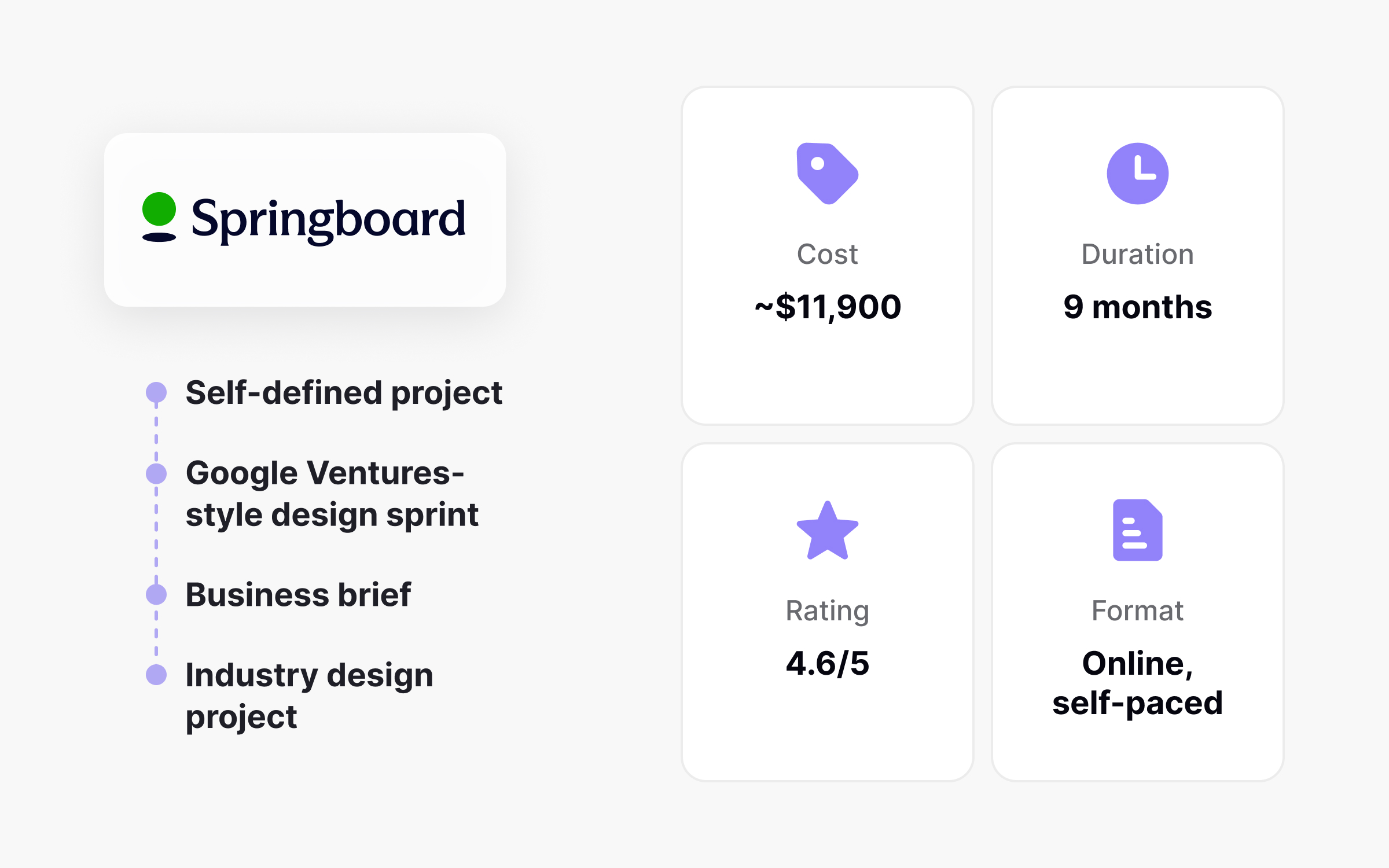
Cost: ~$11,900 upfront (sources vary; installment and deferred options available)
Duration: 9 months, 15-25 hours/week
Format: 100% online, self-paced, asynchronous
Job guarantee: Yes (tuition-back promise if no qualifying job within 6 months)
Ratings: 4.67/5 SwitchUp, 4.6/5 Career Karma (450+ reviews)
Springboard has been around since 2013 and has outlasted most of its competitors. That longevity matters more than it used to. In a market where bootcamps keep closing, the fact that Springboard is still operating, still honoring its job guarantee, and still enrolling students is a meaningful data point.
Why Springboard outlasted its competitors
The job guarantee is the headline feature, and it’s one of the few still active in the industry. If you don’t land a qualifying design role within 6 months of graduating, Springboard refunds your tuition. The fine print matters (strict requirements around applications submitted, networking activities, and eligibility), so read the terms before treating it as a safety net. But it’s real, and it’s legally binding.
The curriculum includes 4 portfolio projects. The first is self-defined, the second is a Google Ventures-style design sprint, the third is a business brief with a tight deadline, and the 4th is an Industry Design Project: a 4-week remote externship with an actual company. That externship is a genuine differentiator. Portfolio development is a central part of the program, with students guided step-by-step in building a strong portfolio that showcases their skills and completed projects. You’re not just building hypothetical projects for your portfolio. You’re working on real problems for a real organization, and that experience matters when hiring managers scan your portfolio.
Springboard pairs each student with a dedicated mentor (a working industry professional) for weekly one-on-one calls. You also get a separate career coach for job search support, plus 6 months of career services after graduation. The program has integrated AI learning throughout its curriculum, which keeps it current for 2026. The skills acquired through this comprehensive curriculum, including UX/UI design, problem-solving, and real-world project experience, directly contribute to career readiness and help graduates stand out in the job market.
The trade-offs to weigh
Pricing is confusing. I spent quite some time trying to pin down the actual number, and different sources report wildly different figures ($8,200, $8,900, $11,691, $11,900, $16,200). The variation depends on payment method, whether you're looking at the UX-only or combined UI/UX track, and when the price was last updated. Confirm directly with Springboard before making any assumptions based on third-party listings. I couldn't find a single source I'd trust completely on this.
The 9-month timeline is a commitment. Self-paced sounds flexible, but students consistently report that early modules move slowly while later phases ramp up fast. Maintaining motivation for 9 months of asynchronous learning takes discipline that not everyone has. Multiple reviews mention periods of isolation, especially compared to cohort-based programs like Flatiron.
Career services are US-focused. If you're targeting a job market outside the United States, Springboard's employer partnerships and career coaching may be less relevant.
How students feel about the experience
Reviews on Course Report and SwitchUp paint a generally positive picture. Students praise the curriculum structure, the quality of mentor calls, and the career coaching as the strongest elements. The capstone projects and Industry Design Project get highlighted repeatedly as the most valuable parts of the experience, with several graduates describing the IDP as the thing that made their portfolios stand out in interviews.
The criticisms are consistent too. Early modules feel slow for students who already have some design knowledge. The asynchronous format can be lonely, especially during weeks when the coursework is heavy and there's no peer group to commiserate with. Some students report that the curriculum could go deeper on visual design fundamentals, leaning more heavily on UX research and process than on pixel-level UI craft.
The job guarantee is a double-edged sword in practice. It provides peace of mind, but the eligibility requirements create real pressure during the post-graduation period. You need to document your job search activity, meet networking minimums, and follow a specific process. Students who met all the terms and didn't get hired report that the refund process worked, but the documentation burden is nontrivial. The takeaway: treat it as real insurance, but read the policy document carefully before enrollment.
Springboard reports that since 2013, 94% of eligible graduates secured a job within one year, with an average salary increase of $26,000. These are strong numbers, though they cover all programs, not just UI/UX specifically. The company publishes an outcomes report for transparency.
Who Springboard is best for
Career changers who need the security of a job guarantee, can maintain self-discipline over 9 months, and are targeting the US job market. The Industry Design Project is a strong differentiator for portfolio building. Also worth considering if you need to keep working while studying, since the flexible schedule accommodates that. Skip if you can't handle asynchronous learning or if you need in-person interaction.
Can Designlab's mentorship model build a stronger portfolio?

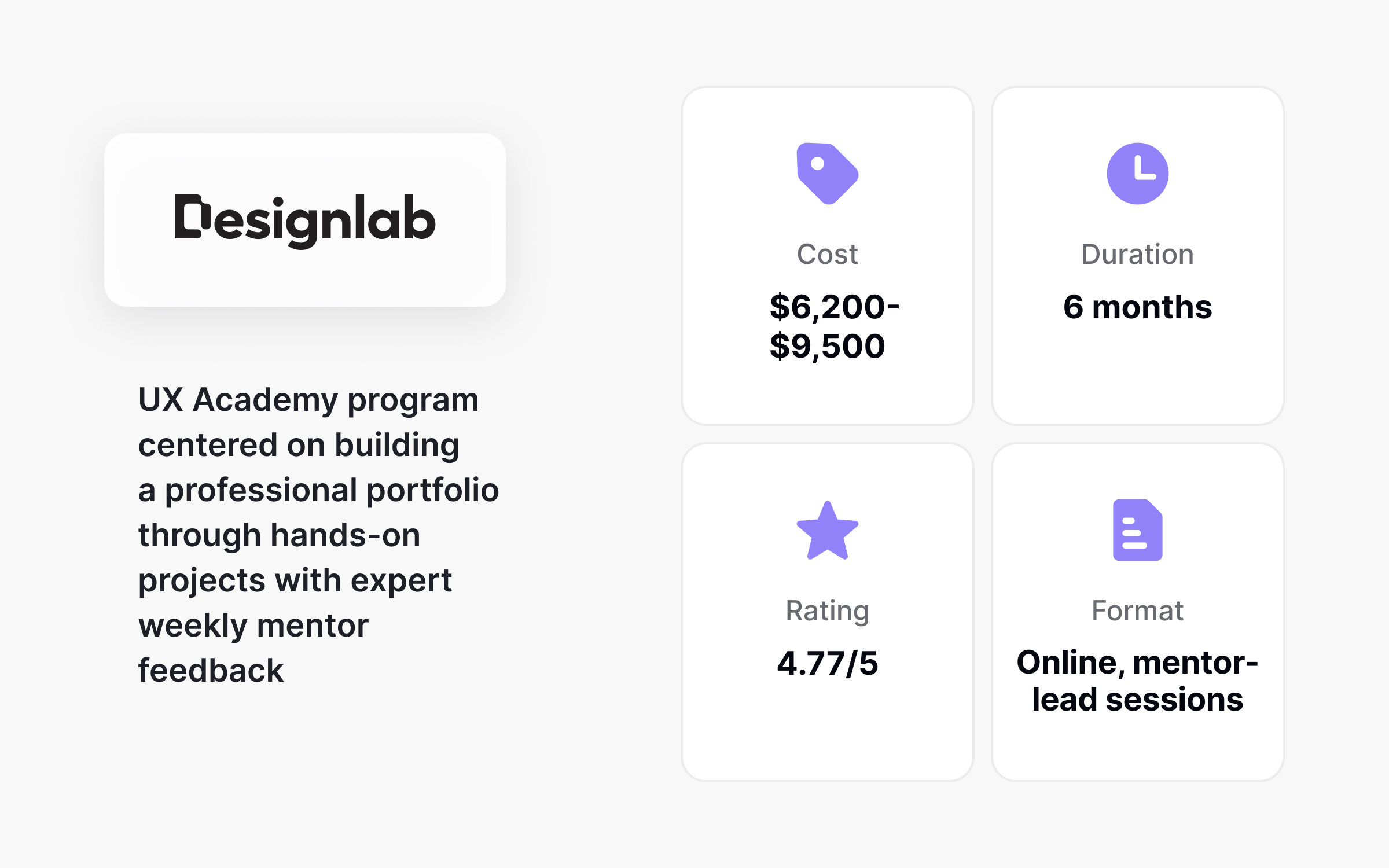
Cost: $6,200 to $9,500 depending on payment plan
Duration: About 6 months, 20-25 hours/week
Format: 100% online, mentor-led with weekly 1-on-1 sessions
Job support: Tuition reimbursement policy (their version of a job guarantee) for eligible graduates
Ratings: 4.77/5 across 1,600+ reviews
Designlab runs a UX Academy program centered on building a professional portfolio through hands-on projects with expert mentor feedback. As a leading UX bootcamp, Designlab’s curriculum is grounded in core UX principles, ensuring students gain a strong foundation in usability, user research, and interaction design. The focus is less on theoretical breadth and more on producing work that demonstrates your abilities to hiring managers. In a market where portfolios matter more than credentials, that approach has real value.
Mentorship as the core differentiator
Designlab's mentors are practicing designers, not career coaches who happen to know about design. The weekly one-on-one sessions are structured around reviewing student work, which means feedback is specific and actionable rather than generic. Students consistently describe the experience as closer to an apprenticeship than a traditional course.
Students produce multiple case studies with detailed mentor feedback throughout the process. The emphasis on portfolio depth is the central selling point. Graduates leave with work they can put in front of hiring managers immediately, not just a certificate to add to LinkedIn.
The prerequisite UX Academy Foundations course ($499) is essentially free because Designlab credits the full amount toward your UX Academy tuition. It also serves as a trial run: if you complete Foundations and decide Designlab isn't for you, you've only spent $499 finding that out.
Honest limitations to consider
There's a narrower scope than some competitors. Designlab focuses heavily on UX/UI design rather than the broader "product design" umbrella. If you're specifically interested in the strategic, business-oriented side of product design (stakeholder management, product strategy, cross-functional collaboration), Designlab is less focused on those areas. It's a UX/UI program with strong execution, not a holistic product design education.
The program expects some baseline design aptitude going in. Complete beginners from non-visual fields may find the learning curve steeper than more beginner-friendly programs. The self-paced flexibility exists but is less forgiving than it sounds, with more structured expectations around weekly deliverables.
Designlab requires more weekly hours (20-25) than some self-paced alternatives. The pricing is comparable to a full bootcamp at $6,200 to $9,500, and Climb Credit financing can push the total higher depending on terms. The tuition reimbursement policy exists, but it's geographically limited and not as straightforward as Springboard's job guarantee. Don't choose Designlab expecting a safety net on placement.
The reviews tell a consistent story
The reviews are remarkably consistent across platforms. With a 4.77/5 rating across 1,600+ reviews, Designlab has one of the highest satisfaction scores in the bootcamp industry. That number caught my attention because most programs see their ratings drift downward as they scale. Designlab's went up. Students overwhelmingly credit the mentor relationship as the defining element.
The curriculum gets praised for balancing theory with hands-on work. The capstone projects demand real independence, which some students find challenging but most describe as exactly the right preparation for real-world design work.
Criticisms tend to focus on the self-paced element. Students who lose momentum report difficulty catching back up. Designlab still lacks the cohort structure that makes programs like Flatiron's full-time track feel more communal. A few reviews also note that career services are helpful but not as intensive as Springboard's, particularly for international students.
The Diversify Design scholarship program awards one 50% tuition scholarship and three $1,000 scholarships per month to applicants from underrepresented backgrounds in tech.
Who Designlab is best for
People who already have some design interest or aptitude and want to focus on building a strong portfolio with expert guidance. Anyone who learns best through one-on-one mentorship and direct feedback on their actual work. Working professionals who need flexible scheduling but still want structured accountability. If CareerFoundry appealed to you primarily because of its portfolio projects and mentorship, Designlab delivers those same elements with arguably more intensity. Skip if you need a guaranteed job placement, want broad product design strategy training, or have zero prior exposure to design concepts.
Should you fly to Paris for The Design Crew?

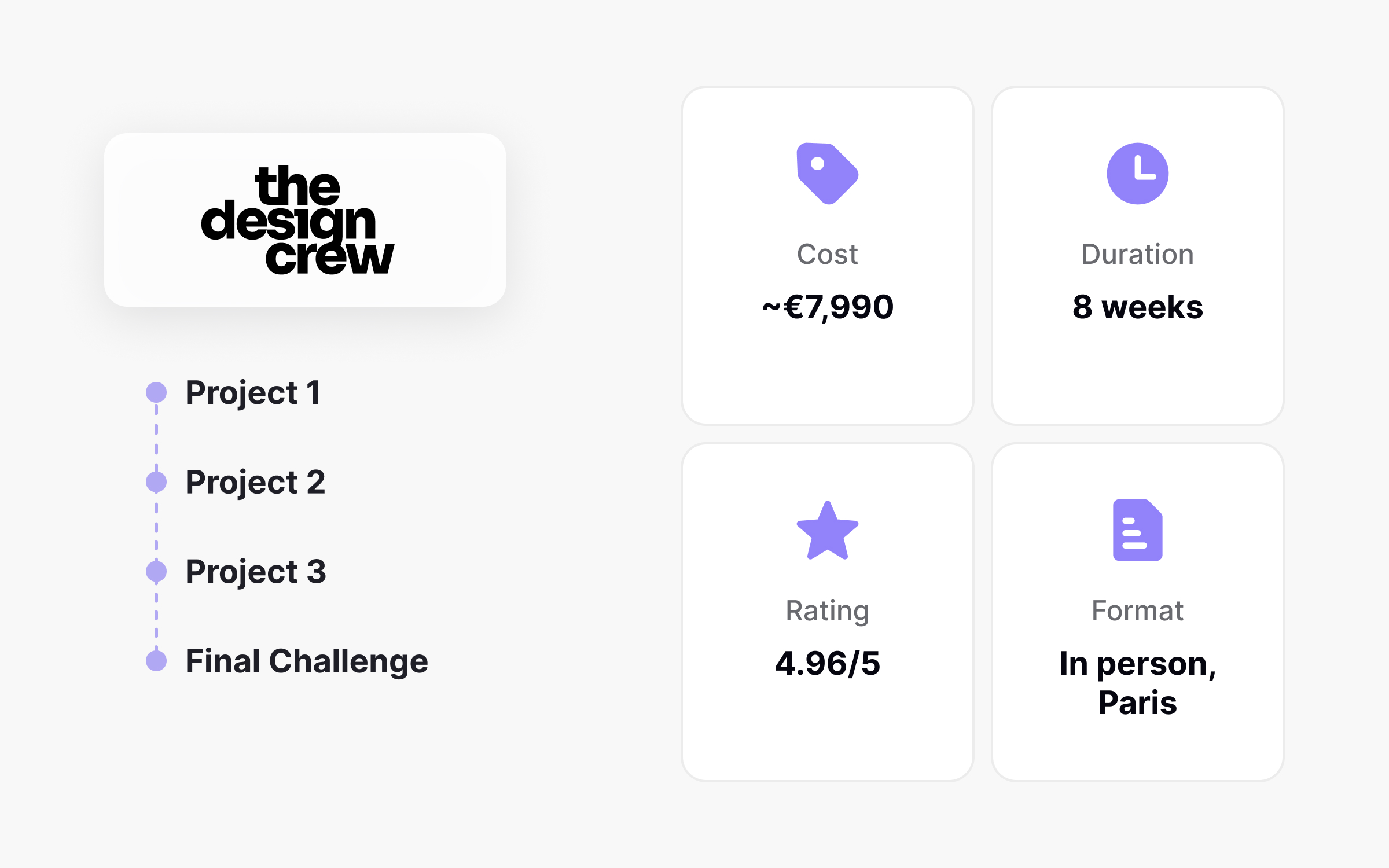
Cost: ~EUR 7,990 (~$8,700 USD)
Duration: 8 weeks, full-time, in-person only
Format: In-person, Paris, France (no remote option)
Certification: RNCP Level 6 (French government-recognized)
Ratings: Near-perfect scores across 3 review platforms
The Design Crew is the outlier on this list, and deliberately so. It's an eight-week intensive in Paris that operates more like a design studio than a classroom. If you can get to Paris, speak at least functional French, and commit to 8 weeks of full-time immersion, this program delivers something online bootcamps structurally cannot replicate.
3 things online programs can't replicate
3 things set it apart. First, every project is done with a real company. Not a hypothetical brief, not a "design sprint simulation." Students work directly with partner organizations on live problems, and those projects go into your portfolio as genuine client work. Second, the RNCP Level 6 certification carries weight in the French job market in ways that bootcamp certificates don't. French HR departments look for RNCP-registered qualifications, and this opens doors that a generic completion certificate won't. Third, the in-person format creates a community intensity that online programs can't match. Multiple reviews describe it as a "human experience first and a training program second."
The program reports an 89% in-field employment rate within 180 days and a 100% graduation rate. Those numbers come from a small, self-selected cohort (you have to relocate to Paris), but they're independently verified through Course Report.
The geographic and language barriers
Location is the biggest limitation. Paris only. No remote. If you can't physically be in France for 8 weeks, this program is off the table entirely. Living costs in Paris add substantially to the total investment beyond the EUR 7,990 tuition.
The program operates primarily in French. International students can attend, but the experience is optimized for the French-speaking market, and career support is focused on placing graduates in French companies or French-speaking roles.
Eight weeks is also short. The format covers fundamentals well, but advanced topics get compressed. You'll leave with a strong foundation and real portfolio pieces, but you won't have the depth of a 9-month Springboard or Designlab program.
Graduate feedback from a tight-knit community
Reviews are limited in volume compared to larger programs (smaller cohorts mean fewer reviews), but they're remarkably positive in tone. Graduates consistently highlight the mentor quality and the real company projects as the defining strengths. Several describe the experience of presenting work to actual clients during the program as "terrifying and incredible at the same time," the kind of pressure that accelerates growth in ways that hypothetical classroom projects don't.
The in-person community element comes up in nearly every review. Students form tight bonds over 8 weeks of intensive daily work, and the alumni network in Paris provides ongoing value for graduates staying in the French market. The transition from student to professional feels more gradual than at online programs, because you're already operating in a studio-like environment during the bootcamp itself.
The negative feedback centers on what the program isn't: it's not flexible, it's not remote, and it's not for people who need more time to absorb material. Students who needed a few extra days on certain modules felt the pace was unforgiving. The career coaching is strong for French market placement but less useful for international job searches.
Who The Design Crew is best for
Designers targeting the French or broader European job market, people who thrive in immersive in-person environments, career changers who can relocate to Paris for two months, and anyone who values government-recognized certification over a bootcamp certificate. Skip if you need remote learning, can't get to France, or need English-language instruction.
How does Uxcel compare as an alternative approach?

Uxcel isn’t a bootcamp. Calling it one would be misleading, and comparing it head-to-head with Flatiron or Springboard misses the point. Uxcel is a skill-building platform launched in 2020 that takes a fundamentally different approach to design education: continuous, bite-sized learning rather than a one-time intensive program. Unlike traditional tech bootcamps, which offer intensive, cohort-based training over a set period, Uxcel allows learners to progress at their own pace and fit learning into their busy schedules.
The reason it belongs in this conversation is simple. For a large percentage of people researching product design bootcamps, a $9,000 to $17,000 program isn’t the right answer. Maybe the budget isn’t there. Maybe you need to test whether product design is right for you before committing that kind of money. Maybe you’re already working as a designer and need to sharpen specific skills, not start from scratch. Uxcel addresses all 3 of those situations at $24 per month. The skills acquired through Uxcel’s curriculum, such as UX fundamentals, UI design, product thinking, and portfolio building, are mapped to real-world design challenges and professional roles, similar to what you’d gain in a tech bootcamp, but with the flexibility of ongoing, habit-forming learning.
500+ resources at $24 per month
The platform has over 500 learning resources covering UX design, product management, and AI skills. The format is interactive and gamified, with 5-minute micro-lessons that work across web browsers and native iOS and Android apps. Everything syncs across devices, so you can start a lesson on your laptop and finish it on your phone during a commute.
The feature that no competitor replicates is cross-functional skill mapping. As you complete courses and assessments, Uxcel automatically maps your competencies across both design and product management disciplines simultaneously. A senior designer can take product management courses while tracking how those complementary skills develop alongside their design expertise. No bootcamp offers this, and no other platform tracks cross-disciplinary growth in the same way.
The outcomes data backs up the model. Uxcel's Impact Report shows a 48-50% completion rate (compared to an industry standard of 5-15% for online courses). That gap is striking, and it's worth pausing on. Most online learning platforms lose the vast majority of their users within the first few lessons. Uxcel keeps nearly half of them through to the end. The report also shows a 68.5% higher promotion rate among active users and an average salary increase of $8,143. Over 200 companies, including Microsoft, Deloitte, and PwC, use Uxcel for team development.
When a platform won't replace a bootcamp
Uxcel doesn't build a full portfolio for you. There are project briefs available, but you won't leave with 4 polished case studies the way you would from Designlab or Springboard. It doesn't pair you with a dedicated mentor for weekly calls. And it doesn't provide intensive, hands-on career coaching with resume reviews, mock interviews, and employer introductions.
If you're making a complete career change from a non-design field and need the structure, accountability, and career services that a bootcamp provides, Uxcel alone won't get you there. It's best understood as a complement to bootcamp-level training, or as an alternative for professionals who don't need that level of hand-holding.
That said, the price difference makes a combination strategy worth considering. Start with Uxcel ($24/month) to build foundational skills and validate your interest. Use the skill assessments to identify specific gaps. Then, if a bootcamp still makes sense, you'll enter with a baseline that lets you move faster through early modules and focus your energy on portfolio-level work. That approach costs less overall and gives you a reality check before committing thousands of dollars.
Who Uxcel is best for
Working professionals who want to build or sharpen design and product skills without a $7,000+ commitment. Career changers who want to test whether product design fits before investing in a bootcamp. Mid-level and senior designers expanding into product management (or vice versa). Teams and companies looking to upskill designers and PMs together. Anyone who has tried expensive programs that didn't stick and wants something that builds consistent daily learning habits instead.
What are the costs nobody tells you about?
Tuition is the number everyone compares, but it's rarely the full picture. Here's what actually determines your total investment.
- Time cost. A 15-week full-time program at 8 hours/day represents roughly 600 hours of your life. A 9-month part-time program at 20 hours/week represents 780 hours. If you're currently earning income, the opportunity cost of quitting or reducing work matters. Flatiron's full-time track is essentially incompatible with employment. Springboard and Designlab can work alongside a job, but reviews consistently warn that the real time commitment exceeds what marketing materials suggest.
- Living expenses. The Design Crew's EUR 7,990 tuition doesn't include eight weeks of Paris rent, food, and transportation. Depending on your housing situation, the real cost could easily double. Similarly, Flatiron's in-person tracks in NYC or Denver assume you already live in those cities or can afford temporary relocation.
- Financing costs. Designlab's pricing ranges from $6,200 to $9,500 depending on payment plan, and Climb Credit financing can push the total even higher. Springboard's installment plans carry different total costs than upfront payment. Always calculate the all-in number, including interest and fees, before comparing programs.
- Post-graduation time. Springboard's job guarantee covers six months after graduation. Flatiron provides six months of career coaching. During those months, you may not have income. Budget for a job search that takes longer than you expect, because in the 2026 design market, it probably will.
- Tool and material costs. Most programs assume you have a laptop and internet access. Some require specific software (Figma is free for students, but other tools may not be). These costs are minor compared to tuition, but worth factoring in.
Side-by-side comparison
Which program fits your situation?
The comparison table helps, but the real decision depends on a few specific factors about your life right now. Most bootcamps feature a simple admission process, often requiring just a brief call with an advisor, making it easy for people from diverse professional backgrounds to apply. Here’s a framework for thinking through it.
When choosing the best product designer bootcamp, job prospects are a key consideration for most students. Look for programs that offer strong career support, real-world project experience, and resources to help you improve your employment opportunities after graduation.
Your budget shapes the conversation
If you have less than $1,000 to invest, start with Uxcel ($24/month). Build foundational skills, figure out whether product design is genuinely something you want to pursue, and use the skill mapping to identify gaps before committing to something bigger.
If your budget is $6,000 to $10,000, Designlab gives you the strongest portfolio outcome for the money. The Foundations course is essentially a free trial, and the mentorship quality is consistently praised across 1,600+ reviews.
If you can invest $10,000 to $12,000 and need a job guarantee, Springboard is the only realistic option. The tuition-back promise provides a financial safety net, and the Industry Design Project puts real client work in your portfolio.
If money isn't the primary constraint and you want an immersive cohort experience, Flatiron's full-time program (especially at the $9,500 promotional rate) delivers a work-simulation model that nothing else on this list can match. Just don't do Flex.
If you can get to Paris and want to work in the French or European market, The Design Crew's RNCP certification and real company projects are unmatched for that specific goal.
Your timeline matters too
Need to be job-ready fast? Flatiron (15 weeks full-time) or The Design Crew (8 weeks) are the shortest paths, though both demand full-time commitment. Springboard's 9 months and Designlab's 36 weeks (part-time) are longer investments but fit around existing jobs. Uxcel has no finish line, which is either a feature or a bug depending on your personality.
Your learning style is the tiebreaker
Cohort-based, structured, someone-else-sets-the-pace? Flatiron full-time or The Design Crew. Mentor-driven, feedback-intensive, self-directed? Designlab. Structured but flexible, with a safety net? Springboard. Short daily sessions you can squeeze around a full schedule? Uxcel.
There's a less obvious factor here too: your track record with online learning. If you've purchased Udemy courses that are still sitting at 3% completion, or started a Coursera specialization and dropped off after week two, that pattern is information. It doesn't mean you're undisciplined. It means asynchronous, self-paced formats may not match how you learn best. Programs like Flatiron's full-time track and The Design Crew force attendance and participation. That external pressure is why their completion rates are higher, and it's worth paying for if self-directed learning hasn't worked for you historically.
On the other hand, if you're already a working designer who wants to sharpen specific skills without quitting your job, the flexibility of Uxcel or the part-time tracks at Designlab and Springboard makes more sense. Not everyone needs (or benefits from) the bootcamp intensive format. Senior designers expanding into product management, for instance, get more value from Uxcel's cross-functional skill mapping than from sitting through beginner UI modules they already know.
The combination strategy worth considering
One pattern that emerged across all of our research: the most successful learners often combine multiple resources rather than relying on a single program.
Start with Uxcel ($24/month) to build foundational knowledge and figure out which areas of product design interest you most. Use the skill assessments to get an honest read on where your gaps are. Spend two to three months doing this, not because you need that long, but because it gives you enough time to develop genuine daily learning habits and confirm that design is something you want to pursue seriously.
Then, if a bootcamp makes sense, you enter with context. You already know the terminology, you've worked through interactive exercises, and you have skill map data that tells you exactly what you need to focus on. That baseline means you move faster through early modules and spend more of your bootcamp investment on the high-value elements: portfolio projects, mentor feedback, and career services.
Total cost of this approach versus going straight into a bootcamp? Significantly lower, with arguably better outcomes. The combination of affordable continuous learning and targeted intensive training addresses a wider range of skill gaps than any single program can.
Common questions answered
Are product design bootcamps still worth it in 2026?
For the right person, yes. But “worth it” depends entirely on what you need. If you’re making a full career change from a completely unrelated field, the structure, mentorship, and career services of a bootcamp (Springboard, Designlab, or Flatiron full-time) provide scaffolding that self-study and cheaper alternatives struggle to replicate. If you’re already in a design-adjacent role and want to sharpen specific skills, a platform like Uxcel makes more financial sense. The bootcamps that are “worth it” in 2026 are the ones that survived the closures, updated their curricula for AI, and can demonstrate real graduate outcomes.
Which bootcamp has the best job placement rate?
Springboard reports that 94% of eligible graduates secured a job within one year (across all programs, since founding). Flatiron reports 86% within one year (again, all programs combined). The Design Crew reports 89% in-field employment within 180 days. Designlab has confirmed 1,900+ graduate hires but doesn’t publish a specific percentage rate. None of these figures are specific to product design alone, which is an industry-wide transparency gap. Take all placement stats with context: eligibility requirements, reporting windows, and what counts as a “qualifying” job vary by program.
Can I work while attending a product design bootcamp?
Depends on the program. Flatiron full-time (8 hours/day for 15 weeks) and The Design Crew (full-time in Paris for 8 weeks) are essentially impossible to pair with a job. Springboard (15-25 hours/week over 9 months), Designlab (20 hours/week part-time), and Flatiron Flex (self-paced over 40 weeks) are designed for working professionals, though student reviews consistently warn that the workload is heavier than the marketing materials suggest. Uxcel’s five-minute lesson format is built for busy schedules.
What happened to CareerFoundry?
CareerFoundry filed for bankruptcy in October 2025 and ceased all operations by February 28, 2026. The closure left students mid-program and raised serious concerns about the sustainability of the job-guarantee bootcamp model. Multiple students reported denied refunds despite meeting guarantee requirements. If you’re still seeing CareerFoundry on “best bootcamps” lists, those articles are outdated.
Do I need a bootcamp to become a product designer?
No. A bootcamp is one path, not the only path. Some designers are self-taught using free resources, YouTube tutorials, and personal projects. Others transition from adjacent roles (graphic design, marketing, front-end development) by building portfolios independently. What a bootcamp gives you is structure, mentorship, career services, and accountability. Whether that’s worth $8,000 to $17,000 depends on how much of that structure you genuinely need.
How important is AI knowledge for product designers in 2026?
Increasingly important. Employers expect designers to know how to use AI for research synthesis, persona creation, rapid wireframing, and content generation. Programs like Springboard and Designlab have integrated AI modules into their curricula. Uxcel offers dedicated AI courses. If a bootcamp doesn’t address AI at all, that’s a red flag in 2026.
Should I choose an online or in-person bootcamp?
In-person programs (Flatiron campus options, The Design Crew) offer community, immediate feedback, and an environment that forces focus. Online programs (Springboard, Designlab, Flatiron online) offer flexibility and lower total costs (no relocation). The “right” choice depends on your learning style and life circumstances, not on one format being objectively better. If you’ve tried online courses before and consistently failed to finish them, that’s useful information about what you actually need.
What’s the best bootcamp for a complete beginner with no design background?
Springboard is designed specifically for career changers from non-design backgrounds. The curriculum starts from fundamentals and doesn’t assume prior knowledge. The admission process for most top bootcamps is simple and approachable, typically just a brief call with an advisor and no complex prerequisites, making it easy for beginners to get started. Bootcamps also welcome students from a wide range of professional backgrounds, so you don’t need prior design experience to apply or succeed. Designlab’s Foundations course ($499, credited toward UX Academy tuition) provides a low-risk entry point to test whether you’re ready for the full program. Flatiron also accepts beginners, though the pace is intense. Uxcel works well as a pre-bootcamp foundation builder; several weeks at $24/month gives you a baseline understanding of design principles before committing to a larger investment. Avoid jumping straight into programs that assume prior design exposure unless you’re comfortable with a steep learning curve from day one.
How do I know if a bootcamp is worth the investment for my career?
Ask yourself three questions. First, can you describe what you’d do differently in your job search with a bootcamp portfolio versus without one? If the answer is vague, you might benefit from exploring free resources and cheaper platforms first. Second, does the specific program you’re considering have verifiable outcomes data (independently audited placement rates, real graduate reviews, documented salary increases)? Programs that won’t share this data should raise red flags. Third, can you afford the tuition without taking on debt that would create financial stress during a potentially slow job search? The best investment is one that doesn’t put you in a worse position if the job market takes longer to cooperate than expected.
So, which product design bootcamp should you pick?
There’s no single best answer, and anyone who tells you otherwise is selling something (probably the bootcamp they’re reviewing).
But after going deep on every program still standing in 2026, a few things are clear.
If you need the full career-change package with a financial safety net, Springboard’s job guarantee and industry externship make it the safest bet. You’ll pay for that safety, and you need discipline for nine months of self-paced work, but the support structure is real. The 94% placement rate (across all programs) and $26,000 average salary increase are numbers worth weighing, even with the caveats about how those figures are calculated.
If portfolio quality is your top priority, Designlab’s mentorship model produces strong portfolios through detailed case studies with expert feedback. The 4.77/5 rating across 1,600+ reviews isn’t an accident. The mentors are practicing designers who give specific, useful feedback. And the Foundations course gives you a $499 way to test the format before committing thousands more.
If you want the most immersive experience and can handle the intensity, Flatiron’s full-time program and work-simulation model prepare you for what a junior design job actually feels like. The studio phases, where instructors act as managers rather than teachers, create a transition experience that other programs don’t replicate. Just avoid the Flex track. The reviews are too consistently negative to ignore.
If you’re targeting the French or European market and can be in Paris, The Design Crew’s RNCP certification and real company projects are uniquely valuable in ways online programs can’t replicate. The 89% in-field employment rate within 180 days, from a program with a 100% graduation rate, speaks to the quality of the experience, even if the small cohort sizes mean the data set is limited.
And if you’re not ready for a $8,000+ commitment, or you need to build skills alongside your current job, or you want to figure out whether product design is right for you before making a bigger investment, Uxcel at $24/month is the most practical starting point. The cross-functional skill mapping alone is something no bootcamp offers. At 75x documented ROI and a 68.5% higher promotion rate among active users, the outcomes data is hard to argue with, especially at that price point.
The smart move isn’t to pick one option and hope it covers everything. Start with a lower-risk investment to validate your interest and build foundations. Then, if a full bootcamp makes sense for your goals and budget, you’ll enter with baseline skills that let you get more out of the experience. That combination, building skills affordably first, then investing in intensive training when you’re confident it’s the right path, is often more effective and less financially risky than going straight into a $12,000 program cold.
Here’s the thing about the bootcamp market in 2026. It’s been through a correction. What survived is smaller, but it’s more honest. The programs on this list have earned the right to still be here by delivering real value, adapting to market changes, and being transparent about what they can and can’t do. Your job is to figure out which one, if any, matches where you are right now. And if none of them feel right yet, that’s fine too. Start learning. Build something. The right moment to invest will become clearer once you’ve spent some time inside the work.
Ultimately, the best product designer bootcamps in 2026 equip you with the skills acquired to launch a successful design career and significantly improve your job prospects in the digital world.
Disclaimer: This review is based on independent research conducted in April 2026 using publicly available data, alumni reviews, and third-party reports. Information such as pricing, curriculum, and outcomes may change over time. Uxcel is included as one of several alternative learning options for comparison.