


Every product launch, funding round, and leadership change eventually gets written down in the same stiff, dated, third-person form, and most people who work on products will read or contribute to one. The press release has outlived many predictions of its death because it does something no blog post does: it puts the news on the record in a form the press can quote. The release is the one launch document a company agrees to be held to, which is why product teams treat it as the definition of what shipped.
In this glossary topic:
- What is a press release?
- What are the parts of a press release?
- How does a press release differ from a blog post, release notes, or an in-app announcement?
- What does a press release mean for designers and product managers?
- What does a press release look like in practice?
- What are the limits of a press release?
- FAQ

What is a press release?
A press release is a short, formally structured announcement that an organization issues to journalists and the public to communicate news: a product launch, a partnership, a funding round, an acquisition, a leadership change, or a milestone. It is written in the third person, in the register of a news story, so that a reporter can quote it, summarize it, or run it nearly as written. The format has changed little in a century because its job has not changed: to put the facts of an announcement on the record in a form the press can trust and use.
In product companies the release most often marks a product launch or a major feature, and it sits alongside the blog post, the email, and the in-app message that announce the same thing to customers. Those channels can be casual and conversational; the release cannot. A press release is the official version of the news, the one the company is willing to be held to, which is why legal, finance, and leadership usually review it before it goes out.
What are the parts of a press release?
The structure is conventional enough that journalists read it on autopilot, and departing from it costs attention. A headline states the news in one line, often with a subheadline that adds context. A dateline gives the city and date of issue. The lead paragraph answers who, what, when, where, and why in two or three sentences, on the assumption that many readers stop there. The body expands on the lead with details, context, and at least one quote from a named executive, partner, or customer, which is the one place the release is allowed a point of view. A boilerplate paragraph near the end describes the company in standard language reused across every release, and a media contact line gives a name and address for follow-up questions. Many releases close with a call to action and a link to a press kit of images, logos, and product screenshots.
Length is governed by the lead. Everything a reporter needs should fit on the first screen, and the rest of the document exists for the minority who want the detail. The vocabulary of betas, general availability, and launches that releases draw on is covered in the Product Lifecycle & Launch Terms lesson.
How does a press release differ from a blog post, release notes, or an in-app announcement?
The same launch typically produces four documents, and they differ in audience, register, and lifespan. The press release is addressed to journalists and the market at large, written in a neutral third person, and dated; it is a record of what was announced and when, and it is rarely edited after publication. A launch blog post is addressed to customers and prospects, written in the company's own voice, free to explain motivation and show the product in use, and updated as the product changes.
Release notes and a changelog are addressed to existing users, organized by version, and written at the level of individual changes and fixes; nobody issues a press release for a bug fix, and nobody files a changelog entry for a funding round. An in-app announcement, delivered through in-app messaging such as a banner, modal, or tooltip, reaches people at the moment of use and asks for a single action. The press release is the only one of the four written for people outside the product, and that outside audience is what sets its formality.
What does a press release mean for designers and product managers?
Picture a launch six weeks out. The product manager owns the release's claims: each sentence about what the product does is a commitment the shipped feature has to meet, so the draft doubles as a plain-language statement of the value the team must deliver, and it is a quick check that the work in the backlog adds up to news. The date, the embargo, and which customers or partners are quoted are settled by the launch plan rather than by the writer.
Designers supply the assets the release points to: product screenshots at press resolution, a hero image, logo files, and sometimes a short video, all of which need to show the final interface rather than a prototype. They also keep the language consistent. A feature named one way in the release and another way in the product confuses reporters and users alike, so the UX writing in the interface and the copy in the release should agree on names, capitalization, and what the feature is called in its first sentence. The release is a contract between what was promised publicly and what the screens show, and the designer is usually the first person to notice when the two drift apart. The timing of the whole sequence belongs to the go-to-market strategy, which decides when the release, the blog post, and the in-product announcement go live relative to each other.
What does a press release look like in practice?
The clearest illustration of the form is one written for a product that does not exist yet. Amazon's product teams are known for a practice called working backwards, in which a team drafts the press release for a product before building it, together with a list of the questions a customer or reporter would ask, a pairing known as a PR/FAQ. The draft forces the team to state, in the plain language of an announcement, who the product is for, what problem it solves, and why it is better than what the customer uses today. If the mock release is not interesting, the product probably is not either, and the team learns that before the first sprint rather than after the launch.
The exercise works because the format resists vagueness. A headline has to name one benefit; a lead has to say who gets it and when; a quote has to come from a customer whose reaction the team can predict. Whatever the team cannot write convincingly is usually the part of the product it has not thought through. The practice has spread well beyond the company that popularized it.
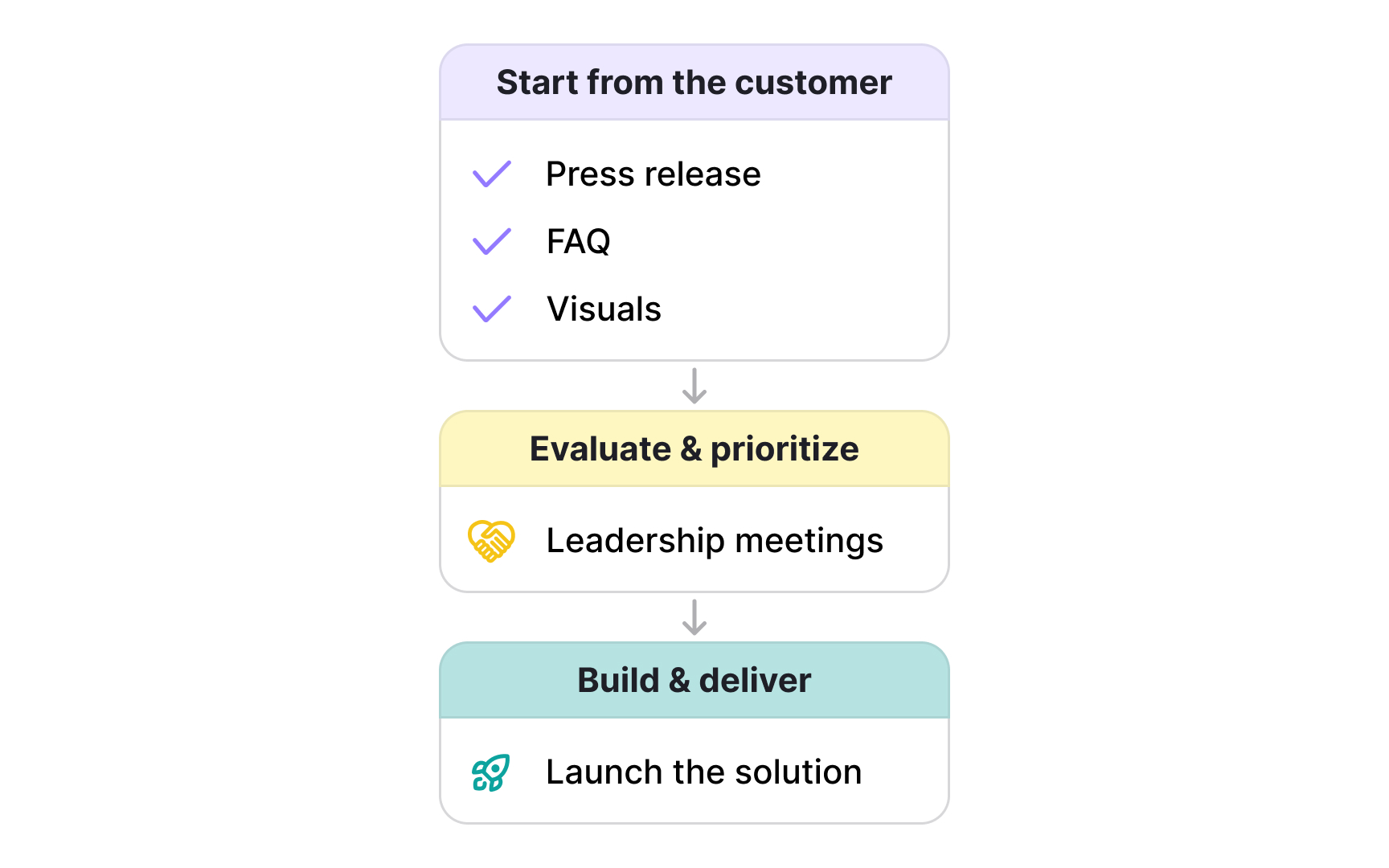
The working-backwards sequence: the press release, FAQ, and visuals are written first, as the test of whether the value is clear enough to announce, and only then does the idea go to leadership for prioritization and on to being built. From the lesson Business Models & Business Casing.
What are the limits of a press release?
A release rarely earns coverage on its own. Newsrooms receive far more releases than they can read, and most announcements are news only to the company that made them. Coverage follows from a relationship with a reporter, an exclusive, a genuinely new fact, or a larger story the release attaches to, and the document itself is the artifact of record that supports that effort rather than the effort itself. Companies that judge a release by whether it was picked up usually find that distribution, timing, and the strength of the news mattered more than the wording.
The format also has a small direct audience. A release posted on a newsroom page is read mostly by investors, partners, analysts, and search engines. For product teams, the useful question is not whether the release will travel but whether it says, accurately and on the record, what the company has done. A release that is true, dated, and consistent with the product has done its job, even when no reporter writes a word, because it fixes the public version of the news that every later conversation refers back to. Where the announcement sits in the wider sequence of a launch, from readiness checks to the day the news goes out, is worked through in the Go-To-Market Strategy lesson.


