.svg)

Partnerships are one of the most overestimated growth levers in early-stage companies. A signed agreement feels like momentum. But the real work begins after the ink dries, and most companies discover this only after months of effort with little to show for it. Partnerships work when both sides have a clear economic case. Partners, whether resellers, affiliates, or distributors, have their own pipelines to manage. Your product is one of dozens they could promote. Without compelling margins, a proven sales playbook to follow, and enablement materials that help them sell confidently, you will not earn meaningful attention. The conditions for a productive partnership are specific, and most early-stage companies have not yet created them. Understanding the different partnership types, what each requires, and when a company is genuinely ready is what separates companies that use partnerships to scale from those who mistake a signed agreement for a distribution strategy. Technology integrators, resellers, distributors, and strategic alliances each serve a different purpose, carry different economics, and demand different levels of organizational readiness. Getting this right requires honest assessment before commitment, not optimism after the fact.
Partnership types and their trade-offs
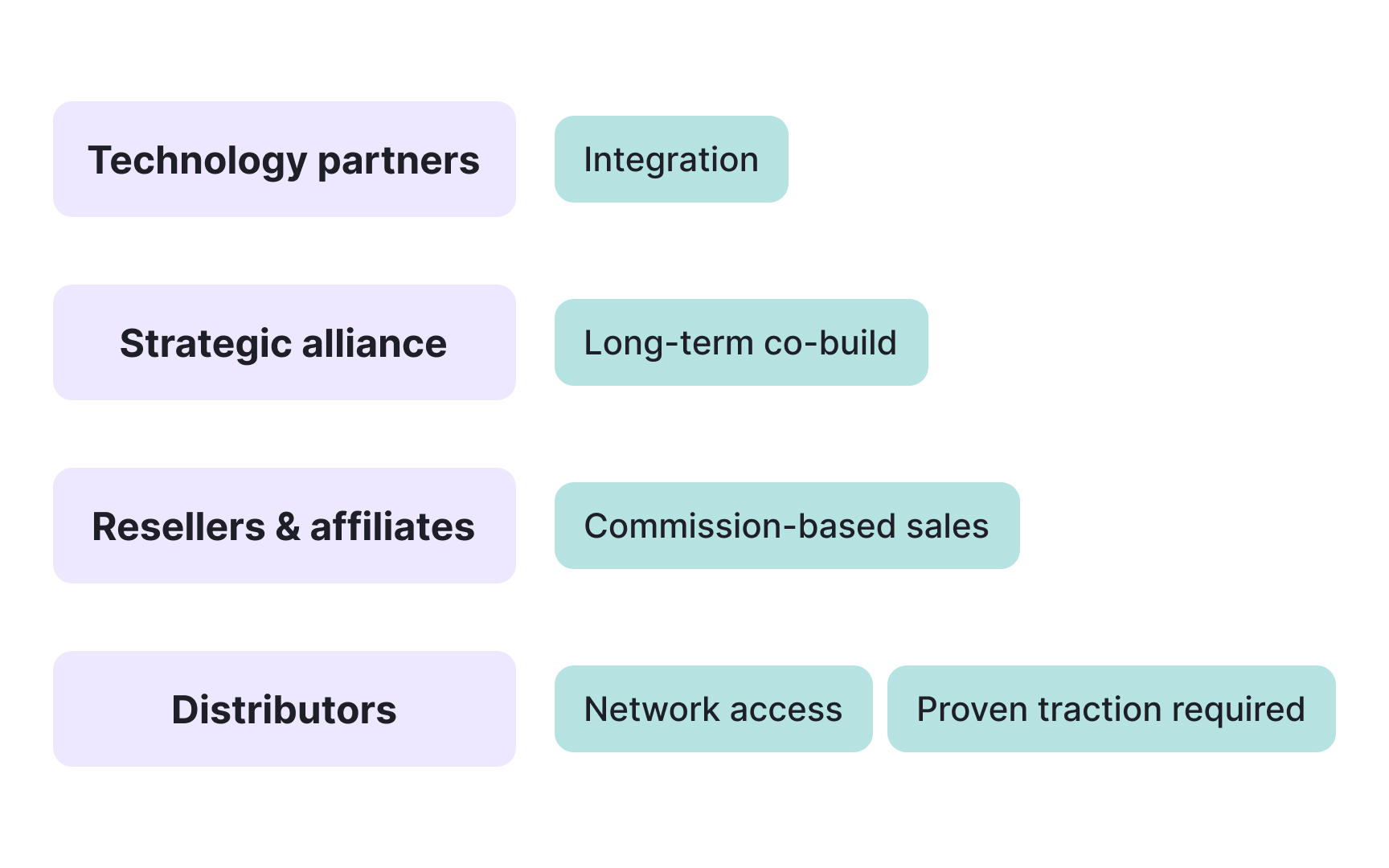
Partnership types differ in how much they demand, how much control you retain, and when they generate results. Understanding these differences before committing prevents months of effort on the wrong arrangement:
- Technology partners integrate your product with another platform so both products become more valuable to shared users. These agreements are relatively easy to reach, but they rarely drive significant volume on their own. A Salesforce integration means customers can use your product in that environment. It does not mean Salesforce sells you to their base.
- Resellers and affiliates sell your product or refer customers in exchange for a commission. Engagement varies. Some resellers actively push your product. Others add you to a catalog and move on.
- Distributors take on pipeline risk and invest in selling into their network. In exchange, they require margins of 40-50% and want proven traction before engaging.
- Strategic alliances are long-term, co-created relationships built around a shared market opportunity. They take months to structure, require sustained executive attention from both sides, and are rarely accessible to early-stage companies.[1]
Pro Tip! Tech integrations expand where your product lives. Only resellers and affiliates expand how many customers buy it.
Why partners must earn money from you
Every partnership comes down to one question: will this partner make enough money to prioritize you? Partners run their own businesses. They have their own customer relationships, their own targets, and a portfolio of products competing for their attention. If the economics of promoting your product are not compelling, they will focus elsewhere. Not because they are unreliable, but because that is how businesses operate.
This means 2 things in practice:
- The margin you offer must be sufficient. Offering a reseller 10% when they earn 25-30% on competing products is not a winning proposition.
- Partners must be able to close deals without requiring constant support from your team. If every sale requires 3 calls from you, the economics collapse for both sides.
A useful test: calculate what a partner would earn in their first year based on a realistic deal volume. Compare that figure to what they earn on other products in their portfolio. If the answer is not clearly attractive, the margin structure needs to change before the partnership can work. The economic case needs to be obvious, not something partners have to squint to see.[2]
Pro Tip! A compelling margin structure is table stakes. Enthusiasm helps, but it does not survive a portfolio review where your product pays less than everything else.
Partner enablement as an ongoing responsibility
Enablement is what allows partners to sell your product without you in the room. Without it, every sale depends on your time, and the partnership economics collapse. Partners do not know your customer personas as deeply as your team does. They have not had the hundred conversations that shaped your sales playbook. Enablement means building the materials, training, and support systems that let partners sell confidently. This includes positioning documentation, a sales playbook covering the customer journey, objection-handling guides for the most common concerns, and technical documentation.
The investment is significant and ongoing. Partners churn. New people join partner organizations. Competitive dynamics shift. A reseller enabled 12 months ago may now have new staff with no knowledge of your product. Keeping partners enabled is a recurring responsibility, not a setup task. Companies that treat enablement as a launch activity rather than an ongoing practice see partner revenue drop off after an initial push. The program appears to stall, but the real cause is that partners lost the capability to sell effectively and received no support to recover it.[3]
Realistic timelines for partnership revenue
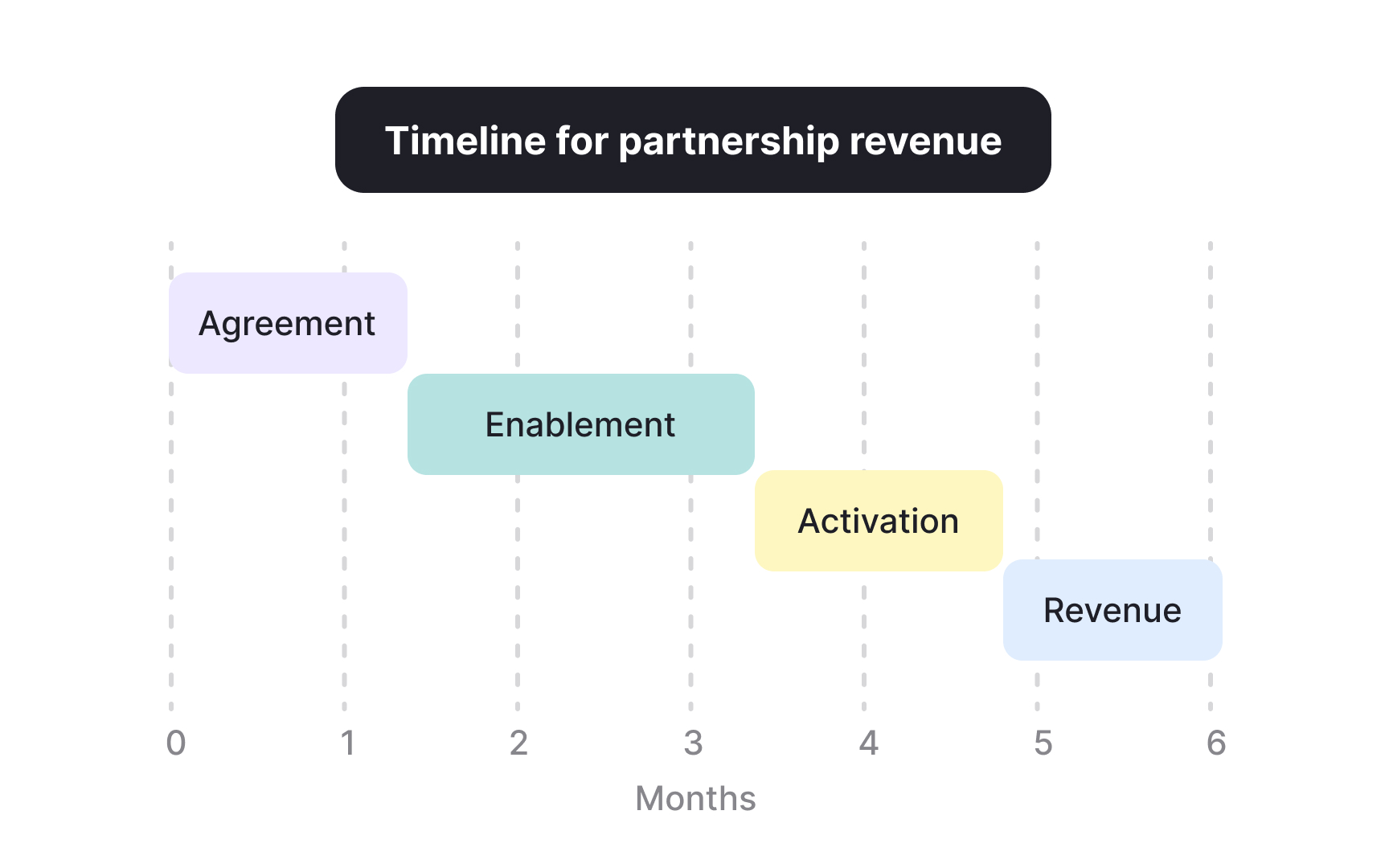
Even well-structured partnerships with committed partners take time to generate meaningful results. A reseller program launched this quarter will not show a significant revenue impact this quarter. The typical timeline from agreement to first meaningful revenue is 3 to 6 months at a minimum, and often longer.
This timeline follows predictable stages:
- The agreement phase involves negotiation and commercial structuring.
- The enablement phase covers training and material development.
- The activation phase is where partners begin actively selling. This takes longer than most companies expect because partners have existing pipelines to manage. Your product enters the queue.
- Revenue contribution becomes meaningful only after partners have closed their first few deals and developed real confidence in the process. Until then, they are learning.
This matters when evaluating partnerships as a solution to a near-term revenue shortfall. If the goal is to close a gap in the next 90 days, partnerships are not the right tool. They are a medium-to-long-term investment that pays off only after the foundational work has been done properly.
Pro Tip! Partnerships are a growth channel, not an emergency lever. Set that expectation with stakeholders before the program launches.
Assessing readiness before pursuing partners
The clearest signal that a company is ready for partnerships is that direct sales is already working. Partners amplify what exists. They do not fix what is broken. If your sales pitch is not converting, a reseller will fail with the same pitch. If your onboarding is confusing, partners' customers will experience that confusion at scale:
- At company maturity Level 1, with 3 to 5 customers, most companies are not ready. You do not yet have the proof points partners need to trust your product, the enablement materials to equip them, or the bandwidth to manage partner relationships alongside everything else. A partnership agreement signed at this stage almost always produces nothing and distracts from direct sales work.
- At maturity Level 2, you may be approaching readiness, but only if you have a working direct sales motion that a partner could replicate and the bandwidth to invest in enablement.
- At Level 3, partnerships become a genuine scaling mechanism because you have the proof, the playbook, and the capacity to make them work.
The readiness question is not "would a partnership help?" It is "do we have the conditions that let a partner succeed on our behalf?"[4]
Matching partner type to company stage
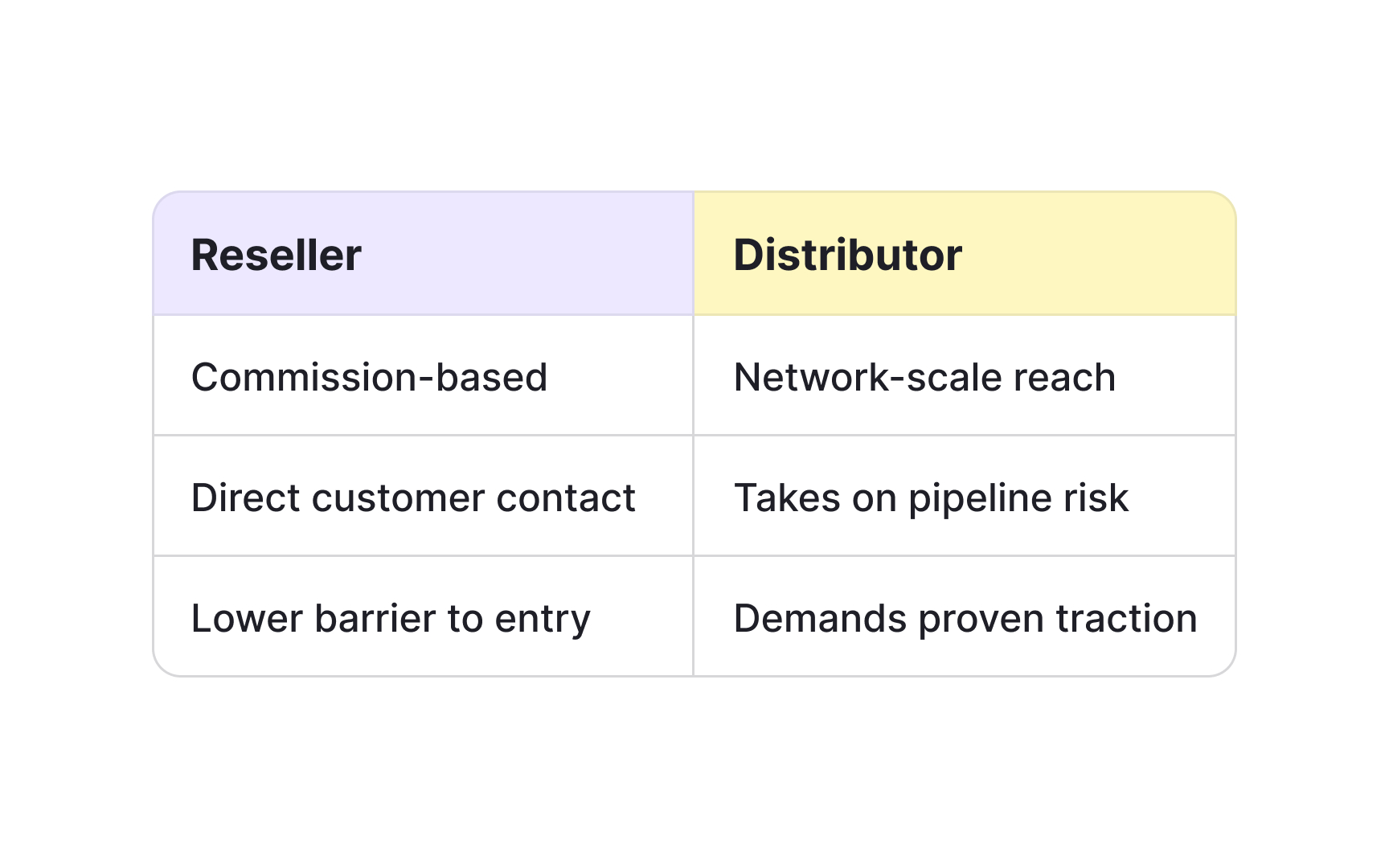
Selecting the right partner type requires matching partner capabilities to your actual gaps, not your aspirations. A common mistake is pursuing high-status partnerships, such as large distributors or strategic alliances, before your company has the traction those partners require.
The matching logic is direct. If you need to reach a segment another organization already serves, a reseller with those relationships fits. If you need to extend your product's value within an existing platform, a technology integration works. If you need access to a market blocked by geography or regulation, a distributor makes sense, but only after proving demand.
For most companies at Level 2, the starting point is a reseller or affiliate arrangement. These are accessible early, require less upfront investment, and let you test the model before committing to complex structures.
Starting with one partner, building a playbook from that experience, and scaling after understanding what makes that partner succeed is how durable programs develop. Signing multiple partners before that understanding exists is one of the most common ways early-stage companies waste time on partnerships.[5]
Building a basic partner enablement package
A basic enablement package contains the materials partners need to represent your product accurately and sell independently. Building it is a practical readiness test. If you cannot assemble these materials, you are not ready to bring partners on:
- Positioning document is the foundation that explains who the product is for, what problem it solves, and how it differs from alternatives. Partners need to answer these questions in conversations with their customers without calling you.
- A sales playbook outlines the typical customer journey, the questions buyers ask at each stage, and the responses that move the process forward.
- An objection-handling guide captures the most common concerns prospects raise and how to address them. Together, these 2 documents reduce the time a new partner needs to reach their first successful sale.
- Supporting materials include technical documentation, case studies from customers similar to the partner's typical client, and a clear escalation path for complex deals. This path handles edge cases without requiring your team to handle every deal, and sets a clear boundary between what partners handle independently and what they refer back to you.
Pro Tip! Treat the enablement package as a forcing function: if you cannot write the playbook yourself, you do not yet understand your sales process well enough to hand it to a partner.
Preventing channel conflict in a partner program
Channel conflict occurs when a partner and your direct sales team are both pursuing the same customer. It creates friction, damages the prospect relationship, and signals a lack of channel structure. Avoiding it requires deliberate decisions about territory and customer type before conflict develops.
The most common cause is ambiguity: no clear rules about which customers belong to which channel. When a reseller closes a deal your direct team was working on, both sides feel undermined, and the prospect experiences confusion.
Deal registration is the primary mechanism for managing this. Partners submit a record of the prospects they are actively pursuing. Your team commits not to engage that prospect directly for a defined period. Without this structure, partners will not invest in deals where they see direct sales activity.
A workable starting rule is to separate customers by segment or geography. Direct sales handles accounts above a contract threshold or regions where you have direct presence. Partners handle smaller accounts or markets where you lack coverage. This reduces conflict without requiring complex tracking infrastructure.
Topics
References
- GTM Partnerships: Most Common Types (With Examples)
- The GTM guide to building SaaS channel partnerships | Bessemer Venture Partners
- Partner enablement: A practitioner's complete guide | Sales Enablement Collective
- What Does It Mean to Be Partner Ready? | Kiflo
- Building a Partnership Strategy in 7 Steps - Partner2B