


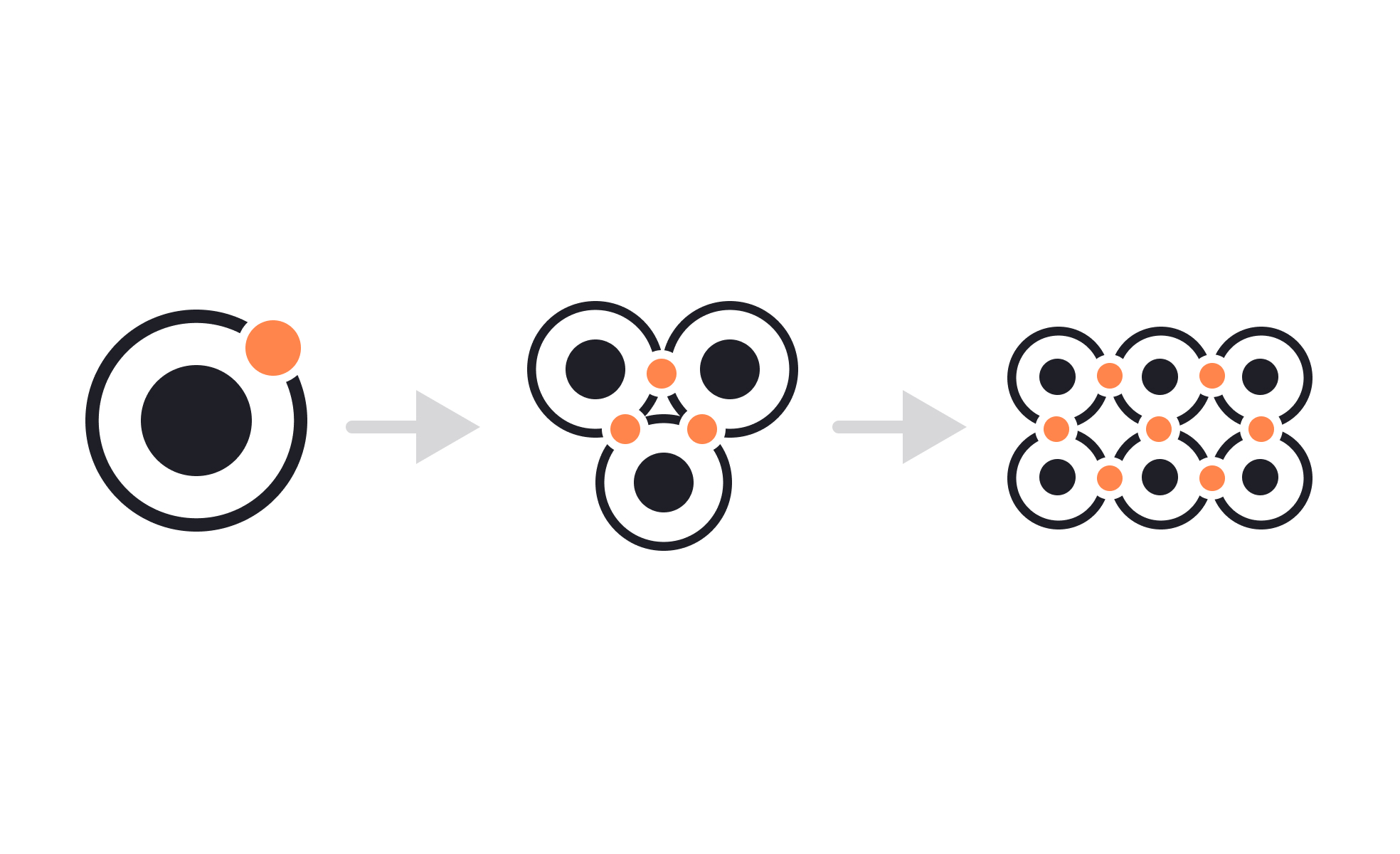
Atomic design is a framework for creating and organizing user interfaces by breaking them down into smaller, reusable pieces. The method was introduced by Brad Frost and is inspired by chemistry, where atoms combine to form molecules and molecules form larger structures. In design, this concept helps teams build complex interfaces systematically while maintaining consistency and scalability.
At the foundation are atoms, the smallest units of a design system. These include basic HTML elements such as buttons, labels, inputs, and icons. While atoms are simple on their own, they establish the visual and functional building blocks of a product. Once defined, they serve as the foundation for everything else, ensuring a cohesive and consistent starting point.
Next are molecules, which combine atoms into functional groups. For example, a search bar molecule may include an input field atom and a button atom. Molecules begin to show how atoms work together in a context, creating meaningful UI patterns that can be reused across multiple pages.
Organisms are larger, more complex structures built from molecules and atoms. Examples include a navigation bar, a card layout, or a product listing section. These organisms represent distinct sections of an interface and often embody higher-level functionality. They provide structure while remaining modular enough to be reused in different contexts.
Templates bring organisms together to form complete page-level layouts. While templates include content structure, they often use placeholder content to focus on layout and functionality rather than final copy. Templates help teams test how organisms interact and ensure that design decisions scale effectively across the product.
Finally, pages are the most complete stage of atomic design. They take templates and fill them with real content, demonstrating how the system works in real-world scenarios. Pages validate design decisions, reveal inconsistencies, and serve as the final test for usability and performance before release.
Real-world applications highlight its impact. Design systems like Google’s Material Design and Salesforce’s Lightning Design System are rooted in atomic design principles.
Learn more about this in the Atomic Design Lesson, a part of the UX Design Foundations Course.
Key Takeaways
- Breaks interfaces into reusable parts: atoms, molecules, organisms, templates, and pages.
- Encourages scalability and consistency across design systems.
- Improves collaboration between designers, developers, and product managers.
- Speeds up iteration by reusing modular components.
- Validates design in real-world contexts through pages.


