


.svg)

Most founders believe strategy is something you build once and then execute. In fact, a go-to-market strategy is the ongoing practice of aligning how your business reaches customers before the pressure of daily operations makes clear thinking impossible. Without it, even a great product can end up chasing the wrong buyers through the wrong channels at the wrong moment.
A go-to-market strategy brings together 5 core components: who your customers are and how they make decisions, which channels connect them to your product, how your pricing signals your market position, when you enter to catch buyers at the right moment, and which partnerships extend your reach. Change one component and the others shift with it.
Timing is one of the most underestimated factors. Launching too early means the market isn’t ready, and you pay to educate customers that your competitors will later convert more cheaply. Launching too late means someone else has defined the category, and your only option is to undercut on price.
Go-to-market strategy as an ongoing system
A go-to-market strategy is often confused with a launch plan. A launch plan is fixed. A GTM strategy is a living system that adapts as your company grows, your market shifts, and your understanding of both deepens. The channel approach that gets you your first 10 customers is almost never the one that gets you to 100. The pricing model that resonates with early adopters may not translate to the mainstream market. Treating GTM as a living system means revisiting key decisions at regular intervals rather than defending them indefinitely. When channel performance drops, the question isn't "how do we fix this channel?" but "is this still the right channel for where we are now?" This ongoing reassessment is not a sign of confusion. It's a sign of strategic maturity. The companies that succeed are not those whose strategy never changes, but those who change it at the right moments with the right evidence.[1]
Pro Tip! Build the habit of reviewing GTM assumptions at each growth milestone: your first 5 customers, your first 25, your first €1M in revenue. Don't wait for a crisis.
Strategy, tactics, and operations
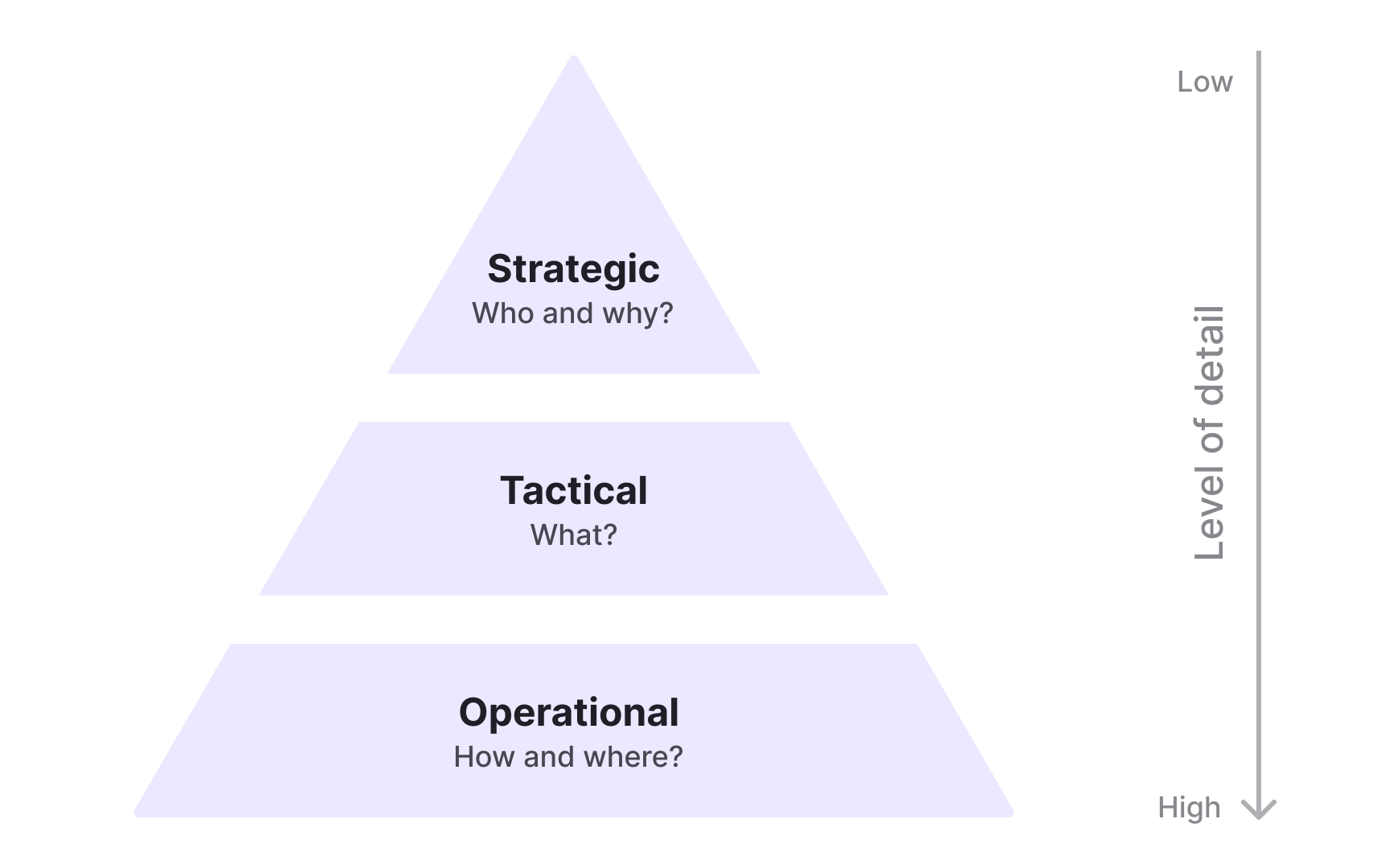
Strategy, tactics, and operations answer 3 different questions, and confusing them is expensive:
- Strategy answers: what game are we playing and how do we win?
- Tactics answer: what specific actions move us toward that goal?
- Operations answer: what do we do today?
A strategic decision might be to focus on accounting firms with 10-50 employees in a single region and win through compliance features they can't find elsewhere. A tactic is attending the regional accountants' conference and running direct outreach to firms in the local directory. An operational action is booking the tickets and writing the email. The 3 levels must be aligned. Tactics without a strategic anchor default to repeating whatever worked last week, regardless of whether it still fits where the business is progressing. Operations without a tactical plan produce activity without purpose. Execution pressure doesn't create alignment automatically. It amplifies whatever direction already exists.[2]
Pro Tip! If you can't connect a daily action to a tactic, and that tactic to a strategic goal, the action is probably misallocated time.
The 5 GTM components and how they interact
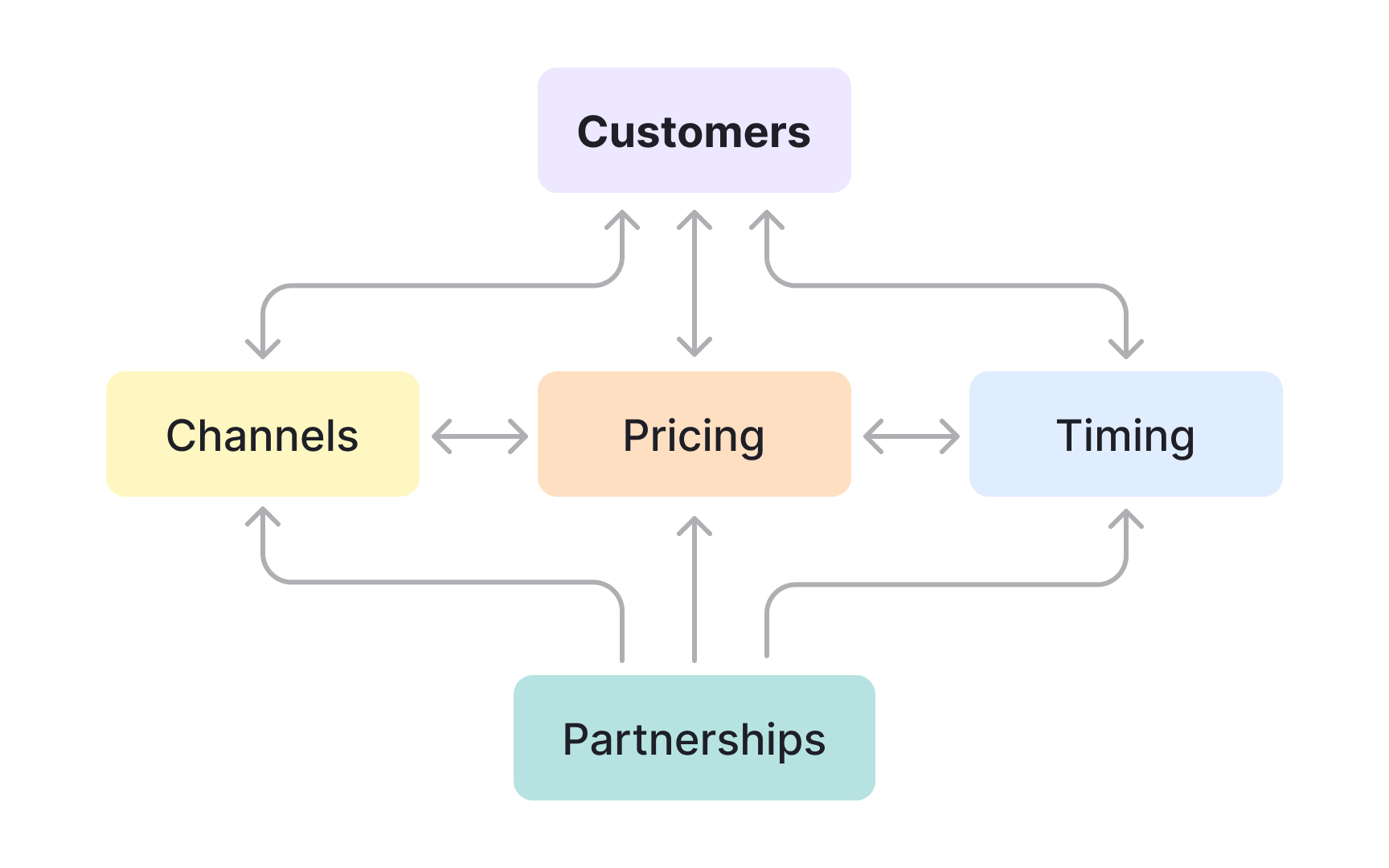
5 components make up any go-to-market strategy, and none of them operate in isolation:
- Customers: specific people with specific problems, not broad categories like "small businesses."
- Channels: not just distribution points, but the cost structure of growth and the depth of the customer relationship.
- Pricing: communicates market position before any sales conversation begins
- Timing: determines whether the other 4 components land in a market that's ready to engage
- Partnerships: extend reach, but only work when the other components are already functioning
The interconnection is the point. A founder who changes pricing without reconsidering channel fit, or adds a partnership without a working direct-sales motion, creates misalignment that compounds over time.
When timing kills a good product
Timing failures are one of the most underestimated causes of startup failure. Post-mortems tend to blame product-market fit or execution. But sometimes, the product is right and the execution is solid, and the market simply isn't ready. The symptoms look identical, which is why the diagnosis is often wrong.
Launching too early means paying to educate customers who aren't yet feeling the pain acutely enough to change behavior. The market education you fund becomes a gift to competitors who enter later, having learned from your mistakes, at a lower cost. First movers in categories without strong network effects or patent protection have a 47% failure rate, compared to roughly 8% for early followers who enter after category demand has been established.[3]
Launching too late creates a different problem. The category exists, a leader has emerged, and your only realistic path is to undercut on price, which is a race to the bottom. Understanding which timing scenario you're in before you commit major resources is one of the highest-value assessments an early-stage founder can make.[4]
Pro Tip! Ask not just "is the market ready?" but "who is paying to make it ready, and will we benefit from that investment or someone else?”
The role of partnerships in GTM
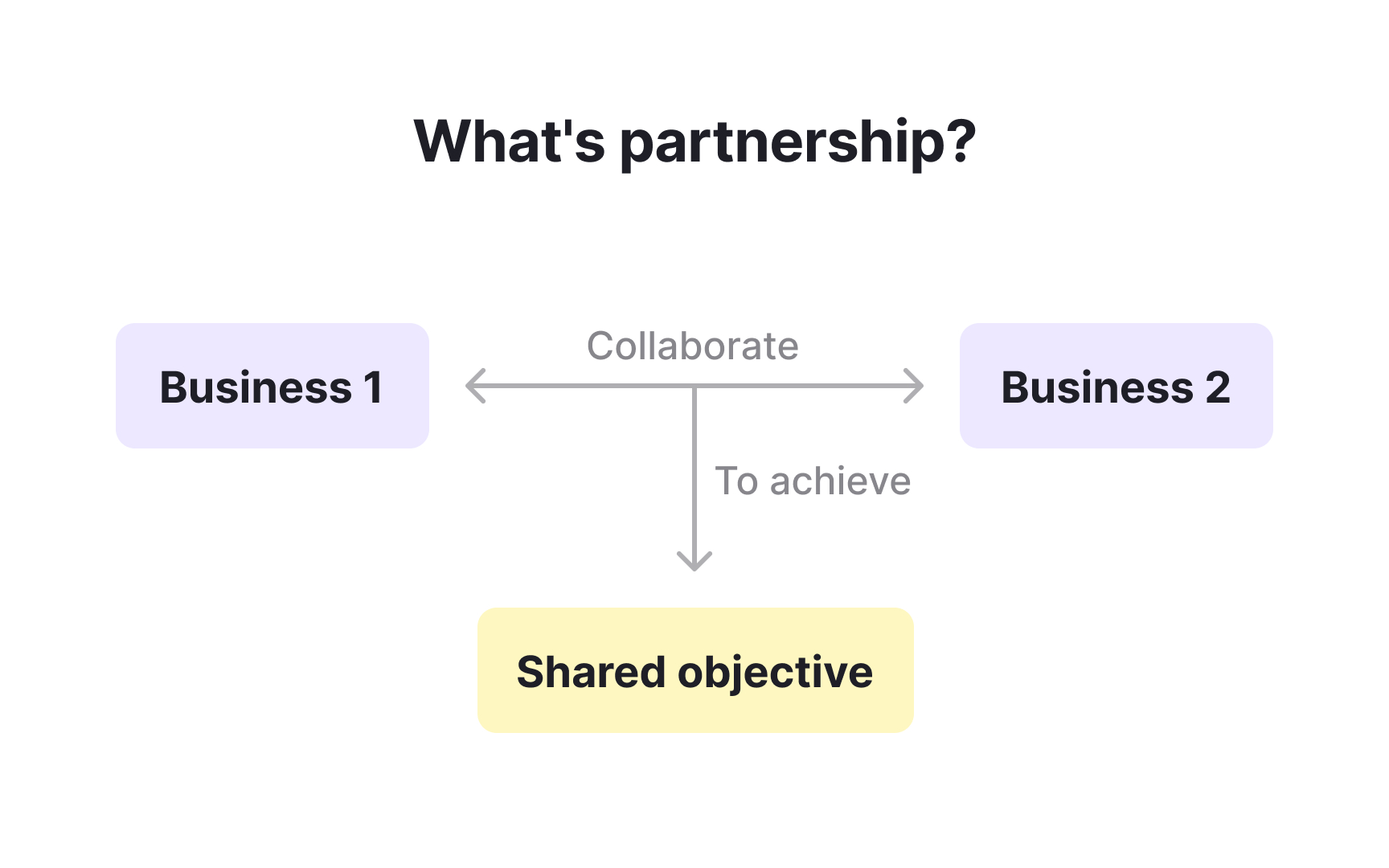
Partnerships are one of the most consistently overestimated GTM levers in the startup world. The appeal is clear: a signed agreement with a large distributor or established platform feels like distribution is solved. In practice, a signed agreement is the beginning of the work, not the end of it. Partnerships work as amplifiers. They magnify what already exists. A healthy direct-sales motion becomes stronger when a partner promotes you to their established customer base. A struggling direct-sales motion becomes more visibly broken when a partner's customers experience the same confusion at scale, and the partner stops prioritizing you as a result. This means partnerships are not a shortcut to avoiding the foundational GTM work. They are a reward for having done it. Before a partner can sell effectively on your behalf, you need proof points that their customers will trust, enablement materials that let them sell without constant support from your team, and a direct-sales playbook that they can replicate.[5]
Pro Tip! If your direct sales are struggling, the honest question isn't "which partner can fix this?" It's "what is broken in our motion that we need to fix first?”
GTM readiness before launch


No amount of go-to-market strategy repairs a product that hasn't found genuine demand. This sounds obvious, but the line between "we have promising signals" and "we have validated demand" is frequently blurred by founders who are eager to move. GTM planning assumes the foundational validation work is already done: real customers have paid, or are seriously committed to paying, or have used the product repeatedly in a way that signals genuine value.
The readiness test is practical. Have you spoken directly with real customers in your target segment? Have you seen someone change behavior, spend money, or commit time because of what your product does? Have you understood not just that they like it, but why they bought and what would make them leave?
Founders who skip validation and move directly to GTM planning often discover midway through execution that their assumptions about who buys, why they buy, and what they're willing to pay were incorrect. Correcting those assumptions after channels are built and pricing is set is significantly more expensive than correcting them before.[6]
GTM strategy vs. marketing strategy
Marketing strategy is one of the components inside a go-to-market system, not a separate phase that follows it. GTM covers how your business reaches customers across all 5 moving parts: customers, channels, pricing, timing, and partnerships. Marketing governs how you create awareness and demand within that system. It belongs inside the framework, not after it.
This matters because GTM is ongoing. As a company moves from Level 1 to Level 4, every component evolves, and marketing evolves with it. At Level 1, marketing might be nothing more than direct outreach and personal referrals. At Level 3, it expands into content, paid acquisition, and events. The approach changes because the company's stage changes, not because GTM has been completed and handed off to a new function.
Treating marketing as something that kicks in once the GTM work is done tends to create a gap between the two. Channel decisions get made without marketing input. Messaging drifts from positioning. Campaigns run independently of where the company actually is in its growth. Keeping marketing inside the GTM system, revisited at each stage, is what prevents that drift.[7]
Identify premature GTM complexity
A common failure pattern among early-stage founders is borrowing the go-to-market playbook of a more mature company and trying to run it at the wrong stage. A startup with 8 customers builds a reseller program. A team that hasn't proven direct sales hires a VP of Marketing to build brand awareness. A founder who hasn't completed 50 customer conversations invests in a self-serve onboarding flow.
These moves don't just fail to help. They actively consume the resources and attention that should be going to the foundational work. The signals that a company is borrowing too far ahead include: adding channel complexity before a primary channel is proven, hiring for scale before understanding what is being scaled, and measuring brand metrics before measuring whether the core sales motion converts. The right question before any GTM investment is: what stage are we at, and is this decision appropriate for that stage? The mistake is not wanting to grow. The mistake is applying growth-stage tactics to a company that hasn't finished the foundation-stage work.[8]
Pro Tip! A useful rule: every new channel, role, or program should be justified by evidence from the stage you're in, not by ambition about the stage you want to reach.
Topics
References
- What is a go-to-market strategy? | Definition from TechTarget | Search IT Channel
- How To Create A Winning Go-To-Market Strategy For Startups
- 2026 go-to-market strategy examples and insights | Highspot
- What is a go-to-market (GTM) strategy? How to build one in 11 steps | Zendesk
- How to Build a GTM Strategy Without Wasting Time on Guesswork in 2026 | Via Marketing, a Strategic B2B Fractional Marketing Agency.