.svg)


UX writing is the craft of the words inside a product: buttons, errors, empty states, and the voice that holds them together. It's a small field with an unusual training market, where one provider sets the de facto industry credential and the free options are genuinely good. The cohort academies, meanwhile, cost as much as a university certificate. Prices run from nothing to $1,499, so the real question is which format actually has you making word decisions under real constraints. If you want to prove the skill you already have, Uxcel's UX writing certification validates it with an 80-question exam. This list covers the courses, grouped by format, with the real price on one line for each.
The shortlist
Self-paced UX writing courses
- Uxcel's UX Writing course for practicing word decisions interactively
- UX Writing Fundamentals by UX Content Collective for the industry-standard certificate
- Certified UX Writer by Technical Writer HQ for a budget certification
Free UX writing courses
- Daily UX Writing for a free practice challenge with portfolio output
- A Taste of UX Writing by UX Writing Hub for a free structured introduction
Cohort and live UX writing training
- UX Writing Academy by UX Writing Hub for a career-switch cohort
- NN/g's UX Writing course for a live seminar with a research pedigree
- Content Design London's fundamentals for the content design angle
What to look for in a UX writing course
Four things separate training that changes your copy from a pleasant read:
- Writing practice, not writing appreciation. The skill is making word decisions under constraints: 30 characters, an error state, a legal review. A course where you never write anything teaches recognition, not the craft.
- Feedback that isn't a quiz score. Copy quality is contextual, so human or scenario-based feedback beats multiple choice alone. This is where cohorts earn their price.
- Credential honesty. No UX writing certificate is a hiring requirement. UX Content Collective's comes closest to an industry standard, and portfolios still beat certificates in interviews.
- The content design overlap. Job titles are shifting from UX writer toward content designer, which adds strategy and systems to the sentence-level work. Several courses on this list already teach under that broader banner, and the skills transfer in both directions.
Self-paced UX writing courses
1. UX Writing by Uxcel: best for practicing word decisions

UX Writing is the most-reviewed course on this list. Over 21,800 learners have enrolled, it holds a 4.7 rating from over 1,600 reviews, and it's the only fully interactive option here. Sixteen lessons across four levels run as scenario decisions with immediate feedback. They move from the psychology behind microcopy through brand voice, UI writing, and the field's conventions. You practice choosing between two error messages rather than watching someone explain one.
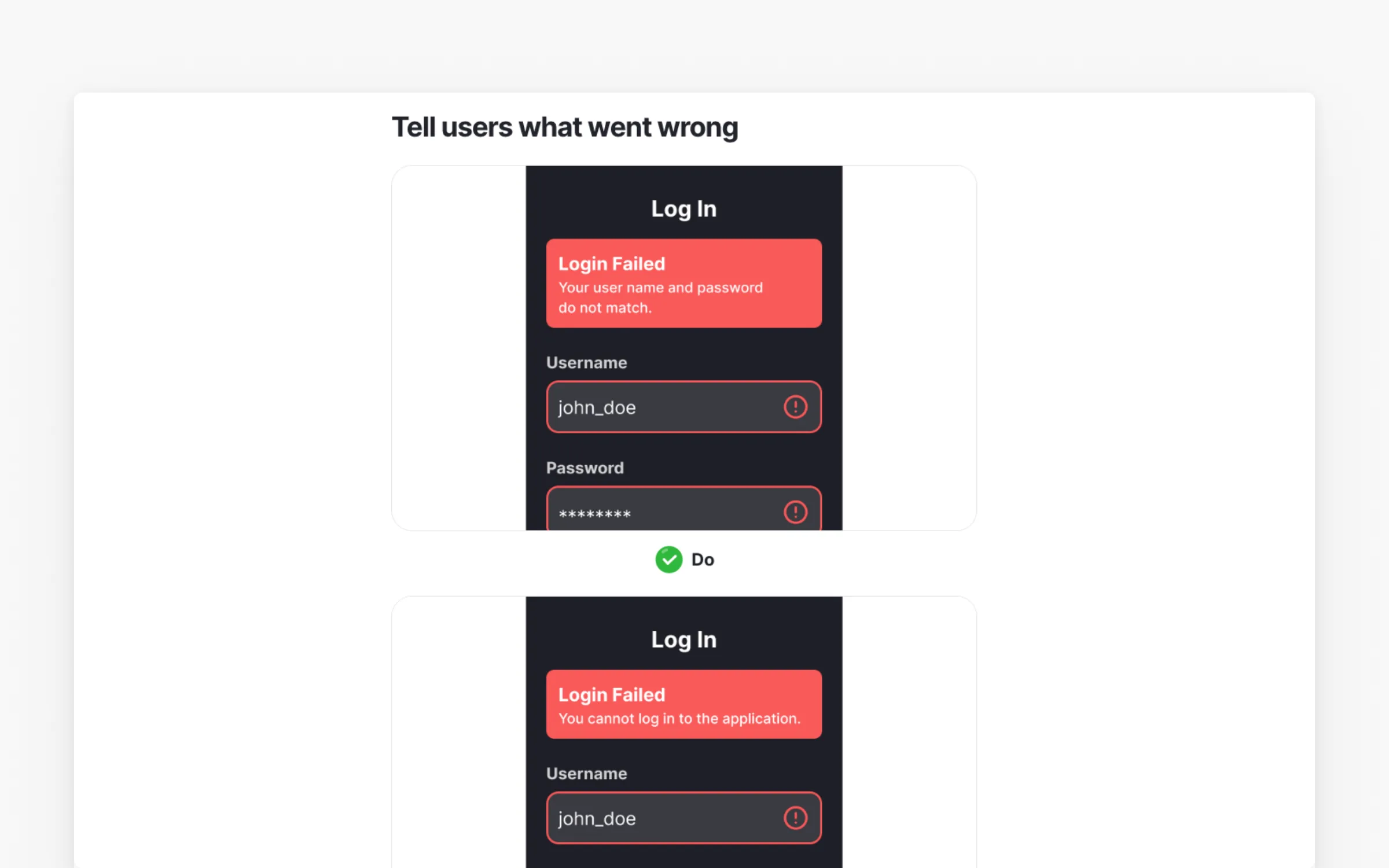
It's an intermediate course, so it assumes you know your way around product design basics. Writers coming from marketing or journalism land fine; complete beginners to digital products should expect a short ramp. For the larger role around the writing, the UX writer career path packages this course with the design foundations beside it.
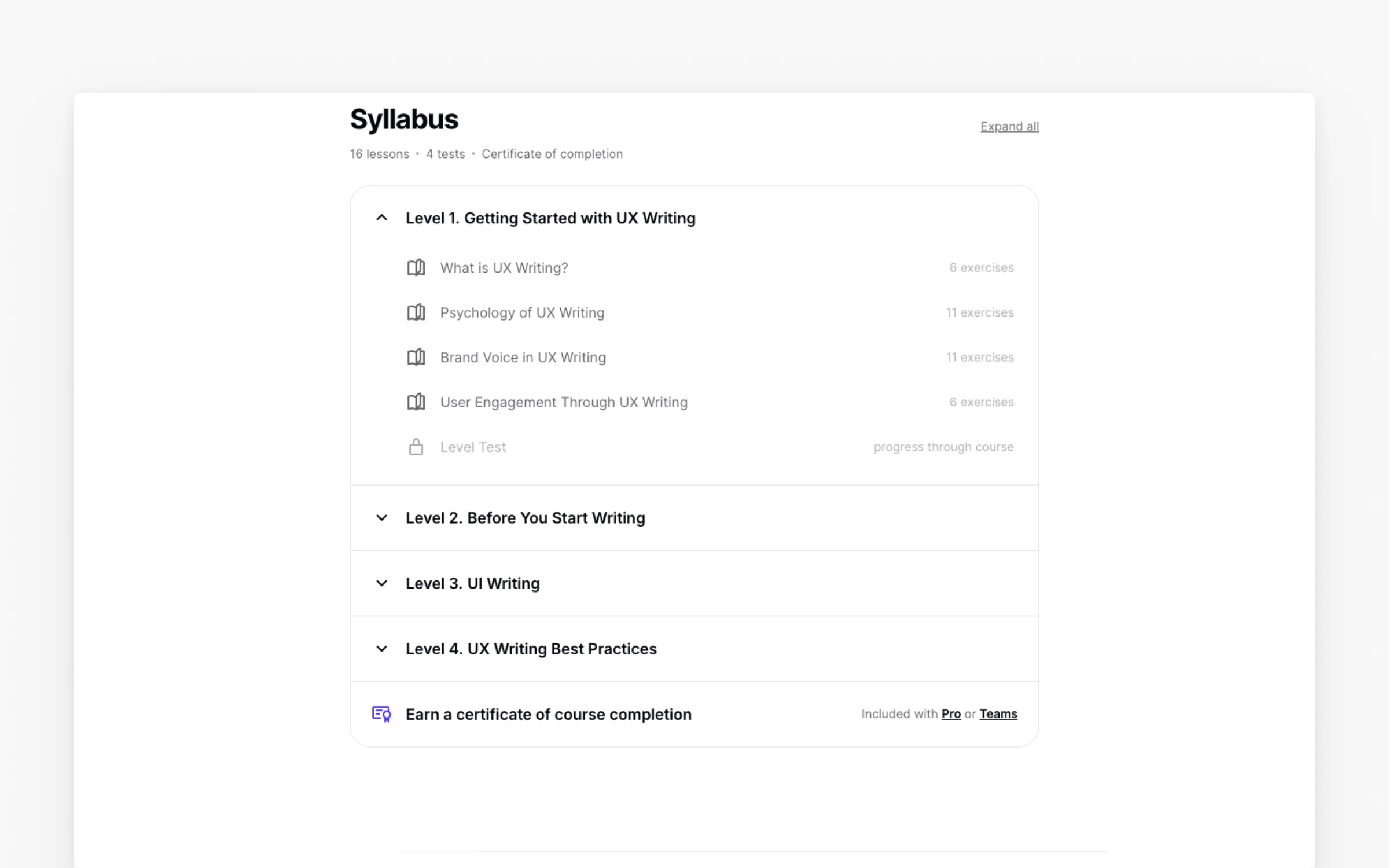
Price: every Level 1 lesson is free, no card required. Pro unlocks the full course and catalog.
2. UX Writing Fundamentals by UX Content Collective: best for the industry-standard certificate
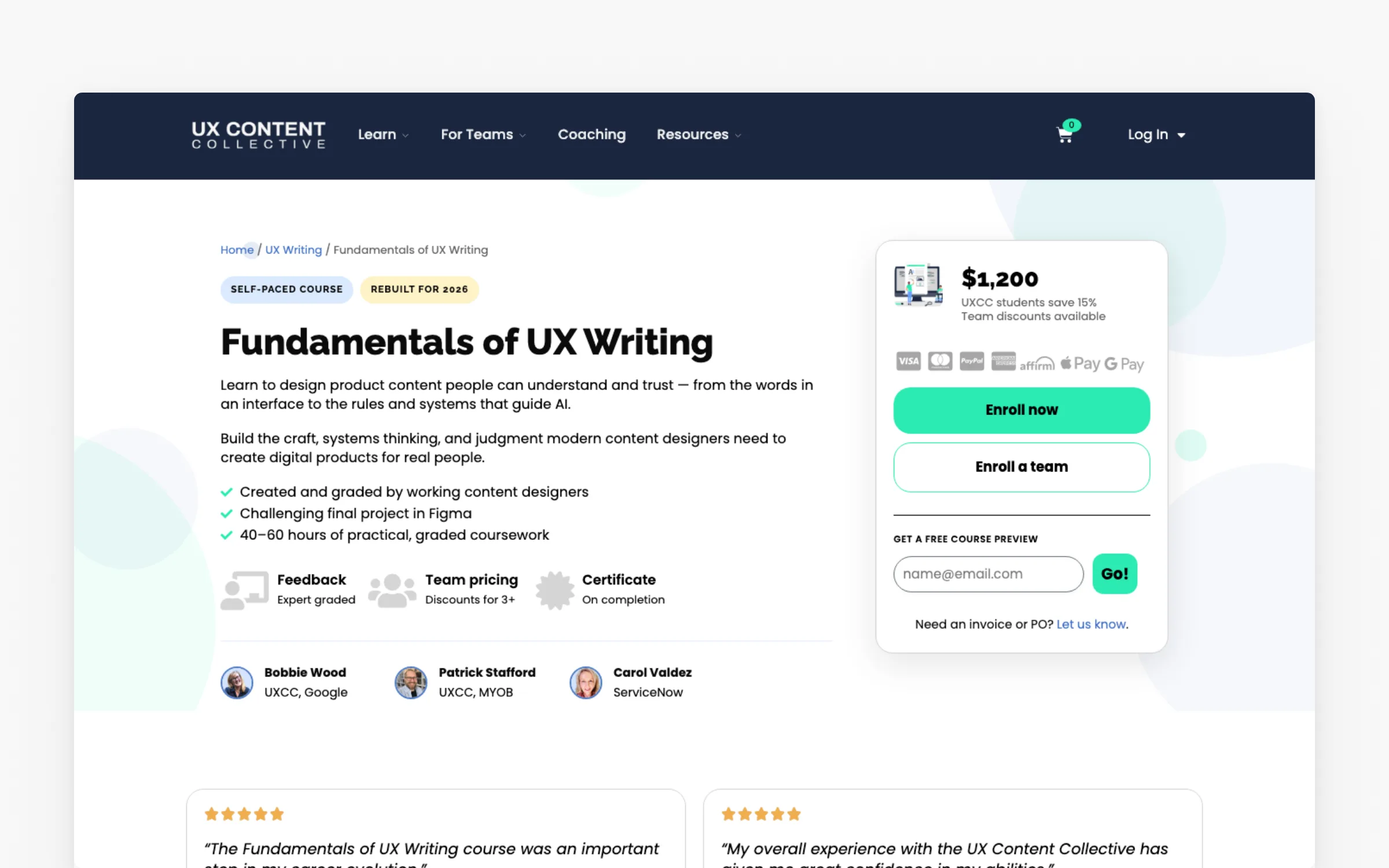
UX Writing Fundamentals comes closest to a standard credential in this field. It's built and taught by working content designers, runs self-paced, and holds back the certificate until a reviewed final project passes. That review step is why hiring managers in the field recognize it. The trade-off is price: at $1,200 it costs university-certificate money for a self-paced course. The same team sells a $300 Intro to UX Writing and Content Design as a smaller first step.
Price: $1,200. The intro course runs $300.
3. Certified UX Writer by Technical Writer HQ: best budget certification

Technical Writer HQ's Certified UX Writer packs 60+ video lessons, assignments, and quizzes into ten self-paced weeks. Plan on about four hours a week across the full run, with lifetime access afterward. It ends in a verifiable digital badge, and the lifetime access includes ongoing content updates. It's video-first, so you'll watch more than you write, and the credential carries less field recognition than UX Content Collective's. At less than half the price, that's the deal on the table.
Price: $499, with a 30-day money-back guarantee.
Free UX writing courses
4. Daily UX Writing: best free practice challenge
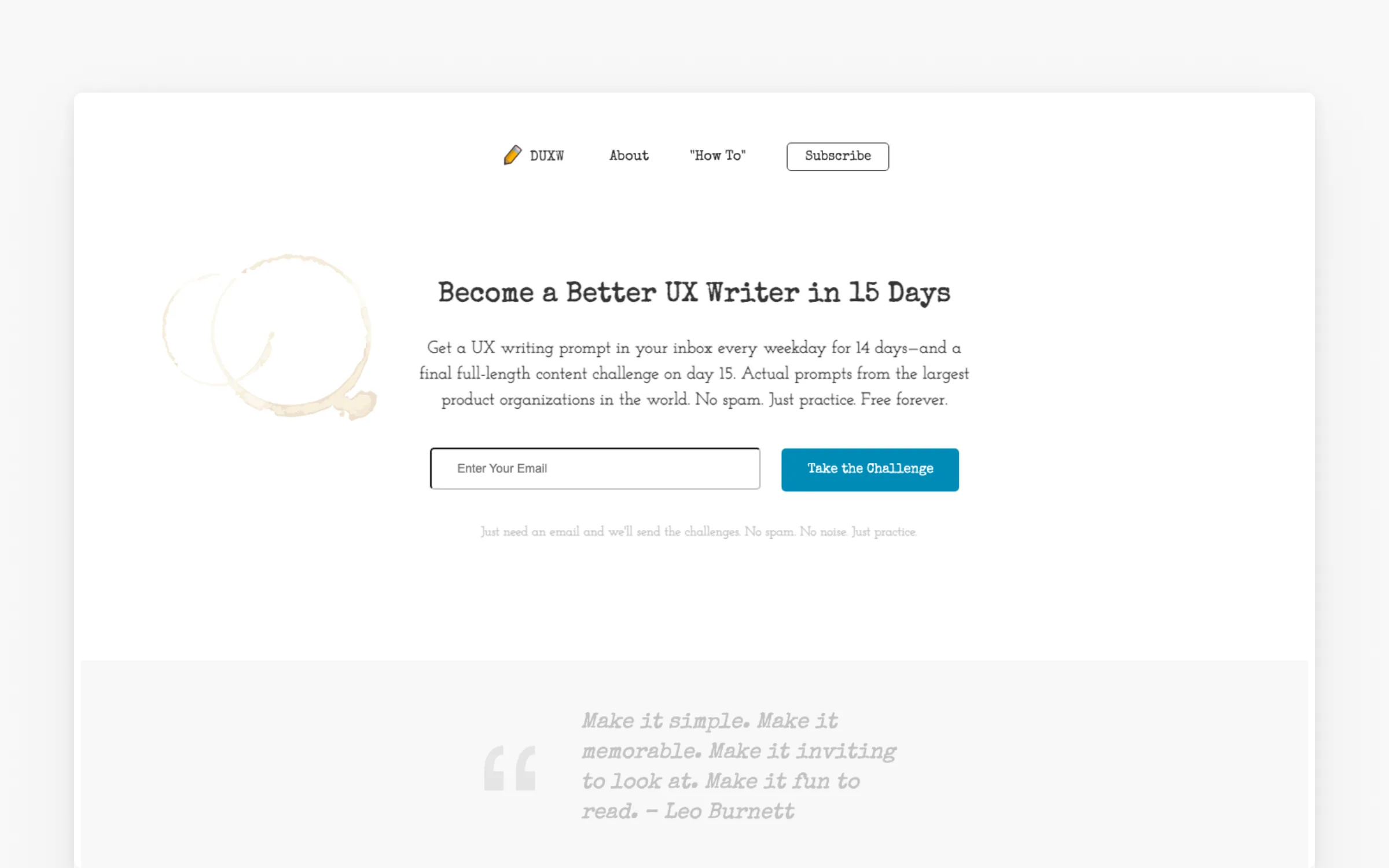
Daily UX Writing sends one short exercise to your inbox daily for 14 days, then caps the run with a bigger final challenge on day 15. The prompts are real scenarios with real constraints, character limits included, which makes it the purest writing practice on this list. Finish it and you have a portfolio-ready case study, which is more than some paid courses leave you with. There's no instruction layer, so pair it with a structured course if you're starting from zero.
Price: free.
5. A Taste of UX Writing by UX Writing Hub: best free introduction

A Taste of UX Writing runs seven days, free. Video lessons, quizzes, and templates carry it, and more than 8,500 students rate it 4.8. Each day's lesson takes well under an hour, and nothing assumes prior product work. It's the structured counterpart to Daily UX Writing: less practice, more explanation, and a fair preview of the paid academy below. Expect a marketing nudge toward that academy at the end; the teaching before it is real.
Price: free.
Cohort and live UX writing training
6. UX Writing Academy by UX Writing Hub: best career-switch cohort

UX Writing Academy is the deep option: four months in a cohort capped at 20. Weekly live sessions come with recordings, and it ends in a certificate covering UX writing and AI content design. The format exists for people changing careers, and the cap means actual feedback on actual work. Two honest caveats. At $1,499 it's the most expensive option here, and the live sessions run on Israel time. Check the math against your time zone before enrolling, especially from the US west coast.
Price: $1,499, or four installments.
7. UX Writing: Foundations and AI-Assisted Techniques by NN/g: best live seminar
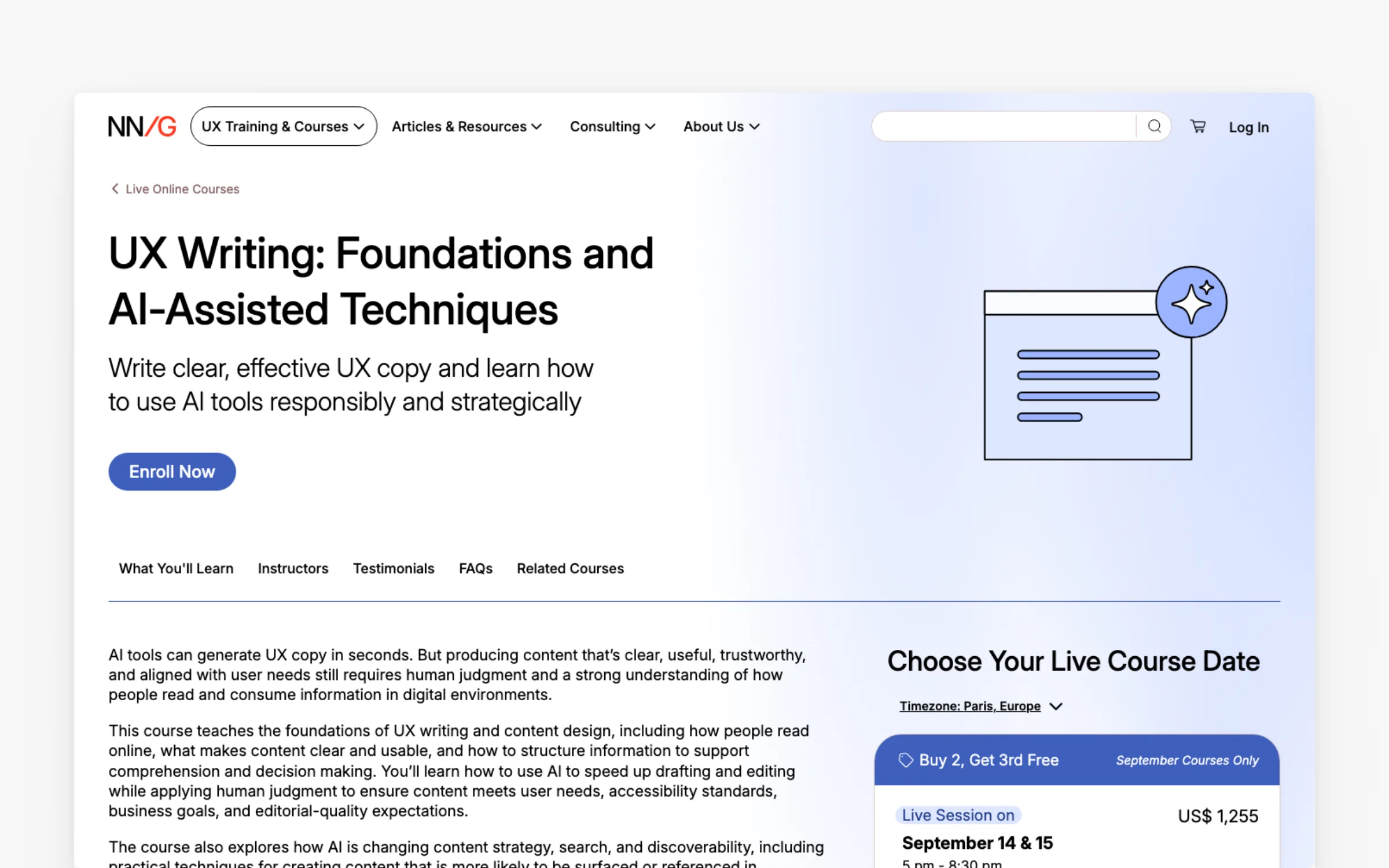
Nielsen Norman Group compresses the field into one live Zoom seminar. UX Writing: Foundations and AI-Assisted Techniques runs seven hours across one or two days, with the research backing NN/g is known for. The current version covers how AI tools change the writing workflow, and the course counts toward NN/g's UX Certification, which carries weight in larger organizations. It's a seminar, though, so you'll leave with frameworks and examples rather than a body of practiced work.
Price: about $1,200, varying slightly by session.
8. Content design: fundamentals by Content Design London: best for the content design angle

Content Design London quite literally wrote the playbook on content design. Its fundamentals course teaches the discipline the way Sarah Winters' team defined it: research-first, evidence-driven, bigger than microcopy. The live online course runs at £795 early-bird, while a self-paced recorded version costs £120 with a year of access, quietly one of the best value buys in this space. UK-centric examples are the honest limit for US readers.
Price: £795 early-bird for the live course, £120 self-paced.
Does AI make UX writing obsolete?
No, it raises the bar for it. AI now drafts passable interface copy in seconds, which automates the typing and none of the judgment. Someone still has to know the psychology behind a reassuring error message, hear when the voice drifts off-brand, and decide what the moment actually needs to say. That's the UX writing skill, and products drowning in generated copy make it more valuable, not less. The strongest courses on this list already treat AI as a drafting partner and teach the craft of directing and editing it.
Is a UX writing certification worth it?
No employer requires one, so treat certificates as tiebreakers rather than tickets, with UX Content Collective's carrying the most field recognition thanks to that reviewed final project. Prefer validating skill over buying a course? A skills exam like Uxcel's UX writing certification tests it directly, at a fraction of academy prices.

The exam itself runs 80 questions in 80 minutes, with a free practice exam to gauge readiness before you pay. Passing earns a shareable certificate on a publicly verifiable credential page. It costs $300, and Pro members get 30% off at checkout, so the course above teaches the skill and discounts the proof. It's aimed at anyone who owns product copy: UX writers, content designers, and the product managers writing in the gaps. In every case, three strong portfolio pieces beat any certificate in an interview. The honest exception is the portfolio gap itself, where a reviewed-project certificate can stand in while your first real work accumulates.
How to choose
Match the format to your gap. If you've never written product copy: A Taste of UX Writing, then the Daily UX Writing challenge for practice. If you write already and want the decisions drilled: Uxcel's interactive course. If you're changing careers and need structure, feedback, and a portfolio: UX Writing Academy. If you'd rather self-pace toward the recognized certificate: UX Writing Fundamentals. If your team writes as part of design work: NN/g's seminar or Content Design London's fundamentals. Pick by whether you want research framing or the full content design discipline. The field is small enough that good work gets noticed fast, and training just shortens the distance to it.