
What separates UX researchers who are thriving from those who’ve been job hunting for months? It’s not experience level. Plenty of senior researchers got laid off. It’s not technical skills alone either. The difference comes down to a combination of competencies that most researchers never developed because they didn’t need them until now.
This guide breaks down that combination. Not every skill applies to every role, but together they map out what competitive UX researchers look like in 2026. For each skill, you’ll get a clear explanation of what it is, why it matters in today’s research landscape, and specific actions to improve it.
Let me be upfront about the scope here. I didn’t interview hundreds of researchers or conduct longitudinal studies. What I did was synthesize job market data, industry reports from sources like Nielsen Norman Group and Maze’s Future of User Research Report, and patterns from real hiring managers. That’s the honest basis for this analysis. User experience research, the discipline at the heart of this guide, is essential for understanding user needs, informing design decisions, and serves as the foundation for effective product development.
What you'll learn from this article
- The essential skill sets required for UX researchers, including technical, soft, applied business, collaboration, and AI skills
- Technical skills that separate professional researchers from DIY attempts
- Soft skills that make your insights actually get implemented
- Applied business skills that connect research to revenue
- Cross-department collaboration skills that expand your influence
- AI skills that multiply your research capacity
Quick reference: all 27 UX researcher skills at a glance
Here’s a quick reference table that provides an at-a-glance overview of all the essential UX research skills you need to succeed as a UX researcher.
What does a UX Researcher do?
UX research is the backbone of creating products that truly resonate with users. At its core, UX research is about understanding user behavior, uncovering pain points, and identifying what motivates your target audience. By systematically collecting and analyzing both qualitative and quantitative data, UX researchers transform raw observations into actionable insights that drive the design process forward.
Whether you’re mapping out a new app interface or refining an existing service, user research ensures that every design decision is grounded in real user needs, and not just assumptions. This process involves a mix of methods, from in-depth interviews to large-scale surveys, all aimed at revealing how people interact with products and where they encounter friction. The ultimate goal is to inform the product development process so that the end result is not only functional, but also intuitive and enjoyable for users.
In today’s competitive landscape, companies that invest in thorough UX research consistently outperform those that skip this step. By prioritizing user research, organizations can create products that are user-friendly, efficient, and tailored to the needs of their target audience, leading to higher satisfaction, loyalty, and business success.
Technical skills for UX researchers

Technical research skills form the foundation of effective UX research. These are the methodological competencies that enable you to gather reliable insights and translate user behavior into actionable recommendations.
According to recent industry surveys, researchers who master both qualitative and quantitative research methodologies command significantly higher salaries and have more job security.
1. Qualitative research methods
Qualitative research involves collecting non-numerical data through methods like user interviews, contextual inquiries, and ethnographic studies. These approaches are forms of primary research, as they involve directly gathering data from users rather than relying on existing sources. You’re exploring the “why” behind user behavior, uncovering motivations, frustrations, and mental models that quantitative data alone can’t reveal.
Why this skill matters
Organizations increasingly recognize that numbers without context lead to misguided decisions. A 30% drop-off rate tells you something is wrong, but qualitative research reveals whether users are confused, frustrated, or simply distracted. In 2026, with AI handling more data processing, human researchers who can conduct nuanced qualitative investigations become even more valuable. This came up constantly in the job postings I reviewed.
How to improve it
Start by practicing interview techniques with friends or colleagues before conducting actual user sessions. Focus on asking open-ended questions and developing your ability to follow unexpected threads without leading participants. Record and review your sessions to identify patterns in your questioning style that might bias responses.
2. Quantitative research methods
Quantitative research collects numerical data through surveys, analytics, A/B testing, and behavioral metrics. A key skill for UX researchers is the ability to efficiently and accurately collect data using these quantitative methods, ensuring reliable insights into user behavior. You’re measuring the “what” and “how much” of user behavior, providing statistical evidence that supports or challenges qualitative findings.
Why this skill matters
Stakeholders make decisions based on numbers. Budgets, roadmap priorities, and resource allocation all depend on quantified evidence. One thing that stuck with me from reviewing job requirements: researchers who can only provide qualitative insights often find their recommendations dismissed as anecdotal. Mixing methods gives you credibility that pure qual researchers lack.
How to improve it
Learn basic statistical concepts like confidence intervals, statistical significance, and sample size calculations. Practice creating surveys that yield measurable, actionable data rather than vague sentiment. Use analytics tools to track user behavior patterns and learn to interpret the data meaningfully.
3. Usability testing
Usability testing involves observing users as they attempt to complete tasks with your product. You’re identifying friction points, confusion, and failure modes in real-time, generating specific recommendations for interface improvements.
Why this skill matters
Nothing replaces watching real users struggle with a design. Usability testing catches problems that internal teams miss because they’re too familiar with the product. In 2026, with AI tools generating design variations rapidly, human researchers who can efficiently evaluate usability become essential quality gates.
How to improve it
Start by creating a detailed test plan to ensure your usability testing sessions are structured and objectives are clear. Practice moderating test sessions with clear task scenarios and neutral facilitation. Learn to observe without intervening, take detailed notes while maintaining rapport, and synthesize findings into prioritized recommendations. Remote testing skills are now essential, so become proficient with tools like Maze, UserTesting, or Lookback.
4. Survey design and analysis
Survey design involves creating questionnaires that yield valid, reliable data. This includes writing unbiased questions, choosing appropriate scales, determining sample sizes, and analyzing results statistically. Well-designed surveys are essential for gathering actionable user feedback to inform product decisions.
Why this skill matters
Surveys scale research capacity dramatically. One well-designed survey can reach thousands of users in the time it takes to interview ten. But poorly designed surveys generate misleading data that damages credibility. I kept seeing job postings specifically mention survey design as a required skill, not just a nice-to-have.
How to improve it
Study question types and when each is appropriate. Practice avoiding leading questions, double-barreled questions, and unclear response options. Learn to pilot test surveys before full deployment. Develop skills in analyzing survey data beyond simple frequencies, including cross-tabulation and basic statistical tests.
5. Research synthesis and analysis
Research synthesis involves transforming raw data from multiple sources into coherent insights and recommendations. To ensure thorough and accurate synthesis, it’s essential to consider all the data collected: comprehensive analysis across every research method and stage is key. You’re identifying patterns, themes, and contradictions across different research activities, then translating findings into actionable guidance for product teams.
Why this skill matters
Data collection is relatively straightforward. Synthesis is where researchers earn their value. Anyone can conduct interviews or run surveys, but few can weave disparate data points into a compelling narrative that drives product decisions. This skill separates junior researchers from senior ones. One hiring manager I came across put it bluntly: they can teach someone to moderate interviews, but synthesis takes years to develop.
How to improve it
Practice affinity mapping and thematic analysis with existing datasets. Develop frameworks for organizing insights by user segment, journey stage, or problem type. Learn to create research reports that lead with recommendations and support them with evidence, rather than burying conclusions at the end.
6. Diary studies and longitudinal research
Diary studies involve participants documenting their experiences over extended periods, capturing behavior and context that single-session research misses. Longitudinal research tracks changes in user attitudes, behaviors, or needs across weeks, months, or years. These methods help researchers achieve a thorough understanding of user behaviors and changes over time.
Why this skill matters
Some user behaviors only emerge over time. How people actually use a product after the novelty wears off differs dramatically from initial impressions. Diary studies reveal patterns in daily routines, emotional fluctuations, and contextual factors that lab-based research simply cannot capture. This surprised me a bit, but diary study experience showed up in a lot of senior researcher job descriptions.
How to improve it
Design diary protocols that balance data richness with participant burden. Learn to use tools like dscout, Indeemo, or even simple messaging apps for data collection. Practice analyzing entries for patterns while accounting for participant fatigue and self-reporting biases. Start with short studies (one week) before attempting longer longitudinal work.
7. Card sorting and information architecture research
Card sorting asks participants to organize content into categories that make sense to them. Information architecture research more broadly examines how users expect information to be structured, labeled, and navigated.
Why this skill matters
Navigation and findability problems frustrate users constantly. When people can’t find what they’re looking for, they blame themselves or abandon the product entirely. IA research prevents these problems by grounding structure in user mental models rather than organizational assumptions. Effective information architecture research leads to a more intuitive user interface that aligns with user expectations, making it easier for users to interact with and navigate the product. This is especially critical as products grow more complex.
How to improve it
Run both open and closed card sorts to understand how users naturally categorize content versus how well they navigate proposed structures. Learn to use tools like Optimal Workshop or UserZoom for remote card sorting. Practice analyzing results with dendrograms and similarity matrices, not just simple frequency counts.
To build these technical skills, Uxcel offers several relevant courses. The UX Research course covers the full spectrum from qualitative and quantitative methods to usability testing, survey design, and research ethics. For strengthening your data interpretation abilities, the Product Analytics course teaches behavioral analysis and metrics that connect user behavior to business outcomes. And if you want to sharpen your synthesis and analytical thinking, the Design Thinking course provides frameworks for processing research data into actionable insights.
Soft skills for UX researchers

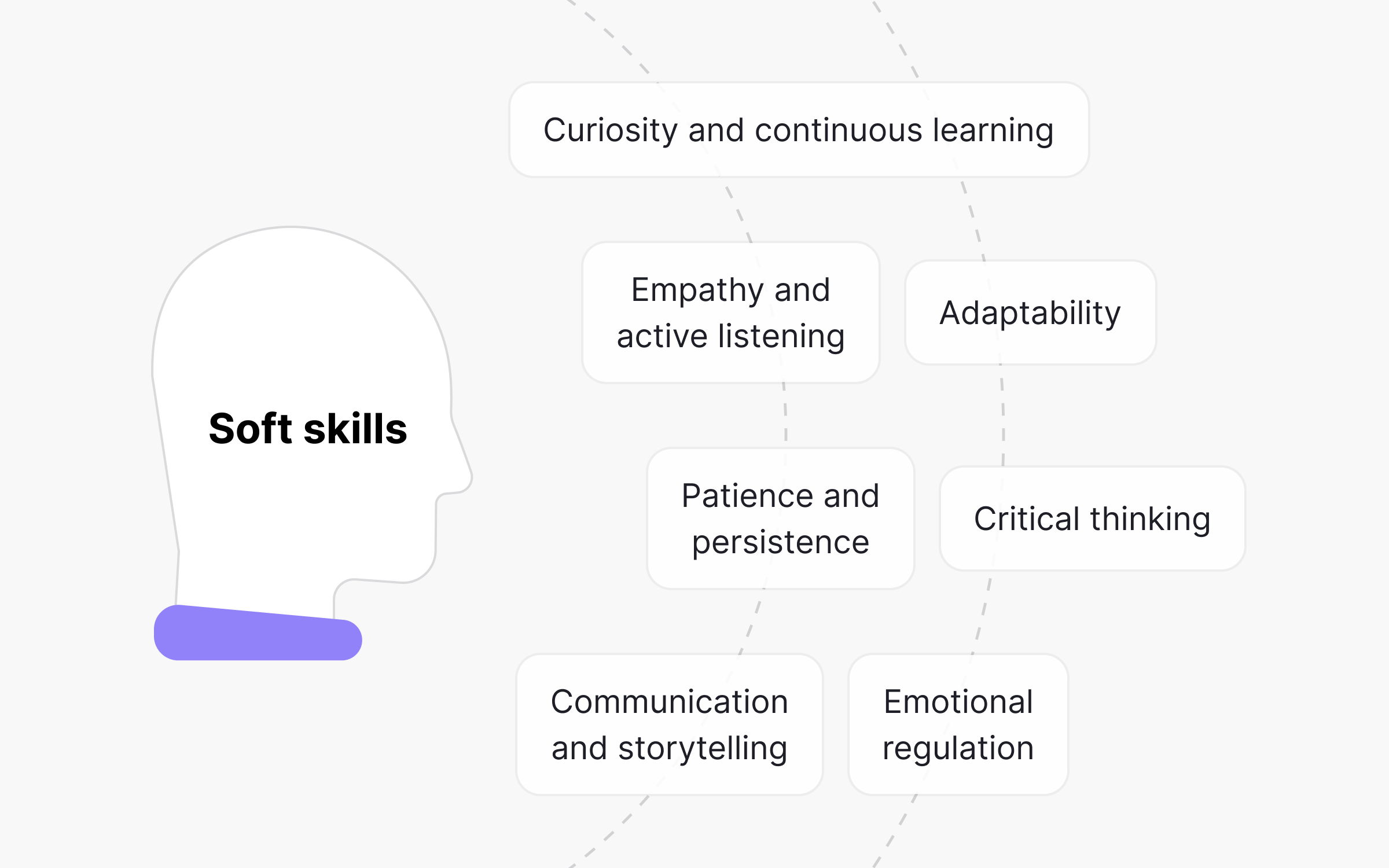
Soft skills determine whether your research actually influences product decisions. Technical competence means nothing if you can’t communicate findings persuasively, collaborate effectively, and build relationships that give research a seat at the table. Strong communication skills are essential for UX researchers to effectively relay insights and collaborate with cross-functional teams.Soft skills are becoming the key differentiators as technical tasks get automated.
8. Empathy and active listening
Empathy in research means genuinely understanding users' perspectives, emotions, and contexts without projecting your own assumptions. Active listening involves fully concentrating on what participants say, asking clarifying questions, and picking up on verbal and non-verbal cues.
Why this skill matters
Users often can't articulate their real needs directly. They describe symptoms rather than causes, solutions rather than problems. Empathetic researchers hear what's not being said and probe deeper. This skill is irreplaceable by AI, which can transcribe and analyze language but can't truly understand human experience. Every single senior researcher I read about mentioned empathy as foundational.
How to improve it
Practice suspending judgment during research sessions. When a participant says something surprising, resist the urge to challenge or redirect. Instead, explore their perspective with genuine curiosity. Review session recordings and notice moments where you could have listened more deeply or followed up differently.
9. Communication and storytelling
Communication for researchers means translating complex findings into clear, compelling narratives that different audiences can understand and act upon. You’re adapting your message for engineers, designers, executives, and other stakeholders with varying priorities and technical knowledge.
Why this skill matters
Research that sits in a report nobody reads is worthless. Your findings compete for attention against a hundred other priorities. Researchers who communicate through stories, visualizations, and strategic framing actually influence decisions. Those who dump data without context get ignored. This frustrates me because I kept seeing researchers complain about being ignored, but their reports were walls of text with no clear recommendations.
How to improve it
Structure presentations around stakeholder decisions rather than research activities. Lead with the “so what” before explaining methodology. Practice creating one-page summaries that busy executives can scan in two minutes. Develop your data visualization skills to make insights visually compelling. Developing your critical thinking skills will also enhance your ability to communicate complex findings clearly and persuasively.
10. Critical thinking
Critical thinking involves evaluating evidence objectively, questioning assumptions, and recognizing biases in your own analysis. Strong analytical skills are necessary for interpreting data objectively and identifying actionable insights. You’re distinguishing between what data actually shows versus what you want it to show, and acknowledging limitations in your research.
Why this skill matters
Confirmation bias affects everyone, including experienced researchers. Organizations pay for objective insights, not validation of existing beliefs. Researchers who challenge their own conclusions and present nuanced findings build long-term credibility, even when their honest assessments aren’t what stakeholders wanted to hear.
How to improve it
Build habits of actively seeking contradictory evidence. When you reach a conclusion, ask yourself what would have to be true for the opposite to be right. Document your assumptions explicitly and revisit them throughout analysis. Seek peer review of your findings before presenting to stakeholders.
11. Adaptability
Adaptability means adjusting your research approach based on changing circumstances, constraints, and emerging information. You're modifying study designs, pivoting methodologies, and responding to unexpected findings without losing sight of research objectives.
Why this skill matters
Research rarely goes according to plan. Recruitment falls short, stakeholders change priorities mid-study, and early findings suggest different questions than you anticipated. Rigid researchers produce irrelevant findings. Adaptive researchers deliver value regardless of obstacles. The researchers who thrived during recent industry turbulence were the ones who could pivot quickly.
How to improve it
Build a toolkit of methods you can deploy quickly when plans change. Practice "good enough" research that delivers timely insights rather than perfect studies that arrive too late. Learn to negotiate scope and timeline tradeoffs with stakeholders transparently.
12. Curiosity and continuous learning
Curiosity drives researchers to dig deeper, ask follow-up questions, and explore tangents that reveal unexpected insights. Continuous learning means staying current with evolving methodologies, tools, and industry practices.
Why this skill matters
The research field evolves constantly. New tools emerge, methodologies get refined, and user behaviors shift with technology changes. Researchers who stop learning become outdated quickly. Genuine curiosity also makes you better at discovery research, where the most valuable insights often come from unexpected directions.
How to improve it
Read research from adjacent fields like behavioral science, behavioral economics, cognitive psychology, and anthropology. Follow UX research publications, podcasts, and communities. When conducting research, give yourself permission to explore interesting tangents before refocusing on core objectives. Treat every project as a learning opportunity, not just a deliverable.
13. Patience and persistence
Patience means accepting that quality research takes time and resisting pressure to rush conclusions. Persistence involves continuing to pursue insights even when recruitment is difficult, findings are ambiguous, or stakeholders are skeptical.
Why this skill matters
Shortcuts in research create problems downstream. Rushed analysis misses nuance. Inadequate sample sizes yield unreliable conclusions. Researchers who maintain standards despite pressure protect their organizations from costly mistakes based on flawed insights.
How to improve it
Set realistic timelines that include buffers for common delays. Practice communicating why rushing compromises quality in terms that stakeholders understand. Develop techniques for staying motivated during tedious phases like transcription or recruitment. Celebrate small wins to maintain momentum on longer projects.
14. Emotional regulation
Emotional regulation means managing your own reactions during challenging research situations. You're staying neutral when participants criticize designs you like, remaining professional when stakeholders dismiss your findings, and processing difficult user stories without burning out.
Why this skill matters
Research exposes you to frustration, criticism, and sometimes genuinely distressing user experiences. Researchers who can't regulate their emotions introduce bias into sessions, damage stakeholder relationships, or experience burnout. Professional detachment protects both research quality and personal well-being.
How to improve it
Develop pre-session rituals that help you enter a neutral, receptive state. Practice techniques for processing difficult sessions afterward, whether through debriefing with colleagues, journaling, or simply taking breaks between emotionally demanding interviews. Recognize your emotional triggers and develop strategies for managing them in the moment.
For developing these soft skills, the User Psychology course explores the cognitive and emotional factors that shape user behavior, which builds the empathy foundation every researcher needs. The Workshop Facilitation course is particularly valuable here too, covering communication techniques, presentation skills, and how to engage diverse stakeholders effectively.
Applied skills for UX researchers

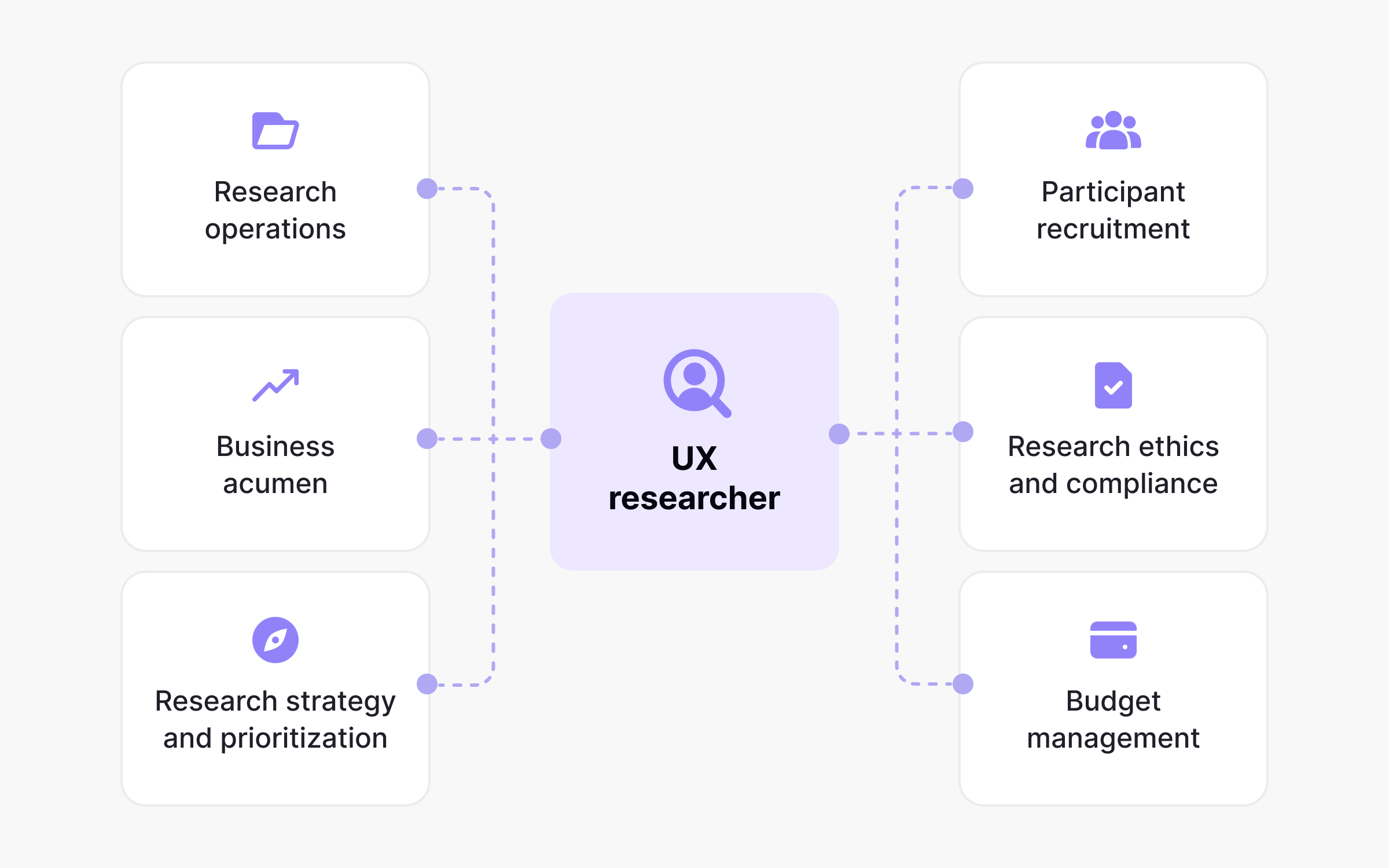
Applied skills connect research to business outcomes. These competencies help you align research priorities with organizational goals, measure research impact, and demonstrate the return on investment that justifies research budgets. Many of these applied skills in UX research are also highly valuable in market research and other business intelligence roles, where interpreting data and understanding user or consumer insights are essential. This is where a lot of researchers struggle, honestly. The technical work is the comfortable part.
15. Research operations
Research operations involves systematizing research activities for efficiency and scale. This includes participant recruitment pipelines, research repositories, consent management, scheduling systems, and quality standards that enable consistent, efficient research.
Why this skill matters
As research democratization spreads, someone needs to maintain quality and efficiency across the organization. Research ops skills let you build infrastructure that multiplies your impact. You’re not just conducting studies, you’re enabling others to do research well while maintaining standards.Organizations with mature research operations integrate insights more effectively into decision-making.
How to improve it
Document your research processes and identify bottlenecks. Create templates for common research activities that save time on future projects. Build participant databases with consent management. Establish research repositories where insights are searchable and reusable. Creating research plans that align with business objectives and support efficient research operations is essential for ensuring your research efforts are strategic and impactful.
16. Business acumen
Business acumen means understanding how your organization generates revenue, where costs accumulate, and how product decisions affect financial outcomes. You're connecting user needs to business value and framing research findings in terms stakeholders care about.
Why this skill matters
Research budgets get cut when leadership doesn't see the connection to business results. Researchers who speak the language of revenue, retention, and competitive advantage protect their function during belt-tightening. You're not just advocating for users, you're showing how user success drives business success. This is probably the biggest gap I noticed between researchers who thrive and those who get laid off.
How to improve it
Learn your organization's business model, key metrics, and strategic priorities. Frame research questions around business outcomes, not just user experience improvements. Practice calculating the potential revenue impact of usability issues or unmet user needs.
17. Research strategy and prioritization
Research strategy involves determining which questions to investigate given limited resources, and prioritization means deciding what to research first based on business impact and decision timelines.
Why this skill matters
You'll always have more research questions than capacity to answer them. Strategic researchers focus on high-impact questions that influence imminent decisions. They say no to interesting-but-low-priority requests. This discipline multiplies the value of every hour you spend on research.
How to improve it
Map upcoming product decisions and identify which have the highest stakes and uncertainty. Create a research roadmap aligned with product strategy. Develop criteria for evaluating research requests and practice declining low-priority work diplomatically.
18. Participant recruitment
Participant recruitment involves finding and screening people who represent your target users. You’re building panels, writing screeners, managing incentives, and ensuring research samples actually reflect the populations you’re studying.
Why this skill matters
Research is only as good as its participants. Recruiting the wrong people wastes time and produces misleading insights. Professional recruitment skills ensure your findings represent actual users rather than whoever was easiest to reach.
How to improve it
Learn to write screeners that filter for relevant characteristics without telegraphing desired answers. Build relationships with recruitment vendors and understand their strengths and limitations. Develop internal panels for quick-turnaround studies. Practice calculating appropriate sample sizes for different research objectives. Backgrounds in social science disciplines can enhance your ability to recruit and understand diverse user populations.
19. Research ethics and compliance
Research ethics involves protecting participant welfare, ensuring informed consent, and maintaining data privacy. Compliance means following legal requirements like GDPR, institutional review board protocols, and industry-specific regulations.
Why this skill matters
Ethical violations damage participants, destroy organizational trust, and create legal liability. As data privacy regulations tighten globally, researchers who understand compliance requirements protect their organizations from costly mistakes. Ethics isn't just about avoiding harm, it's about conducting research that participants can trust.
How to improve it
Study research ethics frameworks and data privacy regulations relevant to your industry and geography. Develop consent processes that genuinely inform participants rather than just collecting signatures. Create data handling protocols that minimize privacy risks. When facing ethical gray areas, err toward participant protection.
20. Budget management
Budget management involves estimating research costs, allocating resources efficiently, and tracking spending against approved amounts. You're making tradeoffs between research quality and financial constraints while demonstrating value relative to investment.
Why this skill matters
Research that exceeds budget expectations doesn't get repeated. Researchers who consistently deliver within budget constraints build trust that leads to larger future investments. Understanding costs also helps you design studies that maximize insight per dollar spent.
How to improve it
Track actual costs for each study and compare against estimates to improve future accuracy. Learn what drives research costs (recruitment, incentives, tools, time) and where you have flexibility. Practice proposing research plans at multiple budget levels so stakeholders understand tradeoffs.
Several Uxcel courses support these applied skills. The Service Design course teaches process mapping and operational efficiency principles that directly apply to research operations. For building business acumen, the Product Analytics course connects user behavior data to business performance metrics, helping you frame research in terms stakeholders care about. And the Product Development Lifecycle course shows how research fits into broader product planning, which is essential for strategic prioritization.
Cross-department collaboration skills for UX researchers

Cross-department skills determine whether research insights actually reach the people who need them and whether you can influence decisions made across the organization. That means collaboration skills matter more than ever. Working closely with the product team is essential to ensure that research insights are effectively implemented throughout the product development lifecycle.
21. Stakeholder management
Stakeholder management involves building relationships with product managers, designers, engineers, and executives who depend on research insights. You're understanding their priorities, managing expectations, and ensuring research delivers what they actually need.
Why this skill matters
Research that stakeholders don't trust gets ignored. Building relationships means your insights receive serious consideration. Strong stakeholder management also gives you early warning about upcoming decisions, so you can plan research proactively rather than reactively.
How to improve it
Schedule regular check-ins with key stakeholders to understand their evolving priorities. Involve them in research planning so they feel ownership of findings. Follow up after research readouts to understand whether insights were useful and what could be improved.
22. Design collaboration
Design collaboration means working effectively with product designers throughout the design process. You’re providing research input at the right moments, participating in design critiques, and helping designers translate insights into interface decisions. Close collaboration with UX designers ensures that research findings are translated into user-centered designs.
Why this skill matters
Research and design are deeply interconnected. Researchers who understand design constraints and vocabulary communicate insights more effectively. Close collaboration ensures research findings actually influence designs, rather than sitting in reports while designers make decisions independently.
How to improve it
Learn the basics of design principles, UI patterns, and design tools. Participate in design critiques and sprints. Practice translating research findings into design implications rather than just describing user problems. Build shared artifacts like personas and journey maps collaboratively with designers.
23. Engineering partnership
Engineering partnership involves collaborating with developers to understand technical constraints, gather implementation feedback, and ensure research recommendations are feasible to build.
Why this skill matters
Brilliant research recommendations that can’t be implemented waste everyone’s time. Engineers often have insights about user behavior from support tickets, bug reports, and analytics that researchers miss. Building relationships with engineering expands your data sources and ensures recommendations are actionable.
How to improve it
Develop a basic understanding of technical concepts and constraints so you can communicate effectively with engineering partners. Learn enough about your product’s technical architecture to understand what’s easy versus difficult to change. Include engineers in research planning for technically complex features. Share raw research data with curious engineers who want to understand users better. Ask engineers about patterns they see in user behavior through support channels.
24. Product management alignment
Product management alignment means synchronizing research activities with product strategy, roadmaps, and decision timelines. You're ensuring research answers questions product managers actually face, delivered when decisions are being made.
Why this skill matters
Research that arrives after decisions are made is useless. Product managers control roadmaps and feature priorities, so their buy-in determines whether research influences the product. Tight alignment means research becomes integral to product development rather than a parallel activity.
How to improve it
Attend product planning meetings and understand the decision calendar. Map research activities to upcoming product decisions explicitly. Learn to speak product management language around metrics, prioritization frameworks, and strategic tradeoffs. Position research as reducing risk in product bets rather than as an academic exercise.
25. Workshop facilitation
Workshop facilitation involves leading collaborative sessions that bring stakeholders together to analyze research, generate ideas, or make decisions. Effective facilitation includes exploring concepts and testing new ideas collaboratively with stakeholders, ensuring that a range of possibilities are considered and validated. You’re creating structured activities, managing group dynamics, and synthesizing outcomes into actionable next steps.
Why this skill matters
Workshops turn passive research consumers into active participants. When stakeholders help interpret findings, they develop ownership and commitment to acting on insights. Facilitation skills also let you run co-design sessions with users, multiplying research value.
How to improve it
Learn facilitation frameworks like design sprints, journey mapping workshops, and insight prioritization sessions. Practice managing difficult participants and keeping groups on track. Develop skills in real-time synthesis, capturing and organizing what emerges during sessions.
26. Research democratization leadership
Research democratization leadership involves enabling non-researchers to conduct basic research while maintaining quality standards. You’re creating guidelines, training colleagues, reviewing their work, and building a research-informed culture.
Why this skill matters
One researcher can’t answer every question an organization has about users. Democratization multiplies research capacity by empowering product managers, designers, and others to conduct simple studies. But without guidance, democratized research produces unreliable insights. Researchers who lead this transition increase their strategic value rather than making themselves obsolete.
How to improve it
Create playbooks for common research activities that non-researchers can follow. Develop training programs that teach basic methodology without overwhelming participants. Establish review processes so democratized research gets quality checks. Building a research-informed culture also means training colleagues in foundational user research skills to ensure quality and consistency. Position yourself as an enabler and coach rather than a gatekeeper.
To strengthen collaboration skills, the Workshop Facilitation course provides comprehensive training in leading collaborative sessions, managing group dynamics, and building stakeholder alignment. The UX Design Foundations course gives you the design vocabulary and principles needed for effective cross-functional work with designers. Understanding the visual and interaction patterns your design colleagues use makes your research recommendations far more actionable.
AI skills for UX researchers

AI skills have become essential for UX researchers in 2026. These competencies help you leverage artificial intelligence tools to scale your research capacity while maintaining the human judgment that makes research valuable. According to Lyssna's survey of 100 UX researchers, 88% expect AI-assisted analysis to significantly impact UX research this year.
27. AI-assisted analysis
AI-assisted analysis involves using artificial intelligence tools to accelerate qualitative data processing. You're leveraging AI for automated transcription, sentiment analysis, theme identification, and pattern detection across interview transcripts, survey responses, and behavioral data.
Why this skill matters
AI tools can reduce qualitative analysis time by up to 80%, according to recent industry research. Researchers who master these tools handle larger sample sizes, faster turnarounds, and more comprehensive analysis than those doing everything manually. The key is knowing when AI helps and when human judgment is irreplaceable. Most researchers I read about are already using AI for transcription at minimum.
How to improve it
Experiment with AI transcription and analysis tools in your current workflow. Learn prompt engineering techniques for getting better results from large language models. Develop criteria for evaluating AI-generated insights and practice identifying when AI analysis misses nuance that human review would catch.
28. Prompt engineering for research
Prompt engineering involves crafting effective instructions for AI tools to generate useful outputs. You're writing prompts that yield accurate transcriptions, meaningful theme categorizations, and valid sentiment analysis rather than generic or hallucinated results.
Why this skill matters
AI tools are only as useful as the prompts that guide them. Vague prompts produce vague outputs. Researchers who master prompt engineering extract dramatically more value from the same AI tools than those who use default settings. This skill compounds across every AI-assisted task you perform.
How to improve it
Study prompt engineering principles and practice iterating on prompts to improve outputs. Learn to break complex analysis tasks into smaller, more specific prompts. Develop templates for common research tasks that you can reuse and refine. Compare AI outputs against manual analysis to calibrate your prompts.
29. AI experience research
AI experience research focuses on understanding how users interact with AI-powered products and features. You're studying user mental models of AI, trust calibration, error handling expectations, and the unique usability challenges that AI interfaces present.
Why this skill matters
AI features are appearing in every product category, but many fail because they don't match user expectations. Researching AI experiences requires understanding both traditional usability and the unique challenges of probabilistic, sometimes unpredictable systems. Specialists in this area are increasingly sought after. NN/g specifically calls out that trust will be a major design problem for AI experiences in 2026.
How to improve it
Study the emerging literature on AI user experience and trust. Practice researching AI features with attention to how users form expectations, respond to errors, and calibrate their trust over time. Learn to evaluate whether AI explanations actually help users or just add complexity.
30. Synthetic user research evaluation
Synthetic user research uses AI-generated personas or simulated users to supplement human research. Evaluation skills involve understanding when synthetic data is valid, recognizing its limitations, and integrating it appropriately with human research.
Why this skill matters
Synthetic users promise faster, cheaper research, and some organizations are adopting them aggressively. Researchers need to evaluate these approaches critically, understanding where they add value and where they produce misleading results. Blind acceptance or blanket rejection both miss the nuance. This is still emerging, but it came up enough in industry discussions that it's worth developing opinions about.
How to improve it
Experiment with synthetic user tools and compare their outputs against actual human research on the same questions. Develop frameworks for evaluating when synthetic data is reliable versus risky. Learn to communicate the limitations of synthetic approaches to stakeholders who may overestimate their validity.
31. AI ethics and bias detection
AI ethics involves recognizing and addressing bias, fairness, and transparency issues in AI systems. Bias detection means identifying when AI tools introduce systematic errors into research processes or when products create disparate impacts across user groups.
Why this skill matters
AI systems amplify biases present in their training data. Researchers who can't identify these biases may inadvertently validate flawed AI features or introduce bias into their own AI-assisted analysis. As AI becomes more prevalent, ethics expertise becomes a differentiator.
How to improve it
Study AI ethics frameworks and common sources of algorithmic bias. Practice auditing AI tools for bias before incorporating them into research workflows. Learn to design research that specifically tests for disparate impacts across user demographics. Develop skills in communicating AI limitations to non-technical stakeholders.
For building AI competencies, the AI Fundamentals for UX course teaches how to integrate AI tools responsibly into design and research workflows. It covers the practical side of working with AI while maintaining quality standards. The Human-Centered AI course goes deeper into designing and evaluating AI experiences from a user perspective, including the ethics and bias considerations that are becoming increasingly important as AI features proliferate across products. The AI Prompts Foundations course teaches how to write clear, effective prompts for AI so you get reliable results across workflows like writing, analysis, research, and design work.
Bonus skill to have: cross-cultural competence
As digital products reach global audiences, cross-cultural competence has become a must-have skill for UX researchers. Understanding and appreciating cultural differences is essential for designing experiences that are inclusive, accessible, and relevant to diverse user groups.
Cross-cultural competence in UX research means going beyond surface-level observations to truly grasp how cultural backgrounds influence user behavior, preferences, and expectations. It requires empathy, cultural awareness, and the flexibility to adapt research methods to different contexts. For example, what works in one market may fall flat in another due to differences in communication styles, values, or technology usage.
By considering these cultural nuances, UX researchers can ensure that their findings, and the products they help shape, are meaningful and effective across different regions and demographics. Ultimately, cross-cultural competence enables teams to create products that resonate with users everywhere, not just in their home market.
How can you start improving your UX researcher skills?
Building these skills doesn’t happen overnight. Here’s a practical approach to development:
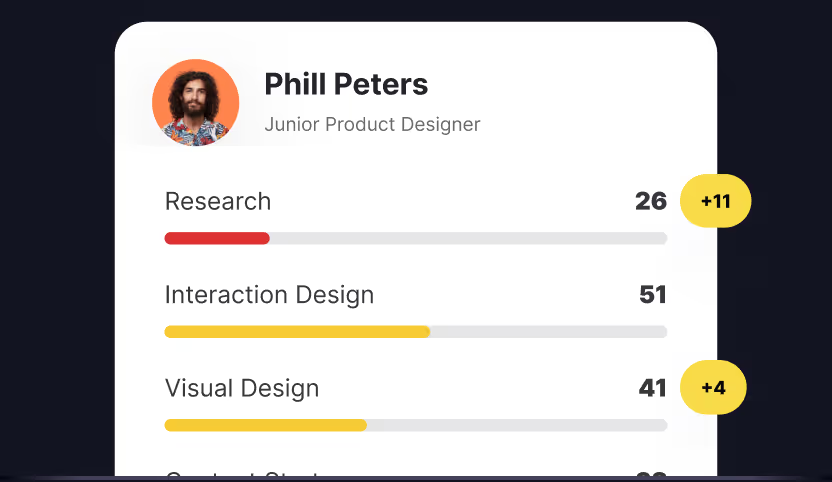
- Assess your current level: Start by evaluating where you stand on each skill.Uxcel Pulse provides a comprehensive assessment that benchmarks your abilities against industry standards, highlighting both your strengths and the gaps worth focusing on.
- Focus on high-impact gaps: Don’t try to improve everything simultaneously. Identify the two or three skills where improvement would most benefit your current role and career goals. Pay special attention to your most critical skill, the one that, if developed, will have the greatest impact on your effectiveness as a UX researcher. A junior researcher might prioritize qualitative methods and communication, while a senior researcher might focus on research strategy and AI tools.
- Learn through structured courses: Self-directed learning has its place, but structured courses provide frameworks and feedback that accelerate development. The UX Researcher career path on Uxcel guides you through a logical progression, or you can take up individual courses for UX research and other product areas based on your specific skill gaps.
- Practice with real projects: Skills develop through application, not just study. Uxcel’s project briefs give you hands-on practice with realistic scenarios, letting you apply new techniques before using them in actual work.
- Join a community of practitioners: Learning alongside other researchers accelerates growth. Discuss challenges, share approaches, and learn from peers facing similar situations.
So, is this skill set actually achievable?
The user experience researcher role is evolving rapidly. AI tools are handling more routine analysis, research democratization means more people conduct studies, and organizations expect researchers to demonstrate business impact. The skills that mattered five years ago aren’t enough anymore.
But here’s what hasn’t changed: organizations still need people who can deeply understand users, ask the right questions, and translate insights into decisions. The user researchers who thrive in 2026 are those who combine traditional research competencies with business acumen, cross-functional collaboration skills, and AI fluency.
The 27 skills covered in this guide represent that complete picture. Technical skills give you credibility. Soft skills make your insights actionable. Applied skills connect research to business outcomes. Collaboration skills expand your influence. And AI skills multiply your capacity.
When this skill set makes sense:
- You’re actively job hunting for UX research roles
- You’re looking to move from junior to senior positions
- Your organization is expanding research responsibilities
- You want to future-proof your career against AI disruption
When to prioritize differently:
- You’re in a specialized research niche with different requirements
- Your organization has unique methodological needs
- You’re transitioning from a related field and need foundational skills first
Ready to build these skills systematically?
Create an account on Uxcel today to identify your gaps, then work through targeted courses to close them. Your career growth depends on continuous skill development. The question isn’t whether to invest in learning, but where to focus.
More Resources and Tools for UX Researchers
Modern UX researchers have a wealth of resources and tools at their disposal to streamline their work and enhance the quality of their insights. From data analysis platforms to user testing suites, these tools help researchers collect, analyze, and visualize both qualitative and quantitative data efficiently.
Popular data analysis tools like Dovetail, Airtable, and Excel make it easier to organize complex data sets and uncover patterns. For user testing and usability studies, platforms such as Maze, UserTesting, and Lookback enable remote observation and feedback collection from real users. Survey tools like Typeform and SurveyMonkey simplify the process of gathering quantitative data at scale, while card sorting and information architecture tools like Optimal Workshop help clarify how users think about content organization.
In addition to these, resources like Uxcel offer structured learning paths, skill assessments, and project briefs to help UX researchers continuously upskill and stay current with industry best practices. Leveraging the right mix of tools and resources empowers UX researchers to deliver more impactful, actionable insights, no matter the size or scope of the research project.
Industry Trends and the Future of UX Research
The field of UX research is evolving rapidly, shaped by technological advancements and shifting business priorities. One of the most significant trends is the integration of AI and automation into research workflows, enabling researchers to analyze data faster and at greater scale. AI-assisted analysis, prompt engineering, and synthetic user research are becoming standard parts of the UX research toolkit.
Another key trend is the democratization of research, where non-researchers across product teams are empowered to conduct basic user research activities. This shift increases the demand for research operations, quality standards, and training to ensure that insights remain reliable and actionable.
Cross-functional collaboration is also on the rise, with UX researchers working more closely than ever with designers, engineers, and product managers to ensure research insights directly inform product decisions. At the same time, there’s a growing emphasis on business acumen. Researchers are expected to connect their findings to business outcomes and demonstrate clear ROI.
Looking ahead, UX researchers who combine technical expertise with soft skills, business understanding, and AI fluency will be best positioned to thrive. Staying ahead of these trends means continuously learning, adapting, and expanding your skill set to meet the changing needs of users and organizations alike.
Commonly asked questions about UX researcher skills in 2026
1. What are the most important skills for a UX researcher in 2026?
The most critical skills fall into five categories: technical skills (qualitative and quantitative methods, usability testing, synthesis), soft skills (communication, empathy, critical thinking), applied business skills (research ops, business acumen, strategy), collaboration skills (stakeholder management, cross-functional partnership), and AI skills (AI-assisted analysis, prompt engineering). Communication and storytelling consistently rank as the most important since research that isn't communicated effectively doesn't influence decisions.
2. Do UX researchers need to know statistics?
You don't need to be a statistician, but understanding basic concepts helps significantly. Knowing about sample sizes, confidence intervals, and statistical significance lets you design better surveys and interpret quantitative findings accurately. It also helps you push back on flawed analysis and communicate the reliability of your findings to stakeholders.
3. How long does it take to develop UX research skills?
It depends on the skill and your starting point. Foundational skills like interview techniques or survey design can be learned in a few weeks of focused practice. Complex skills like research synthesis or stakeholder management develop over months or years through real experience. Most researchers find that focusing on two or three skills at a time for one to three months each produces steady improvement.
4. What skills do senior UX researchers need?
Senior researchers need everything junior researchers need, plus deeper business acumen and strategic thinking. This includes connecting research to business outcomes, building research operations, and leading research democratization efforts. Senior roles also require mentoring abilities since developing junior team members becomes part of the job. The shift to leadership focuses more on influence, organizational navigation, and proving research ROI.
5. Can I become a UX researcher without a psychology degree?
Absolutely. UX researchers come from diverse backgrounds including design, anthropology, sociology, marketing, and even engineering. What matters more than your degree is demonstrating research skills, critical thinking, and the ability to translate findings into actionable insights. Many successful researchers are self-taught or transitioned from adjacent roles.
6. What's the best way to learn UX research skills?
Combination approaches work best. Online courses provide structured learning for specific methods. Reading case studies and research reports builds strategic thinking. But nothing replaces hands-on practice. Conduct real research, even on personal projects. Seek feedback from experienced researchers. Platforms like Uxcel work well because they combine bite-sized learning with practical exercises and design briefs you can complete regularly.
Related articles
How to Become a UX Researcher in 2026 (Step-by-Step Guide)
UX Researcher Salaries in 2026: What Can You Actually Expect to Earn?
Top 56 UX Researcher Interview Questions and Answers for 2026