


TL;DR
- Overall impression of using a product.
- Combines usability, design, and satisfaction.
- Influenced by efficiency, clarity, and trust.
- Central to product success and retention.
Definition
User experience (UX) is the sum of a user’s perceptions and feelings when interacting with a product, covering functionality, usability, design, and emotional response.
Detailed Overview
UX goes beyond the surface appearance of a product. It encompasses how intuitive, efficient, and satisfying it is to use. A product that is visually appealing but frustrating to navigate fails to deliver a strong UX. Conversely, even a plain interface can succeed if it allows users to accomplish tasks easily and confidently.
A frequent question is how UX differs from usability. Usability measures whether tasks can be completed effectively and efficiently. UX is broader, covering not only task completion but also how people feel throughout the process. For instance, an app may let users book a flight quickly (usability), but if the confirmation feels reassuring and the design trustworthy, the overall UX is stronger.
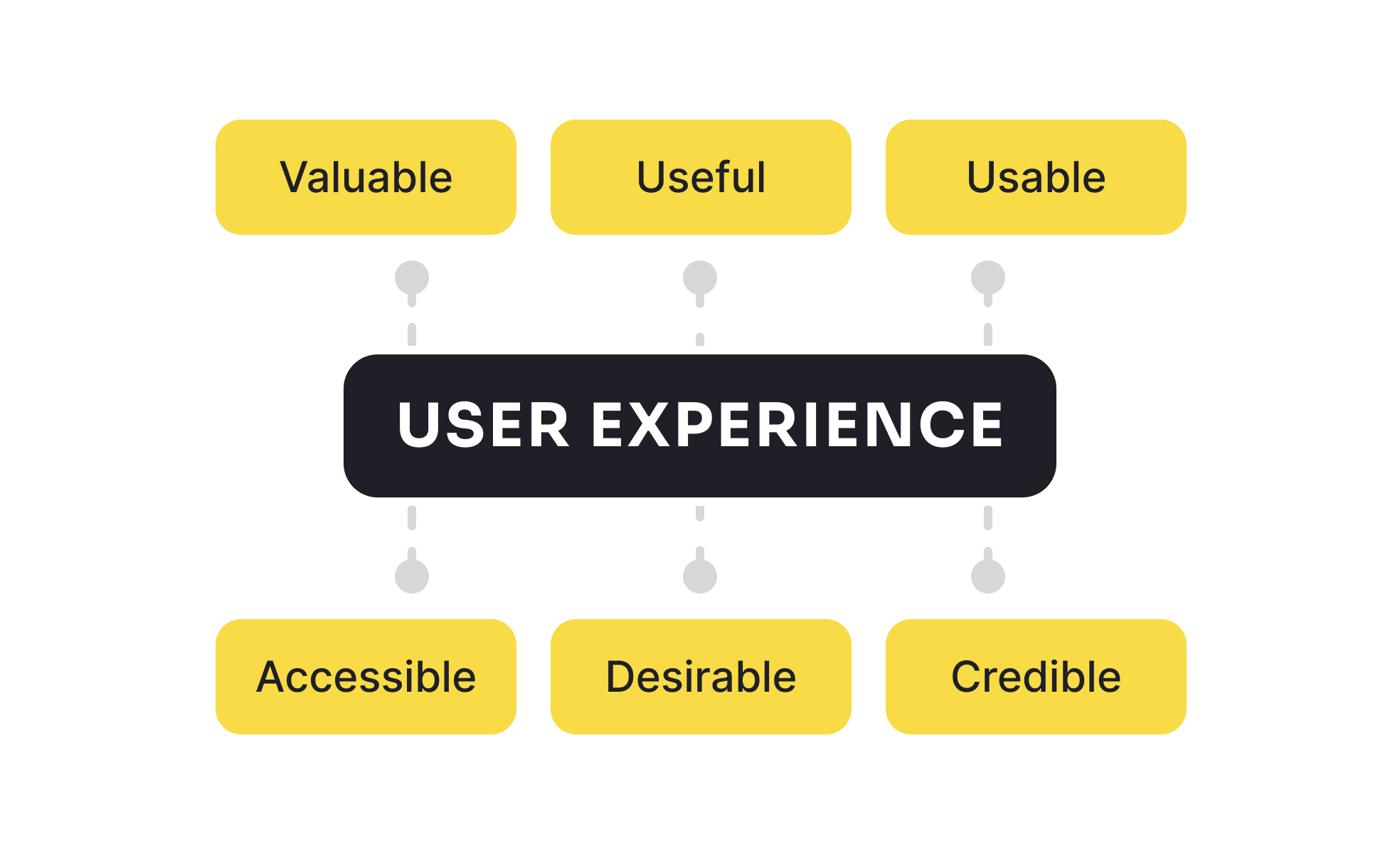
Another common query involves the components of UX. Key elements include usability, accessibility, desirability, credibility, and value. Each contributes differently: usability ensures tasks can be achieved, accessibility ensures inclusivity, desirability builds appeal, credibility fosters trust, and value ties the experience back to user and business goals.
Teams often ask how UX is evaluated. Methods include usability testing, surveys, analytics, and observational research. Heatmaps and session recordings highlight behavioral patterns, while satisfaction surveys and Net Promoter Scores capture sentiment. Combining these methods provides both quantitative and qualitative views of experience.
UX also shapes competitive advantage. Products with strong UX see higher adoption, lower churn, and greater customer loyalty. Poor UX, by contrast, creates frustration, increases support costs, and drives users to competitors. This business impact explains why UX is considered a strategic priority, not just a design concern.
Finally, UX is multidisciplinary by nature. It involves contributions from design, research, engineering, product management, and even customer support. Aligning these roles around user-centered goals ensures that UX is not an afterthought but a guiding principle across the product lifecycle.
Learn more about this in the What is User Experience (UX) Exercise, taken from the What is UX Design Lesson, a part of the UX Design Foundations Course.


