.svg)

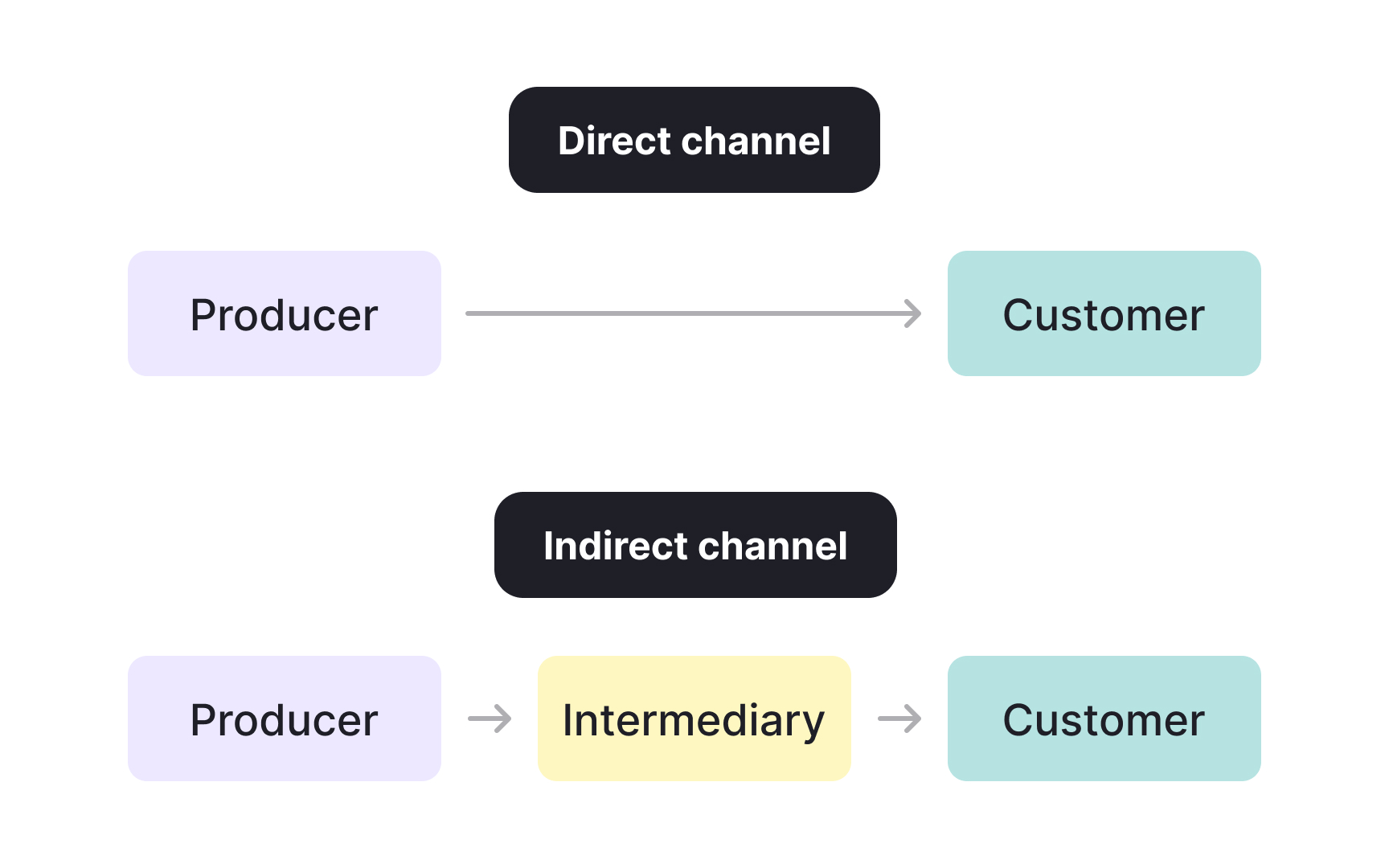
A channel is not just a path from your product to a customer. It is a complete set of decisions: how customers find you, how they evaluate you, how you close the deal, and what the economics look like. Get this wrong, and the rest of your go-to-market strategy works against itself. Direct channels: your own sales team, your website, and your physical location — put you in full contact with the customer. You control the message, the experience, and the relationship. That control has a cost: direct channels are slow to build and expensive to iterate when things are not working.
Indirect channels: resellers, affiliates, distributors, and marketplaces — trade control for speed and reach. A partner can put your product in front of an established customer base immediately. The trade-offs are real: margins shrink with every intermediary, visibility into the customer experience drops, and partners have other products competing for the same attention.
Neither model dominates. Most companies of meaningful scale combine both, but early-stage companies that try to run multiple channels at once typically master none. The question is not which type is best in theory, but which fits your business right
What a channel decision actually means
When founders think about channels, they usually think about where customers come from: a website, a trade show, a sales team. The channel decision goes much deeper than that. It determines your cost structure, your control over the customer relationship, the speed at which you can scale, and the kind of business you are building.
A channel is a complete system for moving a customer from awareness to purchase and beyond. The channel shapes who you hire, how much you spend, how fast you can iterate, and how much margin you keep. A company that sells directly through its own team builds a very different operation than one that routes through resellers, even when selling the same product.
This is why channel decisions are not interchangeable. A startup that chooses a direct sales model commits to building sales infrastructure before it is proven. One that defaults to indirect channels trades margin and visibility for reach. Neither is right nor wrong on its own. The fit depends on what the business is, who the customer is, and what stage the company is at. Getting clear on what a channel decision actually includes is the starting point for making it well.[1]
Direct channel advantages and trade-offs
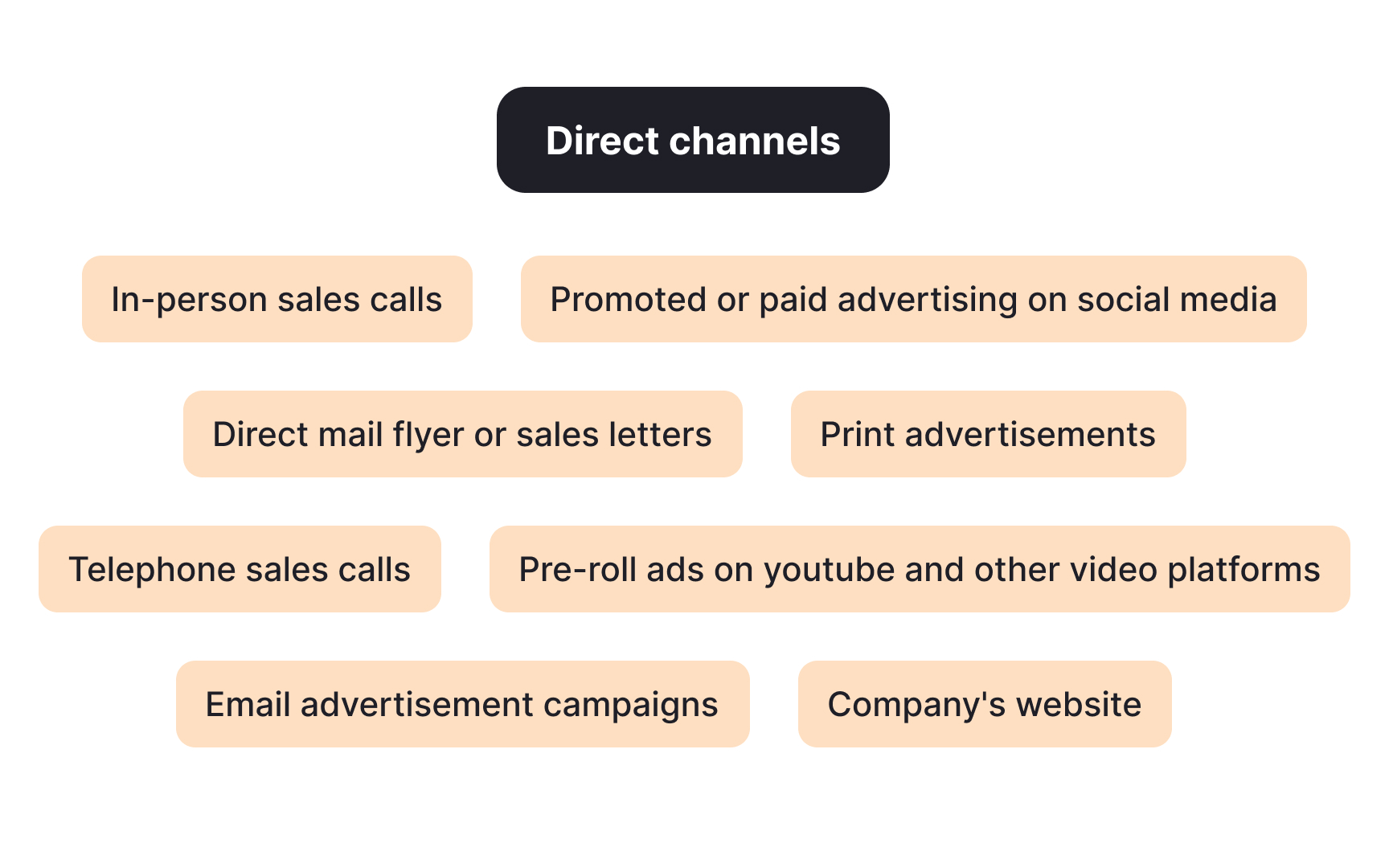
Direct channels put the company in full contact with the customer, with no intermediary owning part of the relationship. A founder running direct sales, talking to prospects personally and closing deals herself, captures learning that no other setup produces. Every conversation reveals which objections recur, which messages land, and how long the sales cycle actually runs in practice, not just how long anyone assumed.
Because the company controls the entire customer interaction, it can iterate the message quickly, fix problems as they surface, and build relationships that drive retention and expansion. Margin stays with the business rather than flowing to a partner.
The disadvantages are equally structural. A direct sales team requires hiring, training, management, and tools before the model is proven, and scaling it means scaling headcount proportionally. A website requires traffic, and generating that traffic takes time and budget. The cost compounds quickly at the early stage. What makes the model worth it is the information quality: no other channel produces the same depth of learning about what customers need, what makes them hesitate, and how the sales cycle truly behaves.
Indirect channel types and how they work
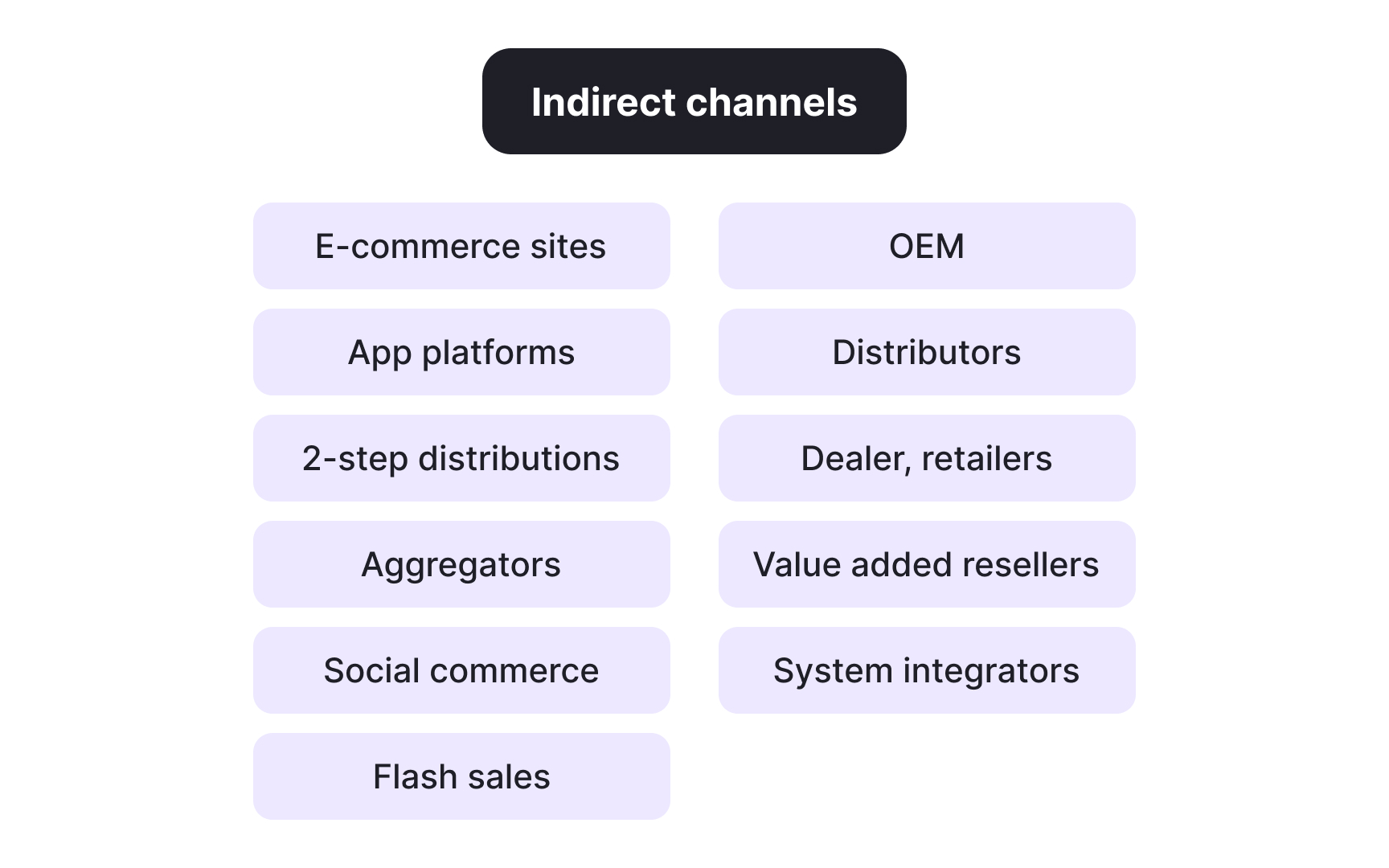
Indirect channels put a partner between the company and the end customer. That partner handles part of the relationship in exchange for a cut of the revenue:
- Resellers and value-added resellers (VARs) buy your product and sell it to their own customer base. They are often most effective when the purchase requires installation or support that customers want bundled together.
- Affiliates refer customers in exchange for a commission. The pay-for-performance structure means you only pay when they deliver.
- Distributors take on inventory or pipeline risk and sell into networks you cannot access directly. They demand significant margins, often 40% or more, and typically require proven market demand before they engage.
- Marketplaces aggregate buyer demand and provide access to customers who are already there and actively comparing solutions.
The key difference across types is commitment and involvement. An affiliate may promote dozens of offers simultaneously. A distributor is making a more significant bet on your product, but only after you have demonstrated that the market exists. Understanding which type fits your situation is the starting point for building any indirect program.[2]
Trade-offs of indirect channels
The core appeal of indirect channels is speed and reach. A reseller with an established customer base can put your product in front of buyers immediately, without the years of relationship-building that a direct team would require. A marketplace gives you access to buyers who are already there, already comparing solutions.
The trade-offs are significant:
- Margin. Affiliates typically take 20-30%, distributors often 40-50%.
- Visibility. When a partner owns part of the customer relationship, you learn less about why deals close or fall through. If a reseller positions your product poorly, you find out when conversion rates drop, not before it happens.
- Attention. Partners are not exclusively focused on your product. A reseller with 50 products in their portfolio is making continuous choices about where to spend limited selling time.
Unless the economics of your product make it their most attractive option, they will focus elsewhere. Competing for partner attention is an ongoing part of channel management. It is not a problem you solve at signing, and it does not go away on its own.[3]
Pro Tip! Partner motivation is not set by contract. It is set by economics. The partner prioritizes whoever makes them the most money this quarter.
How CAC differs across channel types
Customer acquisition cost is not fixed for a product. It varies substantially depending on which channel is doing the acquiring. A direct enterprise sales team closing deals at high contract values may carry a CAC of thousands per customer, but that is rational given the deal size. The same product through self-serve online acquisition might produce customers at a fraction of that cost, typically at much smaller contract sizes.
Content marketing and SEO often produce the lowest long-run CAC because the content continues attracting customers long after the initial investment. The challenge is pace: there is typically a 6-18 month lag between investment and its full contribution to acquisition, making the economics hard to see in short measurement windows.
Paid acquisition produces more predictable, measurable CAC but tends to degrade as spend scales. The first dollars often reach the most qualified audience at the lowest cost. As spending increases, the campaign reaches progressively less qualified buyers. Calculating CAC separately by channel is what allows rational allocation: investing more where economics are favorable and pulling back where they are not.[4]
Multi-channel strategy: the "eventually" principle
No successful business of meaningful scale uses only one channel. A B2B SaaS company might combine a direct sales team for enterprise accounts, self-serve signup for smaller customers, and an affiliate program that brings in warm leads. An e-commerce brand might sell through its own website, a major marketplace, and select retail partners.
The critical word is "eventually." Early-stage companies do not build multi-channel strategies. They identify the primary channel that works and master it before adding complexity. The temptation to run several channels simultaneously is understandable, but each additional channel requires dedicated attention, iteration, and learning. A company running 3 channels with limited resources typically runs all 3 poorly.
The right time to add a second channel is after the first is working consistently, not before. The second channel should be a tested experiment layered onto a proven primary motion, not an attempt to compensate for problems with the first. Adding channels to solve conversion or messaging problems does not fix those problems. It gives you more channels with the same problems.[5]
Match your channel to your business type
The right channel fit depends on the product's complexity, customer type, ticket size, and the sales motion required:
- High-ticket, low-volume products that require explanation or trust typically need direct channels. Enterprise software sales, consulting engagements, and complex B2B products fall here. The economics support a direct sales team because each customer generates enough revenue to justify the acquisition cost.
- Low-ticket, high-volume products with simple value propositions work well through digital direct channels, marketplaces, or affiliate programs. The economics do not support a human sales process per customer, so the channel has to be efficient and largely automated.
- Businesses that need geographic reach faster than they can build teams often benefit from distributors or regional resellers, provided they have enough traction to be attractive.
The worst-fit scenarios are a low-margin product with a high-cost direct sales team, or a technically complex product handed to affiliates who lack the knowledge to represent it accurately. Channel fit is not about preference. It is about the mechanics of who buys and how.
Single-channel risk
A company that depends entirely on one channel for all customer acquisition has a specific vulnerability: if that channel breaks, growth stops. Channels break in predictable ways, and the risk is often invisible until it becomes a crisis.
A business built on organic search can see acquisition collapse when an algorithm update reduces its rankings. A company entirely dependent on one reseller loses its primary distribution if that reseller changes strategy or shifts focus to competing products. A SaaS business that grew through a major marketplace is exposed if the marketplace changes its fee structure or algorithms in ways that disadvantage the product.
Single-channel dependency typically develops gradually. Companies that built growth on paid social advertising, for example, did not see the concentration risk until iOS privacy changes reduced targeting effectiveness and CAC jumped sharply. The protection is not to diversify before the primary channel is working, but to begin building a second channel before the first shows signs of stress. Waiting until there is a problem is almost always too late to diversify without significant disruption.[6]
Topics
References
- Direct vs. Indirect Sales: Best Model for B2B Growth - Partner2B
- Indirect Sales Explained: Key Strategies and Advantages | Salesforce
- Pros and cons of direct and indirect product distribution | BDC.ca
- The CAC Journey: How It Evolves as Your Business Grows
- Indirect vs Direct Sales: Learn How To Use Them Together | Kiflo
- 19 Customer Acquisition Channels: Which Ones Drive the Best ROI?.