



.svg)

Most PM training focuses on launching and growing products. It treats maturity and decline like embarrassing footnotes, something to skip past on the way to the next big bet. That's a mistake.
Understanding the full product lifecycle, including its uncomfortable final chapters, is one of the most valuable and underused skills in product management.
Every product moves through recognizable stages: introduction, growth, maturity, and decline. The decisions that matter most are not just the ones you make at launch. They're the ones you make when growth plateaus, when competitors close the gap, when a feature quietly stops pulling its weight, and when the honest answer is that it's time to stop.
This lesson covers the complete lifecycle arc. It addresses what product managers need to prioritize at each stage, how to identify features that are costing more than they deliver, how to run a structured deprecation process without destroying user trust, and how to recognize when a product has hit its ceiling and a pivot is the only productive move forward.
The skills here are operational and strategic. They protect your team's capacity, your product's focus, and your users' experience at every stage of the journey.
Product lifecycle stages
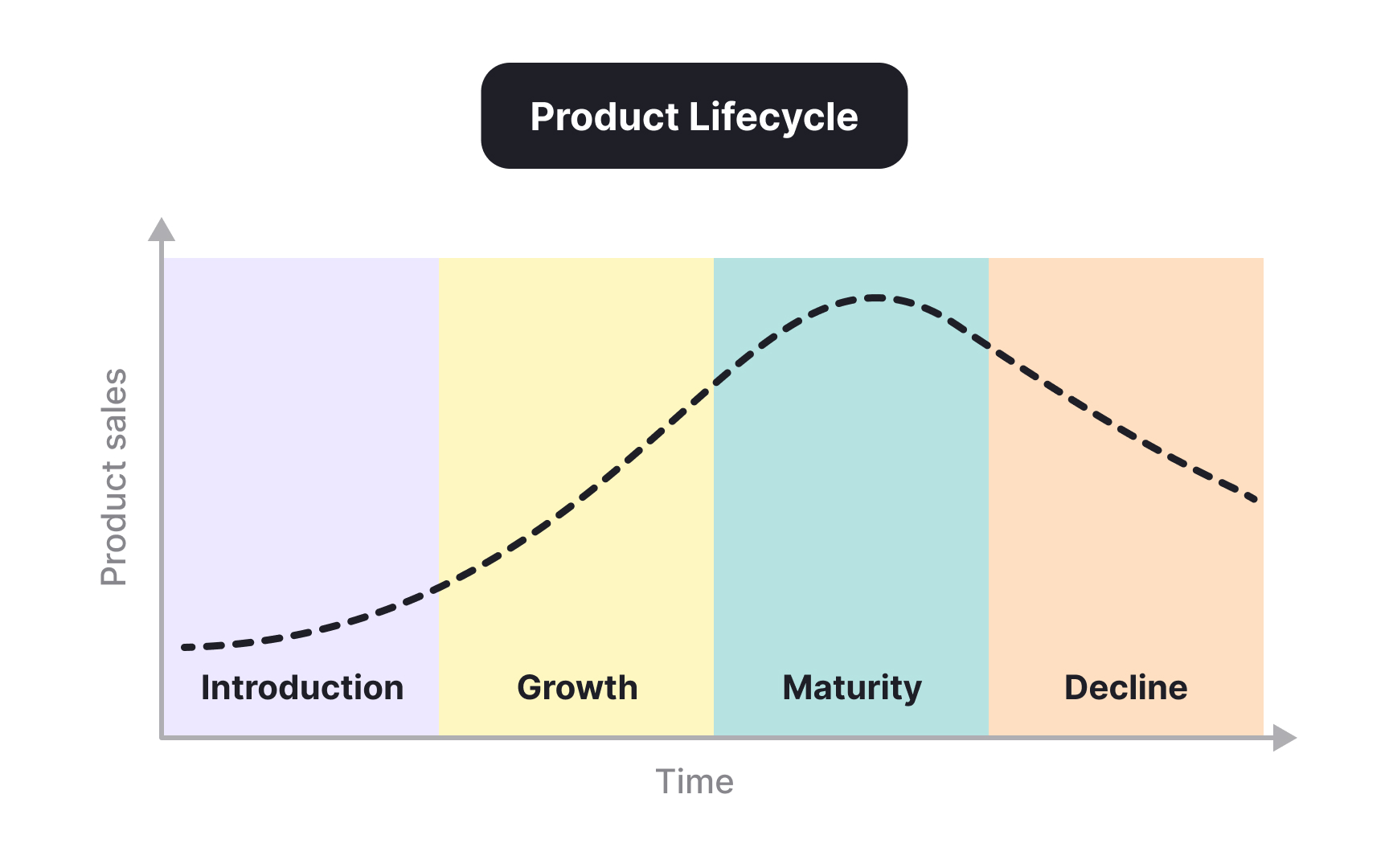
Every product follows a predictable arc: introduction, growth, maturity, and decline. Understanding which stage your product is in changes almost every decision you make, from pricing strategy to where you invest engineering time to how aggressively you compete.
- In the introduction stage, the primary job is generating demand and confirming product-market fit. Sales are low, costs are high, and the team must be quick to respond to early signals.
- In the growth stage, competitors enter the market, and the focus shifts to expanding the user base, reinvesting in product development, and managing pricing under competitive pressure. Maturity brings peak sales and a saturated market. The PM's job here is defending margin, managing churn, and identifying new customer segments before growth stalls completely.
- In the decline stage, the product loses relevance. The decisions shift to whether to extend the lifecycle through iteration, harvest remaining value, or prepare for sunset.
The mistake most teams make is applying growth-stage thinking to a mature or declining product.
Pouring marketing spend into a product at its ceiling creates waste. Recognizing the stage changes what success looks like and what decisions are worth making.[1]
Pro Tip! If adding new users costs more than retaining old ones, your product is likely past the growth stage.
Identify zombie features in your product
A zombie feature is one that is technically alive but practically dead. Nobody uses it, almost nobody asks for it, and yet engineering spends time every quarter keeping it working. Security patches, library updates, and compatibility fixes all quietly drain capacity that could go toward something that actually moves the needle.
The way to surface these features is a regular audit. Once a quarter, map every significant feature against two dimensions:
- Usage frequency: what percentage of monthly active users interact with it?
- Strategic value: does it contribute to retention, conversion, or revenue?
Features that score low on both dimensions are candidates for the zombie list. Features that score low on usage but high on strategic value, such as an onboarding step that fewer users complete but that correlates with 30-day retention, deserve a closer look before any decisions are made.
The audit is not about being ruthless. It is about being honest. Zombie features have a real cost: they make the product harder to maintain, harder to document, and harder to explain to new users. Every feature you keep is a feature you are choosing to support, indefinitely.[2]
Run a feature deprecation process
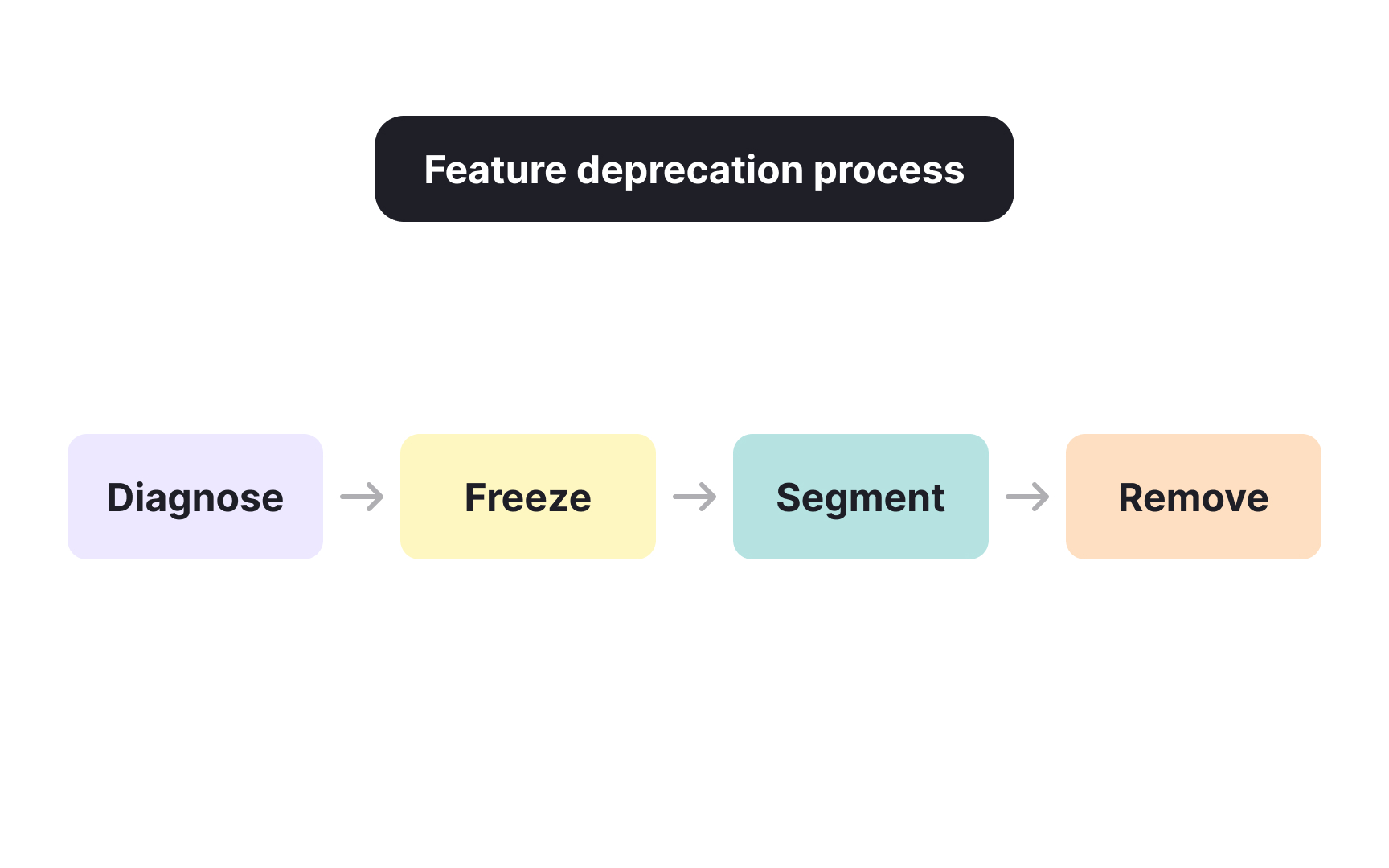
Killing a feature is 90% communication and 10% code deletion. Even if only five users rely on a feature, they will notice the moment it disappears. Done poorly, deprecation erodes trust. Done well, it demonstrates that your team makes deliberate, honest decisions about product quality.
A sound deprecation process follows a sequence:
- Diagnose. Confirm the condition is terminal by checking usage data, revenue impact, and whether any previous attempts to improve adoption have been made.
- Freeze. Stop offering the feature to new sign-ups by adding a feature flag, removing it from marketing materials, and ensuring your sales team no longer mentions it.
- Segment. Divide existing users into two groups: real users with significant, recent activity, and dabblers with minimal engagement. Dabblers are unlikely to notice the removal. Real users will, and they deserve direct communication, a concrete timeline, and, where possible, an alternative that covers their use case.
- Remove. Complete the removal and follow up with affected users.
The core rule is simple: never kill a feature without giving users value back elsewhere. Offering a migration path, an export option, or a workflow that achieves the same goal through a different feature prevents the deprecation from feeling like abandonment.[3]
Pro Tip! Dabblers rarely complain about a feature being removed. Focus your communication effort almost entirely on real users.
Keep the lights on (KTLO) vs. new development
Every engineering team carries a silent overhead cost: keeping the lights on. KTLO refers to the maintenance work required to keep an existing product functioning, things like security patches, compliance audits, library upgrades, and minor bug fixes. It does not add features. It does not delight users. It just keeps the product alive.
The problem is that KTLO is easy to underfund and dangerous to ignore. Teams that skip it accumulate technical debt that eventually forces an expensive reckoning. Teams that overfund it have no capacity left for new development. The practical benchmark is to make KTLO visible and explicit in sprint planning rather than treating it as invisible overhead. When a team knows that 20% of their capacity goes to maintenance, they can make honest decisions about how much capacity remains for new bets. The distinction between KTLO and hoarding matters here. Some teams keep features alive out of inertia rather than necessity, because removing them feels risky or because no one wants to own the deprecation conversation. That is not KTLO. That is accumulation. A healthy product organization distinguishes between maintenance that keeps a live product functioning and features that no one has had the courage to kill.[4]
Apply lifecycle thinking to sunsetting decisions

Sunsetting a product is different from deprecating a feature. When a full product is being wound down, the stakes include customer contracts, data retention obligations, legal compliance, and the reputation effects of how the shutdown is handled. Users who trusted your product with their data and workflows deserve more than a 30-day email notice.
A responsible sunset process works backward from the shutdown date. Legal and compliance must sign off on data handling and export policies before any public communication goes out. Customers affected by the sunset need a clear migration path, whether that means a competitor recommendation, a data export tool, or a transition to a surviving product in your portfolio. Communication should lead with honesty about why the decision was made, not just the logistics of how users can move on.
The emotional dimension matters too. Prospect theory explains why users react more strongly to losing a product than they would have responded positively to gaining a new one. Acknowledging that loss directly, rather than burying the shutdown announcement in product update language, builds more trust than attempting to soften the blow with product marketing framing.[5]
Spot when a product has hit its growth ceiling
A local maximum is a point where your product is performing as well as it possibly can within its current form. Metrics look stable. The team is shipping. But growth has quietly stalled because the product has run out of room to improve without fundamentally changing.
Spotting a local maximum before it becomes a ceiling requires looking at the right signals. Declining marginal returns from optimization work, a high-performing but shrinking addressable market, increasing retention without corresponding revenue growth, and feature requests that increasingly conflict with each other are all warning signs. None of them individually proves a local maximum, but together they suggest the product is near the edge of what incremental improvement can deliver.
The risk is that teams confuse a local maximum with maturity and respond with more of the same: more experiments, more A/B tests, more polish. What a local maximum actually calls for is a strategic question, not a tactical one. Is the product architecture still the right one? Is the market segment still the right one? Is there an adjacent problem that this product's core capability could address in a more expansive way?[6]
Pivot strategies for declining products
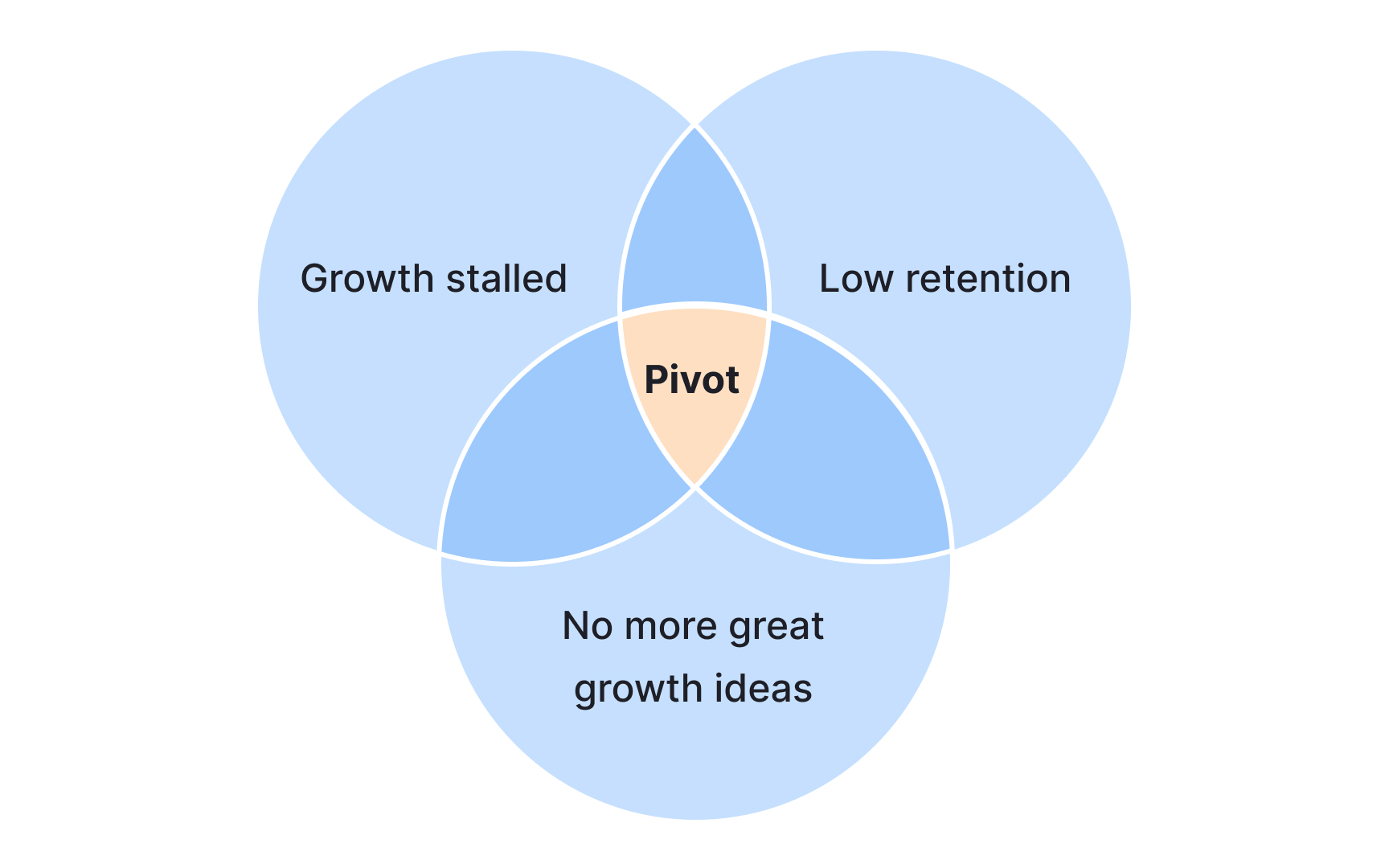
A pivot is not a failure. It is a recognition that the current product form has reached the limit of what it can do in its current market, and a decision to redirect core capabilities toward a more productive opportunity. Twitter began as Odeo, a podcast platform. Netflix started by mailing DVDs. Both pivoted before they were forced to, which is the only kind of pivot that actually works.
There are recognizable types of pivots in product management:
- A customer segment pivot keeps the product roughly the same but targets a different audience.
- A problem pivot keeps the existing audience but addresses a different need.
- A platform pivot transforms a point solution into a system that others can build on.
The right type depends on what the product has already proven: which capabilities are genuinely strong, which customer relationships are worth preserving, and what the market is actually rewarding.
The danger in a pivot is that teams treat it as a reset, discarding everything that came before. In practice, successful pivots almost always preserve the strongest validated asset from the previous version, whether that is a particular distribution channel, a user behavior, a technical advantage, or a data asset. The question is not "What do we throw away?" but "What has already been proven that we can redirect?"[7]
Manage the maturity stage without over-investing
Maturity is the stage where product teams face the strongest pressure to keep spending as if they were still in the growth phase. Sales are high. The product is well-known. And yet meaningful growth has stopped. Adding a new feature at this stage rarely moves the retention or revenue needle in proportion to the cost of building it.
The right PM posture in maturity is to defend margin, not chase growth. That means controlling costs, reducing KTLO overhead through consolidation, protecting the features that drive retention, and carefully evaluating whether any new development is actually necessary. It also means being honest with leadership about what optimization can and cannot accomplish at this stage.
The segment extension play is a legitimate exception. When the core market is saturated, finding an adjacent segment that the product can serve with minor adaptation can extend the maturity stage meaningfully without a full pivot. A B2B product with strong mid-market adoption might find traction in the enterprise segment with the addition of SSO and audit logging. That is not starting over. It is expanding carefully, using what already works.
Topics
References
- Product Management's Role at Every Phase of the Product Lifecycle | ProductPlan
- Feature Audit | ProductPlan
- How to sunset a feature | The Intercom Blog
- What does keeping the lights on (KTLO) mean? - LogRocket Blog | LogRocket Blog
- How to sunset a product: Complete guide + examples | Product Marketing Alliance
- When It’s Time to Pivot Your Product | ProductPlan
- When It’s Time to Pivot Your Product | ProductPlan