



.svg)

At scale, the founder's role re-centers from builder to public-facing executive. The product stays central, but the day-to-day work becomes the company itself: analyst briefings, enterprise deals, and governance, all while preserving the lean, AI-centered structural advantage that got the company here.
This lesson defines the scale-stage goals, systematic growth and a defensible moat, and the heightened scrutiny that public investors, regulators, and enterprise buyers apply. It frames the exit not as a single milestone but as a threshold event: sustainable profitability, IPO-readiness, or acquisition.
This lesson draws on Anthropic's "The Founder's Playbook: Building an AI-Native Startup" [1].
From builder to executive
At the scale stage, the founder's role re-centers from builder to public-facing executive. The product is still central, but the founder's personal day-to-day shifts toward the company itself. New activities appear, analyst briefings, IPO roadshows, enterprise negotiations, even as the founder works to preserve the lean, AI-centered structure that created the advantage in the first place.
This is a different kind of work than any prior stage demanded. Earlier, growth could be felt through closeness to users and tight feedback loops. Now the founder represents the company to outside audiences whose standards and vocabularies differ from users'. The shift isn't an abandonment of the product; it's an expansion of the founder's surface area to include everything around it.
Systematic sustained growth
At every prior stage, growth could be felt by staying close to users and adjusting course from tight feedback loops and founder instinct. At scale, going from thousands of users to millions and from one market to many, that intuition no longer reaches. The goal becomes systematic growth sustained by mature organizational operations rather than founder feel.
Systematic means the growth doesn't depend on the founder being personally close to it. It runs through repeatable processes, defined channels, and operations that hold up as the numbers climb by orders of magnitude. The instinct that worked at small scale doesn't disappear, but it's no longer the engine. The engine is the system, and the founder's job is to ensure that system is sound.
The defensible moat
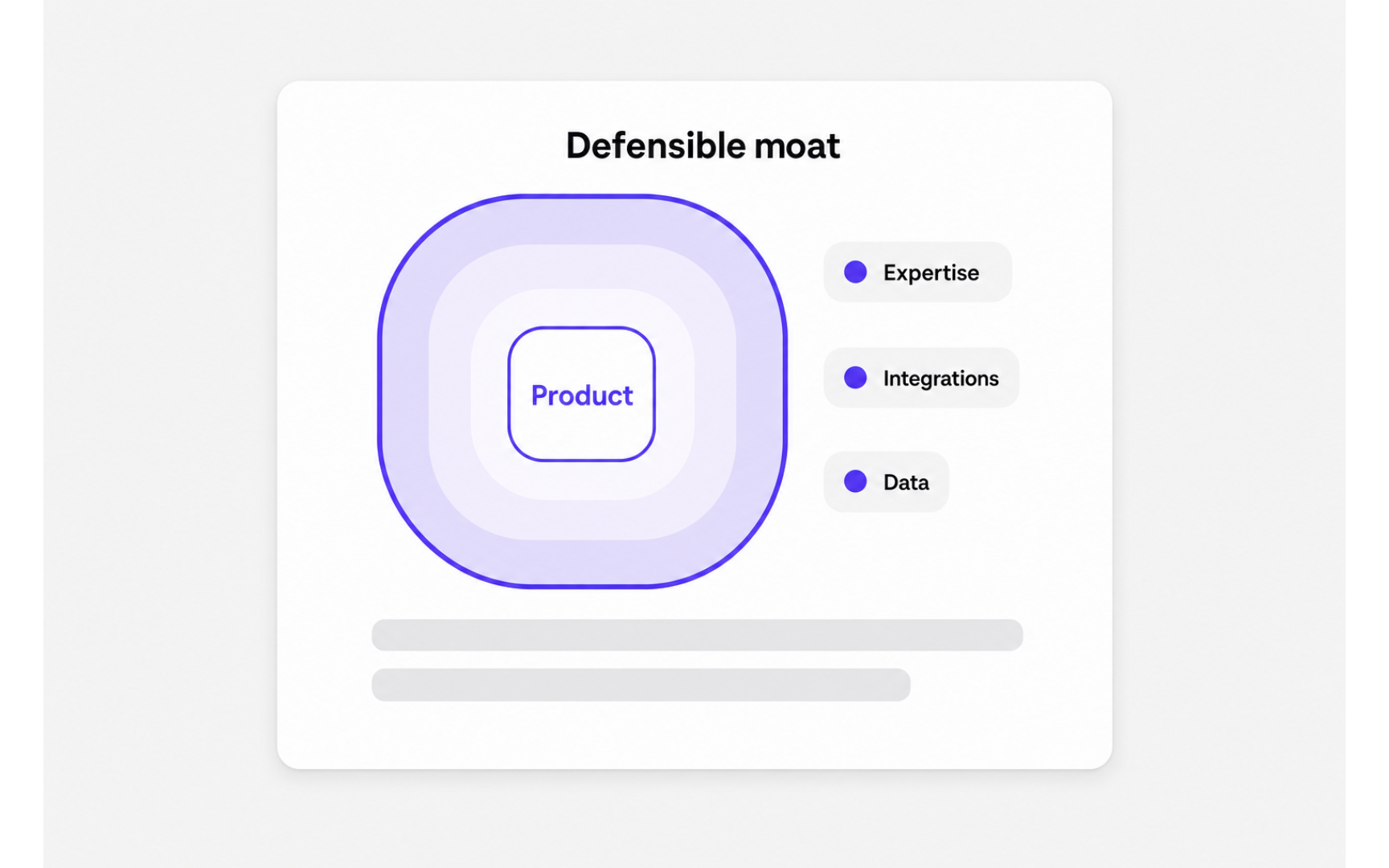
For an AI-native startup, the scale-stage goal is to build a defensible moat through accumulated depth. That depth comes from three compounding sources: the expertise built into the product, the product's depth of integration with the other tools and platforms users rely on, and the proprietary data and workflows that accumulate as users work inside it.
The founders who have been building consistently in one direction, on consistent infrastructure, end up with something genuinely hard to replicate. The moat isn't a single clever feature; it's the cumulative result of depth that took time to build and can't be bought. The test of a moat is simple: if a well-funded incumbent copied the product today, would the users stay?
Withstanding external scrutiny
At scale, the audience changes and so does the level of skepticism. Public investors, analysts, regulators, enterprise procurement teams, and acquirers all apply greater pressure because the stakes are higher. The product and organization now have to withstand external scrutiny, not just on the capabilities of what's been built, but on the governance, compliance posture, financial controls, and strategic narrative around it.
This is a broader bar than product quality. A capable product with weak governance or unclear financial controls won't clear the review that a major enterprise contract or a public offering requires. Preparing for scrutiny means making the company legible to outsiders who will probe it adversarially, which is a different exercise than satisfying users who simply want the product to work.
The threshold event
The scale-stage exit is no longer a single milestone but a threshold event: the company becomes sustainable even as the founder is, increasingly, not directly running daily operations. Reaching it means three things are true at once. Growth is systematic and auditable. Governance and compliance infrastructure satisfies the most demanding external reviewers. And the product moat stands up to the question of whether users would stay if a well-funded incumbent copied the product today.
The shift from milestone to threshold matters. Earlier stages ended when a specific condition was met; the scale stage ends when a durable state holds across the whole company. When it does, the startup has gone from being a bet to being a business.
Profitability, IPO, or acquisition
In practice, the scale-stage threshold takes one of three forms. Sustainable profitability at a level that no longer requires external capital lets the company fund itself. IPO-readiness means the company can withstand the disclosure and governance demands of public markets. Acquisition means another company values what's been built enough to buy it.
What the three share matters more than how they differ. All require that growth is systematic and auditable, that the product moat stands up under scrutiny, and that the organization is operationally mature and sustainable. None of them is reachable by product strength alone. Each is a verdict on the whole company, which is why the scale stage is as much about the organization as about the product.