


Two typefaces set at the same size can look nothing alike in scale, and cap height is a large part of why. It is the measure designers reach for when a headline face and a body face have to sit together, when text has to center inside a button, or when a brand font falls back to a system font on a user's device. Point size describes the space a font occupies; cap height describes what the reader actually sees.
In this glossary topic:
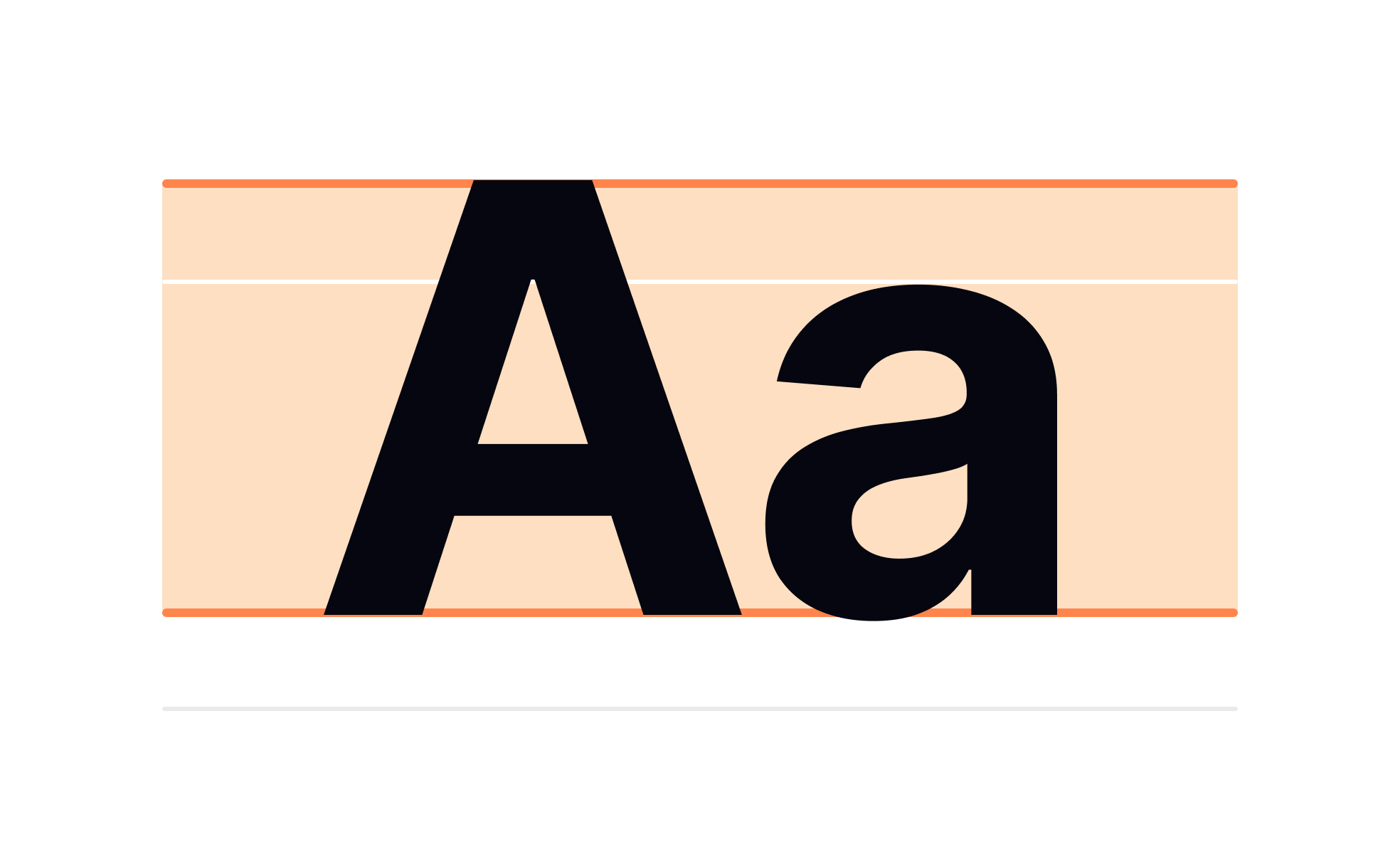
What is cap height?
Cap height is the measurement from the baseline to the uppermost edge of a flat capital letter. The baseline is the imaginary horizontal line on which most letters appear to rest. The cap height is measured to the top of a letter like H or I, which terminates in a flat stroke at that height. Letters with curved tops like O and rounded letters like C may extend very slightly above the cap height line due to optical compensation, but the cap height is defined by the flat-topped uppercase letters.
Cap height is one of several key vertical measurements in a typeface. The x-height is the height of lowercase letters without ascenders or descenders. The ascender height is how high the tallest lowercase letters like b, d, h, and k reach. The cap height sits between x-height and ascender height in most typefaces, though some fonts have caps that reach to the ascender height or sit below it.
These measurements define the proportional relationships within a typeface and between different typefaces. Two typefaces set at the same point size may look dramatically different in scale because point size is not a direct measurement of letter height; it includes surrounding space that varies by design.
Why is cap height important in digital design?
Cap height is practically significant in several specific design situations.
- In typeface pairing, cap height determines whether two typefaces set at the same size will appear visually consistent or mismatched. When pairing a display typeface for headlines with a body typeface for reading text, matching or deliberately calibrating the cap heights creates visual coherence. Pairing fonts with very different cap heights at identical point sizes produces an unsettling mismatch where one typeface appears much larger than the other despite identical specifications.
- In component design and UI elements, cap height is the relevant measurement for vertical alignment of text within buttons, navigation items, labels, and other compact elements. A button height calculated to provide consistent padding above and below text should be calculated relative to the cap height of the uppercase characters and the descender depth of the lowercase ones, not the overall point size. Using point size for this calculation produces inconsistent visual results across typefaces.
- In responsive design and variable type sizing, understanding how cap height scales helps designers predict how text will look at different sizes. A headline at 64px has different proportional relationships with surrounding elements than the same typeface at 16px, and the cap height is part of what changes those relationships.
- In mixed-font layouts, particularly in products that render user-generated content with varying fonts, cap height variation can disrupt visual consistency. Content that renders in different typefaces depending on the user's system fonts, for example, may show noticeable height differences that no single point size compensates for.
How does cap height relate to optical alignment?
A well-understood phenomenon in typography is that geometrically precise alignment often doesn't look aligned. This is why designers make optical adjustments.
Rounded letters like O, C, and G are designed to slightly overshoot the cap height line at the top. If they were perfectly contained within the cap height, they would appear shorter than flat-topped letters because the curve has less visual weight at the very top and bottom. The overshoot compensates for this, making the rounded letters appear the same height as flat letters to human perception even though they're technically taller.
This means that letters in a word aren't all exactly the same height geometrically, even though they appear the same height visually. Type designers calibrate these overshoots carefully as part of letterform design. When using display type at very large sizes, these overshoots become more visible and may require manual adjustment in specific design contexts like logo work or large-format printing.
How does cap height differ between typefaces at the same point size?
This is one of the most important practical facts about typography: two fonts at the same point size can have significantly different cap heights.
Point size is a unit inherited from metal typesetting, where it described the height of the physical metal type block. Different fonts within the same point size can occupy different portions of that block, which means their actual letterform heights differ.
A common comparison is Helvetica versus Times New Roman, or Georgia versus Arial. At the same point size, these typefaces appear noticeably different in scale to the human eye, primarily because their x-heights and cap heights differ. Fonts with larger x-heights relative to cap height, common among typefaces designed for screens, tend to appear larger at the same point size than fonts with smaller x-heights and taller caps.
This is why designers working with multiple typefaces, especially in component libraries or design systems that need to accommodate brand typography alongside fallback system fonts, specify font sizes with explicit knowledge of the target typeface's cap height rather than assuming that identical point sizes will produce comparable-looking results.
How are cap height and x-height related?
Cap height and x-height together define a typeface's proportion system. Their ratio is one of the most visible characteristics that distinguishes typeface categories.
Old-style typefaces tend to have a larger cap-height-to-x-height ratio: the caps are significantly taller than the lowercase letters. This gives text a traditional, formal character and requires larger point sizes for comfortable reading because the x-height is relatively small.
Many contemporary text typefaces, humanist sans-serifs among them, tend to have a smaller cap-height-to-x-height ratio: the lowercase letters are taller relative to the caps. This increases legibility at smaller sizes because more of the character's height is in the x-height zone, which is where most reading recognition happens.
Screen-optimized typefaces like Georgia, Verdana, and many contemporary web fonts were specifically designed with large x-heights relative to cap heights, which improves legibility on lower-resolution screens by ensuring lowercase letters have enough height to be clearly distinguished.
What does cap height look like in practice?
The diagram below marks the measurement directly on the letterforms: the baseline the characters sit on, and the cap height line at the top of a flat-topped capital. Drawn on the letters themselves, the measure makes visible why two fonts at the same point size can look so different in scale: the number describes the em, the line describes what the reader sees.
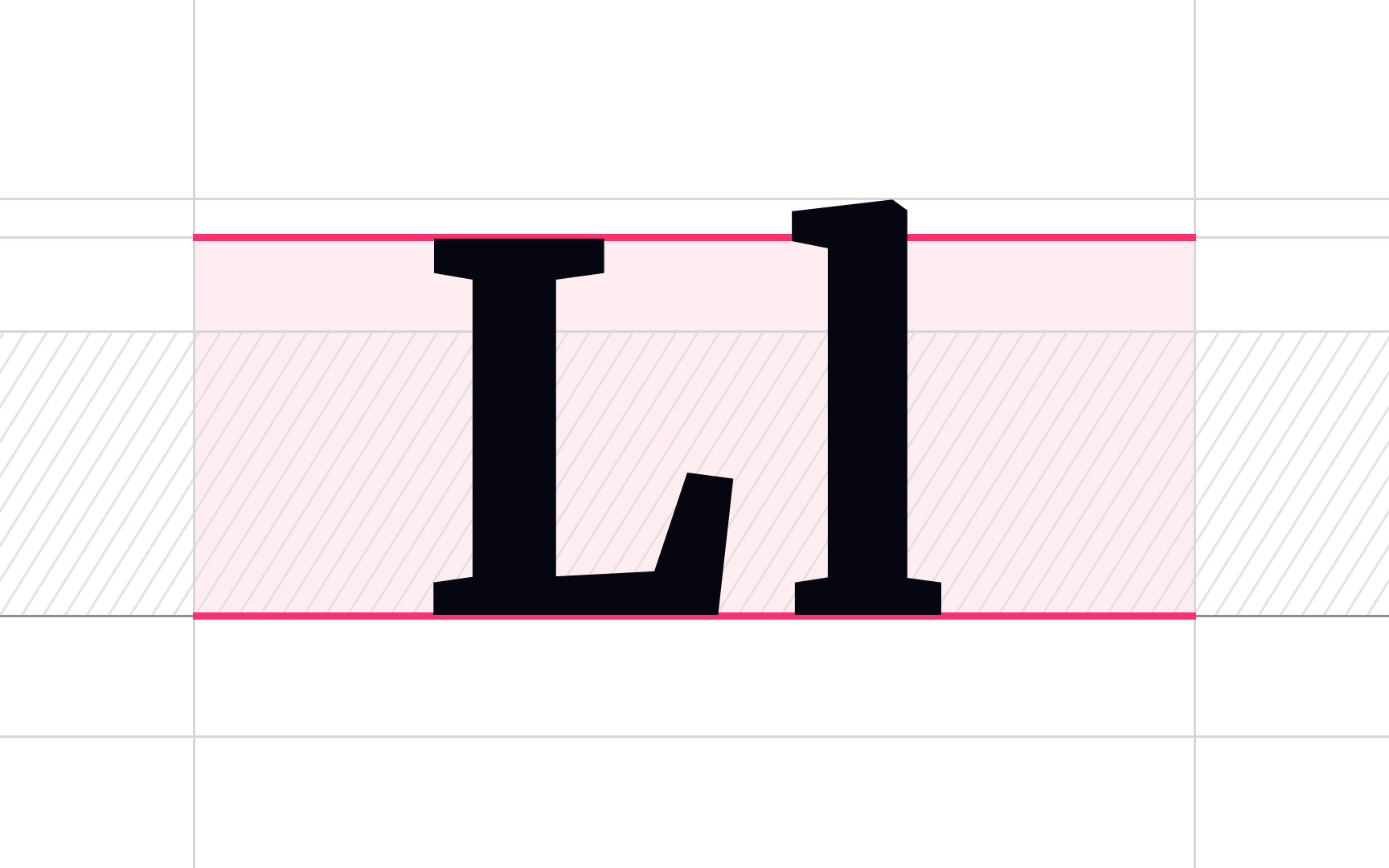
The cap height drawn as a band from the baseline to the top of the capital L; the lowercase l beside it shows how close an ascender can run to the same line. From the lesson Characters in Typography.


