For most of the generative AI era, the deal was simple. You asked a question, a chatbot wrote an answer, and everything after that, from booking the table to fixing the bug, stayed with you. AI agents change the second half of that deal. They take a task, work through the steps on their own, and come back with a result: a cited research report, groceries on the way, or code that passes its tests. From the outside, the chat box can look exactly the same.
Agents didn't arrive with one big breakthrough. Models slowly got reliable enough at using tools, and at staying on a task for hours instead of minutes, that handing over whole jobs started to make sense. By 2025, agents sat inside deep research tools, browsers, and coding assistants, and many people had already used one without noticing. Coding came first, because code can be tested automatically and an agent can keep fixing it until the tests pass.
The most important shift isn't technical, though. Once an agent can carry out the steps, your job moves from doing the work to delegating it: deciding what to hand over, describing what done looks like, and judging what comes back. Agents still fail often enough that the judging matters as much as the handing over.
Answers vs. actions

A chatbot and an agent can look identical, with the same chat box and often the same model underneath. The difference shows up after the request. A chatbot returns text and waits for the next message. An agent takes a task and carries out the steps itself, whether that means searching the web, clicking through a site, editing files, or filling in forms, and then reports back with a result.
The contrast is easiest to see side by side. Asking a chatbot for Japanese breakfast recipes produces a list. When OpenAI launched ChatGPT agent in July 2025, its showcase request was to "plan and buy ingredients to make Japanese breakfast for four." [1] The first request ends with information, and the second ends with groceries on the way. A chatbot that runs one quick web search before replying is still answering, because the search only feeds its reply.
Stanford's 2026 AI Index described 2025 as the year agents moved from answering questions to completing tasks, while noting they still fail roughly 1 in 3 attempts on structured benchmarks [2]. Agents act, but they don't always act correctly.
Why agents arrived now
Agents didn't come from a single breakthrough. The pieces arrived over several years: a 2022 research paper showed models could alternate between reasoning and acting, OpenAI let developers connect models to outside tools in June 2023, and Anthropic released computer use in October 2024. Each step made it more practical for a model to do something rather than just say something.
Anthropic's explanation is that agents emerged as models matured in a few key capabilities, including "using tools reliably, and recovering from errors." [3] Reliability matters more for agents than for chatbots. An agent strings many tool calls together, so it only becomes useful once each step works almost every time.
Staying power mattered too. Independent evaluator METR found that leading models in 2023 could complete software tasks that take a skilled person about 4 minutes, at least half the time. By early 2026, it had reached about 12 hours [4]. Once models could stay on a task that long, products built around handing over work became worth launching, and a wave of agent products followed in 2025.
Deep research as an agent
Deep research tools are agents that many people have already used. Given a question, they draft a research plan, run dozens of searches that build on each other, change direction based on what they find, and return a report with citations. Google shipped the first major version in December 2024, and OpenAI and Anthropic followed in early 2025.
What makes deep research an agent is that the path isn't fixed in advance. OpenAI described its version as "pivoting as needed in reaction to information it encounters." [5] Anthropic built its research feature as an agent for the same reason: "You can't hardcode a fixed path for exploring complex topics, as the process is inherently dynamic and path-dependent." [6]
The result is a strong first draft, not a verified answer. OpenAI's launch post also cautions that the tool can struggle to tell authoritative information from rumors. Citations make checking possible, but they don't do the checking.
Agents that act in the world
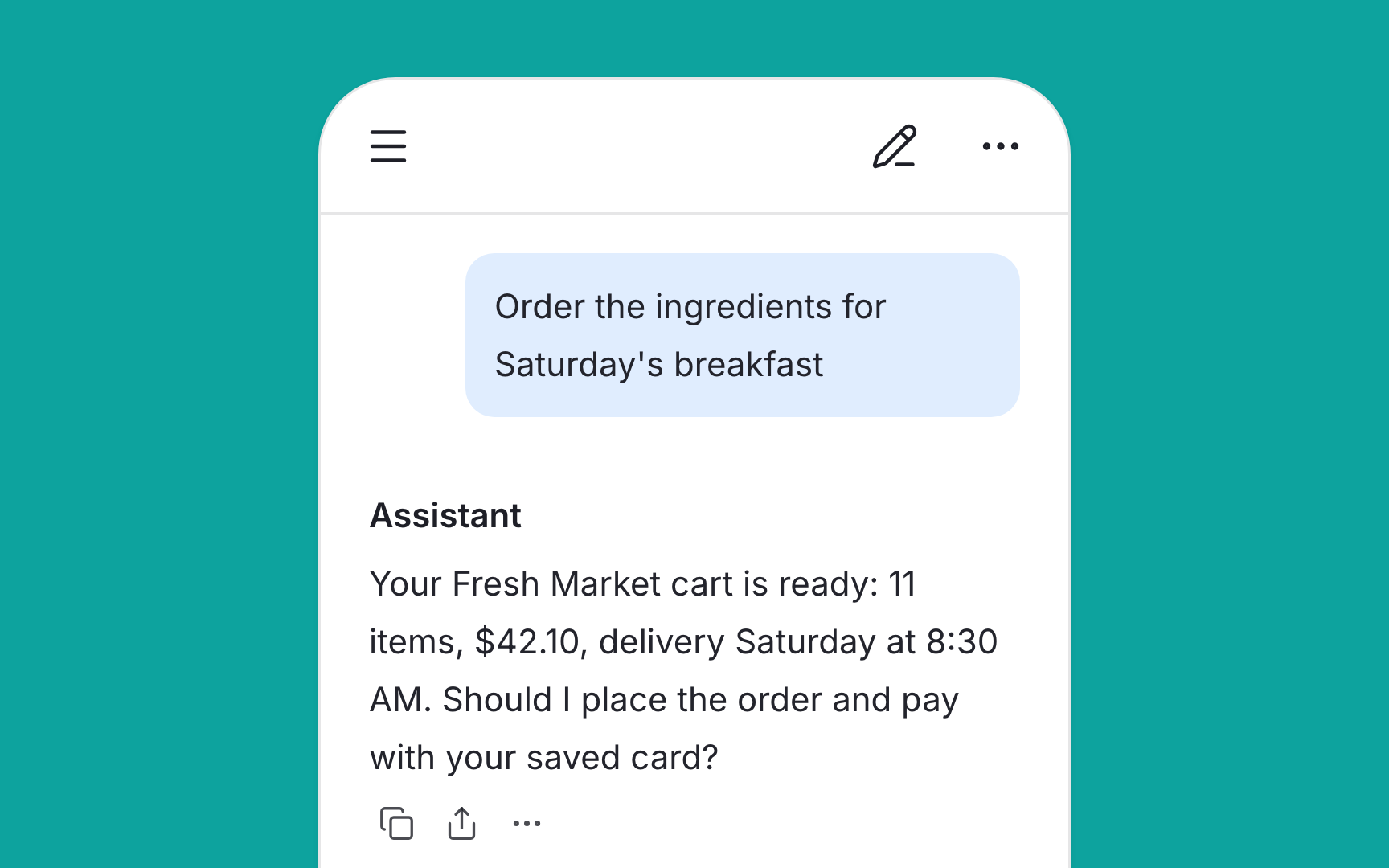
Some agents go beyond reading the web and start running errands on it. They fill in forms, book appointments, and shop on a person's behalf, often by operating a web browser the way a person would. OpenAI's Operator, launched in January 2025, used its own browser to type, click, and scroll through tasks like ordering groceries [7].
Acting agents raise the stakes, so well-designed ones pause before anything consequential. OpenAI's ChatGPT Work, for example, "will always ask for confirmation before consequential actions, such as completing a reservation or payment." [8] Google's agentic checkout, launched in November 2025, also asks permission before buying anything [9].
This category is still settling. OpenAI shut down its Atlas browser in August 2026, less than a year after launch, and moved its agent features into other products [10]. The idea of agents that run errands is durable, even if the specific products aren't.
Coding agents lead the way
Coding is where agents work best today, and the main reason isn't that AI knows programming especially well. It's that code can be checked automatically. A coding agent can run a project's tests, see exactly what failed, fix it, and run the tests again, repeating until everything passes.
Anthropic points to this as the reason coding agents succeed: "Code solutions are verifiable through automated tests," so agents "can iterate on solutions using test results as feedback." [11] Andrej Karpathy put the broader principle in one line: "Software 1.0 easily automates what you can specify. Software 2.0 easily automates what you can verify." [12] He notes that tasks without a clear check, such as creative or strategic work, lag behind.
The lead shows up in how people use these tools. In Anthropic's 2025 analysis, 79% of Claude Code conversations were classified as automation, where the AI carries out the task directly, compared with 49% on the Claude chat app [13].
From doing to delegating
With chatbots, the person stays in charge of every step: ask, read, adjust, and ask again. Agents change the job. The person hands over a whole task, then judges what comes back. Ethan Mollick, a Wharton professor who studies AI at work, describes the change directly: "work is increasingly about assigning work to agents, rather than working together with chatbots." [14]
Handing over work doesn't make expertise less important. In Anthropic's study of about 400,000 Claude Code sessions, people made around 70% of the planning decisions but only about 20% of the execution decisions: "people decide what to build, and the agent decides how to build it." [15] The same study found that people who brought more domain expertise had more successful sessions.
For anyone who has taken Intro to Vibe Coding, this is the next step. In vibe coding, the person drives the loop prompt by prompt. With agents, the loop runs itself, and the person's role shifts to setting the goal and checking the result.