.svg)


The best UX design course in 2026 depends on your level, not on any single ranking. A beginner needs foundations and a portfolio to show; a working designer needs a sharper specialty. So this list is organized by skill level, free and paid together. Six of the eleven cost nothing to start, and every entry ends with its real price on one line, because course sites hide the number more often than they show it.
If your goal is a credential rather than coursework, start with a professional certification like the Uxcel Certified Product Designer exam instead, then use courses to close specific gaps.
The shortlist by skill level
Beginner
- Uxcel for interactive daily lessons, free to start
- Google UX Design Certificate for a job-ready credential
- UX Design Institute's free short course for testing the water in a week
- DesignLab UX Academy Foundations for mentored fundamentals
- Georgia Tech's Intro to UX Design for a six-hour university primer
Intermediate
- University of Michigan's UX Principles and Processes for research technique
- IxDF's Agile Methods for UX Design for working inside sprints
- CalArts UI/UX Design Specialization for graphic designers crossing over
- Google's Product Design course on Udacity for design sprints, free
Advanced
- LinkedIn Learning's Advance Your Skills in UX path for senior tooling and analytics
- Acumen's Human-Centered Design 201 for prototyping practice, free
What to look for in a UX design course
Six things separate a course you'll finish from one you'll abandon:
- Skill level fit. Learning below your level wastes money; learning above it wastes motivation. The list below is grouped by level so you can match honestly.
- Format. Self-paced suits working professionals; cohorts and mentorship suit career changers who need structure and feedback.
- Time to complete. These courses run from six hours to several months. Pick what your calendar can survive, not what your ambition wants.
- What you produce. Portfolio pieces and completed projects outlast video certificates. Prefer courses where you make things.
- A credential that means something. Course completion certificates vary wildly in weight. If credibility is the goal, compare the best UX design certificate programs separately, since a credential and a course solve different problems.
- Price honesty. Subscription, one-time, or free tier: each entry ends with the real number on one scannable line.
Beginner UX design courses
1. Uxcel: best for interactive, self-paced UX learning
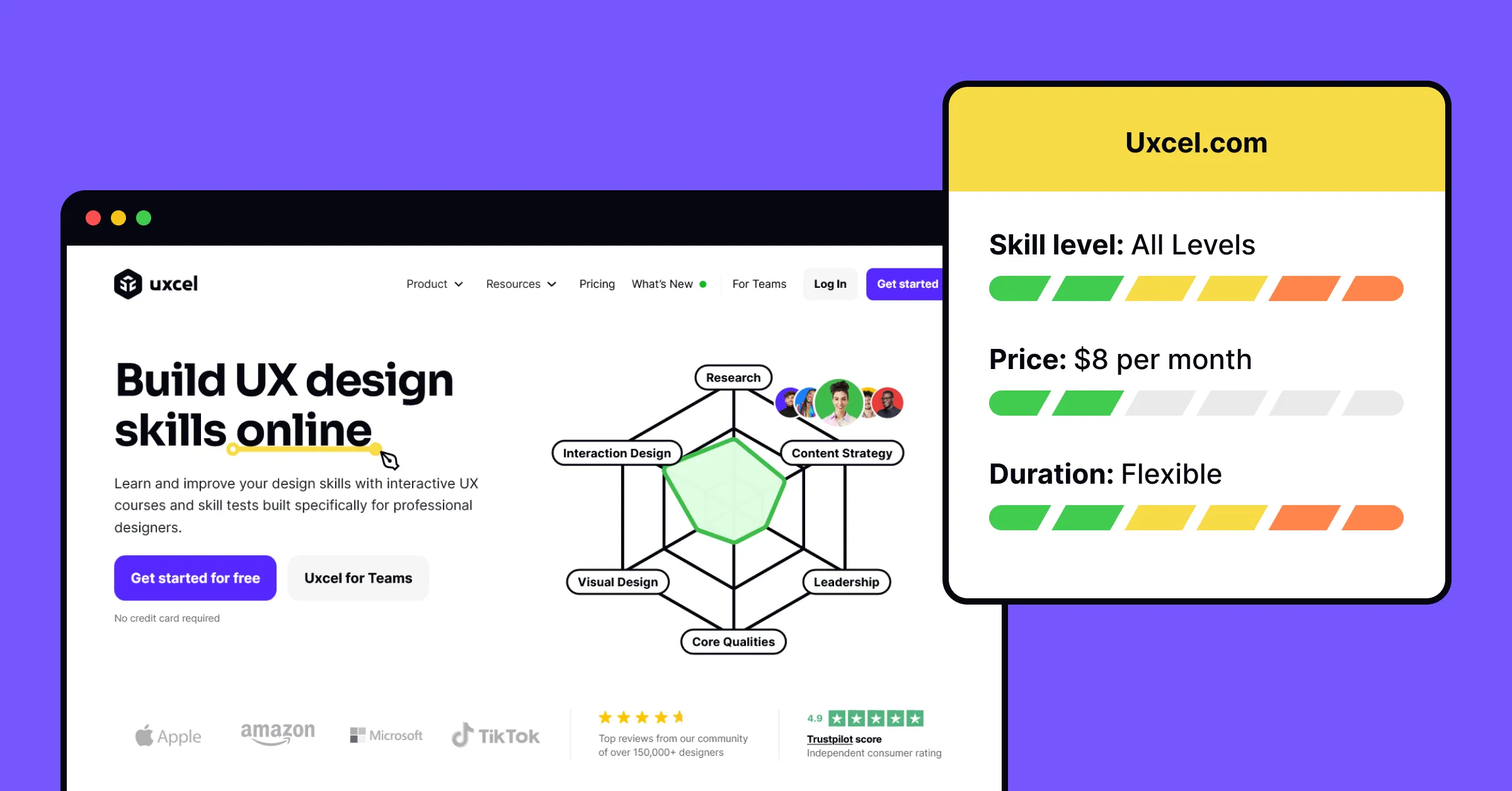
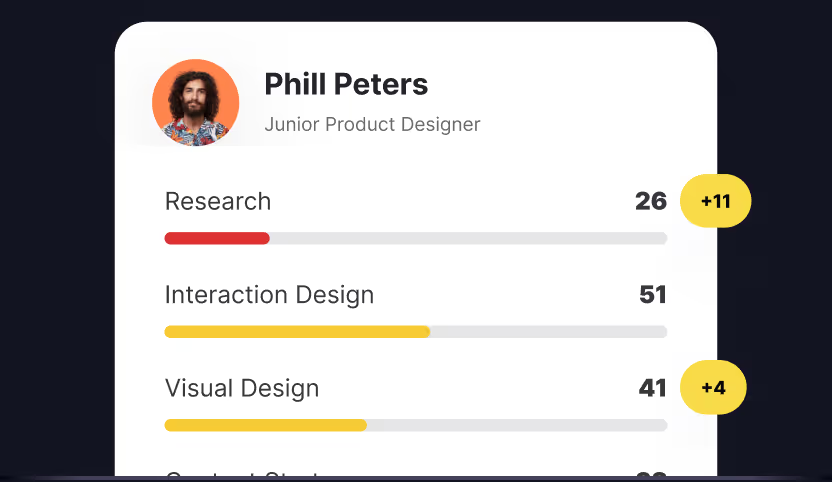
Uxcel teaches UX through 5-minute interactive lessons rather than video, across 59 courses organized into beginner, intermediate, and advanced levels, so it stays useful long past the beginner stage. The courses are crafted by working practitioners from top companies like Google, Mastercard, and Miro, so the material reflects how product teams actually operate. You learn by answering and doing, not watching, and a Skill Graph maps what you actually know as you progress. The catalog runs from UX Design Foundations through research, typography, accessibility, and AI-assisted workflows, and the full library of UX design courses is browsable by category. Structured career paths bundle courses into a role-shaped sequence with a certification exam at the end.
The honest limit: there's no live human instruction. If you need a mentor looking at your work every week, pair it with a mentored program below.
Price: free to start, with every Level 1 lesson free on the Starter plan. Pro unlocks everything, monthly or annual.
2. Google UX Design Professional Certificate: best for a job-ready credential
.webp)
Google's certificate on Coursera remains the most recognized beginner credential in the field. Seven courses and roughly 240 hours take you from zero to a three-project portfolio, and the Google name carries weight with recruiters screening entry-level candidates. It works because it's genuinely complete: research, wireframing, prototyping in Figma, and portfolio assembly in one sequence.
Its weakness is pace and generality. It's built for absolute beginners, so anyone with design exposure will find whole stretches slow.
If this certificate is your finalist, the Google UX certification review covers its pricing, pace, and outcomes in depth.
Price: $49 a month on Coursera; most learners finish in 3 to 6 months. Free 7-day trial.
3. UX Design Institute Free Short UX Course: best for testing the water

The UX Design Institute's free short course is a one-week email course that answers a narrower question: do you actually want to do this work? Daily 15-minute lessons walk through what UX designers do, the design process, and where the careers lead.
It won't teach you design. It will tell you cheaply whether to invest in something that does.
Price: free.
4. DesignLab UX Academy Foundations: best for mentored fundamentals
.webp)
UX Academy Foundations is the mentored on-ramp: four to eight weeks of design fundamentals with a personal mentor reviewing your work in weekly sessions. You build real projects in Figma and finish with portfolio pieces and a habit of receiving critique, which is the single most job-like part of any beginner course. Rolling monthly cohorts mean you can start almost anytime.
Price: $499, with mentorship included.
5. Introduction to User Experience Design by Georgia Tech: best for a university primer
.webp)
Georgia Tech's six-hour Coursera course condenses the academic view of UX into one sitting: requirement gathering, design alternatives, prototyping, and evaluation. Over 350,000 learners have taken it, and it's the fastest legitimate way to understand the four-step design cycle before committing to anything longer.
Treat it as a primer, not training. There are no projects, so nothing goes in your portfolio.
Price: free to audit; a shareable certificate costs extra.
Intermediate UX design courses
6. Introduction to UX Principles and Processes by the University of Michigan: best for research technique
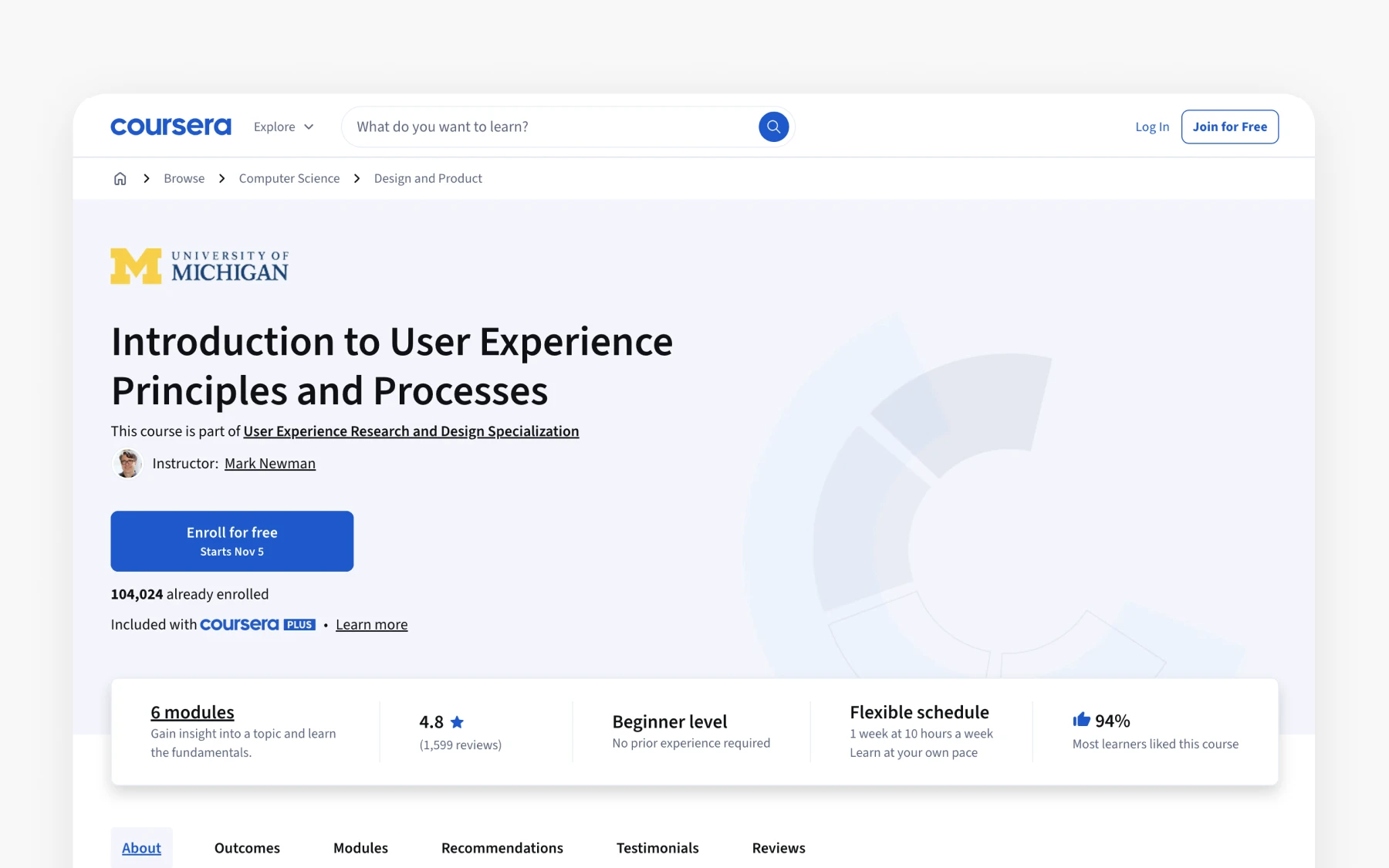
Michigan's Coursera course opens its six-course UX specialization and goes deeper on research technique than any other beginner-to-intermediate option here: user interviews, micro-usability tests, and assessing user needs the way a research team actually does. Over 108,000 learners have enrolled, and if it clicks, the remaining five courses in the specialization build directly on it.
Price: free to audit; certificates and graded work need a Coursera subscription.
7. Agile Methods for UX Design by IxDF: best for working inside sprints
.webp)
The Interaction Design Foundation's Agile Methods for UX Design solves the problem most mid-career designers actually have. It isn't design skill; it's fitting design work into sprints, scrum, and Dual Track Agile without being flattened by the process. Assignments are graded by experts, and finishing earns an industry-recognized certificate.
Price: $279 standalone, or free with an IxDF membership, which unlocks the whole catalog.
8. UI/UX Design Specialization by CalArts: best for graphic designers crossing over
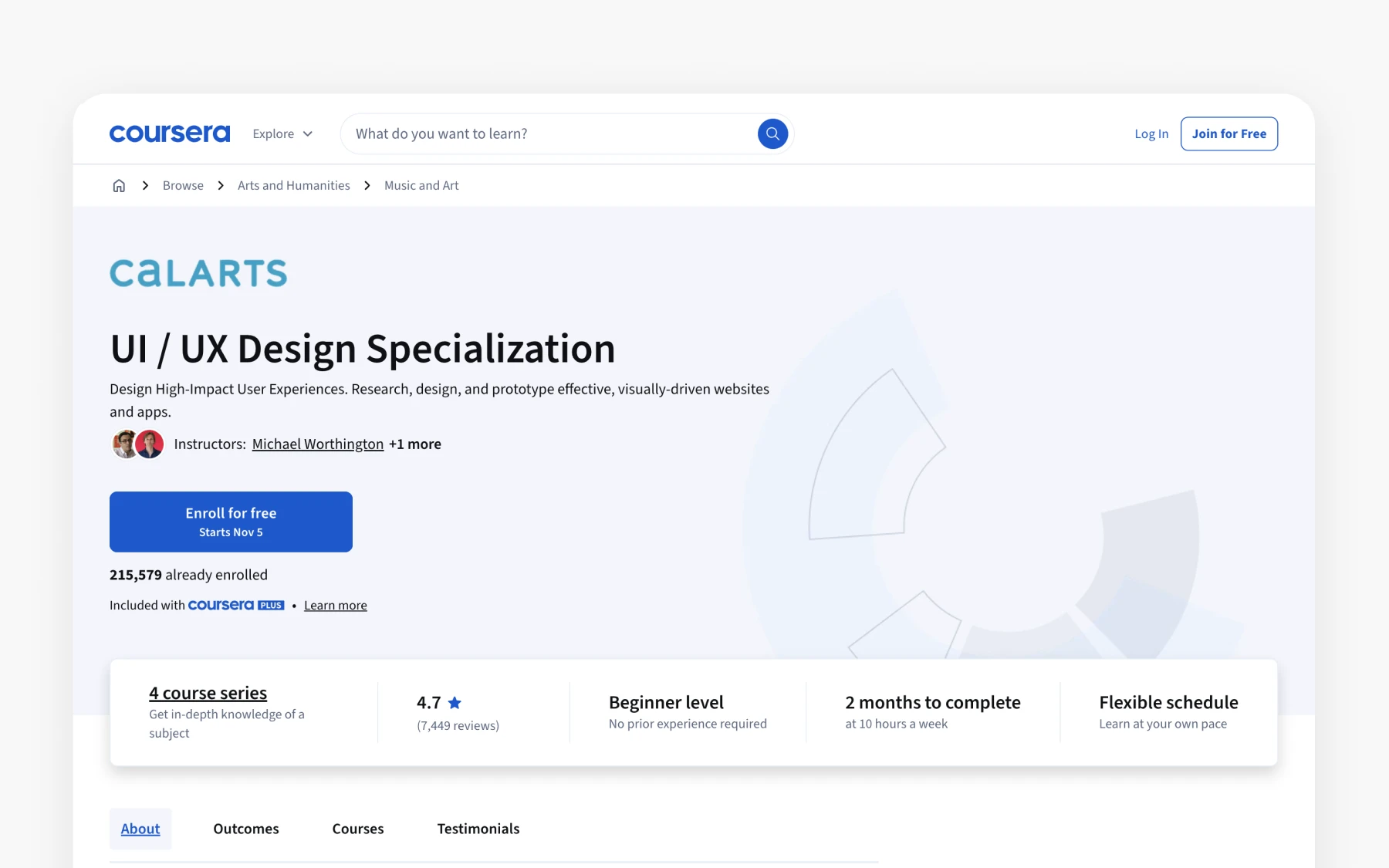
CalArts' four-course specialization is the bridge for people who already have visual craft and need UX method. It runs about four months at five hours a week and treats visual design as a strength to build on rather than a beginner topic to sit through.
The free version only unlocks content; projects, feedback, and the certificate require the paid tier.
Price: free to audit; full access via Coursera subscription.
9. Product Design by Google on Udacity: best for design sprints, free
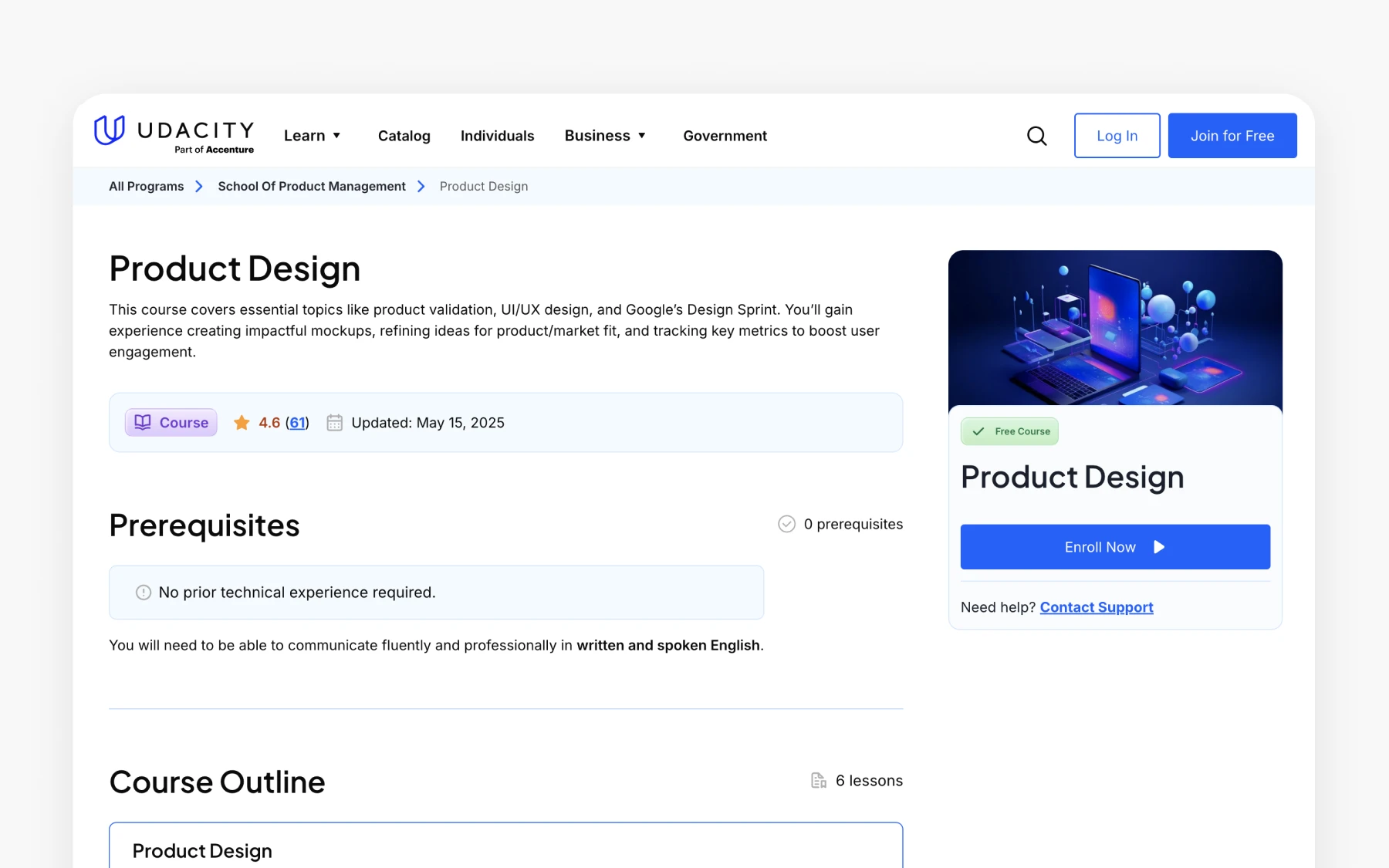
Google's free Udacity course teaches its design sprint process end to end: ideation, validation, UX metrics, and turning an idea into something testable. It was updated as recently as May 2026, which makes it a rarity among free courses, most of which quietly rot.
It's a product course as much as a UX course, which is exactly why designers who want product sense should take it.
Price: free.
Advanced UX design courses
10. Advance Your Skills in UX Design by LinkedIn Learning: best for senior tooling and analytics
.webp)
This LinkedIn Learning path packs eight hours from six instructors into the topics senior ICs get asked about: web analytics, interaction design, remote research, and advanced Figma and Sketch work. It's the strongest subscription-library option for designers who already have fundamentals.
One correction to a claim that circulates: LinkedIn courses don't earn academic credit. A few partner universities accept them toward their own programs, which is a different thing.
Price: $19.99 a month billed annually, or $39.99 month to month, with a 30-day free trial.
11. Human-Centered Design 201 by Acumen Academy: best for prototyping practice, free
.webp)
Acumen's HCD 201: Prototyping is a free four-week course built with IDEO.org, and it's the rare advanced option that costs nothing. The format is practice-first: build prototypes, run them past real people, and debrief with structured guides.
Price: free.
How to choose
No experience, testing interest: take the free UX Design Institute short course, then Georgia Tech's primer. Two weeks and zero dollars tell you whether this field is yours.
Committed to breaking in: Google's certificate for the credential, or Uxcel if you learn better by doing than by watching. You can start free either way.
Career switcher with a deadline: DesignLab's mentored Foundations first. If you're weighing full immersion instead, compare the best UX design bootcamps before spending five figures.
Working designer leveling up: IxDF for process, Michigan for research, LinkedIn Learning for senior tooling. Pick the gap, not the brand.
Whichever route you pick, the pattern that works is the same: short daily practice beats weekend binges, and courses you finish beat courses you admire.