.svg)


UX researcher skills fall into five groups: technical methods, soft skills, applied business skills, collaboration, and AI. What separates researchers who are thriving from those job hunting for months isn't experience level or methods alone. It's the combination, because organizations now expect business impact, cross-functional range, and AI-scaled output from the same person. This guide covers all 32 skills with a practical way to develop each one. Communication ranks first among them, and per Lyssna's survey of 100 UX researchers, 88% expect AI-assisted analysis to significantly reshape the work this year.
Key takeaways
- The 32 skills span five categories: technical, soft, applied, collaboration, and AI. Technical skills earn credibility; the other four determine whether your insights change anything.
- Synthesis is the skill that separates junior from senior researchers. Data collection is learnable in weeks; weaving data into decisions takes years.
- Business acumen is the biggest gap between researchers who thrive and researchers who get cut when budgets tighten.
- AI skills multiply capacity: AI-assisted analysis can cut qualitative processing time dramatically, but only for researchers who can judge when it misses nuance.
- Develop two or three skills at a time. The UX Researcher career path sequences the full set if you want structure.
Quick reference: all 32 UX researcher skills at a glance
| Category | Skills | Key courses |
|---|---|---|
| Technical | Qualitative research, Quantitative research, Usability testing, Survey design, Research synthesis, Diary studies, Card sorting & IA | UX Research, Product Analytics, Design Thinking |
| Soft | Empathy & active listening, Communication & storytelling, Critical thinking, Adaptability, Curiosity, Patience, Emotional regulation | User Psychology, Workshop Facilitation |
| Applied | Research operations, Business acumen, Research strategy, Participant recruitment, Research ethics, Budget management | Service Design, Product Development Lifecycle |
| Collaboration | Stakeholder management, Design collaboration, Engineering partnership, PM alignment, Workshop facilitation, Democratization leadership | Workshop Facilitation, UX Design Foundations |
| AI | AI-assisted analysis, Prompt engineering, AI experience research, Synthetic user evaluation, AI ethics & bias | AI Fundamentals for UX, Human-Centered AI, AI Prompts |
Technical skills for UX researchers
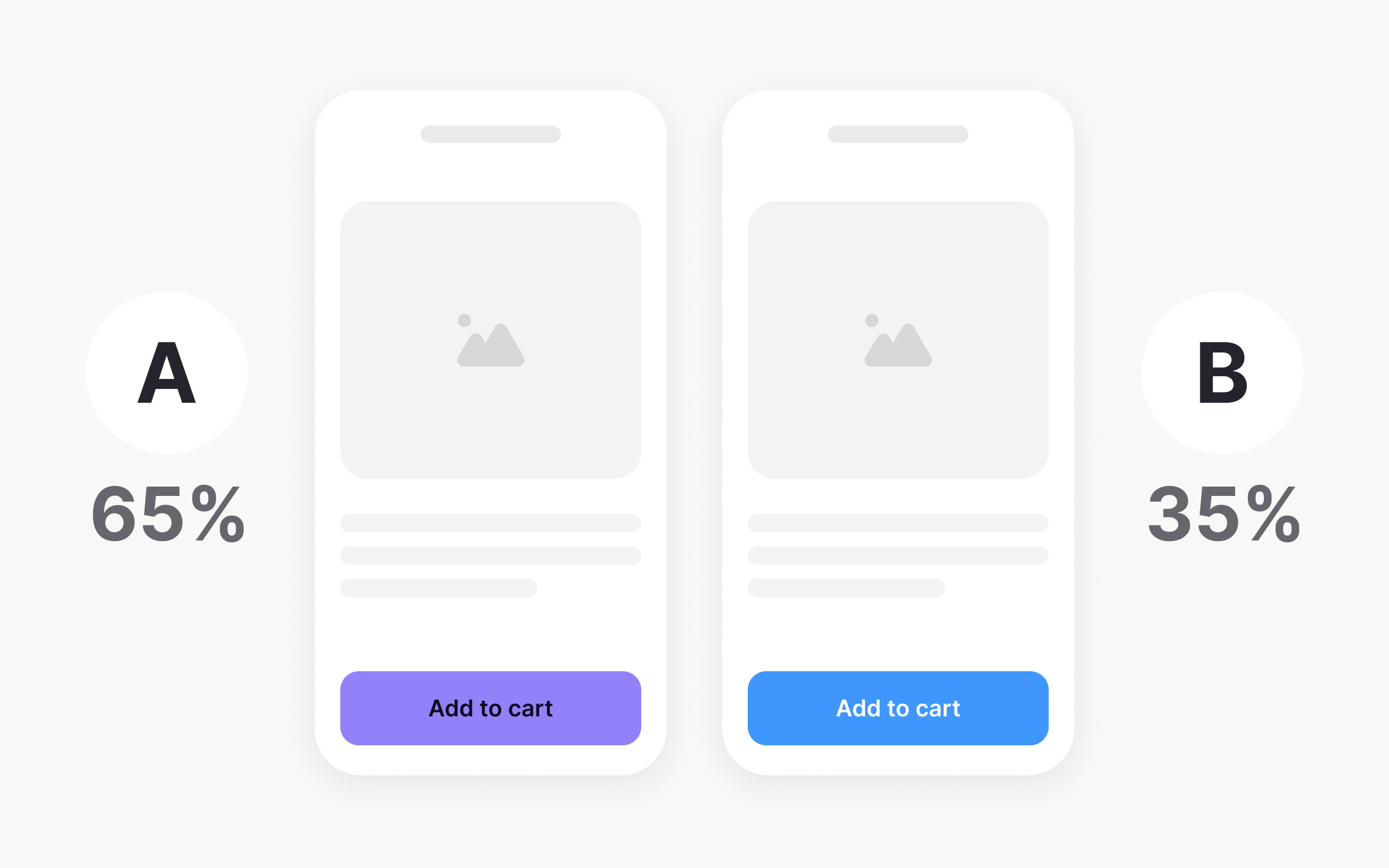
Methodological competence is the foundation: the skills that produce reliable insights instead of anecdotes.
1. Qualitative research methods
Interviews, contextual inquiries, and ethnographic studies that explain the why behind behavior. A 30% drop-off rate says something is wrong; qualitative work reveals whether users are confused, frustrated, or distracted. Practice interviewing before real sessions, ask open-ended questions, and review recordings for the moments your phrasing biased a response.
2. Quantitative research methods
Surveys, analytics, A/B tests, and behavioral metrics that measure the what and how much. Stakeholders fund what they can count, and qualitative-only findings get dismissed as anecdotal. Learn confidence intervals, significance, and sample sizes, and practice building surveys that yield measurable answers.
3. Usability testing
Watching users attempt real tasks catches the problems internal teams can't see anymore. Write a test plan with clear task scenarios, moderate neutrally, and synthesize findings into prioritized recommendations. Remote-testing fluency with tools like Maze, UserTesting, or Lookback is now expected.
4. Survey design and analysis
One good survey reaches thousands of users in the time ten interviews take; one bad survey produces confident nonsense. Study question types, avoid leading and double-barreled questions, pilot before deploying, and analyze beyond simple frequencies.
5. Research synthesis and analysis
Turning raw data from multiple sources into insight is where researchers earn their value, and it's the skill hiring managers say takes years to develop. Practice affinity mapping and thematic analysis, and write reports that lead with recommendations instead of burying them.
6. Diary studies and longitudinal research
Some behaviors only appear over time: how people use a product after the novelty fades looks nothing like first impressions. Design protocols that balance data richness against participant burden, and start with one-week studies before attempting longer work.
7. Card sorting and information architecture research
When users can't find things, they blame themselves or leave. Card sorting grounds structure in user mental models instead of org charts. Run open and closed sorts, use tools like Optimal Workshop, and analyze with dendrograms rather than raw counts.
Where to build these: the UX Research course covers the method spectrum end to end, Product Analytics strengthens data interpretation, and Information Architecture grounds the structural work.
Soft skills for UX researchers
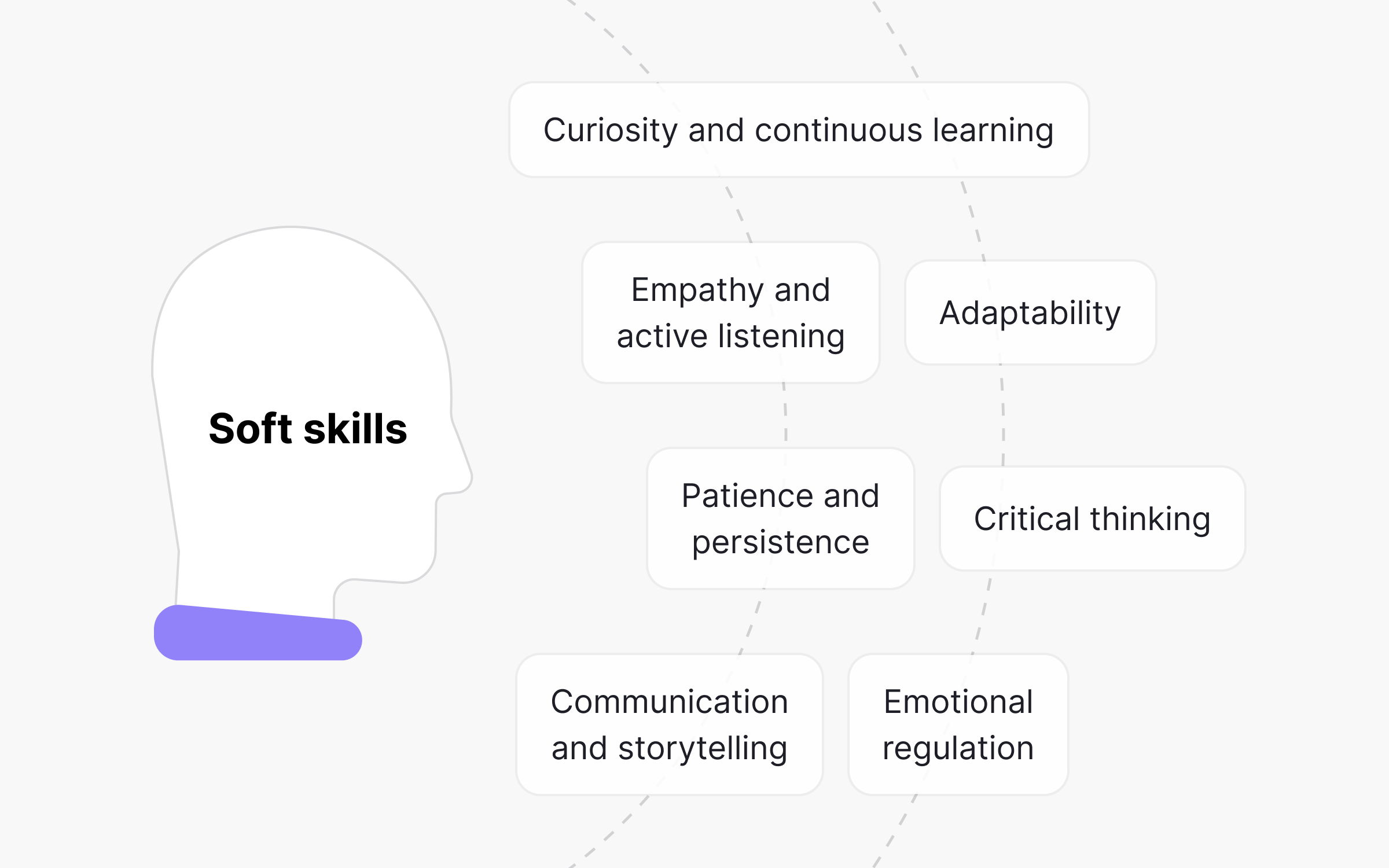
Technical competence means nothing if the findings never influence a decision. These skills are why some research gets acted on and some gets archived.
8. Empathy and active listening
Users describe symptoms rather than causes and solutions rather than problems. Empathetic researchers hear what isn't said and probe there. Practice suspending judgment mid-session: when a participant surprises you, explore instead of redirecting.
9. Communication and storytelling
Research that sits in an unread report is worthless. Lead with the "so what," structure presentations around the decisions stakeholders face, and build one-page summaries an executive can scan in two minutes.
10. Critical thinking
Organizations pay for objective insight, not validation. Actively hunt for disconfirming evidence, document your assumptions, and ask what would have to be true for the opposite conclusion to hold.
11. Adaptability
Recruitment falls short, priorities shift mid-study, early findings change the question. Build a toolkit of methods you can deploy fast, and practice good-enough research that arrives in time to matter.
12. Curiosity and continuous learning
The field moves constantly, and genuine curiosity is what makes discovery research work. Read adjacent fields (behavioral economics, cognitive psychology, anthropology) and give yourself permission to follow interesting tangents before refocusing.
13. Patience and persistence
Rushed analysis misses nuance and small samples mislead. Set timelines with buffers, explain the cost of rushing in stakeholder language, and keep momentum through the tedious phases.
14. Emotional regulation
Staying neutral when a participant trashes a design you love, staying professional when findings get dismissed, and processing hard sessions without burning out. Develop pre-session rituals and debrief after difficult interviews.
Where to build these: User Psychology builds the empathy foundation; Workshop Facilitation covers communicating with and engaging diverse stakeholders.
Applied skills for UX researchers
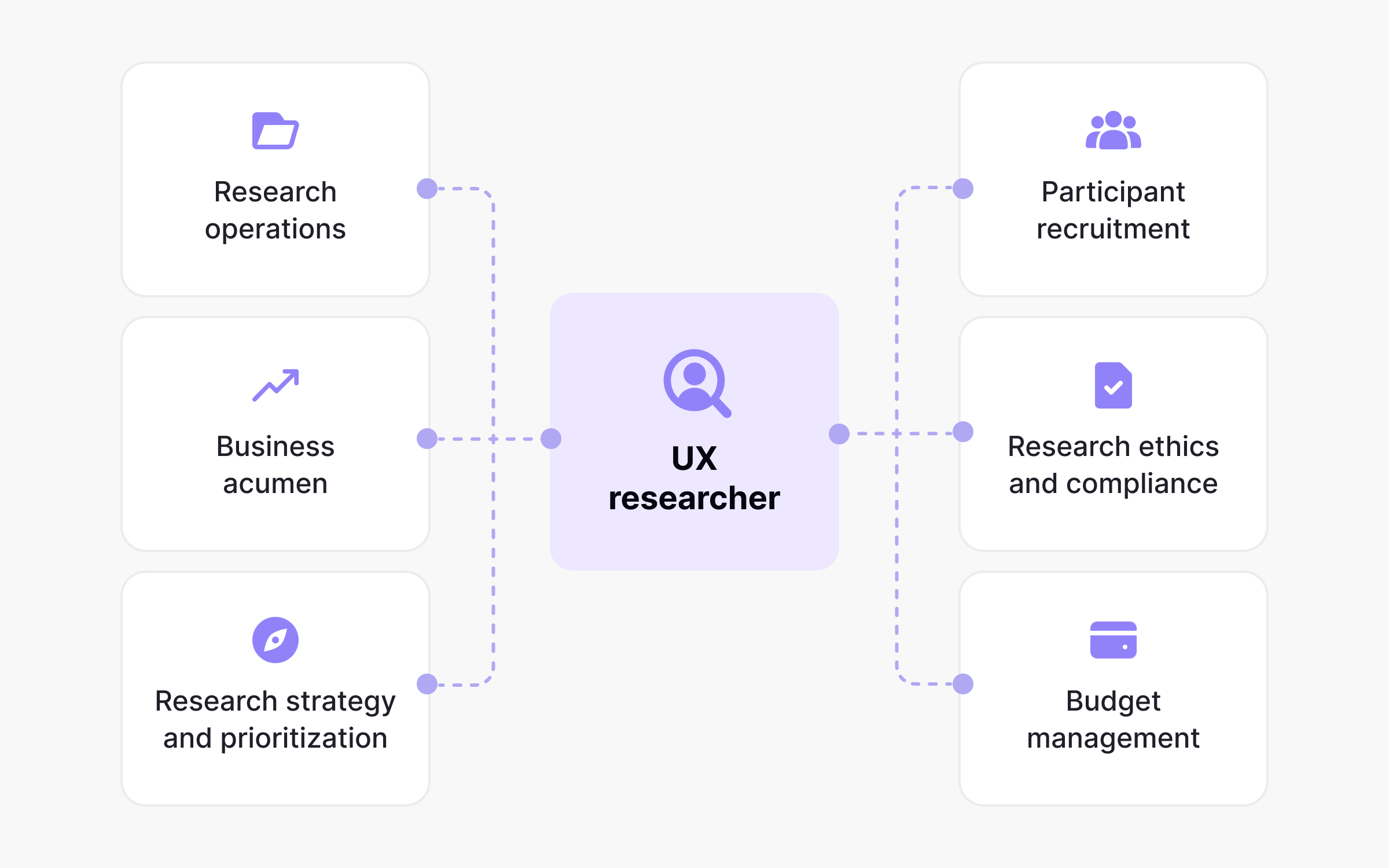
These connect research to revenue, and they're where the biggest gap sits between researchers who thrive and researchers who get laid off.
15. Research operations
Recruitment pipelines, repositories, consent management, and quality standards that let research scale. Document your processes, template the recurring work, and make past insights searchable instead of re-discoverable.
16. Business acumen
Research budgets get cut when leadership can't see the connection to results. Learn your organization's business model and key metrics, then frame findings in revenue, retention, and competitive terms.
17. Research strategy and prioritization
There are always more questions than capacity. Map upcoming product decisions, focus on the high-stakes, high-uncertainty ones, and practice declining low-priority requests with alternatives attached.
18. Participant recruitment
Research is only as good as its participants. Write screeners that filter without telegraphing the desired answer, build internal panels for fast turnarounds, and over-recruit for no-shows.
19. Research ethics and compliance
Informed consent, data privacy, GDPR. Ethics failures damage participants and create legal liability, and tightening regulation keeps raising the bar. Build consent processes that genuinely inform, and err toward participant protection in gray areas.
20. Budget management
Studies that blow their budget don't get repeated. Track actual costs against estimates, learn what drives them (recruitment, incentives, tools, time), and propose research plans at more than one budget level.
Where to build these: Service Design teaches the process-mapping behind research ops, and Product Development Lifecycle shows where research fits in product planning.
Collaboration skills for UX researchers

Insights only matter if they reach the people who decide, in a form they can act on.
21. Stakeholder management
Research that stakeholders don't trust gets ignored. Regular check-ins, shared research planning, and post-readout follow-ups turn skeptics into sponsors. The stakeholder management course covers the frameworks.
22. Design collaboration
Researchers who speak design translate findings into interface decisions instead of problem descriptions. Join critiques, learn UI patterns, and build personas and journey maps together with designers rather than handing them over.
23. Engineering partnership
Engineers hold user-behavior insight from support tickets and analytics that researchers rarely tap, and they know what's feasible. Learn enough architecture to understand easy versus hard, and include engineers in planning for technically complex features.
24. Product management alignment
Research that arrives after the decision is useless. Attend product planning, map studies to the decision calendar, and position research as de-risking product bets.
25. Workshop facilitation
Workshops turn passive research consumers into participants who own the findings. Learn design sprints, journey-mapping workshops, and insight prioritization sessions, and practice real-time synthesis.
26. Research democratization leadership
One researcher can't answer every question. Create playbooks and training so PMs and designers can run simple studies safely, with review processes that keep quality up. Enabler beats gatekeeper.
27. Cross-cultural competence
Global products meet users whose communication styles, values, and technology habits differ from your home market's. Adapt methods to context, and treat cultural nuance as data rather than noise.
Where to build these: Workshop Facilitation for leading sessions, UX Design Foundations for the design vocabulary that makes recommendations land.
AI skills for UX researchers

Per Lyssna's survey, 88% of researchers expect AI-assisted analysis to significantly affect the field this year. These skills scale your capacity while keeping the judgment human.
28. AI-assisted analysis
Transcription, sentiment analysis, theme identification, and pattern detection at speeds manual work can't match. The skill is knowing when AI output misses nuance a human would catch. Fold AI tools into your current workflow and audit their output against your own analysis.
29. Prompt engineering for research
Vague prompts produce vague outputs. Break analysis into specific, smaller prompts, build reusable templates for recurring tasks, and calibrate by comparing AI results against manual work. AI Prompts Foundations covers the practical patterns.
30. AI experience research
Users bring unpredictable mental models to AI features, and trust is the design problem NN/g flags for 2026. Research how users form expectations, respond to errors, and calibrate trust over time.
31. Synthetic user research evaluation
AI-simulated users promise cheap research and sometimes deliver misleading research. Test synthetic tools against human studies on the same questions and build a framework for when they're valid.
32. AI ethics and bias detection
AI amplifies the biases in its training data, in your tools and in your product. Audit AI tools before adopting them, and design studies that test for disparate impacts across user groups. Human-Centered AI goes deep on evaluating AI experiences responsibly.
How do you grow a UX research career?
The role has three broad stages, and the skills above map onto them. Early on, technical methods and communication carry you: run clean studies and report them clearly. Mid-career, applied and collaboration skills decide your trajectory, because that's when research strategy, stakeholder trust, and business framing start mattering more than another method. Senior roles run on influence: research operations, democratization leadership, and connecting insights to company outcomes.
Credentials can support the climb, though they don't replace a portfolio of real studies. A UX research certification is an exam-based way to make your skills legible to employers, and the UX Researcher career path sequences courses from foundations through the strategic layer. If you're earlier than that, the guide on how to become a UX researcher covers the full route in. And when the skills are ready to test, the UX researcher interview questions guide shows exactly what employers screen for.
How should you start improving?
Assess first, then focus. Two or three skills at a time, one to three months each, beats trying to improve everything at once. A junior researcher usually gets the most from qualitative methods plus communication; a senior one from research strategy and AI tooling. Practice on real projects as you learn: Uxcel's project briefs provide realistic scenarios before the stakes are real, and Uxcel Pulse benchmarks where you stand against industry standards so the gaps pick themselves.