.svg)


UX researcher interviews test five things: research fundamentals, method execution, judgment under constraints, data fluency, and organizational influence. This guide covers 56 real questions across all five, each with an example answer and the reason interviewers ask it. Many are drawn directly from Uxcel Pulse, the skills assessment built around the competencies hiring managers actually screen for. The bar has moved: knowing what a usability test is no longer lands offers. Interviewers now want to watch you think on your feet, connect research to business outcomes, and make methodological trade-offs under pressure.
Key takeaways
- Questions cluster by level: general and beginner questions test method fundamentals, intermediate ones test judgment, technical ones test data fluency, and senior ones test organizational influence.
- Example answers work as calibration, not scripts. Interviewers score the reasoning and the trade-offs you acknowledge, not recited definitions.
- Data fluency is the newest filter: statistical significance, A/B test design, and funnel analysis now appear in most UX research interviews.
- Behavioral answers need STAR structure (Situation, Task, Action, Result) with specifics about what you personally did.
- Benchmark your gaps against the UX researcher skills employers screen for, and close them along the UX Researcher career path before you book the interview.
Who this guide is for
Early-career researchers (0 to 2 years): core methods, usability testing basics, qualitative versus quantitative. Mostly definitional and methodology-selection questions.
Intermediate researchers (2 to 5 years): research planning, stakeholder management, synthesis, mixed methods. Behavioral questions, case walkthroughs, and trade-off discussions.
Senior and lead researchers (5+ years): research strategy, team leadership, organizational influence, research operations. Strategic scenarios and judgment calls.
UX researcher interview questions at a glance
| Experience level | Topics covered | Question types |
|---|---|---|
| General | UX research definition, method selection, research impact, staying current | Foundational, introductory |
| Beginner | Usability testing, qual vs. quant, screeners, note-taking, recruiting, affinity mapping | Definitional, methodology selection |
| Intermediate | Research planning, stakeholder management, synthesis, prioritization, triangulation | Scenario-based, trade-off discussions |
| Technical | Analytics interpretation, A/B testing, experimental design, statistics, data ethics, AI research | Analytical, technical concepts |
| Senior/Leadership | Research strategy, team building, organizational influence, scaling, ResearchOps | Case studies, judgment calls |
Practice answering out loud. The gap between knowing an answer and articulating it under pressure is where interviews are lost, so record yourself and listen for filler and drift.
General UX researcher interview questions
These open every UX research interview regardless of level, and they set the tone. A strong answer to "What is UX research?" signals you see research as a strategic function; a weak one suggests a checkbox activity.
1. What is UX research and why does it matter?
A strong answer: UX research is the systematic study of users and their needs to inform product and design decisions. It combines qualitative methods like interviews and usability testing with quantitative approaches like surveys and analytics. The goal is to reduce assumptions: without research, teams design from internal opinion rather than external reality, which produces features nobody uses.
Why they ask: They're checking whether you see research as a strategic function that drives outcomes or a checkbox.
2. How do you decide which research method to use?
A strong answer: Method selection depends on the research question, the product stage, and constraints like time and budget. Understanding why users behave a certain way calls for qualitative methods like contextual inquiry or interviews; measuring how many users hit a problem calls for surveys or A/B tests. Early in the lifecycle, generative research finds opportunities; later, evaluative research validates solutions. Practical constraints matter too: a diary study takes weeks, a usability test days.
Why they ask: It reveals methodological range and whether you choose methods by goal or by habit.
3. Describe a research project you're particularly proud of.
A strong answer: Pick a project with a business problem, a deliberate method choice, and a measurable outcome. Example shape: onboarding completion had dropped 15% over two quarters; analytics located where users abandoned the flow, then 12 interviews explained the friction; findings became a prioritized recommendation framework; the team shipped progressive disclosure and completion recovered within six weeks. The connective tissue (quantitative signal, qualitative explanation, implemented change, measured recovery) is what interviewers listen for.
Why they ask: They're assessing scoping, method choice, synthesis, communication, and whether you measure your own impact.
4. How do you handle stakeholders who disagree with your research findings?
A strong answer: Start by understanding their perspective, since disagreement sometimes carries context you lack. If they question methodology, walk through the approach and sampling. If they question interpretation, show the underlying data and let them draw conclusions; raw quotes and video clips persuade better than summaries. If disagreement persists, document the findings and recommend revisiting when specific conditions occur. Research informs decisions; it doesn't dictate them.
Why they ask: Navigating disagreement without becoming adversarial is a daily senior skill.
5. What is the difference between qualitative and quantitative research?
A strong answer: Qualitative research explores the why through interviews, observation, and diary studies: rich context, small samples. Quantitative research measures the what and how much through surveys, analytics, and experiments: statistical confidence, less depth. Effective programs use both, with qualitative work generating hypotheses that quantitative methods validate at scale.
Why they ask: A foundational check; weak answers here end interviews early.
6. How do you ensure research findings lead to action?
A strong answer: Actionability starts before the study: decision-driven research questions tied to choices the organization actually faces. During synthesis, frame implications rather than observations ("users need clearer wayfinding, addressable through persistent breadcrumbs" beats "users struggle with navigation"). Prioritize recommendations by impact and effort, then follow up after the readout to find implementation barriers.
Why they ask: It separates researchers who deliver reports from researchers who enable decisions.
7. How do you stay current with UX research trends and methods?
A strong answer: A mix: publications like Nielsen Norman Group, communities like ResearchOps and Mixed Methods, and piloting unfamiliar methods on lower-stakes projects. Structured learning counts too; a UX research certificate signals ongoing professional development to employers. Lately the moving edge is AI in research workflows, especially synthesis and transcription.
Why they ask: The field shifts constantly, and they want people who invest in their own development.
Beginner UX researcher interview questions
For first roles or transitions from design and product, these dominate. Hiring managers aren't looking for perfection; they want evidence you can run a usability test independently, write a screener that filters, and synthesize findings into something useful, even from class or freelance projects.
8. What is a usability test and how do you run one?
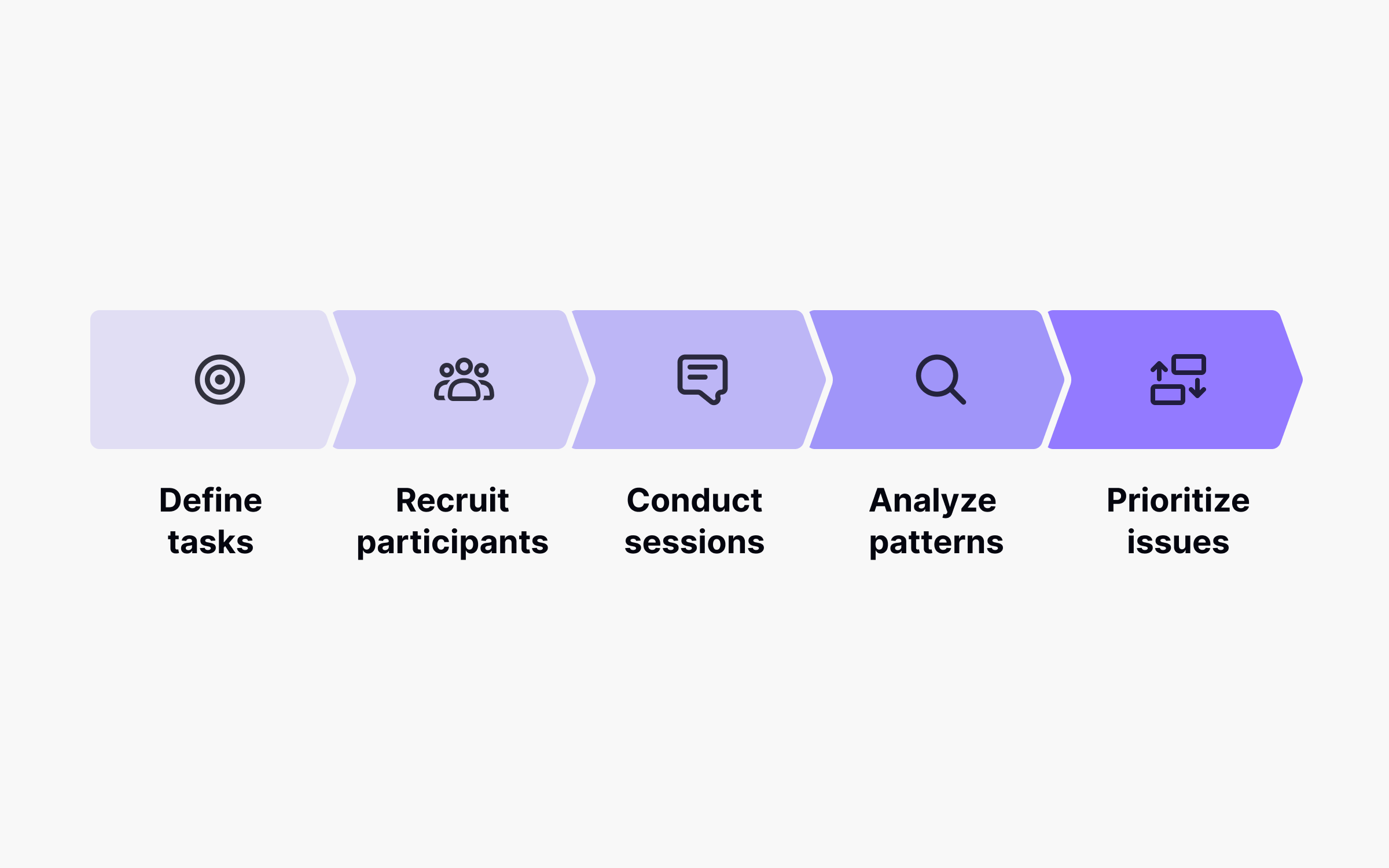
A strong answer: A usability test observes real users completing tasks to find friction. Define the research questions and the tasks that answer them, recruit five to eight participants matching the user profile, give tasks without leading, and encourage thinking aloud. Analyze patterns across sessions and prioritize issues by severity and frequency.
Why they ask: It's the core method; they need to know you can execute unassisted.
9. What is the difference between generative and evaluative research?
A strong answer: Generative research happens early to discover opportunities and understand needs before solutions exist: contextual inquiry, interviews, diary studies. Evaluative research assesses specific designs: usability tests, A/B tests, surveys. Generative work ensures you solve the right problem; evaluative work ensures you solve it well.
Why they ask: Researchers who only know evaluative methods limit their strategic value.
10. How many participants do you need for a usability study?
A strong answer: For qualitative studies, five to eight participants surface most significant issues, per Nielsen and Landauer's research, though distinct user segments may each need their own five. Quantitative usability studies measuring success rates or time-on-task need 30 or more for statistical confidence. Match the sample to the goal instead of quoting a universal rule.
Why they ask: They want the rationale, not the memorized number.
11. What should you avoid when preparing a prototype for usability testing?
A strong answer: Hints and leading instructions ("click the blue button to see your dashboard") that erase the chance to observe natural behavior. Also: testing only features you expect users to like, explaining how the prototype works upfront, and testing exclusively with team members who carry context real users lack.
Why they ask: It tests whether you understand that methodology decides validity.
12. What is a research screener and why is it important?
A strong answer: A screener qualifies participants before a study, filtering for the target profile and against professional survey-takers. Good screeners hide the qualifying questions among neutral ones so respondents can't guess the right answer: "Which of these tools do you use regularly?" beats "Do you use project management software?" Wrong participants produce misleading insights.
Why they ask: Recruitment quality is research quality.
13. How do you take notes during user research sessions?
A strong answer: Separate observations from interpretations. Capture verbatim quotes, specific behaviors, and timestamps; save interpretation for analysis, because interpreting mid-session biases what you notice next. Record sessions where possible, and brief any note-taker on what to capture, reviewing together immediately after.
Why they ask: Note quality caps synthesis quality.
14. What is the difference between an interview and a contextual inquiry?
A strong answer: An interview is a conversation in a neutral setting, good for attitudes, motivations, and past experience. A contextual inquiry observes people doing real tasks in their real environment, with questions woven in, and it reveals behavior people can't self-report: someone who says they check email "a few times a day" may be observed doing it 30 times.
Why they ask: Method-to-goal matching, again: the recurring test.
15. How do you write effective research questions?
A strong answer: Work backward from the decision the research must inform to questions that are specific, answerable, and actionable. "What factors influence a user's decision to upgrade from free to paid?" beats "What do users think of our product?" Keep research questions (which guide the study) distinct from interview questions (which must be concrete and conversational).
Why they ask: Question quality determines study quality.
16. What is the primary use of analytics tools like Mixpanel or Google Analytics in UX research?
A strong answer: Tracking what users actually do: which features get used, where flows leak, how segments differ. Analytics are a starting point rather than an answer, because they show what without why; the why comes from qualitative follow-up. The strongest researchers pair behavioral data with direct user feedback.
Why they ask: They want researchers who work with product data, not interview-only specialists.
17. How do you recruit research participants?
A strong answer: Match the channel to the audience: product and customer-success teams for existing users (with behavioral criteria from analytics), panels like User Interviews or Respondent for prospects, LinkedIn outreach and referrals for B2B. Over-recruit by 20 to 30% for no-shows, and screen rigorously regardless of source.
Why they ask: Recruitment is often the hardest operational problem; they want it solved without hand-holding.
18. What is the most important component of an effective user persona?
A strong answer: The goals, motivations, and frustrations that drive behavior. "Sarah needs expense reports done quickly because delays block her team's budget" informs design; "Sarah is 34 and lives in Chicago" doesn't. Names and photos help stakeholders remember; the behavioral insight is what makes a persona actionable.
Why they ask: It tests whether your artifacts drive decisions or decorate slide decks.
19. What is affinity mapping and what is its main purpose?
A strong answer: A synthesis technique for finding themes: individual observations and quotes get grouped iteratively until patterns emerge. It suits messy qualitative data where the structure isn't obvious upfront, and running it collaboratively reduces individual bias in interpretation.
Why they ask: Synthesis is where research value is created, and they want a method, not vibes.
20. What is evolutionary prototyping and how does it relate to research?
A strong answer: Building a system incrementally, where each tested iteration shapes the next until the prototype becomes the product. For research it means continuous involvement: each version gets tested, findings feed the next cycle, and insights must arrive fast enough to keep up with development.
Why they ask: They want researchers who fit iterative development, not waterfall rhythms.
21. When is a high-fidelity prototype appropriate for research?
A strong answer: Late, once core concepts are validated: for testing realistic interactions, validating visual decisions, or presenting to stakeholders who can't extrapolate from wireframes. Early on, high fidelity is a trap; it anchors feedback on visual detail and slows iteration.
Why they ask: Fidelity-to-goal matching shows strategic method choice.
Intermediate UX researcher interview questions
At this level, interviewers assume you can run studies; now they probe whether you run the right ones. The shift is from methods to judgment: prioritizing competing requests, handling pushback, synthesizing messy data, and proving research changed something.
22. How do you prioritize research requests when you have limited capacity?
A strong answer: Score requests on strategic alignment, decision urgency, and feasibility, and look for chances to combine them: if three teams need the same segment understood, one well-designed study serves all three. When declining, offer alternatives such as lightweight methods, existing findings, or guidance for teams to self-serve.
Why they ask: Constraints are universal; they want trade-offs made strategically, not first-come-first-served.
23. Describe your approach to research synthesis.
A strong answer: Four phases: immerse in the data without concluding, code observations with descriptive labels, group codes into patterns across participants and sources, then develop insights by asking what the patterns mean for users and the product. Keep observations (factual) distinct from insights (interpretive), and actively hunt disconfirming evidence; the strongest insights survive attempts to break them.
Why they ask: Synthesis rigor separates research from data collection.
24. What is the most strategic outcome of applying rigorous research methods?
A strong answer: Insights that reduce risk, validate decisions before expensive development, and feed prioritization. The test of any study is whether it changed something; research that confirms existing beliefs and triggers no action has questionable strategic value however thorough its report.
Why they ask: It connects methodology to business outcomes, which is the intermediate bar.
25. How do you measure the impact of UX research?
A strong answer: At the project level, track which decisions the research informed and what shipped differently because of it. At the program level, track utilization: how often findings surface in design reviews, roadmaps, and strategy documents, plus stakeholder feedback on usefulness. Precise ROI is elusive since research is one input among many, but decisions influenced plus outcomes achieved builds the case over time.
Why they ask: Research functions live under pressure to prove value; they want people who think impact, not activity.
26. How do you handle stakeholders who want answers faster than good research allows?
A strong answer: First find out what's driving the deadline, since urgency is sometimes real and sometimes discomfort with uncertainty. If the timeline is fixed, trade scope for speed: five participants with rapid synthesis inside a week, unmoderated instead of moderated sessions. Be explicit that faster means fewer participants, less depth, or lower confidence, and let stakeholders choose. Sometimes the right call is shipping without research and validating post-launch.
Why they ask: Pragmatism without abandoning rigor is exactly the intermediate skill.
27. What is triangulation in research and why does it matter?
A strong answer: Studying the same question through multiple methods or sources. When interviews, survey data, and behavioral analytics agree, confidence rises; when they contradict (users request a feature in interviews but ignore its equivalent in analytics), the contradiction itself is a finding worth chasing. Triangulate when stakes justify the added effort.
Why they ask: It tests whether you understand validity threats and how to counter them.
28. What can go wrong when research is biased, and how do you prevent it?
A strong answer: Biased research builds roadmaps around what stakeholders already believed. Bias enters through leading questions, unrepresentative samples, selective synthesis, and cherry-picked presentation. Countermeasures: neutral discussion guides peer-reviewed before use, participants recruited to represent the base rather than the reachable, deliberate searches for disconfirming evidence, and findings presented before recommendations.
Why they ask: Biased research is worse than none, because it manufactures false confidence.
29. How do you present research findings to different audiences?
A strong answer: Tailor format, depth, and framing. Executives get implications and recommendations in five minutes, tied to business outcomes. Product and design get user needs with design implications. Engineers get specific issues with technical context. Video clips and direct quotes beat summaries everywhere, and detailed findings stay accessible for whoever wants depth.
Why they ask: Impact rides on communication, and audiences differ more than most candidates admit.
30. What does a high churn rate indicate, and how would you investigate it?
A strong answer: Churn is a symptom, not a diagnosis. Segment first: who churns, when in the lifecycle, with what usage patterns. Then pair the quantitative signal with qualitative work; if users who skip onboarding churn at triple the rate, interviews with churned users explain what onboarding failed to do. The destination is "users leave because X, addressable by Y."
Why they ask: Translating business metrics into research questions is the job.
31. Describe a time research findings surprised you. How did you handle it?
A strong answer: The shape that works: expected one cause, found another, followed the evidence. Example: checkout "abandonment" that turned out to be users saving carts as a wishlist workaround; the reframe shifted the fix from checkout repairs to a save-for-later feature, and abandonment improved as a side effect. Lead with the evidence (clips of users explaining themselves) when the finding contradicts team assumptions.
Why they ask: Intellectual honesty under surprise is the trait being screened.
32. How do you balance depth and breadth in a research program?
A strong answer: Treat research as a portfolio. Early-stage products need breadth to map the landscape; mature products reward depth on specific problems. Build depth iteratively: a broad discovery study identifies three opportunity areas, and follow-up studies go deep on each. The mix should track strategic priorities, not researcher preference.
Why they ask: Program-level thinking distinguishes intermediate from beginner.
33. What is a research repository and how do you use one?
A strong answer: A searchable system for findings, study details, and artifacts that makes institutional knowledge outlive individual studies. Tag consistently so "what do we know about onboarding?" is answerable without re-reading everything, include enough context for reuse, and let it prevent redundant studies.
Why they ask: Knowledge management is the difference between a research function and a series of projects.
34. How do you involve stakeholders in the research process?
A strong answer: At every stage: co-create research questions during planning, invite observation during sessions (firsthand user exposure beats any readout), run collaborative synthesis so patterns are co-owned, and tailor the readout to their decisions. Involvement builds trust and makes action more likely.
Why they ask: Engagement drives impact, and they want relationship-builders.
35. What is the primary role of a workshop facilitator in UX research?
A strong answer: Creating the conditions for a group's best thinking: clear objectives, managed time, full participation, actionable outcomes. The facilitator owns the process, not the content, and the best workshops feel like the group found the insight itself.
Why they ask: Facilitation extends research from individual sessions to organizational sense-making.
Technical UX researcher interview questions
The days when researchers could ignore data are over. These questions test whether you can partner with data scientists and metric-fluent PMs, or whether you'll be limited to qualitative-only work.
36. What does funnel analysis help you identify?
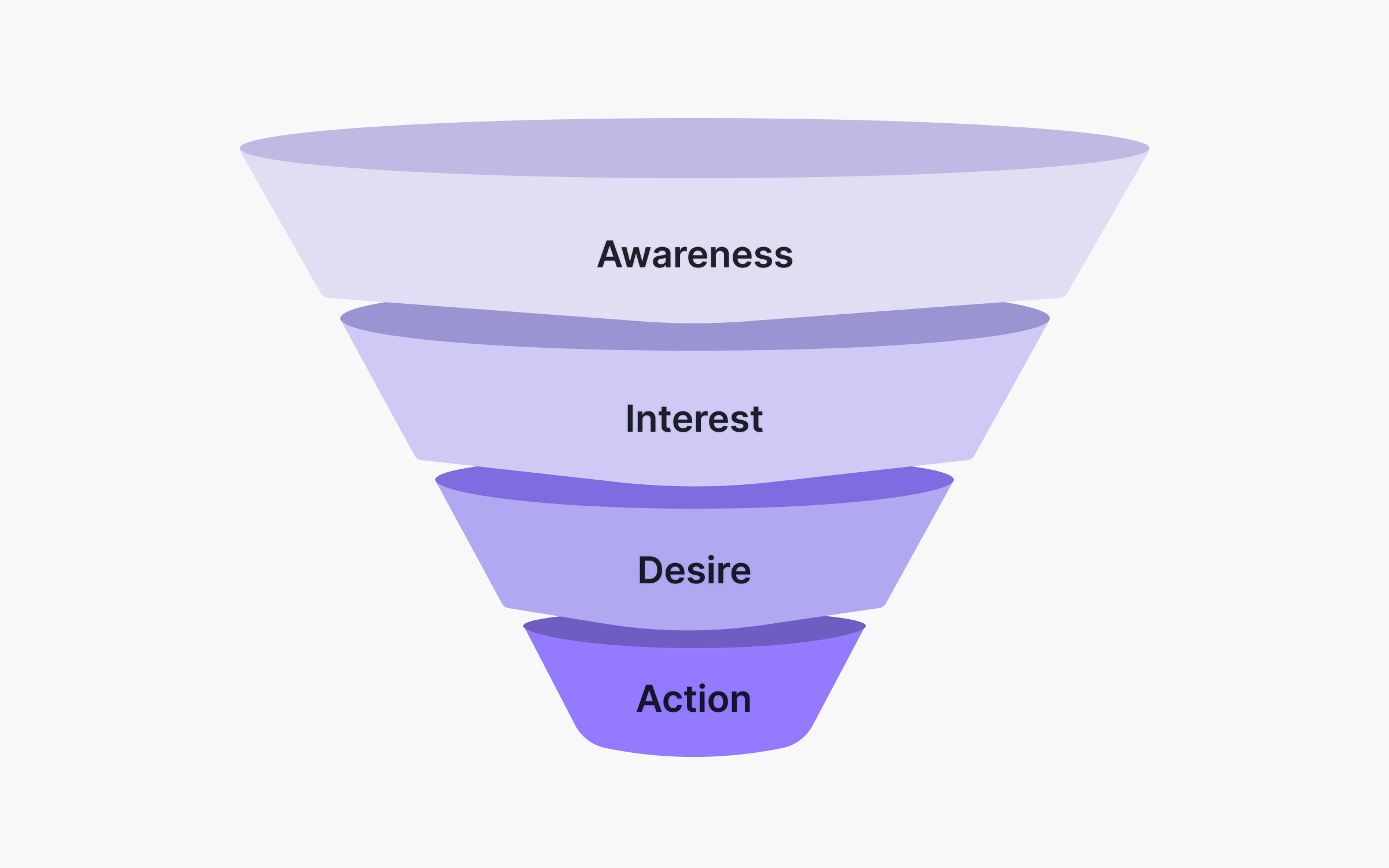
A strong answer: Where users drop off across a flow, which is where qualitative research should dig next. If 60% abandon at the payment step, that's the hypothesis generator; interviews and session recordings supply the why. Look past raw drop-off too: segment differences and return behavior often matter more than the headline rate.
Why they ask: Using analytics to aim research, rather than treating them as separate worlds, is the modern expectation.
37. What makes a good A/B test?
A strong answer: A clear hypothesis, adequate sample for the effect size you care about, controlled variables so the tested change is the only difference, and success metrics tied to business goals rather than convenience. Run long enough to absorb day-of-week and novelty effects, and decide in advance what happens on a win, a loss, or a null result.
Why they ask: Experimentation literacy is table stakes for evaluative work at scale.
38. Why is randomization critical in A/B testing?
A strong answer: It makes groups statistically comparable at the start, so outcome differences can be attributed to the treatment. Without it, systematic differences (weekday versus weekend users, power users clustered in one variant) contaminate results. Randomization spreads known and unknown confounders evenly, which is what makes causal inference possible.
Why they ask: Understanding why the method works beats knowing how to click "start test."
39. Why include a control group in experiments?
A strong answer: The control isolates the treatment effect from everything else happening at the same time: seasonality, campaigns, behavior drift. If conversion rises 10% in the test group during a holiday surge that lifted the control 8%, the real effect is 2%. Without the control you'd claim five times the impact.
Why they ask: It's the fundamental logic of valid experiments, tested with a concrete trap.
40. How do you determine sample size for a survey?
A strong answer: From the analysis you plan to run. Population estimates use standard calculators driven by confidence level and margin of error; segmented analysis needs sufficient sample per segment, often 100+ each for reliable comparison. Factor response rate into invitations: a 10% response rate means inviting ten times the target.
Why they ask: Underpowered surveys produce confident-looking unreliable data.
41. What is statistical significance and what are its limitations?
A strong answer: Significance means the observed result is unlikely under chance, conventionally p below 0.05. Its limits: it says nothing about practical importance, it's sample-size sensitive (huge samples make trivial differences significant), and it doesn't establish causation outside controlled designs. Read effect size alongside p-values and ask whether the magnitude justifies action.
Why they ask: Statistics beyond buzzwords, the recurring technical filter.
42. What issues result from misinterpreting statistics in research?
A strong answer: Wrong conclusions, wasted roadmaps. The classics: a self-selected power-user survey generalized to the whole base, significance confused with importance, favorable numbers cherry-picked past contradicting data. Prevention: examine sample composition, present confidence intervals, and make limitations as visible as findings.
Why they ask: They want critical evaluation of numbers, not uncritical relay.
43. How would you design a study to understand why users are churning?
A strong answer: Mixed methods. Behavioral data finds the patterns: when churn happens, what actions precede it, which segments leave fastest. Interviews with churned users explain the departure; interviews with near-churners who stayed explain retention. A survey to churned users can quantify the reasons at scale.
Why they ask: It's a realistic business problem requiring methodological range.
44. What is the difference between correlation and causation?
A strong answer: Correlation means variables move together; causation means one drives the other. Third variables and coincidence make correlation cheap: ice cream sales and drownings correlate through summer, not through each other. Causation requires controlled manipulation; observational work generates hypotheses, experiments confirm them.
Why they ask: Confusing the two is the most expensive analytical mistake in product work.
45. How do you handle missing or incomplete data?
A strong answer: Diagnose why it's missing before deciding what to do. Random and limited: proceed, noting the limitation. Concentrated on certain questions: investigate confusion or sensitivity, and check whether skippers differ systematically from answerers. Avoid imputing without justification, and treat non-response itself as a potential finding.
Why they ask: Real data is messy; thoughtful handling beats pretending otherwise.
46. What is the most ethical approach to tracking that collects sensitive data?
A strong answer: Clear opt-in consent with a genuine explanation of what's collected, why, and how it's used, before agreement, not an opt-out buried in settings. Then data minimization: collect only what's needed, store securely, anonymize when sharing, delete when done. Ethics is ongoing consideration for participants, not GDPR paperwork.
Why they ask: Privacy judgment is now a hiring criterion in its own right.
47. How should you approach a feature that is usable but not accessible?
A strong answer: Delay or revise it. Accessibility is a requirement, not a demand-driven enhancement, and accessibility issues usually flag broader usability problems: a button a screen reader can't find is typically hard for everyone to find. Build accessibility into research from the start with assistive-technology users and WCAG evaluation.
Why they ask: They're screening for researchers who advocate inclusive design rather than trade it away.
48. How do you approach research for AI or ML-powered features?
A strong answer: Focus on transparency, control, and trust calibration. Research how much explanation users actually want, whether they understand why recommendations appear, and how they respond to errors. Test the edge cases where the AI fails and make sure the experience degrades gracefully, with users able to verify or override uncertain outputs.
Why they ask: AI features fail on expectations more than on models, and that's a research problem.
Senior and leadership UX researcher interview questions
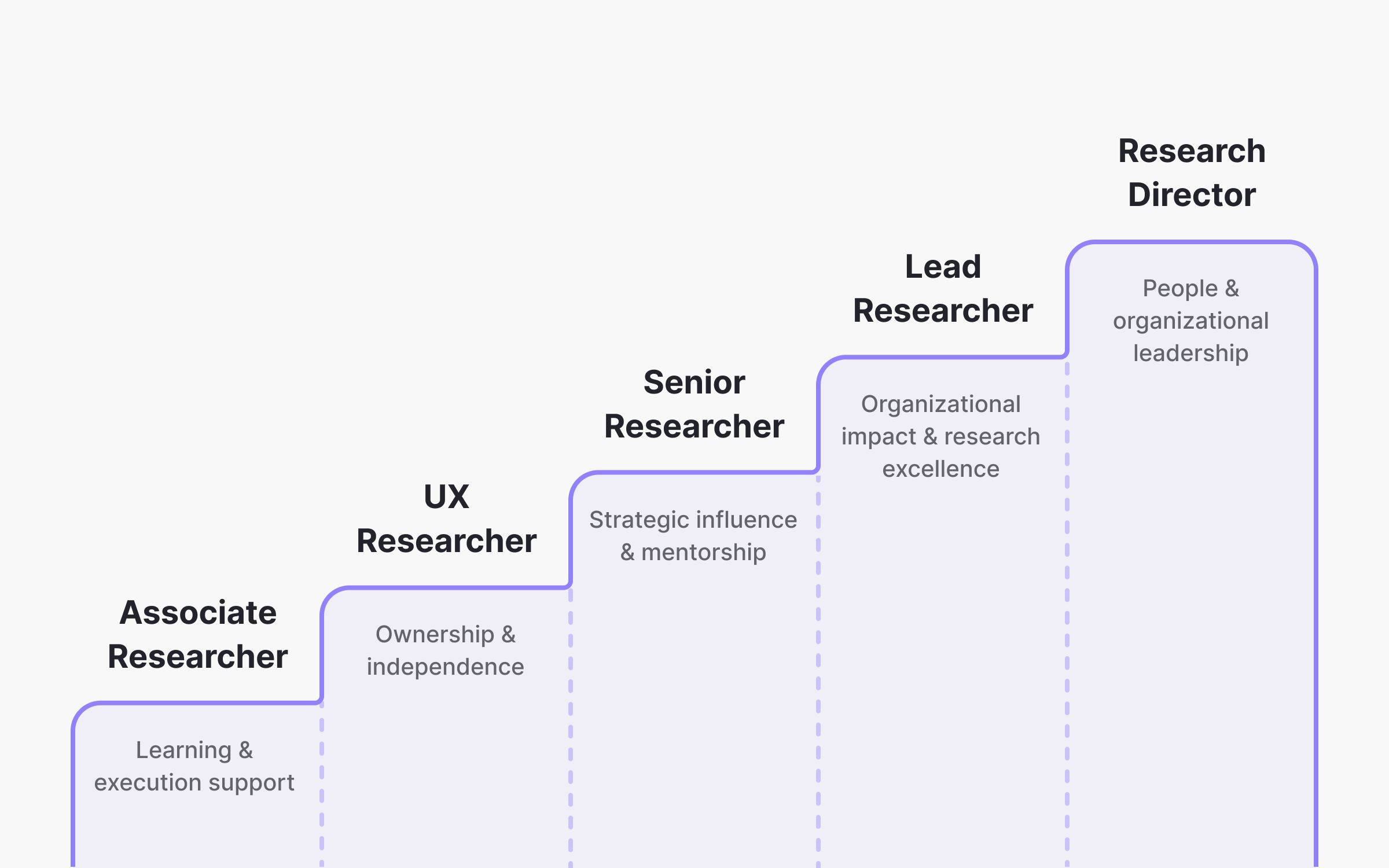
Senior interviews care less about what you can do and more about what you can build: a research practice, executive buy-in, and junior researchers who become independent.
49. How do you build a research practice from scratch?
A strong answer: Read the organization first: which decisions need research input, where the knowledge gaps are, who the key stakeholders are. Win credibility through high-impact, high-visibility projects, and build basic infrastructure (templates, recruitment channels, a repository) in parallel. Grow headcount by documenting unmet demand and connecting research to outcomes, and build culture by showing up where decisions happen.
Why they ask: Zero-to-one capability building is the definitive senior test.
50. How do you align research priorities with business strategy?
A strong answer: Understand the strategy deeply enough to map research to it: planning meetings, strategy documents, leadership relationships. Frame proposals in strategic terms, move studies supporting priority bets up the backlog, and proactively propose research for strategic questions nobody has answered yet. The goal is research as a strategic function, not a service desk.
Why they ask: Senior researchers must operate at the level where budgets get decided.
51. How do you develop other researchers on your team?
A strong answer: Through stretch projects with support, frequent specific feedback rather than review-cycle surprises, learning structures like study clubs and work reviews, and gradual delegation of leadership tasks to people aiming that way. Development goals belong to the researcher; the lead's job is matching opportunities to them.
Why they ask: Growing and retaining talent is distinct from personal excellence.
52. How do you handle product decisions that contradict research findings?
A strong answer: Accept that research is one input among business constraints, technical feasibility, and strategy. Make the trade-off explicit: acknowledge the reasons for proceeding, propose post-launch monitoring of the metrics the research flagged, and document the finding. When predicted issues appear, the documentation speaks without anyone saying "told you so."
Why they ask: Influence without adversarialism is the mature posture they're hiring.
53. How do you scale research impact across a large organization?
A strong answer: Three levers: democratization through enablement (templates, training, guardrails) so product teams handle basic studies, deliberate placement of researcher time on the highest-impact questions, and knowledge infrastructure that makes insights discoverable and reusable. Research champions inside each team extend reach further.
Why they ask: Demand always exceeds capacity; leaders multiply rather than add.
54. Describe your philosophy on research operations.
A strong answer: Operations exist so researchers research: recruitment, tooling, incentives, repository, compliance. Invest proportionally to team size, automate the repetitive, standardize where consistency pays, and stay flexible where needs vary. Well-run operations are invisible.
Why they ask: Operational thinking separates program builders from senior ICs.
55. How do you measure and communicate research team performance?
A strong answer: Track activity (studies, participants, stakeholders served) but weight impact: decisions informed, recommendations implemented, outcomes moved, plus qualitative stakeholder feedback. Communicate through regular leadership updates tied to strategy and a running portfolio of impact stories; narrative plus examples persuades where metrics alone don't.
Why they ask: Leaders defend resources with evidence.
56. Where do you see UX research evolving in the next few years?
A strong answer: AI keeps absorbing transcription, synthesis assistance, and pattern-finding while interpretation stays human. Research integrates tighter with product analytics as data fluency becomes standard. Continuous discovery replaces project-based research, democratization pushes specialists toward complex strategic work, and ethics rises with regulation and scrutiny.
Why they ask: Perspective on the field's direction signals strategic maturity.
Do you need a UX research certification to get hired?
No employer requires one, and a portfolio of real studies outweighs any credential. Certifications earn their place in three situations: career switchers who need third-party proof they've covered the fundamentals, researchers whose resumes must survive automated screening, and anyone whose employer funds professional development anyway. The market's known names include Nielsen Norman Group's UX Certification and Interaction Design Foundation courses; Uxcel's UX research certification is the exam-based route, paired with courses that map your skills against the role's requirements as you prepare. Treat any certificate as evidence of structured learning, then let your case studies do the actual persuading.
How to prepare for a UX researcher interview
Review your own work first. Two or three projects you can explain end to end: business context, method choices, findings, what changed. Reasoning and impact beat perfect process.
Practice thinking out loud. Live exercises are common, and interviewers score the thought process. "I'm weighing two approaches here" beats silence.
Use the company's product. Find one or two places research could improve it and be ready to discuss them.
Ask questions that reveal research culture. How findings get used, the generative-to-evaluative ratio, the current biggest research challenge. You're assessing them too.
Know your gaps honestly. Never run a diary study? Say so, explain your understanding of the method, and describe how you'd learn it. Self-awareness reads better than bluffing.
In every answer: lead with the point, use specific examples ("8 to 10 interviews with users who churned in the last 30 days" beats "I'd do interviews"), acknowledge trade-offs, connect to outcomes, and structure behavioral stories with STAR in about two minutes.
Where do you go from here?
Work the questions where your answers feel thin, out loud, until they don't. The patterns repeat across companies: method-to-goal matching, synthesis rigor, statistics literacy, and stakeholder judgment cover most of what you'll face. To find the gaps precisely, take Uxcel Pulse, which benchmarks your research competencies by role and level, and the UX Researcher career path sequences whatever needs strengthening before the interview.